
When the grid goes dark, a flickering flashlight and a phone at 10% battery are the last things you want to rely on. A dedicated backup battery system isn’t a luxury—it’s the difference between a fridge full of spoiled food and keeping your CPAP machine, Wi-Fi router, and sump pump running straight through a multi-day outage. The modern solution has moved past clunky lead-acid bricks to compact lithium iron phosphate stations that deliver silent, emission-free power on demand.
I’m Min — the co-founder and writer behind Gadgets Feed. I’ve spent countless hours analyzing the technical specifications of portable power stations, comparing battery chemistries, inverter types, and charge cycle ratings to separate the gear that genuinely holds up from the marketing fluff. This guide focuses exclusively on the real-world performance that matters most when the lights go out.
After deep-diving into capacity, inverter wattage, and UPS response times across dozens of models, I’ve narrowed the field to the nine best options for every need and budget — this is the definitive best backup battery for power outage guide you’ll find anywhere.
How To Choose The Best Backup Battery For Power Outage
Not all backup batteries are created equal. A station that works fine for a weekend camping trip might die on you during the first summer blackout. You need to match three core specs to the specific devices you plan to keep alive.
Battery Chemistry: LiFePO4 vs. Lead-Acid vs. NMC
Lithium Iron Phosphate (LiFePO4) is the clear winner for outage duty. It offers 3,000 to 5,000 charge cycles before degrading to 80% capacity, compared to only 500 cycles for standard lead-acid UPS batteries. LiFePO4 also handles partial state-of-charge better, meaning you can keep it plugged in at 80% for months without damage, and it won’t off-gas toxic fumes indoors. Nickel Manganese Cobalt (NMC) packs higher energy density but degrades faster under constant high heat and is less safe for long-term home storage.
Inverter Type and Wattage: Matching Your Load
Pure sine wave inverters are mandatory for sensitive electronics like CPAP machines, medical equipment, and variable-speed refrigerators. Modified sine wave inverters can cause buzzing, overheating, or failure in these devices. For continuous wattage, add up the running watts of everything you need simultaneously: a typical refrigerator draws 150-300W, a router draws 10W, and a chest freezer uses 200-400W. Surge wattage—the peak draw when motors start—can be 2-3x the running wattage. Always choose an inverter rated for at least 20% headroom above your combined load.
UPS Switchover Speed: Seamless vs. Blink-Loss
A standard portable power station may take 20-30 milliseconds to switch from wall power to battery. For computers, NAS drives, and medical devices, that gap is enough to cause a reboot or data corruption. Look for stations with an advertised switchover time under 20ms—preferably 10ms or faster. The EcoFlow DELTA Pro 3 and Jackery HomePower 3000 both deliver sub-20ms UPS performance, while the BLUETTI Elite 30 V2 offers a 10ms switch for sensitive gear. If you’re only powering lights and fans, a slower switch is acceptable.
Quick Comparison
On smaller screens, swipe sideways to see the full table.
| Model | Category | Best For | Key Spec | Amazon |
|---|---|---|---|---|
| AFERIY P210 | Premium | Home Backup | 2048Wh, 2400W inverter | Amazon |
| DABBSSON 2000L | Premium | Semi-Solid Safety | 2048Wh, 2200W inverter | Amazon |
| Jackery Explorer 2000 v2 | Premium | Lightweight 2kWh | 2042Wh, 2200W, CTB tech | Amazon |
| EcoFlow DELTA Pro | High-End | Expandable Home Power | 3600Wh, 3600W, expandable | Amazon |
| Jackery HomePower 3000 | High-End | Whole-Home Essentials | 3072Wh, 3600W, CTB | Amazon |
| EcoFlow DELTA Pro 3 | High-End | 240V Whole-Home Backup | 4096Wh, 4000W, 240V | Amazon |
| GOLDENMATE 1000VA | Mid-Range | Electronics UPS | 153.6Wh, 600W, LiFePO4 | Amazon |
| BLUETTI Elite 30 V2 | Mid-Range | Compact UPS + Portable | 288Wh, 600W, 10ms UPS | Amazon |
| VTOMAN Jump 600X | Value | Car Jump + Backup | 299Wh, 600W, 2-in-1 | Amazon |
In‑Depth Reviews
1. AFERIY P210 2048Wh Portable Power Station

The AFERIY P210 hits the sweet spot between high capacity and reasonable weight. Its 2048Wh LiFePO4 battery sustains 3,500 cycles before dropping to 80% capacity—that’s over a decade of daily use. The pure sine wave inverter delivers 2400W continuously (4800W surge), which covers a refrigerator, chest freezer, lights, and a few smaller appliances simultaneously without breaking a sweat.
Noise is barely a factor here: the cooling system measures under 30 dB at full load and only 16 dB at typical draw. That’s quieter than a library, so you can keep it in a bedroom or hallway during an outage without any sleep disruption. The six AC outlets, four USB-C ports (including a 100W PD), and dual DC outputs let you charge nearly everything at once.
The <10ms UPS response is certified for computers and networking gear, meaning a blackout won’t cause a single reboot. The AFERIY app adds remote monitoring and scheduling. Considering the 7-year warranty and the fast 1-hour AC recharge, this is the most complete package for serious home outage preparedness without jumping to a 3kWh+ behemoth.
Why it’s great
- True sub-10ms UPS for sensitive equipment
- Near-silent operation, even at full load
- Generous 7-year warranty backing
Good to know
- 48.5 lbs is manageable but not ultra-portable
- Display screen can glitch after solar charging
2. DABBSSON 2000L 2048Wh Portable Power Station
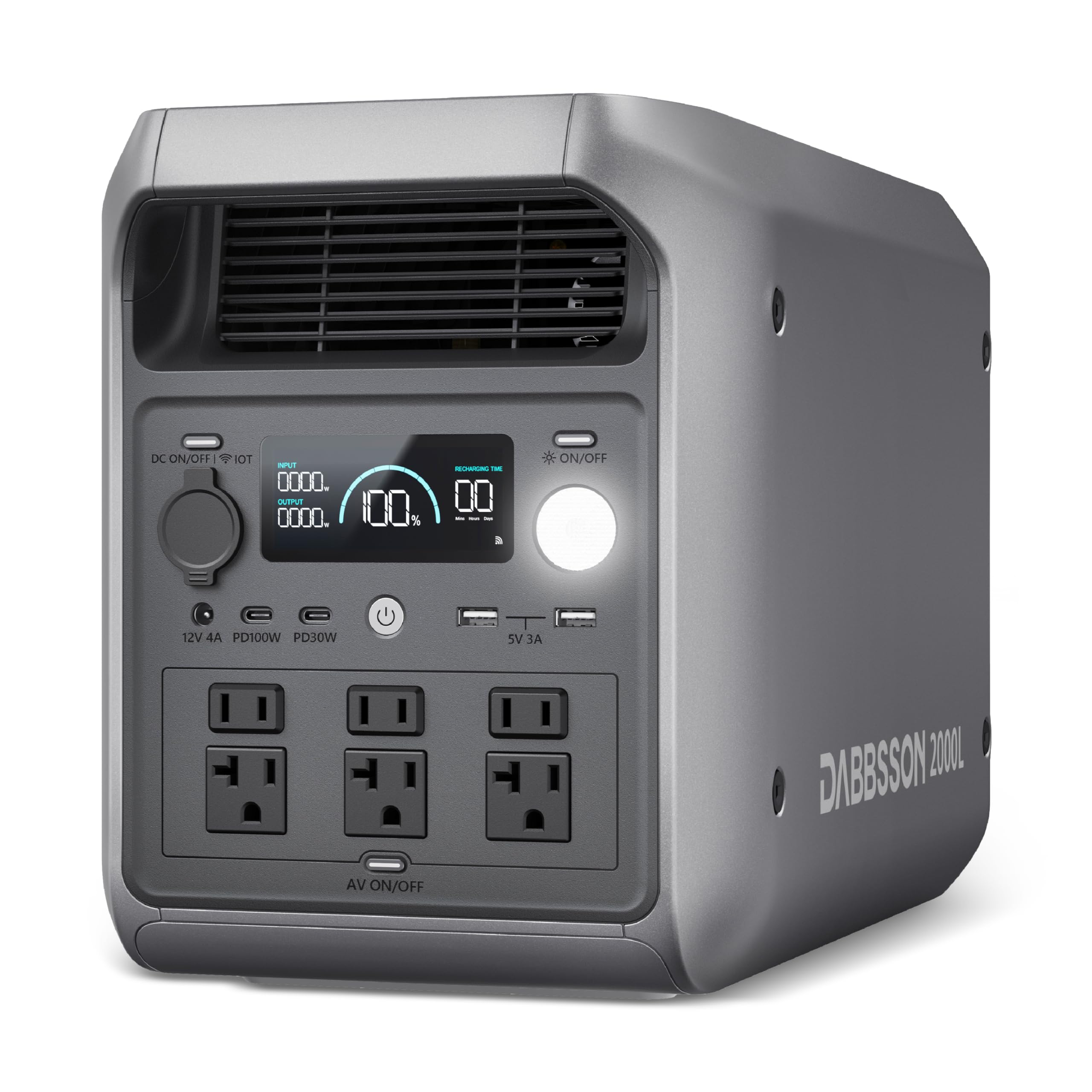
The DABBSSON 2000L uses advanced semi-solid LiFePO4 cells, a chemistry step above standard LFP that offers higher stability and flame-retardant UL94-V0 housing. With 4,000 deep cycles to 80% capacity, this station is built to outlast most competitors by years. The 2200W rated output (3300W Power Boost) easily handles a microwave or 1400W air fryer, which is rare in a sub-50 lb package.
Weight comes in at 41 lbs—lighter than the AFERIY and significantly lighter than typical 2kWh stations. The <10ms EPS switch protects computers and NAS drives, and the Dabbsson app allows remote management of charging speed and schedules. The AC input recharges the full 2048Wh in just one hour, a blistering speed for this class.
Customer reports confirm it runs a Keurig, air fryer, and even two freezers plus two fridges for 7.5 hours straight. The only hiccup is that some early units experience software issues preventing full charge/discharge, and support responsiveness has been inconsistent. For a purely hardware-focused buyer, however, this is a price-to-performance leader.
Why it’s great
- Semi-solid LiFePO4 for superior cycle life
- Only 41 lbs for a full 2kWh capacity
- 1-hour full recharge via AC input
Good to know
- Some units have reported software glitches
- Customer support can be slow to respond
3. Jackery Explorer 2000 v2 Portable Power Station

Jackery’s Explorer 2000 v2 uses Cell-to-Body (CTB) technology borrowed from EV manufacturing, which packs 2042Wh into a frame that’s 41% lighter and 34% smaller than typical 2kWh stations. At 39.5 lbs, it’s the lightest 2kWh option on this list, making it genuinely portable for loading into a car or carrying up a flight of stairs during an evacuation warning.
The 2200W pure sine wave inverter feeds three AC outlets, dual 100W USB-C PD ports, and a flashlight with SOS mode. AC fast charging hits 80% in 66 minutes, and a silent charging mode keeps noise under 30 dB for overnight use. The 20ms UPS switchover is UL1778 certified—fast enough for desktops and networking gear but not quite as razor-edged as the sub-10ms options.
Real-world testing shows it runs a standard refrigerator for over 21 hours on a single charge. The Bluetooth connectivity is a bit inconsistent at range, and the solar barrel ports are a known weak point, but overall build quality is excellent. If portability is your top priority after capacity, this is the benchmark.
Why it’s great
- Lightest 2kWh station at just 39.5 lbs
- UL-certified 20ms UPS switchover
- Silent charging mode at <30 dB
Good to know
- Solar barrel connectors are not the most durable
- Bluetooth pairing can be intermittent
4. EF ECOFLOW DELTA Pro 3600Wh Power Station
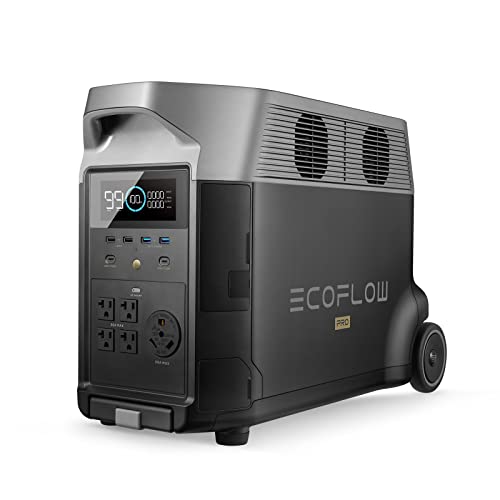
The original DELTA Pro remains a powerhouse for those who need room to grow. Its 3600Wh LFP battery feeds a 3600W inverter that handles nearly any household load, and X-Boost technology pushes up to 4500W when needed. The real star here is expandability: add extra batteries or the Smart Generator to scale from 3.6kWh all the way to 25kWh—enough to power a home for days.
Five 120V AC outlets plus a full suite of USB-A, USB-C (100W), and DC ports mean you can run a refrigerator, freezer, medical device, and several electronics simultaneously without adapter drama. X-Stream fast charging refills the battery in 2.7 hours from a wall outlet or as fast as 1.8 hours with a 240V NEMA 14-50. Solar input hits 1600W, providing daily top-ups during extended outages.
Buyers praise its quiet operation and seamless pass-through UPS mode that auto-switches during outages. At 99 lbs, it’s not a carry-on—but the integrated handles and optional wheel kit make garage-to-living-room moves doable. The 30% federal tax credit for qualified solar equipment is an extra financial incentive that no competitor matches as cleanly.
Why it’s great
- Scales from 3.6kWh to 25kWh with add-ons
- 3600W continuous output powers heavy appliances
- May qualify for 30% federal tax credit
Good to know
- 99 lbs is heavy; wheel kit is recommended
- Higher price entry point before expansion
5. Jackery HomePower 3000 Portable Power Station
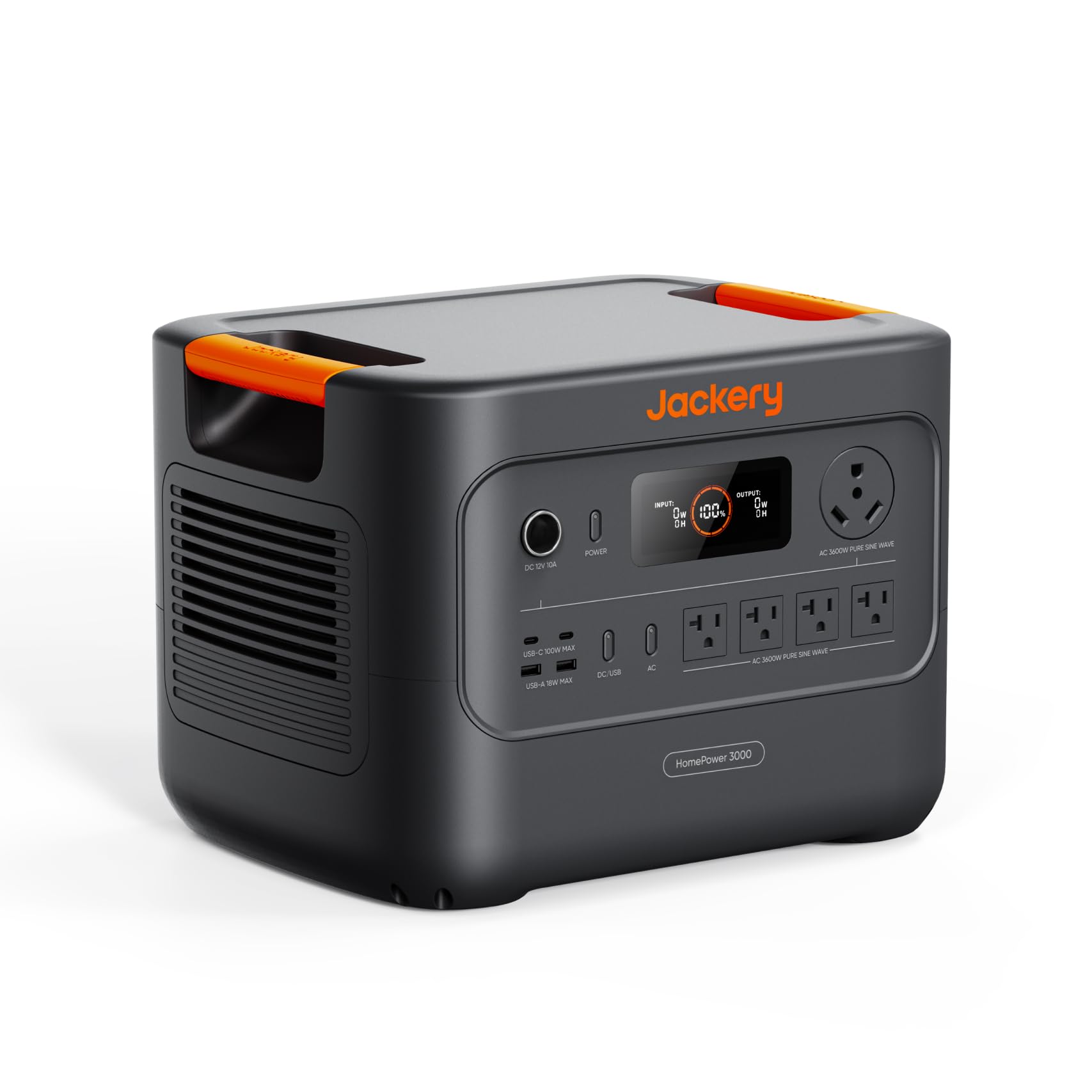
The Jackery HomePower 3000 leverages CTB technology to deliver 3072Wh in a frame 47% smaller and 43% lighter than comparable 3kWh models. With a 3600W inverter (7200W surge), it powers a full-size refrigerator for 1-2 days, plus lights, router, and a CPAP simultaneously. The built-in TT-30 RV port is a standout feature, letting you plug into a travel trailer directly without adapters.
ChargeShield 2.0 with AI algorithms prolongs battery life to 4,000 cycles while retaining 70% capacity. The UPS switchover is UL-certified at under 20ms, providing seamless backup for security systems and medical fridges. Hybrid AC+DC charging refills to full in just 1.7 hours—remarkable for a 3kWh bank.
Noise is a trade-off: the fan runs at around 60 dB whenever any load is present, which is noticeable in a quiet room. At over 60 lbs, it’s also not truly portable for everyone. But for whole-home essential coverage in a compact footprint, the HomePower 3000 is a serious contender.
Why it’s great
- Compact 3kWh with integrated TT-30 RV port
- Fast hybrid recharge in under 2 hours
- AI-optimized charging extends cycle life
Good to know
- Fan runs at ~60 dB even on light loads
- Warranty only honored with direct purchase
6. EF ECOFLOW DELTA Pro 3 4096Wh Power Station

The DELTA Pro 3 is the most capable single-unit portable power station on the market. Its 4096Wh LFP battery and 4000W inverter (6000W with X-Boost) can power a 3-ton central AC or a 1 HP water pump thanks to native 120/240V dual-voltage output. Expandability goes up to 48kWh with extra batteries and the Smart Generator, providing 2-4 days of whole-home backup.
X-Quiet technology keeps operation at 30 dB—whisper-quiet for indoor use. The <10ms UPS switchover is the fastest in this class, protecting NAS systems and servers from any interruption. IP65-rated CTC battery pack technology adds dust and water resistance, a rare safety feature. Seven unique charging methods include EV stations, solar (2600W max), and gas generators, with combined AC+DC input reaching 7000W for a full recharge in under two hours.
At 115 lbs, the DELTA Pro 3 is a stationary solution for most people. The app requires internet to change settings, which can be a problem during an outage if not pre-configured. For those willing to invest in the highest-tier hardware, however, this is the closest thing to a whole-home generator in a portable chassis.
Why it’s great
- 240V native output powers well pumps and ACs
- Sub-10ms UPS for zero-drop backup
- Up to 48kWh capacity expansion possible
Good to know
- 115 lbs requires permanent placement
- App needs internet for configuration changes
7. GOLDENMATE 1000VA/600W Lithium UPS

The GOLDENMATE 1000VA is a traditional UPS form factor with a modern LiFePO4 heart—a 153.6Wh battery that lasts 10+ years and 5,000 cycles. This is the ticket if you want to protect a computer workstation, networking rack, or telecom gear without dedicating floor space to a power station. The 600W pure sine wave inverter is clean enough for any sensitive electronics.
The LCD panel shows real-time battery and load data, and the fan stays under 50 dB during heavy use. Eight NEMA 5-15R outlets provide ample ports for a full home office setup. Users report it powers a TV/PS5/router combo through outages easily, though the 20ms switchover may be borderline for some high-end audio equipment.
At roughly 13 lbs, this is the lightest and most compact permanent backup option here. The trade-off: 153.6Wh won’t run a refrigerator for long. It’s best positioned as a dedicated UPS for critical electronics while a larger station handles appliances. The buzzer alarm can be muted, and the unit is maintenance-free for its entire lifespan.
Why it’s great
- LiFePO4 battery with 5,000-cycle lifespan
- Compact UPS form factor with 8 outlets
- Pure sine wave output for sensitive gear
Good to know
- 153Wh capacity not for appliance backup
- Outlets are closely spaced for large adapters
8. BLUETTI Elite 30 V2 Portable Power Station
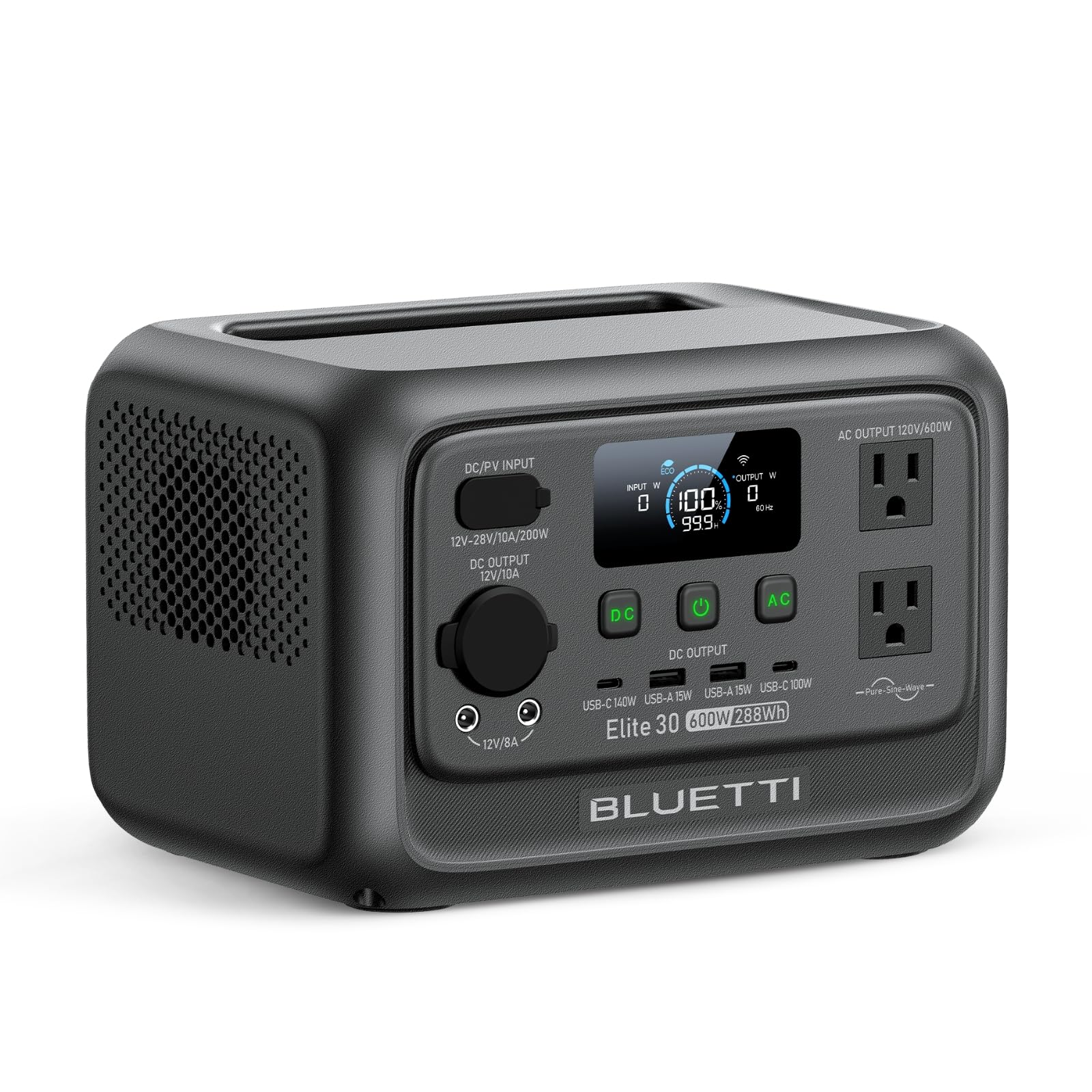
The BLUETTI Elite 30 V2 packs 288Wh into a 9.4 lb frame that’s small enough to toss in a go-bag. The 600W inverter handles power lifting up to 1500W, meaning it can briefly run a small kettle or toaster in a pinch. Its 10ms UPS response is faster than most dedicated UPS units, protecting CPAP machines, routers, and laptops seamlessly during a grid drop.
Eight charging modes include a 380W wall input that hits 0-80% in just 45 minutes. The two USB-C ports deliver 140W and 100W respectively—enough to fast-charge a MacBook Pro at full speed. The Wi-Fi app adds remote monitoring and scheduling, a rare feature at this price tier. Buyers confirm it runs a TV at 80W for 3.5 hours or a CPAP and phone charger through an entire night.
For extended multi-day outages, 288Wh is entry-level. You’ll need solar panels (sold separately) to keep topping it off. But as a lightweight, ultra-responsive UPS that doubles as a portable camping battery, the Elite 30 V2 is outstanding value in its class.
Why it’s great
- 10ms UPS switch for medical and data gear
- Weighs only 9.4 lbs for true portability
- Fast charging: 0-80% in 45 minutes
Good to know
- 288Wh is entry-level for multi-day outages
- UPS mode requires settings tweak out of box
9. VTOMAN Jump 600X Portable Power Station

The VTOMAN Jump 600X solves two emergency problems with one 14.6 lb device: it’s a 299Wh portable power station AND a car jump starter capable of cranking a full-size truck. The 600W inverter (1200W surge) can sustain 600W even when driving appliances over that rating, a unique constant-power feature that keeps water heaters and space heaters running when other units would cut out completely.
Capacity expands to 939Wh with an optional extra battery, giving you room to grow into longer outages. The regulated 12V/10A DC outputs are perfect for car refrigerators and CPAP machines, maintaining steady voltage even under load. Pass-through charging lets you power nine devices simultaneously while the station itself recharges.
Buyers consistently praise the jump start capability—one user reports starting a Dodge Ram in three seconds. The AC recharge takes about 3 hours, and solar input flows through a standard DC5521 barrel plug. The main caveat is base capacity: 299Wh is best for overnight use or as a supplement to a larger station. If you need both a power station and a jump starter, this is a space-saving no-brainer.
Why it’s great
- Integrates a car jump starter into the battery
- Constant 600W output even with over-range loads
- Expands to 939Wh with add-on battery
Good to know
- Base 299Wh is modest for multi-day use
- DC input uses barrel plug, not MC4
FAQ
Can I run a refrigerator on a backup battery during a power outage?
What is the difference between a UPS and a portable power station?
How long does a 2000Wh battery last during a blackout?
Can I charge a backup battery from solar panels?
Final Thoughts: The Verdict
For most users, the best backup battery for power outage winner is the AFERIY P210 because it combines 2048Wh of clean LiFePO4 capacity with a near-silent 2400W inverter and a reliable sub-10ms UPS—all for a mid-range investment. If you want the lightest possible 2kWh station for quick evacuation, grab the Jackery Explorer 2000 v2. And for whole-home coverage including 240V well pumps, nothing beats the EcoFlow DELTA Pro 3.