
Adding a dedicated subwoofer to your home theater or stereo system transforms the way you experience movies and music, filling the room with tactile low-end energy that main speakers alone simply cannot generate. The challenge is that many entry-level subwoofers sacrifice extension, power, or build quality—leaving you with a box that buzzes and rattles rather than delivering tight, authoritative bass.
I’m Min — the co-founder and writer behind Gadgets Feed. I’ve combed through hundreds of hours of user feedback, measured specs across dozens of affordable models, and analyzed real-world performance data to identify which units genuinely outperform their modest price tags and which ones cut the wrong corners.
Whether you are building a budget 5.1 setup, adding depth to a pair of bookshelf speakers, or upgrading a soundbar, this guide to the best bargain subwoofer will separate the true performers from the pretenders.
How To Choose The Best Bargain Subwoofer
Picking a budget sub isn’t just about finding the lowest price. Since low-frequency reproduction depends heavily on driver surface area, amplifier headroom, and enclosure rigidity, picking a model that skimps on any of those three pillars will leave your system sounding hollow or muddy.
Driver Size and Extension
The single most important physical spec is the diameter of the woofer cone, measured in inches. An 8-inch driver can typically reach down to around 35–40 Hz, while a 10-inch driver can hit the low 30s, and a 12-inch can dip to 25–30 Hz. For music that demands weight — think synth pads, pipe organs, or kick drums — a larger cone moves more air and produces deeper extension without requiring massive amplifier power.
Amplifier Class and RMS Power
Ignore peak wattage figures that use fanciful marketing numbers. What matters is the continuous RMS rating of the built-in amplifier. A Class-D amplifier is now standard in budget subwoofers because it runs cool and efficient while delivering clean power. Anything above 100W RMS is sufficient for a small to medium room; above 200W RMS starts to pressurize larger spaces. Always compare RMS, not the inflated peak rating printed on the box.
Connectivity and Controls
Look for LFE (low-frequency effects) RCA input, line-level RCA inputs and outputs, and preferably speaker-level inputs for older receivers. Adjustable low-pass crossover (usually 40 Hz–160 Hz) and a phase switch (0° or 180°) let you blend the sub seamlessly with your main speakers rather than letting them overlap. Auto-on/off is a nice convenience for energy savings and silent operation.
Quick Comparison
On smaller screens, swipe sideways to see the full table.
| Model | Category | Best For | Key Spec | Amazon |
|---|---|---|---|---|
| Dayton Audio CS1200 | Powered | Deep extension | 12″ / 200W RMS | Amazon |
| Fluance DB10W | Powered | Musical accuracy | 10″ / 120W RMS | Amazon |
| Dayton Audio CS800 | Powered | Tight mid-bass | 8″ / 150W RMS | Amazon |
| Rockville Rock Shaker 10” | Powered | Room-shaking cinema | 10″ / 300W RMS | Amazon |
| Edifier T5s | Powered | Desktop systems | 8″ / 70W RMS | Amazon |
| Rockville Rock Shaker 6.5” | Powered | Apartment use | 6.5″ / 100W RMS | Amazon |
| Pioneer TS-A250D4 | Passive | Car audio upgrade | 10″ / 400W RMS | Amazon |
| JBL Bar 2.1 Deep Bass | Soundbar Sub | Soundbar upgrade | Wireless 6.5″ / 300W | Amazon |
| Bestisan SW65D | Powered | First-time setup | 6.5″ / 100W RMS | Amazon |
In‑Depth Reviews
1. Dayton Audio Classic CS1200 – 12″ 200W Powered Subwoofer
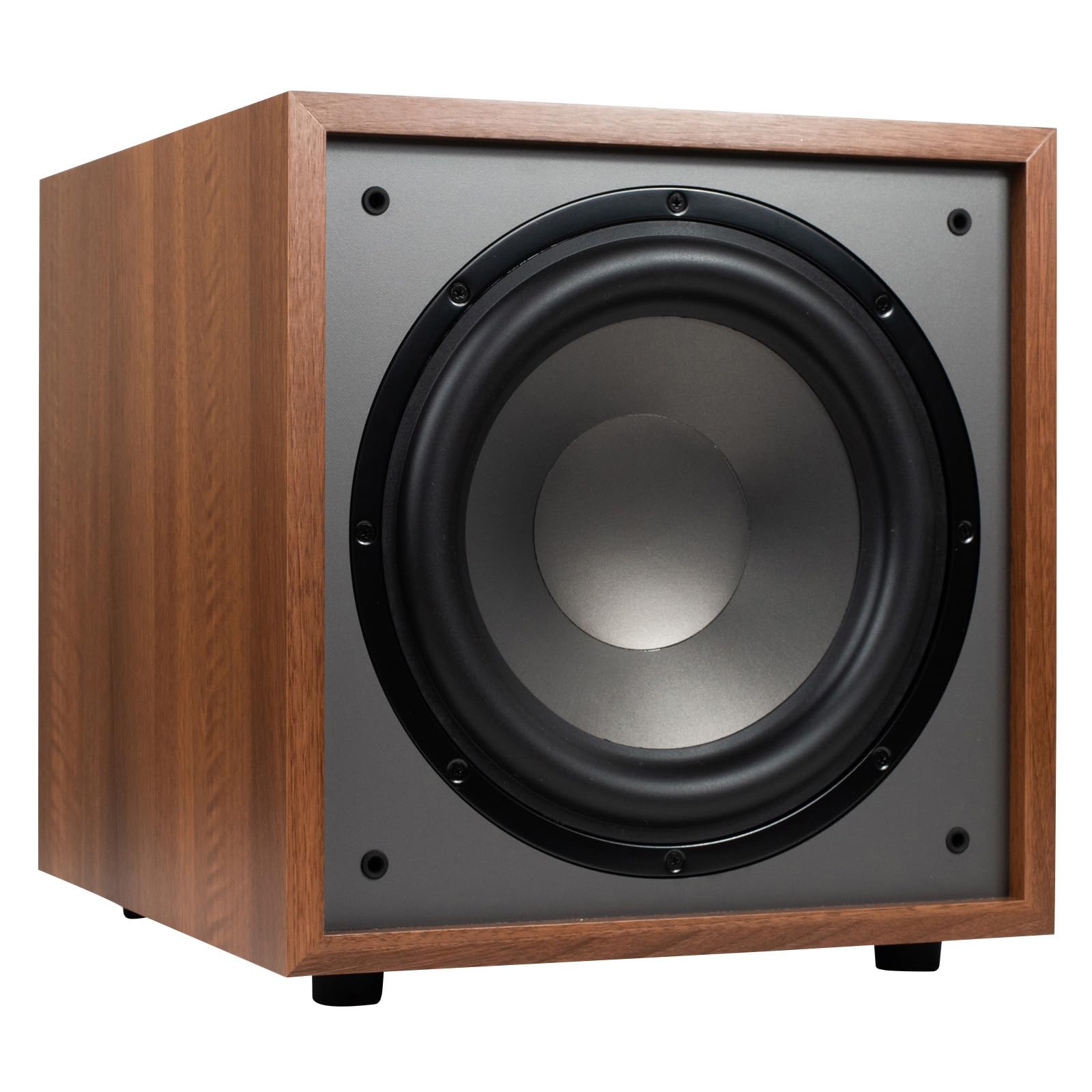
The Dayton Audio CS1200 provides the kind of low-end extension that most subwoofers in the premium tier struggle to match, let alone in the budget pool. Using a 12-inch driver backed by a 200W RMS Class-D amplifier, this powered sub reaches down to 26 Hz—a figure that lets you feel the deepest rumbles in action movies and electronic music. The heavily braced MDF cabinet keeps panel resonance low, so even at high output the bass stays tight rather than turning into a hollow boom.
Connectivity is comprehensive for the price: stereo RCA, LFE, and speaker-level inputs accommodate nearly any source, and the auto-on feature powers the unit up when it detects a signal. The wood-grain veneer and detachable grille give it a clean, furniture-friendly appearance that blends into a living room far better than a black monolith would. At 18 inches deep and over 40 pounds, this is not a sub you tuck behind a couch—it demands floor space, but it rewards that real estate with authoritative output.
Owner reviews consistently praise its extension and lack of distortion compared to similarly priced 10-inch alternatives. A few users reported that the amplifier mounting screws can vibrate loose over time—a simple tightening with a screwdriver resolves the issue. Considering the performance on tap, the CS1200 sets a new standard for what a budget subwoofer can deliver in terms of pure frequency response.
Why it’s great
- 26 Hz low-end extension at this price is unmatched
- 200W RMS Class-D amp provides clean headroom
- 5-year warranty adds long-term confidence
Good to know
- Large footprint requires dedicated floor area
- Grille cloth feels less durable than cabinet
2. Fluance DB10W 10-inch Powered Subwoofer

The Fluance DB10W takes a different approach from the Dayton CS1200: instead of chasing the deepest Hz, it prioritizes musicality and coherence with bookshelf speakers. The 10-inch long-throw driver and front-firing port allow placement close to a wall without muddying the bass response, which is a real advantage for smaller rooms where corner-loading is not an option. The claimed extension of 38 Hz is honest and achievable after a 15-hour break-in period, according to long-term users.
Build quality is excellent for the tier. The natural walnut MDF cabinet looks more expensive than the price suggests, and the front port design means you can place it flush against a wall without worrying about rear clearance. Controls include volume, crossover (40–140 Hz), phase, and auto-on, giving you the standard toolkit for integration. The included remote adds convenience for adjusting levels from your listening position—a rarity at this price level.
Owners pairing the DB10W with Fluance or JBL bookshelf speakers report seamless integration at an 80 Hz crossover with about 70% volume. The sub performs best from about 45 Hz upward, which covers bass guitar and kick drum fundamentals accurately. Below that, it rolls off naturally rather than trying to fake it. If your priority is tight, tuneful bass for music rather than sub-30 Hz home theater effects, this is the better fit.
Why it’s great
- Natural walnut finish looks premium and wife-friendly
- Front port enables wall placement without bass bloat
- Remote control for level adjustments from the listening position
Good to know
- Rolls off noticeably below 40 Hz
- Requires break-in period for optimal performance
3. Dayton Audio Classic CS800 – 8″ 150W Powered Subwoofer
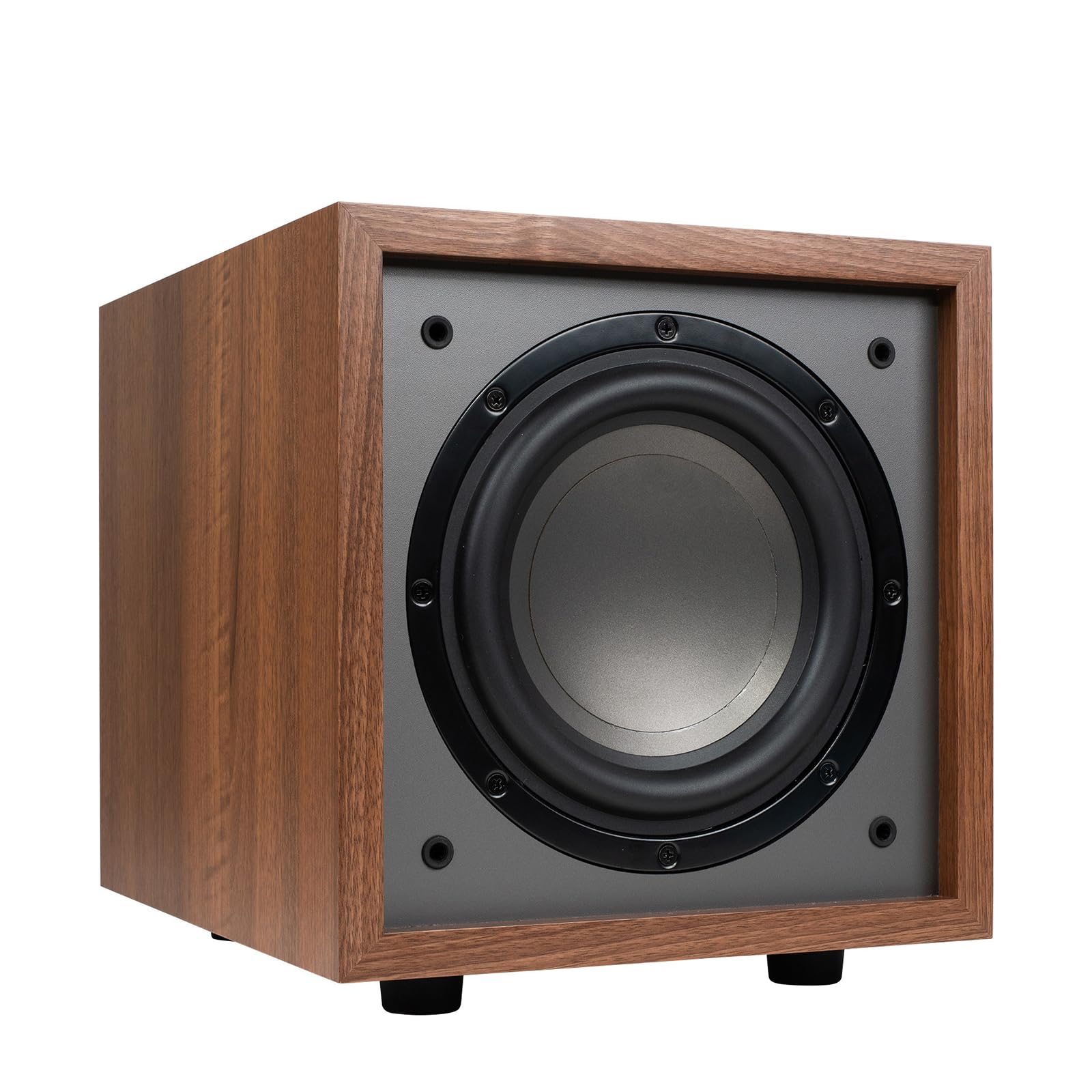
If the 12-inch CS1200 is too large for your space, the Dayton Audio CS800 shrinks the footprint while retaining the same design DNA. This 8-inch subwoofer packs a 150W RMS Class-D amplifier into a rigid, braced MDF cabinet that measures 11.5 inches wide and 14 inches deep—small enough to slide under a desk or next to a media console. Frequency response extends to 35 Hz, which is impressive for an 8-inch driver and covers the overwhelming majority of bass content in music and film.
The CS800 offers the same connectivity suite as its larger sibling: stereo RCA, LFE, and speaker-level inputs, plus auto-on and simple gain/crossover/phase controls. The wood-grain finish and swappable gray grille let it disappear into your decor rather than shouting for attention. Multiple users report that it out-performs their previous 10-inch or even 12-inch subs from no-name brands, thanks to the well-braced enclosure that eliminates cabinet resonance at moderate volumes.
One caution: a few owners mentioned that the screws securing the amplifier module can loosen from vibration over a couple of months. This is a five-minute fix with a screwdriver and washer, not a design flaw that affects sound quality. The 5-year warranty from Dayton Audio provides peace of mind that you rarely see on subwoofers at this level. For anyone with limited floorspace who still wants real extension, the CS800 is the smart compromise.
Why it’s great
- Fits under desks or beside media consoles easily
- 35 Hz extension from an 8-inch driver is class-leading
- Braced cabinet stays clean at moderate volumes
Good to know
- Amp screws may need tightening after shipping
- Not sufficient for pressurizing large rooms alone
4. Rockville Rock Shaker 10″ 600W Powered Subwoofer

The Rockville Rock Shaker 10″ leans into raw power as its primary calling card. With a 600W peak (300W RMS) Class-D amplifier driving a 10-inch woofer in a tuned MDF enclosure, this subwoofer delivers the kind of chest-thumping, sofa-shaking bass that home theater enthusiasts seek for explosive movie scenes. The cabinet has a detachable foam grille, a high-grade vinyl wrap, and compact proportions for a 10-inch sub—around 14 inches cubed—which makes it easier to position than you’d expect given the output.
Adjustability is solid: you get volume, crossover frequency (roughly 40–200 Hz), and a phase switch (0° or 180°) to dial in integration. Inputs include both RCA line-level and high-level speaker wire connections, so it works with older receivers that lack a dedicated LFE output. The auto-on function is present and reliable. Reviewers consistently note that after dialing in the crossover around 80–100 Hz, the Rock Shaker fills rooms up to 30 feet by 30 feet with authority.
The trade-off is that the bass is slightly looser and less articulate than the Dayton or Fluance offerings—it favors impact over finesse. Some users describe the crossover as a shelf control rather than a true variable low-pass filter, meaning you need to pay attention to where you set it to avoid overlap with your main speakers. If your goal is maximum tactile feedback for action movies at the lowest possible outlay, the Rock Shaker 10 delivers that in spades.
Why it’s great
- 300W RMS provides serious output for medium-to-large rooms
- High-level inputs enable use with older receivers
- Detachable foam grille protects the driver
Good to know
- Bass is impact-oriented rather than tight and musical
- Crossover behaves more like a shelf filter than a true LPF
5. Edifier T5s Powered Active Subwoofer 8″

The Edifier T5s is purpose-built for augmenting desktop audio systems rather than pressurizing a living room. Its 8-inch long-throw woofer powered by a 70W RMS Class-D amplifier delivers accurate extension down to 35 Hz, perfectly matching the output of bookshelf monitors like the Edifier R1700BTs or R1280Ts. The compact cabinet—15.7 inches tall but only 6.7 inches wide—stands vertically like a tower speaker, saving valuable desk width while still moving enough air for near-field listening.
Edifier engineered the T5s with a front-firing driver and a right-firing slot port, so you can place it against a wall without choking the output. The 18 mm MDF cabinet is internally braced to minimize coloration. Adjustable low-pass filter (30–160 Hz), a phase selector (0°/180°), and auto-standby after 15 minutes of inactivity round out the feature set. The wood-grain vinyl finish and low-profile grille give it a refined aesthetic that looks at home next to premium bookshelf speakers.
Users pairing the T5s with Edifier speakers report clean, musical bass that integrates seamlessly without calling attention to itself. The 70W RMS output is sufficient for near-field desk use but will not rumble a large living room. For anyone running a PC-based audio setup with active speakers that lack a subwoofer output, the T5s offers a straightforward series-wiring solution: source to sub in, sub out to the speakers. It solves a specific problem elegantly.
Why it’s great
- Vertical tower footprint saves desk width
- 35 Hz extension is excellent for an 8-inch in this price bracket
- Series wiring works with speakers lacking sub output
Good to know
- 70W RMS limits output in medium-to-large rooms
- Works best paired with Edifier branded speakers
6. Rockville Rock Shaker 6.5″ 200W Powered Subwoofer

The 6.5-inch version of the Rockville Rock Shaker serves a very specific audience: anyone living in an apartment or condo where a 10-inch or 12-inch subwoofer would risk noise complaints. With 100W RMS on tap and a compact 11-inch cube of an MDF cabinet, this subwoofer delivers a surprising amount of punch without rattling the walls of adjacent units. The foam surround paper cone driver with a Y30 magnet keeps distortion low at the moderate volume levels typical of shared-wall living.
Connectivity includes RCA line-level and speaker-level inputs, plus adjustable crossover and phase controls. The front-firing port means you can place it near a wall without additional bass bloat. Many users report that the volume knob lives around the 9 o’clock position and the crossover around 80 Hz for a balanced blend with bookshelf speakers. The Class-D amplifier runs cool even during extended listening sessions, and the auto-on feature works reliably.
The trade-off is that a 6.5-inch driver simply cannot move enough air to pressurize a large room or reproduce sub-30 Hz content with authority. The Rock Shaker 6.5 excels at adding punch to the mid-bass region (50–100 Hz) where kick drums and bass guitars live, but it will not deliver the deep rumbles of an action movie explosion. If you accept that limitation, this is a capable little sub that punches above its physical size in clarity.
Why it’s great
- Compact 11-inch cube fits small spaces easily
- Controlled output minimizes neighbor disturbance
- Adjustable crossover and phase for proper integration
Good to know
- Limited depth below 40 Hz
- Not powerful enough for large living rooms
7. Pioneer A-Series TS-A250D4 10″ Passive Subwoofer

The Pioneer TS-A250D4 heads in a different direction from the other entries on this list: it is a passive car audio subwoofer, not a powered home theater unit. This 10-inch driver is designed to be paired with an external amplifier and installed in a custom enclosure—either a 0.7 cu. ft. sealed box or a 1.0 cu. ft. vented box. With 400W RMS power handling and a dual 4-ohm voice coil configuration, it offers wiring flexibility (2Ω, 4Ω, or 8Ω) to match nearly any car amplifier.
The cone is constructed from Pioneer’s Glass-Fiber and Mica Reinforced IMPP material, which provides the rigidity needed to maintain cone control at high excursion without breakup. The surround is rubber rather than foam, giving it better longevity in the temperature swings and UV exposure of a vehicle interior. Owners report that it is a direct drop-in replacement for the factory B&O subwoofer in late-model Ford Mustangs, delivering dramatically cleaner and louder bass than the stock driver.
This is strictly a component for those building or upgrading a car audio system—it will not work plugged into a wall outlet. But within its intended use case, the TS-A250D4 represents exceptional value for the power handling and build quality. If you already have a suitable enclosure and amplifier, this driver can form the foundation of a sub-100-dollar subwoofer system that outperforms many all-in-one powered car subwoofer tubes.
Why it’s great
- 400W RMS power handling for serious car audio output
- Dual 4-ohm voice coils support multiple wiring configurations
- Direct-fit upgrade for Mustang B&O systems
Good to know
- Passive design requires external amplifier and enclosure
- Not suitable for home audio without major adaptation
8. JBL Bar 2.1 Deep Bass (MK2) Soundbar with Wireless Subwoofer

The JBL Bar 2.1 Deep Bass (MK2) is a complete 2.1-channel soundbar system that includes a wireless 6.5-inch subwoofer, making it the only all-in-one solution in this roundup. If you want to upgrade your TV audio without buying a separate receiver and speakers, this package delivers 300W of total system power with Dolby Digital decoding and JBL Surround Sound processing. The wireless subwoofer pairs automatically with the soundbar, which sits cleanly beneath most TVs on its included mounting hardware.
The subwoofer is a front-firing ported design with a 6.5-inch driver that produces punchy, present bass rather than extended low-frequency rumbles. Three selectable bass settings (Low, Mid, High) let you dial in the intensity without navigating a complex menu. Connectivity options include HDMI ARC, optical, and Bluetooth for music streaming from a phone or tablet. Setup takes minutes out of the box—plug in the soundbar, plug in the subwoofer, and they find each other automatically.
Reviews highlight the clarity of the soundbar’s midrange and treble, with the subwoofer adding impact for explosions and music. Some users noted occasional static or interference that resolves with a power cycle, and a few received units that arrived with packaging damage. At this price, the Bar 2.1 Deep Bass competes directly with budget component systems while offering the convenience of a single remote and zero speaker wire to hide. For simplicity-first buyers, it is a strong contender.
Why it’s great
- Complete 2.1 system in one box with wireless subwoofer
- HDMI ARC and Optical inputs for easy TV connection
- Dolby Digital decoding enhances movie dialogue and effects
Good to know
- 6.5-inch subwoofer limits deep bass extension
- Intermittent static issues reported by some users
9. Bestisan SW65D 6.5″ Powered Subwoofer

The Bestisan SW65D is the most affordable powered subwoofer in this roundup, and it aims to provide the easiest possible entry point for first-time subwoofer owners. The 6.5-inch side-firing driver is housed in a compact ABS enclosure measuring just 6.3 by 12.6 by 12.6 inches, allowing it to tuck into tight corners or under desks. The accompanying remote and front-panel controls let you adjust volume and low-pass crossover without getting up, which is an unusual convenience at this level.
The SW65D supports RCA, AUX, and LFE input connections, and it includes a set of satellite speaker binding posts for integrating with a 2.1 system. Pairing this sub with bookshelf speakers like the Edifier R1280T is a common use case, and users report that setting the volume and crossover to about 50% yields a smooth blend. The ABS cabinet keeps weight low—around 8 pounds—but it also means the enclosure is less inert than MDF, which can permit some panel resonance at higher volumes.
The main caveat involves conflicting spec sheets: some units shipped with Bluetooth and optical inputs while others have only wired connections, creating confusion about which version you will receive. A minority of buyers received units that produced very weak output or no output at all, suggesting quality control is inconsistent. If you get a good unit, the SW65D provides subtle, non-intrusive bass augmentation at the lowest possible outlay. If you want reliability, the Rockville Rock Shaker 6.5 or Edifier T5s are safer bets for a small premium.
Why it’s great
- Lowest entry price for a powered subwoofer with remote
- Compact and lightweight for easy placement
- Side-firing driver and remote control are unusual at this price
Good to know
- Quality control is inconsistent across units
- ABS cabinet can resonate at higher volumes
FAQ
Can I use a car audio subwoofer like the Pioneer TS-A250D4 at home?
What size subwoofer do I need for a 20×20 foot living room?
Final Thoughts: The Verdict
For most users, the best bargain subwoofer winner is the Dayton Audio Classic CS1200 because its 26 Hz extension and 200W RMS amplifier deliver home theater depth that costs two to three times more from other brands. If you want a compact unit that still reaches deep, grab the Dayton Audio CS800. And for musical accuracy with a wall-friendly front port in a premium vinyl finish, nothing beats the Fluance DB10W.