
A car battery charger that merely dumps voltage into a dead cell is obsolete. The real job is to intelligently assess the battery’s chemistry, deliver the correct amperage without cooking the plates, and then float-maintain it for weeks without damage. A modern smart unit does all that, plus pulse-desulfates to recover lost capacity from sulfated lead-acid or rebalances LiFePO4 cells. Whether you’re storing a motorcycle for winter or reviving a daily driver that sat too long, the charger you choose determines whether that battery lasts another season or heads for recycling.
I’m Min — the co-founder and writer behind Gadgets Feed. I’ve dug through the charging profiles, safety certifications, and pulse waveforms of dozens of units to separate the smart maintainers from the basic power supplies masquerading as chargers, and this guide reflects hundreds of hours comparing real-world performance data and user experiences.
After analyzing output curves, temperature compensation accuracy, and compatibility with AGM, flooded, and lithium chemistries across seven leading models, one unit emerges as the clear winner for the best car battery charger for most owners.
How To Choose The Best Car Battery Charger
Selecting a charger isn’t about grabbing the highest amperage you can find. It’s about matching the charging profile to your battery’s chemistry and your usage pattern — a deep-cycle marine AGM needs a different absorption voltage than a standard flooded starter battery. The top considerations below will help you avoid damaging your battery or wasting money on features you don’t need.
Amperage Output and Battery Capacity
Amperage determines how fast the charger replenishes energy, but it also affects safety. A general rule is to pick a charger that delivers roughly 10% to 25% of your battery’s amp-hour (Ah) capacity. For a typical 50Ah car battery, a 5A to 12A charger is ideal. Higher currents, such as 20A, are fine for faster charging or larger banks, but they generate more heat and can warp plates in older batteries. Low-current units like 1.25A work well for long-term maintenance.
Chemistry Compatibility: Lead-Acid vs. LiFePO4
Not all smart chargers automatically support lithium iron phosphate (LiFePO4) batteries. Lithium cells require a higher absorption voltage (around 14.4V to 14.6V) and a very different float stage than lead-acid. If you plan to charge both types, look for a unit with a dedicated lithium mode — otherwise you risk undercharging or damaging the BMS (battery management system). Many mid-range units now offer both lead-acid and lithium profiles, making them much more versatile.
Charging Stages: Beyond Simple Trickle
The difference between a basic trickle charger and a true smart charger lies in the number of stages. Entry-level units may only offer constant-current followed by float. Premium units use four to eight stages, including desulfation (pulse repair), bulk charge, absorption, analysis, reconditioning, and temperature-compensated float. Multi-stage chargers actively restore lost capacity and prevent overcharging cycles, extending battery life measurably. Pulse repair mode sends high-frequency voltage spikes to dissolve lead-sulfate crystals on the plates — a feature that can reclaim batteries that won’t hold a charge.
Quick Comparison
On smaller screens, swipe sideways to see the full table.
| Model | Category | Best For | Key Spec | Amazon |
|---|---|---|---|---|
| E-FAST 20A | Smart Multi-Chem | Versatile home use | 20A max / 7-stage | Amazon |
| Huiaipaic 20A | Fast Charge | Quick top-ups | 20A / 300W / pulse repair | Amazon |
| Battery Tender Plus | Maintainer | Long-term storage | 1.25A / 4-step | Amazon |
| NOCO GENIUS5 | Smart 6V/12V | Precision charging | 5A / thermal sensor | Amazon |
| CRAFTSMAN 12A | 4-in-1 Tester | Built-in diagnostics | 12A / desulfation | Amazon |
| CTEK CT5 | Motorcycle Pro | Small batteries | 2.3A / recond mode | Amazon |
| Schumacher SC1446 | Wheeled Starter | Dead battery rescue | 200A start / 10A charge | Amazon |
In‑Depth Reviews
1. E-FAST Battery Charger 0-20A 12/24V

The E-FAST pulls ahead with its unusual dual-voltage 12V/24V capability and a full 7-stage charging algorithm that includes desulfurization, compensation, and floating. It delivers 20A at 12V and 10A at 24V, making it appropriate for everything from a compact car to a farm truck or boat with a 24V system. The LCD display shows real-time voltage, current, temperature, and an explicit 100% full indicator — no guesswork.
Pulse repair mode applies high-frequency low-frequency pulses to dissolve sulfation on old lead-acid plates, and multiple owners report reviving deeply discharged batteries that other chargers refused to touch. It’s also verified for UL certification, which adds a layer of safety assurance that many budget units lack. The physical package is impressively compact and lightweight for a 20A unit.
The charger auto-detects battery chemistry (LiFePO4, AGM, Gel, Flooded, SLA) and adjusts its absorption voltage accordingly. Some users note that if the display shows ‘dE5’, the unit is still calibrating and simply needs a few minutes to analyze the battery before starting. The lack of a jump-start function is the only real omission, but as a dedicated charger-maintainer-desulfator, it covers every essential base.
Why it’s great
- 20A output charges a car battery in roughly 2 hours
- 7-stage algorithm covers desulfation, bulk, absorption, and float
- UL certified and compatible with LiFePO4 and all lead-acid types
Good to know
- No jump-start mode for instant engine cranking
- Small backlit display can be tricky to read in direct sunlight
2. Huiaipaic 20A Smart Charger 12V/24V
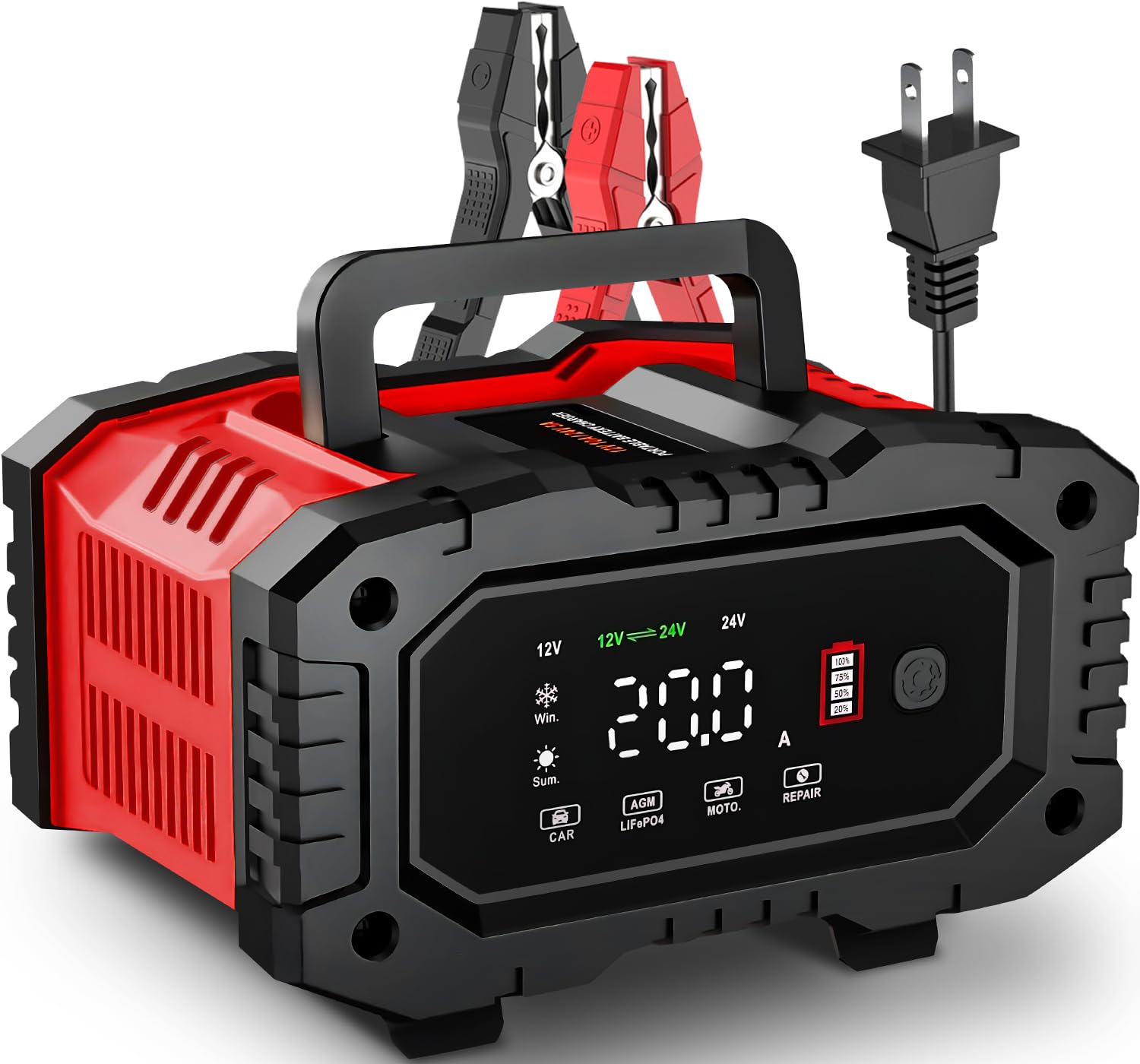
This unit matches the E-FAST on raw amperage (20A at 12V, 10A at 24V) but adds a 300W output transformer and a unique summer/winter temperature mode that compensates for ambient conditions. It’s designed to charge, maintain, and pulse-repair lead-acid and LiFePO4 batteries from 6Ah up to 200Ah, covering small lawn mower cells all the way to large RV deep-cycle banks.
The physical design stands out with a foldable carry handle, clip organizers on the back to wrap cables neatly, and a tilt-stand on the bottom so the LCD sits at a comfortable viewing angle on a bench. Owners praise the auto-detect feature that correctly identifies battery voltage and sulfation level before beginning the charging profile. The repair mode has successfully recovered old idle batteries that other units flagged as dead.
The large LCD displays percentage, voltage, current, temperature, and battery full status clearly. The only common complaint is that the screen is dim in outdoor daylight, making it hard to read settings while standing in a driveway. Setting the battery type before moving into bright sun avoids this issue. The 24-month warranty adds peace of mind for a charger that runs unattended for days.
Why it’s great
- Summer/winter temperature compensation prevents mischarging in extreme weather
- 300W high-frequency transformer provides efficient, fast bulk charging
- Integrated clip and cord management keeps the workspace tidy
Good to know
- LCD screen visibility suffers under bright outdoor light
- Lithium chemistry mode is disabled — only works with LiFePO4, not NMC
3. Battery Tender Plus 12V 1.25A

The Battery Tender Plus is the benchmark for seasonal battery maintenance. Its 4-step charging program (bulk, absorption, analysis, float) is optimized for long-term storage — it won’t overcharge even if left connected for months. At 1.25A, it’s not for fast recovery of deeply depleted batteries, but that’s not its job. It’s designed to keep a stored battery at peak state of charge without boiling off electrolyte.
The build quality is proven over a decade-plus of use by thousands of owners. The included quick-disconnect harness with fused ring terminals and alligator clips makes swapping between vehicles effortless. The two-color LED indicates charging progress and automatically resumes full current if the battery voltage drops under load. Many customers report units lasting over ten years of continuous service.
This charger is limited to 12V lead-acid (AGM, Gel, flooded) and does not support lithium chemistries. At 1.25A, it will take around 24 hours to bring a deeply discharged 50Ah battery to full charge — it’s best used as a maintainer, not a primary charger. The 10-year manufacturer warranty reflects the confidence in its longevity and is a strong signal of quality.
Why it’s great
- 10-year warranty and proven reliability over decades
- True 4-step maintenance algorithm prevents overcharging
- Quick-disconnect harness with fused eyelets for permanent vehicle installation
Good to know
- No LiFePO4 compatibility — lead-acid only
- 1.25A output is too slow for charging a dead battery quickly
4. NOCO GENIUS5 5A Smart Charger

The NOCO GENIUS5 is the most precise charger in this lineup thanks to its integrated thermal sensor that dynamically adjusts the charge voltage based on ambient temperature. Hot garage in July? The voltage drops to prevent gassing. Cold shed in January? It raises to ensure full absorption.
It can charge a battery from as low as 1 volt, and Force Mode allows manual recovery of completely dead batteries down to zero volts — a feature that separates dedicated chargers from maintainers. The 5A output at 12V (and 6V mode for classic cars) is the sweet spot for typical car and motorcycle batteries: fast enough for overnight recovery, slow enough to avoid overheating a 20Ah bike battery.
The unit supports both lead-acid (AGM, Gel, SLA, VRLA, flooded) and lithium-ion (LiFePO4) chemistries, making it a versatile garage companion. The included 72-inch AC cable and 80-inch DC cable with eyelet terminals and battery clamps gives ample reach. Some users note the lack of a printed instruction guide and that the mode button has a slight delay, but the performance is faultless.
Why it’s great
- Active thermal sensor compensates for ambient temperature for optimal charging
- Force Mode recovers batteries from zero volts
- Compact size — 34% smaller than predecessor with 65% more power
Good to know
- Plastic housing may crack if dropped on concrete
- No separate storage bag or detailed desulfation manual included
5. CRAFTSMAN 12A 4-in-1 Charger/Maintainer
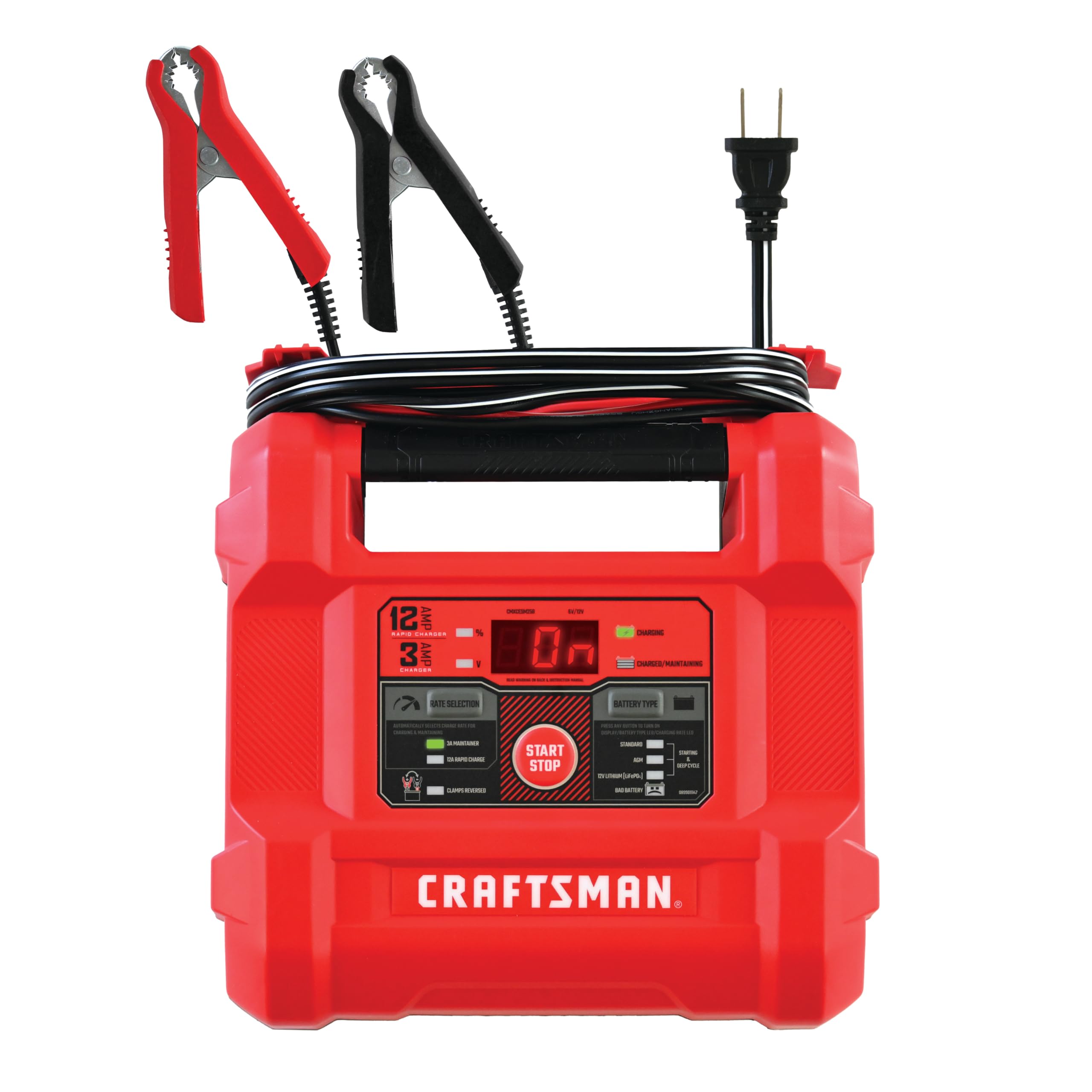
The CRAFTSMAN 12A is a 4-in-1 device: charger, maintainer, desulfator, and battery tester all in one unit. The integrated battery tester measures battery health directly from the clamps — a feature that eliminates guessing whether a battery is sulfated or simply depleted. It delivers 12A at 12V charging, plus separate 3A 12V and 2A 6V modes for gentler maintenance.
The recondition (desulfation) mode applies a programmed high-voltage pulse sequence specifically designed to break up lead-sulfate crystals on aged plates. Users consistently report recovering batteries that wouldn’t accept a charge on standard profiles. The unit works with lead-acid (standard, AGM, deep-cycle) and lithium (LiFePO4) chemistries, covering most modern automotive and marine batteries.
Reverse polarity protection prevents damage if the clamps are accidentally swapped, and the 6-foot power cord offers reasonable reach for most garage layouts. Some users mention that the LCD could be larger for easier reading at a distance, and the unit lacks a dedicated lithium mode selector — it relies on auto-detection, which can be finicky with some LiFePO4 BMS configurations. The CRAFTSMAN brand backing and Schumacher manufacturing add durability assurance.
Why it’s great
- Built-in battery tester eliminates guesswork about battery condition
- Recondition mode effectively restores sulfated lead-acid batteries
- 12A output provides fast, usable charging for cars and SUVs
Good to know
- No dedicated lithium mode toggle — relies on auto-detection
- Display size is adequate but not as large as some competitors
6. CTEK CT5 12V Automotive Charger

CTEK is a Swedish brand synonymous with high-end battery management, and the CT5 is purpose-built for motorcycles, ATVs, Jet Skis, and snowmobiles — vehicles with small batteries (typically 10Ah to 30Ah) that are easily damaged by excessive current. It outputs a max of 2.3A, which is gentle enough for a 12Ah bike battery but still charges it fully in a few hours.
The charger features a dedicated Recond mode for reconditioning deeply discharged lead-acid batteries, using sequential pulses to break down sulfation. The normal mode is optimized for all lead-acid types (AGM, Gel, flooded). A separate lithium mode supports 12V LiFePO4 batteries at the correct absorption voltage. The included Comfort Connect clamps and eyelets with a storage drawstring bag make it easy to keep organized.
Users in cold climates report that the CT5 maintains batteries perfectly through long winter storage without any maintenance issues. The build quality is exceptional, and the 5-year warranty reflects CTEK’s confidence. The main downside is the low 2.3A output — it’s too slow for charging a large car battery, so it’s best suited for powersports or as a dedicated maintainer for a seldom-driven classic car.
Why it’s great
- Recond mode can recover batteries that show zero state of health
- Compact size with storage bag and dual connector types
- Swedish-built quality with 5-year warranty
Good to know
- 2.3A output is too slow for charging standard car batteries
- Not suitable for large deep-cycle banks above 80Ah
7. Schumacher SC1446 Wheeled Charger/Starter

The Schumacher SC1446 is a heavy-duty wheeled unit that serves as both a 10A manual battery charger and a 200A engine starter. It’s built around a legacy transformer design that delivers the raw current needed to wake deeply dead batteries that modern automatic chargers reject as unchargeable. The 135-minute timer gives you manual control over charging duration, essential for old-school lead-acid batteries that need a timed absorption phase.
The 200A engine start function provides a massive burst of current to crank a dead vehicle instantly — a feature that directly addresses the pain point of a stranded car. The 40A boost charge mode quickly adds a surface charge to deeply depleted batteries. The steel case, retractable handle, and compact wheels make it portable enough to roll around a shop, and it weighs just under 30 pounds for stability.
This charger is manual, not automatic — the timer must be set correctly to avoid overcharging. The analog ammeter gives a vague needle reading rather than a precise digital readout. It supports 6V and 12V lead-acid (standard, AGM, gel, deep-cycle) but is not suitable for lithium batteries. It’s best for a garage with older vehicles, farm equipment, or anyone who wants the reliability of a transformer-based charger that won’t be confused by a dead battery.
Why it’s great
- 200A engine start delivers instant cranking power for dead batteries
- Manual timer control with 40A boost for deeply discharged batteries
- Durable steel chassis with wheels for easy shop mobility
Good to know
- Manual operation requires user attention — no automatic cut-off beyond timer
- Not compatible with lithium batteries or sensitive AGM electronics
FAQ
Can I leave a smart car battery charger connected indefinitely?
Will a 20A charger damage a small motorcycle battery?
What does pulse repair mode actually do for a sulfated battery?
Final Thoughts: The Verdict
For most users, the best car battery charger winner is the E-FAST 20A because it combines high-speed 20A output, full LiFePO4 and lead-acid compatibility, a comprehensive 7-stage algorithm with pulse repair, and UL certification — all at a price that undercuts many lesser 10A units. If you want precision temperature compensation and Force Mode for zero-volt battery recovery, grab the NOCO GENIUS5. And for rescuing a completely dead battery with engine-start capability, nothing beats the Schumacher SC1446.