
Our readers keep the lights on and my morning glass full of iced black tea. As an Amazon Associate, I earn from qualifying purchases.
Specs are compiled from manufacturer listings and verified buyer reviews and can change over time — please confirm the key details on the product page before buying.
A batting-practice screen is the only thing standing between you and a 70 mph comebacker, but picking the wrong one means a flimsy frame that buckles or netting that rips mid-session. You want a screen that sets up fast, stays planted when a line drive smacks it, and folds down small enough to toss in the trunk. This guide breaks down the best options by frame strength, portability, and the real-world owner feedback that actually tells you what survives a season.
I’m Min — the founder and writer behind Gadgets Feed. This guide is built by comparing the manufacturers’ published specifications and the patterns across verified customer reviews, so you get each pick’s real strengths and trade-offs instead of marketing spin.
We’ve separated the heavy-duty field anchors from the portable backyard nets so you can match the right baseball pitching screen to your exact practice setup and skill level.
Our Picks at a Glance


How To Choose The Best Baseball Pitching Screen
You need a pitching screen that matches the speed of the hitters you face. A screen built for Little League fun will not survive daily high-school batting practice, and a regulation field anchor is overkill if you just need backyard protection.
Decide between an L-screen and a Z-screen
The L-screen is the classic flat protector with a cutout on one side, letting a pitcher or coach stand behind it while staying close to the hitter’s box. The Z-screen adds a bend in the frame that offers a wider protected zone for the person feeding balls or tossing front toss. Both work for baseball and softball, so the choice is really about how much coverage you want versus how much space you have.
Check the steel gauge and frame diameter
The frame takes the real punishment, so look for the thickness of the steel tubing and the gauge of the metal itself. A lower gauge number means thicker steel, which resists bending when a hard line drive hits the frame directly. Thicker tubing, like 1.5-inch diameter, also adds rigidity so the whole screen does not wobble or rock on impact.
Look at net ply for stopping power
The netting’s ply rating tells you how many layers of polyethylene are woven together, and higher ply means a denser, stronger barrier. A 42-ply net handles everyday batting practice, while a 45-ply or 60-ply net shrugs off harder hits and longer exposure to the sun. If you leave the screen outside, check that the net is UV-treated so it does not become brittle and crack.
Quick Comparison
| Model | Best For | Size | Frame | Netting | Amazon |
|---|---|---|---|---|---|
| Skywalker Sports Safety Screen★ Best Overall | Heavy-duty home cages | 6′ x 3.5′ | Powder-coated steel | UV-treated net | Amazon |
| Franklin Sports MLB 2-in-1Skill Builder | Youth skill drills | 68″ x 44″ | 7/8″ steel | 30-ply PE | Amazon |
| ACELETIQS Flexible L ScreenTravel Pick | Portable travel use | 7′ x 7′ | Fiberglass poles | Polyester knotless | Amazon |
| ACELETIQS Defender XL | Distance batting practice | 7′ x 7′ | 18-gauge 1.5″ steel | #42 HDPE | Amazon |
| CHAMPRO Rebound Screen | Fielding and rebounding | 7′ x 5′ | 18-gauge 1.5″ steel | 45-ply PE | Amazon |
| ACELETIQS L-Screen with Wheels | Mobility in the cage | 7′ x 7′ | 18-gauge 1.5″ steel | 42 double pillowcase | Amazon |
| Fortress Regulation L-Screen | Club and school use | 7′ x 7′ | 1.5″ steel | #42 HDPP | Amazon |
| CHAMPRO Brute Z-Screen | Maximum impact resistance | 7′ x 5′ | 13.5-gauge 1.5″ steel | 60-ply PE | Amazon |
| Trigon Black Series L-Screen | All-level daily training | 7′ x 7′ | 18-gauge 1.5″ steel | 42 double pillowcase | Amazon |
In‑Depth Reviews
1. Skywalker Sports Baseball & Softball Safety Screen
Our pick — over 4.5★ from 250+ verified ratings; the strongest balance of quality and price.
The backyard anchor that shrugs off adult-sized rockets without flinching.
This L-screen solves the scariest part of batting practice: standing in front of a hard hitter. The powder-coated steel frame and UV-treated netting are built for repeated outdoor sessions, and the design works for pitchers needing protection or hitters doing solo drills. It is a substantial piece of gear at 18.69 kg, roughly four times the heft of the Franklin 2-in-1 below, and that weight is exactly why it stays planted instead of sliding on impact.
Assembly takes about 30 to 45 minutes for one person using the included hardware, and the net slips directly over the frame. Buyers report the setup is manageable solo, with one noting they did it alone in about 45 minutes and felt totally fine standing behind hitters of any age, including adults. Quality is what wins people over — owners consistently single out the solid steel frame and durable net as the standout features.
The trade-off is that this is a fixed backyard or cage piece, not something you haul to a park each day. The weight draws mixed feedback precisely because moving it is a two-person job, and some owners add extra bungees because the netting fits looser than they would like. But for a home setup where you want real protection every single session, this is the one.
Solid where it counts
- Powder-coated steel frame holds up to hard contact
- UV-treated netting survives full summers outdoors
- 3-year frame warranty backs the build
Heft to plan around
- 18.69 kg weight makes solo transport a workout
- Netting runs loose; extra bungees help
Reach for this if: you want a permanent backyard or cage screen that protects against hard-hitting adults and teens.
Keep looking if: you need something you can fold and carry to a field every day — this one stays put.
2. Franklin Sports MLB 2-in-1 Pitching Target and Return
A pitch-and-rebound trainer that turns one backyard corner into a full practice station.
For a young player, this 2-in-1 does double duty: one side is a strike-zone target with a switch-hitter batter simulation, and the flip side is a rebound net that returns balls for fielding drills. The 7/8-inch steel frame and 30-ply all-weather net keep it light enough to move around, and the batter simulation flips to practice against both lefties and righties. At 4.48 kg it is a featherweight next to the Skywalker’s 18.69 kg, which makes it a haul-and-set-up-anywhere trainer rather than a fixed protection wall.
Owners praise its functionality and training value, calling it a sturdy design that never topples under daily use by young boys. The honest catch shows up in durability — the strike-zone ribbon has a habit of ripping, with buyers reporting it gave out within a week and got replaced with string, and the bungee system demands even wrapping to avoid tearing the netting.
This is a training tool first and a protective screen second, so it shines for Little Leaguers working on accuracy and fielding rather than for coaches standing behind hard hitters. Assembly gets mixed feedback on the instructions, but the front-and-back throwing options and easy switch between pitch-and-return modes keep kids entertained for hours.
Great for kids, light on heavy-duty protection. The dual-sided target and rebound design is the hook, but the strike-zone ribbon is the weak link owners keep replacing.
Pick this for: a young player building accuracy, fielding, and switch-hitting practice in one compact unit.
Think twice if: you need a protective screen for adult-speed batting practice — this is a trainer, not a fortress.
3. ACELETIQS Flexible L Screen 7x7ft
The folding L-screen that rides in a carry bag and still stops the hot shots.
This is the screen for the coach who lugs gear to a park, playground, or covered court and refuses to leave it behind. The 1-inch galvanized steel base anchors a frame of lightweight fiberglass poles, with polyester knotless netting stretched across a regulation 7×7 footprint and a 3.5-foot L-shaped cutout. It all collapses into the included carry bag, and owners say it sets up and breaks down in minutes once you have done it the first time.
Assembly is the thing everyone raves about — clear instructions, no tools, and a design that is easy to figure out even without the manual. Owners mention it surviving two full baseball seasons and still being in great shape, with one dad noting it saves him frequently from rocket shots up the middle as his sons grew to 11 and 13 and got faster. The portability is the whole point, and the lifetime warranty backs the build.
The fiberglass poles are the trade-off for that portability: they flex on impact rather than standing rigid like steel, which protects the frame but means a slightly different feel on direct hits. For a coach who wants protection anywhere and does not want to haul a 40-pound steel frame, this balances weight and safety well.
Built to travel: the carry bag, fiberglass poles, and tool-free setup make this the easiest screen to take anywhere. The trade-off is flexibility — it bends where steel frames stay rigid.
Reach for this if: you coach at multiple fields and want a protective screen that folds into a bag.
Look elsewhere if: you want a rigid steel frame that never flexes under the hardest high-school hits.
4. ACELETIQS Defender XL Baseball Pitching Net
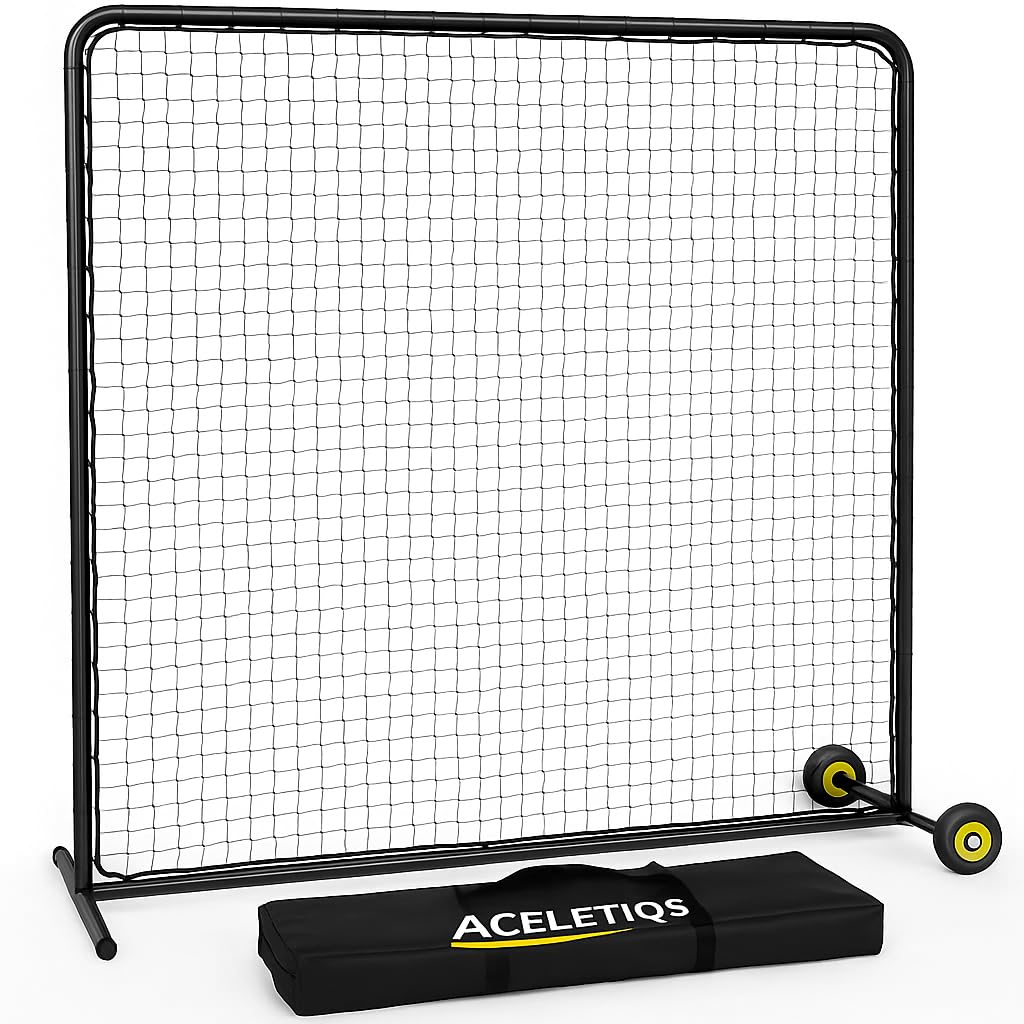
A steel-framed i-screen that stays rigid when cheaper fiberglass models bow back.
This Defender XL uses an 18-gauge 1.5-inch steel frame with heavy-duty #42 double-pillowcase HDPE netting across a 7×7 face, and the metal poles go together in minutes. Owners specifically note it does not bow back at you the way fiberglass pole versions do, which matters when a hard line drive smacks the center. The steel frame keeps its shape, making it a reliable barrier for batting cage setups where coaches feed balls from a distance.
Owners praise its effectiveness, with one noting It handles 100 mph exit velocities off the bat., and the carry bag makes it portable. The recurring gripe is durability under close-range abuse — a few customers note the top bar bending or denting from hard hits, and one coach found it effective at 35 feet or more but says fastpitch players beat it up from inside 20 feet. One owner swears the poles dent on hard hits but stay functional.
This is the screen for coach-fed batting practice from a distance rather than tight underhand toss. The steel frame is sturdier than flexible fiberglass, but it is not indestructible, so match it to the depth of your feeding position.
Sturdy at range: the rigid steel frame holds its shape on impact unlike fiberglass. Keep it at 35 feet or more for best results; close-range feeds can dent the top bar.
Best if: you run batting practice from a distance and want a steel frame that does not flex or bow.
Skip if: you plan to feed balls from 12 to 20 feet away — reviewers point out the frame takes a beating up close.
5. CHAMPRO Rebound Screen

The Z-shaped workhorse that fires grounders back at you for hours of fielding work.
The Z-screen shape is the secret here — it protects whoever is throwing while the rebound net returns balls at different angles for fielding practice. Built with 18-gauge 1.5-inch diameter steel tubes and a weatherized 45-ply polyethylene envelope net, it handles hard contact and outdoor conditions. Shoppers say it stopping 70+ mph hits from 17 feet. and being easy to assemble in about 5 minutes with the pushpin design.
Quality is what wins people over, with owners consistently praising the sturdy welded construction and noting it still looks new after a month of regular use. The rebound feature is a standout, returning balls at different angles to sharpen fielding and confidence, and the reversible design works for both right and left-hand pitchers. It includes stakes for outdoor stability, though some owners find them unnecessary.
The recurring gripe is the springs — a few buyers report them falling off or breaking, with three lost and one broken in a week of heavy use by an 8-year-old. One owner who had a cheap screen break in three hours called this one durable and like new after a month. If you want a protection screen that doubles as a fielding trainer, this Z-screen earns its spot.
The training edge
- 45-ply weatherized net survives outdoor seasons
- Rebound returns balls at varied angles for fielding
- Pushpin assembly in about 5 minutes
Small parts to watch
- Springs can fall off or break under heavy use
- Large footprint needs real backyard space
Reach for this if: you want one screen that protects the thrower and returns balls for fielding practice.
Think twice if: you want a purely flat L-screen — the Z shape is built for rebound work, not just protection.
6. ACELETIQS L Screen with Wheels

The L-screen that rolls itself across the backyard and parks wherever practice starts.
This is the screen that solves the drag-it-everywhere problem. The 18-gauge powder-coated 1.5-inch steel frame has a 7×7 face with a 3.5-inch cutout, and wheels on the bottom mean you roll it into position instead of lifting and carrying. The waterproof double-pillowcase 42 netting withstands daily line drives, and the push-button assembly puts it together without tools in minutes.
Ease of assembly is the thing everyone raves about — owners say it takes under 5 minutes after the first setup and that kids can even move it thanks to the wheels. It stays stable under hard pitching-machine hits without tipping or rocking, and the heavy-duty metal frame holds up in batting cages. The wheels are larger than expected, making movement genuinely easy.
The push pins can be slightly awkward when moving it, and storing it indoors is recommended. For a family or youth coach who wants protection without the back strain, the wheels are the difference-maker.
Mobility first: the wheeled base and tool-free assembly make this the easiest screen to reposition. It shines for youth play but is not built for high-school-speed contact.
Pick this for: youth coaches and families who move their screen around the yard or park constantly.
Look elsewhere if: you need to stop varsity-level line drives — this one targets younger players.
7. Fortress Regulation L-Screen

A regulation-size L-screen built for clubs and schools that need reliable everyday protection.
This L-screen is engineered for organized practice, with a 1.5-inch diameter steel frame that is powder-coated for rust resistance and #42 grade HDPP pillowcase netting with overlocked edges. The UV-treated, rot-proof netting holds up outdoors, and the button locking system secures the frame with wide steel feet for stability on any surface. It is a large 7×7 screen that handles baseball ricochets during training.
Quality and sturdiness are what owners praise most, calling it a solid value that holds hard line drives without feeling flimsy. One high-school parent called it the perfect price with an excellent gauge net, and a 66-year-old grandfather uses it to safely throw batting practice to his grandson’s team. The wide feet keep it planted, and the powder coating resists the elements.
The catch is its size — owners note it is large and not really portable, making it best for fixed cages and fields rather than hauling around. Assembly is mostly easy, though fitting the net can be tricky and a video guide helps. Like the Skywalker, this is a station that stays where you put it, not a travel companion.
Built to stay: the powder-coated frame and #42 netting handle club-level use. Its size makes it a permanent cage fixture, not a portable option.
Best if: you run a club, school, or team cage that needs a tough screen left in place all season.
Skip if: you need to pack up and move the screen between locations — this one is a fixture.
8. CHAMPRO Brute Heavy-Duty Z-Screen

The thickest steel in this lineup, built to eat repeated high-school contact for years.
This is the screen you buy when you are tired of frames flapping and bending. The Brute uses 13.5-gauge 1.5-inch diameter steel tubes — the thickest gauge in this whole comparison — paired with a 60-ply weatherized polyethylene envelope net. Owners mention the 60-ply net surviving five years of Texas sun without UV damage., and it withstands 17U and high-school hits without issue.
Everyone praises its durability, and the numbers back it up: One owner’s unit from 2018 still works today., another calls it the best L-screen they have owned after six months in an outdoor cage with no fading. It outperforms cheaper bownet i-screens with no flop on impact, and the reversible Z-design works for right and left-hand pitchers throwing overhand or underhand. The 46-pound weight is the price of that toughness.
The trade-off is portability — at 46 pounds with no carrying case, this is a set-it-up-and-leave-it screen for clinics and team facilities. A few owners note the pushpins can pinch and recommend silicon spray to ease assembly. But for pure impact resistance that lasts years, the Brute is the benchmark.
The strongest frame here
- 13.5-gauge steel resists bending from hard hits
- 60-ply net survives years of UV exposure
- Reversible for right and left-hand pitchers
Built to stay put
- 46 pounds with no carry case limits travel
- Pushpins can pinch during assembly
Reach for this if: you run clinics or team cages and want a screen that outlasts every cheaper option.
Think twice if: you need to move it between fields — the Brute’s strength is also its weight.
9. Trigon Sports Black Series L-Screen
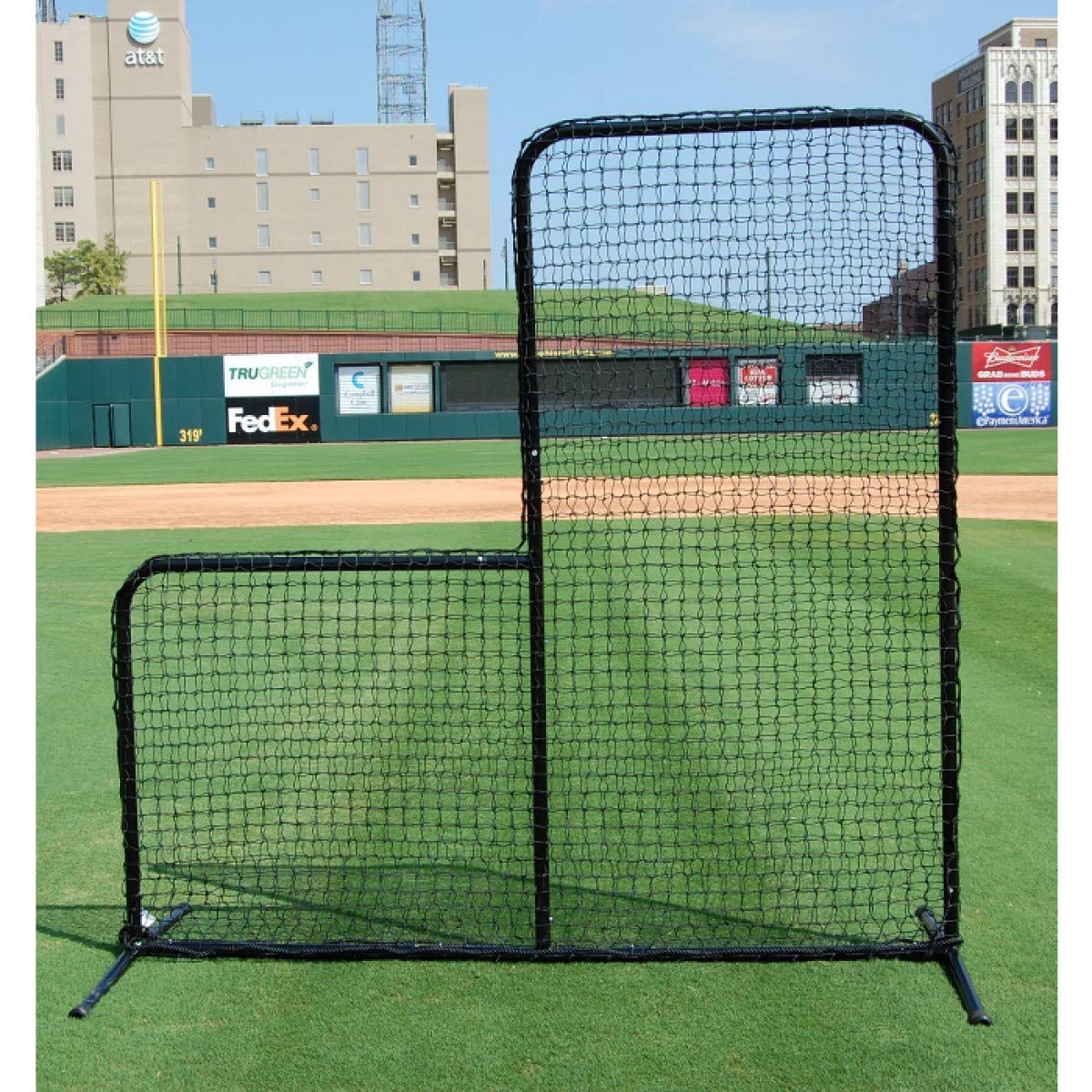
The push-button L-screen that stops hard line drives from 10 feet and still rides in a truck bed.
This Black Series L-screen pairs an 18-gauge powder-coated 1.5-inch steel frame with waterproof double-pillowcase 42 netting across a 7×7 face with a 3.5-inch cutout. The polyester netting resists breaking and UV damage, and the push-button assembly makes setup and takedown quick. Customers note it stopping hard line drives from just 10 to 12 feet away and feeling completely safe behind it, with the steel tubing praised as a solid gauge.
Quality and sturdiness are what owners praise most, with one saying they expected thin flimsy poles but found a really sturdy, high-quality L-screen with thick resilient netting. A dad puts it simply: It has saved him from doctor bills and ice packs, making the protection worth the cost.. It folds easily for lifting into a truck, making it a practical option for coaches who travel.
The mixed feedback centers on disassembly — the middle section parts are reversible, and the directions do not clarify hole orientation, so putting it together wrong makes breakdown frustrating. One owner says it takes about 10 minutes if done correctly. For a daily-training screen that balances steel rigidity with portability, this is a strong all-rounder.
Solid and portable: the steel frame stops hard line drives from close range while the push-button design folds for travel. Watch the assembly directions on the middle section.
Best if: you want a steel-framed screen that stops close-range rockets and still folds for a truck bed.
Keep looking if: you want the absolute thickest frame — the Brute’s 13.5-gauge beats this 18-gauge for raw toughness.
Understanding the Specs
Frame Gauge and Tubing Diameter
The gauge number tells you how thick the steel is, and a lower number means thicker, stronger metal. An 18-gauge frame is the everyday standard that handles regular batting practice. A 13.5-gauge frame, like the CHAMPRO Brute, is significantly tougher and resists bending from repeated high-speed contact. The tubing diameter matters too — 1.5-inch steel tubes add rigidity so the whole screen stays planted instead of wobbling on impact.
Net Ply and Treatment
The ply rating on a pitching screen net tells you how many layers of polyethylene are woven together. A 42-ply net handles standard practice, while a 45-ply or 60-ply net provides denser protection for harder hits and longer outdoor life. Look for UV treatment, which keeps the net from becoming brittle and cracking after months in the sun, and rot-proof materials if you plan to leave the screen outside between sessions.
FAQ
What is the difference between an L-screen and a Z-screen?
How much steel gauge do I need for high school batting practice?
Can I leave a pitching screen outside in the sun and rain?
What size pitching screen should I buy for a backyard cage?
Are portable fiberglass screens as safe as steel ones?
How long does assembly take for most pitching screens?
Can a pitching screen be used for softball too?
What is the best screen for a young Little Leaguer?
Final Thoughts: The Verdict
For most people, the baseball pitching screen winner is the Skywalker Sports Safety Screen because its powder-coated steel frame and UV-treated netting deliver durable protection at a value that the crowd has embraced. If you want a portable option that folds into a carry bag, grab the ACELETIQS Flexible L Screen. And for maximum impact resistance that lasts years, the CHAMPRO Brute Z-Screen with its 13.5-gauge steel frame is the one to reach for.
How We Picked
We do not accept paid placement. Every pick is matched to a real buyer and a real use-case; we do not hands-on test units.
Sources & Methodology
Specifications: manufacturer listings and product documentation. Review insights: verified customer reviews, as of August 2026. Pricing: not shown on this page (it changes often); check the current price via the retailer link.
As an Amazon Associate, Gadgets Feed earns from qualifying purchases. This does not affect which products we feature.