
You step into the cage, take your load, and rip the hardest swing of your life. The ball screams off the barrel. But three practice sessions later, you have no data to prove that swing ever happened. That’s the core problem with old-school baseball training: you’re working entirely on feel, with zero objective feedback on the one metric that actually matters at the plate.
I’m Min — the co-founder and writer behind Gadgets Feed. I’ve spent hundreds of hours dissecting the technical specs of baseball swing analyzers and radar guns, cross-referencing user field reports with real-world accuracy claims to separate devices that deliver actionable data from gadgets that simply display numbers.
This guide cuts through the noise to reveal the best baseball swing analyzer for every budget and skill level, whether you’re a 10U player building foundational mechanics or a collegiate hitter fine-tuning attack angle.
How To Choose The Best Baseball Swing Analyzer
Choosing the right swing analyzer starts with understanding whether you need a motion-capture sensor that attaches to the knob of the bat or a Doppler radar gun that measures ball or bat speed from a distance. Each approach delivers different data points, and the best choice depends on your training environment and what you’re trying to improve.
Sensor vs. Radar — The Core Distinction
A swing analyzer sensor, like the Blast Motion, mounts directly to the bat handle and captures 3D motion data including attack angle, vertical bat angle, and hand speed through its onboard accelerometers and gyroscopes. Radar guns, on the other hand, use Doppler technology to measure speed of the ball or bat head from a distance. Sensors give you mechanical insights; radars give you raw velocity numbers. Serious players often layer both tools.
Accuracy and Measurement Range
The reliability of a swing analyzer depends on its measurement accuracy. High-end radar devices like the Pocket Radar Ball Coach claim accuracy within ±1 mph at close range, while budget-friendly options may show a 4-5 mph variance compared to pro-grade units. Pay attention to the speed range — most baseball radar guns cover 3 to 150 mph, but some entry-level models struggle below 25 mph or above 100 mph.
Key Metrics Beyond Speed
Bat speed is only one piece of the puzzle. Attack angle (the vertical angle of the barrel at impact) and time to contact (how fast the bat gets to the hitting zone) are critical for identifying swing path inefficiencies. Vertical bat angle at load and at contact tells you if you’re getting the barrel through the zone. A sensor-based analyzer provides these metrics; a radar gun alone cannot.
Quick Comparison
On smaller screens, swipe sideways to see the full table.
| Model | Category | Best For | Key Spec | Amazon |
|---|---|---|---|---|
| Blast Motion Baseball Swing Analyzer (GEN3) | Sensor | Mechanics & swing path analysis | Attack angle & time to contact data | Amazon |
| Pocket Radar Ball Coach | Radar | Game-verified pitch velocity | ±1 mph accuracy at 4–5 ft | Amazon |
| Swing Speed Radar (Sports Sensors) | Radar | Bat speed & tempo for golfers/baseball | 40–200+ mph range, ±1% accuracy | Amazon |
| PlayAput Baseball Radar Gun (B0D1X5Q5DX) | Radar | Budget solo practice with dual displays | 3–150 mph, SS/MS modes | Amazon |
| PlayAput Baseball Radar Gun (B0C9TKPYCJ) | Radar | Travel-friendly speed tracking | 3–150 mph, handheld + tripod | Amazon |
| FITPLAY Baseball Radar Gun | Radar | Entry-level pitch & exit velo tracking | 3–150 mph, dual display | Amazon |
| TGU Baseball Radar Gun (Hands-Free) | Radar | Ultra-portable multi-sport speed | 3–150 mph, voice notification | Amazon |
In‑Depth Reviews
1. Blast Motion Baseball Swing Analyzer (GEN3)
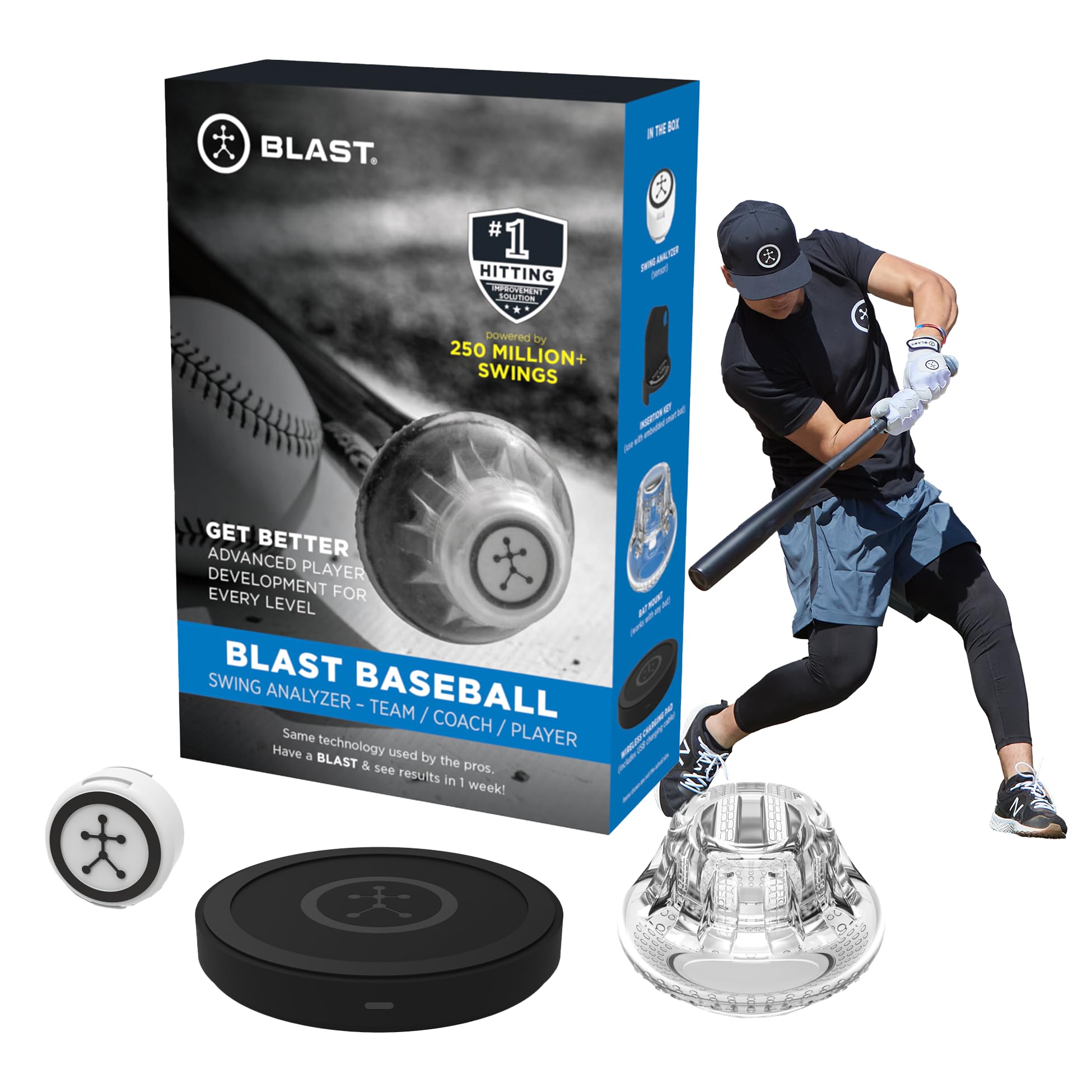
The Blast Motion sensor is the gold standard for swing path analysis. Attaching directly to the knob of the bat, it captures six key metrics — bat speed, peak hand speed, attack angle, vertical bat angle, time to contact, and power — through its triaxial accelerometer and gyroscope. You get a 3D swing tracer that replays your barrel path from any angle, which is indispensable for identifying a steep attack angle or a long time-to-contact number that signals a slow bat through the zone.
After setup through the Blast Baseball app, you can train with Air Swings mode anywhere, no ball required, and the app auto-clips video of your hitting sessions for side-by-side analysis. Real-world reviews confirm that consistent use can produce measurable improvements — one verified buyer reported a 30-point BA jump in two weeks by tracking swing data and adjusting daily. The sensor requires no calibration and sends metrics to your phone within seconds of each swing.
The major drawback is the subscription model that rolled out mid-2025. A free tier still offers some metrics, but advanced features like attack angle and time to contact now require a /year Blast Membership. For serious players and coaches who want the full mechanical picture, the annual cost is justified by the depth of data — just be aware that the device relies heavily on ongoing subscription access for its most valuable insights.
Why it’s great
- Delivers six high-fidelity swing metrics including attack angle and time to contact
- 3D swing tracer lets you visualize barrel path from any angle
- Air Swings mode enables effective practice without a ball or cage
Good to know
- Core metrics now require a /year subscription after the first free month
- Sensor attachment may not fit all bat knob shapes perfectly
2. Pocket Radar Ball Coach

The Pocket Radar Ball Coach is a purpose-built Doppler radar that measures the fastest speed of a ball in flight, designed for baseball, softball, tennis, hockey, and cricket. It weighs just 4 ounces and fits in your palm, making it the most portable radar option for on-field velocity verification. Its accuracy is what separates it from cheaper alternatives — when placed within 4 to 5 feet of the ball’s flight path and aligned for a direct line-of-sight, it consistently matches game readings within ±1 mph.
Verified coaches report using it to confirm pitch velocity at tryouts and to measure change-up speed differential during bullpen sessions. The unit comes with a wrist strap and quick-start guide, and supports continuous mode when mounted on a tripod for solo pitching practice. Unlike the Smart Coach model, this version is not compatible with the Pocket Radar app, so it functions purely as a stand-alone display-only device.
For the premium price, you get exceptional build quality and a 2-year manufacturer’s warranty, but you lose the software layer that higher-end units offer. The radar requires a direct, unobstructed line to the ball’s path — side-angle placement or distance beyond 10 feet will cause missed readings. It also lacks text-to-speech, so you have to glance at the display after every pitch. For a coach who needs reliable, scouting-grade velocity data without frills, this is the benchmark.
Why it’s great
- Proven ±1 mph accuracy when positioned correctly within 4-5 feet
- Ultra-lightweight 4-ounce design fits in any coach bag or pocket
- Two-year manufacturer warranty backs up the premium build quality
Good to know
- Not compatible with the Pocket Radar app — no data logging or analysis
- Requires precise line-of-sight positioning for consistent readings
3. Swing Speed Radar (Sports Sensors)

The Swing Speed Radar from Sports Sensors is a 25-year veteran of the training landscape, and it earned its reputation through consistent, repeatable Doppler readings. Its speed measurement range of 40 mph to over 200 mph makes it equally suited for baseball swing speed and golf driver speed, with a stated accuracy within 1% when the sensor is placed 8 to 10 inches behind the ball and level with the ground. The Tempo Timer feature helps you groove a consistent swing rhythm by timing the duration from start to finish.
Verified user reports confirm that a 14-handicap golfer increased his clubhead speed from 88-90 mph to 98-100 mph in 90 minutes by simply slowing his tempo and focusing on the feedback. For baseball, the unit tracks bat speed effectively and can be used with any swing trainer including the Stack System, RypStick, or SuperSpeed sticks. The drawstring pouch is basic but functional for carrying to the field or range.
The sensor can occasionally miss a swing — roughly one in ten attempts according to user reviews — and false readings can occur if you take a wide, fast waggle right before the swing. The tempo timer is somewhat limited in utility compared to dedicated swing analyzers, and the device runs on 3 AA batteries (not included). It’s best suited for athletes who want a simple, battle-tested speed reference without app dependency or subscription fees.
Why it’s great
- Proven ±1% accuracy with 25 years of field validation
- Measures from 40 to 200+ mph, supporting baseball and golf training
- No subscription or app required — pure hardware feedback
Good to know
- Misses about 1 in 10 swings, requiring multiple attempts for data
- Requires 3 AA batteries and precise 8-10 inch setup distance
4. PlayAput Baseball Radar Gun (Dual Display)

The PlayAput radar gun delivers the most practical feature set at a mid-range price point. It measures from 3 mph to 150 mph with a stated accuracy of ±1 mph, and offers two measurement modes — SS mode for speeds below 25 mph (useful for entry-level youth players or soft toss) and MS mode for speeds above 25 mph. What makes this unit stand out is the dual-display system: a bright side LED display that the player can read from a distance during solo practice, and a back LCD display for a coach or partner standing behind the action.
It ships with a metal tripod, which adds real stability compared to budget units that include plastic stands. The speed recall feature stores the last ten measurements, so you can review a full batting practice session without writing numbers down. Users consistently note that the red LED is easily readable in sunlight, and the voice notification — while not the loudest on the market — provides enough audio feedback at 10-15 feet to keep your eyes on the ball.
The plastic mount attachment point is the weakest link here. Several reviewers reported that the mounting bracket broke after a few months of regular use, though the metal tripod itself held up. Accuracy is consistently described as within a couple mph of higher-end units when used head-on from close range, but side-angle readings and longer distances (10+ feet) degrade reliability. For a family with multiple young players doing backyard practice, the value proposition is hard to beat.
Why it’s great
- Dual LED and LCD displays enable simultaneous player and coach feedback
- Includes a stable metal tripod for hands-free solo training
- Speed recall stores up to ten readings per session
Good to know
- Plastic mounting bracket is prone to breaking with regular use
- Accuracy drops significantly beyond 10 feet or with side-angle placement
5. PlayAput Baseball Radar Gun (B0C9TKPYCJ)

This second PlayAput model shares the same core engine — 3 to 150 mph range, dual SS/MS modes, and the side LED plus back LCD display configuration — but packages it in a slightly lighter aluminum and plastic chassis. At 0.95 kg with the stand, it’s about 13% lighter than the previous PlayAput model, which makes a difference when you’re carrying gear between practice fields. The speed recall feature functions identically, storing your last ten measurements.
The included metal stand is the same tripod design, and the overall feel in hand is solid for the price tier. The LED display remains bright and clear, and the device will auto-measure without cosine effect if you aim it straight at the target. Verified reviews praise its ease of use for kids’ blitz ball field sessions and backyard practice, with multiple users noting that it tracks pitch speed, bat speed, and exit velocity depending on where you position it.
Reliability is where this unit splits opinions. Some users report spot-on readings for driving ball speeds and consistent pitch detection, while others describe it as reading only a third of the time with erratic numbers. The radar aperture appears narrow — if the ball or bat doesn’t pass through the exact center of the beam, you get no reading. For a coach who needs every pitch to register, the inconsistency will be frustrating. For a parent looking for a fun practice tool to keep kids engaged, it works well enough.
Why it’s great
- Lighter aluminum build at 0.95 kg for easier transport
- Auto-measuring with no cosine effect when aimed correctly
- Speed recall feature stores last ten hits or pitches
Good to know
- Narrow radar beam misses a significant fraction of pitches
- Accuracy is inconsistent — some users report readings off by 5-8 mph
6. FITPLAY Baseball Radar Gun

The FITPLAY radar gun enters the budget space with the same feature set as the PlayAput units — 3 to 150 mph range, dual SS/MS speed modes, and a side LED plus back LCD display. It includes a metal tripod for hands-free operation and touts the same speed recall technology that stores the last ten measurements. The one-year warranty is standard for this tier, and the brand markets it as suitable for both baseball and softball at all skill levels.
Verified buyer feedback suggests the unit works well when it works — bright display, easy to use, and functional for tracking a grandson’s pitching speed in the backyard. The tripod is functional if slightly flimsy, and the dual-display layout mirrors the other budget competitors in this range. For a beginner who just needs a number to chase during practice, the FITPLAY delivers the core experience.
The accuracy problems are more pronounced here than in the PlayAput models. Multiple reviews report that the radar picks up only about 10% of pitches, especially on breaking balls or off-speed pitches, and it fails entirely if the ball doesn’t pass through a very narrow central window. One verified user stated they resorted to using a stopwatch because the radar was so unreliable. If consistent, reliable data is your priority, this entry-level unit may leave you frustrated. It’s best viewed as a toy for casual practice rather than a serious training tool.
Why it’s great
- Bright dual displays (LED + LCD) for player and coach visibility
- Includes metal tripod for hands-free placement
- One-year warranty provides basic coverage
Good to know
- Extremely narrow radar beam misses most pitches in practice conditions
- Fails to register breaking balls and off-speed pitches consistently
7. TGU Baseball Radar Gun (Hands-Free)

The TGU radar gun is built around a unique hands-free design philosophy — it’s intended to be used by a single person without a coach or partner. The adjustable-angle housing lets you position it on the included tripod and get voice notifications that announce the reading speed aloud, so you never need to break your pitching or hitting stance to check a display. The large LED display is also bright enough to read from a distance if you prefer visual feedback.
It covers 3 to 150 mph and includes a tuning fork for verification, a silicone hammer for sensitivity adjustment, and a stylish carrying case for transport. The speed recall feature retains the last ten readings, and the unit is lightweight at 1.9 pounds. Users have successfully adapted it for disc golf (measuring throw speed through a net from behind) and hockey shot velocity, demonstrating a broader multi-sport utility than most mid-range alternatives.
The trade-off for the low entry cost is accuracy variance. Side-by-side tests against a Stalker 2 pro radar showed the TGU consistently reading 4 mph higher, and comparison with a Pocket Radar Smart Coach showed a ±4 mph variance. The voice notification is loud enough at 15 feet, but the display becomes hard to read in direct sunlight. For a young player who wants to see a number go up each session, or a multi-sport family who wants one cheap gadget for everything, it delivers — but for scouting-grade precision, you’ll need to spend more.
Why it’s great
- Voice notification enables true solo hands-free training
- Includes carrying case, tripod, tuning fork, and silicone hammer
- Works for baseball, softball, disc golf, and hockey
Good to know
- Consistently reads 4 mph higher than pro-grade radars in side-by-side tests
- Display is difficult to read in direct sunlight conditions
FAQ
Can a swing analyzer sensor measure exit velocity?
Why does my budget radar gun miss so many pitches?
Is the Blast Motion subscription worth per year?
Final Thoughts: The Verdict
For most users, the best baseball swing analyzer winner is the Blast Motion Baseball Swing Analyzer (GEN3) because it delivers the deepest swing mechanics data — attack angle, time to contact, vertical bat angle — that no radar gun can match. If you want game-verified pitch velocity with pro-grade reliability, grab the Pocket Radar Ball Coach. And for entry-level solo practice with voice feedback and multi-sport usefulness, nothing beats the TGU Hands-Free Baseball Radar Gun.