
A musty, damp smell and peeling paint are the telltale signs of efflorescence and moisture wicking through your basement walls. Ignoring it can lead to structural damage and mold that threatens your home’s air quality. The right coating stops moisture at its source, forming a barrier that blocks hydrostatic pressure from pushing water through porous concrete and masonry.
I’m Min — the co-founder and writer behind Gadgets Feed. After weeks of analyzing technical data sheets and cross-referencing customer reports on application viscosity, dry times, and pressure ratings for dozens of masonry sealers, I’ve narrowed down the top performers that actually hold a line against groundwater intrusion.
The key is finding a proven formula that can withstand up to 12 psi of hydrostatic pressure. This guide examines the top-rated solutions to help you identify the best basement waterproofing paint for lasting protection against leaks and moisture.
How To Choose The Best Basement Waterproofing Paint
The wrong choice can peel within months, wasting your labor and money. Focus on these three factors to ensure your coating bonds to the wall and resists the constant pressure of groundwater.
Understand Hydrostatic Pressure Ratings
This is the single most important spec for below-grade use. Hydrostatic pressure is the force of groundwater pushing against your foundation walls. Standard masonry paint cannot stop this pressure. A waterproofing paint must explicitly state its resistance to hydrostatic pressure, measured in pounds per square inch (psi). Look for coatings rated for 10 psi or higher — premium acrylic options like the INSL-X WaterBlock can withstand up to 12 psi, which is sufficient for most residential seepage issues.
Elastomeric vs. Penetrating vs. Membrane
For basement walls, you need a film-forming coating, not a penetrating sealer. Penetrating sealers like silane-siloxane formulas soak into the concrete to repel water from the surface, but they won’t fill hairline cracks or stop active water infiltration. Elastomeric paints and liquid rubber membranes create a thick, flexible skin that bridges small cracks and expands with the wall as temperatures shift. For walls with visible cracks, a liquid rubber membrane with high elongation (like 900%) is the superior choice.
Alkali Resistance and Breathability
Concrete and masonry are highly alkaline, with a pH that can exceed 12. A waterproofing paint must be alkali-resistant or it will chemically degrade and peel from the wall. The INSL-X WaterBlock is rated for pH up to 13 specifically for this reason. However, a coating that completely seals a wall can trap moisture vapor inside the masonry if applied incorrectly. The ideal product allows the concrete to “breathe” slightly, avoiding blistering while blocking liquid water intrusion.
Quick Comparison
On smaller screens, swipe sideways to see the full table.
| Model | Category | Best For | Key Spec | Amazon |
|---|---|---|---|---|
| INSL-X WaterBlock | Acrylic Paint | Vertical interior walls | 12 psi hydrostatic pressure | Amazon |
| AMES Blue Max | Liquid Rubber | Foundations & cracks | 900% elongation | Amazon |
| LATICRETE Hydro BAN | Liquid Membrane | Wet areas & showers | Flood-test in 2 hours | Amazon |
| MasonryDefender All Purpose | Penetrating Sealer | Brick & stone walls | Silane-siloxane formula | Amazon |
| Tufinein Rubber Sealant | Rubber Coating | Gutters & roofs | -40°F to 176°F range | Amazon |
| LUVBOATE Clear Sealant | Acrylic Coating | Touch-ups & small leaks | 70 oz coverage | Amazon |
| MasonryDefender Concrete | Penetrating Sealer | Driveways & slabs | Water beading formula | Amazon |
In‑Depth Reviews
1. INSL-X WaterBlock Acrylic Masonry Waterproofer

The INSL-X WaterBlock is a water-based acrylic masonry paint engineered specifically for vertical interior and exterior concrete walls. Its headline specification — resistance to 12 psi of hydrostatic pressure — places it in a category far above standard latex paints. This means it is designed to hold back actively seeping groundwater, not just damp air. The semi-gloss finish provides a clean, washable surface ideal for a finished basement.
Formulated with high alkali resistance up to pH 13, this paint will not chemically break down when applied to fresh concrete or cinder block. Users consistently report that two coats applied according to the label stop leaks that persisted for years through heavy rain. The included can opener and stir stick are thoughtful touches, but the real value is the proven seal. Coverage is rated at 75 to 125 square feet per gallon, making it efficient for a standard wall application.
One important note: the label specifies application only when air and surface temperatures are between 50°F and 90°F. It dries to a hard, semi-gloss finish, not a flexible membrane, so it is best suited for walls without active structural cracks. For most settled foundation walls that show only efflorescence or dampness, this is the most reliable, code-friendly option available at a mid-range price.
Why it’s great
- Rated for 12 psi hydrostatic pressure
- High alkali resistance up to pH 13
- Easy water cleanup and low odor
Good to know
- Not flexible enough for wide structural cracks
- Requires temperatures above 50°F to apply
2. AMES Blue Max White Liquid Rubber Waterproofer

When your basement walls have hairline cracks that widen and contract with the seasons, a rigid acrylic paint will fail. The AMES Blue Max is a liquid rubber waterproofer with a staggering 900% elongation rating, meaning it can stretch nearly ten times its original length before tearing. This elastomeric membrane is designed for below-grade insulated concrete foundations and actively bridges moving cracks without peeling.
The rubberized formula applies as a thick, trowelable liquid that can be brushed, rolled, or sprayed onto vertical and horizontal surfaces. Users report excellent adhesion to concrete, wood, and metal, and many have used it to seal pet-stained subfloors and shower window sills. The white finish provides a clean base coat, though it should be top-coated if exposed to direct sunlight outdoors. It is non-toxic, eco-friendly, and VOC compliant in all 50 states, making it safe for interior applications.
One key specification is the cure time: allow 24 hours between coats. The thick rubber layer requires patience, but the result is a seamless membrane that expands and contracts with the structure. For foundations with visible stress cracks or for use as an underlayment membrane, this product provides a level of flexibility that no standard masonry paint can match.
Why it’s great
- Exceptional 900% elongation bridges active cracks
- Strong adhesion to concrete, wood, and metal
- Non-toxic and VOC compliant
Good to know
- Requires a top coat for exterior UV exposure
- Full cure takes 24 hours between coats
3. LATICRETE Hydro BAN Liquid Waterproofing Membrane

LATICRETE Hydro BAN represents the professional-grade standard for liquid waterproofing. Unlike paint or simple rubber coatings, Hydro BAN is an anti-fracture membrane that can be flood-tested just two hours after application at 70°F. This rapid cure time is a game-changer for contractors and DIYers on a tight schedule. It dries to a light green finish that makes inspection easy, and it is IAPMO approved for use in wet areas.
This liquid rubber formula requires no fabric reinforcement for gaps of 1/8 inch or less, simplifying application significantly. Users — including a 30-year general contractor — consistently rank it above competing membranes like RedGard and Aquadefense for ease of application and sheer performance. It applies like thick paint with a brush or roller, cleans up with water, and forms a durable rubber mat that tile mortar grabs aggressively. Coverage is excellent; a single gallon provides enough material for two thick coats on a standard 3×5 foot shower floor.
The trade-off is price. This is the most expensive option in the roundup, and it is engineered primarily for tile substrates and wet rooms rather than vast basement wall surfaces. However, for a basement bathroom, a pool house, or any area where absolute waterproofing is non-negotiable, Hydro BAN offers a bulletproof guarantee that cheaper paints cannot approach.
Why it’s great
- Flood-test ready in 2 hours
- Anti-fracture membrane with no fabric needed for small gaps
- IAPMO approved and professional-grade performance
Good to know
- Premium price significantly higher than other options
- Best for tile installations, not raw concrete walls
4. MasonryDefender All Purpose Brick Stone & Concrete Sealer

Not every basement leak requires a thick film. If your issue is water seeping through porous brick, sandstone, or limestone walls, a penetrating silane-siloxane sealer like the MasonryDefender All Purpose can be the correct solution. This clear formula penetrates deep into the pores of the masonry and chemically bonds to form a water-repellent barrier that allows the material to breathe — preventing trapped moisture that leads to spalling.
Users report immediate results: water beads up and rolls off treated surfaces on contact. It is easy to apply using a standard pump-up garden sprayer, and it dries quickly without altering the natural color or texture of the stone. One reviewer specifically noted that it stopped water seepage from a stone porch post through a basement ceiling. Coverage is specified at 90-150 square feet per gallon, which is competitive with other sealers.
The critical limitation is that this is a penetrating sealer, not a film-forming coating. It will not fill cracks, bridge gaps, or stop active hydrostatic pressure pushing through joints. For brick or stone walls that are structurally sound but porous, this is an excellent invisible solution. For actively leaking walls with cracks, pair this with a hydraulic cement repair first, then seal.
Why it’s great
- Invisible finish maintains natural stone appearance
- Deep penetration into brick and limestone
- Easy spray-on application with garden sprayer
Good to know
- Will not fill cracks or stop active leaks
- Requires shaking well to avoid clogs
5. TUFINEIN Rubber Liquid Waterproof Sealant

The TUFINEIN Rubber Liquid Waterproof Sealant is a neutral gray rubber coating designed for multi-surface applications where extreme temperature tolerance is required. Its operating range spans from -40°F to 176°F, making it a suitable choice for foundation walls in climates with harsh freeze-thaw cycles. The rubber compound self-levels and forms a dense membrane that is flexible enough to cover small cracks and gaps.
Users have applied it successfully to concrete fountain bowls, cracked rubberized porch floors, and metal roofs. The self-leveling property makes it easy to work with using a brush, roller, or spatula. It dries to a battleship gray color that is neutral enough for most industrial and utility spaces. The initial film forms in 2-4 hours, which is faster than many other rubber coatings, and it resists aging and cracking effectively.
However, this product is not intended for walking surfaces due to surface tackiness when fully cured. It also has a strong odor that requires good ventilation during application. The bucket is smaller than it appears in product photos, and the thick consistency can attract dust and debris during drying. For vertical basement walls where a flexible, weather-resistant membrane is needed, it performs well, but it is better suited for exterior foundation work and roof repairs.
Why it’s great
- Extreme temperature tolerance from -40°F to 176°F
- Self-leveling with fast 2-4 hour film formation
- Flexible rubber membrane resists cracking
Good to know
- Not for walking surfaces; remains tacky
- Strong odor requires good ventilation
- Can attract dust during drying
6. LUVBOATE Liquid Waterproof Sealant 70oz

The LUVBOATE Liquid Waterproof Sealant offers the largest volume in the roundup — 70 ounces at a very accessible price point. This water-based acrylic formula dries clear, which makes it a versatile option for touch-ups where you want to maintain the existing look of the surface. It is designed to form a dense waterproof membrane that insulates against air and moisture, and it shows decent UV resistance for a product in this budget tier.
The sealant applies easily using the included brush, and it self-levels to penetrate small gaps and cracks. Users confirm it works as intended on metal buildings and painted surfaces in direct sun, with no deterioration after months of exposure. The clear finish is a practical advantage when sealing around window sills, pipes, or skylights where an opaque white or gray coating would look unsightly. Coverage is modest at approximately 28 square feet for the full container, which is smaller than a gallon paint.
The trade-off for the low price is that this is not a heavy-duty hydrostatic pressure barrier. It is not rated for psi resistance, and it is best used as a supplemental sealant for minor leaks, gaps, and above-grade applications rather than as a primary defense against active groundwater intrusion. For sealing the seam where the wall meets the floor, or for coating a small cinder block wall with minor dampness, it is a cost-effective solution that gets the job done without breaking the bank.
Why it’s great
- High volume (70 oz) at an economical cost
- Clear finish preserves surface appearance
- UV resistant and easy water cleanup
Good to know
- Not rated for hydrostatic pressure
- Modest coverage of 28 sq. ft. per container
- Slow cure — requires 48-72 hours
7. MasonryDefender Concrete Sealer Deep Penetrating
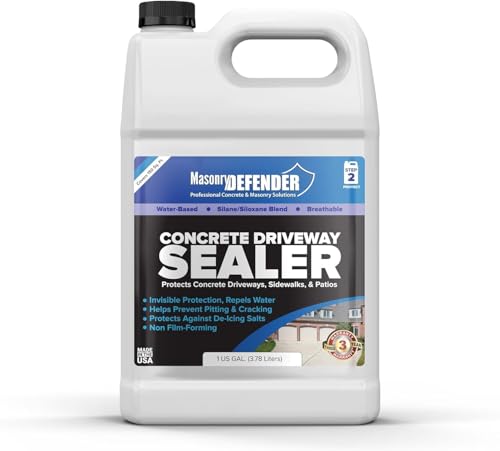
The standard MasonryDefender Concrete Sealer is a clear penetrating water repellent built on silane-siloxane chemistry. It is designed for use on driveways, sidewalks, and patios, but it can be applied to poured concrete foundation walls where the goal is to reduce water absorption rather than stop active leaks. The formula is breathable, meaning it allows moisture vapor to escape the concrete while preventing liquid water from penetrating the surface.
Users consistently praise the water-beading effect it creates — water rolls off treated concrete in perfect droplets. One reviewer noted that after three years of exposure in South Carolina, treated driveway sections still repelled dirt and mold better than untreated areas. Application is straightforward using a low-pressure garden sprayer, and the sealer dries quickly without leaving any glossy residue. Coverage is listed at 90-150 square feet per gallon.
The key limitation for basement use is that this product is not a coating — it does not build a film on the surface. It will not fill cracks, bridge gaps, or stop water from being pushed through the wall under pressure. It is best suited for above-grade concrete slabs or as a maintenance layer over an existing waterproof membrane. For raw below-grade walls with active moisture, this will not solve the problem; it is designed for prevention, not remediation.
Why it’s great
- Invisible, breathable protection for concrete
- Creates a strong water-beading effect
- Easy spray-on application with no residue
Good to know
- No film builds — will not fill cracks or stop active leaks
- Best for above-grade slabs and maintenance
- Not a solution for hydrostatic pressure
FAQ
Can I use standard latex paint instead of basement waterproofing paint?
How many coats of waterproofing paint do I need for a basement wall?
Final Thoughts: The Verdict
For most users, the best basement waterproofing paint winner is the INSL-X WaterBlock because it provides a proven 12-psi hydrostatic pressure rating at a mid-range price, making it the most reliable choice for typical vertical foundation walls. If your wall has visible structural cracks that shift with temperature, grab the AMES Blue Max for its enormous 900% elongation that bridges gaps. And for a premium, bulletproof application in a basement bathroom or wet room, nothing beats the LATICRETE Hydro BAN.