
A welder’s most expensive enemy isn’t a bad weld — it’s an argon regulator that creeps, drifts, or leaks, silently draining a bottle of shielding gas without producing a single clean bead. The difference between a porous, contaminated weld and a flawless stack of dimes often comes down to whether the ball in the flow tube stays steady at 20 CFH or bounces around like it’s on caffeine.
I’m Min — the co-founder and writer behind Gadgets Feed. This guide is built on comparing inlet thread standards, flow tube materials, needle valve precision, and brass body weights across over a hundred hours of spec analysis so you know exactly which regulator keeps your gas locked in and your puddle stable.
Whether you’re running a Miller, Hobart, Lincoln, or a no-name import, the best argon pressure regulator for your rig must hold a precise flow rate at the torch tip without gauge drift or seal failure over multiple bottle swaps.
How To Choose The Best Argon Pressure Regulator
Choosing an argon regulator is about selecting a device that can safely drop 2000+ PSI from the bottle down to a usable 15-30 CFH at the torch. A bad regulator wastes gas, ruins welds, and can even pose a safety hazard if the high-pressure seal fails. Focus on these three criteria to land the right unit for your shop.
Inlet Compatibility and Material
Every standard argon tank in North America uses a CGA-580 valve. The regulator must match this thread pattern exactly. Beyond fit, the body material matters: a machined brass body is standard, but some budget units use zinc alloy or cast brass that can crack under the stress of repeated tank changes. Look for solid brass construction and a brass stem, not plastic, on the needle valve for longevity.
Flow Meter Type and Range
You’ll choose between a traditional pressure gauge and a glass-tube flow meter with a floating ball indicator. The glass tube (or Lexan impact-resistant tube) gives a direct visual of actual gas flow and responds instantly to adjustments, while a gauge-based system measures pressure drop and is less responsive. For TIG welding, a flow range of 0-30 CFH is typical, but if you also MIG weld or use helium blends, a regulator that goes up to 50-70 CFH offers more versatility.
Valve Precision and Drift Resistance
The needle valve is the heart of the regulator. A fine-thread, knurled brass stem allows micro-adjustments to flow rate without overshooting. Some cheaper regulators use a simple ball valve or a spring-loaded stem that drifts as the tank pressure drops. A quality regulator stays locked at 20 CFH from a full tank at 2500 PSI all the way down to 200 PSI with no adjustment needed.
Quick Comparison
On smaller screens, swipe sideways to see the full table.
| Model | Category | Best For | Key Spec | Amazon |
|---|---|---|---|---|
| Victor GRF400-580 | Flowmeter | Precision TIG flow control | 5-50 SCFH Argon / Lexan tube | Amazon |
| Forney 85363 | Regulator Kit | Drop-in for Miller/Hobart | Dual-scale gauge / Brass body | Amazon |
| SPARC SP00005 | Flow Meter | Lifetime-warranty value | 0-65 CFH / Glass scale | Amazon |
| SÜA 1C008-0096_H | Combo w/Hose | Welder upgrade kits | 0-30 CFH / 5ft hose incl. | Amazon |
| ARCCAPTAIN ACR | Regulator | Budget dual-gas use | 0-30 CFH / Relief valve | Amazon |
| RX WELD SBDQG-001 | Starter Regulator | Entry-level users | 0-40 CFH / 6.6ft hose | Amazon |
| Western VN-500 | HVAC Regulator | Nitrogen purging/test | 500 PSI test / CGA-580 | Amazon |
In‑Depth Reviews
1. Victor GRF400-580 Flowmeter Regulator

Victor’s GRF400-580 is the gold standard for dedicated TIG welders who cannot tolerate flow drift. The all-brass body is paired with a high-impact Lexan flow tube that protects the precision glass meter from shop floor accidents, and the red ball indicator is highly visible even under bright welding helmets. It handles argon from 5 to 50 SCFH and helium up to 150 SCFH, making it a versatile unit for both thin-gauge TIG and heavier MIG work.
The precision needle valve is engineered to stay locked at low flows — one reviewer reported zero drift over a full year of use, verified with a secondary flow meter. Unlike cheaper units where the knob feels loose and the flow wanders, Victor’s valve uses fine threads that deliver repeatable, micro-adjustable control down to 15 CFH and below. The CGA-580 inlet includes a filter to catch debris from the tank.
The only trade-off is that this model does not include a hose; you must supply a 5/8″ UNF-18RH hose separately. Several users noted that the outlet barb requires a 1/4″ hose, not the 3/16″ found on some older welders. For professionals who value consistency and are tired of replacing disposable regulators, this is the unit that pays for itself in gas savings alone.
Why it’s great
- Lexan tube protects glass meter from breakage
- Needle valve holds flow steady across full tank pressure range
- Brass construction with built-in inlet filter improves longevity
Good to know
- Hose sold separately — no barb adapter included
- Outlet requires 1/4″ ID hose, not 3/16″
2. Forney 85363 Argon/CO2 Regulator Kit

The Forney 85363 is a direct replacement regulator for welders like the Millermatic 140 and similar entry-level MIG machines that use a standard 4mm hose outlet. The dual-scale gauge provides readout for both argon and CO2, making it equally suited for hobbyist MIG welders who switch between gas types. The gold anodized brass body is rugged and impact-resistant, with a polycarbonate lens that survives drops better than glass.
Installation is straightforward — the CGA-580 inlet includes a filter screen, and the kit comes with all necessary brass fittings except the 4mm hose adapter that is required for many older Miller and Hobart machines. Multiple reviews mention this adapter is missing from the package, though it is shown in product photography. If your welder uses a 5/8″ UNF connection, you are good to go; if it requires the smaller 4mm push-on fitting, order it separately.
The regulator holds steady flow within a 10 PSI window across a full tank cycle, though the gauge-based system is inherently less responsive than a ball-type flow meter for detecting instantaneous changes. For a shop that does light to medium-duty work and needs a reliable drop-in replacement with no hose included, the Forney delivers consistent performance at a reasonable investment.
Why it’s great
- Machined brass body with polycarbonate lens for durability
- Dual-scale gauge handles both argon and CO2 applications
- Direct replacement for many Miller and Hobart machines
Good to know
- 4mm hose adapter not included despite being shown in photos
- Gauge-based flow indication is less precise than a flow meter tube
3. SPARC Argon Regulator & Flow Meter (SP00005)
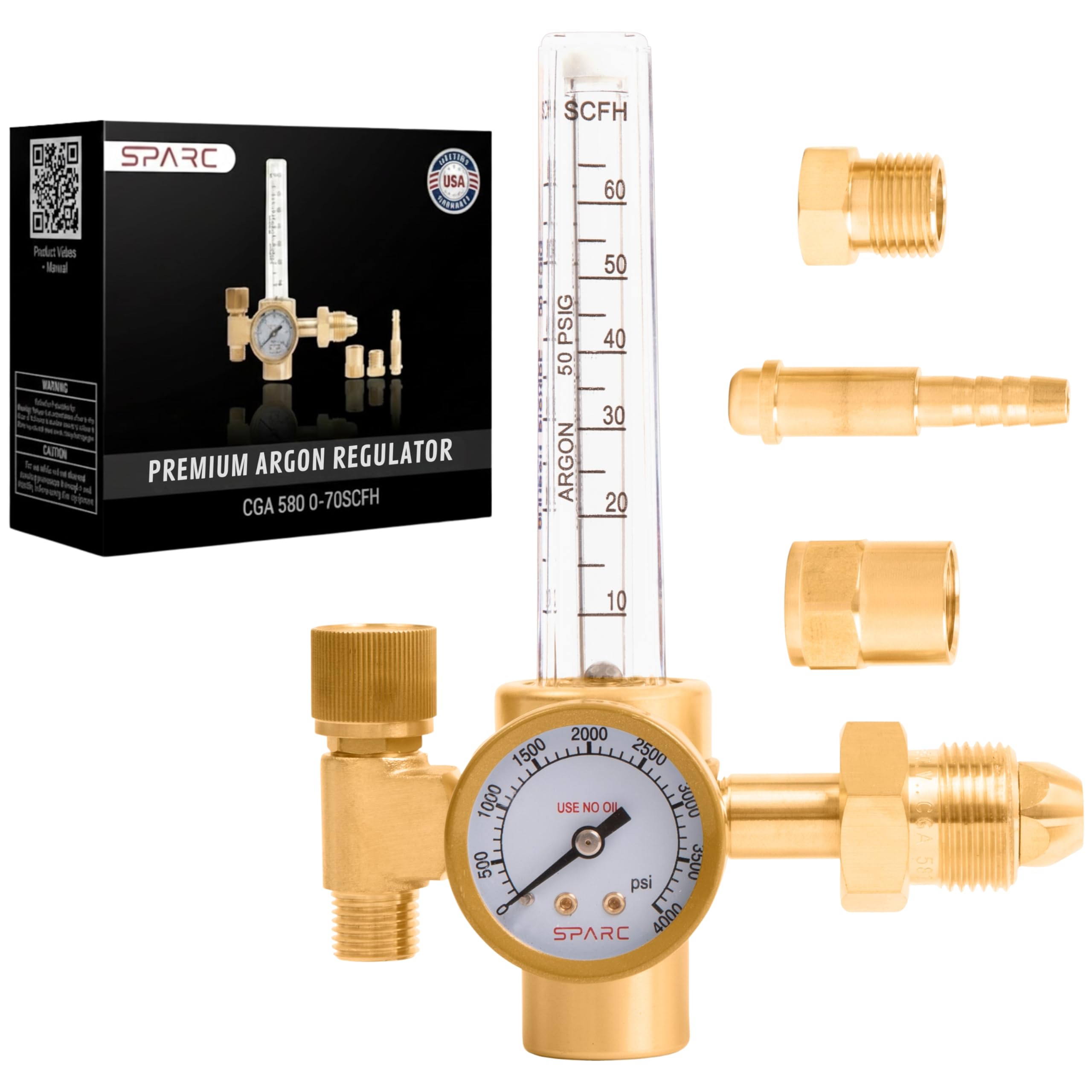
SPARC backs this argon flow meter with a no-hassle lifetime warranty — a rare confidence signal in a category where most budget regulators are considered disposable after 12 months. The unit features a glass flow tube with a ball indicator calibrated for 0-65 CFH on argon and 0-70 CFH on argon/CO2 blends. The 0-4000 PSI inlet gauge is large and easy to read without squinting.
The brass body is solid and the needle valve provides notably finer control than the handle-style valves found on typical cheap units. One reviewer swapped out the failing regulator on their MIG welder and immediately noticed the precision of flow adjustments. The outlet includes a 5/8″ UNF-18RH nut plus a barb adapter that fits both 5/16″ and 1/4″ hose, providing compatibility with most modern welders from Miller to Primeweld.
A few users noted that the outlet barb’s outer diameter (around 0.33″) was slightly too large for a 3/16″ ID hose, requiring a separate 3/16″ barb fitting for older machines. The glass scale also took a moment to calibrate visually, but this is true for any glass-tube flow meter. If you want a single-purchase solution that the manufacturer expects to last indefinitely, SPARC’s lifetime support is the differentiator.
Why it’s great
- Lifetime warranty from a US-based support team
- Needle valve offers superior precision over handle-style valves
- Wide flow range covers both MIG and TIG applications
Good to know
- Barb may be too large for 3/16″ hose without adapter
- Glass tube requires careful handling during installation
4. SÜA Industrial Argon Regulator/Flowmeter with 5ft Hose

The SÜA regulator combo is designed for welders who want a turnkey kit: the all-brass body attaches to a CGA-580 tank, and the included 5-foot hose with 5/8″-18 male fittings on both ends connects directly to most MIG and TIG machines. The clever three-way outlet adapter gives you 9/16″ male, 5/8″ female, and a hose barb in one unit, so you never need to hunt for fittings when switching between welders.
The dual-scale flow gauge reads 0-30 CFH for argon and 0-20 CFH for CO2, which covers the typical range for hobbyist TIG and light MIG work. The inlet gauge measures 0-400 PSI — this is a tank pressure gauge, not a line pressure gauge, so it tells you roughly how full your bottle is. Construction feels solid, with smooth threading on the CGA-580 nut that customers compare favorably to old Snap-on equipment.
Accuracy can vary depending on tank fullness, and the flow gauge is not as finely calibrated as a premium ball-type tube. One reviewer noted the unit still works fine after running two 80-cubic-foot tanks through it, but mentioned that the components feel slightly less premium than dedicated Victor or Harris units. For the occasional welder who wants a complete kit without sourcing a separate hose, the SÜA provides a solid, ready-to-run setup.
Why it’s great
- Complete kit with 5-foot hose and fittings included
- Three-way outlet adapter fits most welder connection types
- Solid brass construction with smooth threading
Good to know
- Gauge accuracy varies as tank pressure drops
- Components feel less refined than premium brand units
5. ARCCAPTAIN Argon CO2 Regulator (ACR)
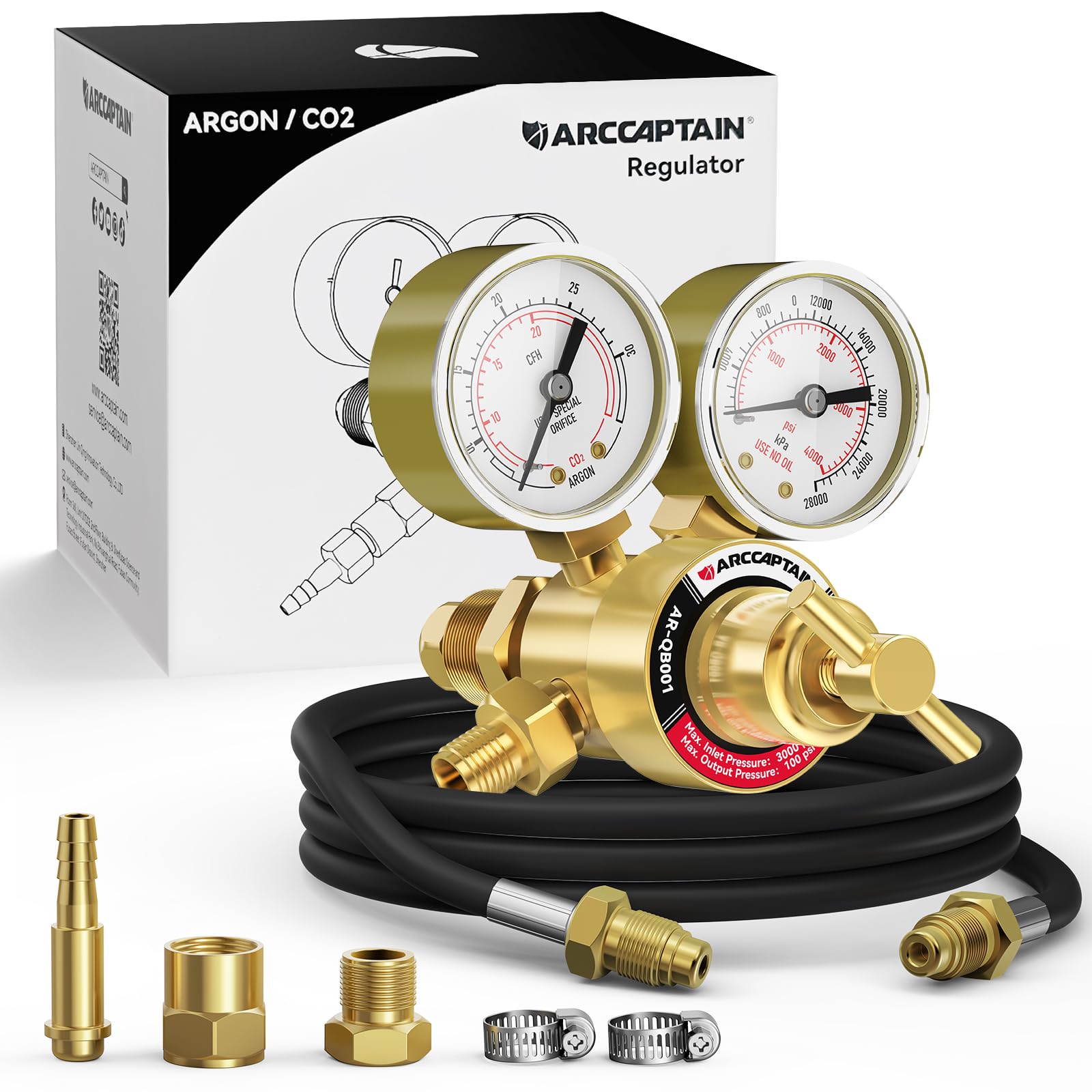
ARCCAPTAIN’s regulator is a modern entry in the budget-to-mid-range space with a thoughtful safety feature: a built-in pressure relief valve that releases excess pressure before the gauge or diaphragm can fail. The CGA-580 inlet includes a removable filter to catch rust and debris from old tanks, extending the life of the regulator. The brass body is paired with a bright, easy-to-read dual-flow scale for argon (0-30 CFH) and CO2 (0-20 CFH).
The package includes an 8.2-foot inert gas hose — longer than the standard 5-foot hose found on most combo kits — plus two hose clamps for a secure seal at the barb connection. The outlet provides three connection options: 9/16″ external, 5/8″ internal, and a 1/4″ hose barb. Installation is tool-free on the tank side, and the knurled brass needle knob turns smoothly without binding.
A small number of users reported minor cosmetic scratches on the CGA-580 face, which raised concerns about high-pressure sealing, though no functional leaks were observed. The flow scale is adequate for TIG welding but may feel limited if you need higher flow for helium blends or heavy MIG work. For the price, the ARCCAPTAIN offers a complete, safe starting package with a longer hose than its competitors.
Why it’s great
- Pressure relief valve adds a layer of safety against overpressure
- 8.2-foot hose is longer than most included hoses in this tier
- Brass body with inlet filter protects internal components
Good to know
- Flow range limited to 30 CFH — not ideal for high-flow applications
- Some reports of minor scratches on the inlet sealing surface
6. RX WELD Argon Regulator (SBDQG-001)
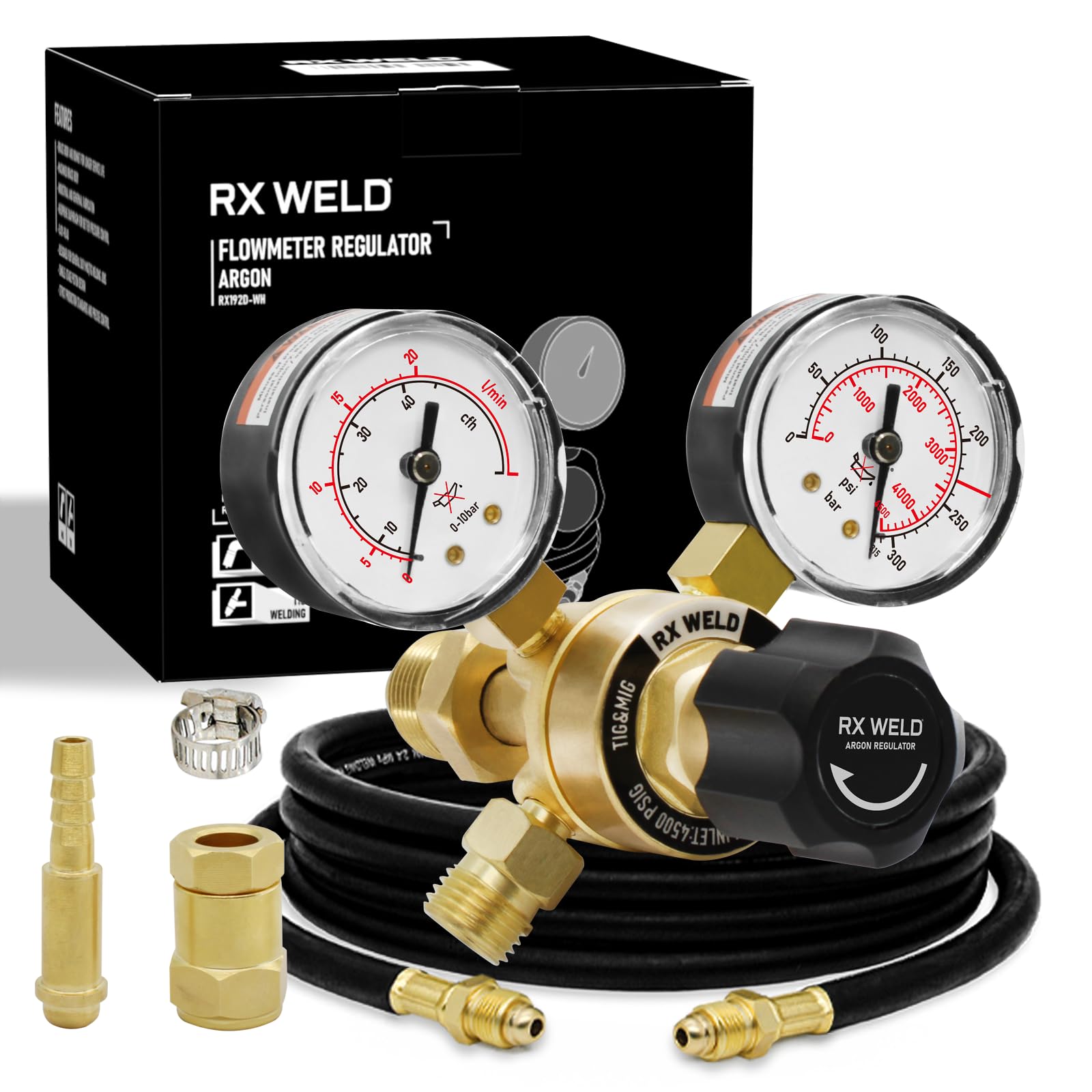
The RX WELD regulator is the most affordable option in this lineup, yet it still provides a ball-type flow meter — not a cheap gauge — for direct visual confirmation of gas flow. The CGA-580 inlet covers the standard tank connection, and the outlet offers both 9/16″ male and 5/8″ female threads, plus a hose barb. The included 6.6-foot hose is a nice bonus at this entry-level price point.
The brass body and 0-40 CFH delivery range are adequate for hobbyist TIG and light MIG work where spot-on flow accuracy is helpful but not critical. The ball indicator is easy to read and responds quickly to needle adjustments, which is a step up from pressure-gauge-only systems that lag behind actual flow changes. Users generally report the gauges are clear and the unit functions as expected out of the box.
The main long-term concern is hose durability: one Arizona user reported the hose cracked after one year of use in a hot garage, though the regulator itself continued to function fine. If you can budget for a better quality hose separately or store your rig in a temperature-controlled shop, the RX WELD is a perfectly capable starter regulator that lets you put the savings toward a better welding helmet or filler rod.
Why it’s great
- Ball-type flow meter provides direct flow visibility
- Included 6.6-foot hose gets you set up immediately
- Affordable entry point for hobbyist welding
Good to know
- Included hose prone to cracking in extreme heat within 12 months
- Overall fit and finish feels utilitarian, not premium
7. Western Enterprises VN-500 Nitrogen Test Regulator

The Western Enterprises VN-500 is a specialized hybrid regulator and flow meter combo designed for nitrogen purging and pressure testing in HVAC applications. Unlike standard welding regulators, this unit has a 500 PSI test pressure gauge for verifying system integrity after brazing, plus preset flow rates for purging and brazing atmospheres. The all-brass body is compact and rugged, built to survive daily use in truck beds and job sites.
The CGA-580 inlet is identical to argon tank threads, so this regulator works on standard inert gas bottles. The one-piece design eliminates the need to swap between a regulator and separate flow meter, saving time during every service call. HVAC professionals report using this same unit for seven years on a daily basis without failure — the needle valve remains smooth and the test gauge stays accurate.
The VN-500 is not designed for TIG or MIG welding, as its flow control range is optimized for nitrogen at higher line pressures than typical shielding gas applications. If you need a regulator for argon welding, this is not the right tool. But for any technician who does commercial HVAC or refrigeration work requiring nitrogen purging and leak testing up to 500 PSI, this is the most efficient all-in-one tool in its class.
Why it’s great
- Hybrid design saves time — no regulator-to-flowmeter swap needed
- 500 PSI test gauge built into the unit for system verification
- Brass construction proven to survive years of daily trade use
Good to know
- Designed specifically for nitrogen — not recommended for argon welding
- Higher price point suited for professional trades, not hobbyists
FAQ
Can I use an argon regulator for CO2 or nitrogen welding?
Why does my argon regulator flow rate drift downward as the tank empties?
What does the “0-400 PSI” gauge on my regulator actually show?
Should I get a flow meter or a pressure gauge style regulator for TIG welding?
Final Thoughts: The Verdict
For most users, the best argon pressure regulator winner is the Victor GRF400-580 because it combines an impact-resistant Lexan tube, a precision needle valve that eliminates drift, and the durability of an all-brass body from a trusted industrial brand. If you want the best lifetime-backed value and a flow meter that works across multiple MIG and TIG machines, grab the SPARC SP00005. And for a complete ready-to-run starter setup that includes a hose at a palatable entry price, nothing beats the RX WELD ball-type regulator.