
You found the perfect spot on the lake — a deep ledge where the bass are stacked — and then the wind cranked up, the current shifted, and your boat dragged fifty feet into the wrong zone. That drift kills the bite, and the frustration of hauling up a fouled anchor or wrestling with a system that won’t set in sand, mud, or rock turns a productive day into a chore. The right anchor system erases that pain completely, turning your boat into a stationary fishing platform that holds exactly where you drop it.
I’m Min — the co-founder and writer behind Gadgets Feed. For this guide, I combed through real-world deployment tests, analyzed holding power per pound across fluke, plow, auger, and power-pole designs, and cross-referenced hull lengths, bottom types, and retrieval mechanisms to find the systems that deliver on their promises without breaking your back or your budget.
Whether you run a 16-foot aluminum tiller or a 25-foot fiberglass bass rig, the best bass boat anchor system comes down to matching holding style, deployment speed, and weight to your specific water and boat size.
How To Choose The Best Bass Boat Anchor System
Every bass boat owner faces the same decision: do you want a traditional anchor that grabs the bottom with sheer weight and fluke design, or a shallow-water anchor that spikes into the seabed with hydraulic or electric force? The answer depends on where you fish, how fast you need to reposition, and how much space your boat has for stowage. Get these three fundamentals right and you will never chase your boat across a cove again.
Bottom Composition: Sand, Mud, or Rock
The surface below the water dictates everything. Fluke-style anchors like the Danforth series excel in sand and mud because their wide, flat flukes dig deep and create massive resistance. Auger-style anchors, like the SandShark, screw into sand or gravel and use suction to hold — ideal for sandbars where wind and wake push hard. For rocky or weedy bottoms, a plow or claw design with a narrow shank (like the Lewmar DTX) penetrates gaps and snags without skipping. Never buy a system that expects one bottom type if you fish varied water — look for models tested across sand, mud, clay, coral, and rock.
Deployment and Retrieval Speed
Bass fishing is dynamic. You move, you stop, you reposition. A traditional anchor that requires manual hauling and chain handling slows you down and can spook fish with splash noise. Electric anchor winches like the Trac Outdoors AutoDeploy give you push-button retrieval, saving your arms and your back. Shallow-water anchors such as the Power-Pole and Minn Kota Talon deploy and retract in seconds with a single remote click — no rope, no chain, no kneeling on the deck. If you fish multiple spots per hour, the speed advantage of an electric or hydraulic system justifies its cost many times over.
Boat Length and Weight Capacity
Every anchor has a recommended boat-size range printed in the specs. A 7-pound Fortress FX-11 is rated for 28-32 foot boats because its aluminum-magnesium alloy delivers disproportionate holding power. But the same anchor on a 16-foot bass boat is overkill and takes up unnecessary storage. Conversely, a lightweight PWC anchor won’t hold a 22-foot fiberglass rig in a crosswind. Match the anchor’s holding power in pounds (2,000 lbs, 3,000 lbs) to your boat’s displacement plus the wind and current forces typical for your lake. When in doubt, go one size up — a slightly heavier anchor sets faster and resists dragging better in gusty conditions.
Quick Comparison
On smaller screens, swipe sideways to see the full table.
| Model | Category | Best For | Key Spec | Amazon |
|---|---|---|---|---|
| WAVESRX TriAnchor | Folding Fluke | PWC & Small Boats | 12 lb, folding stainless steel | Amazon |
| Fortress FX-11 | Aluminum Fluke | Weight-sensitive boats | 7 lb, 28-32 ft rating | Amazon |
| Trac Outdoors AutoDeploy-G3 | Electric Winch | Push-button convenience | 40 lb capacity, 100 ft rope | Amazon |
| Danforth Standard 43 lb | Hot-Dip Galvanized | Large pontoons & bass boats | 2,000 lb holding power | Amazon |
| SandShark Ultimate XL | Auger Anchor | Sandbar & shallow water | 316 stainless steel, 39 in | Amazon |
| Lewmar DTX Stainless Steel | Plow Anchor | Versatile bottoms, showpiece | 14 lb, polished 304 SS | Amazon |
| Danforth Standard 70 lb | Heavy-Duty Fluke | Large cruisers & offshore | 3,000 lb holding power | Amazon |
| Power-Pole Sportsman II 8ft | Hydraulic Shallow Water | Quiet spot-locking | 8 ft, powder-coated finish | Amazon |
| Minn Kota Talon 10ft | Electric Shallow Water | Tech-forward anglers | 10 ft, wireless remote | Amazon |
In‑Depth Reviews
1. WAVESRX TriAnchor
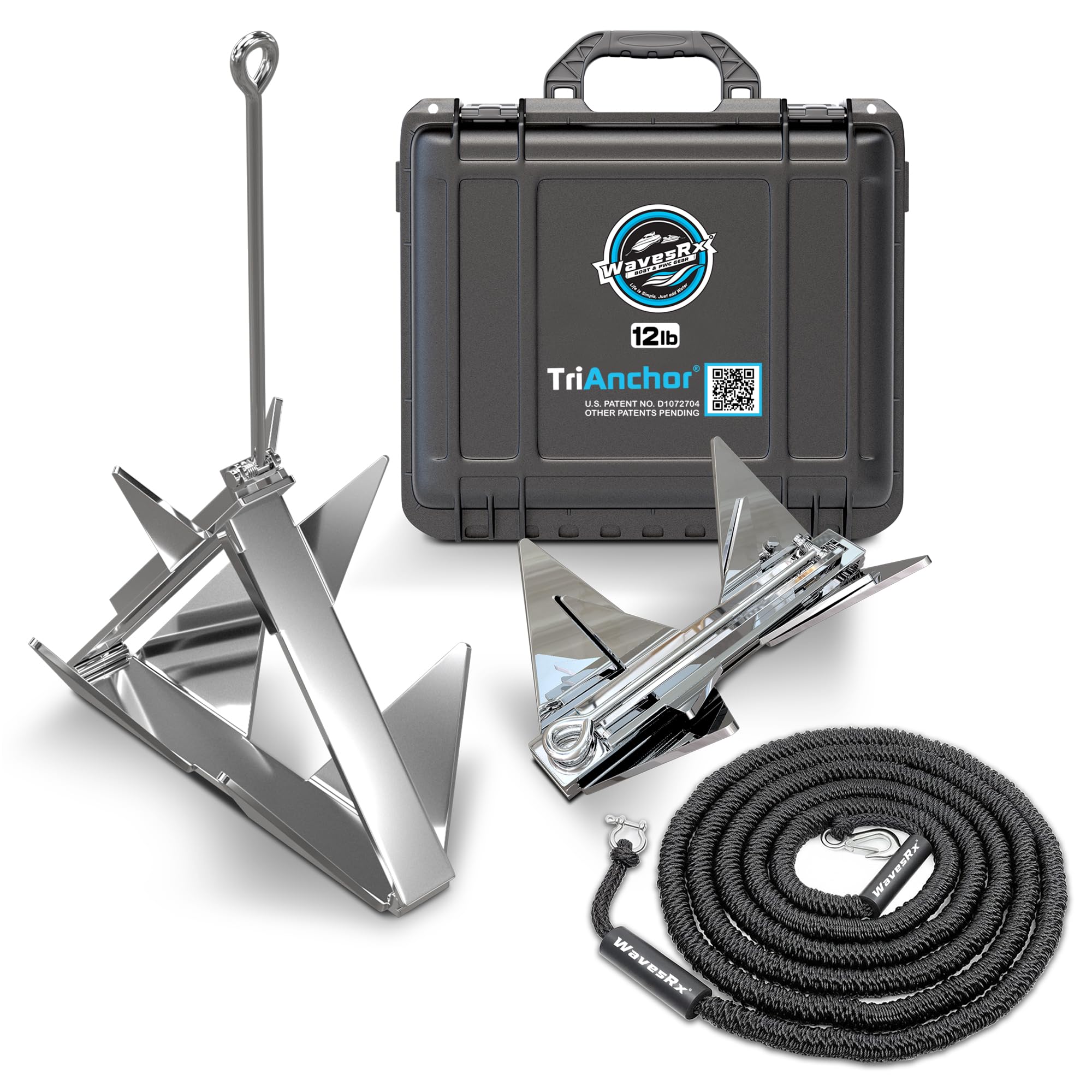
The TriAnchor solves the exact problem that drives small-boat owners crazy: traditional anchors that won’t set in varied bottoms or take up too much storage. This patented design folds flat into a 16.3 x 12.7 x 7.5 inch box, yet its three fluke arrangement grips sand, mud, clay, coral, and rock with authority. On a 25-foot Yamaha 255XD, one tester reported the TriAnchor held the boat within one foot of drift while the previous FX-7 allowed three feet of wander — a meaningful difference when you are trying to stay on a brush pile.
The included 14-foot AnchorMate bungee line stretches up to 50 feet, absorbing wake and wind gusts that normally pop a rigid rope anchor loose. The stainless steel construction resists corrosion, and the mirror-polished finish looks surprisingly good considering it is meant to dig into the bottom. At 12 pounds total with the bungee and case, it is light enough to haul by hand but heavy enough to hold a 900-pound Boston Whaler or a 24-foot deck boat in moderate chop.
Several reviewers noted the case is too small to store the full rope length, so you will likely bundle or replace the line for longer deployments. But the core anchor design — compact, instantly grabbing, self-resetting when current shifts — makes this the most versatile fluke-style option for bass boats under 25 feet that need to stow gear efficiently.
Why it’s great
- Folds nearly flat for tight PWC and small-boat storage compartments
- Bungee line prevents dislocation from wakes and wind gusts
- Sets instantly across sand, mud, clay, coral, and rocky bottoms
Good to know
- Included storage case is too small for full anchor rope length
- 12 lb model may be undersized for heavy offshore bass boats over 26 feet
2. Fortress Marine FX-11

The Fortress FX-11 is the anchor that changes the math for weight-conscious boaters. At only 7 pounds, it is built from a hardened aluminum-magnesium alloy that never rusts — unlike traditional steel fluke anchors that corrode in saltwater and leave orange stains on your deck. Fortress anchors have been rated highest in over 20 independent tests, and the U.S. Navy and Coast Guard use them. The weight-to-holding ratio is genuinely impressive: a 7-pound FX-11 holds a 6,000-pound, 25-foot competition boat firmly in soft sand when set correctly.
The fluke design digs deep and resets automatically if the wind shifts, which matters when you are anchored on a river bend with reversing current. The anchor disassembles into two flat pieces for storage — no awkward triangular shape to wedge under a seat. The 100% hassle-free lifetime warranty adds confidence, especially given the premium price tier.
Some buyers balk at the cost relative to steel anchors, but the corrosion resistance alone pays for itself when you are not replacing a rusted anchor every two seasons. The FX-11 is the right choice for bass boat owners who want a permanent, lightweight solution for sand and mud bottoms without sacrificing holding power.
Why it’s great
- Rustproof aluminum-magnesium alloy eliminates corrosion worries
- Over 20 independent tests rank it highest in holding power per pound
- Disassembles for flat storage, ideal for confined compartments
Good to know
- Premium price tier compared to steel anchors of similar size
- Requires correct setting technique for maximum holding in soft sand
3. Trac Outdoors AutoDeploy-G3

If you are tired of hand-over-hand retrieval and want to stay seated at the console while dropping anchor, the Trac AutoDeploy-G3 converts your manual anchor into an electric winch system. The 12-volt DC all-steel gear motor draws less battery power than competing winches, and the included 100 feet of pre-wound 3/16-inch braided rope handles depths up to 30 feet easily. The wireless remote and sealed membrane UP/DOWN switch give you control from anywhere on the boat — no more running to the bow.
The winch is rated for anchors up to 40 pounds, which covers most fluke and plow anchors used on bass boats in the 18-to-24-foot range. The automatic deployment feeds rope smoothly without tangling, and the retrieval motor pulls steadily even when the anchor is buried in muck. On a 21-foot pontoon with a 15-pound anchor, one user reported the winch retracted the anchor from heavy mud without stalling — a solid test of torque.
Durability concerns appear in longer-term reviews: the spindle can fail after a year or two, and Trac’s customer service has been criticized for slow response and parts availability. Reinforcing the deck mount with a metal plate is a smart precaution. For anglers who value speed and convenience over absolute long-haul ruggedness, the AutoDeploy-G3 delivers excellent push-button anchoring at a mid-range price.
Why it’s great
- Wireless remote control for deployment and retrieval from anywhere on deck
- Handles anchors up to 40 lb with minimal battery drain
- 100 feet of pre-wound braided rope ready to use out of the box
Good to know
- Spindle and plastic components may fail after 1-2 years of heavy use
- Customer service and spare parts availability reported as inconsistent
4. Danforth Standard 43 lb Anchor

The Danforth Standard Anchor has been a fixture on bass boats and pontoons for decades because the fluke design is brutally effective in sand and mud. At 43 pounds with 2,000 pounds of holding power, this anchor is built for boats in the 25-to-35-foot range that need to stay put in strong wind and current. The hot-dip galvanized coating provides long-term corrosion resistance — not as mirror-shiny as stainless steel, but far more practical when the anchor spends its life on the bottom.
Owners report the Danforth digs in aggressively and holds a 22-foot pontoon firm during fishing sessions, even when lighter anchors dragged. The high-strength steel construction absorbs the abuse of repeated deployment on rocky or shelly bottoms without bending. The flukes pivot to fold flat, making storage manageable despite the 43-pound weight — though you will want a dedicated storage tray or cradle.
The galvanizing on newer units is thinner than vintage US-made Danforths, and the manufacturing has shifted to Asia. However, the welds are evenly laid and reviews consistently rate the quality above generic store-brand alternatives. The anchor requires a strong arm for manual retrieval — pairing it with an electric winch like the Trac AutoDeploy-G3 is a smart upgrade for larger boats.
Why it’s great
- 2,000 lb holding power with proven fluke design for sand and mud
- Hot-dip galvanized steel resists rust in freshwater and saltwater
- Pivoting flukes fold for more compact storage
Good to know
- Galvanized finish is thinner than historic US-made versions
- At 43 lb, manual retrieval is strenuous without an electric winch
5. SandShark Ultimate XL
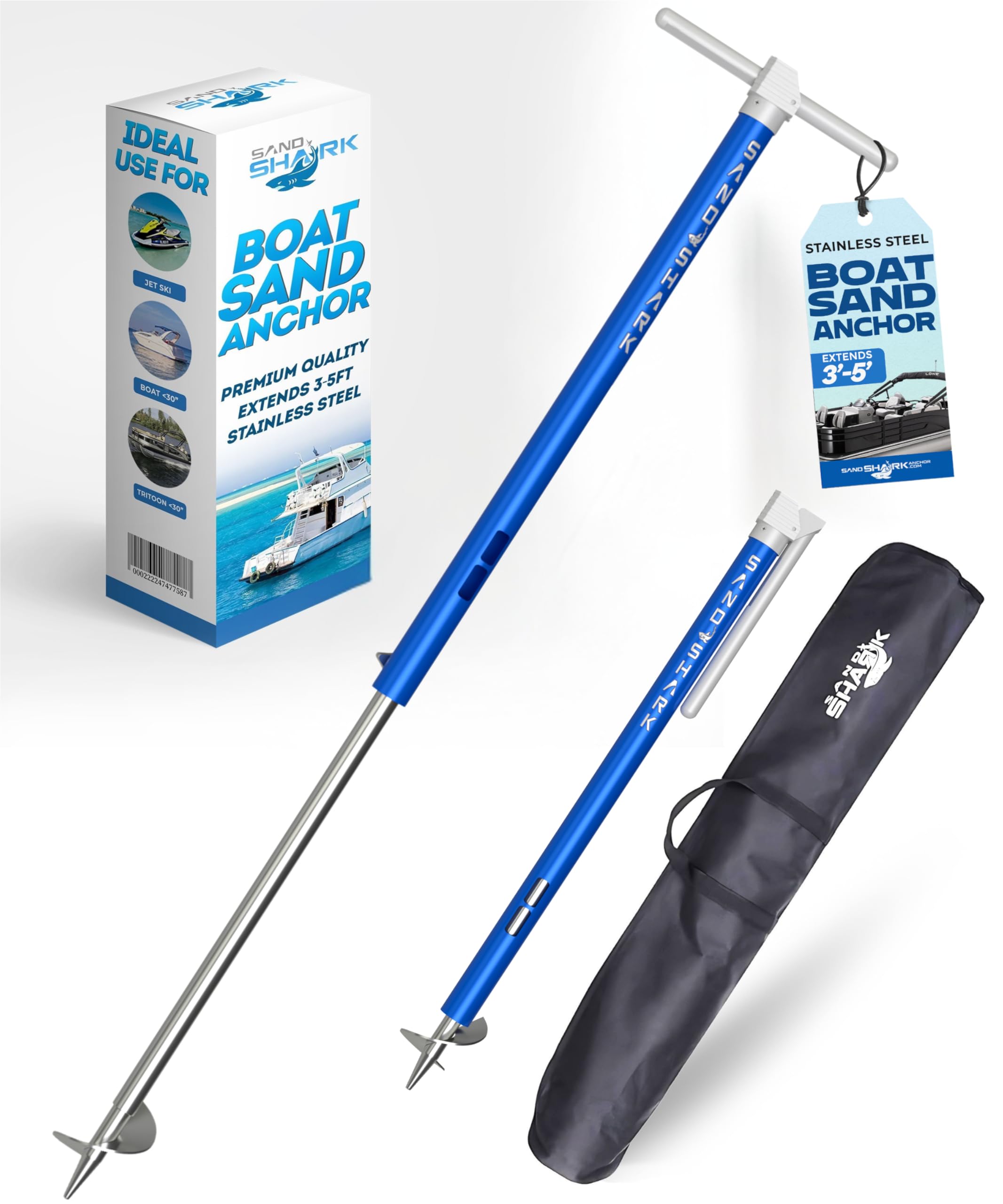
The SandShark Ultimate XL is a screw-in auger anchor purpose-built for sandbars and shallow-water anchoring — exactly the scenario where fluke anchors struggle to get a bite. The 316 stainless steel shaft threads deep into sand, and the water pressure above the auger creates suction that locks the anchor in place. On a 25-foot center console weighing 6,000 pounds, the latest 3.0 version (with a solid shaft replacing the old hollow design) held the boat securely even with current and wake action.
The hand-operated T-handle makes insertion and removal straightforward — twist it into the sand until the flukes are buried, and reverse to extract. The 39-inch length works for depths up to roughly 3 feet of water, making it ideal for beaching or anchoring at the sandbar. The included carry bag protects the fiberglass hull during transport, though one reviewer noted the bag arrived with a tear that could cause contact scratches.
Because the SandShark relies on suction rather than sheer weight, it holds better than a 40-pound fluke anchor in sand while weighing only a fraction as much. The trade-off is that it is useless in mud, clay, or rock — the auger cannot form a suction seal. For bass anglers who primarily fish sandy flats and sandbars, this anchor is a purpose-built solution that outperforms every fluke in its specific environment.
Why it’s great
- Auger design creates suction lock in sand for superior holding power
- 316 stainless steel resists corrosion better than galvanized alternatives
- Lightweight and easy to twist in and out by hand
Good to know
- Only works effectively in sand — ineffective in mud, clay, or rock
- Carry bag durability reported as inconsistent in some units
6. Lewmar Stainless Steel DTX Anchor

The Lewmar DTX is the anchor you buy when you want both performance and aesthetics. The 304 stainless steel is polished to a mirror chrome finish that complements any boat bow, and the one-piece manganese steel construction carries Lloyd’s certification for holding power per pound. The low-profile plow design sets immediately on contact with the seabed — no dragging, no waiting — and the lead ballast in the tip helps the anchor find the optimal angle for penetration.
This anchor is self-launching from a bow roller, which means you can deploy it without leaving the helm if you have a roller setup. The narrow shank drives deep into grass, rock, sand, and weeds, making it one of the most versatile designs for varied bottom compositions. At 14 pounds, it is sized for boats between 12 and 20 feet, which covers most single-console bass boats and smaller bay boats.
The primary downside is the premium cost — you are paying for the stainless steel polishing and the Lewmar brand reputation. The anchor is not intended for heavy offshore use; the 14-pound weight limits its holding capacity in severe weather. For the bass angler who wants a durable, good-looking anchor that sets fast in any bottom and stows neatly on a bow roller, the Lewmar DTX is a top-tier choice.
Why it’s great
- Mirror-polished 304 stainless steel with Lloyd’s certification
- Self-launching from bow roller for one-person deployment
- Sets immediately in grass, rock, sand, and weeds
Good to know
- 14 lb weight limits use to boats under 20 feet
- Premium pricing reflects polished finish and brand, not just raw holding power
7. Danforth Standard 70 lb Anchor
When your bass boat pushes 45 to 55 feet or you fish in a big lake with serious wind fetch, the Danforth Standard 70 lb anchor delivers 3,000 pounds of holding power. This is the anchor that large pontoons, heavy fiberglass rigs, and offshore-capable bay boats use to stay pinned in place when the whitecaps roll in. The hot-dip galvanized steel shrugs off saltwater, and the fluke design has been proven on commercial vessels for decades.
The holding power is not marketing fiction — owners routinely report this anchor holds their 26-foot pontoon firm in strong current and wind where lighter anchors dragged. The flukes penetrate deep into sand and mud, and the weight alone helps the anchor set faster. Despite its 70-pound mass, the anchor is manageable for two-person deployment and storage, especially if you use a roller or winch system.
The biggest practical consideration is handling: 70 pounds of steel is heavy to haul manually, and the large fluke footprint demands generous deck space. The galvanized finish, while durable, does not match the corrosion resistance of stainless steel — expect some surface rust if stored wet. For bass boat owners with the hull size and storage capacity to accommodate it, this anchor provides an unmatched margin of security in harsh conditions.
Why it’s great
- 3,000 lb holding power for boats up to 55 feet
- Hot-dip galvanizing provides long-term corrosion resistance
- Proven Danforth fluke design trusted by commercial operators
Good to know
- 70 lb weight is strenuous to retrieve manually without a winch
- Large fluke dimensions require ample storage space on deck
8. Power-Pole Sportsman II 8ft

The Power-Pole Sportsman II is the entry point into hydraulic shallow-water anchoring — the system that revolutionized bass fishing by letting you stop instantly and silently without a traditional anchor. The 8-foot spike deploys straight down into the bottom with a quiet hydraulic pump, locking your boat in place regardless of wind or current. The “down and away” deployment angle keeps the pole clear of your transom, and drive-off protection prevents damage if you forget to retract before moving.
Installation is straightforward for a DIY owner — one reviewer completed the job in 15 minutes using the included hardware and two remotes. The Sportsman II holds well in mud and sand bottoms, and owners report it keeps their boats stable in up to moderate current. The powder-coated finish resists corrosion, though it is not as tough as the stainless steel on higher-end models.
The main critique involves the pole durability: some users report the spike bending or breaking in moderate current on the second trip, describing it as “cheap plastic” compared to the solid steel shaft on the more expensive Power-Pole Blade. The Sportsman II is also slower and noisier than the Blade series. For anglers on a tighter budget who want the convenience of instant shallow-water anchoring, the Sportsman II delivers the core function at a lower entry point, but careful bottom awareness is required to avoid rock strikes.
Why it’s great
- Hydraulic deployment is quiet and does not spook fish
- Drive-off protection prevents pole damage if you forget to retract
- Easy installation with included hardware for DIY boat owners
Good to know
- Pole spike has reported breakage issues in moderate current or rocky bottoms
- Slower and noisier than premium Power-Pole Blade models
9. Minn Kota Talon 10ft

The Minn Kota Talon is the shallow-water anchor that sets the benchmark for speed, quietness, and integration. The 10-foot spike deploys sequentially and vertically — faster and quieter than hydraulic competitors — and the built-in work light illuminates the entire aft section with blue or white light at three brightness levels. The wireless remote gives you full control from anywhere on the boat, and optional foot switch or smartphone app control adds convenience for solo anglers.
User-selectable modes for normal, rough water, and soft bottom let the Talon adjust its holding force to the conditions. The corrosion-resistant metal construction and lifetime spike warranty mean this anchor is built to outlast the boat. On a 24.5-foot Bluwave boat with dual Talons, one owner reported holding position in up to 15 mph winds easily — a level of security that feels like a permanent dock line.
Installation is a two-person job and requires careful measurement to avoid obstructions inside the transom. The 10-foot length needs overhead clearance — it will not fit a standard 7-foot garage door opening. The cost is the highest in this guide, but the five-year manufacturer warranty and lifetime spike coverage provide long-term value. For the serious bass angler who demands instant, quiet, and reliable positioning, the Minn Kota Talon is the gold standard.
Why it’s great
- Sequential vertical deployment is quieter and faster than hydraulic systems
- Integrated work light with blue/white options and adjustable brightness
- Lifetime spike warranty and five-year manufacturer coverage
Good to know
- Requires two-person installation and careful transom clearance checks
- 10 ft spike needs overhead clearance beyond standard garage doors
FAQ
How much holding power do I need for a 20-foot bass boat?
Can I use a shallow-water anchor on a rocky lake bottom?
What is the advantage of a folding anchor for a bass boat?
Final Thoughts: The Verdict
For most bass boat owners, the best bass boat anchor system winner is the WAVESRX TriAnchor because it combines compact folding storage, instant grab across multiple bottom types, and a bungee line that absorbs wakes without dislodging — all at a weight that one person can handle easily. If you prioritize corrosion-free, lightweight performance and often fish sand or mud, grab the Fortress FX-11. And for anglers who demand instant, silent spot-locking and have the budget for premium gear, nothing beats the Minn Kota Talon 10ft.