
An inverter generator delivers a stable sine wave that protects your sensitive electronics—laptops, CPAP machines, and modern refrigerator control boards—something conventional generators simply cannot promise without risking damage. The challenge for most buyers is finding a model that provides this clean, fuel-efficient power without demanding a premium price that rivals the backup power it is meant to replace.
I’m Min — the co-founder and writer behind Gadgets Feed. I’ve spent countless hours analyzing the technical specifications, real customer experiences, and market pricing of portable inverter generators to separate the units that genuinely deliver clean, quiet power on a budget from those that will leave you stranded.
This guide ranks the models that balance starting watts, runtime, and noise output without sacrificing the inverter technology that makes them safe for your gear. These are the options that define the best budget inverter generator category for real-world use.
How To Choose The Best Budget Inverter Generator
Buying an inverter generator on a budget means making informed trade-offs between peak power, fuel type, and noise levels. Understanding which specs genuinely affect your daily use will help you avoid paying for features you do not need—or skipping the ones that matter most.
Peak vs. Running Watts
The starting watts (peak) handle the initial surge when a motor kicks on, like a refrigerator compressor or a well pump. The running watts (rated) is what the generator sustains continuously. A common mistake is buying a unit based on peak watts alone. For a budget inverter generator, prioritize a running wattage that covers 110% of your combined continuous load. If your essential load is 1500W, a generator with 1800 running watts gives you a safe margin.
Noise Output and Eco Mode
Decibel (dBA) ratings vary by distance and load. The quietest budget models hover around 52-59 dBA at 23 feet under moderate load. Eco mode adjusts engine RPM to match the load, which cuts fuel consumption and noise significantly at idle. If you are camping or using it in a residential outage, a unit under 60 dBA makes a noticeable difference in comfort. Always check THD—look for under 3%, ideally under 1.5%, to safely run laptops, TVs, and battery chargers.
Fuel Type and Runtime
Gasoline is the most common fuel source for budget models. Dual-fuel generators that also accept propane add flexibility and longer shelf life for the fuel itself, but they often reduce peak wattage by about 10% on propane. Runtime at 25% load is the standard comparison metric. A 1.1-gallon tank that runs 8-10 hours at quarter load is far more practical than a 1-gallon tank that only lasts 4 hours, especially during multi-day outages.
Quick Comparison
On smaller screens, swipe sideways to see the full table.
| Model | Category | Best For | Key Spec | Amazon |
|---|---|---|---|---|
| ERAYAK 4500W | Premium | High-power backup & RV | 4500W peak / 3500W rated | Amazon |
| Champion 2500W | Premium | Ultralight camping | 39.7 lbs / 53 dBA | Amazon |
| Westinghouse 2550W | Premium | Dual fuel & CO safety | 2550W peak / Dual Fuel | Amazon |
| Pulsar PGD40ISCO | Mid-Range | Lightweight 4000W power | 47.3 lbs / 59 dBA | Amazon |
| Aceup Energy 4000W | Mid-Range | RV AC & digital display | THD below 1.5% | Amazon |
| WEN 56360i | Mid-Range | RV use & fuel shutoff | 2900W rated / TT-30R | Amazon |
| PowerSmart 3800W | Mid-Range | Wheeled portability | 3800W peak / 52 lbs | Amazon |
| Ford FG2300IS | Mid-Range | Known brand reliability | 2300W peak / 6 hrs half load | Amazon |
| ERAYAK 2400W | Mid-Range | Quiet 2400W eco mode | 52.5 dBA / 16 hrs runtime | Amazon |
| POXURIO 2550W | Budget | Wheeled convenience | 2550W peak / 59 dBA | Amazon |
| Pulsar PG2200BiS | Budget | Dual fuel value | 2200W peak / 60 dBA | Amazon |
In‑Depth Reviews
1. ERAYAK 4500W Portable Inverter Generator

The ERAYAK 4500W delivers 3500 running watts from a 208cc engine, placing it above most competitors in this tier. The THD sits between 0.2% and 1.2%, making it safe for laptops, gaming consoles, and medical devices without any additional line conditioning. The 50A parallel-ready capability allows you to pair two units for 7000W rated output, which is rare in this price segment.
At 55 pounds, it is heavier than the 2400W models, but the integrated wheel kit and telescoping handle mitigate the weight for moving around a campsite or job site. The electric start is a welcome feature, eliminating the wrist fatigue of recoil pulling after a long day. The 1.32-gallon tank provides approximately 5 hours at half load, which is adequate for overnight use with an eco mode that trims fuel consumption at lower loads.
Real-world feedback from contractors confirms it powers demolition hammers and food truck appliances without bogging down. The inclusion of a TT-30R RV outlet and a USB-C port reflects modern device needs. The 3-year warranty and lifetime technical support add reassurance, though a few owners reported pull cord issues after extended use.
Why it’s great
- 50A parallel-ready for doubling output
- THD below 1.2% for sensitive electronics
- Electric start with eco mode
Good to know
- Heavier at 55 pounds with no wheels included
- Some units reported pull cord failure within months
2. Champion 2500W Ultralight Portable Inverter Generator

The Champion 2500W weighs 39.7 pounds, making it one of the lightest 2500-watt inverters available. The 79cc engine produces 1850 running watts and 2500 starting watts, supported by a 1.16-gallon fuel tank that delivers up to 11.5 hours of runtime at 25% load. The 53 dBA noise rating at 23 feet places it among the quietest in this category, suitable for campgrounds with strict noise ordinances.
The CO Shield carbon monoxide auto-shutoff system adds a critical safety layer for outdoor use near tents or shelters. The parallel-ready design lets you connect a second Champion 2500W for double the output. The 120V household duplex outlet (5-20R) provides clean power with less than 3% THD, verified by owners running refrigerators, chest freezers, and sensitive electronics for over 26 consecutive hours during outages.
Several owners noted the CO sensor can trigger frequent shutdowns in enclosed spaces or high-wind conditions, which may be frustrating in winter use. Starting after nine months of storage required only 1-2 pulls, suggesting good carburetor design. The included oil, funnel, and spark plug wrench add value for first-time generator owners.
Why it’s great
- Industry-leading 39.7-pound weight for portability
- CO Shield safety sensor
- 53 dBA is genuinely quiet
Good to know
- CO sensor may cause nuisance shutdowns outdoors
- Limited to 1850 running watts — not for larger RV ACs
3. Westinghouse 2550W Dual Fuel Inverter Generator

The Westinghouse 2550W runs on gasoline or propane, with 2550 peak watts on gas and a slightly derated output on LPG. The 1900 rated watts and less than 3% THD make it suitable for home essentials and RV use. The noise output dips as low as 52 dBA in eco mode, and the 1.16-gallon gas tank provides up to 12 hours of runtime at quarter load, which is impressive for a unit weighing 43 pounds.
The TT-30R outlet is ideal for direct RV hookups without an adapter, and the CO sensor adds automatic shutdown protection. The included propane hose, oil funnel, and tool kit mean you can run on either fuel out of the box. Owners report consistent two- or three-pull starts on propane, even after extended storage. The 3-year warranty covers service, labor, and parts, backed by a nationwide support network.
Some users found the supplied oil quantity insufficient for the initial fill, and the horizontal dipstick makes level checking tricky without overfilling. Several units required an AC soft start to handle RV rooftop units without tripping the breaker. The lack of an integrated hour meter makes scheduled maintenance intervals harder to track.
Why it’s great
- Dual fuel flexibility with propane hose included
- 52 dBA at eco mode for quiet camping
- TT-30R RV outlet standard
Good to know
- No built-in hour meter for maintenance tracking
- Soft start recommended for RV AC units
4. Pulsar PGD40ISCO 4000W Inverter Generator

The Pulsar PGD40ISCO packs 4000 peak watts and 3200 rated watts into a 47.3-pound frame, making it one of the lightest 4000-class inverter generators on the market. The 145cc engine and 1-gallon fuel tank deliver 4 hours of runtime at half load, which is shorter than many competitors but acceptable for intermittent backup use. The 59 dBA noise rating keeps it conversation-quiet at moderate loads.
Parallel-ready capability allows daisy-chaining two units for tripled output capacity. Owners report it handles 13,500 BTU RV AC units with a soft start and consistently starts on the first pull, even after sitting for months. The filtered inverter power is safe for sensitive electronics, confirmed by users running pellet stoves, lights, and laptops simultaneously. The white color and compact dimensions make it easy to store under an RV bunk.
Fuel consumption runs about 1 gallon per 4-6 hours under load, and some owners note the fuel cap can vapor-lock in high heat, requiring periodic cracking to relieve pressure. The unit has no wheels, so moving it on rough terrain is challenging at 47 pounds. After 410 hours across three summers, routine maintenance was limited to spark plug and air filter changes.
Why it’s great
- 47.3 pounds for a 4000W peak unit
- Proven reliability over 400+ hours of use
- First-pull start even after storage
Good to know
- 1-gallon tank limits runtime to 4 hours at half load
- Fuel cap may vapor-lock in hot conditions
5. Aceup Energy 4000W Inverter Generator
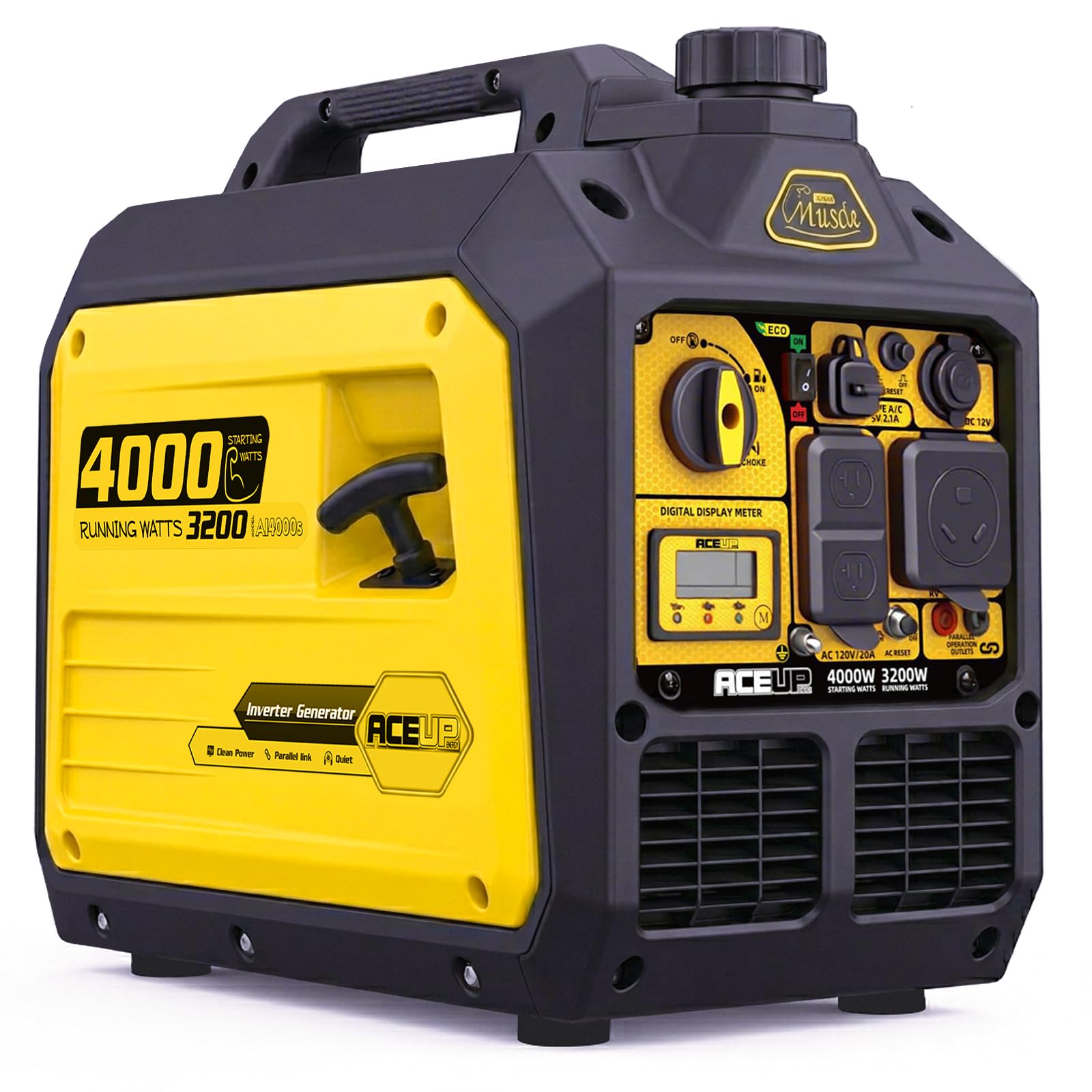
The Aceup Energy 4000W uses a 149cc 4-stroke OHV engine to produce 4000 peak watts and 3200 rated watts, with total harmonic distortion below 1.5%. This clean power parameter is superior to many mid-range competitors and makes it a strong candidate for running CPAP machines, medical equipment, and home theater systems without additional surge protection. The 1.32-gallon fuel tank provides up to 5 hours at half load.
The intelligent gauge displays voltage, runtime, fuel level, hertz, and power output—a feature typically reserved for premium units. The 5-in-1 control knob integrates fuel on/off, engine start/stop, and choke into a single motion, simplifying shutdown and reducing the risk of leaving the fuel valve open. The noise level is around 60 dBA at 23 feet in eco mode, which is comparable to a normal conversation.
Owners transitioning from a 2000W unit report the Aceup 4000W handles a 15,000 BTU RV AC and lighting without strain. The 48-pound weight is manageable for one person, though the lack of a wheel kit limits mobility. Some units showed build quality issues after three months, including unexpected shutdowns under load, though customer service promptly replaced affected units.
Why it’s great
- THD below 1.5% for medical-grade clean power
- Full digital display with voltage, hertz, and runtime
- 5-in-1 knob simplifies shutdown sequence
Good to know
- No wheels or handle for transport
- Some units reported early shutdowns under load
6. WEN 56360i 3600W Inverter Generator

The WEN 56360i generates 3600 surge watts and 2900 rated watts from a 149cc engine, with a TT-30R RV receptacle built directly into the panel. The 46-pound weight is competitive for this power class, and the fully enclosed design keeps noise levels down while protecting the engine from debris. The fuel shutoff feature runs the carburetor dry before shutdown, which extends engine life by preventing varnish buildup during storage.
The parallel-ready ports allow connecting two units for combined output. The two 120V three-prong outlets, one 12V DC receptacle, and two 5V USB ports provide flexibility for multiple devices. Owners report it runs a 13,000 BTU RV AC continuously with eco mode engaged, consuming roughly 1 gallon per 4 hours under the AC load. In cold weather (14°F), starting took 4 pulls but remained reliable.
The 3-year warranty is solid for this price tier. Some owners felt the 2900 running watts was insufficient for larger tools or multiple high-draw appliances simultaneously. The low-oil shutdown adds engine protection, but the lack of a propane option limits fuel flexibility for off-grid use.
Why it’s great
- TT-30R outlet for direct RV connection
- Fuel shutoff protects carburetor during storage
- 46 pounds with fully enclosed design
Good to know
- Not dual fuel — gasoline only
- 2900W rated may not power well pumps or large ACs
7. PowerSmart 3800W Inverter Generator
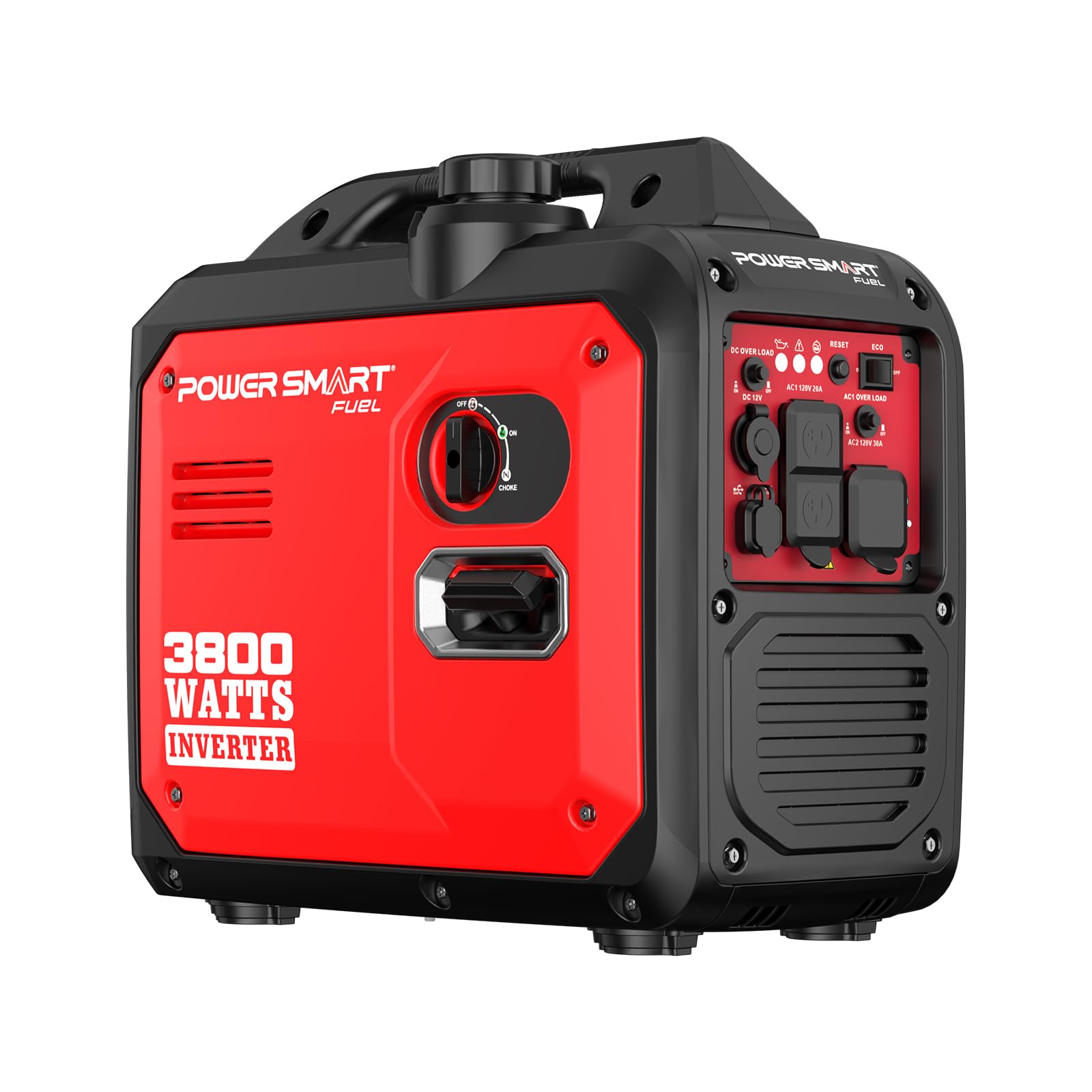
The PowerSmart 3800W delivers 3800 starting watts and 3200 rated watts from a 143cc 4-stroke OHV engine, with a 59 dBA noise rating at 23 feet. The 52-pound unit includes wheels and a handle, making it one of the most mobile options in the 3800W class. The 1.19-gallon fuel tank provides approximately 4.5 hours of runtime at 50% load, with the eco mode adjusting engine speed to save fuel during lighter loads.
The less than 3% THD ensures clean sine wave output that is safe for laptops, tablets, and cell phones. The two 120V 26.7A AC outlets accommodate larger appliances, and the parallel-ready design allows pairing two units for increased capacity. Owners report it starts easily without choke, runs two fans and two air pumps on minimal load, and is audibly quieter than comparable Predator models.
A few owners noted that the wheels work well on pavement but struggle on grass or gravel. The no-assembly-required setup is convenient, and after running continuously for over 24 hours during an outage, the unit performed without hiccups. The 2-year warranty provides basic coverage, though the manufacturer support response time varies.
Why it’s great
- Wheels and handle included for easy transport
- No choke, easy pull-start operation
- Quieter than Predator equivalents
Good to know
- Wheels struggle on soft terrain
- 1.19-gallon tank limits extended runtime at high load
8. Ford FG2300IS 2300W Inverter Generator

The Ford FG2300IS produces 2300 peak watts and 2000 running watts from an 80cc 4-stroke engine. The 1.2-gallon fuel tank provides 6 hours of runtime at half load, which is competitive for the 2000W class. The 46.3-pound weight with a compact carrying case and sturdy grip handle makes it portable, though there are no wheels. The built Ford Tough branding references the engine durability and reliability testing behind the design.
The inverter technology provides stable energy for all types of electronic devices without the voltage fluctuations common in conventional generators. The two 120V 20A outlets, one 12V 8A DC outlet, and integrated USB port cover standard device needs. Owners consistently report first-pull starts, even after sitting unused for months. The noise level is roughly one-quarter to one-third of a gas lawn mower, which translates to approximately 60 dBA at moderate load.
The recoil start requires no battery, simplifying cold-weather operation. However, maintenance access is cumbersome—removing the side panel requires removing four screws that are easy to lose, and spark plug access is tight for larger hands. The low-oil shutdown protects the engine, but the small fuel tank means refueling every 6 hours during continuous use. Propane conversion is not factory-supported, though aftermarket kits exist.
Why it’s great
- Reliable first-pull start every time
- 80cc engine is durable and proven
- 6-hour runtime at half load is solid for the size
Good to know
- No wheels; carrying case only
- Side panel screws easily lost during maintenance
9. ERAYAK 2400W Portable Inverter Generator

The ERAYAK 2400W produces 2400 peak watts and 1800 running watts from a 79.7cc 4-stroke engine, with a noise output of just 52.5 dBA at 7 meters under 25% load. This makes it one of the quietest sub-2500W inverters in the budget category, well-suited for campgrounds and residential areas where noise restrictions apply. The 42-pound weight and compact dimensions (18.82 x 11.73 x 18.11 inches) make it easy to stow in an RV compartment or truck bed.
The THD ranges from 0.2% to 1.2%, matching the premium ERAYAK 4500W unit in clean power delivery. The eco mode dynamically adjusts engine speed based on load, and at 25% load, the unit consumes only 0.21 gallons of fuel per hour, enabling a theoretical runtime of 16 hours from the 0.95-gallon tank. Owners compare its performance and noise level favorably to the Honda EU2000i at roughly half the price.
The unit includes two AC outlets, two USB ports, and a DC output, covering basic charging and appliance needs. A digital readout shows power output and runtime. Some units failed within 90 days, but customer service was responsive with replacements. The oil fill cap is small and easy to cross-thread, so careful attention during initial setup is required.
Why it’s great
- 52.5 dBA is whisper-quiet for a 2400W unit
- THD as low as 0.2% for pristine power
- 42 pounds with compact footprint
Good to know
- Small oil fill cap prone to cross-threading
- Some early failures reported within warranty period
10. POXURIO 2550W Inverter Generator
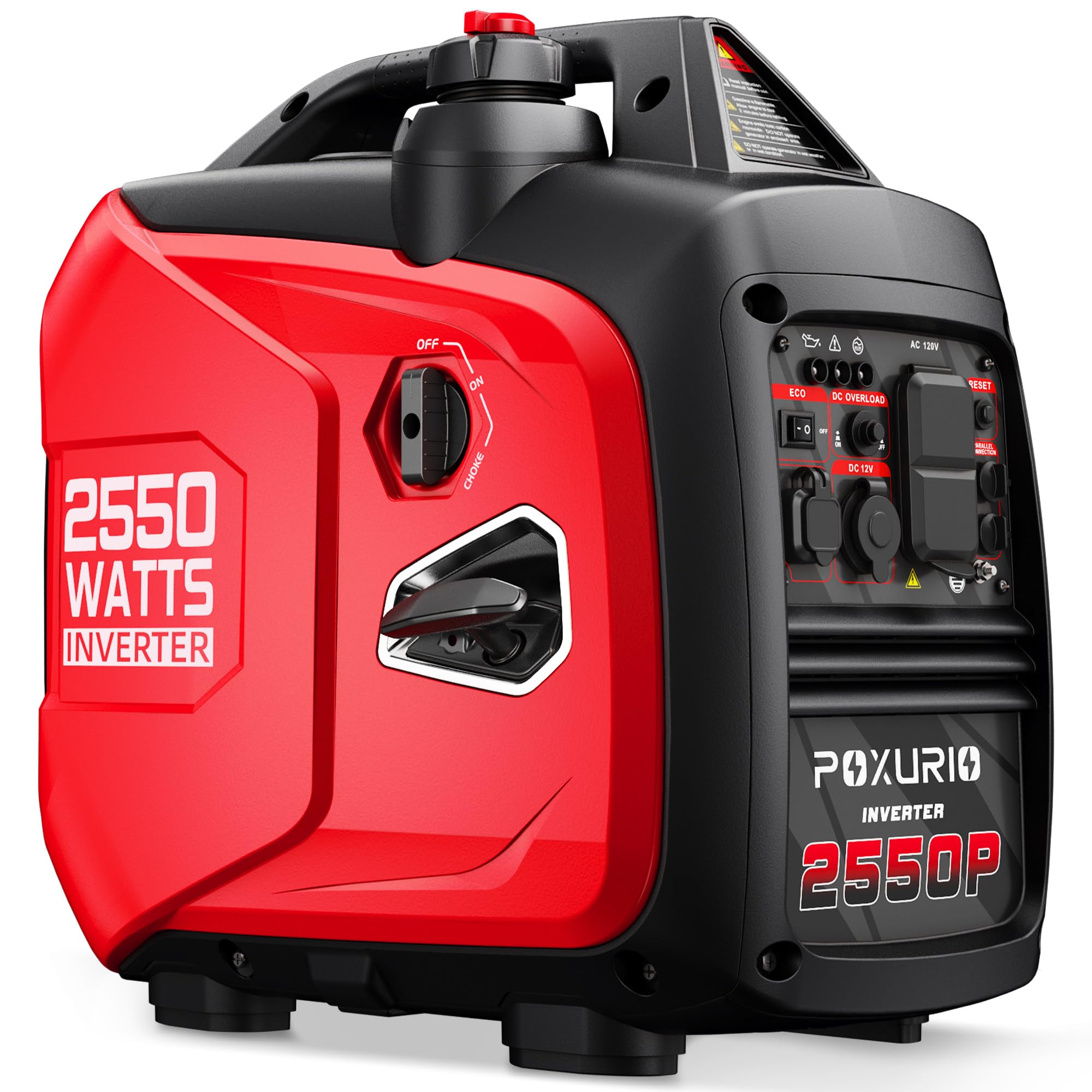
The POXURIO 2550W delivers 2550 starting watts with a 59 dBA noise rating, powered by a gasoline engine that uses a 1.06-gallon fuel tank for up to 10 hours of runtime at 25% load. The 43.9-pound unit includes strong load-bearing wheels and a carbon fiber pull rod, adding significant mobility for a budget-priced inverter. The electric start option simplifies operation for users who prefer not to pull a recoil cord.
Owners report excellent functionality for camping and basic home backup, noting the unit powers a coffee pot, TV, Starlink, and AC simultaneously in an RV. The low-oil and overload indicators provide essential protection, and the parallel-ready ports allow for future expansion. The noise level at moderate load is quiet enough for campsite use, though higher loads increase noise noticeably.
The primary complaint is the small fuel tank—roughly 1 gallon—which under heavy AC load only lasts about 3 hours before refueling. A few units arrived defective and would not start, highlighting the importance of testing immediately upon arrival. The manual lacks clarity on the break-in procedure, and oil must be drained for long-term storage, which is standard but not always obvious to new generator owners.
Why it’s great
- Wheels and handle included for easy mobility
- Electric start option for convenient operation
- 10-hour runtime at 25% load on eco mode
Good to know
- Small tank limits runtime under heavy AC load
- Quality control issues reported in some units
11. Pulsar PG2200BiS Dual Fuel Inverter Generator

The Pulsar PG2200BiS produces 2200 peak watts on gasoline (2000W on LPG) and 1800 rated watts on gas (1600W on LPG). The 80cc, 3-horsepower, 4-stroke OHV engine runs at 60 dBA, making it one of the more affordable dual-fuel inverter generators available. The 1.18-gallon fuel tank provides 8 hours of runtime at half load on gasoline, and the propane hose is included, so no separate purchase is needed for LPG operation.
The parallel capability allows daisy-chaining two units for additional power, and the clean sine wave output is safe for sensitive electronics like laptop chargers and CPAP machines. Owners report it starts reliably on gasoline in 2-3 pulls, while propane can require more pulls (4-20, depending on adaptation). The unit is lightweight and compact enough for one person to carry, making it a strong candidate for camping, jobsite backup, and recharging battery power stations.
The propane adapter diaphragm can stick if the unit sits unused, requiring a simple suck on the hose to free it. Some owners noted the eco mode causes the engine to surge at low RPM, which can be audible but not harmful. The included 10W30 oil bottle, funnel, and spark plug wrench reduce the initial setup cost, but the manual suggests charging a USB device via the port, which some users found inconsistent.
Why it’s great
- Dual fuel with propane hose included at a low entry price
- 8-hour runtime on gasoline at half load
- Parallel-ready for future expansion
Good to know
- Propane start requires more pulls and can be finicky
- Eco mode may cause audible RPM surging
FAQ
What is the difference between peak watts and running watts in an inverter generator?
How does eco mode affect fuel efficiency on a budget inverter generator?
Can I run a large RV rooftop AC on a 2500W-rated inverter generator?
Final Thoughts: The Verdict
For most users, the best budget inverter generator winner is the ERAYAK 4500W because it delivers 3500 running watts with less than 1.2% THD and 50A parallel-ready capability at a price that undercuts other 4500W inverters by a wide margin. If you want ultralight portability for camping, grab the Champion 2500W at 39.7 pounds with a 53 dBA noise floor. And for dual-fuel flexibility without sacrificing clean power, nothing beats the Westinghouse 2550W with its included propane hose and TT-30R outlet.