
That dim, flickering solar path light that barely makes it past 10 p.m. is not a fixture problem — it is a battery problem. Standard alkalines cannot handle the shallow, daily charge-and-drain cycle that solar lights demand, losing capacity fast and corroding inside the compartment within months. The right NiMH (Nickel-Metal Hydride) cell with low self-discharge (LSD) technology is the only fix that turns a six-pack of solar lights from a seasonal decoration into a reliable landscape feature that runs through the night.
I’m Min — the co-founder and writer behind Gadgets Feed. For this guide, I analyzed the mAh capacity ratings, cycle life claims, self-discharge percentages, and real-world customer discharge test data across seven solar-light battery packs, focusing specifically on the 1.2V NiMH chemistry that solar garden lights require.
Here is the definitive, spec-by-spec breakdown of the best batteries for solar lights that will keep your walkway glowing from dusk until dawn.
How To Choose The Best Batteries For Solar Lights
Solar lights are uniquely punishing on batteries. They receive a trickle charge during the day (often incomplete in winter or under shade) and must discharge completely every single night. This daily deep-cycle demands a battery with low self-discharge (LSD), high capacity retention over months of use, and the ability to withstand hundreds of cycles without losing runtime.
Capacity (mAh) — More Is Not Always Better
Solar light batteries typically range from 900 mAh to 2800 mAh. A higher mAh rating means longer runtime per charge, but capacity must match the solar panel’s daily charge output. An oversized 2800 mAh cell in a small solar stake light may never fully charge on short winter days, leaving the battery chronically under-charged and degrading its lifespan. For small path lights and string lights, 900–1200 mAh is often the sweet spot. For large flood lights or lanterns that receive full sun, 2000–2800 mAh provides all-night runtime.
Low Self-Discharge (LSD) Technology
Standard NiMH batteries lose 10–15% of their charge within 24 hours just sitting idle. LSD cells, by contrast, retain 70–85% of their charge after one year of storage. In solar lights, this matters enormously because the battery must hold whatever small charge it collected during a cloudy day and deliver it after sunset. All the premium options in this guide use LSD chemistry; budget cells without this label will let your solar lights dim after just two or three cloudy days.
Cycle Life — The Real Cost of Ownership
Cycle life describes how many times a battery can be fully charged and discharged before its capacity drops below 70%. Typical budget NiMH cells promise 400–500 cycles. Mid-range cells offer 900–1000 cycles. Premium Japanese-made cells like Eneloop are rated for 2100 cycles. A solar light battery cycles every single day, so 500 cycles is roughly 1.4 years, while 2100 cycles is nearly 6 years. The upfront cost difference is usually small, making high-cycle cells the smarter long-term investment for permanent landscape lighting.
Voltage Compatibility — 1.2V NiMH Only
Most solar garden lights are designed for 1.2V NiMH rechargeable batteries. Standard 1.5V alkaline batteries will work temporarily but cannot be recharged by the solar panel, so they die after one cycle. Lithium-ion AA cells (3.7V or 1.5V regulated) may damage the light’s internal charging circuit. Always check the existing battery’s voltage before replacing — if the original reads “NiMH 1.2V 600mAh” or similar, stay with 1.2V NiMH cells of similar or slightly higher capacity.
Quick Comparison
On smaller screens, swipe sideways to see the full table.
| Model | Category | Best For | Key Spec | Amazon |
|---|---|---|---|---|
| Eneloop Panasonic BK-3MCCA4BA | Premium | Ultimate cycle life & reliability | 2100 cycles | 2000 mAh min | Amazon |
| Amazon Basics High-Capacity 2400 mAh | Mid-Range | High capacity at low cost | 2400 mAh | 400 cycles | Amazon |
| Amazon Basics 2000 mAh Standard | Mid-Range | Reliable everyday performance | 2000 mAh | 1000 cycles | Amazon |
| Granicell 2800 mAh | Premium | Max capacity for heavy drain | 2800 mAh | 1300 cycles | Amazon |
| NICEBATT 2800 mAh | Premium | High capacity & cold weather | 2800 mAh | 1200 cycles | Amazon |
| Howardly 900 mAh | Budget | Budget-friendly replacement | 900 mAh | 900 cycles | Amazon |
| JiajaX 900 mAh | Budget | Reviving old solar fixtures | 900 mAh | 900 cycles | Amazon |
In‑Depth Reviews
1. Eneloop Panasonic BK-3MCCA4BA AA 2100 Cycle

The Eneloop white is the undisputed reference standard for LSD NiMH batteries, and for solar light owners, the 2100-cycle rating is the headline number. At one full cycle per day, that translates to nearly six years of reliable service before capacity drops significantly — more than double what most budget cells offer. Each cell delivers a guaranteed minimum 2000 mAh, and independent testing consistently shows Eneloop cells exceed this rating with tight voltage matching across the pack.
What makes Eneloop uniquely suited for solar applications is its industry-best self-discharge performance. Panasonic claims 70% charge retention after 10 years of storage; in practical solar use, this means the cells hold onto every bit of charge collected during marginal daylight hours. Temperatures down to -4°F do not phase them, making them the go-to choice for year-round landscape lighting in cold climates. The 4-pack format is small, but you can combine multiple packs without issues.
The trade-off: you pay more per cell, and 2000 mAh is modest compared to the 2800 mAh cells on the market. For large solar flood lights that need extended runtime, a higher-capacity cell may be necessary. But for path lights, string lights, and decorative garden fixtures, the Eneloop’s longevity and reliability make it the smartest long-term investment on this list.
Why it’s great
- 2100-cycle rating — lasts 5-6 years in daily solar use
- Exceptional low self-discharge holds charge through cloudy days
- Made in Japan with tight quality control and consistent cell performance
- Operates reliably down to -4°F for winter landscape lighting
Good to know
- Only 4 cells per pack — you’ll need multiple packs for a full solar setup
- 2000 mAh capacity is lower than 2800 mAh high-capacity alternatives
- Premium price per cell compared to budget options
2. Amazon Basics 16-Pack Rechargeable AA NiMH High-Capacity 2400 mAh

Amazon Basics takes the high-capacity approach seriously with this 2400 mAh NiMH cell in a 16-pack that covers an entire landscape lighting installation in one purchase. Independent capacity testing shows these cells average 2555 mAh, exceeding the rated spec, giving solar flood lights and large lanterns the extra runtime they need to stay lit until sunrise. The low self-discharge chemistry retains about 85% of its charge after five months of storage.
The catch is cycle life: Amazon Basics rates these at only 400 cycles. In daily solar use, that means about 13 months before noticeable capacity fade begins. The cells also run slightly larger than standard AAs — some users report they do not fit about 25% of tight battery compartments. For solar lights with roomy trays, this is not an issue, but it is worth checking fit on your specific fixtures before ordering.
For the price per cell, this is the highest mAh-per-dollar option available. If you are willing to replace batteries every year or two, the lower upfront cost more than compensates. For seasonal lighting displays that come out for a few months each year, this 2400 mAh pack provides massive runtime at a fraction of the cost of premium brands.
Why it’s great
- Outstanding 2400 mAh capacity — real-world tested above 2550 mAh
- 16-pack covers an entire property’s solar lights in one purchase
- Excellent value per mAh among high-capacity NiMH cells
- Low self-discharge retains 85% charge after 5 months
Good to know
- Only 400 cycles — expect replacement every 1-2 years in daily use
- Slightly oversized cells may not fit tight compartments
- Some units manufactured in China may have variable quality
3. Amazon Basics 12-Pack Rechargeable AA NiMH 2000 mAh

This standard-capacity Amazon Basics pack splits the difference between budget and premium: 2000 mAh with a 1000-cycle rating. Independent testing has confirmed these cells average 2130 mAh after activation, with a flat discharge profile that delivers consistent brightness throughout the night — no dimming after three hours. The 1000-cycle rating translates to roughly 2.7 years of daily solar use before noticeable capacity loss.
Self-discharge performance is solid but not Eneloop-class: 80% capacity retention after 2 years is the claim, which is fine for seasonal solar lights stored between seasons. The 12-pack provides enough batteries for most residential path light setups (typically 6-10 lights) plus spares. Weight consistency across the 12 cells is excellent, with 27g ±0.03g reported by testing, reducing the risk of one weak cell dragging down a string of series-connected lights.
Where this pack truly shines is cost-per-cycle. At roughly the same price as the Eneloop 4-pack, you get 12 cells — but each cell lasts 1000 cycles versus Eneloop’s 2100. The math depends on whether you prioritize lower upfront cost or longer replacement intervals. For most homeowners with a medium-sized solar lighting investment, this pack hits the value sweet spot.
Why it’s great
- 1000-cycle rating offers nearly 3 years of daily solar service
- Tested above rated capacity at 2130 mAh with flat discharge curve
- 12-pack provides full coverage for a typical landscape setup
- Excellent cell-to-cell weight consistency for balanced performance
Good to know
- 2000 mAh is less than the 2400-2800 mAh high-capacity alternatives
- Not as long-lived as Eneloop’s 2100-cycle cells
- Self-discharge is decent but not best-in-class at 80% in 2 years
4. Granicell AA Rechargeable Batteries 2800 mAh
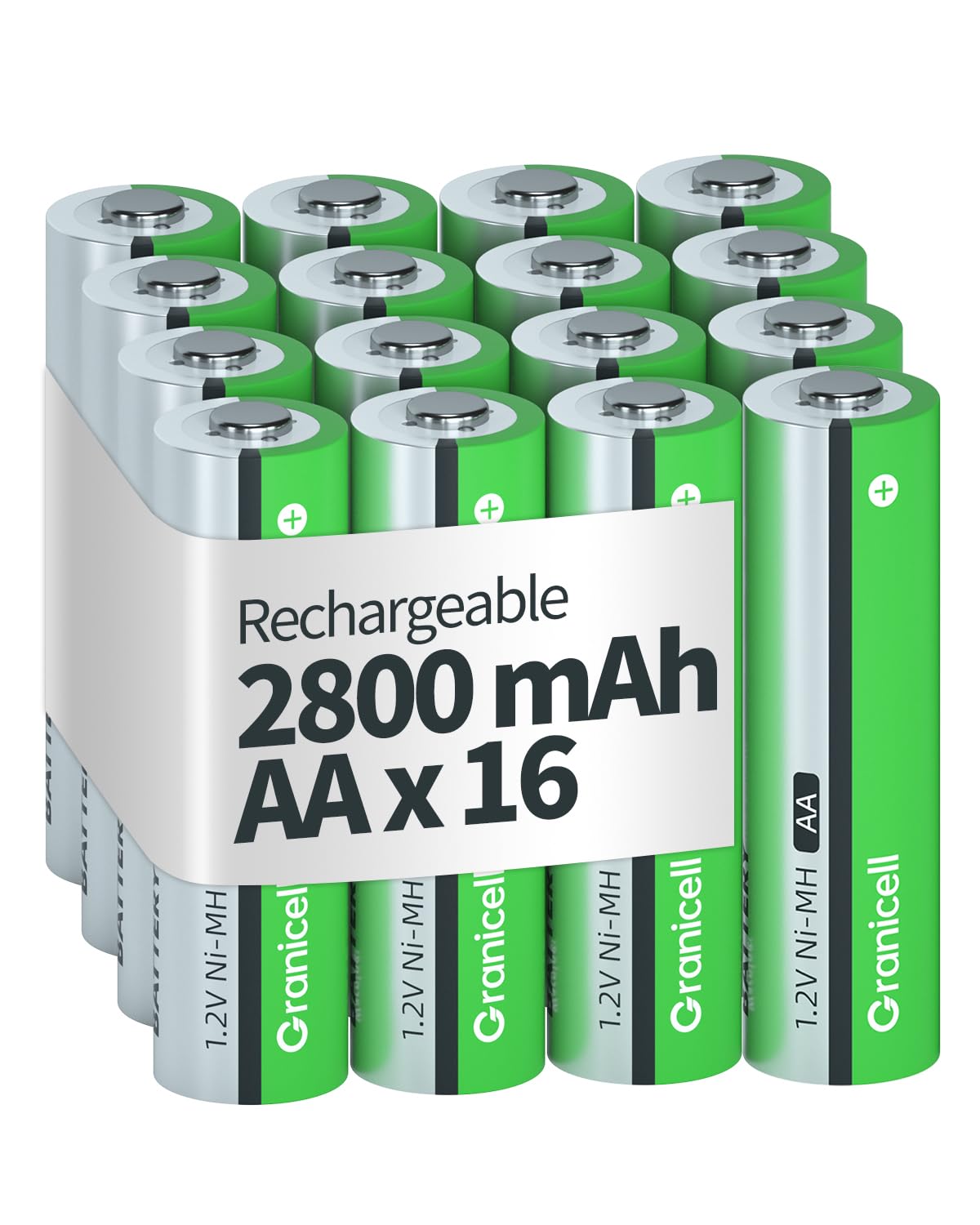
Granicell brings the highest rated capacity on this list — 2800 mAh — combined with a competitive 1300-cycle rating and LSD technology that retains 80% of charge after 3 years of non-use. For large solar flood lights, motion-sensing security lights, or decorative lanterns with bright multi-LED arrays, this capacity translates directly to hours of extra runtime. The 16-pack format is generous for big installations.
The manufacturer emphasizes safety testing, claiming six professional safety certifications for overcharge, short-circuit, and temperature protection. While the solar panel’s charging circuit provides the primary protection, cells with robust internal safety features reduce the risk of swelling or leakage over years of outdoor exposure. These cells are pre-charged using factory solar power, which aligns thematically with solar lighting applications.
Customer experiences confirm solid performance in solar fixtures, though the 2800 mAh rating is based on a low 140 mA discharge rate — under the higher drain of a bright solar light, real-world capacity may be closer to 2300-2500 mAh. This is standard behavior for NiMH cells but worth noting if you are chasing every last lumen. For most solar lights, the extra capacity headroom means the lights stay bright even on days with limited sun.
Why it’s great
- Highest rated capacity at 2800 mAh for maximal nighttime runtime
- 1300-cycle life provides over 3.5 years of daily service
- 80% charge retention after 3 years — excellent for seasonal lighting
- 16-pack covers large properties and multiple fixtures
Good to know
- Real-world capacity under load is lower than the 2800 mAh rating
- Higher capacity may not fully charge in small solar panels on short winter days
- Relatively new brand with less long-term track record than Eneloop or Amazon Basics
5. NICEBATT Rechargeable aa Batteries 16 Count 2800 mAh
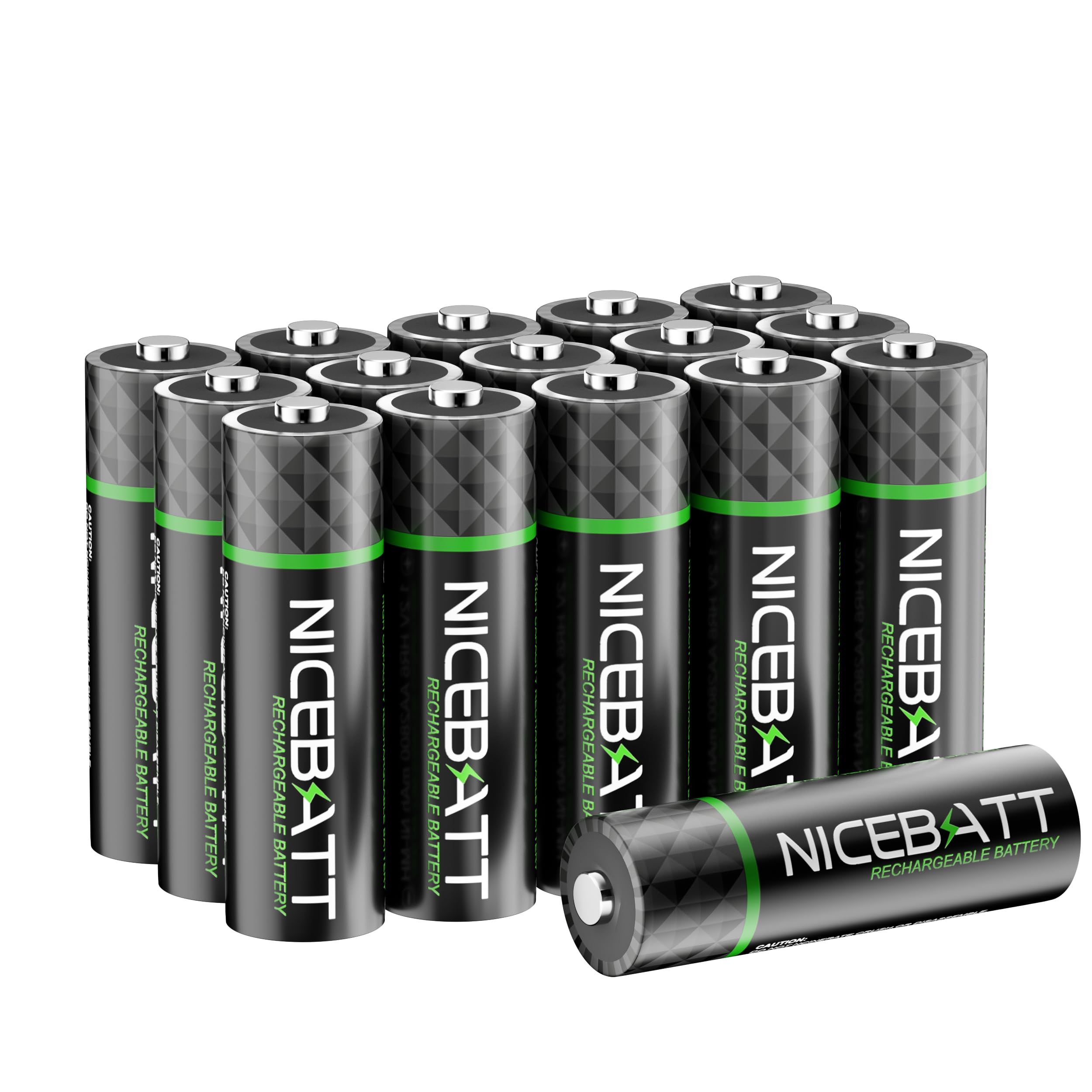
NICEBATT’s 2800 mAh cells match Granicell on rated capacity but add an extended temperature operating range from -4°F to 140°F, along with a 1200-cycle rating and 80% charge retention after 2 years. The 16-pack is ideal for homeowners who want to replace every battery in their solar lighting system at once, ensuring uniform capacity and performance across all fixtures.
Independent testing of new cells showed capacities between 2350-2400 mAh under a 500 mA load (closer to real-world solar light drain), with excellent cell-to-cell voltage matching. The cells arrived at 65-80% charge, consistent with the manufacturer’s transport safety mode. NICEBATT recommends 2-3 full charge-discharge cycles to activate the cells to their full 2800 mAh capacity, so do not judge performance on the first night.
The 1200-cycle rating means these should last approximately 3.3 years in daily solar use. The broad temperature tolerance makes them a solid choice for climates with freezing winters or scorching summers. One note: some customers report using these in VR controller and finding lasting performance in high-drain scenarios, confirming the cells are well-suited for sustained discharge across multiple device types.
Why it’s great
- 2800 mAh high capacity for extended nighttime solar operation
- Wide temperature range (-4°F to 140°F) for extreme climates
- 1200-cycle life offers over 3 years of daily use
- 16-pack allows complete system refresh in one purchase
Good to know
- Requires 2-3 activation cycles to reach full 2800 mAh capacity
- Real-world tested capacity is 2350-2400 mAh under typical load
- Arrives at 65-80% charge — charge fully before first use
6. Howardly 1.2v AA Ni-MH Rechargeable Battery 900mAh 12-Pack

The Howardly 900 mAh cells are purpose-built for solar lights, with the manufacturer specifically listing garden solar lights, lawn lamps, and string lights as their primary applications. At 900 mAh, these are lower-capacity cells designed to match the original batteries found in most budget solar path lights. Replacing a dead 600-800 mAh cell with a 900 mAh unit provides a modest runtime upgrade while ensuring the solar panel can fully recharge the battery each day.
The 900-cycle rating is respectable for a budget-oriented cell, giving roughly 2.5 years of daily service. Customers report these batteries hold charge well, with one reviewer noting lights stayed bright from 9:30 p.m. to 6 a.m. after installation.
The limitation is clear: 900 mAh is not enough for larger solar fixtures with multiple bright LEDs or security lights that need all-night coverage. For small stake lights, pathway markers, and string lights with dimmer LEDs, 900 mAh is sufficient. The cells support two charging methods — direct solar panel charging and standard NiMH charger charging — giving flexibility for off-season maintenance.
Why it’s great
- Specifically designed for solar garden lights and string lights
- 900 mAh matches the needs of small path lights and decorative fixtures
- 900-cycle life provides over 2 years of daily use
- 12-pack at a budget-friendly price point
Good to know
- Low 900 mAh capacity — not suitable for large flood lights or bright lanterns
- Arrives at 30-50% pre-charge; needs full charge before first use
- Budget brand with less rigorous quality control than premium options
7. JiajaX AA 1.2V Ni-MH Rechargeable Battery 900mAh 12-Pack

JiajaX enters the same tier as Howardly with a nearly identical product: 900 mAh NiMH cells in a 12-pack, also targeting solar garden lights, landscape lights, and lawn lamps. The 900-cycle rating matches Howardly. The difference lies in customer-reported outcomes: multiple reviews mention these cells revived 3-year-old solar lights that had become dim after their original batteries degraded, restoring them to original brightness.
One customer in the Southwestern desert reported the JiajaX cells lasted 10 months in daily use with no performance drop, experiencing triple-digit summer temperatures and occasional winter freezes. The manufacturer includes a note that the actual capacity slightly exceeds the 900 mAh label rating, allowing direct replacement of older 500-800 mAh NiCd or NiMH cells with a guaranteed improvement in runtime.
Like the Howardly pack, these are best suited for small-format solar lights. The 900 mAh capacity keeps the cells small and compatible with tight compartments. If your fixtures originally came with 600 mAh or 800 mAh cells, this 900 mAh replacement will fit and perform. For users who want to revive a set of solar lights rather than replacing the entire fixture, this 12-pack delivers the minimum viable upgrade at the lowest possible cost.
Why it’s great
- Direct replacement for aging 500-800 mAh original solar light batteries
- 900 mAh capacity restores brightness to dimmed 3-year-old fixtures
- 900-cycle life in a 12-pack at a budget-friendly price
- Actual capacity slightly exceeds label rating for mild runtime uplift
Good to know
- 900 mAh is insufficient for large flood lights or high-output lanterns
- Budget-tier build with no premium temperature or safety certifications
- May not last as many calendar years as higher-cycle premium cells
FAQ
Can I use regular alkaline batteries in solar lights?
Why do my solar lights dim after a few hours at night?
Should I buy 900 mAh or 2800 mAh cells for my solar lights?
How often should I replace batteries in my solar lights?
Can I mix different brands of NiMH batteries in my solar lights?
Final Thoughts: The Verdict
For most users, the best batteries for solar lights winner is the Eneloop Panasonic BK-3MCCA4BA because its 2100-cycle rating and best-in-class self-discharge performance deliver the lowest cost-per-year across the full lifespan of your solar lighting investment. If you want maximum nighttime runtime for large flood lights, grab the Granicell 2800 mAh 16-Pack. And for budget-conscious revival of small path lights, nothing beats the Howardly 900 mAh 12-Pack.