
Forget about battery anxiety, Bluetooth codec wars, and signal dropouts. Cable headphones deliver a physically tethered, electrically direct connection that guarantees zero latency, uncompressed audio transmission, and a level of reliability no wireless link can match. This is the domain of the purist — where the signal path is a copper wire, not a radio wave.
I’m Min — the co-founder and writer behind Gadgets Feed. I spend countless hours dissecting technical specifications, analyzing driver performance data, and comparing frequency response curves to separate genuine engineering from marketing fluff in the wired audio space.
This guide cuts through the noise to identify the best cable headphones that actually deliver measurable improvements in sound isolation, driver precision, and build integrity — rated for the user who refuses to compromise on wired fidelity.
How To Choose The Best Cable Headphones
Selecting the right wired headphones comes down to understanding your listening environment, your source equipment, and the specific sound signature you want. The wrong choice can leave you with a pair that sounds lifeless on your phone or physically uncomfortable during long sessions.
Driver Size and Type
The driver is the heart of any wired headphone. Larger drivers, typically 40mm to 53mm, can move more air and deliver deeper bass extension. Dynamic drivers are the standard, offering a punchy, natural sound. Neodymium magnets in higher-end models increase sensitivity and transient response, making drums and percussive hits sound more immediate.
Impedance and Sensitivity
Impedance, measured in ohms, determines how much power a headphone needs. Low-impedance models (16–32 ohms) work efficiently with phones and laptops. High-impedance models (150–600 ohms) require a dedicated headphone amplifier to reach proper volume levels and dynamic range. Sensitivity, measured in dB/mW, tells you how loud the headphones get per milliwatt of power — higher numbers mean easier to drive.
Closed-Back vs. Open-Back Architecture
Closed-back headphones have sealed ear cups that block external noise and prevent sound leakage, making them ideal for commuting, recording studios, and shared spaces. Open-back headphones have vented ear cups that allow air and sound to pass through, creating a wider, more spatial soundstage at the cost of zero noise isolation. Choose based on whether you need to keep your music private or prioritize imaging accuracy.
Quick Comparison
On smaller screens, swipe sideways to see the full table.
| Model | Category | Best For | Key Spec | Amazon |
|---|---|---|---|---|
| Audio-Technica ATH-M50X | Premium | Studio monitoring & critical listening | 45mm drivers, detachable cable | Amazon |
| HyperX Cloud III | Mid-Range | Competitive gaming & long sessions | 53mm drivers, DTS Spatial Audio | Amazon |
| Sennheiser HD 650 | High-End | Audiophile open-back listening | 42mm drivers, open-back design | Amazon |
| Sony MDR-M1 | Professional | Reference monitoring & production | 40mm drivers, 5 Hz–80 kHz response | Amazon |
| Audio-Technica ATH-M20x | Entry-Level | Budget studio tracking | 40mm drivers, circumaural design | Amazon |
| OneOdio Pro-10 | Budget | DJ monitoring & casual listening | 50mm drivers, 90° swivel cups | Amazon |
| AILIHEN C90 | Value | Everyday wired use & portability | 40mm drivers, nylon braided cable | Amazon |
In‑Depth Reviews
1. Audio-Technica ATH-M50X Professional Studio Monitor Headphones

The ATH-M50X is the gold standard for closed-back studio monitoring under serious listening scrutiny. Its proprietary 45mm large-aperture drivers with rare earth magnets deliver exceptional clarity across an extended frequency range, producing deep, accurate bass without muddying the midrange. The circumaural earpads seal effectively against ambient noise, making this a reliable tool for tracking and mixing in moderately loud environments.
Build quality is a cut above its price tier, featuring a metal headband reinforced with a self-adjusting mechanism that withstands daily transport. The 90-degree swiveling ear cups allow for one-ear monitoring, a practical feature for studio engineers. The included three detachable cables — a 1.2m coiled, 3m straight, and 1.2m straight — cover everything from portable use to rack-mounted gear connections.
Sonically, the M50X reveals recording imperfections with unflinching accuracy, rewarding clean source material while exposing compressed or poorly mastered tracks. The soundstage is intimate rather than expansive, typical for closed-back designs, but instrument separation remains precise. It shines brightest when paired with a quality DAC or audio interface, where its transient response tightens noticeably.
Why it’s great
- Exceptional clarity and accurate bass response from 45mm drivers
- Military-grade build with metal headband and swiveling ear cups
- Three detachable cables included for versatile connectivity
Good to know
- Soundstage is narrower than open-back designs
- Earpads wear over time and may require replacement for optimal seal
- Highly revealing nature can make poor recordings sound harsh
2. Sony MDR-M1 Professional Reference Closed Monitor Headphones

Sony’s MDR-M1 is engineered for the modern production workflow, offering ultra-wideband playback from 5 Hz to 80 kHz that captures sub-bass rumble and high-frequency air equally. The closed acoustic structure provides high isolation, critical for vocal tracking and critical mixing in untreated rooms. Its uniquely designed driver unit balances low distortion with accurate reproduction, delivering a neutral yet engaging reference sound.
At merely 216 grams, it is among the lightest professional closed-back headphones available, significantly reducing fatigue during all-day sessions. The soft, thick earpads conform to the head with moderate clamping force, creating an effective seal without excessive pressure. Two detachable cables — 1.2m with 3.5mm jack and 2.5m with 6.3mm jack — are included, and the earpads are designed for easy replacement to extend product lifespan.
The sound signature is slightly bass-emphasized compared to pure flat monitors, but it remains accurate enough for professional reference work. The soundstage is surprisingly wide for a closed-back design, with clear separation across instruments. It responds well to amplification, but even straight out of a laptop, the MDR-M1 maintains coherence and avoids the congestion typical of lesser closed-backs.
Why it’s great
- Wide frequency response captures sub-bass and ultra-high frequencies
- Extremely lightweight at 216g for fatigue-free long sessions
- High isolation with detachable cables and replaceable earpads
Good to know
- Earpads can get warm during extended use
- No carrying case included in the package
- Subtle bass emphasis may not suit purist flat-response monitoring
3. HyperX Cloud III – Wired Gaming Headset

The HyperX Cloud III is a wired gaming headset that refuses to compromise on audio integrity. Its 53mm angled drivers, tuned in-house by HyperX audio engineers, deliver a wide soundstage with precise spatial cues — essential for directional audio in competitive shooters. The angled driver orientation aligns the sound path directly into the ear canal, improving imaging accuracy over traditional flat-mounted drivers.
Comfort is the defining characteristic here, with memory foam ear cushions wrapped in premium leatherette that maintain their shape over years of use. The aluminum frame provides structural rigidity while keeping weight manageable, surviving drops and bag compression without flexing. The detachable 10mm noise-cancelling microphone captures voice clearly, with a built-in mesh filter that reduces plosive pops.
DTS Headphone:X Spatial Audio is included with a lifetime license, providing virtual 3D soundstage processing that enhances immersion without destroying frequency balance. The wired connection comes via a USB-C adapter with USB-A compatibility, plus a standard 3.5mm cable for console or mobile use. The non-removable main cable is the only minor compromise, but the overall package is a masterclass in gaming audio value.
Why it’s great
- 53mm angled drivers for precise spatial audio in games
- Memory foam ear cushions and aluminum frame for durability
- Lifetime DTS Headphone:X Spatial Audio license included
Good to know
- Main cable is non-removable from the headset
- Microphone can pick up mouse clicks in quiet rooms
- Long cord may snag on chair wheels or desk edges
4. Sennheiser HD 650 – Open Back Dynamic Headphone

The Sennheiser HD 650 is an open-back reference that has defined the audiophile mid-fi category for two decades. Its acoustic silk damping system keeps total harmonic distortion at an incredibly low 0.05%, ensuring that what you hear is the recording, not the transducer. The hand-selected matched driver elements guarantee consistent channel balance, a rarity at this tier.
The open-back design creates an expansive, three-dimensional soundstage that makes closed-back headphones sound cramped in comparison. Vocals are rendered with a warm, organic presence that the community calls the “Sennheiser veil” — a smooth, non-fatiguing top end that allows for hours of critical listening without ear strain. The 300-ohm impedance requires a dedicated amplifier to reach its full dynamic potential; driving it from a phone produces anemic volume and compressed dynamics.
Build quality prioritizes comfort over ruggedness, with a lightweight plastic frame that feels secure but not armored. The velour ear pads are generously sized and breathable, avoiding heat buildup during extended sessions. For the listener building a dedicated desktop audio chain with a DAC and headphone amp, the HD 650 remains the benchmark for natural, fatigue-free open-back sound.
Why it’s great
- Exceptionally low 0.05% THD for pure, uncolored sound
- Expansive open-back soundstage with natural vocal reproduction
- Breathable velour pads for hours of fatigue-free listening
Good to know
- 300-ohm impedance requires a dedicated headphone amplifier
- Open-back design leaks sound and offers zero noise isolation
- Plastic frame feels less premium than metal alternatives
5. Audio-Technica ATH-M20x Professional Studio Monitor Headphones

The ATH-M20x is the entry point into Audio-Technica’s professional M-Series line, offering a tuned-for-monitoring sound signature that emphasizes low-frequency performance. Its 40mm drivers with rare earth magnets and CCAW voice coils deliver punchy bass response that suits modern studio genres, though the overall balance leans slightly warm rather than clinically flat.
The circumaural earpads contour around the ears to provide solid passive isolation, adequate for blocking out computer fan noise or quiet office chatter. The single-side cable exit is a thoughtful design choice for studio use, reducing cable tangling around the desk. The build is entirely plastic, which keeps weight low but lacks the metal reinforcements found in the higher-tier M40x or M50x.
For the price, the M20x outperforms most consumer headphones under twice its cost, with a sound quality that reveals details normally masked by cheaper drivers. The long 3-meter cable is practical for studio racks but cumbersome for portable use. It is an honest, no-frills monitoring tool that delivers genuine professional-grade audio without the premium price of its siblings.
Why it’s great
- Punchy low-frequency response for monitoring modern genres
- Effective circumaural seal for passive noise isolation
- Excellent sound quality for its price tier
Good to know
- All-plastic construction lacks metal reinforcement
- Non-detachable cable limits replacement options
- Clamping force can be uncomfortable for glasses wearers
6. OneOdio Wired Over Ear Headphones Pro-10

The OneOdio Pro-10 proves that a 50mm dynamic driver can be had at a budget price without completely sacrificing sound quality. The large driver diameter moves substantial air, producing pronounced bass response that makes electronic and hip-hop tracks thump. The neodymium magnet structure keeps sensitivity high, meaning it plays loud even from low-power phone jacks.
Comfort is a strong suit, with padded ear cushions that fit generously over larger ears and a self-adjusting headband that distributes weight evenly. The 90-degree swiveling ear cups allow single-ear DJ-style monitoring, and the detachable cable system includes both 6.35mm and 3.5mm connections out of the box. A shared audio port lets you daisy-chain a second pair, a unique feature for collaborative listening.
Build quality is where the compromise shows — the plastic construction feels less substantial than pricier competitors, and the leatherette on the ear cushions can begin flaking after extended use. The audio signature is bass-forward and not reference-grade, but for a casual listener or beginner DJ, the Pro-10 delivers impressive volume and sub-bass impact for the investment.
Why it’s great
- Powerful bass from 50mm large-aperture drivers
- Detachable cables with both 3.5mm and 1/4 inch jacks
- Swiveling cups and shared audio port for DJ use cases
Good to know
- Plastic build lacks premium feel and long-term toughness
- Ear cushion coating may flake after months of frequent use
- Bass-forward tuning is not suitable for neutral monitoring
7. AILIHEN Wired Headphones C90
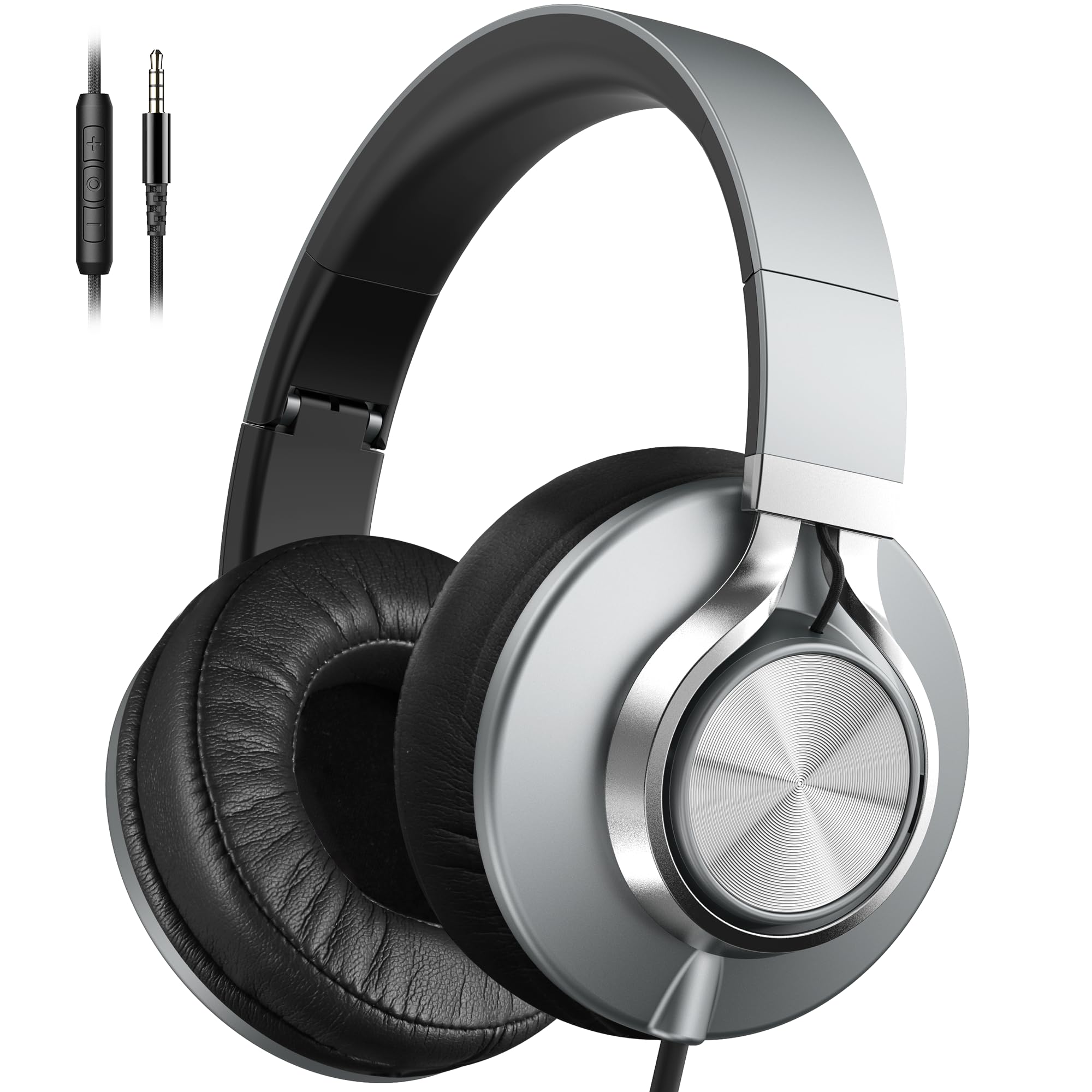
The AILIHEN C90 is a lightweight, portable wired headphone designed for daily carry. At just 7 ounces with a foldable hinge mechanism, it compresses into a compact shape that slides easily into a backpack or carry-on bag. The 40mm DLC dynamic driver delivers a balanced sound signature — not bass-heavy, but clear through the midrange and treble, making it suitable for podcasts, calls, and general music listening.
Noise isolation is achieved through the over-ear seal rather than active circuitry, blocking over 90% of ambient noise according to the manufacturer. The premium protein cotton ear pads are noticeably softer and more breathable than basic foam, reducing sweat during commutes. The inline microphone and volume control work reliably with smartphones and tablets, though the volume rocker may not map to all computer audio drivers.
The nylon braided cable resists tangling and adds durability at the stress points near the plug and earcup junction. While it does not offer the separation or bass depth of higher-end monitors, the C90 nails the basics — clear audio, comfortable fit, and pocket-friendly portability — making it a reliable backup pair or primary commuter headphone.
Why it’s great
- Ultra-light 7-ounce design with foldable portability
- Breathable protein cotton ear pads for extended wear
- Tangling-resistant nylon braided cable for daily use
Good to know
- Bass response is moderate, not deep or punchy
- Volume control may be incompatible with some computers
- No active noise cancellation, only passive isolation
FAQ
Can high-impedance 300-ohm headphones work without an amplifier?
Is an open-back design always better than a closed-back for sound quality?
How often should I replace the ear pads on wired studio headphones?
What does the term “detachable cable” mean for cable headphones and why does it matter?
Final Thoughts: The Verdict
For most users, the best cable headphones winner is the Audio-Technica ATH-M50X because it balances studio-grade accuracy, durable build, and three cable configurations at a price that undercuts professional alternatives. If you want immersive spatial audio for gaming, grab the HyperX Cloud III. And for open-back audiophile listening with a dedicated amplifier, nothing beats the Sennheiser HD 650.