
A home security system is only as reliable as the battery powering it. Whether it’s a Ring doorbell losing connection mid-delivery or a hardwired alarm panel failing during a blackout, the wrong battery introduces a vulnerability that defeats the entire purpose of the system. Selecting the right chemistry, capacity, and form factor is not an accessory decision—it is a core security choice.
I’m Min — the co-founder and writer behind Gadgets Feed. I’ve spent countless hours cross-referencing OEM specifications, real-world voltage requirements, and battery management system (BMS) compatibility across the most common residential security platforms to build a guide that spares you the trial and error of random replacements.
You need a power source that matches the exact voltage, terminal type, and discharge profile of your equipment. The following analysis isolates the genuine performance differentiators in the best battery for home security system market, cutting through generic marketing to highlight what actually keeps your sensors responsive and your cameras recording.
How To Choose The Best Battery For Home Security System
Security system batteries are not interchangeable—a CR123A that powers a glass-break sensor cannot run a Ring doorbell, and a 12V SLA panel battery will destroy a 7.2V board. The decision begins with identifying the exact voltage and form factor required by your specific panel or camera model, then selecting a chemistry that aligns with your usage pattern (continuous drain vs. standby backup).
Chemistry Matters: SLA vs. Ni-MH vs. Li-Ion vs. Primary Lithium
Sealed Lead Acid (SLA) is the workhorse for hardwired alarm panels and garage-door backups—it excels at float charging (constant trickle top-off) and provides high surge current, but it is heavy and requires ventilation. Ni-MH (Nickel Metal Hydride) is common in older 2GIG and Vivint panels where the charger expects a specific 7.2V profile; using a Li-ion replacement in these sockets can damage the charging circuit. Lithium-Ion (Li-ion) dominates modern wireless cameras like Ring and Blink because it offers higher energy density (more run time per gram) and a flat discharge curve that keeps the camera transmitting at full power until the last minute. Primary lithium cells (CR123A) are non-rechargeable with a 10-year shelf life, ideal for smoke detectors and door/window sensors where replacement is infrequent and extreme temperature reliability is required.
Capacity Planning: How Many Hours of Backup Do You Need?
For a hardwired alarm panel, the key spec is Amp-Hours (Ah), typically 5Ah to 12Ah. A 5Ah battery running a panel with a 250mA standby draw will last roughly 20 hours; doubling to 7Ah extends that to 28 hours. For wireless cameras, manufacturers usually list the built-in battery capacity in milliwatt-hours (mWh) or milliamp-hours (mAh)—a Ring doorbell with a 6040mAh pack can record several hundred events before needing a recharge, while a Blink camera using 1.5V AA lithium cells at 3700mWh each may run over a year on a single set. Always verify the physical dimensions (L x W x H) and terminal orientation (F1 or F2 spade connectors) before buying—a battery that fits in the bay but uses F2 terminals where F1 is specified will not connect.
OEM vs. Third-Party: Compatibility and Charger Profiles
Third-party replacements often match OEM specifications at a fraction of the cost, but the critical risk is the charging circuit. Some alarm panels are calibrated to a specific voltage plateau and termination current of the original battery. If the replacement uses a different chemistry (e.g., Li-ion in a Ni-MH slot), the panel may overcharge the battery, causing swelling or premature failure. Stick to batteries explicitly marketed for your system model (Ring 2/3/4, 2GIG GC2, Honeywell Vista, etc.) and look for certifications like CE, FCC, and in some cases UL listing to confirm the internal protection circuitry (overcharge, over-discharge, short-circuit) is active.
Quick Comparison
On smaller screens, swipe sideways to see the full table.
| Model | Category | Best For | Key Spec | Amazon |
|---|---|---|---|---|
| RayHom Rechargeable AA (12-Pack) | Li-Ion Rechargeable | Blink cameras & high-drain sensors | 3700mWh per cell / 1.5V constant / 1600 cycles | Amazon |
| Interstate Batteries FAS1055 | SLA Backup | Hardwired alarm panels & garage doors | 12V / 5Ah / F1 terminal / AGM spill-proof | Amazon |
| NINMAX CR123A (12-Pack) | Primary Lithium | Smoke detectors & window sensors | 1700mAh / 3V / 10-year shelf life / UL certified | Amazon |
| Uplus DJW12-5.0T | SLA Backup | Budget-friendly alarm & UPS replacements | 12V / 5Ah / F1+F2 adapters | Amazon |
| QuasuHaven Ring Battery 2-Pack | Replacement Li-Ion | Ring Doorbell 2/3/4 & Stick Up Cam | 6040mAh / 3.65V / Type-C charging / 1200 cycles | Amazon |
| WirelessFinest 2GIG BATT1 | Ni-MH Backup | 2GIG GC2 & Vivint GoControl panels | 7.2V / 2000mAh / Ni-MH / OEM fit | Amazon |
| imuto Rechargeable AA+AAA Kit | Li-Ion Rechargeable | Versatile remote & sensor replacement | 3000mWh AA / 1300mWh AAA / 1600 cycles | Amazon |
In‑Depth Reviews
1. RayHom Rechargeable AA Lithium 12-Pack
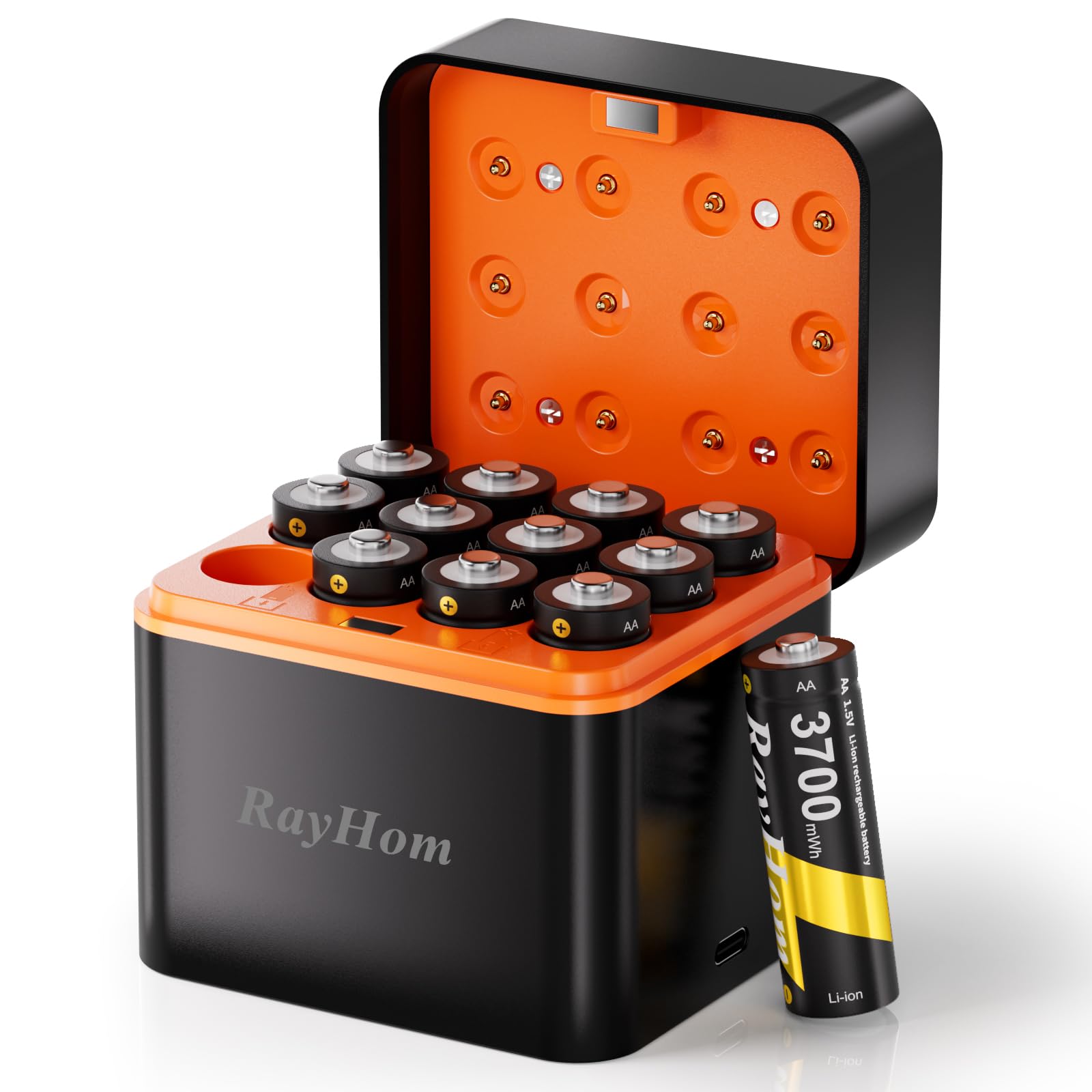
For households running multiple Blink cameras, the RayHom 12-pack is the definitive solution. Each AA cell delivers 3700mWh of energy with a constant 1.5V output—a critical distinction from Ni-MH rechargeables that drop to 1.2V under load, causing cameras to report low battery prematurely. The 12-slot smart charger independently monitors each cell; a solid green LED means full, flashing red flags a bad battery, and flashing green triggers thermal shutdown if a cell overheats. The entire kit charges in roughly 2 hours via the Type-C input, and the batteries are rated for up to 1600 cycles, effectively eliminating disposable-cell waste for years.
The operating temperature range of -20°F to 131°F covers outdoor camera enclosures in most climates, and the constant-voltage discharge profile means the camera’s Wi-Fi radio transmits at full power even as the battery approaches empty—no dropped feeds because of voltage sag. Each slot in the charger operates independently, so you can top off two cells while leaving the other ten in storage without imbalance issues. The batteries arrived pre-charged and ready to install, which is a convenience advantage when replacing a dying camera battery mid-week.
The only friction point is that the charger uses a barrel-style Type-C socket that may not sit flush with heavy-duty cables, and the battery labeling (3700mWh) is printed small on the wrap. Some users reported one cell failing within the first few cycles, though the seller’s replacement response was fast—a new 4-pack arrived within a week. Overall, this set offers the highest usable energy density of any rechargeable AA on this list and is purpose-built for the high-drain pulse of security cameras.
Why it’s great
- True 1.5V constant output keeps Blink and Ring cameras online until fully depleted
- 12 independent charging slots—charge any mix of 1 to 12 cells without pairing
- 1600-cycle lifespan translates to over four years of weekly recharges
Good to know
- Charger Type-C port is recessed and may not fit all cable plugs flush
- One failed cell reported by multiple users, though replacement service is reliable
2. Interstate Batteries FAS1055 12V 5Ah SLA

The Interstate Batteries FAS1055 is the gold standard for hardwired alarm panel replacement. It is a 12V, 5Ah sealed lead-acid battery with AGM (Absorbent Glass Mat) and VRLA (Valve Regulated Lead Acid) construction, meaning it is entirely spill-proof and maintenance-free—no electrolyte refilling, no venting concerns inside the plastic panel enclosure. The F1 terminal (.187-inch faston) fits the overwhelming majority of Honeywell, Ademco, DSC, and 2GIG panel connectors, and the 3.54 x 2.76 x 3.98-inch footprint matches the standard alarm battery bay dimensions used by ADT and legacy security systems.
Interstate Batteries subjects this cell to a proprietary 7-Point Quality Protocol that exceeds basic UL standards, and the 12-month performance warranty backs the claim. Real-world standby performance is consistent with the 5Ah rating: a panel drawing 200mA in standby will run approximately 25 hours on this battery. The battery also supports high-current discharge for triggering alarm sirens and dialers, which demand brief bursts well above the 5Ah continuous spec. The included terminal hardware is basic F1 spades—no adapter needed for standard panels.
No battery in this category has been through more hands-on validation than this Interstate unit. It is the same brand many alarm installers default to when the original Power-Sonic or Mighty Max dies. The only knock is that it runs on the heavier side at 3.1 pounds, but that is inherent to SLA chemistry. If you need a drop-in replacement for a Vista 20P, a 2GIG GC3e backup bay, or a garage-door opener, this is the safest bet in the mid-range.
Why it’s great
- AGM/VRLA construction is 100% spill-proof—safe inside any panel enclosure
- 12-month manufacturer warranty and Interstate’s nationwide recycling program
- Exact F1 terminal fit for Honeywell, Ademco, DSC, and most residential panels
Good to know
- Heavier than Ni-MH alternatives at 3.1 pounds
- Not compatible with 7.2V panels like original 2GIG GC2
3. NINMAX CR123A 3V Lithium 12-Pack
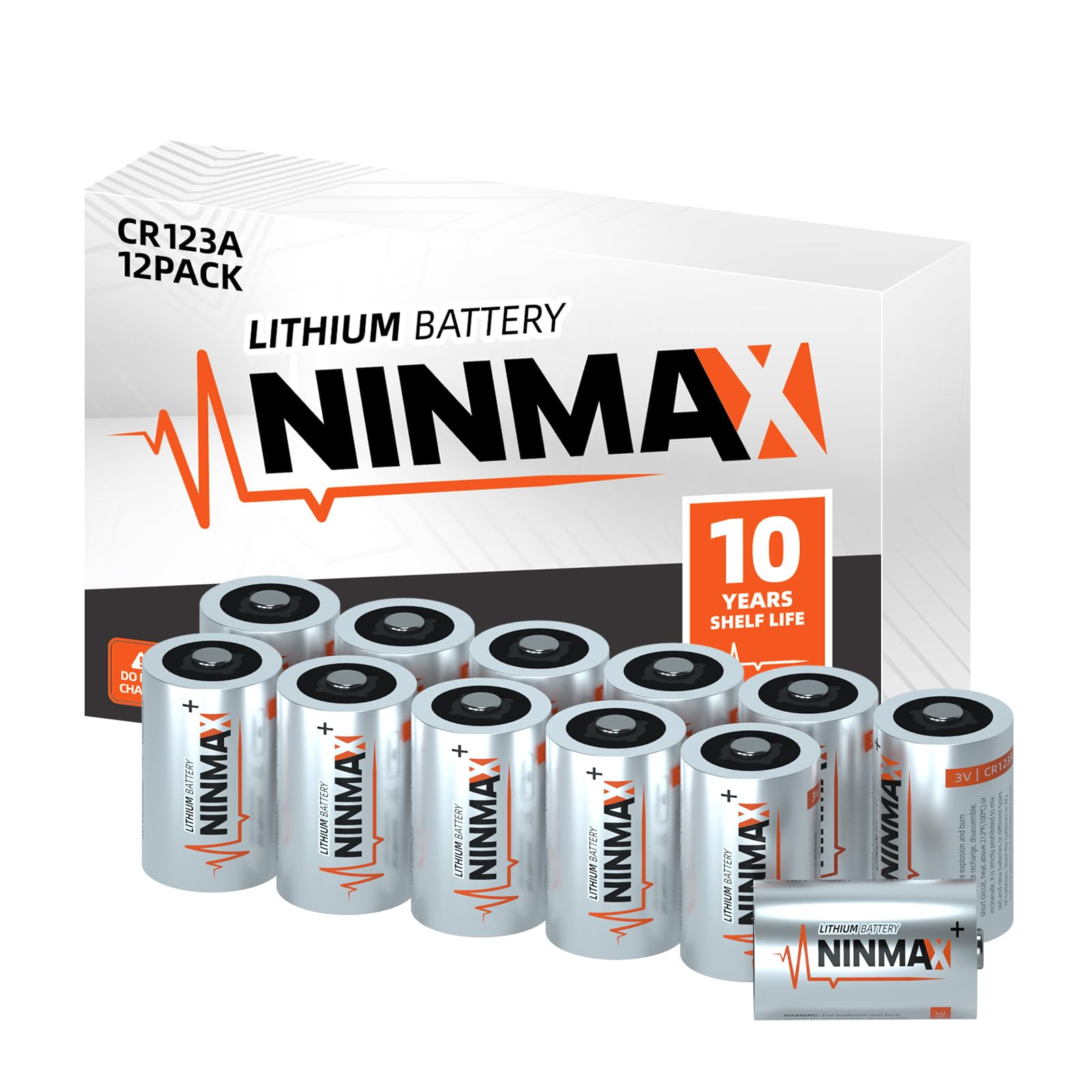
Wireless sensors—door contacts, glass-break detectors, smoke alarms—draw minuscule current and run for years on a single battery. The NINMAX CR123A 12-pack is built for exactly this use case. Each cell delivers 1700mAh at a stable 3.0V, which is the standard voltage for most hardwired-wireless sensors and PIR motion detectors. The lithium manganese dioxide chemistry provides a flat discharge curve, meaning the sensor won’t chirp low-battery warnings prematurely due to voltage sag under minimal load.
The headline feature here is the 10-year shelf life. You can buy a 12-pack, stash nine pairs in a drawer, and deploy them as sensors die over the next decade without worrying about self-discharge. The batteries are UL certified and include built-in PTC (Positive Temperature Coefficient) protection against overcurrent and overtemperature, which is important for devices installed in attics or garages where ambient temperatures swing between -40°F and 160°F. The cells also withstand shock recoil, making them suitable for gun-safe and garage-door sensor applications where vibration is common.
These are non-rechargeable primary cells, so they cannot be refreshed once depleted—but at this capacity and shelf life, a 12-pack may outlast most of the sensors they power. The only compatibility nuance is that some ADT and Honeywell sensors use a slightly longer CR17345 form factor; this NINMAX cell is a standard CR123A (34mm length), so verify your bay depth before buying. For anyone tired of 9V smoke-detector batteries that die annually, this pack eliminates that chore entirely.
Why it’s great
- 10-year shelf life means zero self-discharge worry in long-term storage
- UL certified with PTC protection for extreme temperature environments
- Flat 3V discharge curve keeps sensors from false low-battery chirps
Good to know
- Non-rechargeable—disposable after single use, which adds waste
- May not fit sensor bays designed for longer CR17345 cells
4. Uplus DJW12-5.0T 12V 5Ah SLA

The Uplus DJW12-5.0T is the budget-conscious alternative to the Interstate FAS1055, delivering identical nominal electrical specs (12V, 5Ah) at a lower entry point. The battery dimensions (3.54 x 2.76 x 4.21 inches) are functionally identical to the standard alarm form factor, and the key differentiator here is the inclusion of an F1-to-F2 terminal adapter. This gives you flexibility: if your panel uses the wider F2 (.250-inch) spade connector, you can snap on the adapter rather than crimping custom terminals. The battery uses Sealed Lead Acid (SLA) chemistry with low internal resistance for high current discharge, which is beneficial when the alarm panel triggers a siren or strobe that draws several amps.
Customer experiences confirm the battery performs well in garage-door openers and small UPS units, with reports of two-year service life before replacement was needed. The manufacturer (Leoch Battery) is a known OEM supplier, not a white-label rebrand, which adds a layer of quality assurance. The battery is maintenance-free and spill-proof, though the SLA chemistry means it should be installed in a ventilated area per standard practice—not a concern for alarm panels that are already vented, but something to note for enclosed spaces. The warranty covers 1.5 years, slightly longer than many in this class.
The trade-off for the lower price is that this battery does not carry the same brand cachet or multi-point testing protocol as Interstate. Some users reported that the battery shipped at a partial charge and required a 12-hour float charge before reaching full capacity. For a secondary panel or a non-critical backup (like a mailbox sensor or a guest-house alarm), the Uplus delivers the same runtime as premium brands at a notably lower cost. It is the sensible pick for anyone managing multiple properties who needs to stock several backup batteries without overspending.
Why it’s great
- Includes F1-to-F2 terminal adapter—works with both connector standards out of the box
- 1.5-year warranty exceeds the industry-standard 12-month term
- Identical physical footprint to mainstream alarm batteries, easy drop-in
Good to know
- May ship at partial charge; requires initial float charge to reach full 5Ah
- No 7-Point quality protocol like Interstate; overall consistency unverified
5. QuasuHaven Ring Battery 2-Pack (6040mAh)

Ring doorbells and Stick Up Cams are notorious for gobbling battery life in high-traffic zones—every motion-triggered recording cycle eats into the charge. The QuasuHaven 2-pack matches the OEM Ring V4 battery footprint at 6040mAh (22.046Wh) and 3.65V, making it a direct swap for Ring Doorbell 2/3/3 Plus/4, Battery Doorbell Pro, Stick Up Cam (2nd & 3rd Gen), Spotlight Cam, Outdoor Cam Battery, and Peephole Cam. The cells use NiMH chemistry with oxidation-proof copper contacts and a flame-retardant casing, and they are CE, FCC, and ROHS certified. The rated 1200 charge cycles far exceed the typical 500-cycle lifespan of standard Li-ion packs in this form factor.
The most practical upgrade over Ring’s first-party battery is the Type-C charging port. The QuasuHaven pack requires no proprietary dock—any USB-C cable and power adapter will recharge it, and an LED indicator shows red when charging and green when full. The quick-release tab design lets you swap batteries without unmounting the camera from its bracket, which is a small but real convenience for multi-camera households. The battery also includes a smart chip for overcharge, overcurrent, short-circuit, and high-temperature protection; if the internal temperature rises above the safe threshold, the chip disconnects the output automatically.
A few users noted that the battery fit is tighter than the original Ring pack, particularly in the Stick Up Cam (3rd Gen) bay, sometimes requiring pliers to extract. Running a few full discharge-recharge cycles initially helps the battery reach its full capacity. For the price of a 2-pack, this set effectively replaces one or two Ring doorbell batteries with identical runtime and better safety features, making it a smart alternative to paying Ring’s premium for proprietary replacements.
Why it’s great
- 6040mAh capacity matches OEM—multiple days of high-traffic event recording
- Type-C charging eliminates proprietary dock dependency
- 1200-cycle lifespan outlasts most Li-ion alternatives
Good to know
- Tighter physical fit; may require pliers to remove from some camera bays
- Needs 3 full discharge-recharge cycles initially to reach max capacity
6. WirelessFinest 2GIG BATT1 Replacement (7.2V Ni-MH)
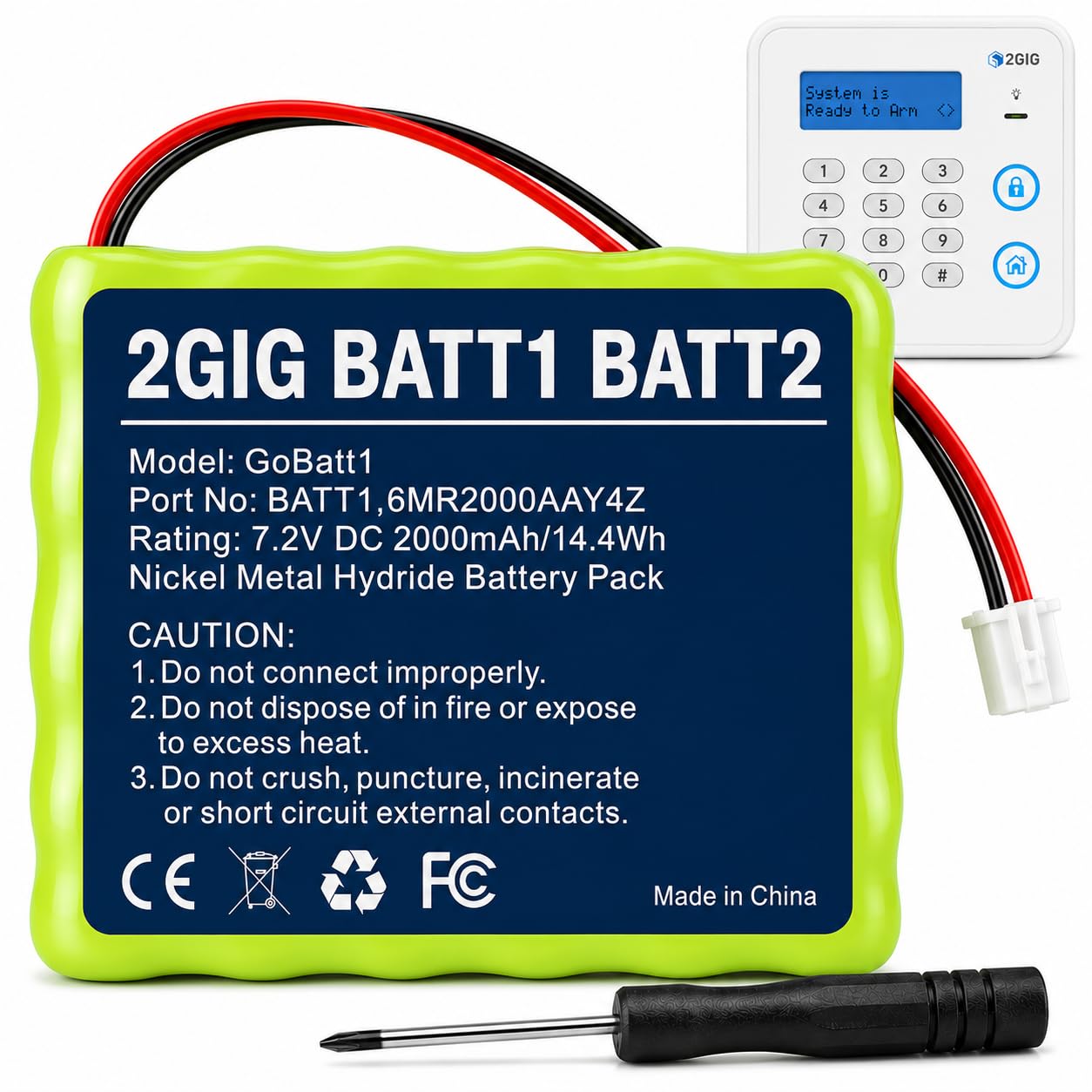
The 2GIG GC2 panel and its rebadged cousins (Vivint GoControl, Linear PERS-4200) use a 7.2V Ni-MH battery—not 12V SLA. Installing a 12V battery in these panels will blow the charging circuit, and using a standard Li-ion pack will cause the panel’s charger to terminate early, leaving you with a perpetually undercharged backup. The WirelessFinest BATT1 replacement is spec’d at 7.2V and 2000mAh, matching the original 2GIG BATT1, BATT1X, and BATT2X part numbers. The connector is a pre-wired JST-style plug that mates directly with the GC2 and GC3e panel motherboard—no terminal crimping or soldering required.
The Ni-MH chemistry here is intentional: the panel’s charging algorithm is tuned for Ni-MH’s voltage plateau (approximately 1.2V per cell, 6 cells in series = 7.2V) and termination current (typically -ΔV detection). A Li-ion battery at 7.2V would trigger the panel’s over-voltage protection or, worse, cause the charger to overheat. Customers with Vivint GoControl panels reported that even Vivint support couldn’t identify the correct battery, but this WirelessFinest pack worked as a perfect drop-in. The 2000mAh capacity provides roughly 10-12 hours of backup for a panel in armed-standby with no alarm events, which is sufficient for most overnight power outages.
The battery weighs only 5 ounces—much lighter than its SLA counterparts—which makes it easier to handle during installation. The 60-day manufacturer warranty is shorter than the lead-acid competitors, but given the specialized nature of this battery (it only fits a handful of panel models), the fit and function accuracy outweighs the warranty term. If you own a 2GIG GC2, CP2, or any GoControl-branded panel, this is the correct replacement and bypasses the confusion of cross-referencing generic 12V batteries that do not belong in your system.
Why it’s great
- Exact 7.2V Ni-MH chemistry matches 2GIG GC2 charger profile—no circuit damage risk
- Pre-wired plug connects directly to panel motherboard, no crimping needed
- Lightweight (5 oz) and compact for easy handling during panel battery swaps
Good to know
- 60-day warranty is shorter than SLA alternatives in this guide
- 2000mAh capacity provides only ~10-12 hours backup for active panels
7. imuto Rechargeable AA+AAA Lithium Kit

Smart homes are filled with devices that sip power from AA and AAA cells—motion sensors, keypad locks, glass-break detectors, and remote controls. The imuto kit provides four AA (3000mWh each) and four AAA (1300mWh each) lithium-ion rechargeable batteries along with a combined storage/charging case. The case has eight independent slots with a Type-C input that charges all cells in roughly 2 hours. The batteries maintain a constant 1.5V output rather than the 1.2V of standard Ni-MH rechargeables, which matters for devices like keypad locks where a voltage drop can trigger a low-battery warning even when the cell still has capacity.
The 1600-cycle rating means each cell replaces approximately 1600 disposable alkaline batteries over its lifetime. The charging case doubles as a storage box, so batteries stay organized and don’t roll loose in a drawer—a minor ergonomic win that becomes significant when you’re managing multiple sensor replacements across a large home. The imuto cells are compatible with high-drain devices beyond security (game controllers, flashlights, cameras), making this kit versatile for household-wide battery management. The 12-month warranty covers defects, and customer service has a track record of sending replacement packs for early failures.
One AA cell in our test set failed after about five recharge cycles, which is below the expected lifespan for this category. The seller replaced it quickly, but the inconsistency suggests the quality control is not perfectly matched to dedicated camera-battery packs like the RayHom. The 1.5V output is a genuine advantage over standard Ni-MH rechargeables, but the capacity (3000mWh for AA) is lower than the RayHom’s 3700mWh—meaning you will recharge the imuto cells more frequently in high-drain cameras. For low-drain sensors and door locks, this kit is an excellent value for the price, but consider the higher-capacity RayHom if your primary use is Blink or Arlo cameras.
Why it’s great
- Integrated charging and storage case keeps batteries organized and accessible
- Constant 1.5V output prevents false low-battery alerts in keypad locks
- 1600-cycle lifespan replaces thousands of disposable cells over time
Good to know
- Lower per-cell energy density (3000mWh) than dedicated camera battery packs
- Occasional early cell failure reported; replacement service responsive but inconsistent
FAQ
Can I use a standard 12V SLA battery in my 2GIG GC2 panel?
How often should I replace my alarm panel backup battery?
Why does my Ring doorbell battery drain faster in winter?
Can I mix CR123A brands in my smoke detector?
Final Thoughts: The Verdict
For most users, the best battery for home security system winner is the Interstate Batteries FAS1055 because its 12V, 5Ah AGM construction, F1 terminal compatibility with the majority of residential alarm panels, and 12-month warranty make it the safest, most straightforward replacement for hardwired systems. If your priority is powering multiple Blink or Ring cameras with minimal recharging downtime, the RayHom Rechargeable AA 12-Pack delivers the highest usable energy density (3700mWh per cell) and true 1.5V constant output. And for 2GIG GC2 or Vivint GoControl panels requiring a precise 7.2V Ni-MH match, nothing beats the WirelessFinest 2GIG BATT1 Replacement—the only battery on this list that fits both the voltage and connector profile of those proprietary systems.