
Our readers keep the lights on and my morning glass full of iced black tea. As an Amazon Associate, I earn from qualifying purchases.
You walk into a battery store and see a voltage number — 12V — and nothing else. That is like picking a shirt by sleeve length alone: it might fit, but the wrong cut will leave you miserable. The single number that tells you how long your gear will actually run is amp-hours (Ah) — a measure of how much electricity the battery stores and can deliver steadily over time.
I’m Min — the founder and writer behind Gadgets Feed. This guide is built by comparing the manufacturers’ published specifications and the patterns across verified customer reviews, so you get each pick’s real strengths and trade-offs instead of marketing spin.
You need a battery that matches your voltage, fits your compartment, and keeps your device running long enough. Knowing which battery lead acid battery does that is the difference between a five-minute swap and a frustrating return.
Quick Picks
- WEIZE 12V 100Ah Deep Cycle Battery — Best Overall
- Interstate Batteries 12V 12Ah Battery — Premium Pick
- Uplus 12V 18Ah Rechargeable Sealed Lead Acid Battery — Top Performer
- Yuasa NP7-12 12V/7Ah Sealed Lead Acid Battery — Most Reliable
- EnerSys Genesis NP7-12 12V 7Ah Sealed Lead Acid Battery — Best Value
- AOKLY 12V 7Ah Replacement Battery — Budget Champion
How To Choose The Best Battery Lead Acid Battery
To get a battery that fits and works, match three things: its physical size (it must sit inside the compartment), its terminal type (the connectors must match your device’s wires), and its capacity in amp-hours (Ah) — how long it runs before needing a recharge.
Check the Physical Dimensions First
A battery that is too tall or wide will not close inside a security panel, UPS (uninterruptible power supply — a battery backup for electronics), or kid’s ride-on jeep. Measure the old battery’s length, width, and height in inches before you buy. For tight compartments, the Yuasa NP7-12 has a compact footprint of 5.94 x 2.56 x 3.7 inches, while a big 100Ah unit like the WEIZE measures 12.99 x 6.73 x 8.34 inches — nearly twice the case volume.
Match the Terminal Type to Your Connector
Lead acid batteries come with F1 terminals (small 0.187-inch slide-on tabs), F2 terminals (larger 0.250-inch slide-on tabs), or nut-and-bolt (NB) posts (threaded posts you tighten with a wrench). If your device uses small push-on connectors, you need F1. Using an F2 connector on an F1 tab gives a loose connection that can fail. The Uplus 18Ah model uses NB terminals, which you secure with a wrench — a sturdier connection for gear that vibrates, like a lawn mower.
Know Your Amp-Hour Budget
Capacity decides how long your device runs. For an alarm panel or small UPS that only needs backup power during outages, a 7Ah battery is standard — it will hold the panel up for a few hours. For a mobility scooter or a larger jump starter, you want 18Ah or more. For powering an RV, trolling motor, or solar setup for hours, a deep-cycle battery rated at 100Ah is what you need. A 7Ah battery would drain in under five minutes trying to run a 12V fridge.
Quick Comparison
On smaller screens, swipe sideways to see the full table.
| Model | Best For | Capacity | Dimensions | Weight | Amazon |
|---|---|---|---|---|---|
| WEIZE 12V 100Ah Deep Cycle | RV & Solar Banks | 100 Ah | 12.99 x 6.73 x 8.34 in | 59.98 lbs | $159.99Amazon |
| Uplus 12V 18Ah NB Terminal | Mobility Scooters & Mowers | 18 Ah | 7.14 x 3.01 x 6.59 in | 11.8 lbs | $39.99Amazon |
| Interstate Batteries 12V 12Ah | Medical Devices & Fences | 12 Ah | 6 x 4 x 4 in | 6.6 lbs | Amazon |
| Yuasa NP7-12 F1 Terminal | Security Systems & UPS | 7 Ah | 5.94 x 2.56 x 3.7 in | 5.2 lbs | $31.99Amazon |
| EnerSys Genesis NP7-12 | Fitness Equipment & Backup | 7 Ah | 5.95 x 2.56 x 3.94 in | 4.4 lbs | Amazon |
| AOKLY 12V 7Ah Replacement | Ride-On Toys & Entry-Level | 7 Ah | 5.94 x 2.56 x 3.7 in | 4.4 lbs | Amazon |
In‑Depth Reviews
1. WEIZE 12V 100Ah Deep Cycle Battery

The heavyweight champ for off-grid power — it rivals a mini power station with 100Ah of stored energy.
You get a deep-cycle battery (built with thick lead plates that can be discharged deeply and recharged hundreds of times without damage) designed for steady, long-draw applications, not for starting engines. The WEIZE stores 100 amp-hours and can peak-discharge at 1150 amps, so you can run a 12V fridge, lights, and phone chargers for a full day without recharging. At 59.98 pounds and 12.99 x 6.73 x 8.34 inches, this is not portable — it goes into an RV compartment, a solar battery box, or a marine console.
Buyers report running two in parallel to create a 200Ah bank that handles a 2000W inverter (a device that converts battery DC power to household AC power), keeping fans and outlets running during outages. The AGM (Absorbent Glass Mat — acid is soaked into a fiberglass mat so it cannot spill) construction makes it sealed and maintenance-free — no checking water, no acid leaks, even if tipped slightly. Unlike the Yuasa 7Ah, which is meant for a few hours of backup, this WEIZE handles daily deep cycling; one reviewer noted two years of off-grid RV use with a 300W solar panel with zero issues.
The honest limit is pure physics: you need two people to lift this into a tight compartment. Also, it uses standard SAE (Society of Automotive Engineers) automotive-style post terminals, not F1 or F2 slide-on tabs, so devices expecting small push-on connectors need an adapter or ring-terminal wiring.
Why it’s great
- 100Ah capacity gives you real all-day power for an RV or solar bank
- Sealed AGM design means no maintenance and no leaks
- 1150A max discharge handles inverter loads without voltage sag
Good to know
- Extremely heavy at 59.98 pounds — plan for installation carefully
- Not compatible with small F1/F2 slide-on connectors; uses post terminals
Best for: Full-time RVers, solar off-grid cabins, or marine applications needing steady deep-cycle power
Skip if: You need a battery to fit inside a small alarm panel or a child’s ride-on toy — this is too large and heavy for those compartments
2. Interstate Batteries 12V 12Ah Battery
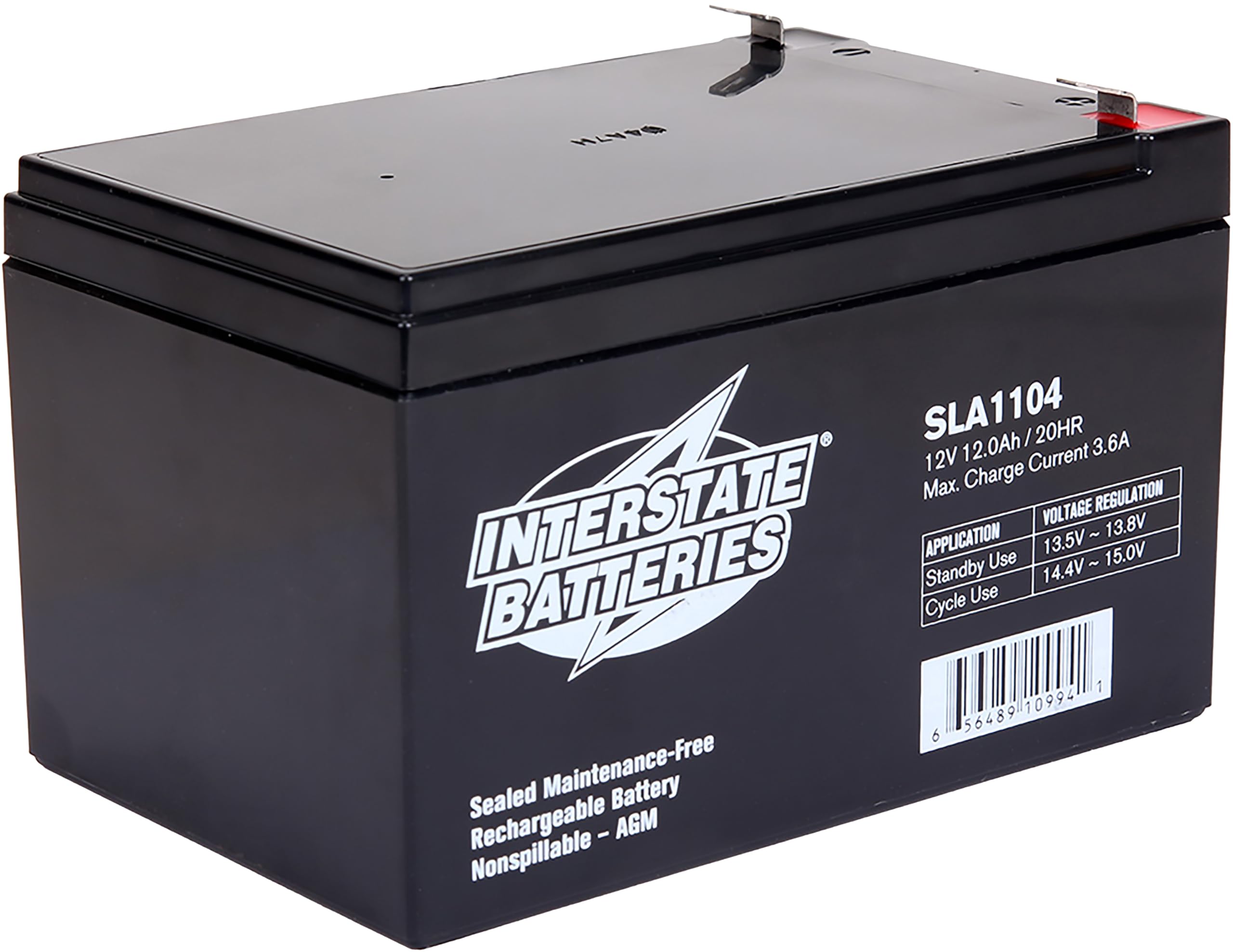
A 70-year-old brand that delivers 12Ah of reliable mid-capacity power for gear that cannot fail.
What sets this Interstate battery apart is the name’s quality process — the brand runs a 7-Point Quality Protocol on every unit and backs it with a 12-month performance warranty. You get a sealed 12V, 12Ah unit with an F2 (0.250-inch) FASTON terminal (a quick-connect slide-on tab), measuring 5.94 x 3.87 x 3.73 inches and weighing 6.6 pounds. That 12Ah capacity gives you nearly double the runtime of a standard 7Ah battery while staying compact enough for medical devices and generator starter bays.
The AGM/VRLA (Valve Regulated Lead Acid — a sealed battery with a pressure relief valve, never needs water) construction is spill-proof and maintenance-free. Unlike the WEIZE above, the Interstate is a general-purpose SLA (Sealed Lead Acid), not a deep-cycle battery — it is for standby and moderate-draw use, so do not expect it to run a trolling motor all day.
The catch is the F2 terminal. At 0.250 inches wide, it is larger than the F1 (0.187-inch) tabs found on most alarm panel batteries and many UPS units. If your device expects F1 connectors, these will not fit without an adapter.
Why it’s great
- 12Ah capacity offers nearly double the runtime of a standard 7Ah battery
- Interstate’s 7-Point Quality Protocol and 12-month warranty give confidence
- Sealed AGM/VRLA construction is spill-proof and maintenance-free
Good to know
- F2 terminals (0.250″) do not fit devices designed for F1 (0.187″) connectors without adapters
- General-purpose SLA — not designed for heavy daily deep cycling like a true deep-cycle battery
Best for: Powering electric fences, medical devices, and generator starter bays where you need more runtime than a 7Ah but still need a compact size
Skip if: Your device uses F1 small push-on connectors — you will need to modify the wiring to fit the larger F2 tab
3. Uplus 12V 18Ah Rechargeable Sealed Lead Acid Battery

The burly 18Ah mid-size battery — its nut-and-bolt terminals stay tight in gear that shakes and moves.
You get 18 amp-hours of storage, a 2.6x capacity jump over a standard 7Ah battery, so this powers a mobility scooter, jump starter box, or riding lawn mower that needs sustained cranking power. At 11.8 pounds and 7.14 x 3.01 x 6.59 inches, it is heavier and larger than the small 7Ah units (which weigh 4.4 pounds), so measure your compartment first. The key spec is the nut-and-bolt (NB) terminal — a threaded post you tighten with a wrench — which resists vibration far better than push-on tabs. That matters for gear that moves, like a scooter that pulls 15+ amps during hill climbs.
Owners mention it arrived well-packaged in a double-wall box with Styrofoam caps, and one owner noted a manufacturing date of January 2025 despite purchasing in August 2025, meaning the battery was fresh and had not lost charge on a shelf. The AGM construction with a flame-retardant ABS (Acrylonitrile Butadiene Styrene — a tough plastic) shell adds safety against sparks in enclosed engine compartments. Unlike the AOKLY 7Ah below with small F1 tabs, the Uplus’s NB terminals handle higher current without loosening over time.
The honest downside: at 18Ah, this is too heavy and tall for small UPS bays or alarm panels that expect a 7Ah unit. One buyer mentioned it fit an older Stanley FatMax jump starter perfectly, but that is a bigger device — do not buy this if your compartment was designed for a 7Ah battery; it will not close.
Why it’s great
- 18Ah capacity provides 2.6x the runtime of a standard 7Ah battery
- Nut-and-bolt terminals stay secure in high-vibration applications like mowers and scooters
- Flame-retardant ABS shell and AGM construction add safety and are maintenance-free
Good to know
- At 11.8 pounds, it is over 2.7x heavier than a 4.4-pound 7Ah battery
- Its larger size (7.14 x 3.01 x 6.59 inches) may not fit compartments designed for standard 7Ah units
Best for: Electric mobility scooters, riding mowers, and jump starter boxes where vibration resistance and higher capacity matter
Skip if: You need a battery for a small alarm panel, UPS, or child’s ride-on toy — the Uplus is too large and heavy for those spaces
4. Yuasa NP7-12 12V/7Ah Sealed Lead Acid Battery

The gold standard for 7Ah replacement — alarm techs reach for this by habit for a reason.
Yuasa has the reputation in the battery world as the benchmark for 7Ah sealed lead-acid batteries. Many security installers will not use anything else. This NP7-12 delivers 12V and 7Ah in a 5.94 x 2.56 x 3.7 inch footprint, weighing 5.2 pounds, with F1 (0.187-inch) terminals that match the slide-on connectors inside almost every residential alarm panel and UPS. The difference from the generic AOKLY below is consistency: Yuasa batteries are usually manufactured fresh and have very low failure rates out of the box.
Buyers rave about longevity — one owner reports a previous Yuasa of the exact same model lasted 9 years in a Precor elliptical machine. Another said their replacement stopped a low-battery alarm indicator immediately after install. One reviewer straightforwardly called Yuasa “the best batteries on the planet.” At 7Ah, this is a standby battery (sits on a trickle charge and delivers backup only during an outage), not for powering a trolling motor or scooter all afternoon — that needs the WEIZE or Uplus.
The downside is the price premium: you pay more for the Yuasa name than for the AOKLY or EnerSys, even though the 7Ah capacity and size are nearly identical. If you need a battery for a hard-to-access alarm panel where longevity matters most, the premium may be worth it. For a kid’s Power Wheels jeep that will be replaced in two years anyway, a cheaper 7Ah option makes more sense.
Why it’s great
- Proven reputation for long service life — some customers note 7-9 years of use
- F1 terminals match the standard slide-on connectors in most alarm panels and UPS units
- Compact 5.94 x 2.56 x 3.7 inch size fits standard 7Ah battery compartments perfectly
Good to know
- Costs more than generic 7Ah alternatives despite identical capacity ratings
- 7Ah capacity is for standby backup only — not for high-drain or deep-cycle applications
Best for: Home security systems, UPS backups, and exercise equipment where long-term reliability and a trusted brand name matter
Skip if: You are on a tight budget for a kids’ ride-on toy or a short-term application — cheaper 7Ah batteries will work fine for those cases
5. EnerSys Genesis NP7-12 12V 7Ah Sealed Lead Acid Battery

The 7Ah workhorse that bridges generic and premium brands — backed by a 12-month warranty from a seller in business since 1991.
This EnerSys Genesis NP7-12 is a 12V, 7Ah sealed lead-acid battery with dimensions nearly identical to the Yuasa — 5.95 x 2.56 x 3.94 inches — but it usually costs less. The key advantage over the cheaper AOKLY is that EnerSys is a recognized industrial battery manufacturer (they own the Genesis brand used in high-end UPS systems), so you get engineering pedigree. It includes a 12-month warranty and lifetime technical support from AAA Security Depot, a seller around since 1991.
Buyers use it in 12V power boxes and fitness equipment, and one owner notes the previous battery of this exact brand lasted 9 years — the same longevity claim Yuasa fans make. The battery holds a charge well when stored and fits scooter and alarm panel compartments without modification. While the AOKLY below may cost less, the EnerSys offers more established warranty support.
The honest limitation: at 7Ah, this is still standard-capacity. It will not provide significantly longer runtime than the AOKLY or Yuasa 7Ah units — the capacity is the same. Its value depends on whether you want a warranty from a long-standing seller over saving a couple of dollars. If you need more power, step up to the Uplus 18Ah or Interstate 12Ah.
Why it’s great
- Reliable brand from a known battery manufacturer with a 12-month warranty
- Standard 7Ah capacity fits most alarm panels, UPS units, and fitness equipment
- Reviewers point out exceptional longevity — one owner noted the previous battery lasted 9 years
Good to know
- Same 7Ah capacity as cheaper alternatives — no extra runtime for the price difference
- Dimensions are slightly taller (3.94 in) than some competitors’ 7Ah batteries, so double-check your compartment’s height
Best for: Replacing batteries in fitness equipment, power boxes, and backup systems where you want a solid warranty from an established brand without paying the Yuasa premium
Skip if: You need a battery for a child’s ride-on toy where the cheapest option works fine — you are paying extra for warranty support you may not need
6. AOKLY 12V 7Ah Replacement Battery
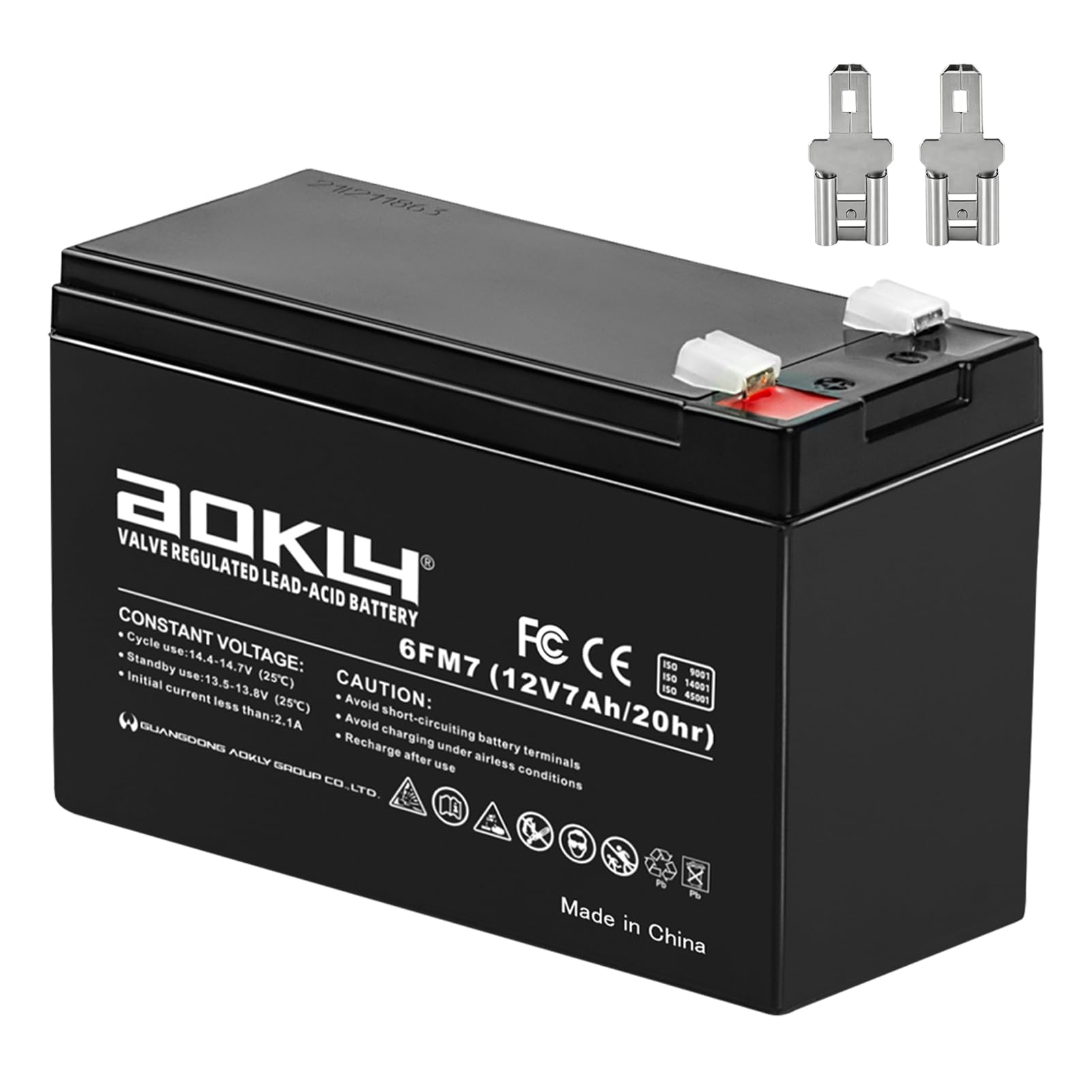
The no-frills 7Ah battery that gets a child’s jeep rolling in under five minutes for the lowest price.
The AOKLY 6FM7 is a 12V, 7Ah sealed lead-acid battery matching the standard 5.94 x 2.56 x 3.7 inch footprint, weighing just 4.4 pounds — identical external dimensions to the Yuasa and EnerSys. Where it wins is price: typically the cheapest entry point into a reliable 7Ah battery. It comes with both F1 and F2 compatible terminals (the connector can accept either tab width), making it adaptable for alarm panels and some ride-on toys. The manufacturer claims a low self-discharge rate of ≤3% per month, meaning it can sit on a shelf for a while without fully draining.
One buyer installed it in a child’s Hotwheels Jeep in under five minutes, and it started the toy immediately. Another noted it is “not heavy at all,” handy for swapping batteries in and out of gear. The AOKLY is made by Guangdong Aokly Group, a manufacturer with over 25 years in the battery market — not a fly-by-night brand. For low-stakes applications like a Power Wheels jeep or a fish finder for occasional use, this battery does the job without overpaying.
The trade-off is quality consistency. Unlike the Yuasa or EnerSys, where owners consistently report 7-9 year lifespans, the AOKLY reviews focus more on price and immediate function than longevity. If it fails in two years instead of seven, you save money upfront, but the inconvenience of a mid-life replacement may not be worth it for a hard-to-reach alarm panel. Note that the manufacturer recommends charging it immediately upon receipt because lead-acid batteries self-discharge over time — a fresh unit may arrive partially depleted after sitting in a warehouse.
Why it’s great
- Most affordable entry into a reliable 7Ah sealed lead-acid battery for basic applications
- Lightweight at 4.4 pounds — easy to handle and install in tight spaces
- Compatible with both F1 and F2 terminals, so it works with a wider range of devices out of the box
Good to know
- Longevity track record is less proven than premium brands like Yuasa — some users report shorter service life
- Manufacturer recommends charging immediately upon receipt as batteries self-discharge during storage
Best for: Power Wheels and ride-on toys, fish finders, and other casual-use gear where keeping costs low matters more than decade-long lifespan
Skip if: You need a battery for a hard-to-access alarm panel or critical medical equipment where unexpected failure would be a major hassle — pay the premium for a Yuasa or EnerSys for peace of mind
Understanding the Specs
Amp-Hours (Ah)
This is the single most important number for sizing your battery. Amp-hours tell you how much electrical energy the battery stores — think of it as the size of the fuel tank. A 7Ah battery can, in theory, deliver 1 amp for 7 hours, or 7 amps for 1 hour (in practice, drawing high current reduces the actual runtime slightly). For a small alarm panel that draws 0.1A, a 7Ah battery will last about 70 hours. For a trolling motor that pulls 30A, a 7Ah battery would drain in about 14 minutes — that is why you need the 100Ah WEIZE for heavy-draw applications. Always match the amp-hour rating to your device’s amp draw and your desired runtime.
Terminal Types: F1, F2, and Nut & Bolt
The terminal type determines whether your device’s wires will physically connect to the battery. F1 terminals are small 0.187-inch wide slide-on tabs — these are the standard for most home alarm panels and UPS backup units. F2 terminals are wider at 0.250-inch — you find them on larger medical equipment and some generator batteries. Trying to push an F2 connector onto an F1 tab gives a loose connection that may spark or fail. Nut-and-bolt (NB) terminals are threaded posts that you tighten with a wrench, providing the most secure connection for high-vibration environments like mobility scooters and lawn mowers. Always check your old battery’s terminal type before buying a replacement.
AGM vs Sealed Lead Acid
Nearly all modern “sealed lead acid” batteries are actually AGM (Absorbent Glass Mat). Inside, the acid is absorbed into a fiberglass mat between the plates, rather than sloshing around as a liquid. This makes the battery spill-proof even if tipped — you can mount it on its side in some cases (check the manufacturer’s specs). AGM also has lower internal resistance than older flooded batteries, meaning it can deliver higher current for short bursts, which helps with starting motors. The term “VRLA” (Valve Regulated Lead Acid) is often used interchangeably with AGM; it means the battery has a one-way pressure relief valve instead of a vent cap, so you never need to add water. All six products in this guide are sealed AGM/VRLA — none require maintenance or refilling.
Deep Cycle vs Standby/Starting Batteries
Not all lead-acid batteries are built the same. A deep-cycle battery (like the WEIZE 100Ah) is designed with thicker plates that can be discharged to 50-80% of capacity and recharged many times without damage — ideal for solar banks, trolling motors, and RVs where you drain the battery regularly. A standby battery (like the Yuasa 7Ah) uses thinner plates optimized to sit fully charged on a trickle source (like an alarm panel) and provide backup power only during outages. If you use a standby battery in a deep-cycle application, the thin plates will warp and fail within a few dozen cycles. If you use a deep-cycle battery in a standby application, it works fine but costs more than you need to spend. Choose based on how often you expect to discharge and recharge.
FAQ
Can I use a 12V 7Ah battery to replace a 12V 4Ah battery?
Can I charge a sealed lead acid battery with a standard car battery charger?
What is the difference between F1 and F2 terminals?
How long does a sealed lead acid battery last?
Can a sealed lead acid battery leak or spill acid?
Why does the battery have a nut-and-bolt terminal instead of slide-on tabs?
Is a 100Ah battery too heavy for an RV?
Can I connect two lead acid batteries together for more capacity?
My battery arrived with a low voltage — is it defective?
What does a deep cycle battery mean and do I need one?
Final Thoughts: The Verdict
For the majority of shoppers, the best battery lead acid battery is the Uplus 12V 18Ah. Its nut-and-bolt terminals stay tight in vibrating gear, and its 18Ah capacity is a 2.6x jump over standard 7Ah batteries, without the 59.98-pound weight of a 100Ah deep cycle. If you need maximum off-grid power for an RV or solar cabin, get the WEIZE 12V 100Ah Deep Cycle. For a simple, no-hassle alarm panel or UPS replacement, the proven long life of the Yuasa NP7-12 is the reliable choice.
How We Picked
We do not accept paid placement, and we did not hands-on test every unit. Instead, we match each pick to a real buyer and use-case by comparing the manufacturers’ published specifications against the patterns in verified customer reviews — so you get each pick’s real strengths and trade-offs instead of marketing copy.
Sources & Methodology
Specifications: manufacturer listings and product documentation. Review insights: verified customer reviews, as of June 2026. Pricing: not shown on this page (it changes often); check the current price via the retailer link.
As an Amazon Associate, Gadgets Feed earns from qualifying purchases. This does not affect which products we feature.
Product prices and availability are accurate as of the date/time indicated and are subject to change. Any price and availability information displayed on Amazon at the time of purchase will apply to the purchase of this product. As an Amazon Associate I earn from qualifying purchases.
CERTAIN CONTENT THAT APPEARS ON THIS SITE COMES FROM AMAZON. THIS CONTENT IS PROVIDED "AS IS" AND IS SUBJECT TO CHANGE OR REMOVAL AT ANY TIME.
Amazon and the Amazon logo are trademarks of Amazon.com, Inc. or its affiliates.