
The moment your camera battery dies mid-shot on a hike or event is the moment you realize runtime matters more than megapixels. For anyone who shoots outdoors, travels remote, or covers long sessions, battery endurance defines what you can actually capture — not sensor size or lens reach. A camera that dies in two hours is just a brick with a good sensor.
I’m Min — the co-founder and writer behind Gadgets Feed. After weeks of digging through real customer shoot data, comparing CIPA-rated shot counts, cold-weather endurance reports, and mirrorless versus action camera real-world drain patterns, I’ve built a guide that isolates the true runners that keep recording when the sun goes down.
Whether you’re backpacking without power access, vlogging in freezing temps, or shooting a wedding timeline, the right best battery life camera means you stop obsessing over charge and start focusing on the frame.
How To Choose The Best Battery Life Camera
Battery life in cameras is a game of trade-offs. A mirrorless full-frame with a massive sensor demands more power per shot than a compact action camera or a small-sensor point-and-shoot. But the best long-running cameras aren’t just about max mAh — they also depend on processor efficiency, recording resolution, and whether the system supports hot-swappable batteries during a shoot. Here’s what to actually look for.
Battery Capacity vs. Real-World Runtime
A 1950mAh battery in an action camera like the DJI Osmo Action 5 Pro gives you up to 4 hours of continuous 4K recording. A full-frame mirrorless with the same mAh will cut that number in half because the sensor and processor work harder. The key metric is not just mAh but the camera’s overall power draw per frame or minute of video. Look for cameras that list either CIPA-rated shots per charge (for stills) or continuous recording time — and always check real user reports for cold-weather and high-frame-rate drain.
Hot-Swappability and External Charging
For mirrorless shooters, the ability to swap batteries without powering down is a massive advantage during long sessions. The Canon EOS R6 Mark II and Sony a7 IV both support hot-swapping and external USB-C charging, meaning you can top up from a power bank between sets. Action camera shooters should look for combo kits that include a multifunctional battery case — the DJi Osmo Action 5 Pro Adventure Combo includes three batteries and a case that can charge them simultaneously, effectively turning one battery into a full-day runtime.
Cold-Weather and High-Frame-Rate Drain
Lithium-ion chemistry loses capacity in sub-zero temperatures. If you shoot in cold climates, a camera rated for -20°C operation with cold-resistant cells is non-negotiable. The DJI Osmo Action 5 Pro can record for 3.6 hours at -20°C, while most mirrorless bodies cut their runtime in half below freezing. Similarly, shooting at 120fps or 4K 60p draws significantly more power — factor in a 30–50% reduction in recording time when you push the frame rate limit.
Quick Comparison
On smaller screens, swipe sideways to see the full table.
| Model | Category | Best For | Key Spec | Amazon |
|---|---|---|---|---|
| Sony a7 IV | Mirrorless Full-Frame | Hybrid stills/video | 2000+ shots per charge | Amazon |
| Canon EOS R6 Mark II | Mirrorless Full-Frame | Action/sports/wildlife | 6h Full HD recording | Amazon |
| DJI Osmo Action 5 Pro | Action Camera | Outdoor/vlogging/adventure | 4h continuous 4K | Amazon |
| DJI Osmo Action 6 | Action Camera | 8K/dual-mic vlogging | 4h continuous 4K | Amazon |
| Nikon Z6 III | Mirrorless Full-Frame | Video/low-light hybrid | ~2h video recording | Amazon |
| Sony a7 III | Mirrorless Full-Frame | Entry-level full-frame | ~710 shots/charge | Amazon |
| Panasonic LUMIX ZS99 | Compact Point-and-Shoot | Travel/concerts | ~6h battery life | Amazon |
| Canon EOS R7 (Kit) | Mirrorless APS-C | Wildlife/sports/action | ~2h recording | Amazon |
| Canon EOS R7 (Bundle) | Mirrorless APS-C | All-in-one starter kit | ~2h recording | Amazon |
| Nikon Z 7II | Mirrorless Full-Frame | High-res stills | Two shoots/charge | Amazon |
| Canon PowerShot ELPH 360 HS | Compact Point-and-Shoot | Travel/day trips | 800mAh battery | Amazon |
In‑Depth Reviews
1. Sony Alpha 7 IV Full-frame Mirrorless

The Sony a7 IV is the hybrid shooter’s endurance champion. Real users report exceeding 2000 shots per charge, thanks to the power-efficient BIONZ XR processor paired with the 33MP full-frame sensor. That’s enough for a full wedding day or a multi-hour wildlife session without swapping batteries once.
The NP-FZ100 battery is the same cell used in the a7 III, but the a7 IV’s image processing is so refined that it squeezes out significantly more runtime, especially during mixed stills-and-video sessions. The 7K oversampled 4K mode draws more power, but at standard 4K 30p, the camera runs cool and keeps recording for well over an hour on a single charge.
USB-C charging via power bank is supported, meaning you can extend sessions indefinitely if you have external power. Dual card slots (CFexpress Type A + SD) add flexibility, but the real headline is that this body just keeps going when others tap out.
Why it’s great
- Real-world battery life exceeds 2000 shots per charge
- USB-C power delivery for continuous shooting with a power bank
- Fast, reliable autofocus with minimal power draw
Good to know
- 4K 60p recording shows 1.5x crop, reducing effective battery time
- Body-only — you’ll need to factor in lens cost
2. Canon EOS R6 Mark II Mirrorless

The R6 Mark II delivers up to 6 hours of continuous Full HD recording on a single LP-E6NH battery, a benchmark most full-frame mirrorless cameras can’t touch. The combination of the DIGIC X processor and a 24.2MP sensor optimized for efficiency means even at 4K 60p, the camera runs for well over an hour without overheating or power drop.
Real-world stills photographers report 700–900 shots per charge in mixed conditions, but the real star is video endurance. The camera supports USB-C charging via power bank, and the LP-E6NH cell is cross-compatible with older Canon bodies, making backup batteries a low-cost addition.
The 40fps electronic shutter mode is battery-hungry, but drop to mechanical at 12fps and the runtime quadruples. For event shooters who need all-day power, this is the most reliable Canon full-frame body available without stepping up to the R3’s price bracket.
Why it’s great
- 6 hours of continuous Full HD recording on one charge
- USB-C power bank charging for extended sessions
- Excellent power management at standard 4K 30p
Good to know
- 40fps electronic burst drains battery faster than mechanical shutter
- Body-only, lens sold separately
3. DJI Osmo Action 5 Pro Adventure Combo

The Osmo Action 5 Pro is a battery-life monster in the action camera world. With a 1950mAh Extreme Battery Plus, it records up to 4 hours of continuous 4K footage — enough to film an entire day hike or a full moto-vlog session without hitting the swap button. The Adventure Combo includes three batteries and a multifunctional battery case, pushing total runtime to about 12 hours.
Cold-weather endurance is equally impressive. The camera maintains 3.6 hours of recording at -20°C (-4°F), which is a spec no other consumer action camera hits at this price tier. The IP68 waterproof rating down to 20m without a housing adds another layer of utility for underwater shooters who need sustained recording deep down.
The 1/1.3-inch sensor with 2.4µm large pixels offers excellent low-light performance, but the real breakthrough is the 4nm chip that processes 4K 120fps footage without overheating. Pro-graders will appreciate the 13.5-stop dynamic range, but for battery-first buyers, the headline is simple: this camera outlasts every other compact shooter in the field.
Why it’s great
- 4 hours continuous 4K per battery, 12 hours with combo
- 3.6 hours recording at -20°C — class-leading cold endurance
- 1950mAh battery charges via USB-C PD
Good to know
- Generates noticeable heat during extended 4K 120fps recording
- Adventure Combo price is higher than Essential Combo
4. DJI Osmo Action 6 Capture More Combo
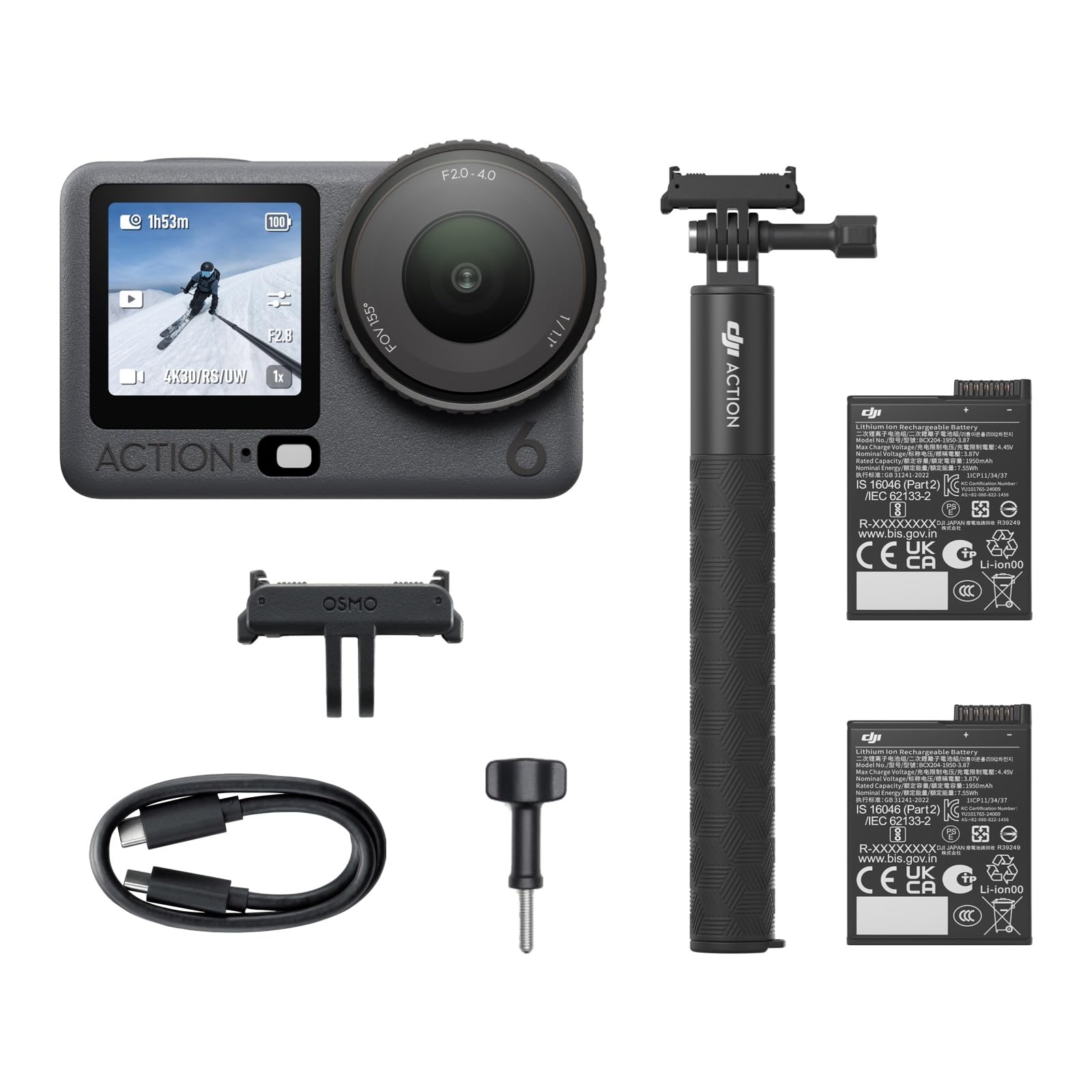
The Osmo Action 6 inherits the same 1950mAh Extreme Battery Plus found in the Action 5 Pro, delivering the same 4-hour continuous 4K recording. But it adds a variable aperture f/2.0–f/4.0 that adapts to lighting conditions, and an upgraded 1/1.1-inch square sensor that can shoot 8K video. The 50GB internal storage means you can record for hours without a memory card — a huge plus for long shoots.
The Capture More Combo includes two batteries and a 1.5m extension rod, giving around 8 hours of total runtime out of the box. Gesture and voice control mean you can start/stop recording hands-free, preserving battery by not keeping the display on. The cold-weather performance matches the Action 5 Pro, with reliable operation down to -20°C.
For vloggers who need dual-mic audio without a receiver, the Action 6 supports direct wireless connection to two DJI Mic 2 transmitters, making it the best battery-life camera for interview-style content creation. The HorizonSteady stabilization eliminates 360° roll shakes, and the 20m waterproof rating adds dive versatility.
Why it’s great
- 4 hours per battery, ~8 hours with Capture More Combo
- 50GB internal storage for backup without card slot
- Variable aperture for optimized power draw in bright light
Good to know
- 8K recording at higher settings drains battery faster
- No lens cap included — front screen protection needed
5. Nikon Z6 III Full-Frame Mirrorless

The Z6 III strikes a strong balance between video power and runtime. Its EN-EL15c battery delivers roughly 2 hours of continuous video recording, and during stills shooting, users report around 600–800 shots per charge. The 6K/60p internal N-RAW recording is power-intensive, but the camera’s power management is noticeably better than the Z6 II, especially at standard 4K 30p.
The EVF is one of the brightest in class at 4000 nits with 120fps refresh, which helps you frame shots without cranking the screen brightness. USB-C power delivery via power bank is supported, making it viable for all-day timelapse or livestream setups. The cold-resistance is average — expect 50% battery life reduction below freezing.
For a full-frame body under the premium tier, the Z6 III offers a compelling mix: professional-grade video specs, reliable runtime for a day shoot, and a form factor that’s lighter than the Z8 but with most of the same video codecs.
Why it’s great
- 6K 60p RAW in a sub- body with good power efficiency
- USB-C power delivery for continuous shooting with external battery
- 4000-nit EVF saves screen battery drain in bright conditions
Good to know
- Real-world video runtime ~2 hours — not for all-day recording
- Cold weather cuts battery capacity significantly
6. Sony a7 III with 28-70mm Lens

The Sony a7 III remains a battery-life legend years after launch. The NP-FZ100 cell was a massive leap over earlier Sony cameras, delivering around 710 stills per CIPA-rated charge in real-world conditions. Users regularly report getting through a wedding reception or a full day of hiking without needing a swap, especially when shooting with the kit lens at standard frame rates.
The 24.2MP back-illuminated sensor combined with the BIONZ X processor is power-frugal compared to the newer 33MP sensor in the a7 IV, meaning the a7 III can actually outlast its successor in pure stills shooting if you’re not hammering the electronic shutter at 10fps. The 693 phase-detection AF points draw minimal power during standby.
While 4K video recording is limited to 30p without oversampling, the camera holds steady at around 90 minutes of continuous recording. For budget-conscious shooters who need a full-frame body that won’t die mid-trip, the a7 III is still a power-efficient workhorse.
Why it’s great
- ~710 shots per charge — more than enough for a full day
- NP-FZ100 battery is robust and reliable
- Kit lens included keeps setup cost low
Good to know
- 4K video capped at 30p with no oversampling option
- Menu system is less intuitive than newer Sony bodies
7. Panasonic LUMIX ZS99 Point and Shoot

The ZS99 is a pocket-sized power bank of a camera. With a 30x optical zoom Leica lens (24–720mm equivalent) and 5-axis Hybrid OIS, it delivers around 6 hours of real-world shooting on a single charge — enough to cover an entire concert or day at a theme park without battery anxiety. Users consistently report getting through full-day events with power to spare.
USB-C charging via Type-C means you can top up from any power bank or laptop, and the 1840k-dot tiltable touchscreen is bright enough to reduce the need for the EVF. The 4K video mode is limited to 15-minute clips for heat management, but in 1080p mode, the camera can record continuously for 30 minutes without shutdown.
The trade-off is the small 1/2.3-inch sensor — low-light performance is not great, and the f/5.6 aperture at telephoto range means you’ll need good light to avoid noise. But for daytime travel, concerts, or daytime wildlife, the runtime is unmatched in the compact zoom category.
Why it’s great
- ~6 hours of battery life — class-leading for compact zooms
- USB-C charging for power bank compatibility
- 30x optical zoom in a pocketable form factor
Good to know
- Small sensor struggles in low light
- 4K video limited to 15-minute clips due to heat
8. Canon EOS R7 with RF-S 18-150mm Kit

The Canon EOS R7 uses the LP-E6NH battery, offering about 2 hours of continuous 4K 60p recording and around 500–700 stills per charge with the 32.5MP sensor. The DIGIC X processor is power-efficient, but the high-resolution APS-C sensor and the in-body stabilization (up to 7 stops) draw noticeable power during heavy use.
What makes the R7 viable for long sessions is the compatibility with Canon’s BG-R10 battery grip, which holds two LP-E6NH cells for double runtime. USB-C charging via power bank is also supported, making it possible to extend recording sessions indefinitely for timelapse or event coverage.
The 15fps mechanical shutter burst is gentler on the battery than the 30fps electronic mode, and the subject detection (people, animals, vehicles) is responsive without excessive power drain. For APS-C shooters who need a balance of resolution and runtime, the R7 holds its own, but it’s not the endurance leader in the mirrorless category.
Why it’s great
- Compatible with BG-R10 battery grip for dual-battery runtime
- USB-C power delivery for power bank charging
- Excellent in-body stabilization reduces need for tripod power
Good to know
- Standard battery ~500–700 shots, not for all-day marathon
- 30fps electronic burst drains battery quickly
9. Canon EOS R7 Mirrorless Camera Bundle

This bundle version of the Canon EOS R7 includes the same camera body and RF-S 18-150mm lens as the standalone kit, but adds a Deco Gear bag, monopod, microphone, and a 64GB SD card. The battery experience is identical — the LP-E6NH provides the same ~2h 4K recording and ~500–700 stills per charge as the standalone R7 kit.
The bundle’s added accessories don’t improve battery life directly, but the inclusion of a monopod with a 2-in-1 tripod grip can reduce power consumption from image stabilization by providing a steady base. The vlogging tripod grip also holds the camera hands-free, allowing you to conserve battery by not using the screen and Wi-Fi continuously.
For beginners or content creators who need a complete setup out of the box, this bundle saves the time and cost of buying accessories separately. Still, the battery runtime is the same as the standalone R7 — plan for a spare LP-E6NH if you shoot events longer than 2 hours.
Why it’s great
- All-in-one bundle with bag, monopod, and memory card
- Same reliable LP-E6NH battery as standalone R7
- Vlogging grip helps reduce power drain from stabilization
Good to know
- Battery runtime ~2 hours — spare recommended for long days
- Bundle may not include extra battery — check contents
10. Nikon Z 7II Full-Frame Mirrorless

Real-world users report that a single charge lasts two separate shoots (morning and afternoon) if you’re not shooting heavy video.
The camera supports USB-C power delivery for charging and continuous power, which is essential given the relatively modest battery life. The built-in vertical battery grip (MB-N11, sold separately) doubles your runtime, and the camera can pull power from a power bank via the USB-C port during long timelapses or studio shoots.
For high-resolution landscape or portrait work, the Z 7II’s battery is adequate for single-day sessions, but it’s not the camera you want for a week-long wilderness trip without charging infrastructure. The dual card slots (CFexpress + SD) add storage flexibility, but the battery is the clear weak point in an otherwise outstanding imaging machine.
Why it’s great
- 45.7MP resolution with good power management for its class
- USB-C power delivery for extended sessions
- Battery grip support doubles runtime
Good to know
- Only 400–500 shots per charge — less than lower-res competitors
- Heavy 4K 60p video drains battery noticeably faster
11. Canon PowerShot ELPH 360 HS + 64GB Card
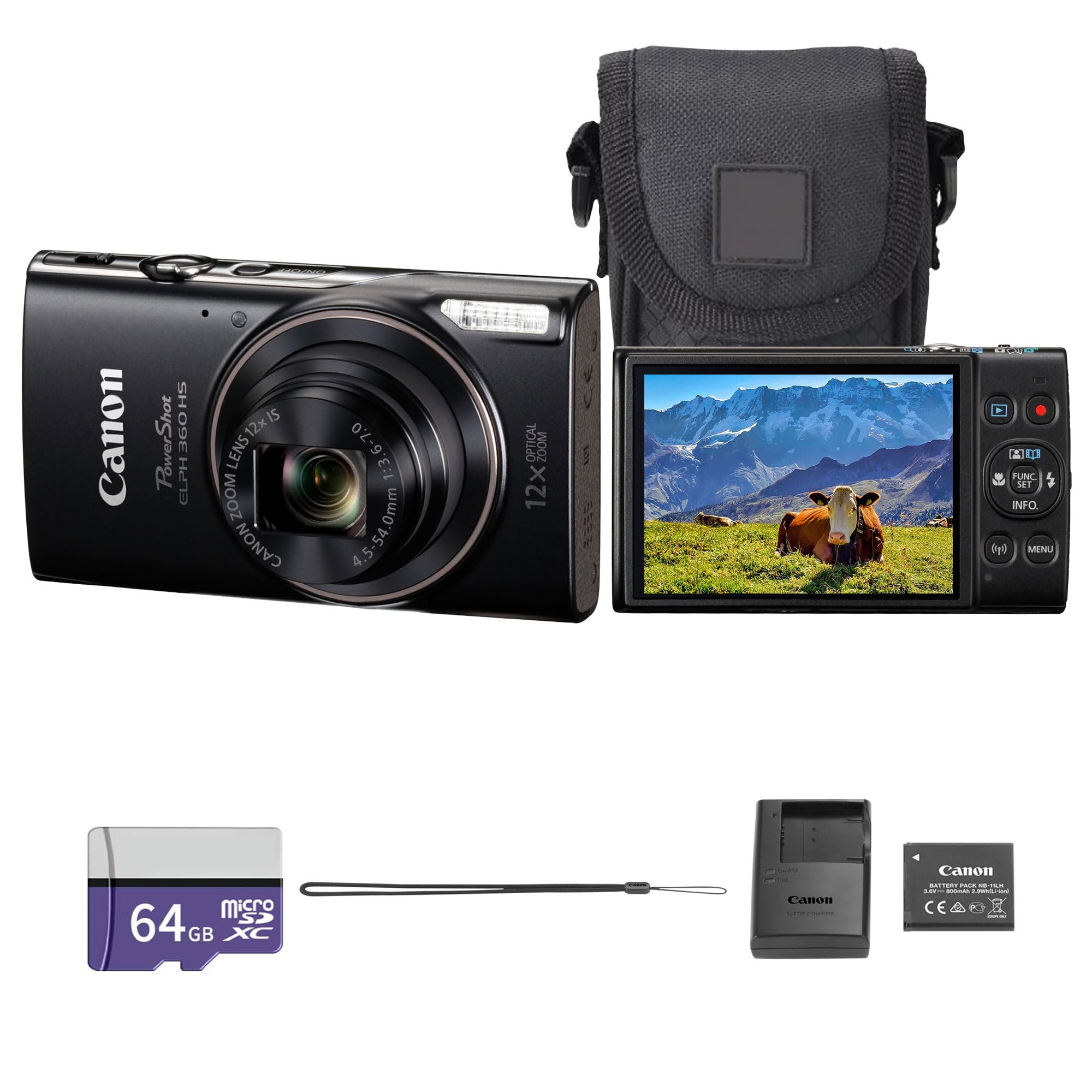
The ELPH 360 HS is a budget-friendly pocket camera that relies on a modest 800mAh lithium-ion battery. In real-world use, this translates to around 300–400 shots per charge with the 12x optical zoom and 20.2MP sensor. The DIGIC 4+ processor is older and less power-efficient than modern processors, but the small sensor and lower resolution help extend runtime compared to APS-C or full-frame bodies.
Full HD 1080p video at 30fps is the only video option, and recording continuously for about 45–60 minutes is possible before the battery dies. The Intelligent IS stabilization helps hand-held shooting but draws additional power. There is no USB-C charging — the camera uses a proprietary battery charger, so you’ll want a spare if you shoot for a full day.
For casual travelers who want a pocket-sized camera for daytime group shots and landscapes, the ELPH 360 HS offers decent runtime for its size and price. But for anyone needing all-day endurance, the Panasonic ZS99 or the action cameras above offer significantly more juice without much extra bulk.
Why it’s great
- Compact and pocketable, easy to carry everywhere
- 12x optical zoom range (25–300mm equivalent)
- Battery charger included — spare battery is inexpensive
Good to know
- Only 300–400 shots per charge — plan for a spare
- No USB-C charging, requires external charger
FAQ
How many shots per charge should I expect from a full-frame mirrorless battery?
Do action cameras last longer than mirrorless cameras per battery charge?
Can I charge a camera via USB-C power bank while shooting?
Final Thoughts: The Verdict
For most users, the best battery life camera winner is the DJI Osmo Action 5 Pro Adventure Combo because it delivers 4 hours of continuous 4K per battery and a stunning 12 hours with the combo pack — all in a rugged, waterproof body that works in extreme cold. If you want full-frame stills and video hybrid endurance, grab the Sony a7 IV for its 2000+ shot runtime. And for a compact zoom camera that lasts an entire day trip, nothing beats the Panasonic LUMIX ZS99.