
Our readers keep the lights on and my morning glass full of iced black tea. As an Amazon Associate, I earn from qualifying purchases.
Specs are compiled from manufacturer listings and verified buyer reviews and can change over time — please confirm the key details on the product page before buying.
A battery pack for camping that survives a full weekend without needing its own recharge is harder to find than it sounds. Many models look good online, but they sag under a CPAP machine, kill your phone twice, and then die before the campfire does. This guide covers four serious power stations head-to-head by capacity, output, charging speed, and portability — so you know which one fits your campsite.
I’m Min — the founder and writer behind Gadgets Feed. This guide is built by comparing the manufacturers’ published specifications and the patterns across verified customer reviews, so you get each pick’s real strengths and trade-offs instead of marketing spin.
The four picks below each take a different approach to keeping you powered off-grid. All deliver the high capacity you need from a real battery pack for camping.
Quick Picks
- BLUETTI Elite 100 V2 Portable Power Station — Best Overall
- BLUETTI AC70 Portable Power Station — Fast Charge Leader
- GRECELL 1000W Solar Generator 999Wh — Lightweight Value
- LIBRIDS Portable Power Station C600, 640Wh — Compact Reliable
How To Choose The Best Battery Pack For Camping
The right campsite power station is not the one with the biggest number in the title. It is the one whose watt-hour capacity, port selection, and recharge speed match how you actually camp. Here is what matters most.
Capacity (Wh) — The Real Runtime Ruler
Watt-hours tell you how much energy the battery stores, so you can judge runtime for any device. A 640Wh pack powers a 60W laptop for about 10 hours, while a 1024Wh pack runs it for 17. Always compare the Wh figure, not just the “power station” label, to see if it covers your full weekend.
Output Ports — AC vs USB vs DC
Check the number of AC outlets (standard wall plugs) for larger gear like CPAP machines or mini fridges. Look for USB-C PD (Power Delivery) ports — these charge laptops at full speed. For group camping, four AC outlets make a bigger difference than a single high-capacity cell. Also look for 12V DC (direct current) ports to power car accessories directly.
Recharge Speed — How Fast It Fills
A power station that takes 8 hours to refill is a liability if you drain it mid-trip. Models that hit 80% charge in under 45 minutes through an AC wall outlet, or accept 500W+ solar input, let you top up between hikes without waiting all afternoon.
Battery Chemistry — Safety and Cycle Life
LiFePO₄ (lithium iron phosphate) batteries are the modern standard for camping power stations. They last 3000 to 4000-plus charge cycles before degrading to 80% capacity. They run cooler and are significantly safer in enclosed tents or vehicles than older lithium-ion chemistries.
Quick Comparison
On smaller screens, swipe sideways to see the full table.
| Model | Best For | Capacity | Output Power | AC Outlets | Amazon |
|---|---|---|---|---|---|
| BLUETTI Elite 100 V2 | Maximum off-grid endurance | 1024Wh | 1800W (3600W surge) | 4 | $449.00$619.00Amazon |
| BLUETTI AC70 | Fast-charging versatility | 768Wh | 1000W (2000W surge) | 2 | $328.99$429.00Limited time dealAmazon |
| GRECELL 1000W | Lightweight group camping | 999Wh | 1000W (2000W surge) | 2 | $279.99$379.99PrimeAmazon |
| LIBRIDS C600 | Compact CPAP backup | 640Wh | 600W (1200W surge) | 4 | $207.97$239.99Limited time dealAmazon |
In‑Depth Reviews
1. BLUETTI Elite 100 V2 Portable Power Station
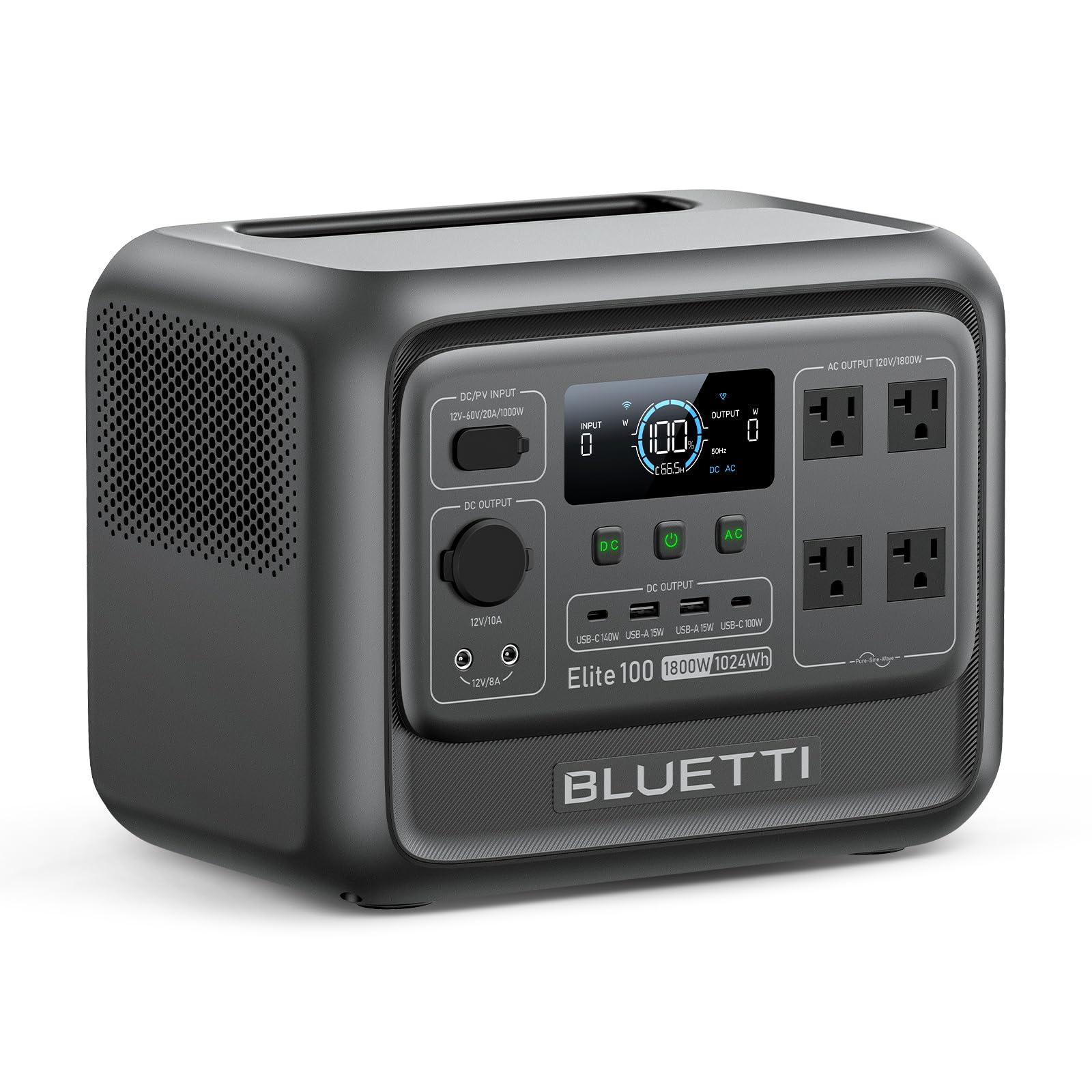
The campsite powerhouse that keeps running long after others tap out, with 1024Wh of capacity.
The BLUETTI Elite 100 V2 earns the top spot because it packs the biggest usable battery here — 1024Wh — into a frame that is 35% smaller than the previous generation. You can run multiple devices at once thanks to four AC outlets (standard wall plugs) rated for 1800W continuous, with a 3600W surge to handle the start-up kick of a mini fridge or power tool. That is 4 AC outlets versus 2 on the GRECELL 1000W below, and 3600W peak wattage versus 1200W on the LIBRIDS C600, so heavier gear is not a problem on a single unit.
It recharges completely in about 70 minutes through AC. Off-grid, you can push up to 1000W solar input to top up between hikes. The built-in UPS (uninterruptible power supply) switchover happens in 10ms — that means Wi-Fi routers and PC desktops run through an outage without a blink. Buyers report it handles a CPAP machine through several nights and powers a mobile notary’s full laptop, printer, and hotspot setup with zero stress. At 25 lbs it is not light, but the hidden handle makes one-handed carries from car to campsite straightforward.
What Lifts It Above
- 1024Wh capacity runs large devices for a full weekend
- 4 AC outlets and 11 total ports handle group gear
- 70-minute AC recharge and 1000W solar input
- LiFePO₄ battery rated for 4000+ cycles to 80%
Where It Might Overshoot
- 25 lbs is heavy for a backpacking load
- No built-in light or wireless charging pad
- App control is handy but cannot power the unit on remotely
Reach for this if: you camp with power-hungry gear (mini fridge, CPAP, multiple laptops) and want the most capacity and fastest solar recharge available in a portable frame.
Know before you take it: at 25 lbs and no light, it is better for car-camping basecamps than solo backpack trips.
2. BLUETTI AC70 Portable Power Station

Fills from flat to full while you make coffee — then powers your whole morning off-grid, recharging from 0-80% in 45 minutes.
The BLUETTI AC70 strikes a sharp balance between size and charge speed. It holds a 768Wh LiFePO₄ battery (lithium iron phosphate, the safer long-life chemistry) and pushes 1000W through two AC outlets, with a 2000W Power Lifting surge to start motor-driven appliances. Its headline talent is AC charging speed: according to buyer reports, it goes from 54% to 100% in roughly 40 minutes, and reaches 0-80% in 45 minutes flat. That is 0-80% in 45 minutes on the AC70 versus a slower recharge on the GRECELL 1000W below, so you can easily top up between hikes.
Solar input maxes at 500W, giving a full charge in under 2.5 hours with the right panel. The BLUETTI App lets you monitor power flow, adjust charge/discharge modes, and update firmware from your phone — something only this pick and the Elite 100 V2 offer. At 22.5 lbs it is lighter than the Elite 100 V2 while still delivering a 768Wh runtime that owners mention powers a Boss Katana 100W amp and five pedals for 8 hours and still had 41% left.
Why It Stands Out
- 0-80% AC charge in 45 minutes
- 768Wh capacity from a proven LiFePO₄ pack
- 100W USB-C PD charges a MacBook Pro 16″ at full speed
- App control for remote monitoring and settings
Where It Cuts Corners
- Only 2 AC outlets — fewer than the Elite 100 V2
- Plastic exterior feels less rugged than metal-framed rivals
- Some customers note it drains faster under continuous high load
Grab this for: anyone who values rapid recharging and wants a mid-capacity pack that can run a campsite’s lights, laptop, and CPAP without carrying a 25-lb brick.
One honest trade-off: two AC outlets mean fewer simultaneous plugs than the Elite 100 V2 or LIBRIDS C600, so plan your device rotation.
3. GRECELL 1000W Solar Generator 999Wh
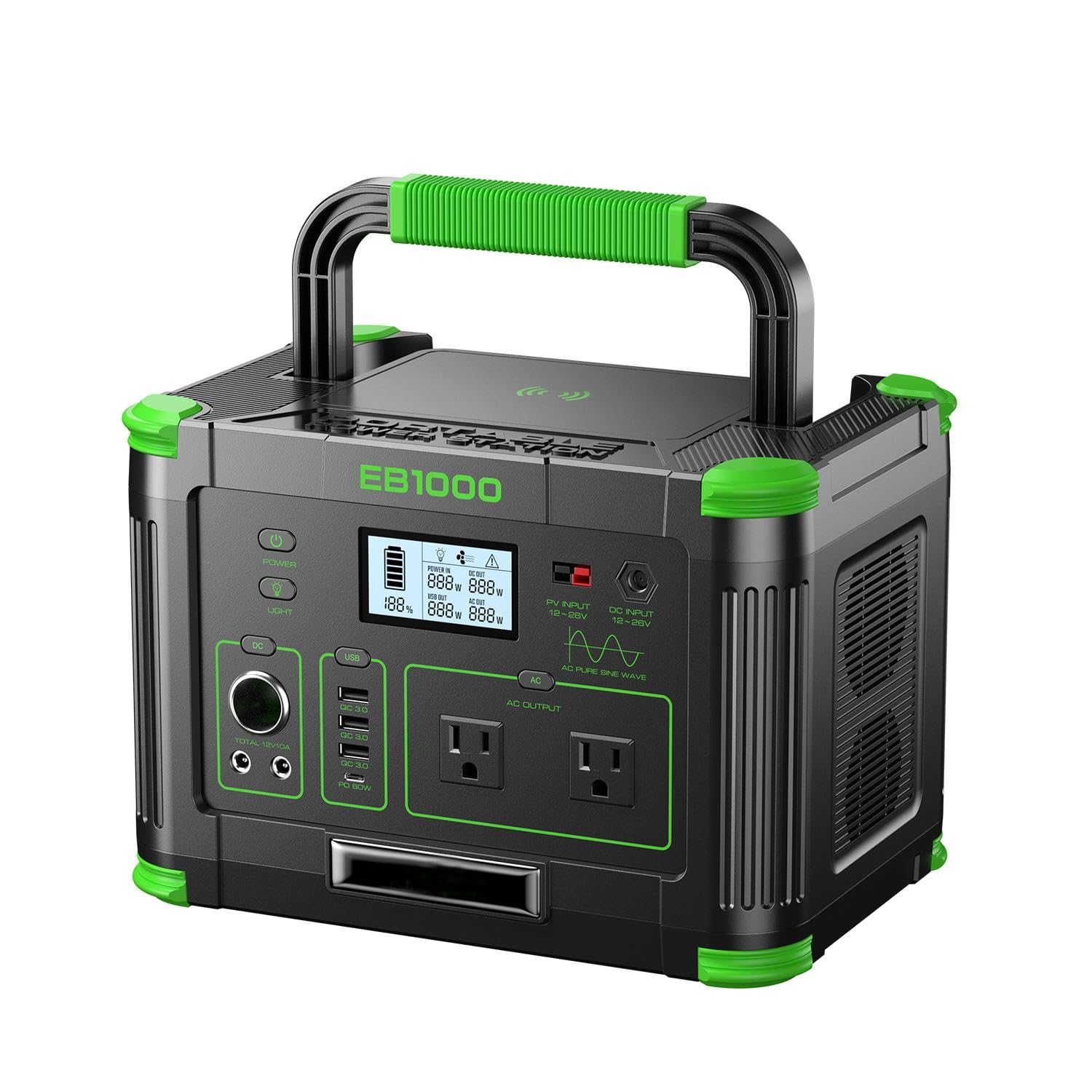
Nearly the same runtime as the premium picks, but at a friendlier weight — 17.86 lbs for 999Wh of capacity.
The GRECELL 1000W delivers 999Wh of capacity, compared with 1024Wh on the Elite 100 V2, in a body that weighs only 17.86 lbs. That makes it the lightest pick here relative to its capacity. It outputs 1000W (2000W surge) through two AC outlets and a total of 10 ports, including a 60W USB-C PD (Power Delivery) port for fast-charging a laptop, a wireless charging pad, and an LED light with SOS mode. Reviewers point out that it held a charge for 5 days of dry camping, running phones, fans, and a headlamp without needing a top-up.
The built-in MPPT (Maximum Power Point Tracking) controller optimizes solar charging to squeeze the most power from a panel on cloudy or indirect sun. Triple-source charging (AC, solar, car) gives flexibility at the campsite. The LCD display shows real-time input and output wattage so you can see exactly how much your gear is drawing. Unlike the Elite 100 V2’s 4 AC outlets, here you get 2. The trade-off is a lighter carry weight and a lower entry point for the same 999Wh capacity that rivals the top-tier models.
What Makes It Smart
- 999Wh at 17.86 lbs — best capacity-to-weight ratio here
- 60W USB-C PD charges a laptop at full speed
- Wireless charging pad and SOS flashlight built in
- MPPT controller extracts maximum solar power
What It Skimps On
- Only 2 AC outlets vs. 4 on the Elite 100 V2 and LIBRIDS C600
- Charging cable uses the older 7909 connector, not XT-60
- No app control for remote monitoring
Choose this if: you want near-top-tier capacity (999Wh) without the weight penalty, and you prioritize carrying comfort over having four AC outlets.
Heads up: the 7909 solar connector is less sturdy than the XT-60 on the BLUETTI models, so treat the port carefully when connecting a panel.
4. LIBRIDS Portable Power Station C600, 640Wh
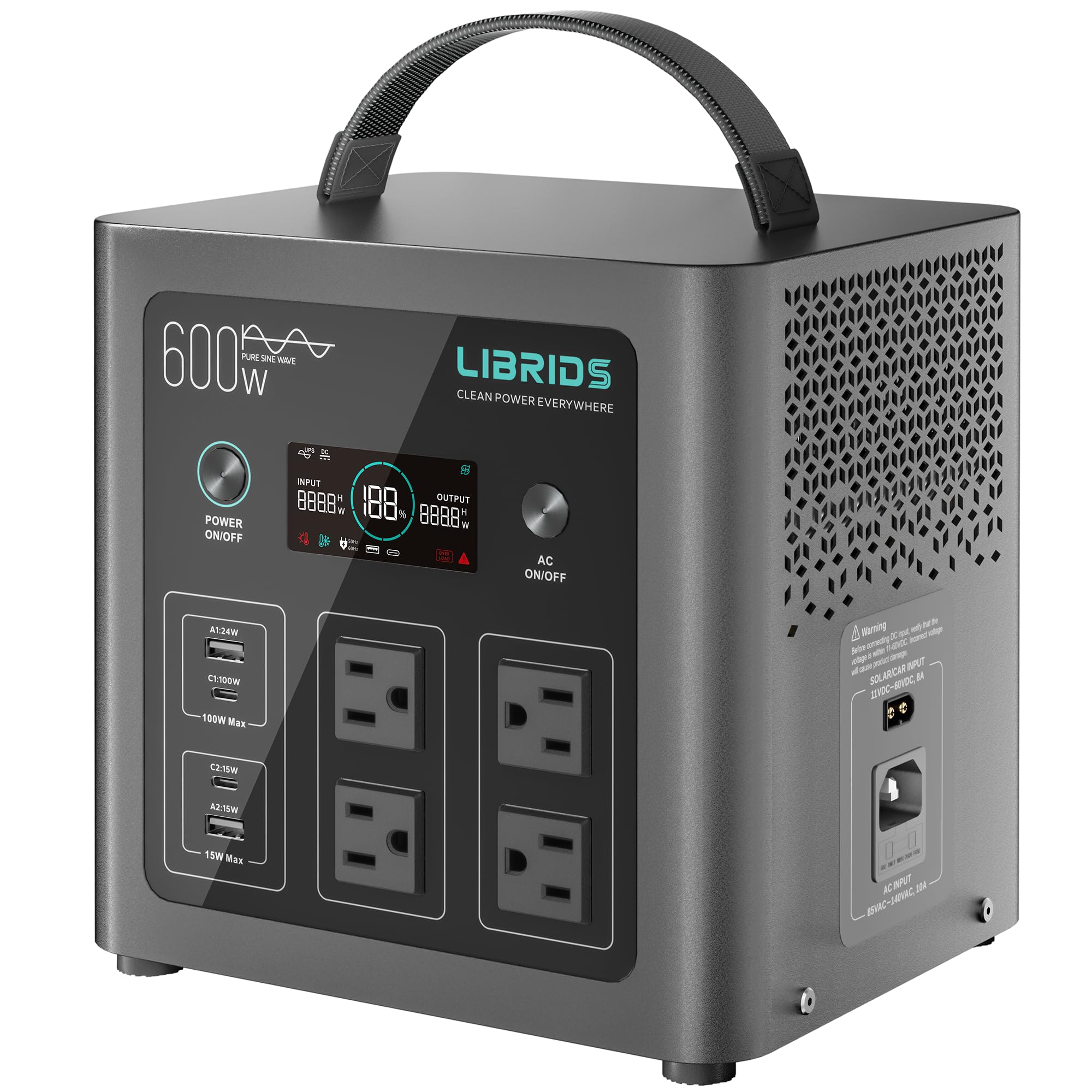
Small enough for a nightstand, rugged enough for a campsite — and a lifesaver for CPAP users, with 4 AC outlets in a 8.3 x 6.9 x 8.2-inch body.
The LIBRIDS C600 squeezes four AC outlets, a 640Wh LiFePO₄ battery, and a 600W inverter (1200W peak) into an 8.3 x 6.9 x 8.2-inch body. That compact metal frame, combined with a comfortable carry handle, makes it the most camp-friendly footprint here. It also outperforms the GRECELL 1000W on AC outlets: 4 vs. 2, so you can plug in a CPAP, phone charger, fan, and lantern simultaneously without a power strip.
Buyers specifically note it ran a Resmed Airsense 11 CPAP for 7 hours using only 24% battery. That means a full tank covers about 29 hours of CPAP use — roughly four nights. The 10ms UPS (uninterruptible power supply) switchover keeps sensitive electronics running through a power flicker without so much as a glitch. Full recharge takes 1.5 hours via AC, and the pure sine wave inverter (which produces clean, stable power that mimics household current) protects medical devices and laptops from damage. The 5-year warranty reduces long-term ownership risk.
The Strong Points
- 4 AC outlets in the smallest physical body of the four
- LiFePO₄ battery rated for 4000+ cycles
- 10ms UPS backup for sensitive medical gear
- Metal enclosure improves heat dissipation and durability
Key Limit
- 640Wh capacity versus 1024Wh on the Elite 100 V2
- 600W output cannot run larger appliances like a mini fridge or microwave
- Indoor/dry-weather label means avoid rain and wet conditions
Ideal for: CPAP campers, solo overlanders, or anyone who needs four AC plugs in a genuinely compact chassis that stows under a car seat or inside a tent’s foot locker.
The hard limit: 640Wh and 600W mean you are covering essentials — not a full kitchen. Grab a bigger unit if you plan to run a mini fridge or power tools.
Understanding the Specs
Watt-Hours (Wh) — Your Runtime Budget
Watt-hours tell you how much energy the battery stores. A 1024Wh pack powers a 50W laptop for about 20 hours, while a 640Wh pack runs it for about 13. Always compare Wh figures between models — not “power station” labels — to see which holds enough juice for your whole trip. Higher Wh means longer runtime but also heavier gear.
Pure Sine Wave vs Modified Sine Wave
A pure sine wave inverter produces the same smooth, clean power your home’s wall outlets deliver. This matters for sensitive electronics like CPAP machines, laptop chargers, and medical devices, which can buzz, overheat, or fail on modified sine wave power. Every pick in this list uses pure sine wave, so you are safe plugging in anything from a phone charger to a printer.
Solar Input and MPPT
Solar input wattage tells you how fast a power station can recharge from a solar panel. MPPT (Maximum Power Point Tracking) is a smart controller that adjusts the load to pull the maximum possible wattage from the panel — especially useful on partly cloudy days. The Elite 100 V2 accepts up to 1000W solar input, while the AC70 maxes at 500W; higher input means faster solar top-ups between activities.
UPS (Uninterruptible Power Supply) Switchover
UPS mode means the power station sits between your gear and the wall outlet, monitoring the current. If the grid power flickers or cuts out, the station switches to battery in 10 milliseconds or less — fast enough that a desktop PC or CPAP machine never even notices the gap. This is a critical feature for home-backup use, less essential for purely off-grid camping where you start on battery anyway.
FAQ
Can a camping battery pack run a CPAP machine through the night?
What is the difference between LiFePO₄ and standard lithium-ion for camping?
How long does a 640Wh battery pack last for camping?
Can I recharge a camping power station with solar panels?
How many AC outlets do I really need for a group camping trip?
Is a 600W power station enough for camping?
What does “UPS backup” mean on a camping power station?
Can I take a LiFePO₄ power station on a plane?
How long does a camping battery pack hold its charge when stored?
What is the difference between peak wattage and continuous wattage on a power station?
Final Thoughts: The Verdict
Across the board, the best battery pack for camping is the BLUETTI Elite 100 V2 because its 1024Wh capacity, 1800W output, and four AC outlets cover everything from CPAP machines to mini fridges with room to spare. If you want the fastest AC recharge in a lighter frame, grab the BLUETTI AC70. And for a genuinely compact unit with four AC outlets that excels as a CPAP backup, the LIBRIDS C600 is the smartest small-battery choice.
How We Picked
We do not accept paid placement, and we did not hands-on test every unit. Instead, we match each pick to a real buyer and use-case by comparing the manufacturers’ published specifications against the patterns in verified customer reviews — so you get each pick’s real strengths and trade-offs instead of marketing copy.
Sources & Methodology
Specifications: manufacturer listings and product documentation. Review insights: verified customer reviews, as of July 2026. Pricing: not shown on this page (it changes often); check the current price via the retailer link.
As an Amazon Associate, Gadgets Feed earns from qualifying purchases. This does not affect which products we feature.
Product prices and availability are accurate as of the date/time indicated and are subject to change. Any price and availability information displayed on Amazon at the time of purchase will apply to the purchase of this product. As an Amazon Associate I earn from qualifying purchases.
CERTAIN CONTENT THAT APPEARS ON THIS SITE COMES FROM AMAZON. THIS CONTENT IS PROVIDED "AS IS" AND IS SUBJECT TO CHANGE OR REMOVAL AT ANY TIME.
Amazon and the Amazon logo are trademarks of Amazon.com, Inc. or its affiliates.