
Our readers keep the lights on and my morning glass full of iced black tea. As an Amazon Associate, I earn from qualifying purchases.
Specs are compiled from manufacturer listings and verified buyer reviews and can change over time — please confirm the key details on the product page before buying.
Polishing your car’s paint usually means dragging a heavy machine and a long extension cord around the garage. But the real trick is getting into those tight spots—around door handles, mirrors, and emblems—without burning through the clear coat. A car buffer kit (a set with a smaller machine and a variety of pads) lets you handle everything from heavy swirl removal to a final wax, all in one box.
I’m Min — the founder and writer behind Gadgets Feed. This guide is built by comparing the manufacturers’ published specifications and the patterns across verified customer reviews, so you get each pick’s real strengths and trade-offs instead of marketing spin.
Below I have broken down the four best options on the market today, comparing power, portability, and included accessories to help you find the right car buffer kit for your next detailing session.
Quick Picks
- BATOCA 6″ Dual Action Car Polisher — Top Performer
- SPTA 3″ Mini Orbital Polisher — Power Pick
- ZOTA Mini Buffer Polisher — Lightweight Champ
- SPTA Cordless Mini Polisher — Cord-Free Freedom
How To Choose The Best Car Buffer Kit
The right buffer kit depends on the size of the job and the space you need to reach. Smaller pads (2 or 3 inches) let you work into tight corners and on curved surfaces, while larger 6-inch pads cover flat panels faster. The motor power, measured in watts, tells you how much cutting force the machine has for removing deeper scratches.
Dual-Action vs. Rotary
A dual-action (DA) buffer moves the pad in a random orbit (a side-to-side pattern that changes each second), which means it is much harder to burn through the paint or leave hologram swirl marks. This makes it the go-to choice for beginners and pros alike who want a safe, forgiving polish. Rotary buffers run in one direction and remove material faster, but they require more skill to use without damaging the clear coat. Every product on this list uses dual-action motion.
Pad Size and What Comes in the Kit
The pads included in a kit determine what you can do right from the start. Foam pads are for applying polish and wax, while wool pads provide a heavier cut for removing oxidation and deeper scratches. A good kit also includes a backing plate (the round disc that holds the pad on the machine), sometimes in multiple sizes, so you can swap between different pads. Look for a kit that gives you at least two pad types so you can compound, polish, and wax without buying extra supplies.
Quick Comparison
On smaller screens, swipe sideways to see the full table.
| Model | Best For | Power (Watts) | Speed (OPM/RPM) | Weight | Amazon |
|---|---|---|---|---|---|
| BATOCA 6″ DA Polisher | Full-car correction with a corded workhorse | 700W | 3800 RPM | 9.2 lbs | $109.99Amazon |
| SPTA 3″ Mini Orbital Polisher | Powerful tight-area polishing without fatigue | 780W | 5500 OPM | 7.1 lbs | $99.99Amazon |
| ZOTA Mini Buffer Polisher | Ultra-light detailing in tight spaces | 380W | 7200 RPM | 3.7 lbs | $69.99$84.99Amazon |
| SPTA Cordless Mini Polisher | Cord-free detailing of emblems and small panels | — | 4500 OPM | 6.6 lbs | $119.99Amazon |
In‑Depth Reviews
1. BATOCA 6″ Dual Action Car Polisher
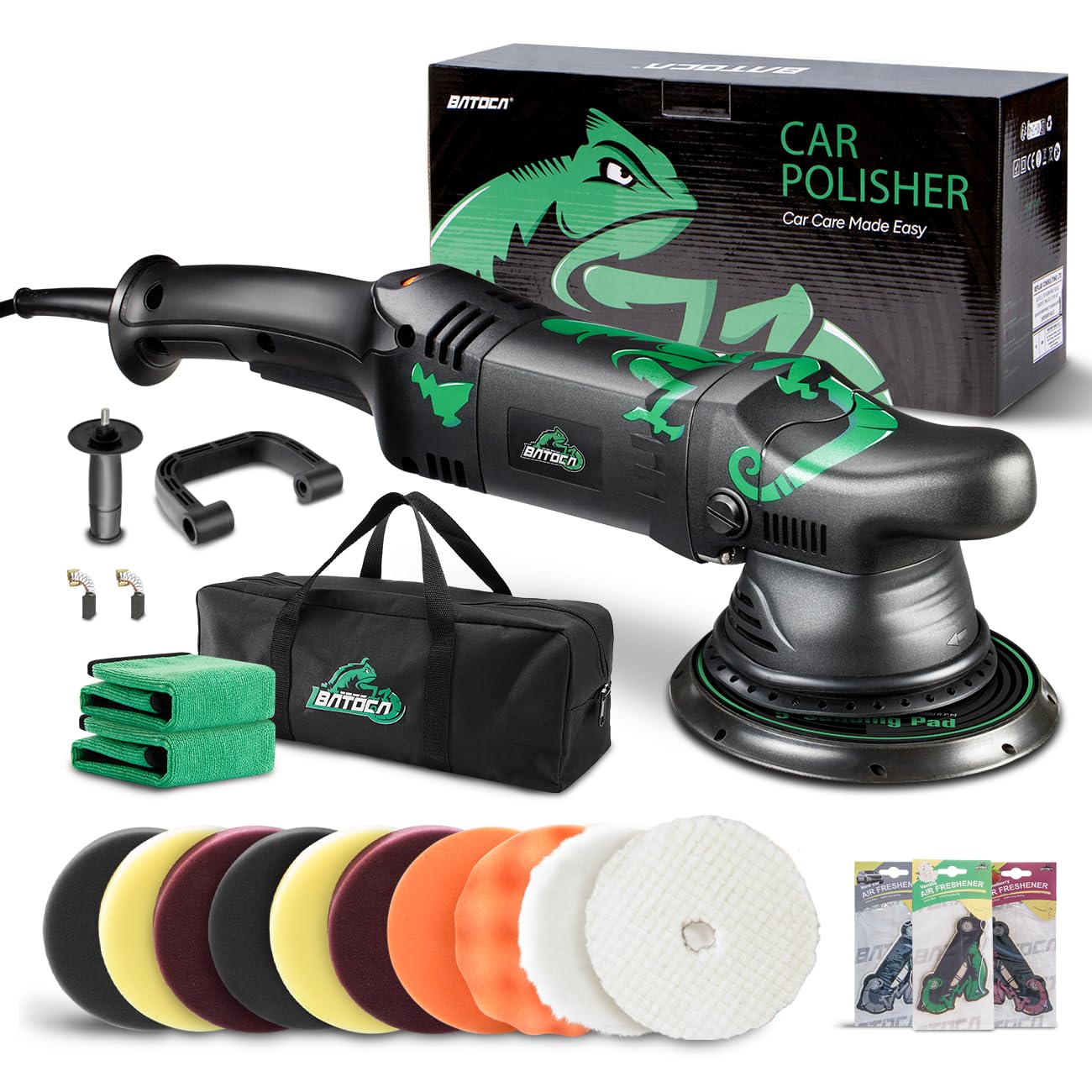
The chameleon-green workhorse that handles a full car without overheating.
If you want to polish an entire sedan in one session, the BATOCA’s 700-watt motor and 6-inch pads make quick work of flat panels. Its 3800 RPM (revolutions per minute) top speed is lower than some competitors, but buyers report they “used to detail 3 cars for 8 hours total” and the machine ran flawlessly. That’s because the motor uses a pure copper winding and has replaceable carbon brushes—tiny electrical contacts that wear down—so when the brushes wear out (roughly every six months per the maker), you can swap them instead of buying a new polisher.
The kit includes foam pads, wool pads, polishing bonnets, sanding papers, a microfiber towel, and a tool bag. The 9.2-pound weight is a double-edged sword: it gives you authority on deep scratches, but at 9.2 lbs versus the ZOTA’s 3.7 lbs, it is noticeably heavier. So you will want both the straight and D-handles attached for control on vertical panels.
Real-world endurance: The motor uses a pure copper winding and has replaceable carbon brushes, so when the brushes wear down—roughly every six months per the maker—you can swap them out instead of buying a whole new polisher.
Reach for this if: you are tackling a full exterior correction on a car, boat, or large panel and you want a complete kit that does not need extra parts.
One trade-off: at 9.2 lbs versus the ZOTA mini’s 3.7 lbs, your arm will feel it after an hour of overhead work on a roof.
2. SPTA 3″ Mini Orbital Polisher

A high-watt mini polisher kit with variable speed control and a generous accessory bundle.
The SPTA pushes 780 watts and uses dual-action motion, giving it a noticeably stronger cut than typical mini polishers. One reviewer even wrote it has “more power & larger orbit than Griot’s G8 at half the price.” The variable speed dial sits right above your thumb and lets you adjust from 2000 to 5500 OPM (oscillations per minute—the number of side-to-side movements per minute) depending on whether you’re waxing or correcting paint.
This kit comes with more than just pads—you get two bottles of scratch remover, a cleaning glove, a tool apron, and a bag to carry it all. The catch is the weight: at 7.1 lbs versus the ZOTA’s 3.7 lbs, a few reviewers mentioned fatigue during long sessions. The lock-on button is also reportedly stiff to operate.
Why it stands out
- 780W motor is the highest wattage in this group, versus the ZOTA’s 380W
- Includes apron, scratch remover, and sanding discs for a full detail kit
Before you buy
- 7.1 lbs is heavy for a “mini”—some buyers reported arm fatigue
- Lock/start switch is hard to engage, according to owners
Grab it for: heavy correction in tight areas where you need real cutting force on a small pad.
skip it if: you prioritize a light, easy-to-handle tool for casual waxing—the ZOTA will feel much more nimble.
3. ZOTA Mini Buffer Polisher
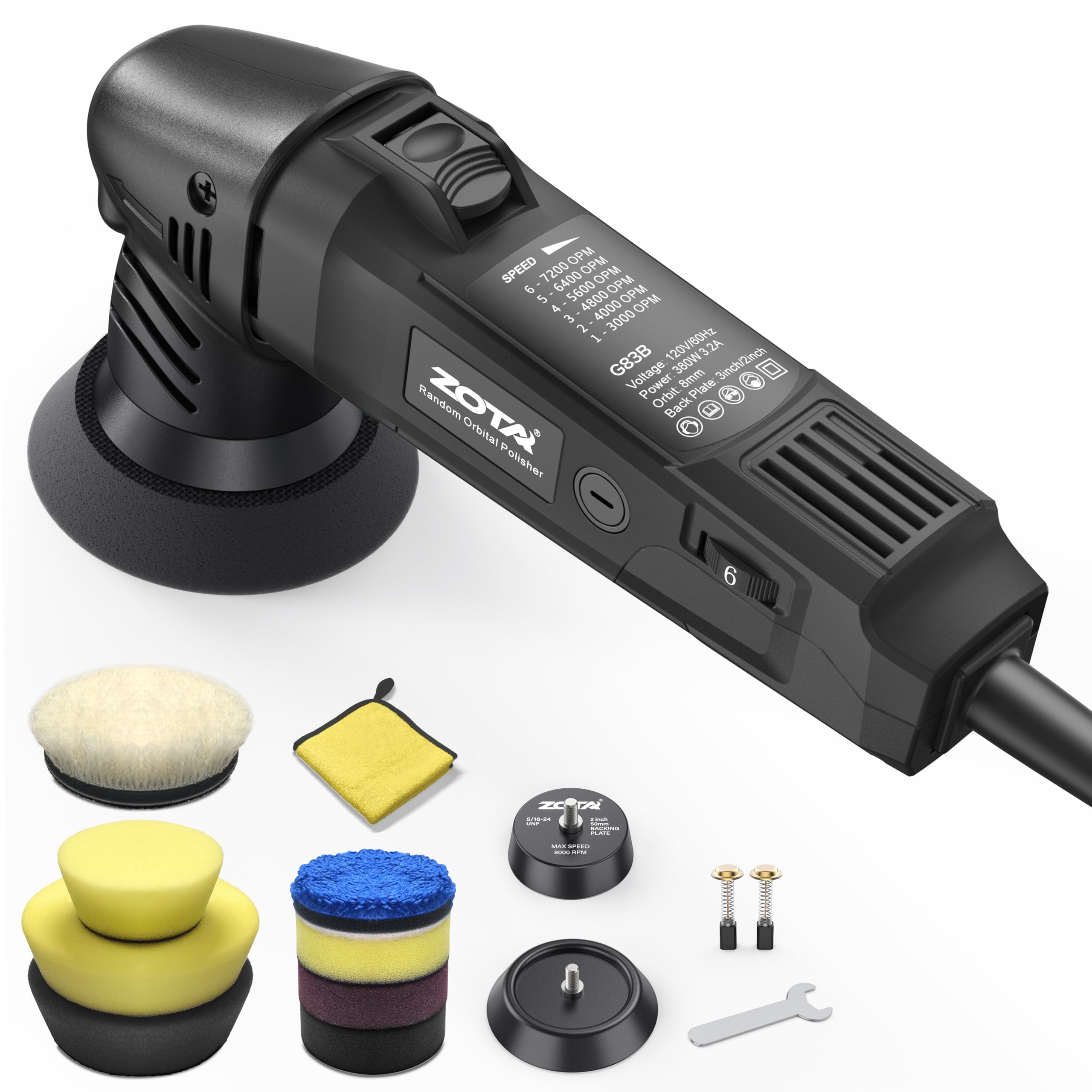
A featherweight that spins fast enough to detail a 22-foot boat without tiring your arm.
At just 3.7 pounds, the ZOTA is the lightest machine here and still packs a 380W motor that spins up to 7200 RPM, versus the BATOCA’s 3800 RPM, which means you can finesse a final wax at a very high rotation without adding heavy pressure. Buyers confirm it works for serious projects: one owner “used for full compound/buff/polish/wax on 22.5ft boat” and said it did not overheat. The body is made from rugged nylon PA6-30%GF (a glass-filled nylon, which resists cracking if you drop it).
The included accessories let you swap between 3-inch and 2-inch backing plates, which is handy for motorcycles or bumpers. You get four 2-inch sponge pads, a 2-inch microfiber finishing pad, a 3-inch wool pad, and a microfiber towel. The one drawback several reviewers pointed out is that the included pads are low quality—they get the job done, but you may want to upgrade to SPTA or name-brand pads for better durability.
Quiet runner: The precision Grissom gears inside keep noise low, so you can work in a residential garage without disturbing neighbors.
Best for: hobbyists and DIYers who want a light, easy-to-control buffer for small cars, boats, or detailing individual panels in tight spaces.
Not ideal for: full-day commercial correction work—the 380W motor is lower-powered than the SPTA’s 780W, so heavy swirls will take longer.
4. SPTA Cordless Mini Polisher
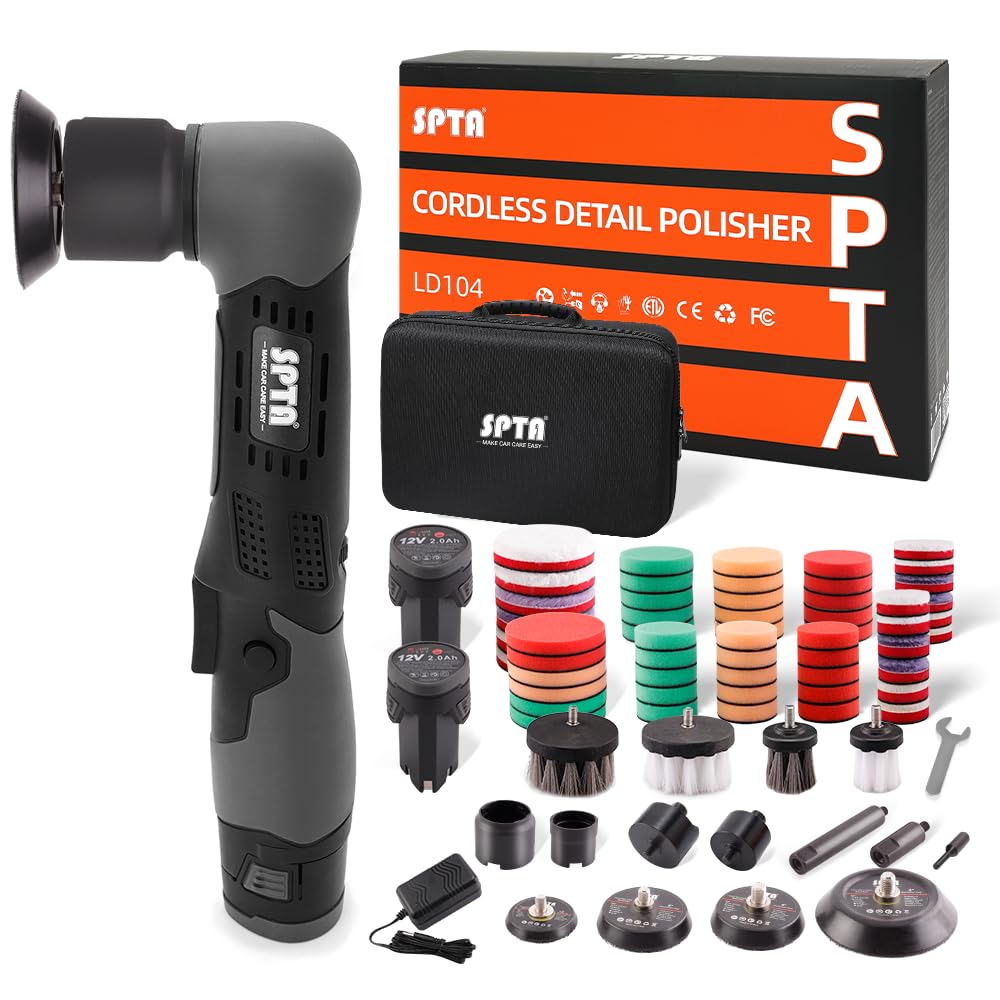
The cordless micro polisher that reaches emblems and door jambs without hunting for an outlet.
For the times when you just need to polish the rear emblems, the mirror edges, or a motorcycle gas tank, the SPTA cordless gives you freedom from the extension cord. One automotive painter noted it is “perfect for denibbing” fresh paint, meaning it gently removes tiny dust nibs without cutting into the new clear coat.
The kit is enormous: two batteries, two extension shafts, four backing plates (25mm, 50mm, 76mm, and 80mm), 21 small polishing pads, 21 medium pads, 12 larger pads, brushes, and a carry bag. The catch is runtime—owners mention 45–55 minutes per battery, which drops after about ten charge cycles. Some units have had the lock-on button fail early, so it is not the most durable option for daily pro use.
Versatile attachments: Because it comes with multiple backing plates and brush heads, you can switch from polishing to cleaning interior vents or dashboard surfaces using the same tool.
Pick this for: spot detailing, motorcycles, and any job where dragging a cord is more trouble than it is worth.
Watch out for: the case is too small to store all the accessories without disassembling them, and the battery life drops over time—not a long-term daily driver for full-car corrections.
Understanding the Specs
Dual-Action vs. Rotary
A dual-action (DA) polisher spins the pad in a random orbital pattern (an unpredictable side-to-side motion), which prevents heat buildup and makes it very hard to burn through your clear coat. This is the safest choice for beginners and ensures a swirl-free finish. A rotary buffer spins in one direction and removes material faster, but it requires skill to avoid leaving hologram marks.
Orbit Size (mm)
The orbit size is the diameter of the circular motion the pad travels. In general, a larger orbit removes more paint per pass and corrects deeper scratches faster, while a smaller orbit produces a finer finish with less cut, which is ideal for applying wax or doing final polishing on already good paint. In this group, the ZOTA uses an 8mm orbit.
FAQ
Can I use a 6-inch polisher on tight areas like door handles and mirrors?
What is the difference between foam pads and wool pads?
How long does a cordless buffer last on a single charge?
Is a dual-action polisher safe for a beginner?
Can I use a car buffer on a boat or motorcycle?
What does OPM stand for and how many do I need?
Do I need to buy extra pads separately?
Why is the SPTA corded polisher heavier than the ZOTA?
Final Thoughts: The Verdict
For most buyers, the car buffer kit winner is the ZOTA Mini Buffer Polisher because it combines an ultra-low 3.7-pound weight, a high 7200 RPM top speed, and a complete set of 2-inch and 3-inch pads that let you detail tight spaces without fatigue. If you want the raw cutting power for heavy correction on large panels, grab the BATOCA 6-inch DA Polisher with its 700W motor and full kit. And for cord-free spot detailing on motorcycles or emblems, the standout is the SPTA Cordless Mini Polisher.
How We Picked
We do not accept paid placement, and we did not hands-on test every unit. Instead, we match each pick to a real buyer and use-case by comparing the manufacturers’ published specifications against the patterns in verified customer reviews — so you get each pick’s real strengths and trade-offs instead of marketing copy.
Sources & Methodology
Specifications: manufacturer listings and product documentation. Review insights: verified customer reviews, as of July 2026. Pricing: not shown on this page (it changes often); check the current price via the retailer link.
As an Amazon Associate, Gadgets Feed earns from qualifying purchases. This does not affect which products we feature.
Product prices and availability are accurate as of the date/time indicated and are subject to change. Any price and availability information displayed on Amazon at the time of purchase will apply to the purchase of this product. As an Amazon Associate I earn from qualifying purchases.
CERTAIN CONTENT THAT APPEARS ON THIS SITE COMES FROM AMAZON. THIS CONTENT IS PROVIDED "AS IS" AND IS SUBJECT TO CHANGE OR REMOVAL AT ANY TIME.
Amazon and the Amazon logo are trademarks of Amazon.com, Inc. or its affiliates.