
Backcountry travel demands gear that performs under pressure, and your beacon shovel probe kit is the final link in the survival chain. A transceiver that loses signal, a probe that bends on impact, or a shovel that snaps mid-dig turns a recoverable situation into a tragedy. The margin for error in avalanche rescue is measured in minutes, not hours, making every gram and millimeter of your rescue system critical.
I’m Min — the co-founder and writer behind Gadgets Feed. For this guide, I’ve spent weeks analyzing the latest transceiver frequencies, antenna configurations, probe locking mechanisms, and shovel blade geometries to separate the life-saving gear from the training-only gear. Every product here earns its spot through measurable specs and real-world reliability data.
A good beacon shovel probe kit combines a 457 kHz digital transceiver with a 240+ centimeter aluminum probe and a sturdy aluminum or steel shovel, but most kits cut corners on at least one component. This guide breaks down the best beacon shovel probe kit options so you know exactly where your money goes.
How To Choose The Best Beacon Shovel Probe Kit
Choosing a rescue kit isn’t like choosing a jacket. Every component must work together under extreme cold, impact, and time pressure. Beginners often grab the cheapest three-piece set without realizing that one weak link can cost precious minutes in a buddy rescue. Here are the three factors that separate a real kit from a toy.
Three-Antenna vs. Single-Antenna Transceiver
The antenna count inside your avalanche beacon directly determines how fast and how accurately it can locate a buried signal. A three-antenna digital transceiver like the BCA Tracker 3 can process signal information from multiple planes simultaneously, giving you a near-instant directional arrow and distance readout. Cheaper single-antenna models force you to manually cross-track, which adds minutes to the search. In a real burial, those minutes are the difference between life and death. Always prioritize a 457 kHz digital transceiver with at least three antennas and automatic mark function.
Probe Locking Mechanism and Length
A flimsy probe that buckles under snow compaction is worse than no probe at all. Look for 240 cm or longer aluminum or carbon fiber probes with a reliable locking system — either a fixed-pin design or a variable-quick lock. Fixed-pin probes are lighter and simpler but require a specific assembly sequence in cold gloves. Lever-lock probes allow faster adjustment but add a few grams. The probe tip should be sharp enough to penetrate hard-packed debris without glancing off. Wall thickness matters more than brand name; a 0.5 mm wall collapses under pressure, while a 1.0 mm wall holds firm.
Shovel Blade Shape and Handle Integration
Your shovel is the tool that moves the snow once the beacon locks the signal and the probe confirms depth. A curved blade with a D-shaped handle provides the best leverage and snow-scooping efficiency. Aluminum blades are lighter but can bend against ice, while hardened steel blades cut through debris but add weight. The handle should extend long enough to allow standing-height digging, because kneeling and scraping exhausts you fast when you’re already at altitude. Some kits include a shovel that locks into the probe handle for compact storage — convenient, but ensure the lock doesn’t fail in cold temps.
Quick Comparison
On smaller screens, swipe sideways to see the full table.
| Model | Category | Best For | Key Spec | Amazon |
|---|---|---|---|---|
| BCA Tracker 3 | Beacon Only | Premium standalone beacon | 3-antenna, 50m range, 215g | Amazon |
| BCA Tracker S + Probe | Bundle | First-time buyers | Tracker S beacon + 260cm aluminum probe | Amazon |
| BCA Tracker 3 (Standalone) | Beacon Only | Reliable mid-range beacon | 3-antenna, motion-activated, 200h Tx | Amazon |
| BCA T S Rescue Package | Full Kit | Complete rescue system | Beacon + probe + shovel + pack | Amazon |
| ACR ResQLink 400 Survival Kit | PLB + Survival | Remote expedition safety | GPS PLB, strobe, signal mirror, whistle | Amazon |
| ACR ResQLink View Survival Kit | PLB + Survival | High-end PLB with display | GPS display, strobe, signal mirror, dry bag | Amazon |
| ACR ResQLink View + ResQFlare Kit | PLB + Flare | Marine and wilderness | View PLB, USCG flare, strobe, dry bag | Amazon |
| Garmin inReach Explorer+ | Satellite Communicator | Two-way text + SOS + maps | Iridium, topo maps, 30h battery | Amazon |
| Garmin Montana 760i | GPS + Communicator | All-in-one navigation | 5″ touch, inReach, 8MP camera, 32GB | Amazon |
In‑Depth Reviews
1. BCA Tracker 3 Avalanche Transceiver Beacon

The BCA Tracker 3 is the benchmark three-antenna digital transceiver that backcountry professionals trust. Its 457 kHz operating frequency and a 50-meter range give you a reliable search radius, while the multiple burial indicator helps you decide whether to dig for a second victim after locating the first. At 215 grams with batteries, it’s light enough that you forget you’re wearing it under a jacket or pack strap.
The auto revert mode switches the beacon back to transmit automatically after two minutes of inactivity, a lifesaver if you’re unconscious after a slide and your partner is also buried. The included harness keeps it snug against your chest with minimal snag risk while riding. Users consistently report strong lock-on distances and easy-to-follow directional arrows even in practice scenarios with multiple targets.
This beacon works best when paired with a quality 260 cm probe and a shovel from a separate purchase, since BCA sells it as a standalone transceiver. If you already own a probe and shovel, the Tracker 3 is the highest-performance beacon you can add to your kit without switching platforms. The AAA alkaline batteries run around 250 hours in transmit mode, giving you a full season of daily tours before replacement.
Why it’s great
- Three-antenna digital processing for fast, precise search vectors
- Auto revert transmit mode adds safety redundancy
- Includes harness and batteries, ready to wear out of the box
Good to know
- Beacon only — no probe or shovel included
- Multiple burial indicator can be confusing without practice
2. BCA Tracker S + Avalanche Probe

This bundle pairs the BCA Tracker S transceiver with a SnowBigDeal 260-centimeter aluminum probe, giving you two of the three essential rescue items in one purchase. The Tracker S prioritizes simplicity — its user interface is intentionally stripped back so you spend less time fumbling with menus and more time searching. Directional arrows and a distance readout appear immediately when you switch to search mode.
The included 260 cm probe is functional but not premium. Users report it works reliably for practice and real scenarios, though the wall thickness is lighter than dedicated high-end probes. Depth markings in centimeters help you estimate burial depth before you start digging. The beacon weighs 0.98 kg combined with the probe, which is reasonable for a complete two-component system.
You will still need to buy a shovel separately to finish your beacon shovel probe kit. The Tracker S itself has a good reputation for signal lock and ease of use, but the probe is the weak link here — consider upgrading to a stiffer probe if you frequently travel in hard snowpacks. For the price, this is a smart entry point for groups building out their first full rescue set.
Why it’s great
- Beacon and probe in one purchase simplifies buying
- Tracker S is one of the easiest digital beacons to use
- 260 cm probe covers most burial depth scenarios
Good to know
- Probe feels less rigid than premium aluminum models
- No shovel included — you need a third purchase
3. Backcountry Access Tracker 3 (Standalone)

The standalone BCA Tracker 3 delivers the same core transceiver technology as the bundled version, but sold separately so you can pair it with your preferred probe and shovel. The motion-activated feature automatically switches from transmit to search mode when it detects movement after a slide — a subtle but critical safety net that reduces the chance of leaving a partner in transmit mode during a rescue.
At 0.22 kg (220 grams), this is one of the lightest full-featured beacons available, and it rides comfortably under any jacket. The LED indicator is bright enough to read in direct sunlight, and the 3600 mAh battery capacity translates to about 250 hours in transmit only or 50 hours in search only. The 50-meter range is standard for digital 457 kHz beacons, but the three-antenna architecture ensures the range is usable, not theoretical.
Users consistently call this the “most reliable transceiver” they’ve owned. It’s certified to North American and European norms, so it works for international backcountry travel. The only trade-off is that you’re buying a beacon only — if you don’t have a probe and shovel already, you’ll spend more building out your kit than buying a prepackaged set.
Why it’s great
- Motion-activated auto transmit mode for hands-free safety
- Lightweight at 220 grams, comfortable for all-day wear
- International certification for global backcountry use
Good to know
- Beacon only — no probe, shovel, or harness included
- Higher total cost if building a complete kit from scratch
4. Backcountry Access T S Rescue Package

The BCA T S Rescue Package is the closest thing to a turnkey beacon shovel probe kit on this list, bundling the Tracker S beacon, a probe, a shovel, and a carry pack into one order. This is the ideal choice for groups outfitting multiple members at once or for a single rider who wants everything ready to go without mixing and matching brands.
The included shovel features a blade designed for dense avalanche debris, and the probe locks securely with a pin system. The pack itself is a low-profile design that sits close to your back to avoid snagging on trees or sled components. Users report the system is comfortable enough for full-day tours and that the beacon interface is intuitive even for first-time owners.
This package prioritizes convenience over component-level optimization. The probe and shovel are functional but not the highest-end options available. If you’re a guide or professional who demands premium stiffness and blade strength, you might prefer sourcing each component separately. For recreational backcountry users, however, this package eliminates the research burden and delivers a coherent system out of the box.
Why it’s great
- Everything in one box — beacon, probe, shovel, and pack
- Low-profile pack design reduces snag risk in trees
- Simple beacon interface suitable for all skill levels
Good to know
- Probe and shovel are entry-level, not pro-grade
- Pack capacity is limited — not for multi-day gear
5. ACR ResQLink 400 GPS Personal Locator Beacon Survival Kit

This isn’t an avalanche beacon in the traditional transceiver sense — it’s a GPS-based personal locator beacon (PLB) that triggers a satellite alert to search and rescue authorities. The ResQLink 400 uses the 406 MHz satellite frequency with built-in GPS to transmit your coordinates globally, making it a critical addition to any deep backcountry or maritime survival kit.
The kit includes the PLB, a C-Strobe H2O rescue light, a Res-Q whistle, a signal mirror, and a RapidDitch dry bag. Unlike avalanche beacons that locate nearby buried victims, this system summons rescue from outside your immediate party. It’s essential for solo travelers or groups where self-rescue via shovel and probe isn’t feasible due to injury or remote location.
The 5-year warranty and long battery storage life make it a set-and-forget addition to a pack. The PLB itself is compact enough to fit in a jacket pocket, and the strobe light improves nighttime visibility. Pair this with a standard avalanche transceiver for complete coverage — the beacon covers companion rescue, and the PLB covers external SAR activation.
Why it’s great
- GPS coordinates transmitted globally for SAR activation
- Compact kit fits in a dry bag for easy pack integration
- Includes strobe, whistle, and signal mirror for multi-modal signaling
Good to know
- Not a substitute for an avalanche transceiver in slide terrain
- Requires registration with national SAR authorities
6. ACR ResQLink View GPS PLB Survival Kit

The ResQLink View upgrades the standard PLB formula with a built-in visual display that shows you GPS signal acquisition status, battery level, and test results. This display eliminates the uncertainty of whether your PLB has locked onto satellites — you can confirm readiness before heading into remote terrain. It’s a small addition that reduces anxiety during extended expeditions.
The kit bundles the PLB with a C-Strobe H2O rescue light, Res-Q whistle, signal mirror, and RapidDitch dry bag. Weighing 0.89 kg, the complete set is heavier than a standalone PLB but still packs smaller than a water bottle. The belt clip is a common complaint — users report it doesn’t hold the unit securely during active movement, so stow the PLB in a secure pocket rather than relying on the clip.
Coast Guard personnel have praised this model as the most advanced consumer PLB they’ve encountered. The 406 MHz signal with GPS embedding means SAR teams get your location within 100 meters rather than the 3-5 km radius of older analog PLBs. For boaters, mountain bikers in remote zones, or hikers pushing deep into wilderness, this is the gold standard for external rescue activation.
Why it’s great
- Visual display confirms GPS lock and battery status
- GPS coordinates accurate to within 100 meters for SAR
- Includes multi-modal signaling kit for day and night
Good to know
- Belt clip design is unreliable during active sports
- Not an avalanche transceiver — companion rescue requires separate beacon
7. ResQLink View GPS PLB & ResQFlare Premium Safety Kit
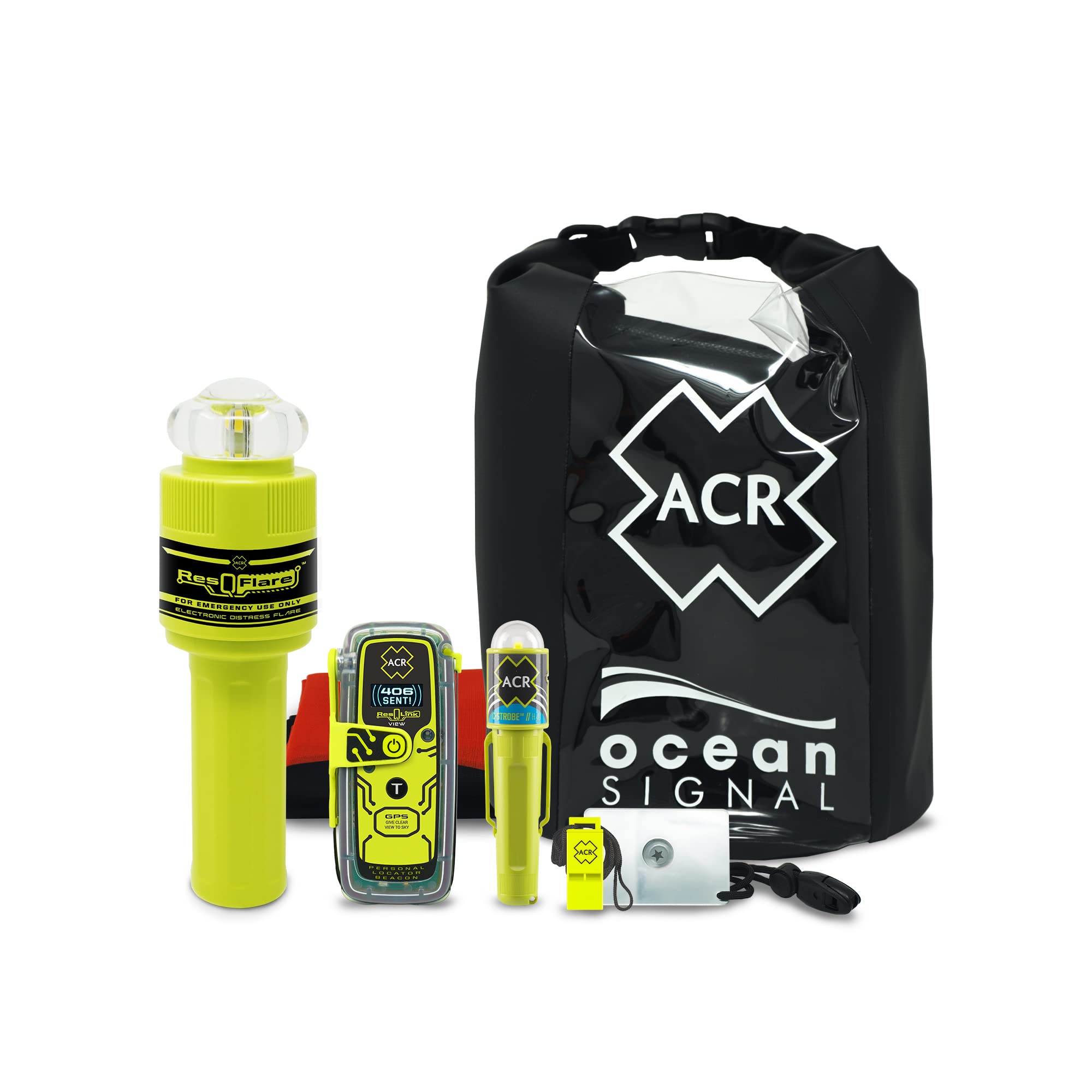
This kit combines the ResQLink View PLB with the ResQFlare US Coast Guard-approved electronic distress flare, creating a comprehensive rescue system for offshore boating and coastal hiking. The electronic flare burns brighter and longer than traditional pyrotechnic flares without the fire hazard, making it a smarter choice for enclosed spaces or fuel-laden environments.
The kit also includes the C-Strobe H2O rescue light, a signal mirror with a USCG-issued Res-Q whistle, a RapidDitch dry bag, and a daytime distress flag. At 2.4 pounds, it’s the heaviest kit on this list, but every component is built for durability in saltwater and extreme UV exposure. The PLB alone covers satellite alert, while the flare and strobe cover visual signaling for boat-to-boat and air-to-surface rescue.
Registering the PLB with the Coast Guard is straightforward, and the 5-year warranty ensures long-term dependability. Users who fish offshore or run coastal patrols consistently rate this kit as the most complete emergency communication package. For backcountry skiing or snowmobiling, this is overkill — an avalanche transceiver and a simpler PLB suffice. But for multi-day maritime or wilderness expeditions, this kit leaves nothing to chance.
Why it’s great
- USCG-approved electronic flare eliminates pyrotechnic hazards
- Comprehensive signaling: satellite, visual, audible, and daylight
- Rugged components designed for saltwater exposure
Good to know
- Heaviest kit at 2.4 pounds, bulky for ski touring
- Over-specified for dry-land avalanche scenarios
8. Garmin inReach Explorer+

The Garmin inReach Explorer+ is a two-way satellite communicator that enables text messaging and SOS alerts over the 100% global Iridium satellite network. Unlike a PLB that sends a one-way distress signal, this device lets you communicate with SAR coordinators, family, and friends — you can explain your situation, request specific assistance, or cancel a false alarm without leaving your partner worried.
Preloaded DeLorme topo maps with GPS routing, a digital compass, barometric altimeter, and accelerometer make this a full navigation tool. The 30-hour battery life in standard tracking mode and IPX7 water rating mean it handles extended trips and rain without shutting down. Pairing with the Earthmate app gives you access to NOAA charts and aerial imagery on your phone screen.
The key limitation is the subscription requirement — an active plan costs /month minimum for safety features and messaging. The inReach Explorer+ does not replace an avalanche transceiver for companion rescue, but it does provide a critical layer of external communication that a beacon cannot offer.
Why it’s great
- Two-way texting over global Iridium network
- Preloaded topo maps with GPS routing for navigation
- IPX7 water rating and 30-hour battery for extended trips
Good to know
- Requires monthly satellite subscription
- Not a companion rescue beacon — use with avalanche transceiver
9. Garmin Montana 760i

The Garmin Montana 760i is a rugged GPS navigator that integrates inReach satellite communication, a 5-inch glove-friendly touchscreen, an 8-megapixel camera, and preloaded TopoActive and City Navigator maps. It’s the most versatile device here, functioning as both a personal navigation system and an emergency communicator, though it does not replace an avalanche transceiver for companion rescue.
With a 32 GB internal memory and microSD expansion, you can store high-resolution satellite imagery, BlueChart g3 charts, and custom waypoints. The 24-hour battery life in GPS mode and 432 hours in expedition mode cover multi-day trips without a power source. MIL-STD 810 rating for thermal, shock, and vibration plus IPX7 water resistance means it survives drops, rain, and dust.
The inReach subscription is required for SOS and two-way texting, but the device’s primary strength is en-route navigation rather than pure emergency response. Pair this with a dedicated avalanche transceiver like the BCA Tracker 3 for complete backcountry coverage — the Montana handles route finding and external communication, while the beacon handles companion rescue. For ATV riders, snowmobilers, and four-season explorers, this is the ultimate command center.
Why it’s great
- 5-inch color touchscreen works with gloves and in rain
- Built-in 8MP camera with geotagging for waypoint capture
- 432-hour expedition mode for multi-day unpowered trips
Good to know
- Heavier and bulkier than dedicated avalanche beacons
- Requires subscription for two-way satellite messaging
- Not a substitute for a 457 kHz avalanche transceiver
FAQ
Does a GPS PLB replace an avalanche transceiver for companion rescue?
What length probe should I carry for typical avalanche terrain?
Can I mix a BCA beacon with a non-BCA probe and shovel?
Final Thoughts: The Verdict
For most users, the best beacon shovel probe kit winner is the BCA Tracker 3 Avalanche Transceiver because its three-antenna digital processing, auto revert mode, and lightweight 215 g design give you the highest probability of a fast, accurate companion rescue. If you want a complete bundle with probe, shovel, and pack included, grab the BCA T S Rescue Package for a turnkey system that simplifies group outfitting. And for expeditions beyond avalanche terrain where SAR activation is needed, nothing beats the ACR ResQLink View Survival Kit for reliable satellite-based emergency communication. Build your kit around the tools that maximize your survival window — every minute counts.