
A stud finder is the one tool that separates a clean wall mount from a repair bill. Whether you are hanging a heavy TV, a floating shelf, or a heavy mirror, drilling into empty drywall guarantees a collapse. The best beam finder tool detects wood and metal studs, live AC wiring, and hidden pipes so you hit solid framing every time.
I’m Min — the co-founder and writer behind Gadgets Feed. After spending many hours comparing detection depths, sensor counts, and calibration systems, I compiled this guide to match a tool to your exact wall type and project size.
For a clean and safe installation, start by choosing the right beam finder tool that matches your wall material and depth requirements.
How To Choose The Best Beam Finder Tool
Picking a stud finder means matching the sensor technology to your wall construction. A standard drywall stud is 1.5 inches deep, but lath and plaster, double drywall, or fire-rated walls require deeper penetration and more sophisticated scanning.
Detection Depth and Mode
Most basic stud finders work at 0.75 inches. For thicker walls, a model with a DeepScan mode that reaches 1.5 inches (or more) is necessary. The best beam finder tools also offer dedicated modes for metal, non-ferrous metal, and AC wires, each with a different maximum depth.
Sensor Count and Calibration
Single-sensor models require a manual swipe and calibration. Multi-sensor units, such as the Franklin Sensors line with 13 sensors, display the full width of the stud instantly and do not need calibration. This speed and accuracy can justify a higher budget if you work on multiple walls.
Additional Features
Integrated laser levels, bubble levels, audio alerts, and color-coded LED rings make marking easier. A positioning hole or a pencil caddy helps you transfer the location without moving the tool. Battery type is also a consideration; rechargeable models eliminate the need for spare 9V or AA cells.
Quick Comparison
On smaller screens, swipe sideways to see the full table.
| Model | Category | Best For | Key Spec | Amazon |
|---|---|---|---|---|
| Franklin Sensors ProSensor MAX | Premium | Plaster & Double Drywall | 2.5 in max depth | Amazon |
| Bosch Professional GMS 120-27 | Premium | Jobsite Durability | 120mm wood depth | Amazon |
| Franklin Sensors ProSensor 710+ | Premium | Instant Full-Width View | 13 sensors | Amazon |
| Zircon MultiScanner A200 | Mid-Range | Center-Finding Precision | DeepScan & StudScan modes | Amazon |
| PREXISO 2-in-1 with Laser Level | Mid-Range | Leveling & Marking | Built-in laser level | Amazon |
| FNIRSI 6-in-1 Stud Finder | Value | Multi-Material Detection | Rechargeable battery | Amazon |
| Zircon StudSensor A100 | Budget | Simple Edge Detection | WireWarning AC alert | Amazon |
In‑Depth Reviews
1. Franklin Sensors ProSensor MAX

The ProSensor MAX raises the bar with 13 sensors that display the full width of a stud — edges and center simultaneously — without any calibration step. Its maximum detection depth of 2.5 inches makes it ideal for older homes with lath and plaster, condos with double drywall, or earthquake-resistant walls with OSB behind the sheetrock. Just press and hold, and the wide LED array lights up exactly where the framing lies.
A second detection mode handles two-plus layers of drywall and heavy tile, a capability that budget finders cannot match. The built-in bubble level and pencil caddy speed up marking, and the durable plastic body withstands job site bumps. Users report that the tool finds studs in ten to fifteen seconds, no test holes needed.
Two AA batteries power the unit, and the low battery indicator prevents surprises mid-project. If you frequently work on older or multi-layer walls, this model delivers the most confidence and fastest results. Its larger footprint is a trade-off for its accuracy.
Why it’s great
- Detects through plaster, double drywall, and tile
- Shows full stud width instantly without calibration
- Rugged build and long battery life
Good to know
- Does not differentiate studs from pipes or electrical
- Larger than standard finders; no carrying case included
2. Bosch Professional GMS 120-27
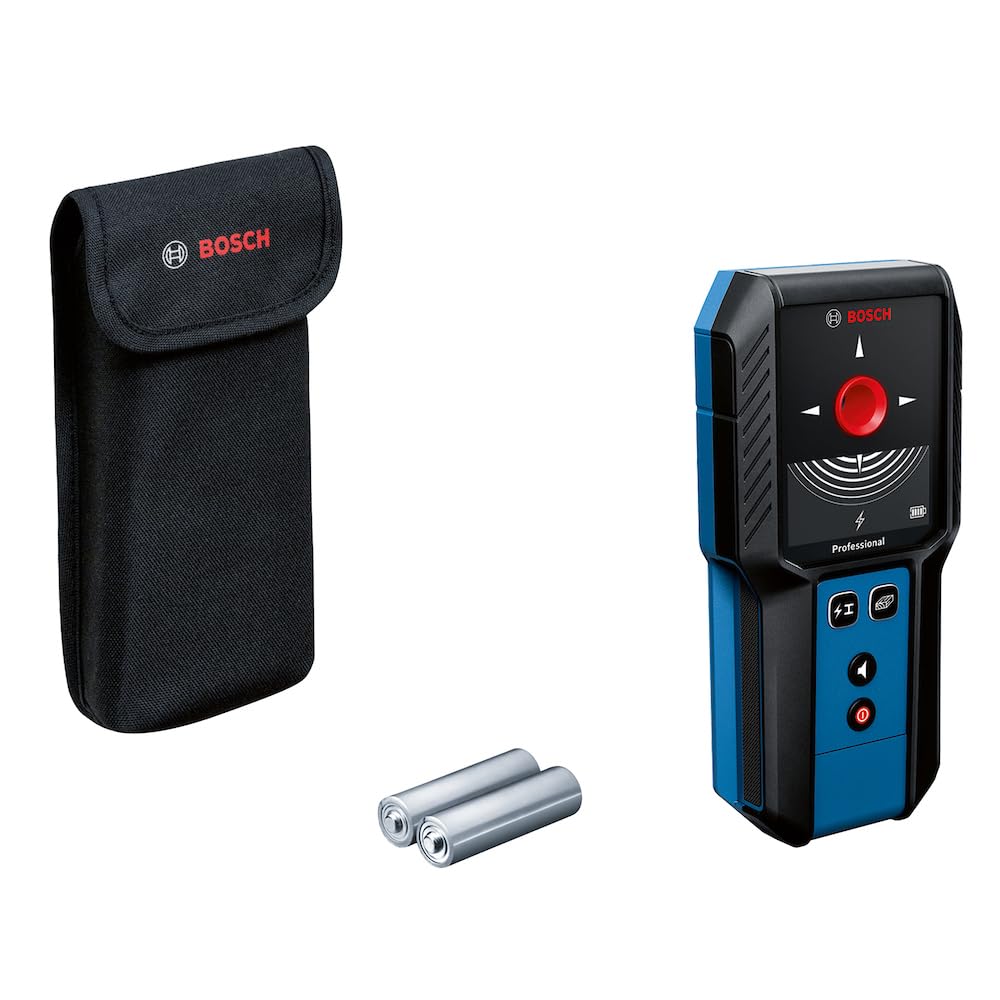
Bosch’s GMS 120-27 is a jobsite-grade multi-detector with a tri-color LED ring that shifts from green to yellow to red as you approach an object. The display identifies whether the target is magnetic metal, non-magnetic metal, live cable, or non-metallic material — a level of material differentiation most consumer finders skip. It detects wood up to 120mm and live wires up to 50mm.
The shock-absorbing rubber housing and IP54 dust and splash protection mean this tool holds up on construction sites and renovations. The simplified mode selection and center-marking aperture let you work quickly without referencing the manual. A protective bag and two AA batteries are included.
Users praise its accuracy on metal and wire detection, though some note that high battery consumption is a minor drawback. For professionals needing a rugged, precise detector that differentiates materials, this model sets a high standard. Its depth display limitation does not affect practical results.
Why it’s great
- Identifies magnetic vs non-magnetic metal objects
- Rugged rubber housing with IP54 protection
- Clear tri-color LED guidance for instant feedback
Good to know
- No depth display on screen
- Higher battery consumption than some competitors
3. Franklin Sensors ProSensor 710+

The ProSensor 710+ brings Franklin’s patented 13-sensor technology into a more affordable package. Its wide LED display lights up to show both edges and the center of a stud simultaneously, which eliminates the guessing game of single-sensor models. No calibration is required — just press the button and slide across the wall.
This model auto-adjusts for depth through one layer of drywall up to 1.6 inches. The integrated bubble level and ruler lines on the housing make alignment and measurement faster. It weighs only 6.4 ounces, so it is easy to handle for extended sessions, and the compact design fits in a tool bag.
Users report accurate detection even on heavily textured walls, a common pain point for budget finders. It requires two AA batteries. For DIYers who want professional-level speed and accuracy without the premium price of the MAX, this is the sweet spot.
Why it’s great
- Display shows full stud width in real-time
- Works accurately on textured walls
- Lightweight and simple operation
Good to know
- Not suitable for plaster or double drywall
- No AC wire detection mode
4. Zircon MultiScanner A200

The Zircon A200 is a center-finding stud scanner with a bright SpotLite beam that projects directly onto the wall to mark the target. It offers separate StudScan, DeepScan, Metal Scan, and AC Scan modes, each tuned to a specific detection depth. The Auto-Correcting Technology (ACT) reduces false positives caused by common scanning errors.
The large LCD display shows clear icons for stud edges, center, and wire alerts, while audio tones and on-screen indicators guide your hand. The A200 detects wood and metal studs up to 0.75 inches in StudScan mode and increases to 1.5 inches in DeepScan. Metal Scan locates rebar, and AC Scan warns of live unshielded wires up to 2 inches deep.
Weighing 0.37 kilograms, it feels solid and balances well. Users highlight its accurate center marking and battery level indicator. An IP54 rating adds durability. It is an excellent choice for those who want a feature-rich tool with a clear digital readout.
Why it’s great
- Projected SpotLite beam for hands-free marking
- Multiple dedicated scan modes for wood, metal, and AC
- ACT technology minimizes false readings
Good to know
- Occasional false readings on uneven walls
- Larger footprint than basic models
5. PREXISO 2-in-1 Stud Finder with Laser Level

PREXISO combines a stud finder and a manual-leveling laser level into one rechargeable device. When the stud finder mode detects a stud edge, it automatically projects a vertical laser line onto the wall, while the top LED lights turn red and an audio alert sounds. This dual feedback makes marking fast and accurate.
The device detects wood and metal studs up to 0.75 inches deep and live AC wires up to 1.5 inches. A 360-degree rotating wall mount and self-adhesive strips provide flexible mounting. The laser level uses two bubble vials for horizontal, vertical, or cross-line alignment, with a working range of 30 feet indoors.
It is powered by a built-in rechargeable battery charged via USB-C. Users note that the laser is not self-leveling, so the bubble vials must be centered manually. This tool is ideal for hanging pictures, installing shelves, or any project where both stud location and level alignment are needed.
Why it’s great
- Auto-projecting laser line for instant marking
- Rechargeable via USB-C, no battery hassle
- Versatile wall mount and carrying bag included
Good to know
- Laser is manual-leveling, not self-leveling
- Not designed for lath and plaster walls
6. FNIRSI 6-in-1 Stud Finder

The FNIRSI 6-in-1 packs six detection modes into a compact, rechargeable unit. It offers Exact Scan for wood and metal studs up to 0.75 inches, Depth Scan up to 1.5 inches, dedicated scans for ferrous and non-ferrous metals, AC wire detection, and a copper wire scan that reaches 1.6 inches. The newly designed positioning hole helps you mark both center and edges precisely.
A digital LCD display and audio alarm confirm detections, and auto-calibration simplifies the start of each session. Being rechargeable via an internal lithium polymer battery eliminates the need to buy 9V or AA cells. The body weighs 9.3 ounces and glides smoothly over painted, wallpapered, or acoustic surfaces.
Users find it accurate and easy to use, especially for the price. It works well on drywall and wood walls. For entry-level and mid-range budgets, this tool provides a wide detection range without recurring battery costs.
Why it’s great
- Rechargeable battery saves long-term cost
- Six detection modes including copper wire
- Positioning hole for precise marking
Good to know
- Battery is not user-replaceable
- Depth scan maxes at 1.5 inches
7. Zircon StudSensor A100

The Zircon StudSensor A100 is a simple edge-finding stud detector with WireWarning AC detection that alerts you to live, unshielded wires up to 2 inches deep. It reliably finds the edges of wood and metal studs up to 0.75 inches deep, making it suitable for basic drywall projects like hanging shelves or pictures.
The easy-to-read display and audio indicators work well in varied lighting. Its ergonomic grip fits the hand comfortably, and the compact 8.4-ounce body reduces fatigue during long scans. A single 9V battery powers it, though one is not included in the box.
Users note that performance depends heavily on fresh batteries — a weak battery causes false beeps and errors. Once calibrated correctly, it provides consistent edge location. This is the go-to choice for budget-conscious users or as a backup tool.
Why it’s great
- Affordable and reliable for basic stud finding
- WireWarning AC detection adds safety
- Lightweight and comfortable to hold
Good to know
- Requires a fresh 9V battery for accurate reading
- Occasional inconsistency on textured walls
FAQ
Can I use a stud finder on a textured or popcorn ceiling?
Why does my stud finder beep even when no stud is present?
What is the difference between edge-finding and center-finding stud finders?
Will a stud finder detect pipes or rebar?
Final Thoughts: The Verdict
For most users, the beam finder tool winner is the Franklin Sensors ProSensor MAX because it handles plaster, double drywall, and OSB without calibration and reveals the full stud width instantly. If you want a rugged, material-identifying detector for the job site, grab the Bosch Professional GMS 120-27. And for DIY projects on standard drywall at a great price, nothing beats the Franklin ProSensor 710+.