
The moment your circuit behaves erratically and your multimeter shows voltage ripple you didn’t expect, you realize the bench power supply isn’t just a box of watts — it’s the single most important tool for repeatable, trustable electronics work. Choosing poorly means chasing ghosts in your prototypes.
I’m Min — the co-founder and writer behind Gadgets Feed. I’ve spent hundreds of hours dissecting the voltage regulation, ripple specs, display accuracy, and build quality of these supplies to separate real lab tools from overhyped imports.
Whether you repair circuit boards, power up Arduino projects, or test battery packs, this guide breaks down the hard specs that matter so you can confidently choose the best bench power supply for your actual workbench needs.
How To Choose The Best Bench Power Supply
Not all bench supplies deliver the same noise floor or resolution. The core decision hinges on your test circuits: sensitive analog gear demands a linear supply with sub-20mV ripple, while digital logic and battery charging tolerate a clean switching unit. Your choice must match both voltage/current range and output quality.
Linear vs. Switching Topology
Linear supplies use a heavy transformer and linear regulator to produce an exceptionally clean output — ripple typically under 5mV. They’re heavier, less efficient, and run warm, but essential for audio, radio, and precision analog work. Switching supplies are compact, efficient, and cheaper, but output ripple often exceeds 20mV, which can couple into sensitive circuits.
Display Resolution and Readback Accuracy
A 3-digit display showing 0.1V steps is fine for basic power-on testing, but a 4-digit IPS screen with 0.01V and 0.001A resolution lets you set precise bias points and verify output without a separate multimeter. Premium units offer curve graphing to visualize load changes over time.
Protection and Safety Features
Overvoltage protection (OVP), overcurrent protection (OCP), and short-circuit protection are non-negotiable for protecting prototype boards. Thermal protection and intelligent fan control extend the unit’s life during long burn-in sessions. Always check whether the protection thresholds are user-configurable.
Quick Comparison
On smaller screens, swipe sideways to see the full table.
| Model | Category | Best For | Key Spec | Amazon |
|---|---|---|---|---|
| Tekpower TP3005T | Linear Benchtop | Low-noise analog work | 0.1V / 0.01A resolution | Amazon |
| KORAD KD3005D | Linear Lab Grade | Precision current limiting | 1mV / 1mA steps | Amazon |
| Abestop AT6301 | Switching Programmable | High-power auto-ranging | 60V / 10A / 300W | Amazon |
| Kiprim DC605S | Programmable Switching | List mode and PC control | 10mV / 1mA resolution | Amazon |
| Naweisz NP6005 | Switching Benchtop | High-voltage battery testing | 60V / 5A (300W) | Amazon |
| FNIRSI DPS-150 | Compact Switching | Portable repair and field use | <20mV ripple | Amazon |
In‑Depth Reviews
1. Tekpower TP3005T
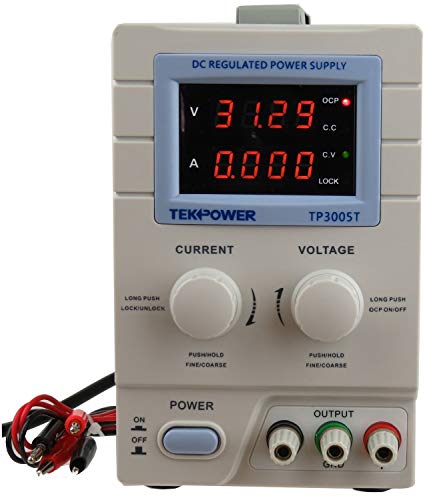
The Tekpower TP3005T is a true linear supply that delivers the lowest ripple floor in this roundup — critical for analog circuits and communications gear where even 20mV of noise masks signals. Its hefty 12-pound transformer block and metal chassis suppress mechanical resonance, while the back-lit LED display shows voltage and current with 0.1V and 0.01A resolution. Users confirm it maintains 0.01V accuracy against a multimeter even under sustained load.
The dual coarse/fine rotary controls take a few minutes to learn — you press the knob to toggle between digit positions — but once mastered, they allow precise 0.01V adjustments. The built-in thermo-sensor automatically activates the cooling fan only when needed, keeping the bench quiet during low-power tasks. The automatic CV/CC mode switching is reliable and handles repeated short circuits without hiccups.
On the downside, the banana plug binding posts feel slightly intermittent with thicker test leads, and the unit emits a noticeable paint curing odor during the first few hours of use. At 12 inches deep, it demands bench space. But for low-noise linear regulation, the TP3005T is the clear value king under premium pricing.
Why it’s great
- True linear topology with sub-5mV ripple for sensitive analog loads
- Thermo-controlled fan stays off at low current for silent operation
- CV/CC mode transitions smoothly without output glitches
Good to know
- User interface takes 10 minutes to learn due to knob-based digit selection
- Binding posts may need replacing for reliable banana plug contact
- Large footprint — not suitable for crowded benches
2. KORAD KD3005D

The KORAD KD3005D is a linear supply prized for its exceptionally fine control — voltage steps down to 1mV and current steps to 1mA make it ideal for biasing transistors and testing low-power sensor circuits. The dual 4-digit LED displays are bright and readable from across the lab, and users have run the unit non-stop for a full week without any thermal shutdown, proving its conservative heat sink design.
The front-panel controls use a digit-selection knob: you choose which digit to adjust and turn to set it. This prevents overshoot but can cause large voltage jumps if you’re not careful with the digit position. The constant current mode is widely praised — several experienced users rate it as more stable than units costing twice as much. The auto-ranging fan is quiet at low loads but hits 57 dB SPL under high current.
Two known quirks: the output voltage can spike momentarily on power-on, so disconnect sensitive loads before cycling AC power, and the current reading may drift 3–6% against a precision DMM. The reverse-voltage protection diode is fragile — connecting a battery backwards can short it. Overall, a solid hobbyist-grade linear supply with lab-like resolution.
Why it’s great
- 100x finer resolution than 0.1V supplies — 1mV steps for precision bias setting
- Constant current mode outperforms many higher-priced units in stability
- Compact footprint for a linear supply at 9 pounds
Good to know
- Output voltage spike on power-on can damage sensitive circuits without external protection
- Fan noise reaches 57 dB at high load — noticeable in quiet labs
- Current readback accuracy may vary 3–6% between units
3. Abestop AT6301
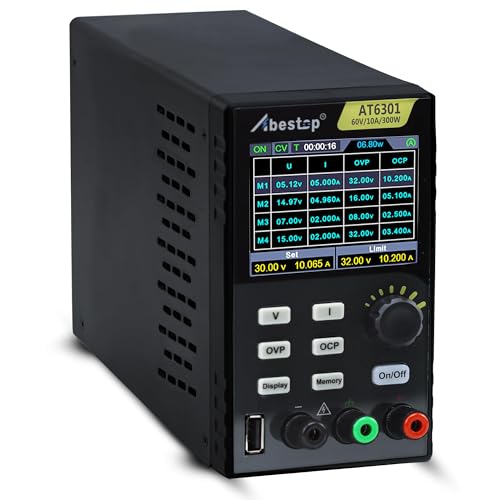
The Abestop AT6301 delivers the widest output envelope in this list: 0–60V and 0–10A with auto-ranging up to 300W. That means you can test a 48V battery pack at 6A or a 5V logic board at 10A from the same unit without toggling output range manually. The 2.8-inch IPS color display offers both numerical and real-time curve views, making it easy to spot load transients during debugging.
PC control over USB with SCPI commands allows integration into automated test racks — LabVIEW users report it works with minor parsing tweaks. The list mode lets you program up to 10 editable steps with adjustable voltage, current, and duration, which is invaluable for burn-in testing sequences. A front USB port provides 5V/2A or 9.5V/1A auxiliary power for development boards.
The fan is loud at high output — you won’t want it running next to a quiet work area. Some units require carefully executed panel button sequences to run list waveforms (the manual is incomplete). Build quality is decent for the price, but the plastic case doesn’t inspire the same confidence as a full metal chassis. For high-power programmability on a budget, this is hard to beat.
Why it’s great
- 60V/10A auto-ranging delivers 300W from a single compact unit
- IPS display with real-time curve graphing for load visualization
- SCPI over USB enables automated test sequences and data logging
Good to know
- Fan noise is intrusive at high power — not library-quiet
- List mode programming requires trial-and-error to learn
- Plastic case feels less robust than all-metal alternatives
4. Kiprim DC605S

The Kiprim DC605S packs programmable features into a compact box: 0–60V, 0–5A, 300W max, with a color LCD that toggles between numeric and curve views. The memory key saves four complete channel parameter sets (M1–M4), so you can recall power profiles for common test boards instantly. The list waveform editor supports up to 10 editable points with independent voltage, current, and duration settings.
Two USB ports — a rear port for PC software control and a front 5V/1A port for charging — make integration convenient. Users report that the PC software works reliably and is intuitive for setting up automated sweeps. The multiple protection settings (OVP up to 61V, OCP up to 5.1A, and thermal at 85°C) are all user-configurable, giving you total control over shutdown thresholds.
Unit-to-unit consistency is a concern: some units arrive with the fan running continuously, while others have a slightly delayed output on transition from high to low voltage. The on/off switch is on the back, making it awkward to reach if the supply is tucked against a wall. For the price, the feature set is generous, but be prepared to test your unit on arrival.
Why it’s great
- Four memory presets allow instant recall of common test configurations
- List waveform editor with 10 programmable steps for automated sequences
- Fully configurable OVP, OCP, and thermal protection thresholds
Good to know
- Quality control varies — some units have fan or output transition issues
- Rear-mounted power switch is inconvenient for bench access
- Current readback below 5mA rounds to zero
5. Naweisz NP6005
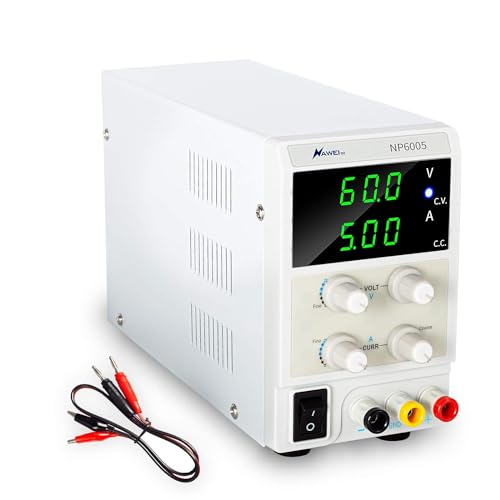
The Naweisz NP6005 fills a specific niche: a 60V/5A switching supply at a very accessible price point, making it the go-to for testing 48V battery packs, electroplating, and power-on testing of high-voltage DC equipment. Its 3-digit LED display shows voltage (0.1V steps) and current (0.01A steps), which is adequate for bulk power tasks but insufficient for precision bias adjustments.
The metal enclosure and twin heat sinks provide adequate thermal mass, and the built-in cooling fan activates on a thermo-sensor. Coarse and fine knobs for both voltage and current give decent control range, though there’s no lock feature — accidental knob bumps can change settings. Users report steady current verified with a multimeter after the initial return-to-zero step.
Build quality is basic: the barrel jack output connector is less secure than banana binding posts, and the included alligator clip leads are utilitarian. Some units arrive non-functional due to poor QC from the factory, but Amazon’s direct replacement policy resolves this quickly. For high-voltage work on a tight budget, this works — just budget time for initial QC validation.
Why it’s great
- 60V output enables testing of 48V battery packs and electroplating gear
- Metal enclosure with dual heat sinks handles thermal load well
- Coarse and fine dual knobs give decent manual control range
Good to know
- 3-digit display limits resolution to 0.1V — not for precision analog work
- Barrel jack output less secure than proper banana binding posts
- Quality control issues require testing on arrival
6. FNIRSI DPS-150

The FNIRSI DPS-150 rethinks bench power supply size: at 4 x 3 x 1.2 inches and 1.4 pounds, it’s smaller than most phone chargers yet delivers 0–30V and 0–5A with a full-color 2.8-inch IPS display. The display supports 90° rotation and toggles between numerical and curve views — remarkable for a module this compact. Ripple is spec’d under 20mV, and real-world users confirm clean output for mobile repair and prototyping.
The input is unusually flexible: it accepts PD (Power Delivery), QC (Quick Charge), and DC input, so you can power it from a USB-C power bank, a QC wall adapter, or a DC bench brick. PC programmable mode lets you save six groups of output parameters for repeatable test setups. The built-in protections include overvoltage, overcurrent, short-circuit, and overheating.
The bundled 100W PD adapter is essential for reaching 30V/5A output, but some units ship with a brick limited to 20V/5A — check the supplied adapter rating. The UI takes a moment to learn, and the run/stop button is the only physical control. For a take-anywhere field power supply, the DPS-150 is unmatched, but it can’t replace a full bench unit for heavy continuous loads.
Why it’s great
- Ultra-compact form factor — fits in a pocket, usable with USB power banks
- Color IPS display with curve graphing rivals desktop models
- PC programmable with six memory presets for quick recall
Good to know
- Bundled PD adapter may be 100W (20V/5A) not 150W needed for full output
- Single button interface limits workflow speed
- No banana jacks — uses U-shaped terminals and fine copper wires
FAQ
What does <20mV ripple mean for my circuit?
Can I use a switching supply for audio or radio work?
Why do some bench supplies list 300W at 60V but only 150W at 30V?
Final Thoughts: The Verdict
For most users, the winner is the best bench power supply in this roundup: the Tekpower TP3005T because it combines true linear regulation, rock-solid CV/CC stability, and a reasonable price point for serious analog work. If you need sub-1mV adjustments for sensor biasing, grab the KORAD KD3005D. And for high-output 60V/10A programmability in an automated lab, nothing beats the Abestop AT6301.