
Cycling with your dog should be a shared burst of freedom, not a knuckle-whitening fight against a leash that yanks your handlebars sideways. The wrong attachment turns every squirrel sighting into a potential crash. A dedicated bicycle dog leash solves this not by being stronger, but by engineering the connection to absorb shock, prevent tangling in spokes, and keep your center of gravity stable.
I’m Min — the co-founder and writer behind Gadgets Feed. I’ve spent hundreds of hours analyzing tensile strengths, bungee lengths, clamp mechanisms, and safety release designs in the narrow niche of hands-free canine cycling gear to separate the physics-engineered solutions from the standard leashes repackaged with a bike clip.
The debate between waist belts and frame-mounted arms comes down to your dog’s pull style and your bike’s geometry, which is why I’ve built this guide around the best bicycle dog leash options that actually keep both rider and dog safe on pavement and trail.
How To Choose The Best Bicycle Dog Leash
Not every leash can handle the physics of a dog bolting while you’re clipped to a bike. The attachment method, the shock-absorbing material, and the release mechanism are the three pillars that define safety. Beginners often grab a standard waist leash and clip it to the seat post, which invites disaster when the dog switches sides, wraps the leash around the rear hub, and locks the wheel. The right system is designed from the ground up for this specific motion profile.
Frame-Mounted vs. Waist-Belt Systems
Frame-mounted arms, like the Springer and Bike Tow Leash, clamp directly to the chainstay or seat stay. This keeps the dog’s pulling force low and centered, preventing the bike from steering sideways. Waist belts, like the Tuff Pupper and Stunt Puppy, give the dog more freedom to explore the trail but require stronger core balance from the rider. Frame mounts are safer for novice riders or dogs that lunge unpredictably; waist belts suit experienced handlers with well-trained dogs.
Shock Absorption and Bungee Stretch
The full elasticity of a bungee—measured in total stretched length versus resting length—determines how jarring a sudden sprint feels. A leash with a small bungee segment concentrates all the shock into one short zone, which can snap the dog back harder. Full-length bungee leashes like the Non-stop Dogwear distribute the force across 110 inches of rubber core, smoothing out the ride. For bike use specifically, a stretch factor of 1.3x to 1.5x is the sweet spot: enough give to protect your dog’s joints, not so much that the leash drags on the ground.
Quick Comparison
On smaller screens, swipe sideways to see the full table.
| Model | Category | Best For | Key Spec | Amazon |
|---|---|---|---|---|
| Bike Tow Leash | Premium | Safe frame-mounted cycling for 10–185lb dogs | Steel arm, 26″ frame length | Amazon |
| Springer Hands Free Dog Leash Bike Attachment | Premium | Heavy-duty spring absorption for unpredictable pullers | Steel spring, 90% shock absorption | Amazon |
| Non-stop Dogwear Bungee Leash | Premium | Full-length elastic for canicross and bikejoring | 110″ total stretch, Twistlock carabiner | Amazon |
| Neewa Tug Line with Bungee | Premium | Bikejoring and skijoring with one or two dogs | 2–2.5m bungee length | Amazon |
| Stunt Puppy Stunt Runner | Mid-Range | Lightweight hands-free running and jogging | 35–51″ bungee connector | Amazon |
| BIKE AND DOG Leash and Harness | Mid-Range | Quick 10-second install for small dogs | 59″ nylon length, 130g weight | Amazon |
| Tuff Pupper Heavy Duty Hands Free Leash | Budget | Waist-belt cycling for large pullers, budget-friendly | 500lb tensile strength, dual bungee | Amazon |
In‑Depth Reviews
1. Bike Tow Leash

The Bike Tow Leash is the only product here that earned a 5-star safety rating from the American Pet Association, and that rating is justified by a steel arm that clamps to the chainstay instead of your waist. By anchoring the dog’s force directly to the bike frame, this leash eliminates steering interference entirely—your handlebars stay straight even when a 70-pound labrador makes a sudden sprint. The 26-inch arm positions the dog slightly behind and to the left, which keeps the leash out of the wheel path and allows the rider to pedal without adjusting stride.
The clamp mechanism fits most standard bike frames and trikes, though the left-side-only attachment means you are committed to that side of the road. The nylon-coated steel arm is flexible enough to absorb minor directional changes but rigid enough to prevent the dog from crossing behind the wheel. Users specifically warn against attaching it to a collar instead of a chest harness, as the rigid arm’s leverage can twist a neck attachment dangerously.
The build quality is reinforced by a 5-star review consensus spanning months of daily use with high-energy breeds. One reviewer logged over 7 months of 4-mile daily runs with a labradoodle without any frame wear or material degradation. The only recurring critique is the left-side-only configuration, which exposes the dog to traffic on roads without bike lanes. For riders who prioritize physics-based safety and a proven track record over portability or multi-position flexibility, this is the gold standard.
Why it’s great
- Frame-mounted steel arm prevents steering torque and wheel tangles
- Supports dogs from 10 to 185 pounds without structural flex
- American Pet Association safety approved for bike use
Good to know
- Left-side-only attachment requires dogs to run on traffic-facing side
- Premium price reflects specialized engineering, not basic materials
2. Springer Hands Free Dog Leash Bike Attachment

The Springer is the only frame-mounted leash that uses a heavy-duty steel spring instead of a bungee, and that distinction makes it the best choice for dogs that lunge without warning. The spring absorbs up to 90% of the force from an unexpected tug, which means the rider stays balanced while the dog is gently restrained rather than yanked back. The 18-inch rope is short enough to keep the dog positioned close to the rear wheel, preventing them from getting ahead of the front tire or wrapping around a tree.
Installation involves clamping the bracket to the chainstay using a cotter pin, and the kit includes three safety release clips that snap open if the dog wraps around a stationary object. Owners of high-energy pit bulls and 75-pound pullers report that the spring’s resistance wears the dog out faster than a standard walk, because the dog learns that pulling forward meets a steady opposing force rather than slack. The clamp fits most mountain bikes and touring bikes, though users on recumbent or hand-cycles have successfully adapted it with additional hardware.
The one weak point across reviews is the plastic safety releases, which some owners found brittle after repeated use and replaced with small carabiners. The packaging can vary, but the core components—steel spring, metal hook, heavy-duty bracket—are consistent in build quality. Riders who value a low center of gravity and minimal rope slack around the rear wheel will find the Springer’s physics more forgiving than a waist-mounted bungee, especially on singletrack trails with sudden turns.
Why it’s great
- Steel spring absorbs 90% of sudden pulling force
- Quick-release cotter pin installs and removes in seconds
- Keeps dog positioned behind the wheel, away from pedals
Good to know
- Plastic safety release clips may need replacement over time
- Quck-release may not work with all frame tube shapes
3. Non-stop Dogwear Bungee Dog Leash

This is a leash built for canicross and bikejoring enthusiasts who know that partial bungee sections create a harsh dead-end snap when the elastic runs out. The Non-stop Dogwear leash uses a 110-inch full-length rubber core encased in polyester that stretches uniformly from clip to carabiner, distributing the load over the entire line instead of concentrating it in a 12-inch segment. The result is a smoother acceleration curve for the dog and a gentler return force for the rider’s core or bike frame.
The Twistlock carabiner is a grade above standard snap hooks: it automatically locks closed once attached, requiring a manual twist to release, which eliminates accidental unclipping during fast trail runs. The anti-twist swivel connection lets the leash rotate freely as the dog changes direction, preventing the webbing from twisting into a tight coil that shortens the effective stretch. The 23mm width of the webbing is wide enough to spread pressure across the dog’s harness attachment point without digging in.
Owners note that the 2.8-meter length is measured at full stretch, which means the resting length is shorter than expected for casual walking. For bike use specifically, this is an advantage because the shorter resting length keeps the dog from wandering into the front wheel, while the full stretch gives them enough range to gallop without dragging the rider. The only downside across reviews is the price point, which positions it as a specialist tool for owners who are already invested in dog-powered sports and expect gear that survives thousands of trail miles.
Why it’s great
- Full-length elastic core provides uniform shock absorption from tip to tip
- Twistlock carabiner prevents accidental detachment during high-speed runs
- Anti-twist swivel keeps the leash untangled through direction changes
Good to know
- Resting length is shorter than expected; full stretch is 2.8 meters
- Premium price suits dedicated bikejoring and canicross athletes
4. Neewa Tug Line with Bungee

Neewa designed this tug line specifically for bikejoring and skijoring, where the dog pulls ahead while the rider provides resistance from behind. The 2.0 to 2.5-meter bungee length is longer than most waist leashes, which gives the dog enough lead to achieve a full running stride without the tension slacking. The bungee segment is positioned in the middle of the line rather than near the clip, which centers the elastic zone away from both the dog’s harness and the bike attachment, reducing the risk of the bungee snagging on a pedal or crank arm.
The 0.16-kilogram weight makes it among the lightest options here, which matters for multi-sport athletes who carry gear on trail runs or ski tours. The snap closure on both ends is compatible with Neewa canicross belts and harnesses, but also works with standard D-rings on most vest-style harnesses. Owners of 70-pound dogs report that the bungee’s tension responds well to sustained pulling without bottoming out, maintaining a consistent resistance curve that trains the dog to maintain pace rather than sprint and collapse.
The material—nylon webbing with a woven outer sheath—holds up against abrasion from trail gravel and road grit. Buyers should note that the shorter 1.5–2 meter version is better suited for close-quarters running, while the 2–2.5 meter variant is explicitly recommended for bikejoring by the manufacturer. The line shows no fraying or stitch loosening after multiple seasons of use, according to long-term reviewers who combine this tug line with a bike through muddy and wet conditions.
Why it’s great
- Long bungee segment allows full stride for sustained pulling
- Lightweight 0.16kg build ideal for multi-sport athletes
- Compatible with Neewa canicross belts and most harness D-rings
Good to know
- Only two length options; the longer 2.5m version recommended for bikes
- Designed specifically for dog-powered sports, not casual walking
5. Stunt Puppy Stunt Runner Hands-Free Dog Leash

The Stunt Puppy Stunt Runner strips the hands-free leash down to its minimalist essentials: a waist belt, a sliding D-ring, and a bungee connector. At just 6.4 ounces, it is the lightest waist-mounted option in this guide, making it a strong candidate for bike riders who want to maintain freedom of upper-body movement without a bulky lumbar pad. The 35-to-51-inch bungee stretch is calibrated for jogging pace rather than full gallop, which aligns well with moderate-speed cycling on paved paths and greenway trails.
The black metal D-ring slides freely along the waist belt, allowing the dog to move from your left hip to your right hip as they explore trail edges. Owners of smaller dogs under 40 pounds report that the bungee’s lighter tension provides gentle correction without shock, while riders with 60-pound labs mention that the same tension feels adequate at a 9-minute-mile pace but lacks the resistance needed for hard pulling. The waist belt adjusts from 28 to 49 inches, which accommodates a wide range of body types without the belt riding up.
Some users found the waist-belt positioning intrusive when walking, as the belt interferes with natural arm swing, but on a bike this issue disappears because the hands are on the handlebars. The bungee connector’s elasticity does weaken over extended use, but the hardware—snaps and buckle—holds up well through hundreds of miles. For riders who want a dual-purpose leash that transitions from bike to trail run without carrying heavy steel arms or bulky belts, this is the simplest solution.
Why it’s great
- Ultra-light 6.4-ounce design minimizes rider fatigue on long rides
- Sliding D-ring lets dog switch sides freely without tangling
- Bungee stretch is proportional for moderate-speed biking and jogging
Good to know
- Bungee elasticity may weaken after extended seasons of use
- Waist belt positioning can feel intrusive if not adjusted correctly
6. BIKE AND DOG Leash and Harness
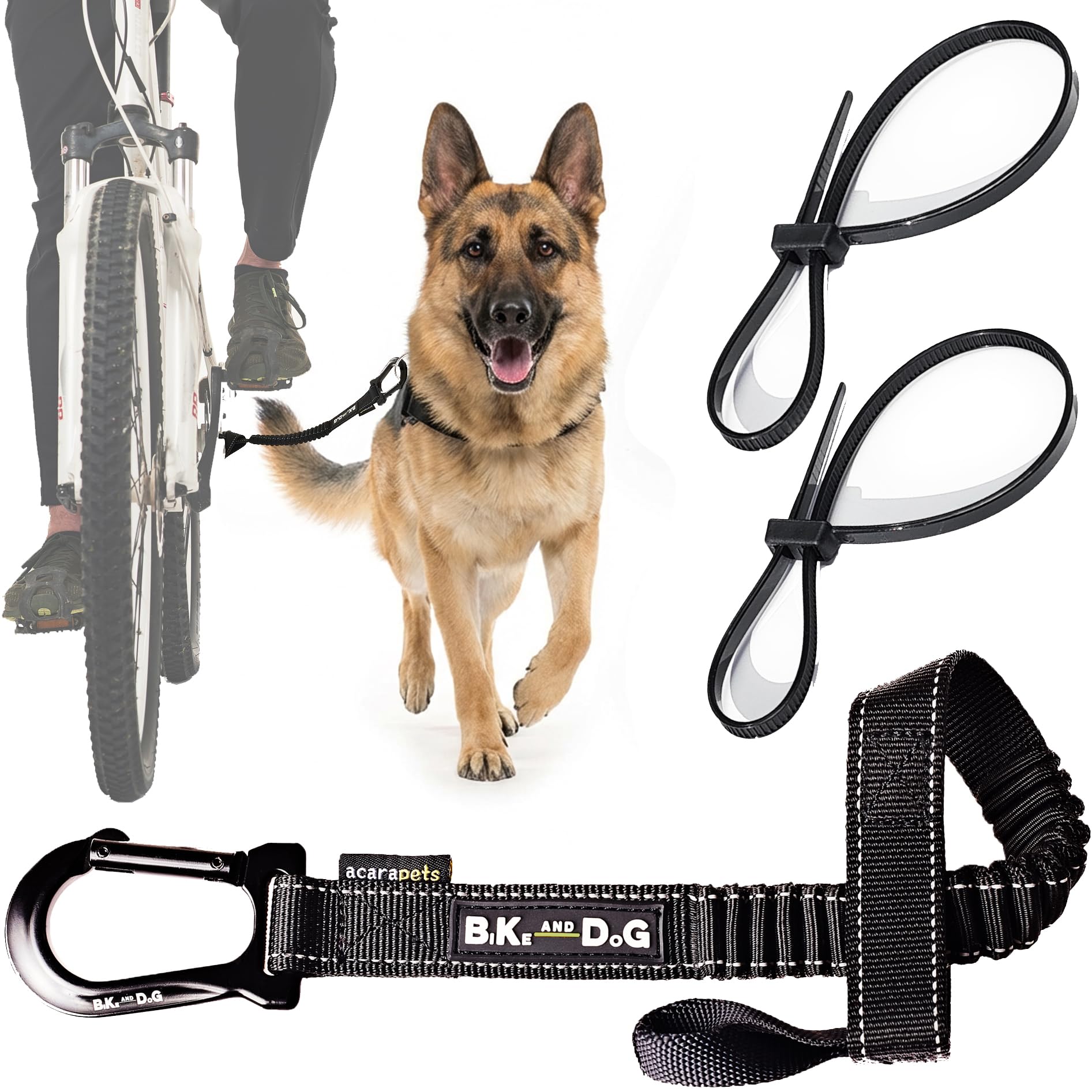
The BIKE AND DOG system is built around a simple observation: most people want to spend 10 seconds clipping in and out, not wrestling with cotter pins and bracket alignment. This set includes a harness with three metal rings (two on the sides, one on the back) and a nylon leash that attaches directly to the bike frame using two included cable ties. No tools are required, and the entire setup can be installed or removed faster than pumping a tire.
The harness ring configuration is designed to keep the leash centered on the dog’s back during bike use, preventing it from slipping off to one side and causing the dog to lean into the bike. At 130 grams, the leash component is extremely lightweight, which reduces drag and bounce. The 59-inch length is generous enough for the dog to run a few feet ahead of the front wheel, though some owners with large dogs found it positioned the dog too close to the rear wheel for their comfort, suggesting a need for an extra two inches.
Customer feedback highlights that this works exceptionally well for small to medium dogs that are already trained to run alongside a bike, but requires conditioning for larger breeds prone to switching sides spontaneously. The cable ties are a clever touch—they fold flat against the frame when not in use—but they must be positioned carefully to avoid contact with the spokes. For budget-conscious riders who want a dedicated bike-specific leash without investing in a frame-mount arm, this pack delivers the fundamentals at a reasonable entry point.
Why it’s great
- No-tool, 10-second install with included cable ties
- Three-ring harness keeps leash centered and prevents side-slip
- Leash and harness combo provides a complete bike-ready set
Good to know
- Large dogs may find the leash length positions them too close to the wheel
- Best suited for dogs already trained to run alongside a bike
7. Tuff Pupper Heavy Duty Hands Free Dog Leash

The Tuff Pupper is the budget-friendly hero for owners of strong, large dogs who need a waist-mounted leash that can handle 125-pound pullers without failing. The 500-pound tensile strength rating from the manufacturer is backed by a construction that uses two separate bungee segments stitched into 43 inches of reflective webbing, distributing the dog’s force across two independent elastic zones. This redundancy means that even if one bungee section wears out, the leash doesn’t become a rigid tow line—it still provides cushioning.
The waist belt includes thick foam lumbar padding that distributes the dog’s weight across the lower back rather than digging into the hips, which is crucial for bike riders who maintain a forward-leaning posture. The belt rotates freely around the waist via a swivel attachment, so the dog can switch from the left to the right side of the bike without twisting the belt material. The dual handles near the dog’s end of the leash give the rider an extra safety grab when stopping at intersections or passing other bikes.
Owners of Bernese Mountain Dogs and golden retrievers report a dramatic reduction in shoulder and neck strain after switching from a handheld leash to this belt, because the pulling force transfers to the core rather than the arm. The 3M reflective stitching across the full width and length of the bungee ensures visibility on evening rides when paired with the waterproof belt’s reflective piping. The only compromise is the shorter bungee length relative to dedicated sports leashes, which limits the dog’s range of motion for galloping but keeps them closer to the bike for safety.
Why it’s great
- Two separate bungee segments provide redundant shock absorption
- Thick foam lumbar waist belt reduces strain during long bike rides
- 500lb tensile strength handles powerful large-breed pullers
Good to know
- Dual bungee may feel shorter than single full-length elastic leashes
- Elastic weakens over years of use, but hardware remains functional
FAQ
Is a waist-belt leash safe for biking with a dog that pulls hard?
Can I use a regular hands-free running leash for bikejoring?
Final Thoughts: The Verdict
For most users, the best bicycle dog leash winner is the Bike Tow Leash because its frame-mounted steel arm eliminates steering torque and wheel tangles for dogs from 10 to 185 pounds. If you need a spring-based shock absorber that handles unpredictable lunges, grab the Springer Hands Free Dog Leash Bike Attachment. And for dedicated bikejoring athletes who want full-length elastic stretch, nothing beats the Non-stop Dogwear Bungee Leash.