
Cutting metal with an angle grinder and abrasive wheel is loud, messy, and showers your workspace with dangerous sparks. A dedicated blade for cutting metal transforms that experience, producing clean, burr-free edges with minimal heat and virtually no hazardous spray. Choosing the right blade, however, requires understanding tooth geometry, arbor size, and material compatibility — one wrong spec and you are looking at dangerous kickback or a ruined workpiece.
I’m Min — the co-founder and writer behind Gadgets Feed. I have spent countless hours studying the technical specifications, real-world customer performance data, and comparative value of metal-cutting blades across every tier to identify which designs actually deliver on their promises without burning through your budget.
The right blade depends entirely on the metal you are cutting and the tool you are mounting it to. This guide breaks down the best options available, helping you identify the ideal blade for cutting metal for your specific project and saw.
How To Choose The Best Blade For Cutting Metal
Your choice comes down to four variables: the specific metal you are cutting (ferrous, non-ferrous, or thin sheet), the saw type (circular, miter, or angle grinder), the required kerf width, and the duty cycle of your projects. A blade optimized for aluminum will fail on rebar, and a ferrous-metal blade will leave a ragged edge on acrylic.
Tooth Grind and Count
Triple-Chip Grind (TCG) is the standard for ferrous metals and hardened alloys because each tooth cuts like a chisel, reducing heat and preventing work-hardening of the material. Alternating Top Bevel (ATB) grinds are better for aluminum, plastic, and thin sheet metal where a shear cut prevents melting. Higher tooth counts (48 to 80) produce a smoother finish but cut slower; lower counts (24 to 40) remove material faster but leave a coarser edge.
Arbor Size and Diameter
The arbor bore must match your saw’s spindle — the most common sizes are 5/8-inch and 7/8-inch, with many blades including diamond knockouts for compatibility. Diameter is tied to your tool: 5-3/8-inch blades fit compact circular saws and metal-cutting saws, while 7-1/4-inch is the universal standard for full-size circular saws. An 8-inch blade requires a miter saw or cold saw with sufficient clearance.
Material Composition
Carbide-tipped (TCT) blades combine a steel body with tungsten carbide teeth for long edge retention on steel, stainless, and cast iron. Cermet blades use a ceramic-and-metal composite that resists heat better but can be more brittle. Diamond-coated blades excel on abrasive composites and masonry but wear quickly on solid ferrous metals due to high friction.
Quick Comparison
On smaller screens, swipe sideways to see the full table.
| Model | Category | Best For | Key Spec | Amazon |
|---|---|---|---|---|
| Diablo Steel Demon D0748CF | Premium Cermet | Thick steel plate and pipe | 48 teeth, 7-1/4″, 5/8″ arbor | Amazon |
| Oshlun SBF-080048 | Premium TCG | Cold saw use, mild steel | 48 teeth, 8″, 5/8″ arbor | Amazon |
| Makita A-95037 | Compact TCT | Cordless saws, 5-3/8″ saws | 30 teeth, ultra-thin kerf | Amazon |
| SHDIATOOL Diamond Blade | Diamond Coated | Multi-material, angle grinder | 7″, 2.6mm kerf, 8730 RPM | Amazon |
| Benchmark Abrasives TCT | Mid-Range TCT | General ferrous, miter saw | 30 teeth, 5-3/8″, 0.07″ thick | Amazon |
| IVY Classic 35050 | Specialty Steel | Aluminum, plastic, thin sheet | 128 teeth, 7-1/4″, 5/8″ arbor | Amazon |
| Milwaukee 5-Pack Cut Off | Consumable Pack | High-volume grinding/cutting | 7″, 3/32″ thin, 5-pack | Amazon |
In‑Depth Reviews
1. Diablo Steel Demon Cermet II D0748CF

The Diablo Steel Demon uses a Cermet II (ceramic and carbide composite) tooth material that stays sharp significantly longer than standard carbide on hard ferrous metals. Its laser-cut stabilizer vents reduce vibration and noise, which translates to straighter cuts with less operator fatigue. The Perma-Shield coating prevents rust and reduces gumming when cutting coated materials.
User reports indicate this blade slices through 1/4-inch Corten steel plate and 3-inch schedule 40 galvanized pipe with minimal heat buildup — the metal is often cool enough to touch immediately after the cut. The 48-tooth TCG grind produces a smooth finish that requires little to no deburring on most projects.
The primary tradeoff is cost per blade and brittleness under extreme abuse. If the blade binds or is fed too aggressively, individual teeth can chip. For professionals cutting thick steel regularly, however, the extended lifespan between sharpening cycles more than justifies the premium.
Why it’s great
- Cermet II teeth resist wear much longer than standard carbide on steel
- Stabilizer vents keep the blade cool and cuts straight
- Slices through 1/4″ thick plate with almost no heat or burrs
Good to know
- Teeth can chip if the blade binds or is forced too fast
- Overkill for occasional light-duty or thin-sheet work
2. Oshlun SBF-080048 8-Inch TCG Blade

The Oshlun SBF-080048 is a professional-grade C-6 carbide blade designed specifically for 8-inch cold saws and miter saws cutting mild steel and ferrous metals. Its Triple-Chip Tooth grind with a 48-tooth count delivers a balance of speed and finish quality — aggressive enough to cut 1/4-inch steel efficiently, yet smooth enough to leave a clean edge for most fabrication work.
Users have cut over 60 feet of 1/4-inch steel on a single blade with plenty of life remaining, outperforming stock blades from major brands. The laser-cut expansion slots reduce heat warping, which is critical when making numerous cuts in quick succession on a cold saw that lacks coolant.
Durability can vary between production batches — some users report losing a tooth early while others get exceptional lifespan. The blade is roughly half the price of comparable Freud or Lenox models, and resharpening at a local service (around ) restores like-new performance, making the lifecycle cost extremely competitive.
Why it’s great
- Exceptional value versus premium brands at roughly half the cost
- Laser-cut slots resist heat warpage during extended cutting
- Capable of cutting over 60 feet of 1/4″ steel per blade
Good to know
- Inconsistent durability reported between some units
- Requires an 8-inch saw — not compatible with standard 7-1/4″ circular saws
3. Makita A-95037 TCT Blade

The Makita A-95037 is engineered for 5-3/8-inch cordless metal-cutting saws, with an ultra-thin kerf design that reduces battery drain and allows more cuts per charge. The 30 carbide-tipped teeth are individually hand-hammered for flatness and tension, ensuring the blade runs true even at high RPM on a compact tool platform.
Trade professionals report this blade lasts 4 to 6 months of daily use cutting unistrut, all-thread rod, EMT conduit, and steel roofing panels. It produces fine chips rather than hazardous dust and generates minimal heat, which prevents work-hardening of the metal — a common issue with abrasive wheels on thin-wall material.
The 0.06-inch kerf saves material and reduces cutting load, but the thin body is less forgiving of side-loading or binding. It is designed exclusively for metal — using it on masonry or wood will immediately dull the carbide tips. It fits the Makita BCS550 and many other 5-3/8-inch saws with a 5/8-inch arbor.
Why it’s great
- Ultra-thin kerf maximizes battery runtime on cordless saws
- Hand-hammered tensioning ensures true, vibration-free cuts
- Long service life of 4-6 months under daily professional use
Good to know
- Thin body is susceptible to damage from side pressure
- Only compatible with 5-3/8″ saws using a 5/8″ arbor
4. Benchmark Abrasives TCT 5-3/8-Inch

The Benchmark Abrasives TCT blade offers a budget-friendly entry into carbide-tipped metal cutting without sacrificing cut quality. Its 30 tungsten carbide teeth handle mild steel, stainless steel, cast iron, and even titanium with clean chip formation rather than abrasive dust. The 0.07-inch plate thickness provides a bit more rigidity than ultra-thin competitors.
Customers have successfully cut EMT conduit, 3/16-inch mild steel plate, and metal roofing panels with results comparable to blades costing twice as much. One user cut approximately 30 feet of rusty 1/4-inch plate and reported the blade remained quiet and true throughout, with no detectable dulling.
The main drawbacks are noise — the blade is louder than premium options — and the spread of fine metal chips that require containment. The longevity threshold versus premium blades is unknown, but for light-to-moderate use the value proposition is compelling. It fits miter saws and circular saws with a 5-3/8-inch capacity.
Why it’s great
- Delivers premium-quality cuts at a budget-friendly price point
- Handles a wide range of ferrous metals from conduit to plate steel
- Thicker plate offers more rigidity than ultra-thin kerf blades
Good to know
- Operates louder than premium ferrous-metal blades
- Long-term edge retention unknown for heavy-duty use
5. SHDIATOOL 7-Inch Diamond Blade
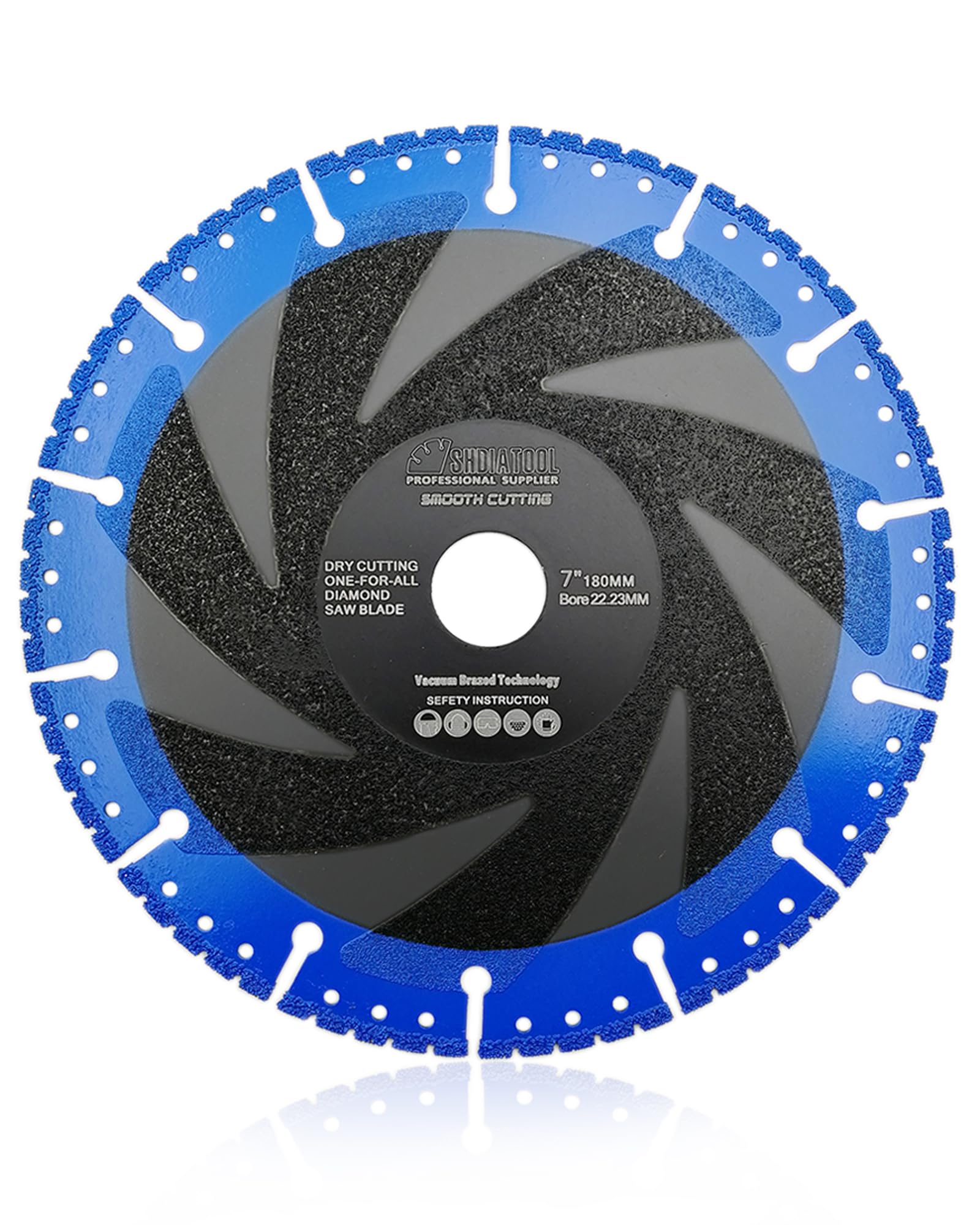
The SHDIATOOL diamond blade uses vacuum-brazed technology to permanently bond industrial diamond grains to a heat-treated steel core, creating a cutting edge that does not wear down like traditional abrasive wheels. It cuts through steel, stainless, rebar, cast iron, copper pipe, and even masonry — making it the most versatile single blade in this lineup.
The 2.6mm kerf is wider than a typical TCT blade, but the diamond coating on both sides of the core provides smooth cutting and reduces heat generation. Users report the blade survives heavy bending and abuse that would destroy a carbide-tipped blade, with no visible wear after cutting thick steel tubes and nails during construction.
The tradeoff is cutting speed versus an abrasive wheel — the diamond blade cuts slower on thick steel but lasts dramatically longer. It is best suited for an angle grinder or circular saw where the operator needs one blade that can transition between metal, wood with embedded fasteners, and masonry without changing accessories.
Why it’s great
- Vacuum-brazed diamond grains resist wear and abuse extremely well
- Cuts ferrous metal, masonry, wood, and plastic with one blade
- Minimal sparking compared to abrasive cut-off wheels
Good to know
- Wider kerf removes more material than TCT blades
- Slower cutting speed on thick steel sections
6. IVY Classic 35050 Swift Cut
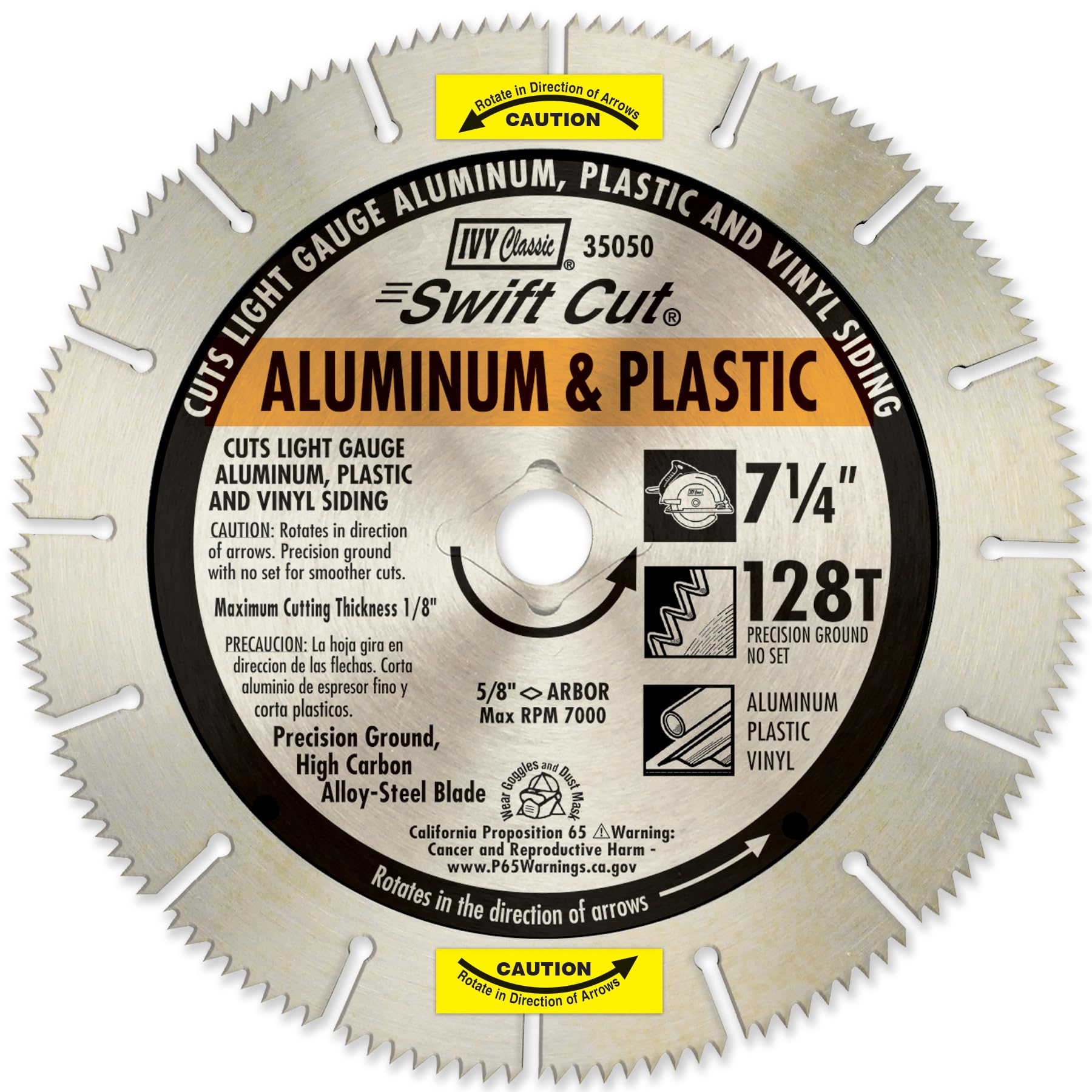
The IVY Classic 35050 is a high-carbon alloy-steel blade with 128 precision-ground teeth and no set, designed specifically for cutting light-gauge aluminum (up to 1/8 inch), plastic, and vinyl siding. The high tooth count produces a shear-like finish that prevents melting and chipping in softer materials — a common failure point for general-purpose carbide blades.
Users report clean, accurate cuts in acrylic sheet on a table saw, with no edge melting unless the feed rate is slowed to a crawl. The expansion slots reduce heat buildup, which is critical when cutting polymers that soften at relatively low temperatures. The 5/8-inch diamond knockout arbor fits most standard circular saws.
This blade is not designed for ferrous metals or thick stock. Attempting to cut steel or aluminum over 1/8 inch will dull the teeth rapidly and may create a safety hazard. It fills a specific niche for finish-quality cuts in thin, non-ferrous sheet materials where a TCG blade would leave a rough surface.
Why it’s great
- 128 fine teeth produce a smooth, polished edge on aluminum and plastic
- No-set design prevents melting on heat-sensitive materials
- Expansion slots manage heat during extended cuts in plastic
Good to know
- Limited to materials under 1/8″ thickness
- Not suitable for ferrous metals or heavy-gauge aluminum
7. Milwaukee 5-Pack Cut Off Blades

This 5-pack from Milwaukee provides thin 3/32-inch abrasive cut-off wheels engineered for fast, straight cuts with minimal burr on metal and stainless steel. The aluminum oxide grit is optimized for rotating at high speeds — Milwaukee claims up to 50% faster cutting and 20% longer life than standard 1/8-inch wheels, making this pack ideal for high-volume metal fabrication.
Each wheel is individually balanced to minimize vibration, which improves cut accuracy and reduces operator fatigue. Users applying them to 26-gauge steel panels report clean, quick cuts with minimal edge distortion. The 7-inch diameter with a 7/8-inch arbor fits both 7-inch grinders and 7-1/4-inch circular saws.
These are consumable abrasive wheels, not reusable carbide blades. The thin profile cuts fast but wears down with heavy use, and the pack provides five replacements in a single purchase. The cost per wheel is low, making this the most economical option for jobs where you need a fresh cutting surface frequently — such as cutting rebar, angle iron, or sheet metal in bulk.
Why it’s great
- Five blades in one pack offer excellent per-unit value
- Thin 3/32″ profile reduces material waste and burr formation
- Balanced wheels produce less vibration than economy alternatives
Good to know
- Abrasive nature generates sparks and dust during cutting
- Each blade is a consumable — lifespan is limited on thick steel
FAQ
Can I use a wood-cutting blade for cutting metal?
Why does my carbide blade produce sparks when cutting steel?
What does the arbor knockout do on a metal-cutting blade?
How do I know if a blade is designed for dry cutting metal?
Final Thoughts: The Verdict
For most users, the best blade for cutting metal overall is the Diablo Steel Demon D0748CF because its Cermet II teeth and stabilizer vents deliver long life and clean cuts on everything from thin sheet to 1/4-inch plate. If you need a blade for a compact cordless saw, grab the Makita A-95037 for its ultra-thin kerf and battery-friendly design. And for multi-material versatility on an angle grinder, nothing beats the SHDIATOOL Diamond Blade.