
Forget tiny Bluetooth pucks and cheap plastic soundbars — a proper home speaker system fills your room with rich, dimensional audio that transforms movies, music, and gaming into visceral experiences. The challenge isn’t just finding one that gets loud; it’s finding the right combination of drivers, power, inputs, and footprint that matches your space without dominating your décor or blowing your budget.
I’m Min — the co-founder and writer behind Gadgets Feed. I’ve spent hundreds of hours dissecting the technical specs, real-world customer feedback, and value propositions of the current market to separate the systems that merely produce noise from those that deliver true, immersive, home-filling sound.
Whether you’re upgrading a desktop workstation, building a small living room setup, or outfitting a home office, this guide breaks down every critical spec and hidden trade-off to help you find the very best bluetooth speaker system for home.
How To Choose The Best Bluetooth Speaker System For Home
Selecting a home speaker system is more nuanced than picking a portable Bluetooth speaker. You’re balancing power delivery, driver architecture, connectivity inputs, and physical footprint to match a fixed location. These are the four critical filters to apply.
RMS Power vs Peak Power — Don’t Fall for the Marketing
Always compare RMS (Root Mean Square) wattage, not peak wattage. RMS tells you the continuous, sustainable power output — what the system can actually play cleanly for an entire movie or album. Peak numbers are momentary bursts that can’t be sustained. A system with 42W RMS will feel significantly more authoritative than one advertised at 400W peak but only delivers 15W RMS.
Driver Configuration and Woofer Size
The size of the woofer directly dictates low-end extension. A 3-inch full-range driver produces decent mid-bass but will struggle with sub-80Hz frequencies. A 5-inch dedicated woofer with a separate tweeter creates a far more convincing soundstage, producing the chest-thump of a kick drum or the rumble of an explosion. For a home system meant for TV and music, a 4-inch or 5-inch woofer paired with a silk-dome tweeter is the sweet spot.
Connectivity Inputs — What Matters for a Fixed System
A true home system needs more than just Bluetooth. Look for at least one wired input — optical (for TV), RCA (for turntables or external DACs), or USB (for lossless PC audio). Bluetooth codec support (SBC, AAC, aptX) determines wireless quality, but a wired connection remains the gold standard for zero-latency, uncompressed playback. Multi-point Bluetooth is a bonus for switching between your phone and laptop.
Form Factor and Cabinet Construction
The cabinet is the speaker’s foundation. MDF (Medium-Density Fiberboard) is vastly superior to plastic — it reduces panel resonance that muddies sound. The form factor (bookshelf vs. all-in-one) dictates placement. A pair of passive speakers with a central amplifier gives you true stereo separation, while a single all-in-one unit like the Marshall Stanmore delivers convenience but sacrifices stereo imaging.
Quick Comparison
On smaller screens, swipe sideways to see the full table.
| Model | Category | Best For | Key Spec | Amazon |
|---|---|---|---|---|
| Edifier R1280DB | Bookshelf | Best All-Rounder | 42W RMS, Optical Input | Amazon |
| Edifier MR3 | Studio Monitor | Critical Listening & Desktop | Hi-Res Cert, TRS Inputs | Amazon |
| Marshall Stanmore III | All-in-One | Style & Simplicity | 5.25″ Woofer, BT 5.2 | Amazon |
| MEVOSTO DS19 | Bookshelf | Deep Bass on a Budget | 5″ Woofer, BT 5.4 | Amazon |
| Panasonic SC-PM270 | Mini System | Kitchen Counter & Small Rooms | 20W RMS, Built-in CD | Amazon |
| Pyle PDA77BU | Receiver + Amp | Customizable Multi-Speaker Setup | 800W Peak, Dual Mic Inputs | Amazon |
| OHAYO 60W | Desktop 2.0 | Budget Desktop Upgrade | 60W Peak, BT 5.3 | Amazon |
In‑Depth Reviews
1. Edifier R1280DB Powered Bluetooth Bookshelf Speakers

The Edifier R1280DB has earned its position as a category staple by nailing the fundamental equation: rich, balanced sound in a compact wood-grain cabinet at a mid-range investment. The 42W RMS total output drives a pair of 4-inch bass drivers and 13mm silk-dome tweeters, delivering a warm and articulate soundstage that comfortably fills a small to medium living room or a dedicated home office. An optical input allows direct digital connection to a TV, bypassing the audio compression of standard Bluetooth, which is a significant advantage for movie and dialogue clarity.
The included remote control gives you volume, input switching, and EQ adjustments without leaving your seat, while the side-panel bass and treble knobs offer analog tone shaping for those who prefer tactile control. The MDF wood construction with a walnut vinyl finish looks far more premium than the price suggests and helps reduce cabinet resonance compared to plastic alternatives. Bluetooth connectivity is stable, though it lacks aptX HD support, meaning the optical or dual RCA wired inputs will always yield higher fidelity for critical listening.
Owners consistently praise the surprisingly wide soundstage for a near-field monitor form factor, with clear highs and controlled bass that doesn’t overpower. The main trade-off is the modest bass depth — this is not a system for sub-50Hz rumbles without a dedicated subwoofer. For a versatile, all-purpose home speaker system that does everything well with minimal compromise, the R1280DB remains the reference point in its tier.
Why it’s great
- Optical input ensures zero-latency, high-fidelity TV audio
- 42W RMS provides punchy, room-filling volume
- Included remote makes source switching effortless
Good to know
- Bass extension is polite; not suited for bass-heavy music at high levels
- Remote is small and easy to misplace between sofa cushions
2. Edifier MR3 Powered Studio Monitor Speakers

The Edifier MR3 takes a decidedly more analytical approach than its R1280DB sibling. It is Hi-Res Audio certified, meaning it can reproduce frequencies up to 40kHz, and its frequency response curve is tuned to be flatter and more neutral — ideal for music production, video editing, or the listener who wants to hear recordings exactly as the engineer intended. The 3.5-inch mid-low drivers and 1-inch tweeters are smaller than typical bookshelf speakers, but the 18W RMS per channel is surprisingly clean, with a peak SPL of 92.5dB that gets loud without distortion.
The connectivity suite is this system’s secret weapon for serious setups. Beyond standard RCA and AUX inputs, the MR3 includes balanced TRS (1/4-inch) inputs, which reject electrical interference over long cable runs — a must for studio desks or desktop setups near Wi-Fi routers and power strips. The Edifier ConneX app allows for a 10-band EQ adjustment, letting you dial in a curve that compensates for room acoustics. Bluetooth 5.4 with multi-point lets you keep a phone and computer connected simultaneously.
Testing feedback highlights the MR3’s incredibly tight, controlled bass that never bloat the mids, and the complete absence of hiss or static even at idle — a rare feat for powered monitors in this class. The main consideration is the monitor-style tuning: casual listeners expecting a bass-boosted “fun” sound may find it too reserved. The MR3 rewards critical, attentive listening more than laid-back background playback.
Why it’s great
- Balanced TRS inputs eliminate interference for studio-quality signal
- Hi-Res Audio certification ensures high-frequency detail retrieval
- App-based 10-band EQ for precise room correction
Good to know
- Flat tuning may sound underwhelming to listeners used to bass-heavy consumer audio
- Speaker wire between the active and passive unit is non-standard, complicating replacements
3. Marshall Stanmore III Bluetooth Home Speaker
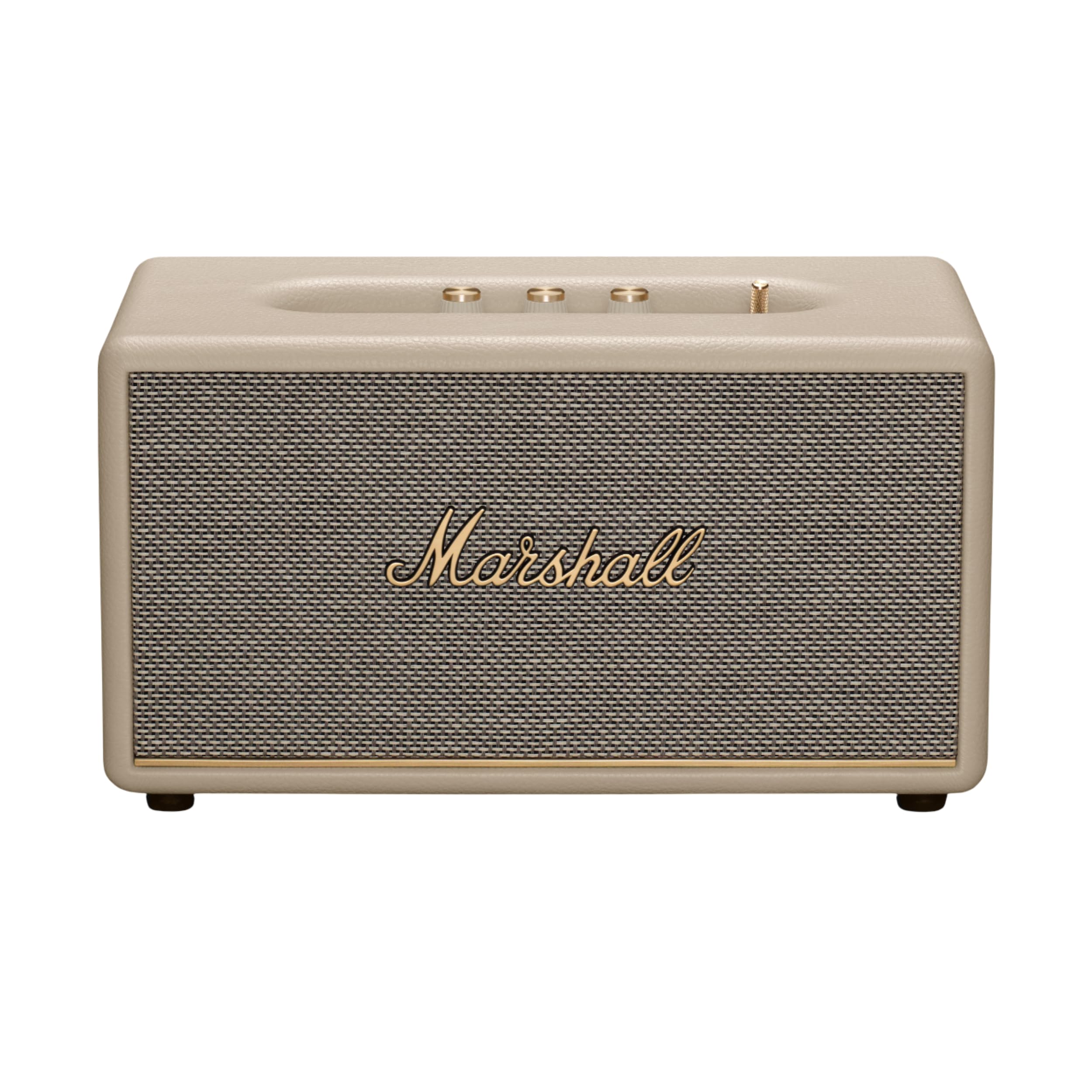
The Marshall Stanmore III is the most famous all-in-one design in the home audio world, and it earns its premium badge by blending iconic rock-and-roll aesthetics with genuine acoustic refinement. The 5.25-inch woofer and dual 0.75-inch tweeters produce a loud, dynamic, and surprisingly wide soundstage for a single-box system. Marshall claims an even broader soundstage than the previous generation, and real-world testing confirms it fills rooms in the 1300 sq ft range with authoritative, clear audio that handles everything from classic rock vocals to modern movie scores.
Bluetooth 5.2 is forward-compatible with the upcoming LE Audio standard, making this a relatively future-proof choice. A 3.5mm aux input and RCA input allow wired connections for turntables, and the front-panel analog bass and treble knobs let you tune the sound in real time without digging into an app. The PVC-free build with 70% recycled plastic is a genuine sustainability step rarely seen from lifestyle brands.
The major structural trade-off is form factor physics: because all drivers fire from a single cabinet, you do not get true left-right stereo separation. The DSP-processed stereo widening is effective, but purists will prefer a pair of dedicated bookshelf speakers for a proper soundstage. The Stanmore III is a premium, high-style, plug-and-play solution for someone who values convenience and looks over absolute audio separation, and it delivers on that promise flawlessly.
Why it’s great
- Rich, room-filling mono sound with surprising bass extension for its size
- Timeless Marshall design transforms any room’s aesthetic
- Front-panel analog tone controls for instant sound shaping
Good to know
- Single-cabinet design cannot provide true stereo separation
- Permanent power cord limits placement flexibility
4. MEVOSTO DS19 Active Bookshelf Speakers

The MEVOSTO DS19 is a standout in the mid-range segment because it brings a 5-inch dedicated woofer and a 1-inch silk-dome tweeter per channel — driver sizes typically associated with significantly more expensive passive speaker setups. The 36W RMS total power (18W per channel) is respectable, but the real story is the low-end authority. The larger woofers move significantly more air than the 3-inch and 4-inch drivers found in competitors at a similar price, producing deep, punchy bass that adds genuine physical impact to movies and bass-heavy music.
Connectivity is modern and practical: Bluetooth 5.4 offers the latest codec support and stable range, while a USB digital input provides a lossless, low-latency connection for PC gaming. The front-panel controls include 10-level bass and treble adjustment, giving you fine-grained control over the tonal balance. The included remote is functional, and the natural wood veneer finish adds warmth to a desk or shelf.
Owner feedback consistently praises the “rich, immersive sound” and the ability to fill a room without distortion. The main downside is that the USB input does not support Dolby Audio pass-through, so TV connectivity via USB may not be ideal — the RCA or AUX inputs are preferred for TV use. For desktop or small-room setups where bass depth is the primary objective, the DS19 delivers exceptional value for its price.
Why it’s great
- 5-inch woofers produce authoritative, deep bass not typical at this price
- USB digital input enables lossless, lag-free PC audio
- Independent 10-level bass and treble tailoring via knobs
Good to know
- USB input does not support Dolby Audio for TV
- Bluetooth introduces a slight audio delay; USB or wired is recommended for movies
5. Panasonic Compact Stereo System SC-PM270PP-K

In an era of streaming-only audio, the Panasonic SC-PM270 is a rare breed: a complete component stereo system with a top-loading CD player at its core. The 20W RMS (10W per channel) is modest by modern bookshelf standards, but it is more than adequate for casual listening in a kitchen, bedroom, or small office. The speakers feature a 10cm woofer and a 6cm tweeter with a bass reflex port, which helps the small cabinet produce more low-end presence than its wattage suggests. Panasonic’s Bluetooth Re-Master processing compensates for the data lost during Bluetooth compression, resulting in clearer wireless playback than most basic systems in this class.
The design is clean and minimalist, with a matte black finish that blends into any room. The “My Sound” presets allow quick EQ switching between genres, and the included remote covers all essential functions. The FM radio tuner is surprisingly sensitive, a welcome feature for those in areas with reliable broadcast reception.
This system’s greatest limitation is its lack of modern inputs — there is no AUX input, no headphone jack, and no digital optical connection. You are limited to Bluetooth, USB flash drive playback, CD, and FM radio. For pure simplicity and physical media playback in a small footprint, the SC-PM270 is unmatched. For a home theater or critical listening setup, the input restraints will feel restrictive.
Why it’s great
- Integrated CD player for physical media collections
- Bluetooth Re-Master enhances compressed wireless audio quality
- Compact footprint fits on kitchen counters and small shelves
Good to know
- No AUX, headphone, or optical input limits connectivity
- 20W RMS is low for larger living rooms
6. Pyle Home Stereo Receiver PDA77BU

The Pyle PDA77BU is fundamentally different from every other product on this list — it is a standalone stereo receiver and amplifier, not a speaker system. You provide your own passive speakers, and the Pyle acts as the brain and muscle. This makes it a uniquely flexible choice for anyone who already owns high-quality passive loudspeakers or wants to build a custom, multi-speaker setup. The 800W peak power rating sounds enormous, but the real-world RMS output is significantly lower; still, it is enough to drive a pair of decent bookshelf or floor-standing speakers to high volume in a large room.
The connectivity selection is genuinely impressive for the price. Dual 1/4-inch microphone jacks with individual volume, reverb, and delay controls make this an excellent karaoke hub. USB and SD card inputs allow direct MP3 playback, while the built-in FM radio with a digital LED display adds versatility. Bluetooth 5.0 connectivity is reliable up to 30 feet.
Real-world owners using it for garage, patio, and office setups report powerful, clean amplification and easy setup, though the Bluetooth reconnection to smart TVs can be finicky, sometimes requiring manual re-pairing. The chassis is large (nearly 5 kg) and will require shelf space. This is not a beginner-friendly all-in-one; it is a component for the enthusiast who wants total control over their speaker pairing and input sources.
Why it’s great
- Use your own passive speakers for a completely custom setup
- Dual mic inputs with reverb make it a karaoke powerhouse
- USB, SD, FM, Bluetooth, and RCA inputs cover every source
Good to know
- Requires external passive speakers; not a standalone sound system
- Bluetooth reconnection to TVs may require manual repairing
7. OHAYO 60W Computer Speakers

The OHAYO 60W system is an entry-level, budget-focused 2.0 desktop speaker set that aims to outperform basic PC speakers without demanding a significant investment. It features a 0.75-inch carbon fiber silk dome tweeter and a 3-inch carbon fiber full-range driver per channel, housed in a compact MDF wooden cabinet. The cabinet material alone is a substantial upgrade over the hollow plastic shells of typical budget computer speakers, immediately improving clarity and reducing resonance. Rear bass ports help extend the low-end reach, though the 3-inch drivers physically limit deep sub-bass.
Connectivity options are generous at this price point: Bluetooth 5.3 provides a stable, low-latency connection with a roughly 20-foot range, while wired inputs include RCA, 3.5mm AUX, and USB. Front-panel controls include a volume knob with push-to-toggle Bluetooth pairing, plus separate treble and bass knobs — a surprising level of tonal control for an entry-level system. The 30W RMS per channel is sufficient for desktop listening and small room fills.
Customer feedback consistently notes that this system sounds far better than its cost suggests, with clear highs and a respectable mid-bass punch. The main constraints are the limited bass depth — it cannot reproduce sub-60Hz frequencies with authority — and the fact that the 3.5mm analog input produces a slightly hollow sound compared to the USB or Bluetooth inputs, which sound more detailed. For a budget-conscious desktop upgrade where space is tight, the OHAYO delivers a meaningful step up in audio quality.
Why it’s great
- MDF wooden cabinet dramatically reduces resonance over plastic alternatives
- Separate treble and bass knobs allow quick tonal adjustment
- Bluetooth 5.3, USB, RCA, and AUX cover all common connections
Good to know
- 3-inch drivers limit deep sub-bass extension
- 3.5mm analog input sounds less refined than USB or Bluetooth
FAQ
Can I use a Bluetooth speaker system for home with my TV?
What is the difference between a bookshelf speaker and a studio monitor?
Do I need a separate amplifier or receiver for passive speakers?
Will a 20W RMS system be loud enough for my living room?
Final Thoughts: The Verdict
For most users, the best bluetooth speaker system for home winner is the Edifier R1280DB because it delivers balanced, room-filling stereo sound with an optical input for TV, a useful remote, and a timeless wood-grain design at an accessible price. If you prioritize studio-grade accuracy and deep connectivity options for a desktop production setup, grab the Edifier MR3. And for rock-solid style with maximum plug-and-play convenience in a single cabinet, nothing beats the Marshall Stanmore III.