
That moment when the garage light flicks on and reveals a female black widow weaving her web near the toolbox — your heart rate doubles and a single question emerges: is your current plan actually going to stop her before she finds a way inside? Black widows don’t just look menacing; their venom requires medical attention for the young, elderly, and pets, making a one-spray-then-forget strategy dangerously inadequate.
I’m Min — the co-founder and writer behind Gadgets Feed. I’ve spent hundreds of hours comparing residual kill duration, label registrations, and active ingredient concentrations across dozens of pest control formulations so you don’t have to weigh contradicting Amazon reviews at midnight.
Whether you need a tool for immediate contact kills, a long-term perimeter barrier, or a targeted trap for specific problem zones, this guide organizes the top contenders into a clear, actionable hierarchy of the best black widow killer for your home and property.
How To Choose The Best Black Widow Killer
Choosing the right weapon against black widows starts with understanding the difference between immediate death and long-term prevention. Most beginners grab the first spray can they see, only to find spiders returning within days because that product lacked residual activity. The right pick depends on whether you’re dealing with a single specimen, a garage colony, or a whole-property perimeter issue.
Residual Barrier Duration
The single most important metric on any label is how long the dried active ingredient remains deadly after application. Concentrates like cypermethrin and deltamethrin can create a kill zone that lasts 30 to 90 days indoors, requiring only seasonal reapplication. Ready-to-use sprays with no residual claim will only kill on direct contact, offering zero protection against the next spider that crawls through the same crack.
Active Ingredient Concentration
Percentage of active ingredient (e.g., Cypermethrin 40%, Deltamethrin 4.75%) dictates how much concentrated power you’re diluting into every gallon of finished spray. Higher percentages give you more total gallons of treatment per bottle, which directly impacts cost-per-square-foot. A 16-ounce bottle of deltamethrin at 4.75% will treat significantly more surface area than a 32-ounce ready-to-use spray containing 0.05% active ingredient.
Formulation Type: Concentrate vs. Ready-to-Use vs. Traps
Concentrates require a separate sprayer and water mixing but offer the lowest cost-per-gallon and longest residual. Ready-to-use sprays provide instant convenience for spot treatments but rarely offer lasting protection. Glue traps serve as passive monitoring tools — they catch wandering males and nymphs but won’t eliminate an established breeding population. Your infestation scale should dictate which format you prioritize.
Quick Comparison
On smaller screens, swipe sideways to see the full table.
| Model | Category | Best For | Key Spec | Amazon |
|---|---|---|---|---|
| Atticus Adjourn SC | Concentrate | Whole-property residual barrier | Deltamethrin 4.75% | Amazon |
| Miss Muffet’s Revenge | Ready-to-Use | Window frames and porch perimeters | 64 oz. ready-to-use | Amazon |
| Martin’s Permethrin 13.3% | Concentrate | Yard and tick control | Permethrin 13.3% | Amazon |
| CSI Cyper WSP | Water-Soluble Packet | Budget concentrate users | Cypermethrin 40% | Amazon |
| Harris Spider Killer | Ready-to-Use | Indoor spot treatment | 32 oz. 2-Pack | Amazon |
| Raid Max Perimeter | Ready-to-Use | Quick indoor perimeter spray | 30 fl oz, 18-month claim | Amazon |
| RESCUE! Spider Traps | Glue Trap | Monitoring and low-level catch | 6 traps per pack | Amazon |
In‑Depth Reviews
1. Atticus Adjourn SC Insecticide Concentrate
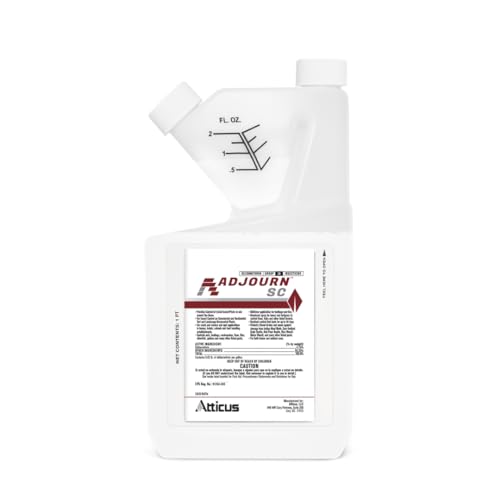
The Atticus Adjourn SC is a professional-grade deltamethrin concentrate that delivers a staggering 90-day residual kill indoors — the longest barrier duration of any product in this comparison. At 4.75% active ingredient, each 16-ounce bottle mixes into a substantial volume of finished spray, making it ideal for perimeter treatments around foundations, garage bases, and basement wall crevices where black widows typically establish harborage.
What sets this apart is its versatile use label: you can apply it to mattresses, upholstered furniture, carpets, and directly to outdoor landscapes without staining or lingering odor. The formulation dries clear and odor-free, which matters when treating occupied living spaces. Buyers in the field report that monitoring stations become noticeably less active within days of a thorough application.
The only real friction point is the mixing requirement — you’ll need a separate pump sprayer, and applying to a half-acre lawn with a hand pump can be physically demanding. For those not willing to invest in a hose-end sprayer, the effort is real. But for sheer knockdown power and duration-per-dollar, nothing else here competes.
Why it’s great
- Up to 90-day residual barrier indoors
- Label allows use on mattresses and upholstery
- Odor-free and non-staining when dry
Good to know
- Requires pump sprayer — not ready-to-use
- Not available for sale in AK, HI, NY, or VT
2. Miss Muffet’s Revenge Spider Killer
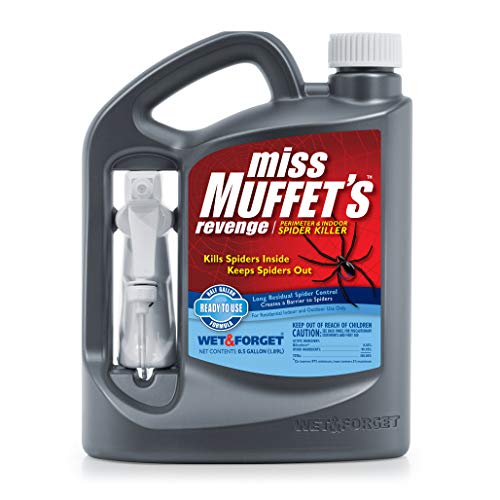
Miss Muffet’s Revenge operates differently from the concentrates: it’s a ready-to-use formula designed to both kill on contact and leave a long-lasting repellent barrier that spiders actively avoid. Real-world user reports from Florida and lake properties confirm it shuts down black widow and wolf spider activity for roughly 1.5 to 2 weeks in exposed outdoor environments, extending longer when applied in sheltered garages and crawl spaces.
The 64-ounce bottle provides generous coverage for window frames, door thresholds, light fixtures, and porch borders — the exact travel paths black widows use when hunting at night. One user reported zero webs or spiders on treated windows from April through October after a single application, suggesting the barrier holds remarkably well under protected conditions.
Weather exposure appears to be the primary limiting factor. Heavy rain or direct sunlight degrades the barrier faster, requiring more frequent reapplication than concentrates. The per-treatment cost is higher than mixing your own, but the convenience for homeowners who don’t own spray equipment makes this a strong “grab and go” solution.
Why it’s great
- Kills on contact plus long-lasting repellent barrier
- No mixing required — spray directly from bottle
- Safe for use around children and pets when dry
Good to know
- Barrier life drops with weather exposure
- More expensive per application than concentrates
3. CSI Cyper WSP Cypermethrin Insecticide

This is the budget-conscious buyer’s ticket to professional-grade chemistry without the professional price tag. Cyper WSP comes as four water-soluble packets, each containing Cypermethrin at a massive 40% concentration. One packet mixed with one gallon of water yields enough finished solution to treat roughly 2,000 square feet — meaning a single purchase can cover an entire home perimeter multiple times.
The non-contact kill characteristic is a crucial detail: spiders that walk through the dried residue die, but not instantly. They crawl away and expire within a few hours, which some users initially mistake for product failure. Once you understand the delayed knockdown, the effectiveness becomes obvious — dead bugs show up in places you didn’t spray. The powder leaves an invisible film with no smell, making it discreet for interior baseboard applications.
The learning curve is real: mixing requires dissolving the packet in a sprayer, and the label allows up to 10 packets per gallon for heavy infestations, which can confuse first-time users. But for someone willing to invest 10 minutes in reading instructions, this is the most cost-effective black widow barrier available.
Why it’s great
- Extremely high active concentration — huge value per gallon
- Odorless and invisible when dry
- Effective on scorpions, roaches, and ants as well
Good to know
- Not an instant kill — delayed knockdown
- Requires measuring and mixing
4. Martin’s Permethrin 13.3% Concentrate
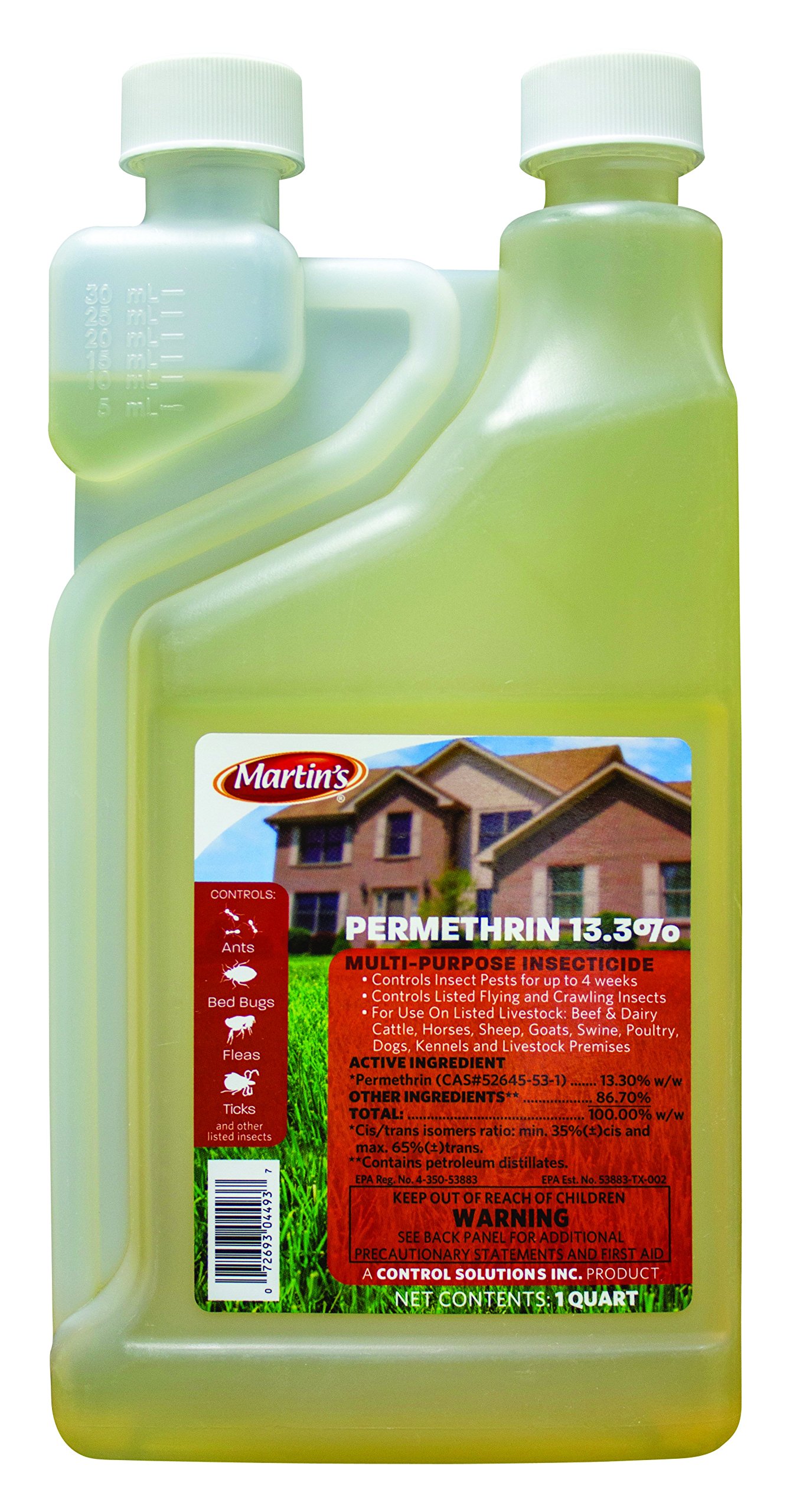
Martin’s Permethrin 13.3% is a broad-spectrum concentrate with a slightly different active ingredient profile than the cypermethrin-based options. Permethrin is the go-to choice for outdoor yard treatments, particularly when ticks and mosquitoes are also a concern. The 32-ounce bottle mixes at 3 ounces per gallon for a standard application, making one bottle yield roughly 10 gallons of finished spray — ample for treating a full yard perimeter plus the foundation line.
Users in tick-heavy regions specifically praise this product for its 4-to-6-week residual when applied to grass, brush lines, and dog runs using a chemical mister. For black widow control, it works best as an outdoor perimeter barrier that intercepts spiders before they approach the structure. The residual indoors is shorter than deltamethrin, landing around 4 weeks compared to Atticus’s 90 days.
The odor is the one consistent complaint: this concentrate has a strong chemical smell reminiscent of paint thinner. It dissipates after drying but is noticeable during application and for a short time afterward. Users sensitive to strong chemical odors should plan to apply it outdoors and keep windows closed during drying.
Why it’s great
- Excellent for yard perimeter and tick control
- High concentration yields many gallons of treatment
- 4-6 week outdoor residual against crawlers
Good to know
- Strong chemical odor during application
- Not labeled for use on mattresses or bedding
5. Harris Spider Killer Liquid Spray (32oz, 2-Pack)
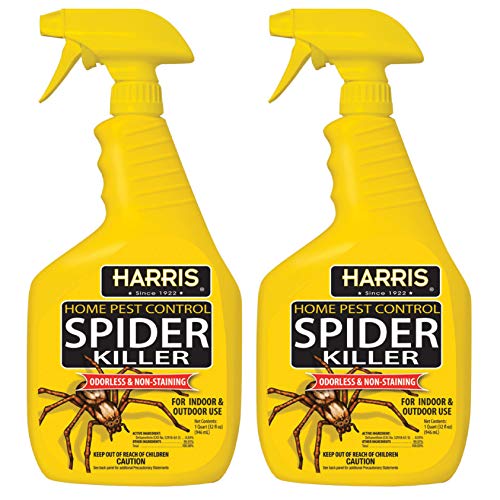
Harris Spider Killer strikes a clever balance between convenience and effectiveness for the homeowner who just wants to grab a bottle and start spraying. The 2-pack provides 64 total ounces of ready-to-use liquid, and the formula is EPA-registered with an odorless, non-staining profile that won’t damage fabrics when used as directed. The spray stream holds together at up to 6 feet, allowing you to reach ceiling corners and light fixtures without a ladder.
The catch — and it’s worth noting — is that Harris is not an instant kill formula. Users report spiders sprayed directly with the liquid are typically found dead the next morning, not within seconds. This delayed action is a function of its safety profile: the product is designed to be less acutely toxic to mammals, which is a trade-off some users welcome when treating kitchens and children’s rooms.
Compared side-by-side with the Raid brand, multiple long-term users report Harris outperforms Raid for spider-specific control. It also handles ants, roaches, silverfish, and Asian lady beetles, giving it utility beyond just black widow defense. For spot-treating visible spiders and maintaining low-traffic zones like storage sheds and garages, this is a solid, no-fuss option.
Why it’s great
- Odorless and non-staining — safe for indoor use on fabrics
- Long spray stream reaches 6 feet
- EPA-registered with multi-insect label
Good to know
- Not an instant kill — spiders die overnight
- Limited residual compared to concentrates
6. Raid Max Perimeter Protection Insecticide Spray
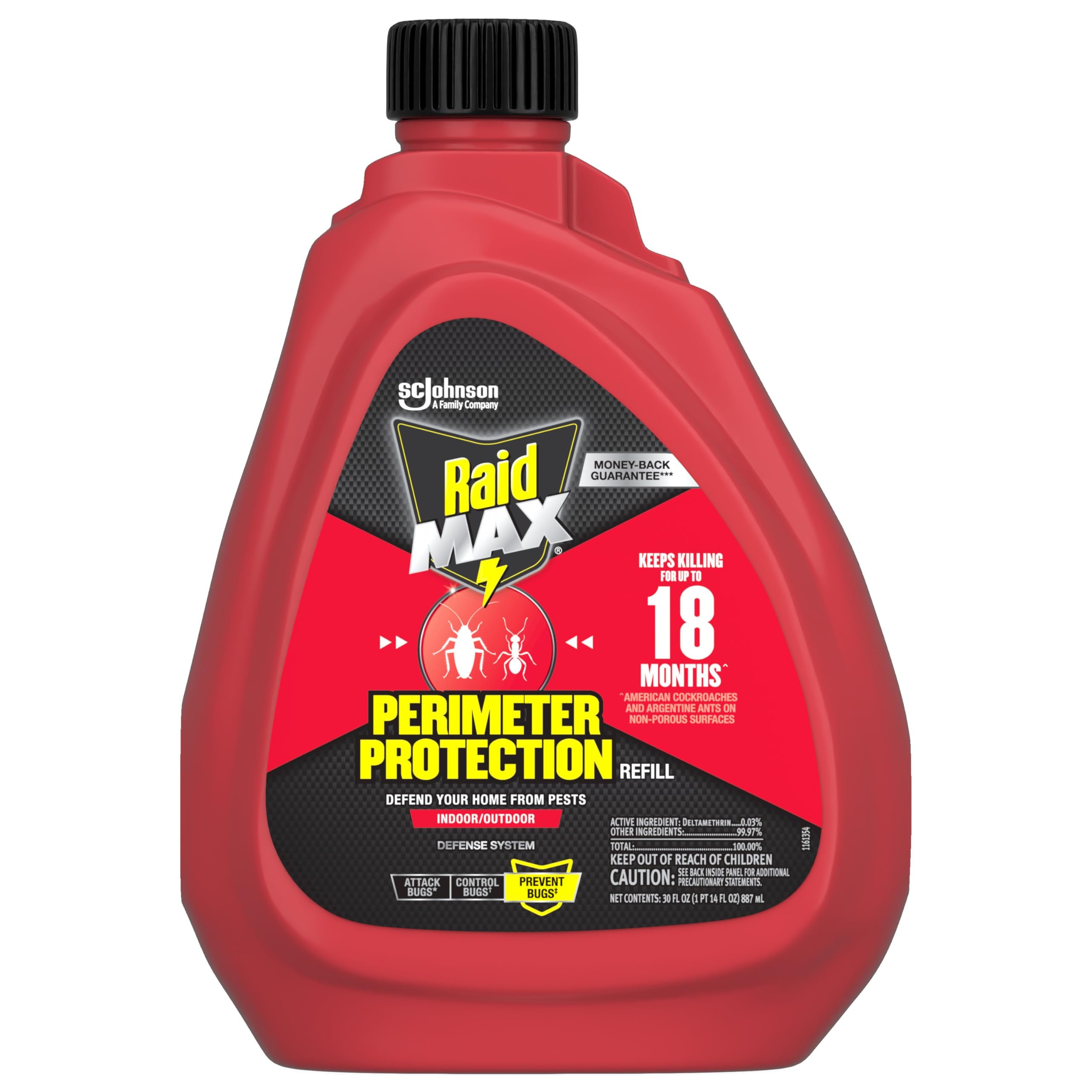
Raid Max Perimeter Protection is the household-name option that delivers exactly what it promises: an odorless, non-staining barrier spray that kills a broad range of insects on contact and claims to keep killing cockroaches and ants for up to 18 months. In practice, the spider efficacy is immediate for direct hits, and the product works well as a crack-and-crevice treatment around door frames, baseboards, and window sills.
The refillable battery-powered spray top is a nice touch for users who bought into the Raid system previously — you can swap the cartridge without buying a new trigger. The spray pattern reaches 3 to 4 feet, adequate for typical indoor perimeter work. Users consistently report zero odor and zero staining, making it a clean choice for indoor living spaces where aesthetics matter.
The main limitation against black widows specifically is that Raid’s residual activity is optimized for crawling insects like roaches and ants, not long-legged spiders that walk on higher clearance. Black widows can sometimes navigate across treated surfaces without picking up a lethal dose, which is why several users who switch to Harris report better spider-specific results. For light indoor use where convenience is king, Raid works — but don’t expect it to solve a heavy infestation.
Why it’s great
- No odor and no staining on surfaces
- Refillable battery trigger system
- Kills on contact for visible insects
Good to know
- Residual may be less effective against long-legged spiders
- One bottle covers limited square footage
7. RESCUE! Spider Traps – 2 Pack (6 Traps)

The RESCUE! Spider Trap fills a different role than sprays: it’s a glue trap housed in a hard plastic shell that prevents dogs, cats, and vacuum cleaners from destroying it. The double-sided glue dot pattern allows you to flip the trap once one side fills, effectively doubling its useful life. This is a passive monitoring tool, not a population eliminator — it catches spiders that wander across its surface but won’t touch the ones that don’t.
The design is genuinely clever: the hard case keeps the trap from collapsing under furniture or being crushed by foot traffic. Users report catching black widows, brown recluses, wolf spiders, cricket nymphs, and even the occasional scorpion. Placing these along baseboards, behind appliances, and near poorly sealed doors creates a detection grid that tells you where the real activity is before committing to a full chemical treatment.
One user reported watching a very large spider walk into the trap and then walk back out — a reminder that glue traps are size-dependent. Large, heavy black widows with strong legs can sometimes escape weak adhesive. Checking traps weekly and replacing them when dusty or full is necessary for continuous monitoring. These are an excellent complement to a barrier spray, not a replacement for one.
Why it’s great
- Hard plastic shell protects from pets and vacuum damage
- Double-sided — flip when one side is full
- Ready to use out of the box, no assembly
Good to know
- Large spiders may escape the glue
- Only catches wandering spiders — no population control
FAQ
Can a glue trap alone stop a black widow infestation?
How often should I reapply a concentrate barrier for black widows?
What active ingredient works best specifically against black widows?
Final Thoughts: The Verdict
For most users, the best black widow killer winner is the Atticus Adjourn SC because its 90-day residual combined with a versatile use label (mattresses, furniture, landscape) makes it the single most effective and convenient long-term solution. If you want a ready-to-use spray that requires no mixing and creates a strong repellent barrier, grab the Miss Muffet’s Revenge. And for the budget-conscious buyer willing to measure and mix, nothing beats the cost-per-gallon of the CSI Cyper WSP.