
Board games turn abstract concepts like earning, saving, and investing into tangible experiences kids can touch, count, and celebrate over. When children move a piece around a board and decide whether to spend their cash on a flashy asset or save it for a bigger goal, they absorb financial habits that no lecture or screen-based quiz can replicate.
I’m Min — the co-founder and writer behind Gadgets Feed. I spent hundreds of hours analyzing board game markets, comparing rulebooks, and cross-referencing educational objectives to find games that genuinely teach money and business skills without sacrificing the fun.
This guide breaks down the best options for family game nights and classroom use, so you can choose with confidence. My curated list of the best board games to teach kids about money and business covers everything from passive income mechanics to supply-chain logistics.
How To Choose The Best Board Games To Teach Kids About Money And Business
The best financial board games do more than just shuffle paper money around. They introduce kids to concepts like cost management, opportunity cost, and the value of assets. Before you pick one, consider how the game handles money flow, game length, and age appropriateness.
Realistic income and expense cycles
The most effective games simulate a paycheck-to-expense loop rather than just landing on a space and paying rent. Look for games that force players to earn an income, pay mandatory bills, and then decide how to allocate what’s left. This mirrors adult financial life far better than a system where money simply appears from passing “Go.”
Investment and asset-building layers
Games that let kids buy businesses, earn passive income, or invest in appreciating assets teach long-term thinking. The best options include a clear feedback loop: spend money on a business card, and each subsequent turn that business generates revenue. This immediate cause-and-effect makes the concept of “making money work for you” intuitive for children aged 8 and up.
Play time and attention span
Financial board games can run anywhere from 20 minutes to over an hour. Shorter games (20–30 minutes) are ideal for introducing young children to basic counting and decision-making. Games in the 40–60 minute range allow for deeper strategy, like weighing risk versus reward on investment opportunities. Avoid games that drag past 90 minutes unless you are playing with older kids who already enjoy strategy-heavy sessions.
Mathematics and counting complexity
Some games use only paper bills (easy for younger kids), while others require making change or calculating interest. If your child is still learning to count coins, a game with a simple bill system and clear denominations is better. Older kids benefit from games that require addition, subtraction, and even basic multiplication to determine profit margins.
Quick Comparison
On smaller screens, swipe sideways to see the full table.
| Model | Category | Best For | Key Spec | Amazon |
|---|---|---|---|---|
| Paycheck to Billionaire | Financial Sim | Passive income & investing lessons | 45 min play time, ages 8+ | Amazon |
| SimplyFun BankIt! | Savings Game | Saving, spending & bank interest | 30 min play time, ages 8+ | Amazon |
| Learning Resources Buy It Right | Math Practice | Making change & counting money | 3 difficulty levels, ages 5+ | Amazon |
| Ravensburger Big Money | Risk & Reward | High-energy asset buying | 40 min play time, ages 8+ | Amazon |
| Game of the States | Geography & Trade | Supply-chain and state economics | 50 state cards, ages 8+ | Amazon |
| Late for the Sky Dino-Opoly | Themed Trading | Introductory property trading | 60 min play time, ages 8+ | Amazon |
| Kangaroo Cravings | Literacy Game | Reading skills (not money-focused) | 300 sight words, ages 4-9 | Amazon |
In-depth Reviews
1. Paycheck to Billionaire

Paycheck to Billionaire is the most complete financial simulation board game on this list. Players start with a paycheck, pay realistic bills like rent and insurance, and then decide how to invest their remaining cash into businesses that generate passive income. The game avoids the punishing bankruptcy spiral of Monopoly by keeping players in the game and focused on asset growth instead of elimination.
The component quality is impressive for its mid-range price point. The game board uses a dark green color scheme with clear space markings, and the included 240 banknotes and 100 play cards support varied strategies. Each game session runs about 45 minutes, which is short enough to maintain engagement but long enough to teach cost management and compounding returns. The rules are easy to learn, making this accessible for children aged 8 and up. Customer reviews consistently highlight how kids stay engaged through multiple rounds and ask to play again.
Where this game truly stands out is its focus on passive income. Players invest in businesses and then collect revenue from those investments in later turns, demonstrating the core principle of making money work for you. The upgrade arrows and Eye of Providence pieces add a visual progression that rewards smart financial decisions.
Why it’s great
- Teaches passive income and smart investing through direct gameplay mechanics
- Realistic paycheck-to-expense cycle mirrors adult financial life
- High-quality board and cards hold up to repeated family game nights
Good to know
- Instructions could be clearer on specific card selection rules
- Some younger players may need help with the investment strategy layer
2. SimplyFun BankIt!
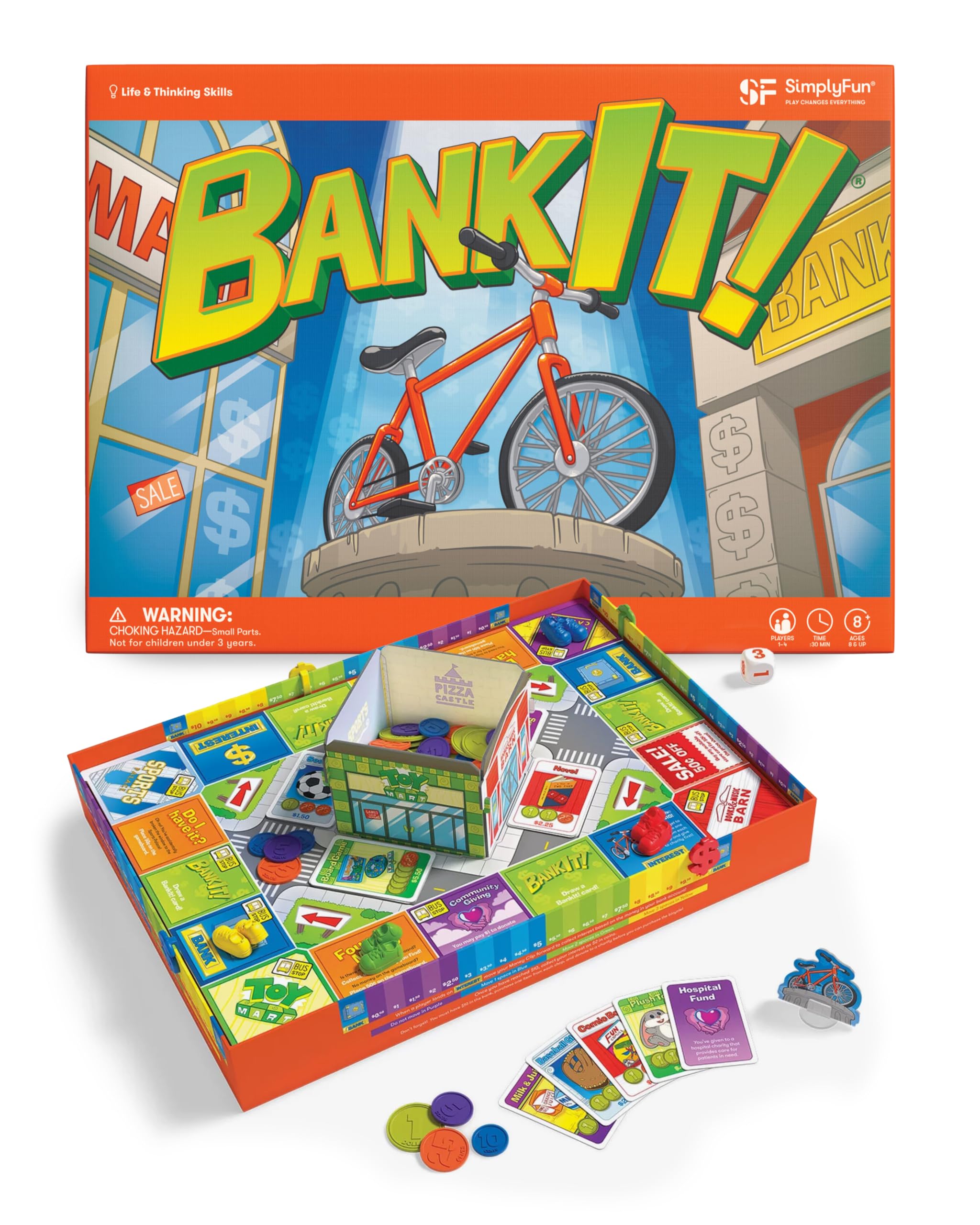
BankIt! distills personal finance down to a simple but powerful loop: earn money, decide whether to spend, save, or donate, and watch your savings grow with bank interest. The game board features a central bank where players deposit cash and earn interest on their savings, teaching one of the most important financial concepts that most board games ignore entirely.
With a 30-minute play time, BankIt! is perfect for quick learning sessions. The game supports 1 to 4 players and includes chips for tracking savings. The goal is straightforward: be the first player to save enough to buy a shiny new bike. This concrete, kid-relatable goal makes saving feel rewarding rather than restrictive. Customer reviews note that even four-year-olds can grasp the basic mechanics with guidance, and older siblings enjoy the strategic tension of deciding when to withdraw savings versus letting interest compound.
The tradeoff for the short play time is that the investment layer is simpler than in Paycheck to Billionaire. There are no business ownership cards or complex asset chains. Instead, the focus stays on the three core pillars of personal finance: spend, save, and donate. The cardboard bank piece could be sturdier, but the gameplay itself is polished and well-tested.
Why it’s great
- Teaches bank interest and compounding in an intuitive way
- Quick 30-minute sessions maintain kid attention
- Concrete saving goal (buy a bike) makes the lesson stick
Good to know
- Cardboard bank component may need reinforcing with tape
- Investment mechanics are simpler than other games on this list
3. Learning Resources Buy It Right Shopping Game

Buy It Right is tailor-made for elementary-aged children who are learning to count money and make change. The game presents realistic shopping scenarios where players set prices, buy items, and calculate correct change. It includes three difficulty levels: paper money only, coins only, and a combined challenge that requires making change up to .
The play money included in this set is highly realistic, which helps children practice recognizing coin and bill denominations. The game board measures 19 inches by 19 inches, giving plenty of space for multiple players. Younger children can start with Level 1 using a single die, while older kids can graduate to Levels 2 and 3 where multiple dice add strategy. The game requires players to add and subtract their way through purchases, reinforcing number sense and problem-solving skills in a natural, non-pressured way.
One of the best features is that the game encourages the “counting back change” method rather than just subtracting on paper. This hands-on approach helps children understand the relative value of items and develops mental math skills. The included calculator is optional and reportedly works best in good lighting, but the game plays fine without it. Keep in mind that this game focuses more on math and change-making than on business strategy or investment concepts.
Why it’s great
- Three built-in difficulty levels grow with your child’s math skills
- Realistic money helps with coin and bill recognition
- Teaches the counting back change method used in real retail
Good to know
- Requires adult facilitation for younger children learning rules
- Calculator component is unreliable and not essential
4. Ravensburger Big Money

Big Money trades the careful savings approach of BankIt! for a high-risk, high-reward dice-rolling experience that teaches kids about risk assessment and asset diversification. Each turn gives players three rolls of the dice to try and land on matching sets. The more matching dice you collect, the more money you earn to invest in outrageous assets like a candy factory or a drone racing league.
The game plays in under 40 minutes, making it a faster alternative to Monopoly while retaining the excitement of buying properties and earning income. It supports 2 to 5 players, and the rules are easy to understand from the first round. The asset cards are varied and entertaining, which keeps children engaged through multiple sessions. Customer reviews consistently highlight how Big Money has become a family favorite because it balances luck with strategic decisions about which assets to invest in.
The tradeoff is that the game is primarily luck-based in its core dice-rolling mechanic. The financial lesson here is more about risk tolerance and asset diversification than about budgeting or savings discipline. It is a pure entertainment-first game with a secondary educational benefit, making it best for family game nights where the priority is fun with a side of financial thinking.
Why it’s great
- Fast-paced dice rolling keeps kids engaged
- Teaches risk/reward assessment through asset purchasing
- Outrageous asset categories add humor and replayability
Good to know
- Heavily luck-based with fewer strategic depth layers
- Not ideal for teaching budgeting or savings habits
5. Game of the States

Game of the States blends geography with economic education in a way that no other game on this list does. Players drive plastic pickup trucks across the United States, buying goods produced in one state and selling them in another. This pick-up-and-deliver mechanic introduces kids to supply chain logic, regional economic differences, and the concept of arbitrage.
The game includes 16 wooden packages representing goods, 4 plastic pickup trucks, a deck of 50 state cards, a thick game board, play money, and a spinner. It is STEM-approved, meaning the geography and economics aspects align with STEM education philosophy. Players become familiar with state capitals, top products, and geographic locations while making buying and selling decisions. The game offers both short and long play versions, making it adaptable to different attention spans.
One customer reported a misspelled state name on a card (“Wisconson” instead of “Wisconsin”), which points to a minor quality control issue. However, the overwhelming majority of reviews praise the game’s educational value and nostalgic appeal. The vintage artwork from the 1970s version captures a classic feel, while the gameplay has been updated to remove outdated elements like tobacco products.
Why it’s great
- Teaches supply-chain economics through pick-up-and-deliver gameplay
- STEM-approved geography and economics integration
- Works for both short and extended play sessions
Good to know
- Some state cards contain misspellings due to quality control
- Requires a knowledgeable player to explain selling-price strategies
6. Late for the Sky Dino-Opoly
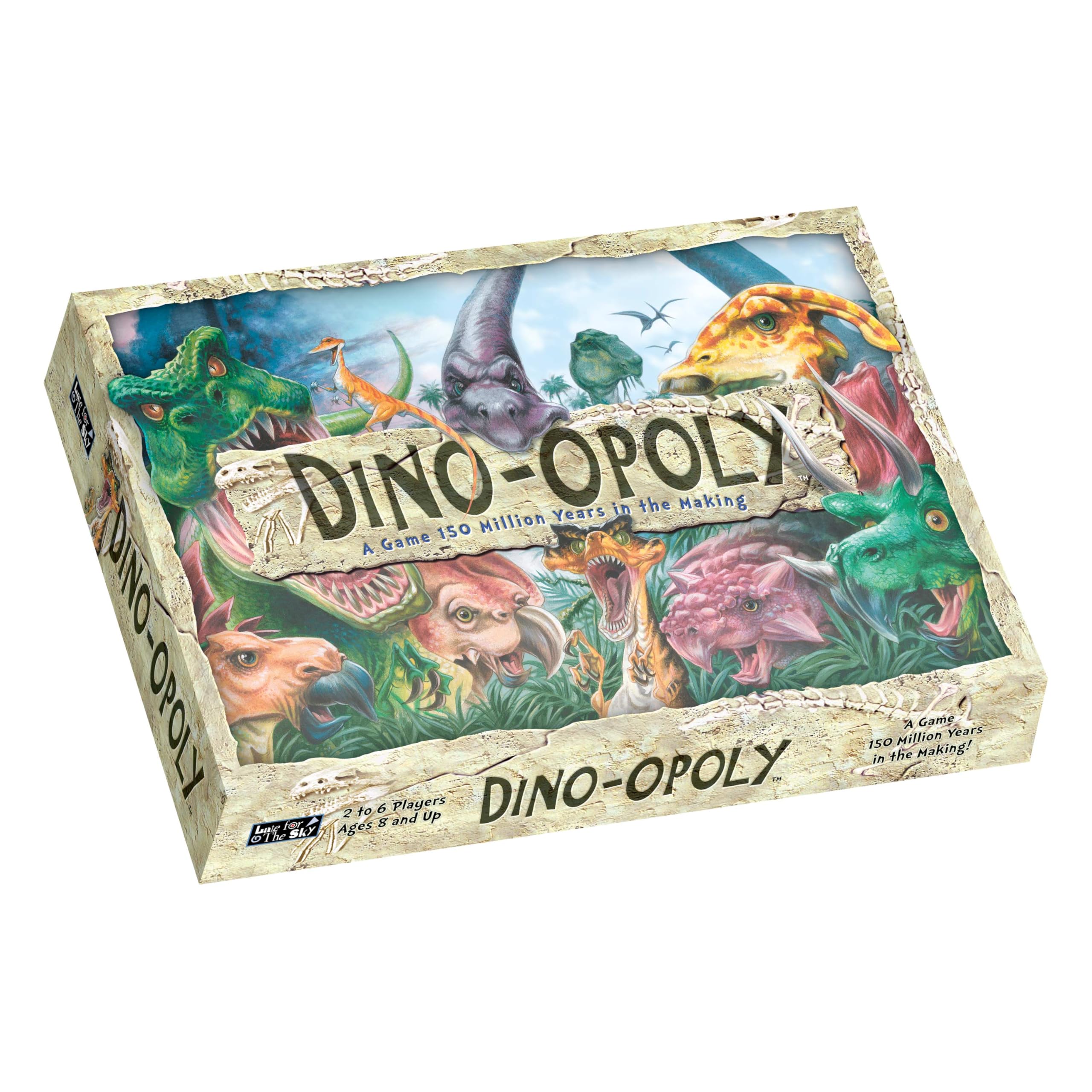
Dino-Opoly is essentially a Monopoly clone with a dinosaur theme, but it stands out for two reasons: it uses simplified rules that play quicker than standard Monopoly, and the dinosaur property cards include educational facts with pronunciation guides. Players buy dinosaurs instead of streets, and they build “bones” and “museums” instead of houses and hotels.
The game supports 2 to 6 players and plays in about an hour. The components are high quality, with a colorful board, custom dinosaur tokens, and play money. The dinosaur facts printed on each deed card add a layer of paleontology education on top of the basic property trading. Customer reviews note that children who love dinosaurs can hardly put this game down, and that the financial management aspect serves as an excellent teaching tool for money handling.
The tradeoffs are clear: the game has fewer Chance and Opportunity cards than standard Monopoly, and the actions on those cards tend to be simpler. This is by design for a younger audience, but it means the financial strategy is less complex than games like Paycheck to Billionaire or Big Money. Dino-Opoly works best as an introduction to property trading for dinosaur lovers who are not yet ready for more abstract financial concepts.
Why it’s great
- Simplified Monopoly-style rules keep games shorter and less frustrating
- Dinosaur fact cards add educational value for paleontology enthusiasts
- High-quality components survive repeated weekly play sessions
Good to know
- Fewer chance cards leads to less variety between games
- Financial concepts are limited to basic property trading
7. Kangaroo Cravings Learn to Read Sight Words Game

Kangaroo Cravings is primarily a literacy game, not a money or business game, but it earns a place on this list because strong reading skills are foundational to understanding financial and business concepts. The game uses 300 high-frequency sight words combined with multi-sensory action cards that involve dancing, acting, and drawing. Children work cooperatively to beat the raccoon or play competitively for a race to the finish.
The game has won the Mom’s Choice Award and has been featured on Good Morning America and Forbes. It is designed based on the Science of Reading, targeting phonological awareness, phonics, fluency, and vocabulary. The game includes three sight word card decks with 100 cards each, and the play time is roughly 20 minutes per session. Customer reviews highlight that children as young as four engage with the game, and it works particularly well for children with dyslexia or ADHD.
Some customer reviews note that the stated 20-minute play time often stretches to 30-40 minutes, and that the “go back” spaces can create frustrating loops that require house rules to fix. The game’s random movement mechanic does not correlate with word difficulty, so a child may land on an easy word early and a hard word later purely by chance. Use this game as a reading supplement to the financial literacy games on this list, not as a direct replacement.
Why it’s great
- Builds reading fluency essential for understanding financial terms
- Multi-sensory actions (dancing, acting) keep kinetic learners engaged
- Award-winning design with strong educator endorsements
Good to know
- Not a money or business game; purely literacy-focused
- Random movement leads to uneven word difficulty exposure
FAQ
What is the single most important concept these games should teach?
How long should a board game session be for a child learning money skills?
Can these games replace formal financial education?
Which game is best for teaching the concept of supply and demand?
How can I verify a game is age-appropriate for my child?
Final Thoughts: The Verdict
For most users, the board games to teach kids about money and business winner is the Paycheck to Billionaire because it offers the most complete financial simulation with passive income mechanics, realistic expense management, and solid component quality at a mid-range price point. If you want a faster, savings-focused lesson about bank interest, grab the SimplyFun BankIt!. And for young elementary students who need to master counting money and making change before tackling business strategy, nothing beats the Learning Resources Buy It Right Shopping Game with its three built-in difficulty levels.