
A boiler inspection isn’t a visual guess — it’s a high-stakes diagnostic mission inside sealed combustion chambers, narrow tube bundles, and steam-side passages where one undetected crack or deposit reading can trigger a catastrophic failure or a multi-day shutdown. The right tool turns a dark, inaccessible space into a data-rich environment you can measure.
I’m Min — the co-founder and writer behind Gadgets Feed. I’ve spent countless hours cross-referencing sensor specs, articulation radii, probe diameters, and battery endurance curves across the full spectrum of industrial-grade inspection hardware to separate true professional solutions from consumer-grade novelties.
This guide focuses on boiler inspection tools for industrial use, covering borescopes, combustion analyzers, sewer cameras, wireless HVAC probes, and thermal imagers that meet the demands of real plant and mechanical environments.
How To Choose The Best Boiler Inspection Tools For Industrial Use
The right inspection tool for a boiler depends on what you’re measuring — flue gas chemistry, tube wall integrity, internal visual condition, or airflow balance. Each tool category serves a different failure mode, and choosing the wrong one means wasted hours and blind spots.
Probe Diameter and Articulation
Boiler tube bundles and burner passages are tight. A probe thicker than 5.5mm will get stuck in spark plug holes and narrow heat exchanger passes. Articulating heads (two-way or four-way) let you look around bends without pulling the entire probe out — critical when you’re snaking through a firetube or checking a superheater return bend.
Sensor Array for Combustion Analysis
If you’re tuning a burner, you need O2, CO, temperature, draft pressure, and efficiency calculations. Entry-level detectors skip CO without H2 compensation, which underestimates true CO in natural gas applications. Look for analyzers that measure CO raw and compensated, and that log data for trending over firing rate changes.
Thermal Resolution and IP Rating
Thermal imagers for boiler inspections need at least 160×120 thermal pixels (320×240 is far better) and MSX technology to overlay visual edges on the heat map. Spec the IP rating — boiler rooms are humid, dusty, and full of steam. IP67 or IP68 is mandatory for probe camera heads; thermal cameras should be sealed against splashing water.
Quick Comparison
On smaller screens, swipe sideways to see the full table.
| Model | Category | Best For | Key Spec | Amazon |
|---|---|---|---|---|
| Testo 310 II | Combustion Analyzer | Flue gas & burner tuning | O2, CO, draft, efficiency + app | Amazon |
| FLIR E8 Pro | Thermal Imager | High-res heat mapping | 320×240 thermal / MSX / Cloud | Amazon |
| FLIR MR277 | Moisture Meter IR | Boiler room leak & moisture | IGM IR + pin probe + hygrometer | Amazon |
| Fieldpiece JL3KH6 | Wireless Manifold Kit | HVACR charge & air checks | Rapid Rail / ±1°F / 5-sec stability | Amazon |
| Fieldpiece SM482V | Digital Manifold | Refrigerant & vacuum logging | 4-port / micron gauge / datalog | Amazon |
| Fluke 922 | Airflow Meter | Differential pressure & velocity | Air velocity / pressure / temp | Amazon |
| Gatebig Sewer Camera | Pipe Inspection | Large-diameter drain/duct runs | 9″ IPS / 164ft / self-level / locator | Amazon |
| Teslong NTS500 | Dual-Lens Borescope | Tube & combustion chamber viewing | Dual lens / 5″ IPS / 9.8ft cable | Amazon |
| Teslong Articulating | Articulating Borescope | Navigating tight bends | 2-way articulating / 5ft cable / Wi-Fi | Amazon |
In‑Depth Reviews
1. Testo 310 II Combustion Analyzer
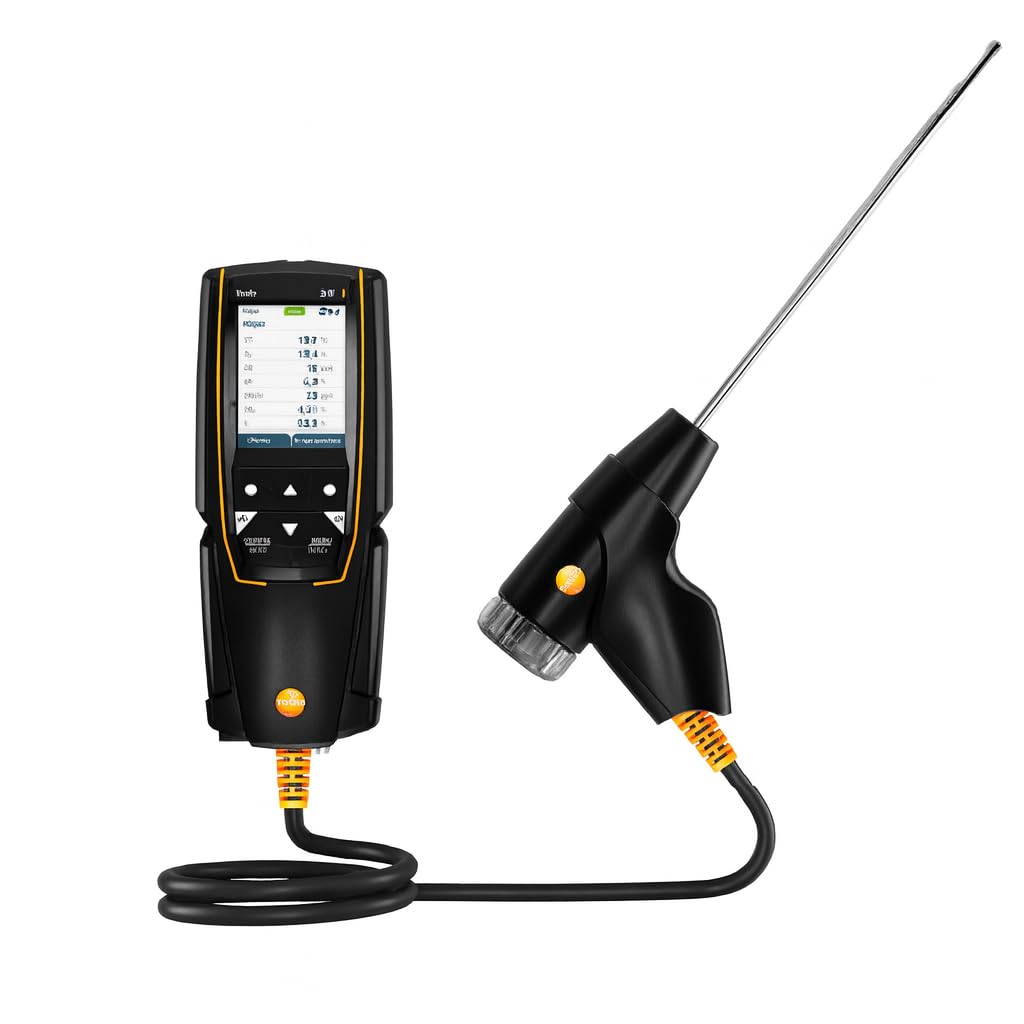
The Testo 310 II is the de facto standard for flue gas analysis on industrial burners, boilers, and furnaces. It measures O2, CO (with and without H2 compensation), draft pressure, flue gas loss, and efficiency simultaneously, feeding real-time data to a companion smartphone app via Bluetooth. The 180mm probe with cone fits standard flue sampling ports without adapter hunting.
One standout feature is the dual thermocouple inputs (K-type and J-type) for measuring combustion air temperature and flue temperature independently — essential for accurate efficiency calculations on multi-pass boilers. The rechargeable battery lasts a full workday, and the five included particle filters keep the sensors clean in dirty coal or oil flue streams.
Field reports confirm it can diagnose a cracked heat exchanger in under 10 minutes by comparing CO levels across firing rates, something visual borescopes can miss when the crack is hairline. The omission of a built-in printer is minor; the app provides PDF reports that satisfy most inspection documentation requirements.
Why it’s great
- Simultaneous O2/CO/draft/efficiency with H2 compensation
- Bluetooth app for remote logging and report generation
- Rechargeable battery and five filter slots for heavy use
Good to know
- No built-in printer — requires app or PC for printouts
- Temperature reading can be slow to stabilize on rapid drafts
2. FLIR E8 Pro Thermal Imaging Camera

The FLIR E8 Pro delivers 320×240 thermal resolution (76,800 pixels) with patented MSX technology that embosses visual edge detail onto the thermal image. For boiler inspection, that means you can instantly spot insulation voids, refractory cracking, and steam trap failures without physical contact. The temperature range spans -20°C to 550°C, covering both ambient boiler room checks and hot surface scanning.
FLIR Ignite Cloud integration allows automatic image upload and sharing from the field — critical for multi-stakeholder industrial sites where a plant engineer needs to review a hot spot remotely. Over-the-air firmware updates keep the camera current without sending it back to the factory. The 2-year warranty on parts and labor plus 10-year detector coverage is unmatched in this class.
Some users note the autofocus struggles beyond 10 feet, limiting distant steam-pipe inspections in large boiler houses. The lack of an SD card slot means all transfers rely on Wi-Fi or USB cable, which can be inconvenient in areas with poor connectivity. For close-range thermal diagnosis of boiler casing and tube sheets, however, this is the most capable handheld unit below the research-grade tier.
Why it’s great
- 320×240 thermal resolution with MSX edge overlay
- FLIR Ignite Cloud for automatic remote image sharing
- 10-year detector warranty covers the most expensive component
Good to know
- Autofocus loses sharpness beyond 10 feet
- No SD card slot — relies on Wi-Fi or USB for image export
3. FLIR MR277 Moisture Meter

The FLIR MR277 is the industrial inspection trifecta — an integrated thermal camera, a non-invasive moisture sensor, and a hygrometer all in one housing. The IGM (Infrared Guided Measurement) system uses 4x the thermal resolution of earlier MR-series meters, so you can scan a boiler room wall or steam-pipe chase and let the camera direct you to the exact spot for pin-probe verification.
Boiler applications go beyond moisture detection: the IR mode reveals insulation degradation behind cladding, leaking gaskets, and condensation patterns on cold feedwater lines before they become visible damage. The external pin probe with optional specialty probes (hammer probe, deep-wall probe) expands the tool’s reach into refractory and lagging checks.
Some reliability concerns surface in user reviews — occasional boot-loop lockups requiring battery removal to reset. The Bluetooth photo transfer to the FLIR app is functional but slow, needing about 60 seconds for images to appear. For a restoration or boiler room auditor who needs moisture and thermal data in one tool flow, the MR277 is a major time-saver over carrying separate meters.
Why it’s great
- Four-way measurement: thermal, non-invasive moisture, pin probe, hygrometer
- 4x thermal resolution of previous FLIR IGM meters
- Laser locator pins the exact spot for follow-up pin testing
Good to know
- Occasional screen freeze requiring battery pull
- Bluetooth photo transfer is slower than direct cable
4. Fieldpiece JL3KH6 Job Link Wireless Probe Kit

The Fieldpiece JL3KH6 redefines how HVACR technicians gather data by replacing traditional analog gauges and thermometers with a set of wireless probes that stream temperature, pressure, and charge data in real time to a smartphone or tablet. Rapid Rail technology uses the pipe itself to complete the circuit, so ambient air temperature never corrupts the reading — the clamp stabilizes in under 5 seconds with ±1°F accuracy.
For boiler-side work, this kit excels at measuring supply and return water temperatures, combustion air temperature differentials, and refrigerant circuit performance for absorption chillers. The probes are light enough to leave in place during a full startup sequence while the technician walks the plant floor monitoring live trends on the Job Link app. The padded case keeps everything organized and protected in a tool bag.
Some users mention shipping delays and packaging issues, but the tool performance itself is rated 5/5 consistently. The probes are not intrinsically safe for explosive atmospheres without additional certification, so check your plant’s area classification before using them in gas valve trains. For everyday commissioning and troubleshooting, this kit reduces steps by half compared to manual measurement.
Why it’s great
- Rapid Rail eliminates ambient temperature interference
- Wireless streaming to phone/tablet for live trending
- Compact kit fits easily into a standard tool backpack
Good to know
- Not rated for hazardous/explosive environments
- Some reports of delayed shipping from third-party sellers
5. Fieldpiece SM482V Wireless Manifold

The Fieldpiece SM482V is a 4-port digital refrigerant manifold with an integrated micron vacuum gauge, thermocouple jacks, and wireless connectivity to the Job Link ecosystem. For boiler systems that incorporate absorption or vapor-compression cycles, this manifold provides superheat, subcooling, and vacuum-level logging in one tool — eliminating the need for a separate vacuum gauge on chiller commissioning.
The datalogging capability is the differentiator: it performs a temperature-compensated system tightness test over a programmable duration, storing the results for validation. The protected thermocouple jacks accept pipe clamp and outdoor air probes, giving you all four measurement points for a complete refrigerant circuit without stray wires. The 4-valve design allows isolation of vacuum and charge procedures without disconnecting hoses.
Some users note the hoses are not included, so factor that into the total investment. The plastic ABS build feels robust but is not armor-plated — protect it from drops. This manifold pairs best with the JL3KH6 probe kit for a full wireless data suite, making it ideal for field service engineers who commission large industrial cooling and heating systems.
Why it’s great
- Integrated micron gauge eliminates one extra tool on chiller work
- Temperature-compensated tightness test for leak validation
- Wireless datalogging to Job Link app for report generation
Good to know
- Hoses not included — purchase separately
- ABS housing is durable but not ruggedized for drops
6. Fluke 922 Airflow Meter
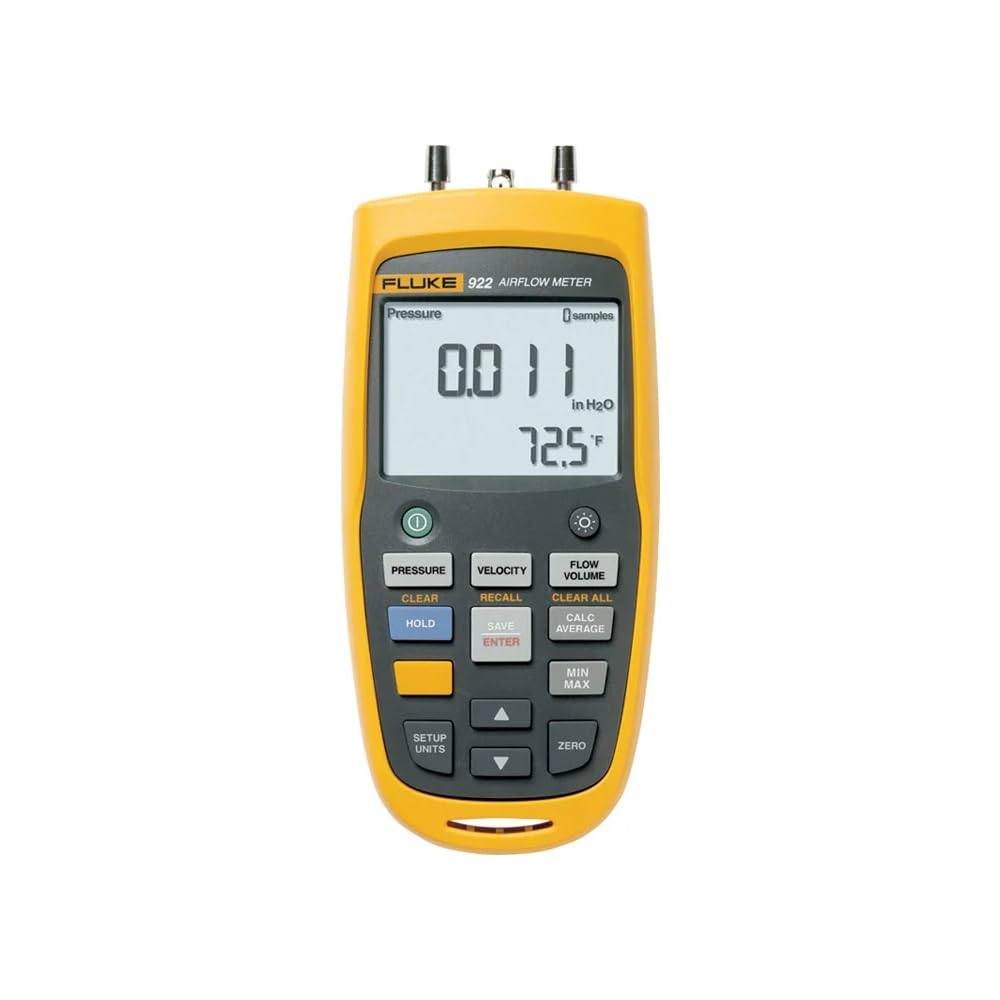
The Fluke 922 measures differential pressure, air velocity, and airflow rate in one handheld unit, making it the go-to tool for balancing combustion air supply and flue draft in industrial boiler rooms. Correct draft pressure is critical for safe boiler operation — too much positive pressure forces flue gas into the room, too little causes incomplete combustion and soot buildup. The 922 reads down to 0.001 inH2O with the included pitot probe.
Beyond draft measurement, the 922 calculates air velocity in fpm and airflow in cfm, letting you verify that burner primary and secondary air openings are delivering the design cubic feet per minute. The 2-year Fluke warranty and the meter’s ability to survive a 3-foot drop onto concrete give it the durability edge for daily plant-floor use.
The temperature probe accuracy is serviceable but not lab-grade — some users note a 2°F deviation at the low end, which affects temperature differential calculations. For EPA compliance work requiring NIST traceability below 0.001 inH2O, a higher-end model may be necessary. For standard boiler commissioning and troubleshooting, the 922 is fast, intuitive, and proven.
Why it’s great
- Measures differential pressure, velocity, and airflow in one device
- Durable build with 3-foot drop rating and 2-year warranty
- Easy to use for daily draft and combustion air balancing
Good to know
- Temperature accuracy varies at low range
- Not NIST traceable below 0.001 inH2O for regulatory work
7. Gatebig Sewer Camera with Locator
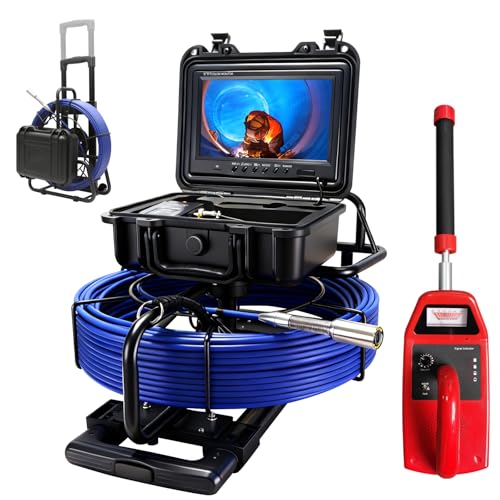
While the Gatebig system is marketed as a sewer camera, its 7mm fiberglass cable, 164-foot working length, and self-leveling camera head make it a natural fit for large-diameter boiler blowdown lines, condensate return piping, and ductwork inspection in industrial plants. The 9-inch IPS screen is bright enough to see in direct sunlight on outdoor steam line trench inspections, and the 304 stainless steel camera head with sapphire lens resists corrosion from acidic condensate.
The 512Hz sonde locator transmits a signal to the included receiver, allowing the operator to mark the exact surface location of a blockage or damage — useful when a pipe is buried under a concrete floor. The 12 adjustable LEDs provide enough light for pipes up to 12 inches in diameter, and the IP68 rating means the camera can be fully submerged without damage. The 5100mAh cold-resistant battery delivers up to 8 hours of continuous operation.
For boiler-side drain and vent inspections the Gatebig is overkill on length but delivers pro-grade video quality and location tracking that consumer borescopes cannot match. The 7mm cable diameter is slightly larger than dedicated boiler borescopes, so it won’t fit into combustion chamber spark plug holes or 3/8-inch tube passages. For its intended use — large-diameter pipe runs and drain inspections — it saves the cost of hiring a camera truck service.
Why it’s great
- Self-leveling camera always shows upright image in pipes
- 512Hz locator pinpoints buried pipe issues precisely
- IP68 submersible and 8-hour battery for all-day fieldwork
Good to know
- 7mm cable too large for spark plug holes or narrow heat exchanger tubes
- Requires trolley for transport — not pocket-sized
8. Teslong NTS500 Dual-Lens Borescope
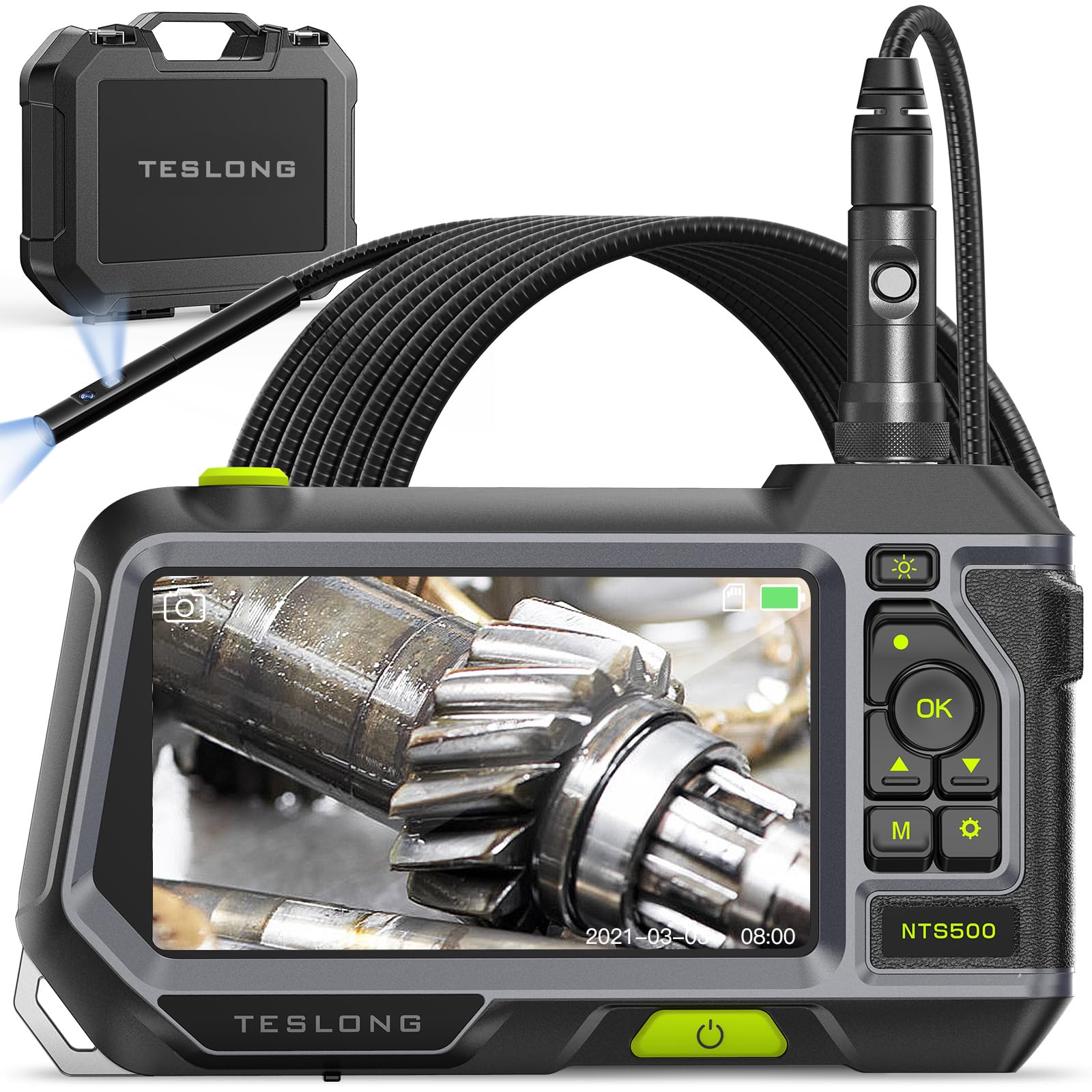
The Teslong NTS500 is the most versatile visual inspection tool for boiler applications in this lineup, combining a 0.21-inch (5.5mm) dual-lens probe with a 5-inch 720p IPS monitor and a 3500mAh battery. The dual-lens design lets you toggle between forward-view and side-view cameras without needing an angled mirror — a critical feature when you need to check tube walls immediately adjacent to the probe tip inside a firetube or waterwall header.
The 9.8-foot semi-rigid cable holds its shape like a gooseneck, giving you precise control over the probe tip without fighting a floppy wire. This is the same build quality mechanics compare favorably to Snap-on borescopes at less than half the cost. The included SD card slot captures 1MP stills and 720p video with audio, and the USB port transfers files to a laptop for inspection reports. Real-world reviews confirm 4+ years of daily shop use without failure.
The IP67 rating covers the probe for wet boiler washdowns and rain exposure, though the 5.5mm diameter cannot fit into the smallest passages (some Ford spark plug holes require a 0.24-inch probe). The side camera has its own LED illumination, but the two lights are not as bright as higher-end articulating borescopes. For the price-to-performance ratio in industrial visual inspection, this is the clear choice for steam and hot water boiler tube checks.
Why it’s great
- Dual front/side cameras eliminate mirror tools in tight tubes
- Semi-rigid gooseneck cable holds position on vertical runs
- Interchangeable probes with Teslong family save long-term cost
Good to know
- 5.5mm head won’t fit the tightest spark plug openings
- Side camera LEDs are less powerful than forward light
9. Teslong Two-Way Articulating Borescope

The Teslong Two-Way Articulating Borescope solves a problem the NTS500 cannot — navigating around bends. Its 0.33-inch (8.4mm) probe tip bends up to 180 degrees via a thumb control on the handle, letting you peer around tube sheets and U-bends inside a boiler without pulling the entire probe out and angling it manually. The 5-foot semi-rigid gooseneck cable is shorter than the NTS500 but ideal for locomotive-type boilers, firetube combustion chambers, and packaged boiler burner zones.
The 5-inch IPS LCD screen shows 1080p video, and the built-in Wi-Fi adapter streams the inspection feed to a tablet or phone — useful when a second set of eyes needs to see the defect live. The included 32GB MicroSD card stores both JPG images and AVI video with audio from the built-in microphone. The 3000mAh battery lasts through a full day of moderate use, and the rugged carrying case keeps the articulating head protected in transport.
The 0.33-inch probe diameter will not fit through 0.24-inch or smaller openings such as Ford spark plug holes, limiting its use on some internal combustion engine-based boiler ignition systems. The articulation mechanism requires practice to master — first-time users may over-steer and overshoot the target. For HVACR, pipe, and industrial combustion chamber inspections where a 180-degree view is needed, this is the tool mechanics and boiler techs consistently reach for.
Why it’s great
- Two-way articulation up to 180 degrees for U-bend viewing
- Built-in Wi-Fi streams live feed to phone or tablet
- Includes 32GB card with audio/video recording capability
Good to know
- 0.33-inch diameter too large for very narrow ignition ports
- Articulation control has a learning curve for precise steering
FAQ
Can I use a standard automotive borescope for boiler tube inspection?
What is the difference between a combustion analyzer and a thermal imager for boiler diagnostics?
Why is H2 compensation important in a CO sensor for boiler inspection?
What is the minimum IP rating required for a boiler inspection camera?
Final Thoughts: The Verdict
For most users, the boiler inspection tools for industrial use winner is the Teslong NTS500 because its dual-lens 5.5mm probe, semi-rigid cable, and 5-inch monitor cover the widest range of boiler tube and combustion chamber visual checks without breaking the budget. If you need flue gas chemistry to tune a burner, grab the Testo 310 II. And for large-diameter condensate or blowdown line inspection with location tracking, nothing beats the Gatebig Sewer Camera with Locator.