
That stabbing throb with every step after a broken toe is a signal you can treat as seriously as any fracture. A medical walking boot unloads the forefoot and transfers impact to the midfoot, letting the bone knit without constant pressure. The wrong boot, however, can introduce new pain points, chafe on the shin, or fail to immobilize the toe—prolonging recovery by weeks.
I’m Min — the co-founder and writer behind Gadgets Feed. I’ve spent countless hours dissecting medical recovery gear, focusing specifically on how offloading mechanics, pneumatic support systems, and sole geometry affect healing timelines for toe and forefoot fractures.
After analyzing dozens of models across real user recovery logs, sizing complaints, and material durability reports, this guide identifies the best boot for broken toe that balances immobilization with everyday walkability.
How To Choose The Best Boot For Broken Toe
A broken toe demands a boot that offloads the forefoot while preventing any bending of the toe joint. You cannot just grab any ankle brace—the right boot uses a stiff rocker sole to shift weight to your midfoot and heel, keeping the toe completely unloaded. Below are the three critical factors that separate effective recovery boots from painful ones.
Rocker Sole Design
The sole curvature determines how your foot rolls from heel-strike to toe-off. A true rocker bottom bends at the midfoot, not the toe box, ensuring the broken toe never bears weight. Boots with flat, rigid soles force you to limp, which strains the hip and lower back. Look for a sole that creates a smooth, continuous arc from heel to the ball of the foot.
Pneumatic vs. Static Padding
Inflatable air bladders press the liner firmly against the foot and ankle, reducing micro-movement inside the boot that can aggravate a fracture. Static foam padding offers less personalized compression and may loosen as swelling subsides. For a broken toe, pneumatic support is preferred because it locks the forefoot in place without over-tightening a single strap.
Boot Height and Weight
A short CAM walker (ankle-height, roughly 6-8 inches tall) is ideal for toe fractures—it stabilizes the foot without restricting knee motion. Full-height boots add unnecessary bulk and can cause gait asymmetry. Weight matters too: every extra pound on your foot multiplies the energy cost of each step. A boot under 1.5 pounds is significantly easier to manage during daily activities.
Quick Comparison
On smaller screens, swipe sideways to see the full table.
| Model | Category | Best For | Key Spec | Amazon |
|---|---|---|---|---|
| Ovation Medical Gen 2 Pneumatic Walking Boot | Premium | Low-profile recovery with natural gait | Pneumatic pump, half-pound lighter than competitors | Amazon |
| United Ortho USA14115 Short Air Cam Walker | Premium | Steel-reinforced durability for active users | Steel-reinforced uprights, rocker sole | Amazon |
| BodyMed Air CAM Walking Fracture Boot | Mid-Range | Shock absorption and impact reduction | Air pump liners, 13″ tall design | Amazon |
| Brace Direct CAM Walker Fracture Boot Short | Mid-Range | Open-toe ventilation for dressing changes | Low-profile rocker, open-toe design | Amazon |
| Jewlri Walking Boot Short Air Walker | Mid-Range | Dual air bladders for customized compression | Inflatable air bladders, whole-shaped rigid frame | Amazon |
| honarry Walking Boot for Broken Foot | Mid-Range | Inflatable airbag for swollen feet | Adjustable airbag, 3-point hook-and-loop straps | Amazon |
| Vive Wedge Post-Op Shoe | Budget | Heel-specific offloading for plantar relief | Wedge design, open square toe box | Amazon |
In‑Depth Reviews
1. Ovation Medical Gen 2 Pneumatic Walking Boot

The Ovation Medical Gen 2 redefines what a fracture boot can weigh and how naturally it lets you walk. The pneumatic pump uses an integrated single push-button release system—far more durable than the twist-valve designs that break after a few weeks of daily use.
The sole is contoured in multiple directions rather than a single rocker curve, allowing a remarkably fluid gait for a medical immobilization boot. The flared struts accommodate all calf circumferences without pinching, and the sure-grip non-slip resting surface provides solid traction on tile and hardwood. Users with fifth metatarsal fractures report that the combination of lightweight construction and pneumatic stabilization significantly reduces walking pain from day one.
The Gen 2 is priced higher than most entries here, but the build quality and user-reported recovery outcomes justify the investment. The only caveat is that the Velcro straps can create pinpoint pressure on the shin if the liner is not rotated to a perfect 90-degree angle during initial setup—a minor adjustment that pays dividends in long-term comfort.
Why it’s great
- Half-pound lighter than other premium boots reduces fatigue during all-day wear
- Multi-directional contoured sole promotes a natural walking motion
- Durable pneumatic pump with one-button release avoids valve failures
Good to know
- Requires careful liner alignment to avoid shin pressure points
- Thick sole may still need a slight shoe lift on the opposite foot for perfectly level hips
2. United Ortho USA14115 Short Air Cam Walker

The United Ortho Short Air Cam Walker has earned a reputation among orthopedic users for a simple reason: steel-reinforced plastic molded uprights that simply do not flex under load. For a broken toe, this rigidity translates directly to reliable immobilization—the toe cannot bend because the boot will not bend. The rocker sole and shock-absorbing insole work together to smooth out each step, reducing the jarring impact that normally travels through the forefoot.
The air pump system inflates the liner to conform around the foot and ankle, which is particularly useful when swelling fluctuates throughout the day. Users recovering from ankle sprains and mid-level fractures report that the boot feels stable enough for outdoor walks on uneven pavement. The package includes four comfort pads that allow fine-tuning of the fit, a detail that matters when a millimeter of pressure shift can mean the difference between comfort and a hotspot.
The weight of 2.3 pounds is noticeable compared to the Ovation Gen 2, but the steel reinforcement makes this boot the best choice for anyone who needs to wear it for extended periods in demanding environments. The hook-and-loop closure system is straightforward, though some users find the boot difficult to put on solo without a second person to hold the liner in place while strapping.
Why it’s great
- Steel-reinforced uprights provide maximum immobilization for toe fractures
- Shock-absorbing insole minimizes forefoot impact during each step
- Four included comfort pads allow precise fit customization
Good to know
- Heavier than competing short boots at 2.3 pounds
- Liner can shift during initial application, requiring careful re-alignment
3. BodyMed Air CAM Walking Fracture Boot

The BodyMed Air CAM Walking Boot prioritizes impact dampening above all else, featuring a shock-absorbing insole that reduces heel-strike forces before they reach the forefoot. For a broken toe, this is critical—every step generates a shockwave that travels through the metatarsals, and the BodyMed’s foam-and-air combination attenuates more of that energy than standard EVA insoles. The 13-inch height provides additional ankle stabilization without climbing all the way to the knee.
The inflation system uses a twist-valve design that allows precise pressure adjustment. Turning the knob clockwise locks the air, and pressing the bulb adds support. Users with fifth metatarsal fractures report excellent healing outcomes after two months of continuous wear, crediting the boot’s ability to prevent subtle rotational movement that can displace a healing bone. The rocker sole base is textured for traction on wet surfaces, a practical safety feature for bathroom visits.
The boot measures 13 x 4.31 x 12.75 inches and is noticeably bulkier than low-profile alternatives. Some users note an audible squeaking sound during walking—a function of the air bladder and plastic shell interface—which can be annoying in quiet environments. The sizing runs small relative to standard shoe sizes, so careful measurement against the size chart is essential before ordering.
Why it’s great
- Superior shock-absorbing insole reduces forefoot impact forces during gait
- Twist-valve air pump provides fine-grained compression control
- Textured rocker sole offers reliable traction on varied surfaces
Good to know
- Bulky profile may not fit under wide-leg pants or work trousers
- Air bladder can produce squeaking sounds during walking
4. Brace Direct CAM Walker Fracture Boot Short
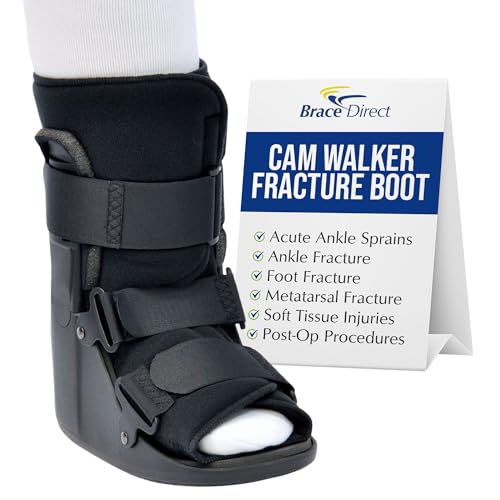
The Brace Direct CAM Walker opts for an open-toe design that serves two specific purposes for a broken toe: it keeps the foot ventilated to reduce moisture buildup around dressings, and it eliminates any pressure on the tip of the toe from a closed toe box. The low-profile rocker sole is less aggressive than some competitors, making this boot suitable for users who need a gentler transition between sitting and standing. It fits both left and right feet with a universal mold.
The boot includes medial and lateral support pads that allow you to dial in the fit around the ankle without adding bulk to the forefoot region. This is particularly useful when a broken toe is accompanied by swelling in the midfoot, as the straps can be loosened at the bridge without compromising ankle stability. The hook-and-loop closure system is simple and effective, and the open toe makes it easy to check for circulation issues without removing the entire boot.
Some users report that the middle strap is less effective at providing upper ankle compression, and the boot lacks the pneumatic air bladder found on more expensive models. For pure toe fractures where ankle immobilization is secondary to forefoot offloading, this is rarely a problem—but for combined toe-and-ankle injuries, you may need to supplement with an ace bandage. The value proposition is strong for those who need a functional boot without air pump complexity.
Why it’s great
- Open-toe design prevents pressure on the broken toe tip and improves airflow
- Low-profile rocker sole allows a gentler, more natural walking transition
- Medial and lateral support pads enable custom fit around the ankle
Good to know
- Middle strap lacks sufficient upper ankle compression for combined injuries
- No pneumatic air bladder for dynamic swelling accommodation
5. Jewlri Walking Boot Short Air Walker

The Jewlri Walking Boot distinguishes itself with dual inflatable air bladders embedded in the liner—one positioned around the ankle and one along the foot arch. This dual-chamber system allows independent control of compression in two zones, which is uniquely beneficial for a broken toe. You can inflate the foot bladder to lock the forefoot in place while keeping the ankle bladder looser, or vice versa, depending on where your swelling concentrates during the day.
The rigid outer shell uses whole-shaped molding technology, which creates a seamless plastic frame without weak seams. The rocker bottom includes arch support that helps distribute weight evenly across the midfoot, reducing the load on the metatarsals. The liner is removable and machine-washable in cold water—a practical feature for long recovery periods where hygiene matters. The pump valve uses a simple red button for inflation and a twist release for deflation, both of which feel robust.
The boot is 0.85 kilograms (1.87 pounds), placing it in the mid-weight range. Some users report that the toe area has pressure points that require extra padding, particularly if your foot shape is narrow. The pump’s location on the front of the boot can press against the shin when kneeling, but for most users this is an infrequent issue. Overall, the Jewlri offers the most adjustable pneumatic experience at this price point.
Why it’s great
- Dual air bladders allow separate adjustment of ankle and foot compression
- High-quality molded plastic frame eliminates weak seam points
- Removable, washable liner supports hygiene during long recovery periods
Good to know
- Toe area may require extra padding for narrow foot shapes
- Pump valve placement can press against shin when kneeling
6. honarry Walking Boot for Broken Foot
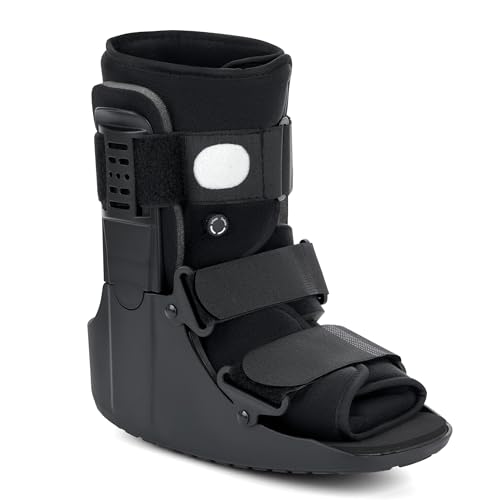
The honarry Walking Boot delivers a surprising amount of functionality at a mid-range price point, featuring an inflatable airbag that you can adjust to match your foot’s exact contour. The 3-point hook-and-loop strap system wraps the foot at the toe bridge, midfoot, and ankle, distributing compression evenly. The rigid plastic shell is lightweight at 1.8 pounds, which is competitive with models costing significantly more.
The boot is designed for left or right foot use and comes with a removable orthopedic insole that conforms to the foot’s shape after a few days of wear. The anti-slip sole is textured with a pattern that provides grip on smooth surfaces—a critical safety feature when your balance is already compromised by an injury. Users recovering from ankle sprains and stress fractures report that the boot provides enough stability to allow walking without pain, even outdoors.
Sizing is the primary challenge with this boot—users with a women’s size 7.5 report that their toes stop about 2 inches short of the boot’s toe in medium size, indicating that the sizing chart skews generous. The boot also lacks the steel reinforcement of the United Ortho model, so it flexes slightly more under heavy load. For toe fractures that do not require extreme rigidity, however, the honarry is a solid entry-level pneumatic boot.
Why it’s great
- Inflatable airbag provides customizable compression for swelling control
- Lightweight 1.8-pound build reduces walking fatigue
- Removable orthopedic insole adapts to foot contour over time
Good to know
- Sizing runs large—measure carefully before ordering
- Plastic shell flexes more than steel-reinforced alternatives
7. Vive Wedge Post-Op Shoe

The Vive Wedge Post-Op Shoe takes a different approach from traditional CAM walkers—instead of immobilizing the ankle, it uses a wedge-shaped sole that shifts the body’s weight forward onto the toes and midfoot, completely unloading the heel. For a broken toe located near the metatarsal head or for combined toe-and-heel issues, this design offers targeted relief that a standard flat-soled boot cannot match. The modified rocker base promotes a smooth gait despite the wedge angle.
The open square toe box is generous enough to accommodate bulky bandages and dressings, and the polyester mesh upper is breathable for long days of wear. The shoe includes two extender tabs that allow you to adjust the fit as swelling changes, and the synthetic rubber outsole provides traction on most indoor surfaces. Users with heel ulcers and plantar fasciitis report significant pain reduction, with one reviewing the relief as “amazing” for heel pain from ladder climbing.
The trade-off is that this shoe provides no lateral ankle support and no upper calf stabilization. For a simple toe fracture with no ankle involvement, that is perfectly acceptable—but if your injury extends into the ankle joint or if you need to prevent inversion/eversion movement, a full CAM walker is a better choice. The material has been noted to feel hard in some spots, and the lack of arch support may shift pressure to the ball of the foot over time.
Why it’s great
- Wedge design transfers weight away from the heel, ideal for forefoot offloading
- Open square toe box accommodates bulky dressings without pressure
- Adjustable extender tabs personalize fit during swelling fluctuations
Good to know
- No ankle or calf support—not suitable for combined toe-and-ankle injuries
- Material firmness and lack of arch support can create new pressure points after extended use
FAQ
Can I wear a walking boot for a broken toe instead of a cast?
How tight should the straps be on a broken toe boot?
Can I drive while wearing a walking boot for a broken toe?
Final Thoughts: The Verdict
For most users, the boot for broken toe winner is the Ovation Medical Gen 2 Pneumatic Walking Boot because it combines the lowest weight in its class with a pneumatic pump that maintains consistent compression throughout recovery. If you want steel-reinforced durability for demanding daily use, grab the United Ortho USA14115 Short Air Cam Walker. And for targeted forefoot offloading without ankle immobilization, nothing beats the Jewlri Walking Boot Short Air Walker with its dual air bladders.