
A sourdough loaf’s defining moment is not the fermentation but the bake — the split-second decision of whether you get a shattering, golden crust or a pale, chewy disappointment. The pan you choose dictates steam retention, heat delivery, and the final geometry of your crumb. Swapping out a thin aluminum tin for a heavy cast iron or enameled vessel transforms a mediocre loaf into one that looks like it came from a £6 bakery.
I’m Min — the co-founder and writer behind Gadgets Feed. I’ve spent countless hours cross-referencing thermal mass data, enamel thickness reports, and real-world user bakes to understand exactly which material and geometry produces the ideal oven spring and crust development.
After analyzing hundreds of loaves baked across seven different pans, I’ve narrowed the field to the absolute best performers. This guide ranks the very best bread pan for sourdough based on heat distribution, moisture management and long-term durability under weekly use.
How To Choose The Best Bread Pan For Sourdough
Most first-time sourdough bakers grab any 9×5 tin off the shelf and wonder why their loaf comes out pale with a dense, gummy crumb. The pan is the unsung ingredient. Sourdough demands a specific thermal environment: rapid, even heat coupled with a sealed chamber of steam during the first half of the bake. Understanding the material, the lid design, and the dimensions is the difference between a bread bowl and an artisan loaf.
Material Matters: Cast Iron vs. Stainless Steel vs. Enameled
Cast iron is the gold standard for sourdough because its volumetric heat capacity — roughly 3.6 J/cm³·K — means it holds and radiates thermal energy long after the oven element cycles off. Bare cast iron needs seasoning to prevent sticking and demands diligent drying. Enameled cast iron sidesteps the seasoning ritual with a glass-like interior that resists staining and releases bread more easily, though the enamel reduces thermal conductivity slightly. Stainless steel heats quickly and never rusts, but its lower mass and higher reflectivity produce less aggressive crust browning unless you preheat it thoroughly and compensate with extended bake times. Nonstick pans lack the thermal mass entirely — they produce pale sides and require liners.
The Steam Trap: Why a Lid Is Non-Negotiable
Sourdough relies on steam to keep the crust flexible during the first 20-25 minutes of baking, allowing maximum oven spring before the crust sets. A lid creates a micro-climate: the dough’s own moisture evaporates and condenses on the lid’s interior, falling back onto the loaf instead of escaping into the oven cavity. Pans marketed as “Dutch oven loaf pans” combine a deep bottom and a matching lid — you bake covered for the first segment, then remove the lid to dry out the crust for the final 15-20 minutes. A standard loaf tin with a loose sheet pan on top traps some steam but won’t match the seal of a fitted lid.
Size and Geometry: 8.5×4.5 vs. 9×5 vs. 11×5
The pan’s internal volume dictates how much dough it can support without overflowing. An 8.5×4.5-inch pan fits roughly 500-600g of dough (total weight) and produces a taller, more domed loaf. A 9×5-inch pan handles 650-800g and yields a classic sandwich-slice shape. An 11×5-inch pan pushes beyond 900g, ideal for large family loaves but risky for smaller recipes — shallow dough in an oversized pan spreads sideways instead of rising upward. The wall angle matters too: steep, nearly vertical sides force the dough upward, creating better oven spring, while tapered sides let the loaf slump. Measure your typical recipe’s dough weight and match it to the pan’s volumetric capacity (quarts or liters) rather than trusting the listed “size” label.
Quick Comparison
On smaller screens, swipe sideways to see the full table.
| Model | Category | Best For | Key Spec | Amazon |
|---|---|---|---|---|
| Flavehc DarkCyan | Enameled Cast Iron | Best Overall | 1.6 qt capacity, 500°F max | Amazon |
| Articasting Seasalt 11×5 | Enameled Cast Iron | Large Loaves | 5.8 qt, 11×5 inch | Amazon |
| Northriver Cerise2 | Enameled Cast Iron | Two-Piece Set | 3.4 qt, 9×5 inch | Amazon |
| Articasting 9×5 | Bare Cast Iron | Budget-Friendly | 5.8 qt, 9×5 inch | Amazon |
| LIANYU 6-Pack | Stainless Steel | Batch Baking | 18/0 stainless, no coating | Amazon |
| VORRINGARD Blue | Enameled Cast Iron | Premium Versatility | 5 qt round, looped handles | Amazon |
| Umite Chef Red | Enameled Cast Iron | Round Baking | 6 qt, domed cloche lid | Amazon |
In‑Depth Reviews
1. Flavehc Enameled Cast Iron Loaf Pan, DarkCyan

The Flavehc strikes the perfect balance between size and thermal performance for standard sourdough recipes. At 8.5×4.5 inches, its 1.6-quart capacity is ideal for dough weights around 500-600g — the sweet spot where the loaf rises tall without spilling over. The enameled interior is matte black, which absorbs radiant heat more aggressively than a glossy white surface, promoting deeper browning on the bottom and sides. Users report consistent results at 450-500°F with a 30-minute covered segment, though some found that standard recipe times fall short and require an additional 10-15 minutes uncovered.
The set includes a lid that fits snugly enough to trap initial steam but lifts off easily after the crust sets. At 4.08 kg (roughly 9 pounds), the pan has substantial thermal mass — it holds temperature during the critical oven-spring window far better than any thin-gauge tin. The dark cyan exterior enamel survived a drop without chipping, per customer feedback, which signals a durable factory bond. Hand-washing with warm soapy water and a nylon brush keeps the interior free of baked-on residue.
The trade-off is the learning curve with timing. Because the cast iron takes longer to heat and holds heat longer, your first loaf may over-bake on the bottom if you follow a recipe designed for aluminum pans. Lowering the rack position or adding a crumpled sheet of foil under the pan prevents scorching. The pan also requires preheating before the dough goes in — cold dough hitting a cold cast iron interior guarantees sticking. Using parchment paper draped into the preheated pan solves this cleanly.
Why it’s great
- Matte black enamel interior boosts bottom crust browning
- 500°F rating gives headroom for high-temp sourdough bakes
- Lid seals tightly, trapping steam for full oven spring
Good to know
- Requires preheating before adding dough to prevent sticking
- Standard bake times may run short by 10-15 minutes
- 11.3-inch length may not fit in compact countertop ovens
2. Articasting 11×5 Inch Cast Iron Loaf Pan, Seasalt
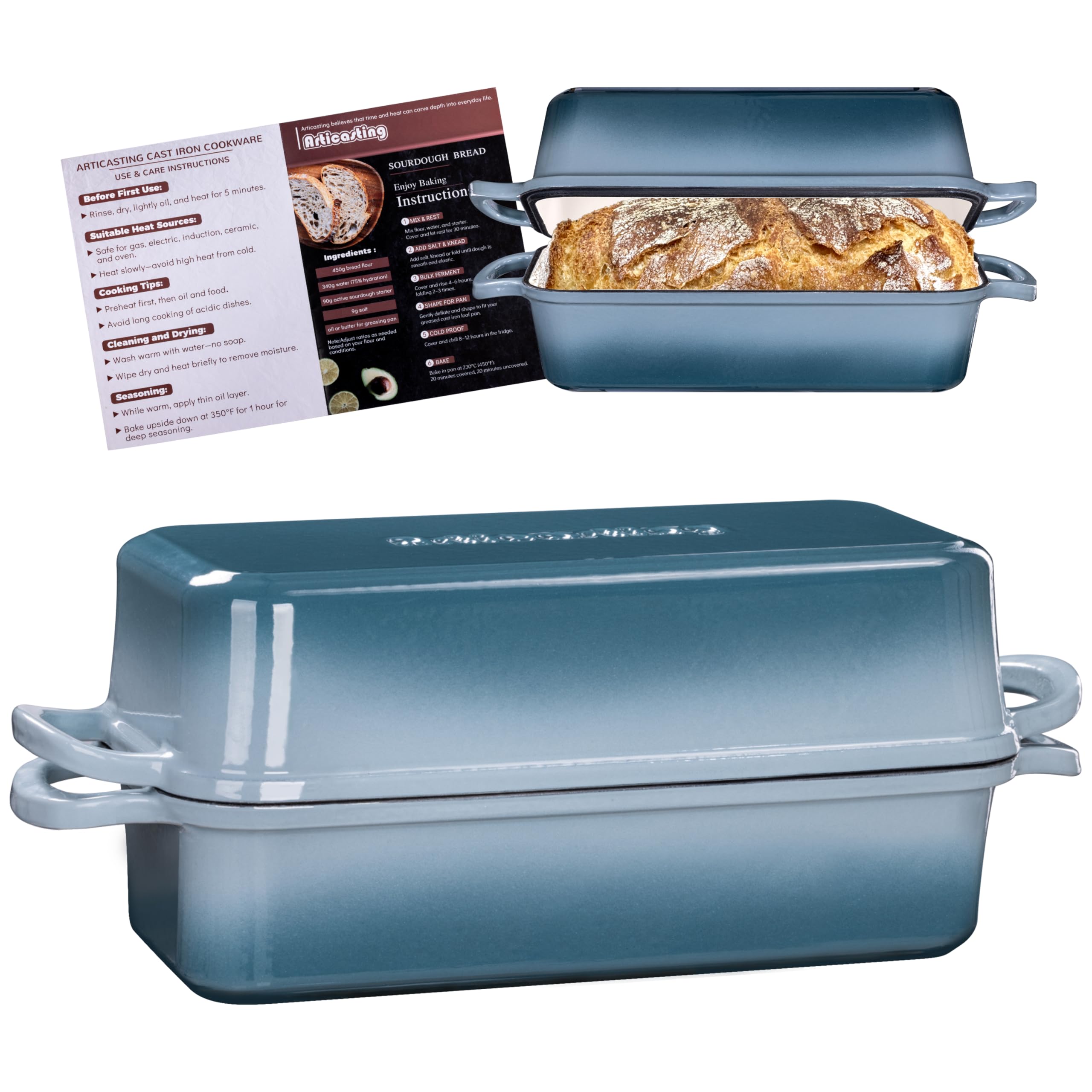
When your sourdough starter is strong and your recipe calls for 900g-1000g of dough, standard 9×5 pans can’t contain the rise. The Articasting 11×5-inch model solves this with a 5.8-quart capacity that accommodates oversized loaves without the sides bowing. The enameled seasalt finish — a muted coastal blue-gray — hides flour dust well and transitions from oven to table without looking like a utilitarian tool. Multiple long-term users report consistent performance after months of weekly use, with no chipping or scratching on the enamel surface.
At 13.3 pounds, this is the heaviest pan in this guide, and that mass directly translates to heat retention. The pan holds enough thermal energy to maintain a steady 450°F internal temperature even after you load cold dough into it. The included lid mirrors the bottom’s shape, creating a true Dutch-oven seal over the loaf. Customers report using 330g-500g of flour per loaf with excellent results — a 500g flour loaf bakes into a substantial but manageable sandwich size. The extra length (11 inches) means the bread slices are wider, making it ideal for toast or hearty sandwiches.
The primary challenge is oven fit. At 14.4 inches long, this pan requires a full-size oven or a large countertop convection model — it will not fit in a standard 12-inch-wide toaster oven. The weight also makes handling a two-hand affair; always use the integrated cast iron handles with thick oven mitts. Some users protect the bottom crust by placing crumpled foil beneath the pan on the lowest rack, as the bottom can darken faster than sidewalls due to the direct contact heat.
Why it’s great
- 11×5 inch capacity handles 900g+ dough weights easily
- 13.3 lb mass provides exceptional thermal stability
- Enamel surface resists staining after months of weekly use
Good to know
- Too large for most countertop toaster ovens
- Very heavy — requires two hands and thick oven mitts
- Bottom crust may over-brown without foil shielding
3. Northriver Casting Enameled Bread Loaf Pan, Red
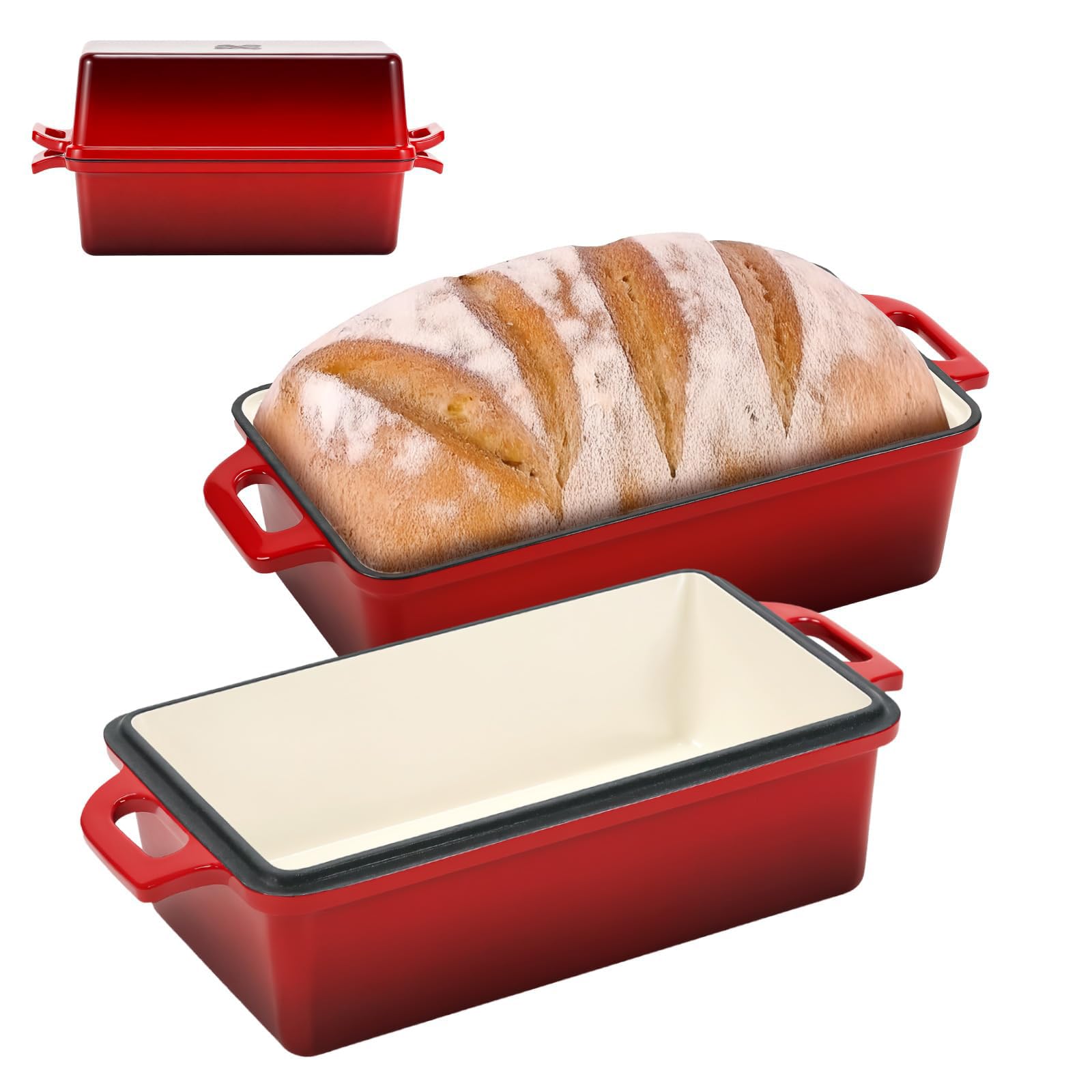
The Northriver Casting set includes two identical 9×5-inch enameled cast iron pans, allowing you to bake two loaves simultaneously or stack one on top of the other as a lid. This dual-mode design is rare in the standard loaf pan market — most covered pans use a single bottom with a dedicated lid, not two full pans. When stacked, the top pan acts as a ceiling that traps steam without the dome constraint of a traditional cloche. Users report that the fit is precise enough to prevent steam leakage while still being easy to lift off mid-bake.
The enamel interior is smooth but not inherently nonstick — multiple customers emphasize that parchment paper lining is essential for clean release, especially on the bottom and sidewalls. Baking at 450°F for 45 minutes covered, then 350°F for 30 minutes uncovered produced excellent results for gluten-free sourdough, which is notoriously difficult to handle in standard pans. The 3.4-quart total capacity per pan (6.8 quarts if using both separately) gives flexibility for small and medium recipes. The exterior cerise red finish is bright enough to serve as a serving dish directly at the table.
The primary drawback is the weight: each pan is roughly 5.3 pounds, and using both together adds up. Hand-washing is mandatory — dishwashers will degrade the enamel over time. Some users found that the smooth enamel surface causes dough to stick more aggressively than seasoned bare cast iron if you skip the parchment. The pan also benefits from a light olive oil wipe before the parchment goes in, which improves release further without altering the crust.
Why it’s great
- Two identical pans can be used separately or stacked as a lid
- Works well for gluten-free sourdough with adjusted timing
- Enamel finish resists rust and doesn’t require seasoning
Good to know
- Parchment paper lining is mandatory for clean release
- Heavy set — lifting stacked pans requires care
- Enamel can chip if knocked against hard surfaces
4. Articasting 9×5 Inch Bare Cast Iron Loaf Pan
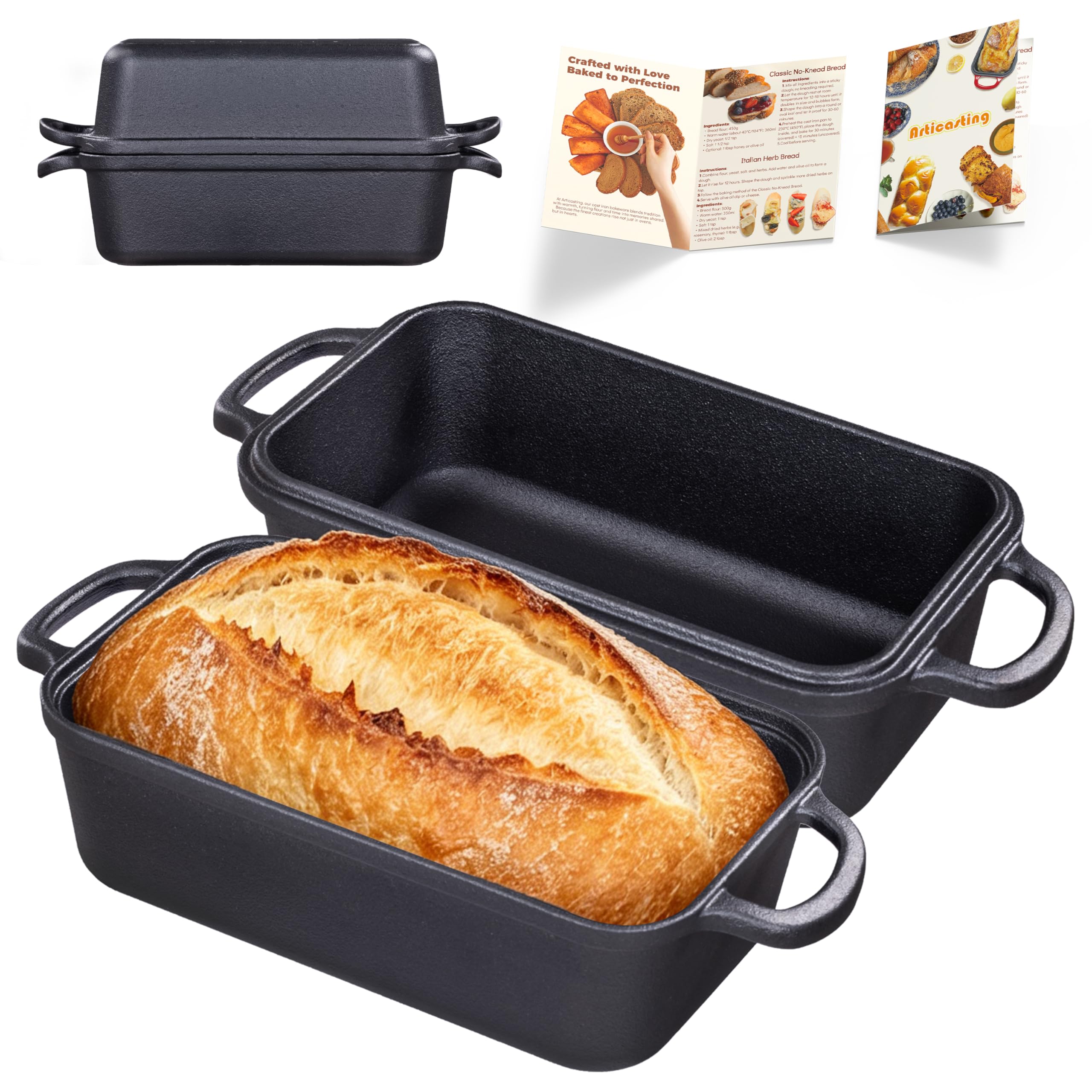
Bare cast iron delivers the highest thermal conductivity and the lowest price point, but only if you’re willing to season and maintain it. This Articasting 9×5-inch pan is pre-seasoned from the factory, and multiple customers confirm that after two or three additional home-seasoning cycles it becomes reliably nonstick for sourdough. The raw iron surface develops a dark patina over time that contributes to crust color — the Maillard reaction proceeds faster on bare iron than on enamel because the surface temperature is more aggressive.
The included lid fits with small handles on both pieces, creating a sealed environment that replicates a Dutch oven’s steam trap. Users report excellent results at 450°F: 35 minutes covered followed by 20 minutes uncovered produces a loaf with a crackling crust and a moist, open crumb. The 5.8-quart capacity is generous for a 9×5 shape, handling recipes up to 800g dough without overflow. The pan is noticeably lighter than enameled competitors at roughly half the weight of the 11×5 model, making handling easier for bakers with wrist concerns.
The downside is the maintenance. Bare cast iron must be dried thoroughly after every wash — even a few drops of water left on the surface can produce rust spots within hours. The pre-seasoning layer is thin and benefits from an immediate additional seasoning round (wipe with vegetable oil, bake at 400°F for one hour). Customers also note that acidic doughs left in contact with bare iron for extended periods can impart a metallic taste; this is rare with straight sourdough but worth noting if you experiment with fruit or cheese additions.
Why it’s great
- Bare iron provides maximum crust browning and heat transfer
- Lid creates effective steam trap for first-stage baking
- Lighter than enameled alternatives, easier to handle
Good to know
- Requires drying and occasional re-seasoning to prevent rust
- Pre-seasoning is thin — add your own seasoning coat
- Acidic doughs may react with bare iron over long proof times
5. LIANYU 6-Pack Stainless Steel Bread Loaf Pans
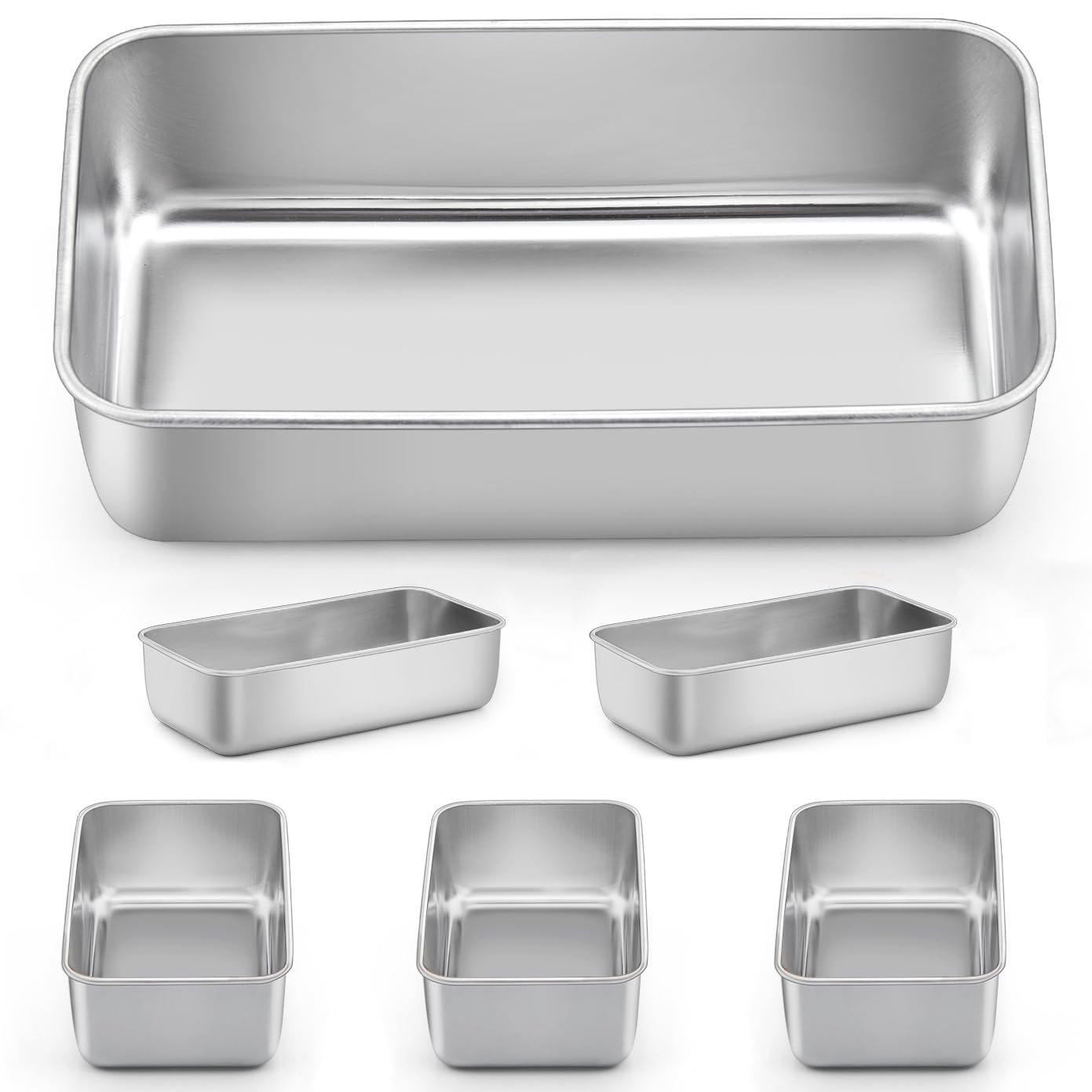
Stainless steel is not the obvious choice for sourdough, but it solves a specific problem: volume. The LIANYU 6-pack gives cottage bakers or frequent entertainers the ability to bake six loaves in a single oven cycle. Each pan is 9x5x2.5 inches and made from 18/0 nickel-free stainless steel — a food-grade alloy that won’t leach into the dough at high temperatures. The brushed surface resists rust indefinitely and is fully dishwasher-safe, eliminating the hand-washing burden of cast iron.
The trade-off is thermal performance. Stainless steel has roughly one-tenth the volumetric heat capacity of cast iron, so the pans lose temperature rapidly when cold dough is loaded. Users report that consistent browning requires preheating the empty pans in the oven for 10 minutes before adding dough, and even then the sides may stay paler than the bottom. Parchment paper liners or silicone inserts are essential — the uncoated steel surface bonds aggressively with baked-on dough without a barrier. Customers running cottage bakeries note that the pans are stackable and do not warp, maintaining their shape through repeated high-heat cycles.
The 18/0 stainless construction means there is no nonstick coating to degrade, which is a long-term durability advantage over coated aluminum pans. The 2.5-inch depth is slightly shorter than standard 9×5 cast iron pans (which are usually 2.75-3 inches deep), so dough volumes over 650g may need adjustment. For bakers who prioritize multi-loaf output and effortless cleanup over crust performance, this set delivers reliability at a price point that competes with a single premium cast iron pan.
Why it’s great
- Six identical pans allow batch baking of multiple loaves
- Dishwasher-safe — no hand washing or seasoning required
- 18/0 nickel-free stainless steel won’t corrode or react
Good to know
- Lower thermal mass produces less aggressive crust browning
- Always needs parchment paper or silicone liners to prevent sticking
- 2.5-inch depth limits maximum dough weight per pan
6. VORRINGARD Enameled Cast Iron Sourdough Bread Oven, Blue

The VORRINGARD takes a different approach from the rectangular loaf pans above — it is a round Dutch oven with a flat bottom and domed lid, designed specifically to produce boule-shaped sourdough rather than sandwich loaves. The 5-quart capacity is ideal for a standard 500-700g boule, and the looped cast iron handles make it easy to transfer the heavy pot in and out of the oven even with thick mitts. The enamel finish in blue (also available in red and other colors) is chip-resistant and maintains its gloss through repeated 500°F cycles.
The domed cloche lid is the key differentiator: it creates a higher ceiling above the dough, which gives the boule room to expand upward without hitting the lid during oven spring. Users report that bread bakes more evenly in this shape because the heat wraps around the dough symmetrically — there are no corners to create cold spots or thick sidewalls. The flat bottom makes loading easy: you can place your parchment-papered dough directly into the preheated pot without maneuvering around edges. Customers who own three different cast iron Dutch ovens ranked this as the best for bread due to its tight lid fit and easy cleanup.
The round shape limits sandwich-making — you won’t get uniform rectangular slices for toast — so this is a specialist tool for bakers who prioritize crust and crumb structure over bread geometry. At 5.86 kg (roughly 13 pounds), it is heavy but manageable. The enamel interior is smooth and cleans with warm soapy water and a soft sponge. Some users add a single ice cube under the parchment before baking to boost steam, a trick that works well with the sealed lid environment. The trade-off is versatility: unlike a rectangular pan, this doesn’t double as a meatloaf or brownie pan.
Why it’s great
- Doméd lid provides extra vertical space for boule oven spring
- Round shape delivers even, symmetrical heat distribution
- Heavy-duty enamel resists chipping and cleans effortlessly
Good to know
- Round shape produces boules, not sandwich-slice loaves
- 13-pound weight requires careful handling with oven mitts
- Cannot be used as a single unit — always needs the lid for bread baking
7. Umite Chef Enameled Cast Iron Dutch Oven, Red
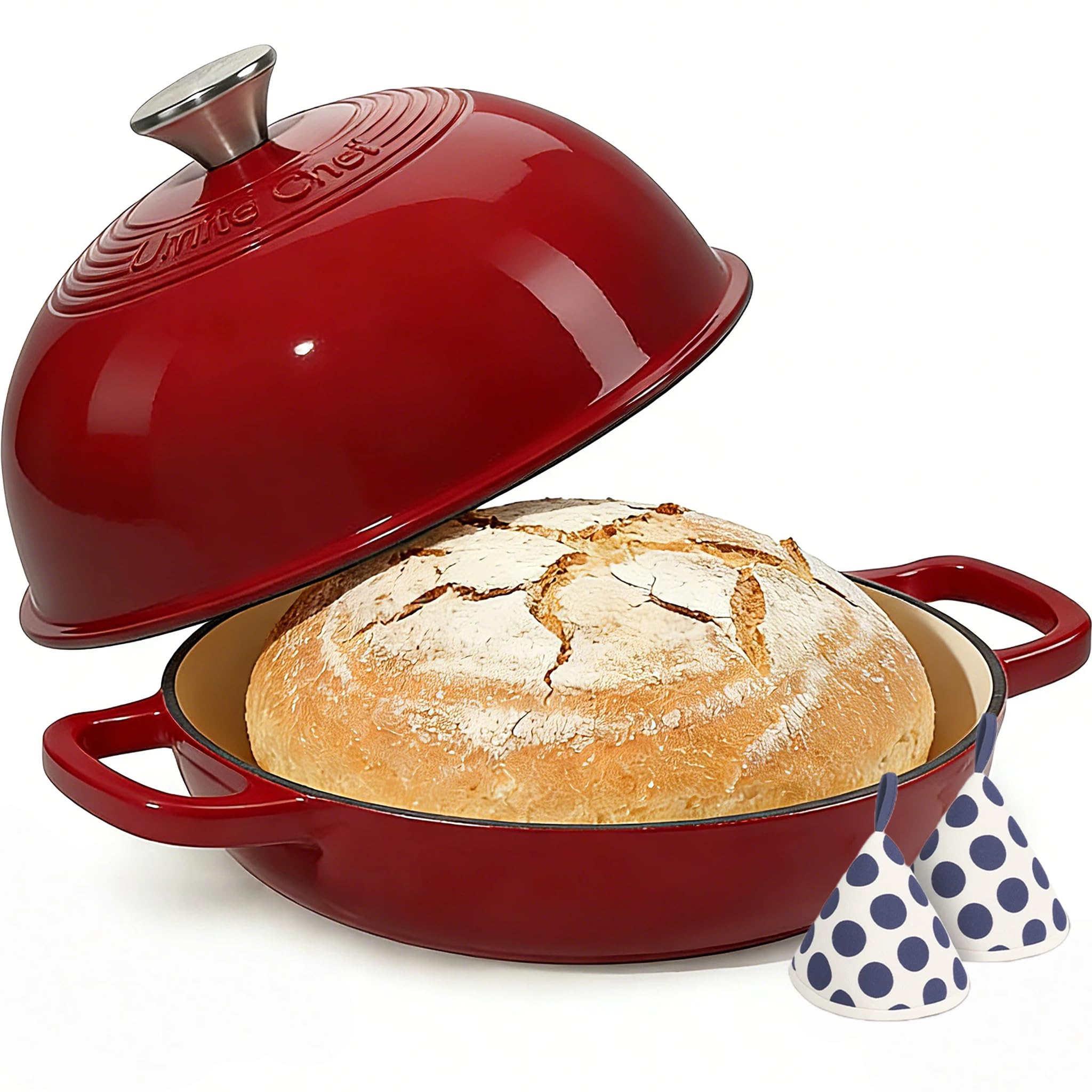
The Umite Chef 6-quart round Dutch oven is positioned as a complete bread-baking kit, coming with a pair of cotton potholders that offer basic heat protection — though the pads are small and some users report they don’t provide enough grip for the heavy lid. The pot itself is enameled cast iron in a vibrant red, with a domed cloche lid that traps steam for the first half of the bake. The round shape and 6-quart capacity accommodate larger boules up to 800-900g dough, giving it flexibility beyond the standard 5-quart formats.
Customers report consistent sourdough results: a crispy, golden crust with a soft interior. The enamelled surface resists staining and is dishwasher-safe in theory, though hand washing prolongs the finish. The lightweight feel relative to some competitors (the actual weight is moderate for cast iron) makes it easier to handle for bakers who struggle with heavier pots. The domed lid’s height helps prevent the dough from sticking to the top during oven spring, a common frustration with lower-profile lids.
The included potholders are a thoughtful addition but not substantial enough for heavy use — they’re thin and better suited as trivets or grip helpers rather than primary oven mitts. Some customers noted that the color online did not match reality (e.g., the red shipping as a pinkish hue), so check recent review photos before ordering. The round shape again means this produces boules, not sandwich loaves. For bakers looking for an affordable, all-in-one bread-baking solution that doesn’t sacrifice build quality, the Umite Chef delivers at an entry-level price for enameled cast iron.
Why it’s great
- 6-quart capacity handles large boules up to 900g dough
- Doméd lid prevents dough from sticking during oven spring
- Complete kit with potholders — no additional accessories needed
Good to know
- Included potholders are small — use your own oven mitts
- Color may differ from product images; check customer photos
- Round shape limits use to boules, not rectangular loaves
FAQ
Can I use a nonstick loaf pan for sourdough?
Do I need to preheat my sourdough bread pan?
Final Thoughts: The Verdict
For most users, the bread pan for sourdough winner is the Flavehc Enameled Cast Iron Loaf Pan because its 8.5×4.5-inch size, 500°F rating, and tight-fitting lid deliver the ideal balance of thermal mass and convenience for standard recipes. If you need larger loaves and have a full-size oven, grab the Articasting 11×5 Inch Seasalt Pan for its 5.8-quart capacity. And for batch bakers who need multiple loaves, nothing beats the LIANYU 6-Pack Stainless Steel Set for volume and dishwasher-safe cleanup.