
Walking into the world of augmented reality used to mean a four-figure investment in developer kits or bulky headsets. That wall has crumbled. A new wave of wearable monitors and smart glasses has pushed usable, high-refresh Micro-OLED screens below the mark, but the market is flooded with confusing specs and trade-offs that make choosing the right pair a minefield for the uninitiated.
I’m Min — the co-founder and writer behind Gadgets Feed. I’ve spent hundreds of hours cross-referencing luminance data, field-of-view distortion patterns, refresh rate consistency, and audio tuning across the current generation of portable display glasses to separate real value from marketing hype.
Whether you want a private cinema on a plane or a floating monitor for your Steam Deck, this guide cuts through the noise to help you find the best budget ar glasses that actually deliver a crisp, immersive experience without breaking your budget.
How To Choose The Best Budget AR Glasses
Not all affordable AR glasses are created equal. Some focus on pure screen mirroring for gaming, while others prioritize camera integration and AI assistance. The key is matching the hardware to your primary use case—whether that’s media consumption, productivity, or hands-free recording.
Display Resolution & Refresh Rate
The heart of any AR glass is its Micro-OLED panel. A 1920×1080 resolution is the baseline, but what separates a good experience from a headache is the refresh rate. 60Hz is acceptable for static productivity, but 120Hz eliminates motion blur in fast-paced games and panning shots in movies. Also check the perceived brightness—1000 nits peak makes a difference in bright indoor environments.
Field of View (FOV) and Screen Size
FOV determines how large the virtual screen appears relative to your natural vision. A 46-degree FOV gives you roughly a 135-inch image at a distance, while 52 degrees pushes that to 200 inches. Wider FOV is more immersive, but it also places higher demands on edge-to-edge lens clarity. Budget-tier glasses often struggle with chromatic aberration or blurry edges at wider FOV, so read reviews on sharpness uniformity.
Connectivity and Device Compatibility
All modern AR glasses in this price range rely on USB-C with DisplayPort Alt Mode. They have no internal battery and draw power from the source device. Verify that your phone, laptop, or gaming handheld supports DP output over USB-C. iPhones with the classic Lightning connector and older iPads require a separate Lightning-to-HDMI adapter plus an HDMI-to-USB-C dongle—a messy chain that can add cost and complexity.
Fit, Weight, and Prescription Support
Comfort is non-negotiable for glasses you might wear for two-hour movie sessions. Target models under 80 grams. Adjustable nose pads and flexible temples prevent the screen from sliding out of the sweet spot. If you wear prescription glasses, look for built-in diopter adjustment wheels (typically up to -6.0D) or a snap-in prescription lens frame. Astigmatism correction still requires aftermarket inserts in most budget models.
Audio and Privacy
Built-in speakers range from tinny to genuinely listenable. Premium partnerships like Bang & Olufsen or Bose deliver a significantly richer soundstage with better bass response. Open-ear speakers let you hear ambient noise, which is safer for public use but means some audio leakage. For flights, electrochromic dimming (with a toggle button) beats physical lens caps by giving you instant immersion control without carrying extra accessories.
Quick Comparison
On smaller screens, swipe sideways to see the full table.
| Model | Category | Best For | Key Spec | Amazon |
|---|---|---|---|---|
| RayNeo Air 4 Pro | Mid-Range | Movies & Gaming | 201″ HDR10, 46° FOV, 120Hz | Amazon |
| VITURE Pro XR | Mid-Range | Bright & Immersive | 135″, 4000 nits peak, 120Hz, Electrochromic | Amazon |
| Lenovo Legion Glasses Gen 2 | Entry-Level | Handheld Gaming | 126″, FHD, 120Hz, Micro-OLED | Amazon |
| Meta Ray-Ban Gen 2 (Wayfarer) | Premium | AI & Hands-Free Recording | 3K Video, 12 MP Camera, Open-Ear Audio | Amazon |
| VITURE Luma | Mid-Range | Media & Productivity | 146″, 1200p, 50° FOV, 120Hz | Amazon |
| HUD Sports Glasses | Premium | Cycling & Hiking | Real-Time HUD, Speed/HR/Nav | Amazon |
| Rokid Max 2 | Premiuim | Gaming & Entertainment | 215″, 50° FOV, 600 nits, 120Hz | Amazon |
| XREAL 1S | Premium | True 3DoF & Workstation | 500″, 52° FOV, X1 Chip, 120Hz | Amazon |
| Meta Ray-Ban Gen 2 (Skyler) | Premium | AI & Style | Transitions Lenses, 3K Video, 12 MP | Amazon |
In‑Depth Reviews
1. RayNeo Air 4 Pro
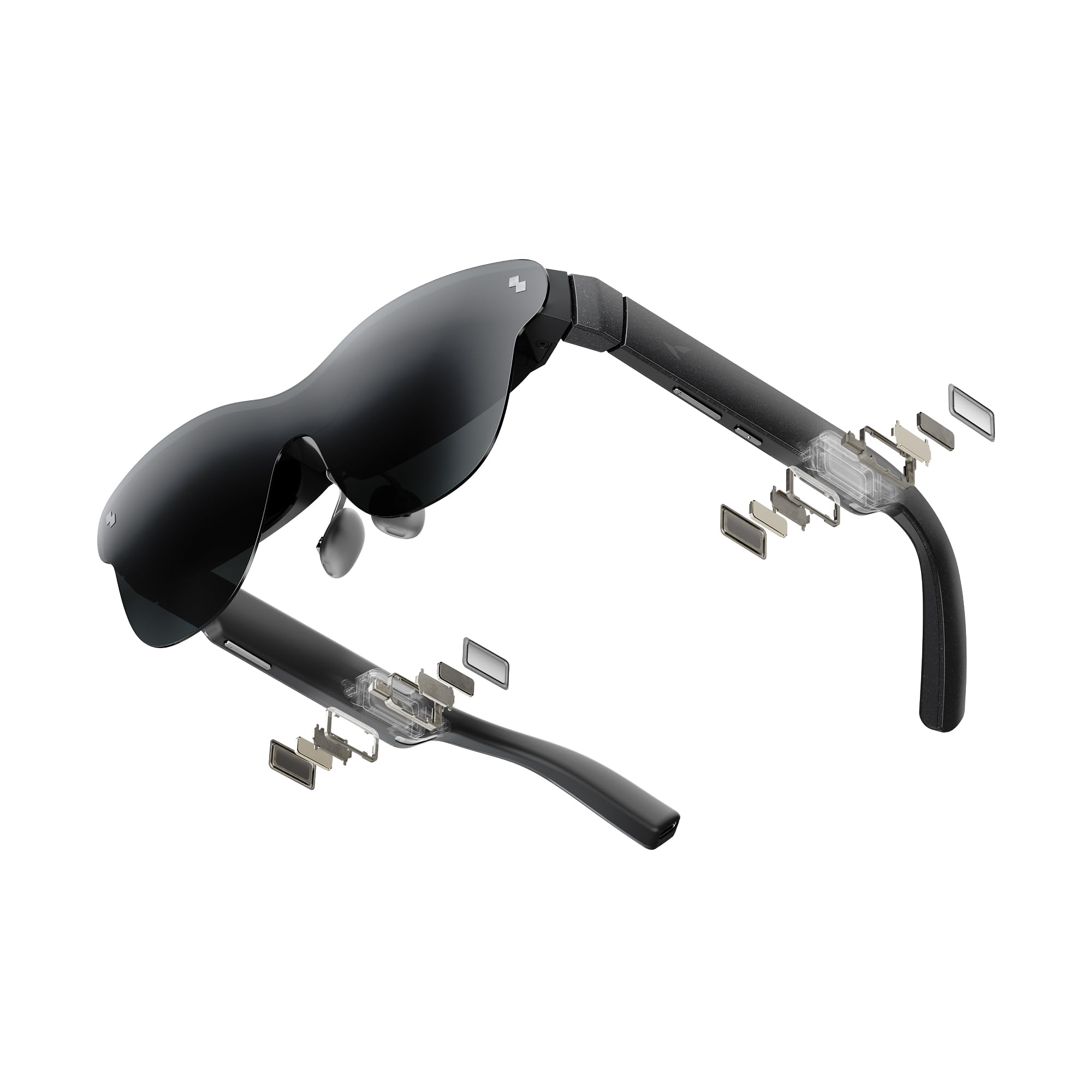
The RayNeo Air 4 Pro brings something genuinely rare at this price point: a full HDR10-certified AR display. With the Vision 4000 chip co-developed with Pixelworks, the glasses perform real-time SDR-to-HDR upscaling, boosting color volume and contrast on standard streaming content. The 120Hz refresh rate and 1200 nits peak brightness ensure fluid motion and strong visibility even in somewhat brighter rooms. At just 76 grams with a 46-degree FOV that translates into a massive 201-inch virtual screen, these deliver an exceptional cinematic FOV for the money.
Audio is handled by Bang & Olufsen’s four-speaker array, delivering 360-degree spatial sound with genuine bass presence—noticeably better than the tinny single-driver setups found in most budget competitors. The open-ear design keeps you aware of your surroundings, and a Whisper Mode reduces audio leakage in quiet spaces. The 9-way fit adjustment system with interchangeable nose pads is solid, though users with wide faces may need to experiment to find the perfect alignment without edge blur.
One trade-off is that the Air 4 Pro is strictly a 0DoF fixed-screen experience; there’s no built-in spatial anchoring or 3DoF tracking without third-party software. For movie marathons and console gaming on a Steam Deck or PS5, the sheer display and audio quality at this price make it a standout. If you need a screen that stays in one place while you move your head, consider stepping up to a model with native spatial tracking.
Why it’s great
- Best-in-class HDR10 display with AI upscaling
- Excellent Bang & Olufsen spatial audio
- Lightweight 76g frame with extensive fit adjustments
Good to know
- No built-in 3DoF spatial tracking
- Some users report slight blur at extreme edges
- Interchangeable nose piece selection could be more generous
2. VITURE Pro XR

The VITURE Pro XR is the brightest player in the budget-adjacent AR space by a wide margin. Its claimed 4000 nits peak brightness—yielding a perceived 1000 nits—is a real-world advantage: the image stays punchy and readable even next to a sunny window or on a brightly lit train. The 135-inch 120Hz Micro-OLED display delivers sharp edge-to-edge clarity, and the company’s electrochromic film (toggled by a button) blocks nearly 100 percent of external light, eliminating the need for a physical shade.
VITURE integrated myopia adjustment directly into the diopter wheels on the glasses (up to -6.0D), so you don’t need prescription inserts for simple nearsightedness. The audio—tuned by Harman—is a definite step above baseline, with 5 dB more volume than the original VITURE One. The aircraft-grade aluminum alloy frame feels dense and durable, and the flexible titanium hinges give confidence for daily packing. The bundled semi-hard case adds to the travel-friendly profile.
The catch is the narrower 46-degree FOV compared to some 50-52 degree competitors, which makes the virtual screen feel slightly less expansive. The magnetic USB-C cable is also a potential weak point; some users have reported loose connections after repeated plug/unplug cycles. That said, for users who prioritize peak brightness and one-button environmental blackout in a portable AR package, this is the most compelling mid-range option available.
Why it’s great
- Industry-leading 4000 nits peak brightness for outdoor-adjacent use
- Built-in diopter adjustment up to -6.0D
- One-button electrochromic blackout
Good to know
- Relatively narrow 46° FOV
- Magnetic cable connector may loosen over time
- Requires SpaceWalker app for 3DoF and multi-screen features
3. Lenovo Legion Glasses Gen 2

The Lenovo Legion Glasses Gen 2 is the most accessible entry point into the world of high-refresh, Micro-OLED wearable monitors. For under , you get a clean 126-inch virtual 1080p display running at a full 120Hz, which eliminates the judder you see on cheaper 60Hz units during fast-paced games. The plug-and-play setup is genuinely frictionless—connect any USB-C device with DP Alt Mode (Lenovo Legion Go, Steam Deck, modern laptops) and you have an instant second screen.
The included carry case, cleaning cloth, light shield, and prescription lens frame show that Lenovo thought about the out-of-box experience. The adjustable nose pads and flexible temples help achieve a stable fit, though the design is slightly bulky compared to newer competitors. The high-fidelity speakers are adequate for casual use, but they lack the spatial presence of the Bang & Olufsen or Bose-tuned offerings at higher price points.
Where the Legion Glasses fall short is the finicky nose pad alignment. Several users report that the glasses slide upward during use, cutting off the bottom portion of the display. This can be mitigated with careful adjustment, but it’s a known ergonomic limitation. For the price, however, you’re getting a legitimate 120Hz Micro-OLED experience that can transform a handheld gaming session into an immersive big-screen session, making it a fantastic gateway device.
Why it’s great
- Incredible value for a 120Hz Micro-OLED display
- True plug-and-play with USB-C DP-Alt devices
- Includes prescription lens frame and hard carry case
Good to know
- Nose pads may slip, causing the screen image to be cut off
- Speaker audio is adequate but not immersive
- Design is slightly bulky; not ideal for extended wear beyond 1-2 hours
4. Meta Ray-Ban Gen 2, Wayfarer Large
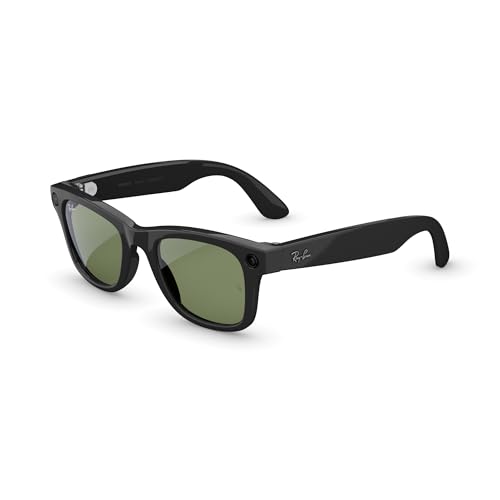
Meta’s second-gen Ray-Ban collaboration is fundamentally a different product from the other glasses on this list. It doesn’t project a translucent digital overlay—instead, it packs a 12 MP ultra-wide camera that captures 3K HD video and a full suite of AI features into a frame that looks like a standard pair of Wayfarer sunglasses. The open-ear speakers deliver good clarity for music and calls, and the rechargeable case provides up to 48 hours of total battery.
The built-in Meta AI assistant handles hands-free queries, real-time translation between English and several other languages, and voice-activated reminders. The recording quality is impressive for a pair of glasses: wind and street noise are suppressed by 90% during calls, and the video stabilization makes first-person clips watchable. The touch-sensitive temple lets you adjust volume and trigger recordings discreetly.
The biggest limitation is that these are not display glasses—you cannot watch a movie or mirror a laptop screen on them. The 5-minute continuous recording cap (enforced via firmware) can be frustrating for longer shoots, and the front-facing LED indicator (which cannot be disabled) eliminates any hope of discreet recording. If your primary goal is wearable display for gaming or media, these are not the right tool. For content creators and tech enthusiasts who want hands-free capture and AI assistance, they are peerless at this price.
Why it’s great
- Best-in-class hands-free 3K video and 12 MP stills
- Functional Meta AI with real-time language translation
- Stylish Wayfarer design that blends into daily wear
Good to know
- Not a display glass—no media mirroring capability
- Continuous recording capped at 5 minutes
- LED recording indicator cannot be turned off
5. VITURE Luma
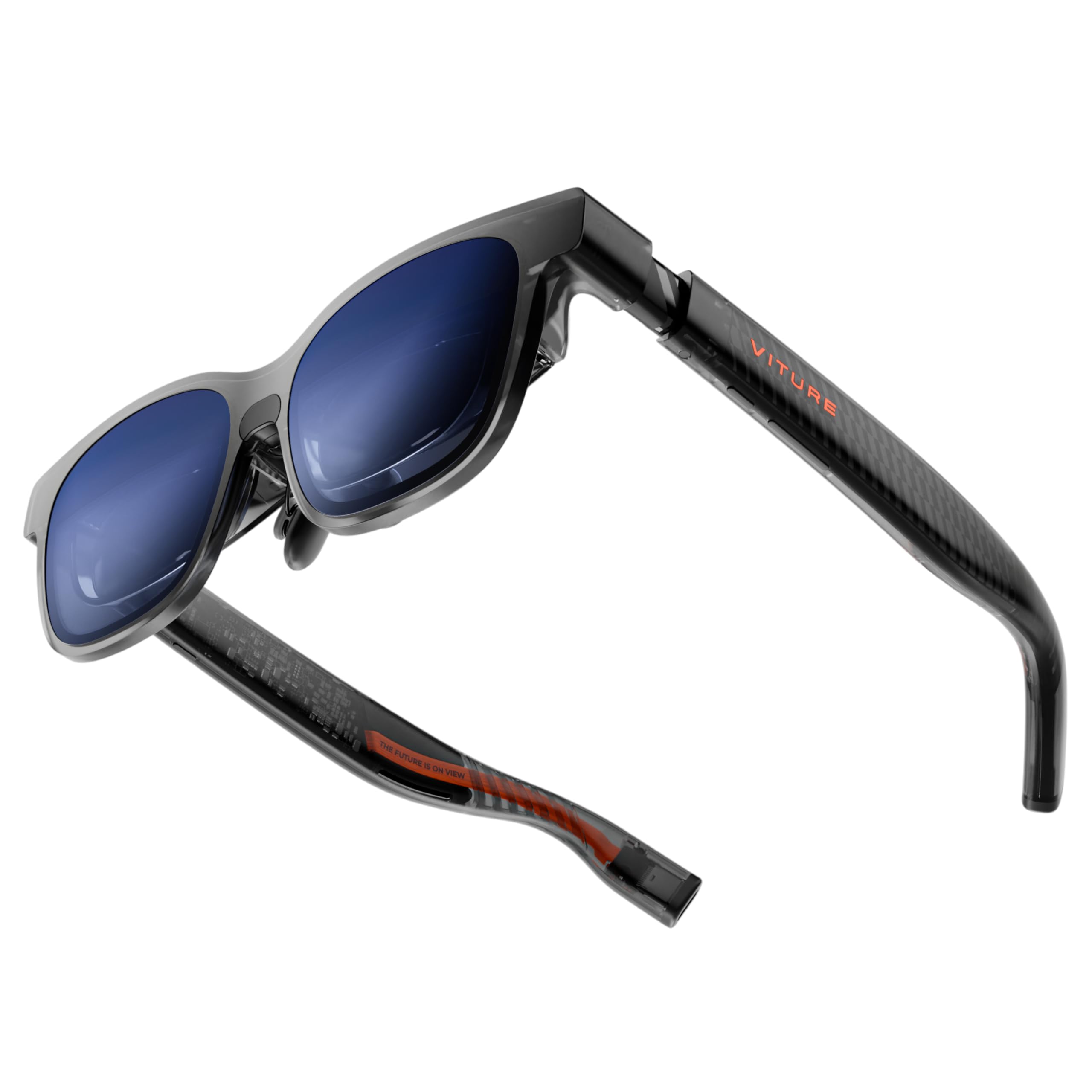
The VITURE Luma is a refined evolution of the VITURE Pro line, offering a 146-inch virtual 1200p display at a slightly higher native resolution than the standard 1080p competition. The 50-degree field of view is a meaningful upgrade over the 46-degree panels, providing a wider, more natural viewing cone that reduces the tunnel-vision sensation. With 1000 nits of peak brightness and a 120Hz refresh rate, the Luma is a strong all-around media and gaming companion.
The build quality stands out: the translucent futuristic frame is lightweight yet robust, with magnetic nose pads and reinforced flexible temples. The integrated myopia adjustment up to -6.0D works well for nearsighted users. The SpaceWalker app adds multi-screen productivity and a real-time 2D-to-3D conversion feature that works surprisingly well for games and streaming. The electrochromic film toggle provides instant environmental darkening.
The main drawback is that the SpaceWalker software ecosystem is still maturing. The Windows and Android apps have fewer features than the iPhone version, and the 3DoF implementation—while functional—is handled entirely in software rather than a dedicated chip. This means occasional drift and less precise anchoring than the hardware-native 3DoF in the XREAL 1S. For users who want a bigger FOV and a higher-resolution panel without jumping to the premium tier, the Luma is a solid mid-range compromise.
Why it’s great
- Wider 50° FOV for more immersive viewing
- 1200p native display resolution
- Myopia adjustment up to -6.0D built-in
Good to know
- 3DoF tracking is software-based, not as stable as hardware-native systems
- SpaceWalker app feature parity varies across platforms
- Nose clips may not hold perfectly for all face shapes
6. HUD Display Sports Glasses
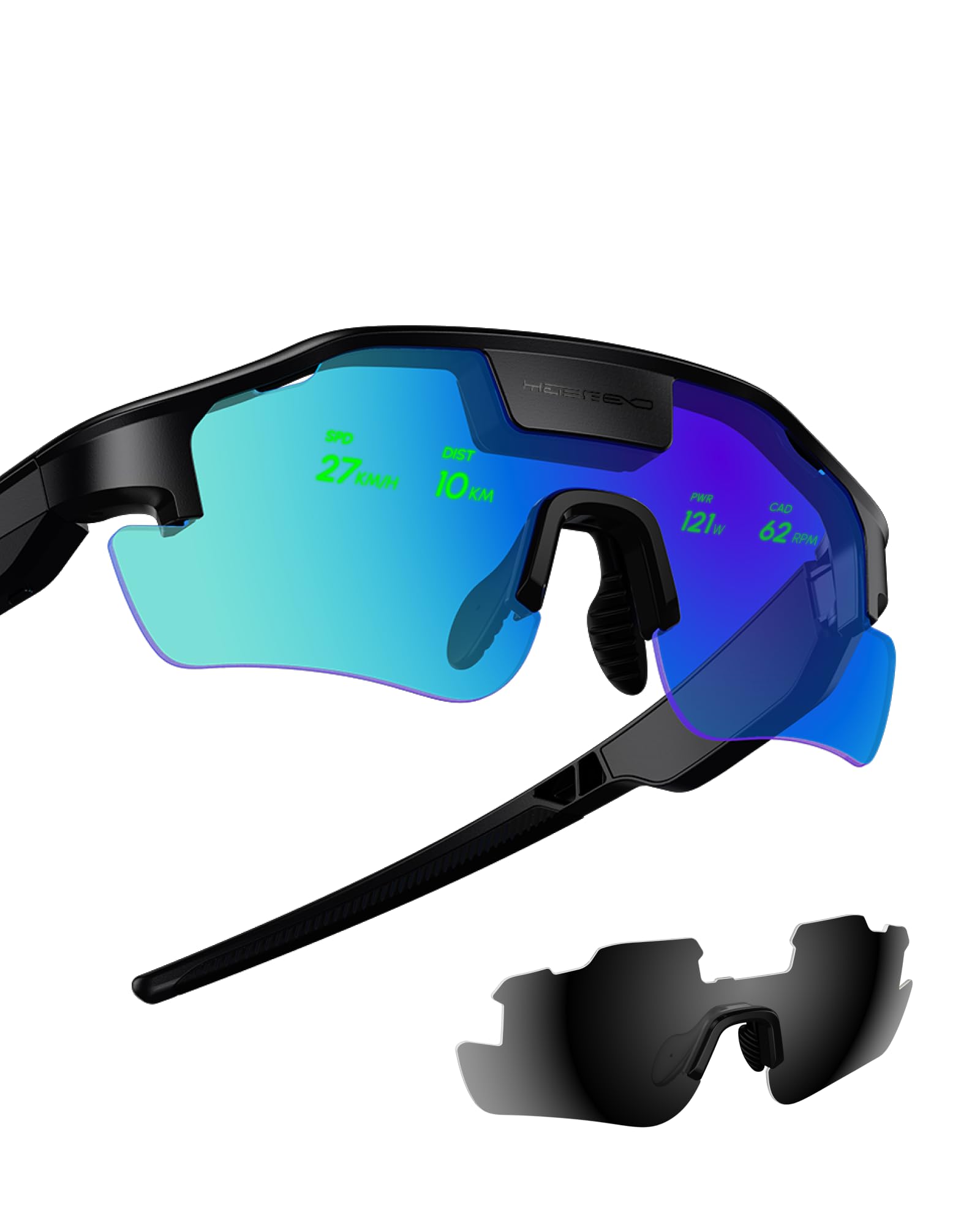
These HUD Sports Glasses carve out a unique niche for cyclists and hikers who want critical performance data projected into their line of sight without glancing down at a bike computer. The real-time display shows speed, distance, heart rate, and navigation directions directly on the lens, keeping your eyes forward and improving situational awareness—especially important for road cyclists sharing lanes with traffic.
The proactive AI alerts are a genuine safety feature: the glasses can warn you of approaching vehicles from behind (when paired with a compatible radar sensor) and highlight upcoming turns. The lightweight frame and adjustable arms make them comfortable for multi-hour rides. The outdoor-optimized display is bright enough to remain readable even under direct sunlight, which is a challenge for standard AR transmissive optics.
The initial setup is more involved than plug-and-play media glasses—pairing with cycling sensors and configuring data fields requires several steps. Customer support appears responsive according to user reports. These are not designed for media consumption or gaming; the HUD is purely a data overlay for physical activity. For serious cyclists who want a heads-up display for metrics and navigation, this is a focused, premium tool that fills a gap left by mainstream AR glasses.
Why it’s great
- Real-time HUD for speed, HR, and navigation
- Safety AI alerts for traffic awareness
- Outdoor-readable brightness in direct sunlight
Good to know
- Complex initial setup with multiple sensor pairings
- Not usable for media or standard AR display functions
- Newer brand with limited community support
7. Rokid Max 2
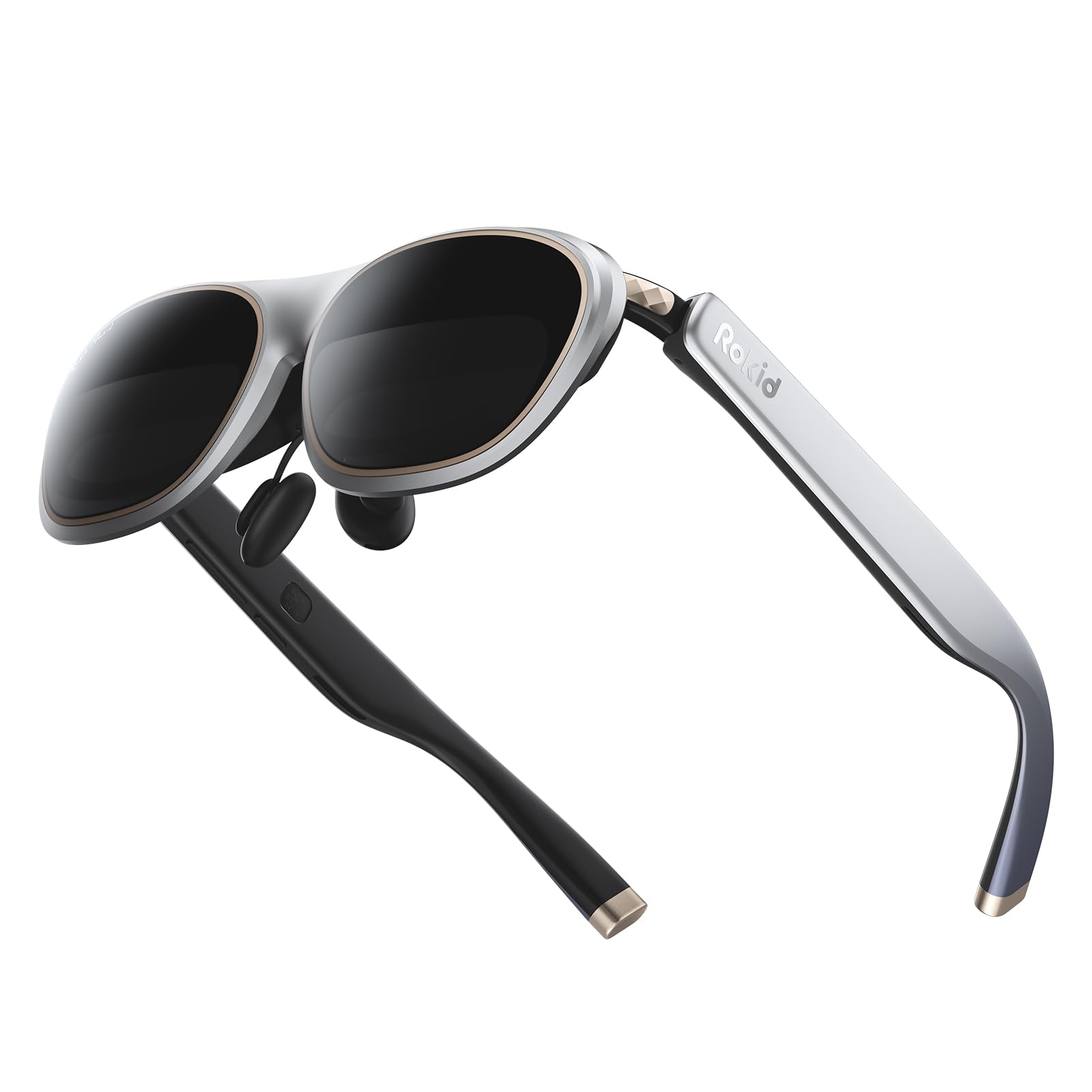
The Rokid Max 2 delivers the largest raw screen size in this roundup at 215 inches, leveraging a 50-degree FOV and a crisp Micro-OLED panel. The 120Hz refresh rate and 600 nits of brightness produce a smooth image that works well in darker rooms, though the 600 nits falls behind the 1000+ nit competition in brighter environments. The adjustment dial on top allows fine myopia correction up to 600 degrees.
The airy cushioning nose pad design is a thoughtful ergonomic touch: it reduces slipping and prevents the bridge fatigue typical of other glasses during long sessions. At just 75 grams, the Max 2 is one of the lightest full-featured AR glasses available. The direct USB-C connectivity works with the iPhone 15 series, Android phones, tablets, laptops, and gaming handhelds without additional adapters for most DP-Alt capable devices.
The optical quality is good, but the 600 nit brightness ceiling means the image loses punch if there’s any ambient light leakage around the nose area. The Max 2 does not support astigmatism correction on the built-in diopter dial; users with astigmatism or myopia beyond 6.0 diopters will need to purchase separate prescription lens frames. For users who want the largest virtual screen real estate in this price tier and are willing to use them in controlled lighting, the Rokid Max 2 is a strong competitor.
Why it’s great
- Massive 215-inch virtual screen with 50° FOV
- Lightweight 75g frame with comfortable nose cushion
- Easy diopter adjustment dial on top
Good to know
- 600 nits brightness is lower than premium competitors
- No built-in astigmatism correction
- Optimal performance requires a dark environment
8. XREAL 1S
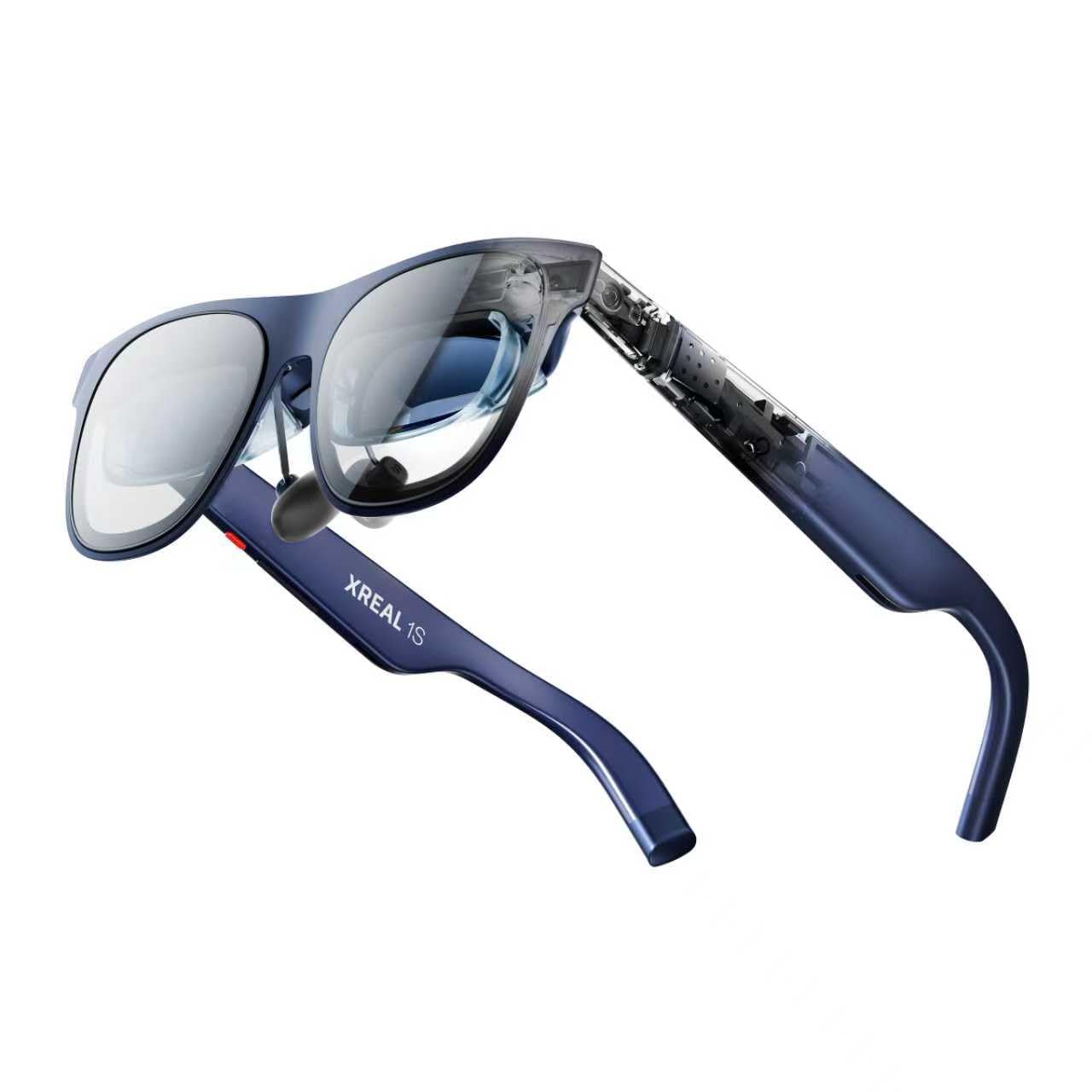
The XREAL 1S is the only glasses in this budget-oriented roundup that integrates a dedicated spatial computing processor—the X1 chip—onboard the glasses themselves. This provides native 3DoF spatial tracking without requiring an external app or accessory. The result is a screen that stays locked in space as you turn your head, a feature that transforms the experience from a head-mounted monitor into a true augmented reality display.
The optical package is top-tier: 52-degree FOV, 500-inch virtual screen capability, 120Hz refresh in 3DoF mode, and a 90Hz global refresh for flicker-free viewing in 0DoF mode. Each unit is individually color-tuned at the factory. The audio, tuned by Bose, delivers a spacious soundstage with deeper lows and clearer mids than any other glasses in this comparison. The TÜV Rheinland certification for low blue light and flicker-free operation makes long sessions easier on the eyes.
The major compromises are comfort and out-of-box experience. The included nose pad is uncomfortable for many users, and the wayfarer-style frame leaks light at the sides, requiring a bulky third-party TPU cover for a fully immersive experience. Setting up spatial modes requires reading Reddit threads and firmware updates—not a polished consumer experience. For users who need rock-solid spatial anchoring and the best available optics at this price ceiling, the XREAL 1S is unmatched, but be prepared for some fit and setup friction.
Why it’s great
- Only native 3DoF tracking with dedicated X1 chip
- Best-in-class Bose audio in this price range
- Factory color-tuned, individually calibrated display
Good to know
- Uncomfortable stock nose pad requires aftermarket replacement
- Light leakage around the sides in the standard frame
- Setup requires user forums and firmware updates for best results
9. Meta Ray-Ban Gen 2, Skyler
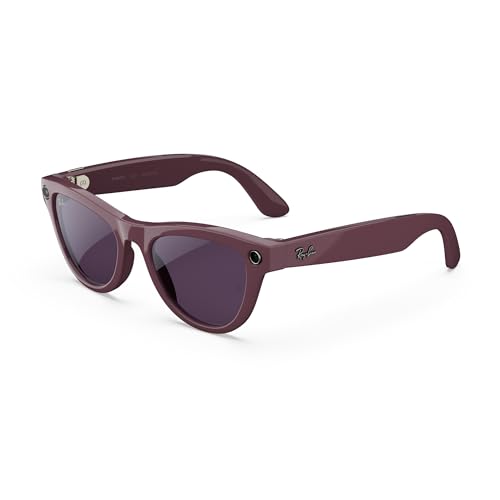
The Meta Ray-Ban Gen 2 in the Skyler frame offers the same underlying hardware as the Wayfarer variant—12 MP ultra-wide camera, 3K video, Meta AI, and open-ear speakers—but wrapped in a cat-eye silhouette with Transitions Amethyst lenses. This makes it the most fashion-forward option on this list, designed specifically for users who want smart glasses that look like regular premium eyewear rather than tech gear.
Functionally, it inherits all the core strengths: up to 8 hours of mixed-use battery life, a charging case that holds enough power for 48 hours of top-ups, real-time translation between English and six other languages, and voice-activated AI that can answer questions, set reminders, and initiate calls. The Transitions photochromic lenses adapt to indoor and outdoor lighting automatically, turning these into everyday prescription-sunglasses replacements.
The same drawbacks apply: no display functionality, 5-minute recording limit, and a slightly heavier frame due to the embedded electronics. The non-removable recording LED may be more conspicuous on the cat-eye frame. For mainstream users who prioritize aesthetics and AI convenience over screen mirroring, the Skyler delivers the most polished wearable AI package that doesn’t scream “gadget.”
Why it’s great
- Stylish cat-eye frame with Transitions photochromic lenses
- Full Meta AI assistant with live translation
- 8-hour battery life with 48-hour charging case
Good to know
- Not a display glass—no media or screen mirroring
- 5-minute continuous record limit per clip
- Heavier than standard fashion frames
FAQ
Can I use budget AR glasses with my iPhone or Android phone?
What does the diopter adjustment wheel do on AR glasses?
Will budget AR glasses work for PC productivity and text editing?
Can I watch 3D movies with budget AR glasses?
What is the most important spec I should prioritize for gaming?
Final Thoughts: The Verdict
For most users, the best budget ar glasses winner is the RayNeo Air 4 Pro because it combines a certified HDR10 display, excellent Bang & Olufsen audio, and the lowest price for a vibrant high-refresh panel. If you want the brightest possible image with one-button electrochromic blackout, grab the VITURE Pro XR. And for the only hardware-native 3DoF spatial anchoring in this price tier, nothing beats the XREAL 1S.