
Our readers keep the lights on and my morning glass full of iced black tea. As an Amazon Associate, I earn from qualifying purchases.
A decent kayak paddle that won’t break the bank or snap on your second trip is the real balancing act. You need something light enough to not exhaust your arms, durable enough to handle a knock against a rock, and adjustable so it fits your boat and height — all without spending what a new kayak costs.
I’m Min — the co-founder and writer behind Gadgets Feed. This guide is built by comparing the manufacturers’ published specifications and the patterns across verified customer reviews, so you get each pick’s real strengths and trade-offs instead of marketing spin.
If you have a wide sit-on-top kayak or a narrow touring boat, the right blade shape and shaft material make the difference between a joyful glide and a sore shoulder. Read on to find your match without wasting money on the wrong budget kayak paddle.
How To Choose The Best Budget Kayak Paddle
A paddle is your direct connection to the water. The wrong one turns a relaxing day into a struggle against drag and sore joints. Here is what matters most when you are balancing performance and cost.
Shaft Material: Fiberglass vs. Aluminum vs. Carbon
The shaft is the backbone of your paddle. A fiberglass shaft (like the ones on the top picks here) is lightweight and does not get cold to the touch like metal, but it costs a little more. An anodized aluminum shaft is very affordable and tough, but it feels heavier in your hands after an hour of paddling. Carbon fiber is the lightest of all, but it usually blows a strict budget. For most recreational trips, fiberglass or good-quality aluminum gives you the best trade-off between weight and cost.
Blade Material and Shape
Blades see the most abuse. A reinforced nylon blade (blended with fiberglass strands) is stiffer and more impact-resistant than plain polypropylene, so it cracks less often when you accidentally jam it into a sandy bottom. Look for a dihedral ridge (a raised spine down the center of each blade) — it makes each stroke track straighter with less flutter (side-to-side wobble), which saves you energy over a long paddle.
Adjustability: Length and Feathering
A paddle that is too short makes you hunch over; one that is too long makes every stroke feel awkward. Most adjustable paddles offer a range of about 210 cm (82 inches) to 250 cm (98 inches). For kayaks over 30 inches wide, you generally want at least 240 cm. Feathering (angling one blade relative to the other so the blade in the air slices through wind) at 0° or 60° lets you customize the paddle to your stroke style — a 0° setting is simplest for beginners because both blades present the same face to the water.
Weight
Every ounce of blade weight gets multiplied by the number of strokes you take. A difference of a few ounces sounds minor, but over a 3-hour trip it translates directly into shoulder fatigue. Budget paddles usually weigh between 34 and 42 ounces (960 g to 1190 g). Aim for 36 ounces or less if you plan to paddle for more than an hour at a time.
Quick Comparison
On smaller screens, swipe sideways to see the full table.
| Model | Category | Best For | Key Spec | Amazon |
|---|---|---|---|---|
| Pelican Symbiosa | Fiberglass | Lightweight touring & tall paddlers | 970g (34.2 oz), 240–250 cm adjustable | Amazon |
| Pelican The downside | Fishing | Kayak anglers with integrated features | 250 cm (98.5 in), 16 oz, hook retrieval system | Amazon |
| Bending Branches Whisper | Aluminum | Recreational lake & river paddling | 240 cm (94.5 in), 2.4 lbs, 0°/60° feathering | Amazon |
| Carlisle Day Tripper | Aluminum | Durability in whitewater & rocky conditions | 230 cm (90.5 in), 37 oz, oval shaft | Amazon |
| WONITAGO Fiberglass | Fiberglass | Lightweight & beginner-friendly all-rounder | 2.3 lbs (1.05 kg), 90–98 in adjustable | Amazon |
| OCEANBROAD | Aluminum | Budget entry-level with leash included | 220–240 cm adjustable, 42 oz, 3 locking angles | Amazon |
In‑Depth Reviews
1. Pelican Symbiosa Kayak Paddle
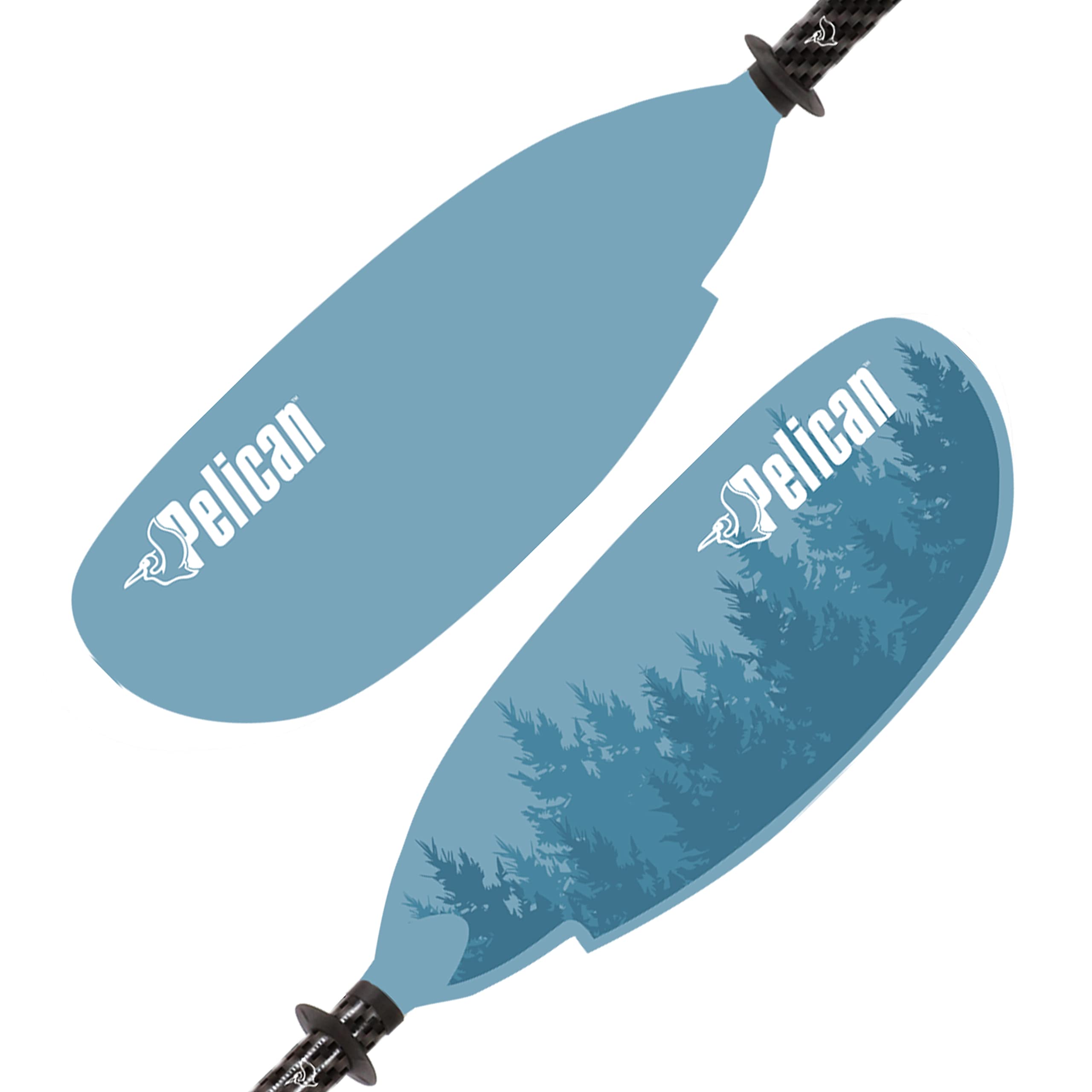
970 grams (34.2 ounces) — half a pound lighter than a typical aluminum paddle — makes the Pelican Symbiosa the top pick for anyone over 5’5″ paddling a kayak wider than 30 inches, especially on multi-hour touring trips where every extra ounce compounds into fatigue. The telescoping ferrule adjusts from 240 cm to 250 cm in seconds, which buyers report is “perfect for tall paddlers (6’1″)” and works well with both inflatable and sit-on-top kayaks. The fiberglass shaft stays warmer than aluminum in early spring water, and the reinforced nylon blades are stiffer than standard polypropylene, holding up against 30 mph winds and submerged rocks without flexing.
The biggest limit: the telescoping ferrule uses a tightening mechanism that can loosen mid-paddle if you do not crank it snug, and a few buyers received theirs with a missing screw that needed tightening. That is a minor hassle for a paddle that otherwise matches the blade shape of a Werner Shuna carbon paddle at a fraction of the price.
A stellar light-touring companion that proves fiberglass does not have to cost a fortune.
Why it’s great
- Lightest at only 970 g (34.2 oz) — spares your shoulders on long trips
- Adjustable from 240–250 cm fits wide kayaks and tall paddlers
- Fiberglass shaft stays warmer to the touch than aluminum in cold water
Good to know
- Telescoping ferrule may need tightening during a long paddle
- Some units arrived with a missing screw in the adjustment mechanism
2. Pelican The trade-off Kayak Paddle
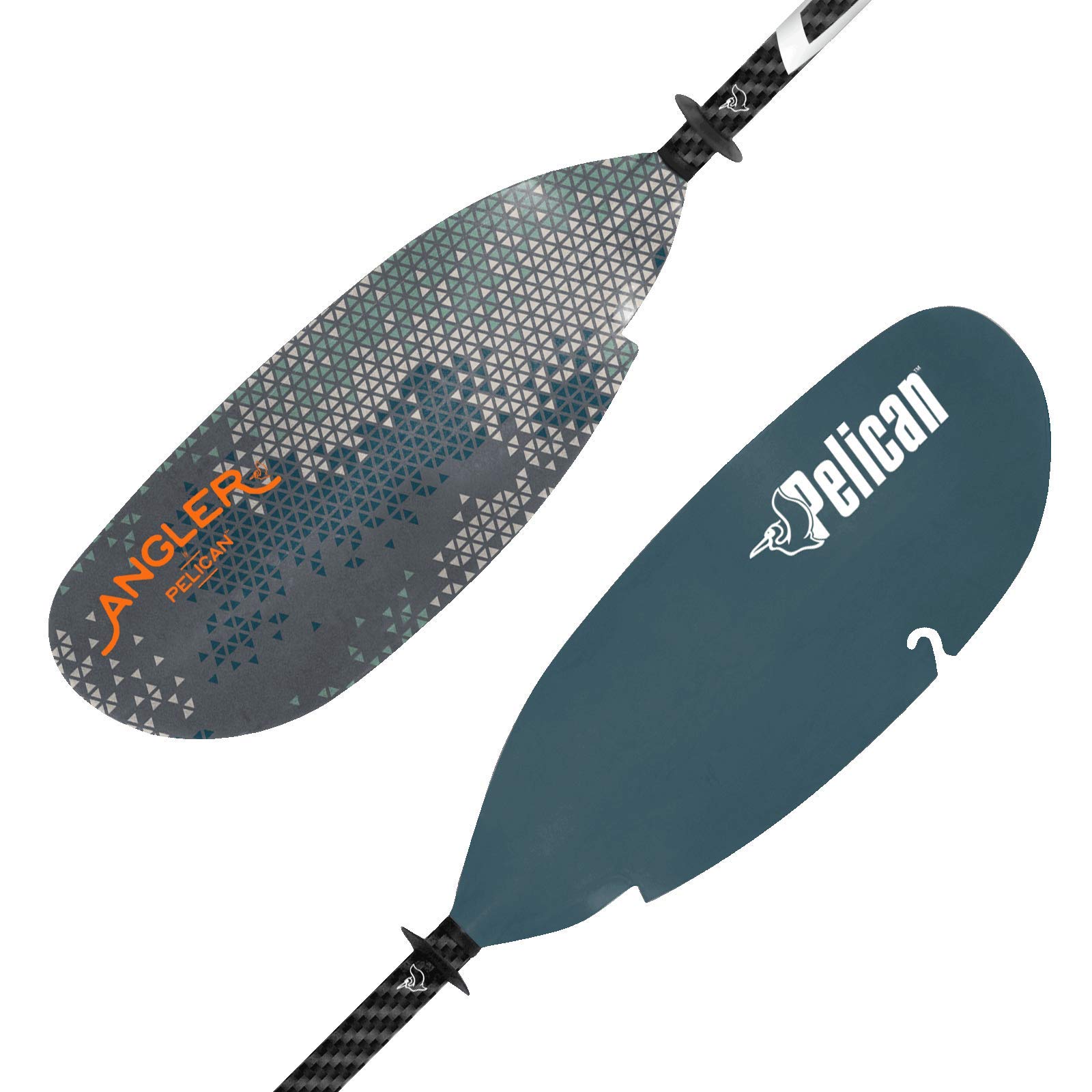
At 16 ounces (454 grams) the Pelican The compromise is actually lighter than the top Symbiosa, and its fiberglass-reinforced nylon blade cuts swiftly through water without flexing — but you trade the Symbiosa’s adjustable length (240–250 cm) for a fixed 250 cm (98.5 inches) that suits anglers with wide fishing kayaks over 34 inches wide. You get a built-in hook retrieval slot on the blade and a tape measure along the shaft, two fishing-specific features the top Symbiosa lacks. Owners mention it is “lighter than the Carlisle Magic Angler” and that the line retrieval slot is genuinely useful for freeing a snagged lure without tipping the kayak.
The drip rings are adjustable, and the ovalized (indexed) shaft tells you by feel exactly where your right hand is without looking. The drawback is the fixed length — you cannot shorten it for a narrower boat or a shorter paddler, which rules it out for family sharing. Also, a few owners noted the blade decal will peel after a season of use, though that is cosmetic.
If you are a dedicated angler who wants a fishing-ready tool in one package, this is your paddle. Choose this over the Symbiosa the moment you want a built-in fish ruler and a hook saver.
Where it shines
- Integrated hook retrieval slot saves you leaning over the side
- Tape measure on the shaft lets you size your catch on the water
- Ultra-light 16 oz weight is barely noticeable during a long cast-and-paddle session
Worth noting
- Fixed 250 cm length will not adjust for shorter paddlers or narrow kayaks
- Blade decal may peel after extended use
3. Bending Branches Whisper Kayak Paddle
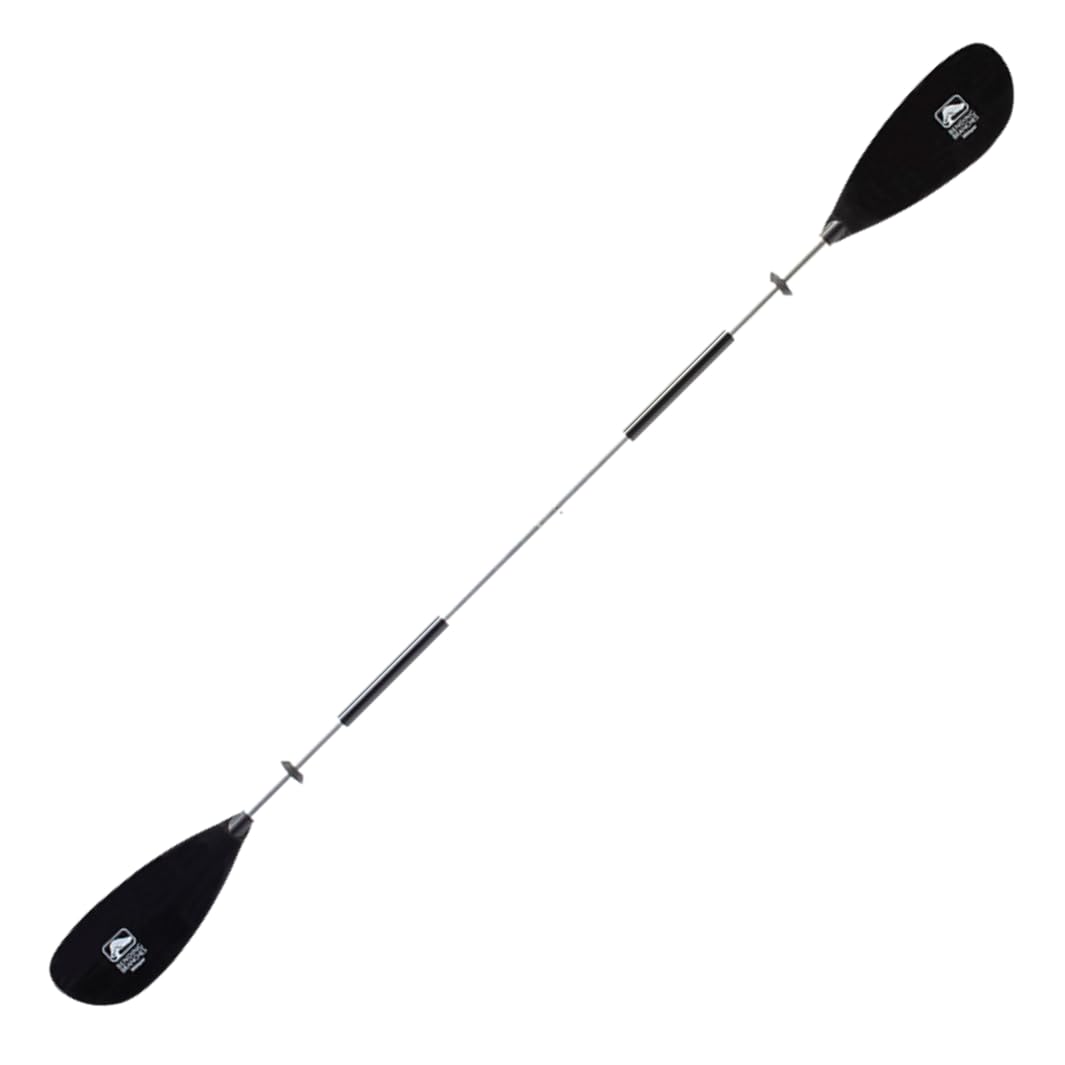
You’re loading up for a calm Saturday morning paddle on the local reservoir, and you just want a paddle that works without fuss or a second thought. The Bending Branches Whisper is the one you see strapped to rental kayaks at every lake — and for good reason. Bending Branches has been handcrafting paddles in Osceola, Wisconsin since 2002, and the Whisper is their workhorse for recreational paddlers. The 2-piece aluminum shaft uses a 3-hole snap button ferrule that lets you feather the blades at 0° or 60° (left or right), giving you the same adjustability found on paddles costing twice as much. The dihedral blade design (a ridge running down the center of each blade) reduces flutter on every stroke so the paddle tracks straight through the water without wobbling, which saves you energy on a long lake crossing.
At 2.4 lbs (38.4 oz) for the 240 cm length, it is heavier than the fiberglass options above, but buyers consistently say “it’s comparable to carbon fiber” in feel and that the oval shaft with the black comfort grip tells your hand where it is without looking. The ferrule only offers fixed offset positions, so you cannot fine-tune the feathering angle between 0° and 60°. Also, if you are 5’5″ or shorter the 240 cm length may feel too long unless your kayak is wider than 32 inches. That said, the Whisper is tough enough to take dings and keep working season after season.
If you want a dependable, grab-and-go paddle built by a family-owned US shop, this is your easy call — and at 2.4 lbs, it’s the lightest aluminum paddle in this guide.
What stands out
- Dihedral blade ridge eliminates flutter for a smoother, more efficient stroke
- Snap-button ferrule offers 0°/60° feathering for wind and comfort
- Handcrafted in the USA with a reputation for lasting many seasons
The trade-offs
- At 2.4 lbs it is heavier than the fiberglass alternatives
- Feathering is limited to only two fixed positions, not continuously adjustable
4. Carlisle Day Tripper Aluminum Kayak Paddle

The single number that matters most in this category is weight: at 37 ounces (2.3 lbs) for the 230 cm length, the Carlisle Day Tripper is roughly 3 ounces heavier than the Bending Branches Whisper. Its lightweight tempered aluminum shaft and asymmetrical polypropylene blades produce smooth strokes and survive impacts that would crack a budget fiberglass paddle. The oval indexed shaft tells your right hand which way the blade is angled without looking. Customers note using this paddle in whitewater, hitting rocks and pushing off them, and it still floats and works.
The pushbutton takedown lets you feather the blades at 60 degrees or inline at 0°, and the two-piece connection is solid enough that owners say there is “no wobbling after 2 months of heavy weekend use.” Several reviewers point out it lasts about 6 years as a primary paddle before needing replacement — impressive for its price tier. Carlisle has been making this same design since 2007, so you are buying proven simplicity, not cutting-edge materials. The available lengths (220, 230, 240 cm) are not continuously adjustable within a single product, so measure your kayak width and your height before ordering.
For the price, this paddle delivers durability that outperforms nearly every other budget option in rocky or shallow conditions. If you regularly paddle rivers with submerged rocks or strainers, Carlisle’s build toughness gives you peace of mind that the lighter options cannot match — a price-to-value read that favors long-term toughness over ultralight weight.
The upsides
- Proven durability in whitewater and against rocks — shoppers say multiple seasons of abuse
- Oval indexed shaft lets you feel the blade angle without looking
- Asymmetrical blade shape provides efficient, flutter-free strokes
Keep in mind
- At 37 oz it is noticeably heavier than a fiberglass paddle
- Not adjustable — you must pick a fixed length before ordering
5. WONITAGO Fiberglass Kayak Paddle
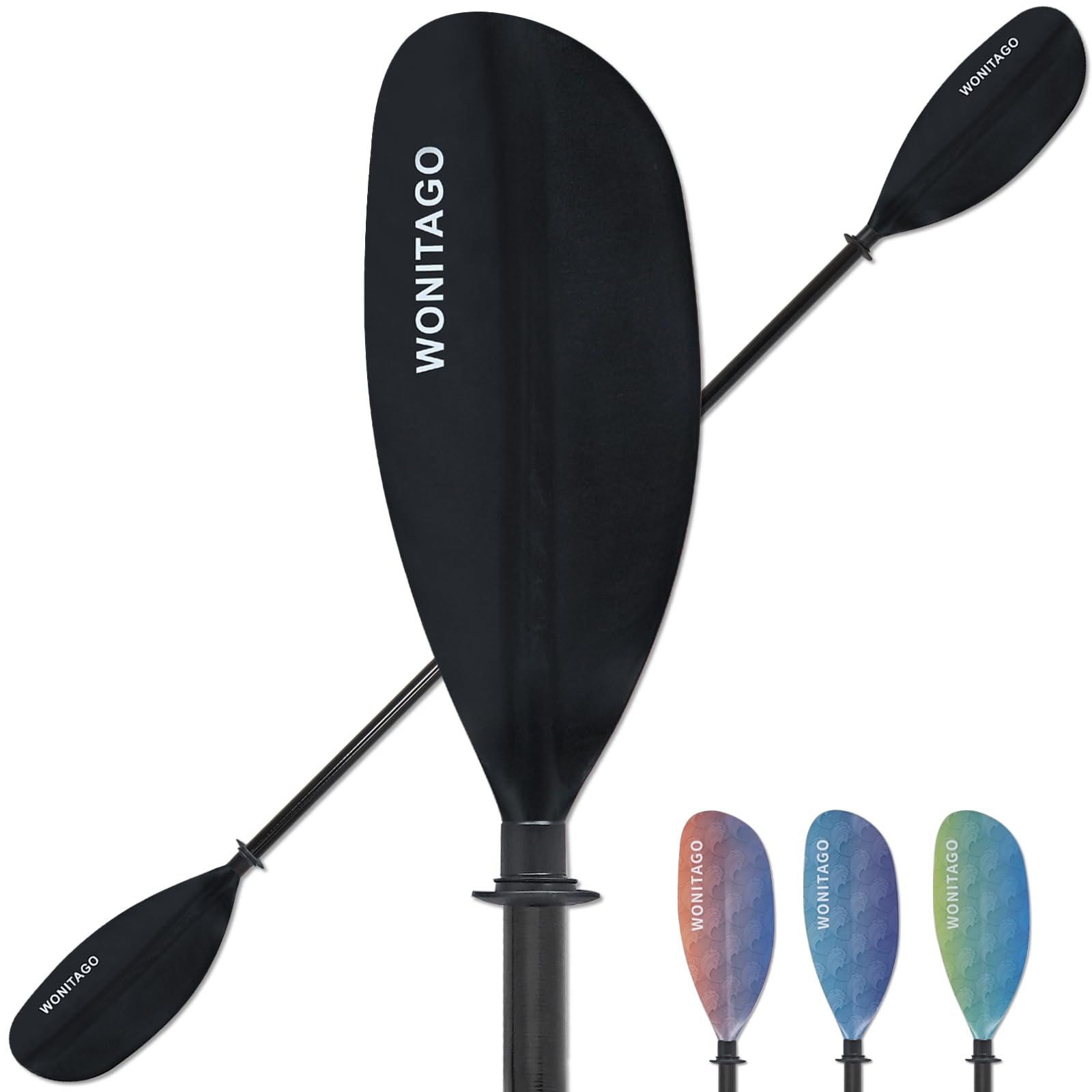
You get a genuine fiberglass shaft and reinforced nylon blades for just 2.3 lbs (1.05 kg) — the same weight as paddles costing twice as much. The WONITAGO’s 3-piece detachable design breaks down to about 32 inches (81 cm) for stashing inside a car trunk or an inflatable kayak bag. The adjustable length from 90 inches (228 cm) to 98 inches (248 cm) covers most recreational kayak widths, and the 60° rotatable ferrule lets you feather the blades left or right for wind management. One verified owner said it is “light, comfortable, performed well on a 2-hour tour” with an inflatable kayak.
You give up some refinement compared to the top picks: the blade has a decorative print that buyers report starts peeling at the edges after a few trips, and the quick-pin locking mechanism can feel less solid than a pushbutton ferrule. For the first-time kayaker who is not sure how often they will paddle, this paddle lets you get a fiberglass feel without committing serious money. The decorative peeling is cosmetic and does not affect performance, and the lightweight build means you will reach for your own paddle instead of borrowing a heavy rental.
If you want a feather-light paddle without paying for the premium label, this is your budget-friendly entry point.
Why we’d pick it
- Genuine fiberglass shaft at a price you expect to pay for aluminum
- Only 2.3 lbs (1.05 kg) — comparable to paddles twice the cost
- 3-piece breakdown is ideal for small car trunks and inflatable kayak bags
A few caveats
- Decorative print on the blade will peel after a few uses
- Quick-pin lock feels less positive than pushbutton alternatives
6. OCEANBROAD Adjustable Kayak Paddle
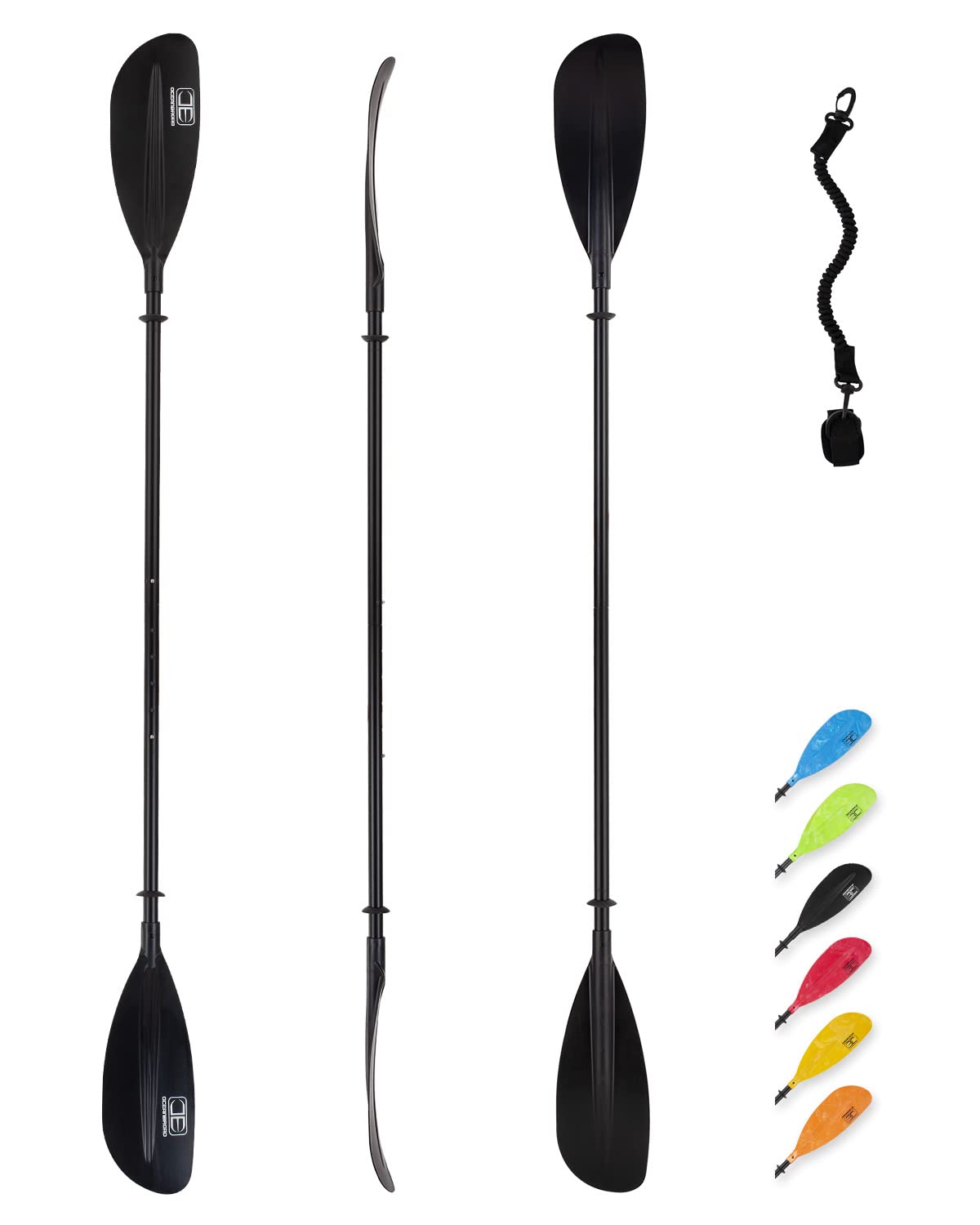
This paddle is perfect for the entry-level paddler on a strict budget who needs a tough, no-frills tool for shallow, weedy water. It packs a 1.1 mm thick aluminum alloy shaft, fiberglass-reinforced polypropylene blades, five adjustable length positions from 220 cm to 240 cm (86 to 94 inches), and a bungee paddle leash that stops you losing your paddle when you stop to take photos — all at a price that is tough to beat.
What that money gets you is a paddle that weighs 42 ounces (2.6 lbs), which is the heaviest of the six paddles here. The extra weight comes from the thick aluminum shaft, which also makes it the most rigid option for pushing off riverbanks or poling through marsh grass. The 3-piece breakdown stores at 44 inches (112 cm), and the three locking positions for blade angle accommodate both right-hand and left-hand feathering preferences. The included leash is a genuine safety bonus that many paddles at double the price omit, and the UV-stable plastic blades will not degrade in the sun.
The OCEANBROAD is the pragmatic choice for the paddler who values affordability and a full feature set over minimal weight. However, owners mention that the “paddle ends slipped after third use” until they tightened the screw in the locking lever — a simple fix you should do proactively before your first trip.
Strong points
- Comes with a bungee paddle leash — a safety feature many paddles omit
- Five adjustable lengths from 220–240 cm cover most kayak widths
- Thick aluminum alloy shaft is very rigid for pushing off obstacles
Before you buy
- At 42 oz (2.6 lbs) it is the heaviest paddle in this selection
- Locking mechanism may slip — tighten the screw before first use
Understanding the Specs
Shaft Material
Fiberglass: lighter and warmer to the touch than metal, making it more comfortable in cold-weather paddling. It absorbs vibration better, so your hands feel less fatigue over long distances. Aluminum: more affordable and very tough, but it conducts cold and is heavier for the same strength. A tempered aluminum shaft (like Carlisle uses) is stronger than basic aluminum. Carbon fiber: the lightest and stiffest but usually exceeds a strict budget.
Blade Material & Shape
Reinforced nylon: blended with fiberglass strands for stiffness and impact resistance — the best choice for durability against rocks. Polypropylene: lighter and cheaper but more flexible and prone to cracking under abuse. A dihedral ridge down the blade center reduces flutter (side-to-side wobble) so each stroke pushes your boat forward efficiently. Asymmetrical blades (like the Carlisle Day Tripper) exit the water cleaner than symmetrical ones.
Feathering & Adjustability
Feathering means angling one blade relative to the other so the blade cutting through the air faces less wind resistance. Common settings are 0° (blades parallel) and 60° (blade angled). A snap-button ferrule locks the paddle at fixed positions; a pushbutton ferrule allows rotating the shaft. For beginners, 0° feathering is simplest because both blades present the same face to the water.
Length & Weight
A paddle that is too short forces you to hunch; one too long makes every stroke awkward. For kayaks wider than 30 inches, aim for at least 240 cm (94.5 inches). For narrower touring boats, 220–230 cm (86–90 inches) works. Weight: measured in ounces or grams. A difference of 3–4 ounces becomes noticeable after an hour of steady paddling. Most budget paddles weigh between 34 and 42 ounces (960 g to 1190 g).
FAQ
How do I know what length paddle to buy for my kayak?
Is fiberglass really better than aluminum for a budget paddle?
What does feathering mean and should I use it?
Should I get a 2-piece or 3-piece paddle for storage?
Final Thoughts: The Verdict
If you want one dependable pick, the budget kayak paddle winner is the Pelican Symbiosa because it combines a lightweight fiberglass shaft and reinforced nylon blades at a price that undercuts almost every similar option — the ideal balance of weight, adjustability, and durability for recreational and touring paddlers. If you want a fishing-ready tool with a built-in hook retrieval system and a measuring tape, grab the Pelican The catch. And for a trusted, tough aluminum paddle that can survive rocky rivers and shallow bottoms season after season, reach for the Carlisle Day Tripper.