
A power outage during a storm or a camping trip without shore power quickly reveals the difference between a cheap inverter and a reliable solar generator. Budget models often skimp on battery chemistry, charge speed, and real-world output — leaving you with a brick when you need juice the most. The right unit balances usable watt-hours with a durable battery that won’t fade after a few seasons.
I’m Min — the co-founder and writer behind Gadgets Feed. I break down solar generator specs, battery cycles, and charging architectures to find the units that deliver real-world performance without the premium markup.
After comparing watt-hours, battery chemistries, and charge times across dozens of models under , I found the units that actually hold up. Read on for the best budget solar generator picks that keep your devices running without burning your wallet.
How To Choose The Best Budget Solar Generator
Budget solar generators pack less watt-hour capacity than premium units, so every spec matters more. Focus on battery chemistry — LiFePO₄ cells last thousands of cycles versus the few hundred from older NMC or lead-acid. A pure sine wave inverter is non-negotiable if you plan to run CPAP machines, laptops, or any device with a sensitive power supply. Check the solar input rating; a 100W panel that takes eight hours to recharge a 300Wh station is usable, but a unit that supports 200W input gives you flexibility to recharge faster with a larger panel later.
Match Wh to your actual load
A 288Wh unit runs a 60W laptop for about four hours or a 30W CPAP for about nine hours. Budget generators often advertise peak surge wattage, but continuous output is what keeps your fridge running. Calculate your total daily draw (phone + laptop + lights + cooler) and aim for a station that offers at least 1.5x that watt-hour figure. The expandable models let you add extra batteries later without replacing the whole unit.
Solar panel ecosystem and charge time
Some budget solar generators ship with a bundled panel that claims 40W or 60W but delivers far less in partial sun. Look for a unit whose solar input port (commonly DC7909, XT60, or Anderson) matches widely available third-party panels. A generator that can accept 100W–200W of solar input is more future-proof than one capped at 60W, even if you start with a smaller panel. Recharge time from a 100W panel in full sun typically runs 4–6 hours for a 300Wh station.
Port selection and pass-through charging
A budget solar generator should have at least one USB-C PD port (30W minimum, 60W preferred) for fast laptop charging, plus two USB-A ports for phones and accessories. AC outlets should be pure sine wave to avoid damaging sensitive gear. Pass-through charging — using the station while it recharges from solar or AC — is critical for home backup scenarios where the generator sits between your panel and your devices. Check the DC output ports: regulated 12V/10A ports are better for running car fridges than unregulated ones that drop voltage under load.
Quick Comparison
On smaller screens, swipe sideways to see the full table.
| Model | Category | Best For | Key Spec | Amazon |
|---|---|---|---|---|
| Jackery Explorer 2000 v2 | Premium | Whole-home backup | 2042Wh, 2200W output, LiFePO₄ | Amazon |
| EF ECOFLOW DELTA Pro | Premium | Max expandability | 3600Wh, 3600W output, 5 AC ports | Amazon |
| OUPES Mega 1 2000W | Premium | Fast AC recharge | 1024Wh, 2000W output, 36-min 0-80% | Amazon |
| BLAVOR S1600 | Premium | All-in-one with built-in solar | 1024Wh, 1600W output, built-in 40W panel | Amazon |
| Anker SOLIX C300 | Mid-Range | Lightweight camping | 288Wh, 300W output, 140W USB-C | Amazon |
| Jackery Solar Generator 300 | Mid-Range | Portable starter kit | 292Wh, 300W output, 40W panel | Amazon |
| VTOMAN Jump 600X | Mid-Range | Car jump starter combo | 299Wh, 600W output, 60W USB-C | Amazon |
| GRECELL EB500 | Budget | High Wh-per-dollar | 519Wh, 500W output, 100W solar panel | Amazon |
| DARAN NEO | Budget | Bundled panel value | 288Wh, 600W output, 80W solar panel | Amazon |
In‑Depth Reviews
1. Jackery Explorer 2000 v2

The Explorer 2000 v2 packs 2042Wh of LiFePO₄ storage and 2200W of pure sine wave AC output in a chassis that is 41% lighter and 34% smaller than typical 2kWh stations. CTB cell-to-body technology compacts the internals, keeping weight at 39.5 lb while maintaining structural rigidity. Three AC ports, two USB-C PD 100W ports, and a 120W car outlet give you full-house backup capability for fridges, CPAP machines, and Wi-Fi routers during outages.
Recharge from 0–80% in 66 minutes using AC fast charging, or hit full charge in 102 minutes via the emergency super charging mode activated through the app. Silent Charging mode caps noise below 30 dB — quieter than a library — so you can run it in a bedroom overnight without disturbance. Solar input supports up to 400W, delivering a full charge in about six hours under peak sun.
The 20ms UPS switching keeps sensitive electronics online when the grid flickers. Bluetooth and Wi-Fi app control let you monitor input/output wattage, battery level, and set charging schedules remotely. Reviewers report running a full-size fridge for over 21 hours on a single charge, and the unit holds its charge well over months of storage without noticeable self-discharge.
Why it’s great
- 1080Wh per pound efficiency with CTB tech
- 66-minute 0-80% AC recharge — fastest in class
- Under 30 dB in silent mode for indoor use
Good to know
- Solar panels sold separately add to total cost
- Barrel-type DC input connectors can feel loose over time
2. EF ECOFLOW DELTA Pro
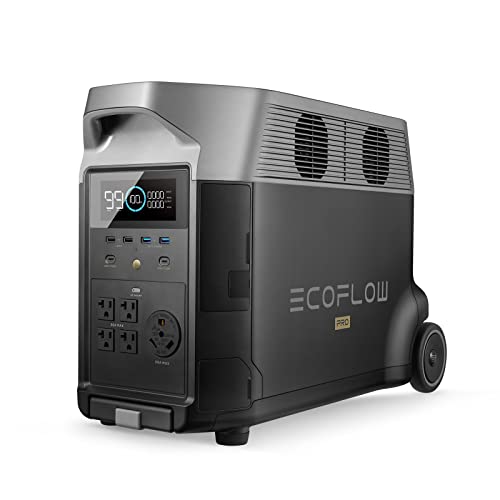
The DELTA Pro delivers 3600Wh of LFP capacity and 3600W of continuous AC output across five 120V outlets. X-Boost technology expands that to 4500W for demanding appliances like microwaves and power tools. Pair two units for 7200W — enough to run most of a home during an extended outage. The 3600Wh base expands to 25kWh with extra batteries and the Smart Generator, making it the most scalable budget-adjacent option in this roundup.
X-Stream fast charging recharges the station from 0–100% in 1.8 hours via a 240V outlet or 2.7 hours from a standard 1800W wall outlet. Solar input accepts up to 1600W (4x 400W panels), hitting a full charge in under three hours in good sun. The 23% solar conversion efficiency is among the highest in portable stations, meaning less time waiting for panels to top off the battery.
Five charging methods — EV station, solar, wall, car, and Smart Generator — give you flexibility no matter where you are. The EcoFlow app provides real-time monitoring, charge scheduling, and usage breakdowns via Wi-Fi or Bluetooth. Reviewers note it powers medical oxygen concentrators for nearly 11 hours on a single battery and handles mobile vendor setups like heat presses without voltage sag.
Why it’s great
- Expands to 25kWh — unmatched scalability
- Five AC outlets plus dual USB-C PD 100W
- 23% solar conversion efficiency
Good to know
- Weighs 99 lb — not a grab-and-go unit
- Premium price point despite budget SEO
3. OUPES Mega 1 2000W
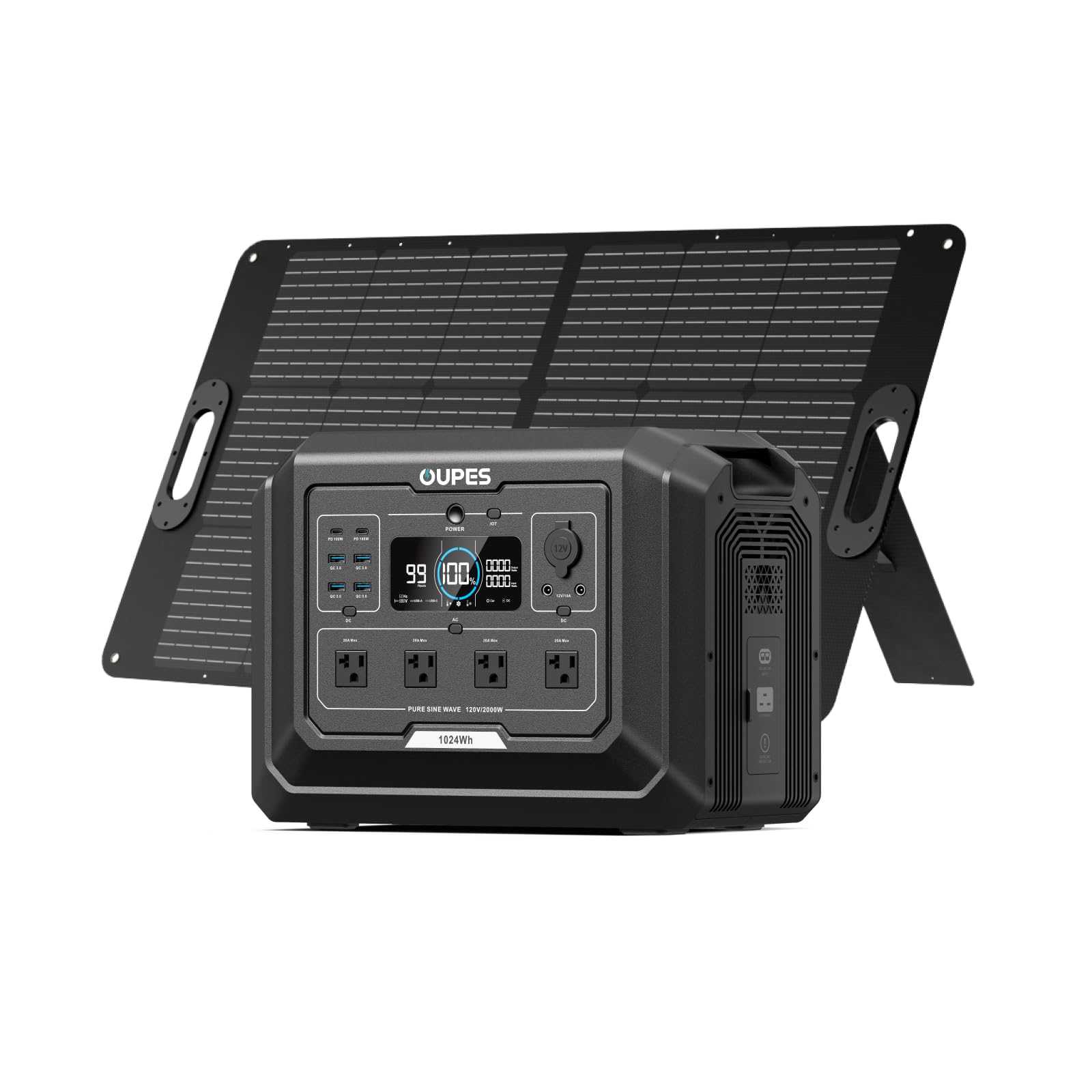
The OUPES Mega 1 achieves 0–80% AC recharge in just 36 minutes via a 1800W wall input — the fastest recharge in this entire lineup. Its 1024Wh LiFePO₄ battery delivers 2000W continuous output (4500W surge) across four 120V AC ports, enough to run a microwave, mini-fridge, and power tools simultaneously. Capacity expands to 5120Wh by adding two B2 extra batteries, giving you multi-day off-grid capability without buying a new station.
Solar input maxes at 800W, achieving 0–80% in roughly 1.3 hours with three 240W panels. Dual charging (AC + solar simultaneously) cuts recharge time to 26 minutes for 80% — a feature normally reserved for much more expensive units. The bundled 100W monocrystalline panel adds immediate off-grid value right out of the box, with a 23.5% conversion efficiency that outpaces many competitors.
Smart app control via Bluetooth and Wi-Fi lets you monitor real-time input/output wattage, battery level, and temperature. The LCD screen displays the same data locally. Reviewers praise its ability to run two fans all day at outdoor events and handle a small swamp cooler without breaking a sweat. The 27.8 lb weight and built-in handle make it surprisingly portable for a 1kWh unit.
Why it’s great
- 36-minute 0-80% AC recharge — industry leading
- Dual charging cuts time to 26 minutes
- Expandable to 5120Wh
Good to know
- Bundled 100W panel is entry-level; larger panels advised for full solar speed
- App integration still maturing compared to EcoFlow
4. BLAVOR S1600
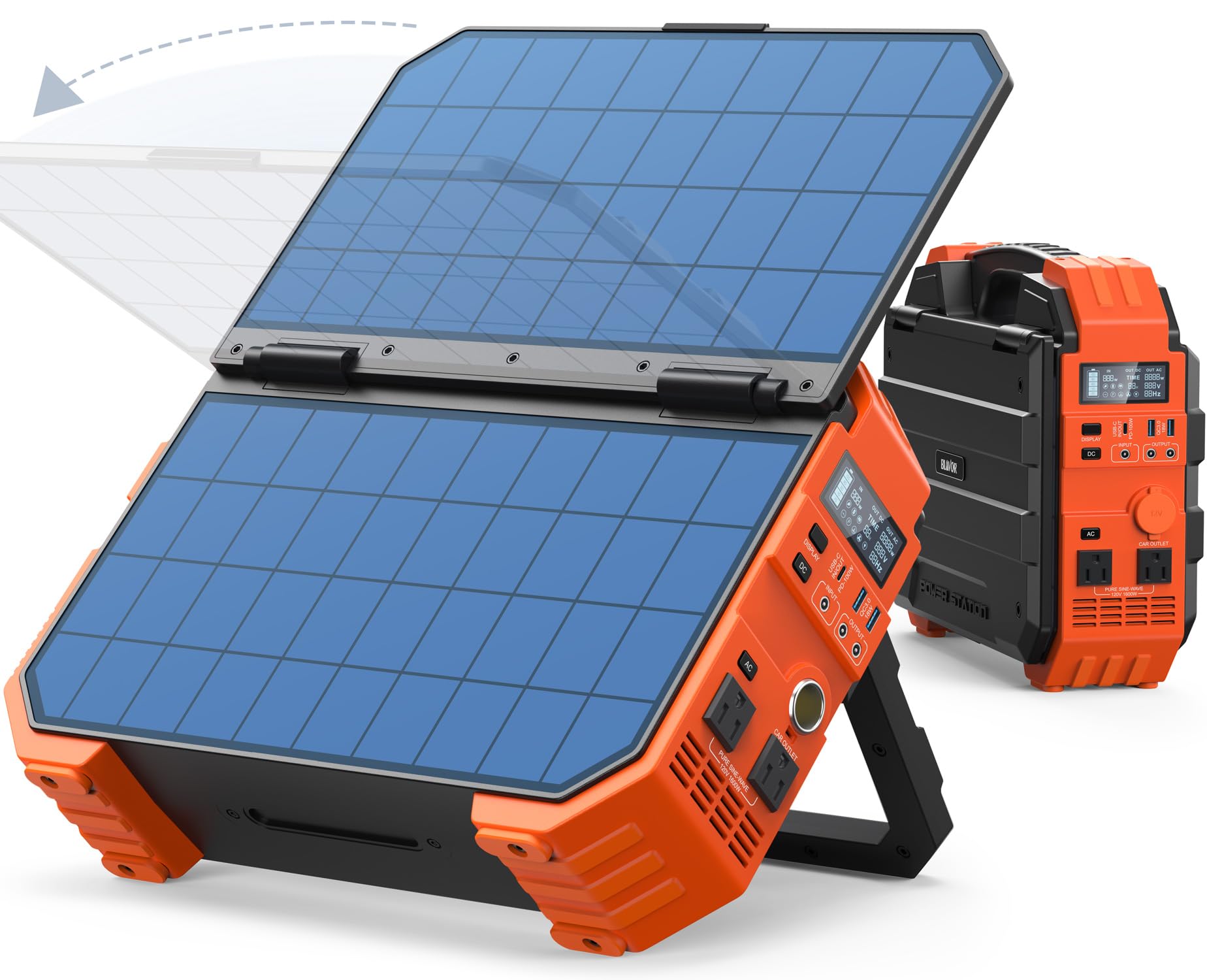
The BLAVOR S1600 integrates a folding 40W monocrystalline solar panel directly into the station body — a design that won the 2022 German iF Design Award. No separate panel to carry, set up, or cable together. Just unfold the panel, angle it toward the sun, and start charging the 1024Wh LiFePO₄ battery. The 1600W rated output (3200W surge) powers 90% of household appliances, including coffee makers, CPAP machines, and mini-fridges.
Four charging methods — built-in solar, external solar (up to 200W input), wall AC, and car outlet — give you flexibility for every scenario. The built-in panel delivers about 30W in full winter sun, enough to trickle charge the battery over a day or maintain it during use. For faster solar recharge, the XT60 port accepts external panels up to 200W, bringing full recharge time down to about 5–6 hours in good sun.
The 26 lb suitcase form factor makes it easy to carry, and the orange/black color scheme is highly visible outdoors. Reviewers report running a deep freezer for about 20 hours on a single charge and powering a home fridge for roughly five hours. The LCD screen shows real-time input/output wattage and remaining battery level. Ten adapter heads cover most DC devices, and the dual USB-C PD 100W ports handle laptops at full speed.
Why it’s great
- Built-in 40W panel eliminates separate gear
- 1024Wh for under 30 lb with integrated solar
- 10 adapter heads for broad DC compatibility
Good to know
- Built-in panel alone is slow for full recharge
- Port labels are low-contrast in dim light
5. Anker SOLIX C300

The Anker SOLIX C300 packs 288Wh of LiFePO₄ capacity and 300W continuous output (600W surge) into a chassis 15% smaller than comparable units from Jackery or Goal Zero. Two 140W USB-C ports support bidirectional fast charging — you can charge the station itself via USB-C PD 3.1, or use the ports to juice laptops and tablets at full speed. Three AC outlets, a 120W car socket, and one 12W USB-A port cover up to eight devices simultaneously.
AC wall recharge hits 80% in just 50 minutes — extremely fast for a sub-300Wh station. The bundled 60W solar panel folds into a compact 11 x 9 inch package and delivers about 50W in full sun, recharging the station from empty in roughly 5–6 hours. The panel itself is IP68 rated, so rain and splashes won’t damage it during outdoor use. The XT60 to DC7909 charging cable is included, along with an extension cable for flexible panel placement.
Noise output is rated at just 25 dB from 3.3 ft away — barely audible, making it ideal for tent camping or bedside use during power outages. Smart temperature control and impact-resistant construction add durability. Reviewers note it ran an AC air mattress pump for 10–12 minutes consuming only 5% battery, and the solar panel fully recharged the station in about 1.5 hours of direct sun.
Why it’s great
- 50-minute 0-80% AC recharge
- 140W bidirectional USB-C for laptop and station charging
- IP68 solar panel handles rain and dust
Good to know
- 60W panel is slow for full recharge; 100W panel recommended
- No included carrying strap (sold separately)
6. Jackery Solar Generator 300
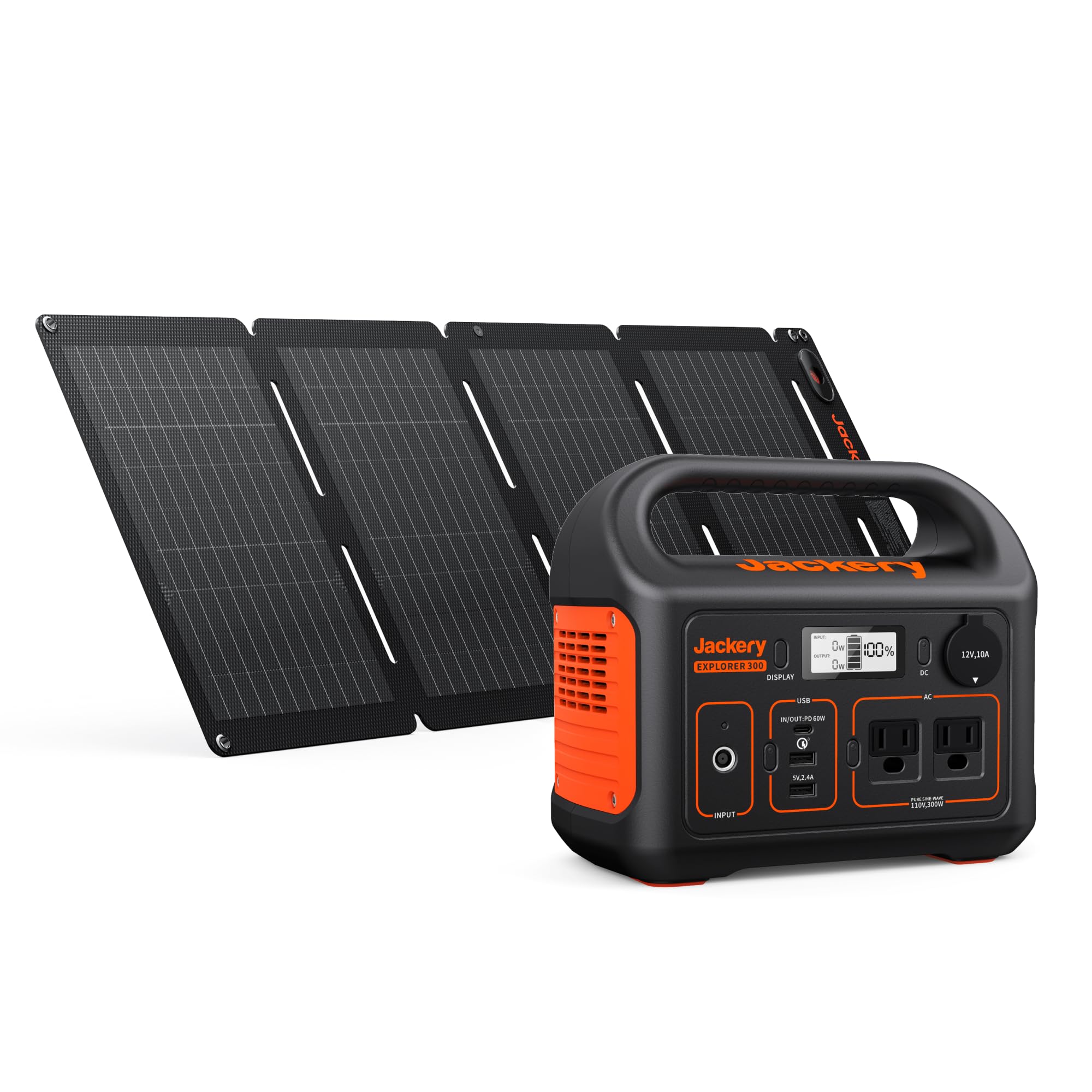
The Jackery Solar Generator 300 pairs the Explorer 300 power station (292Wh, 300W output) with a 40W Air solar panel. The Explorer 300 weighs just 7.5 lb, making it one of the lightest 300Wh-class stations available — 17% lighter than industry average for its capacity class. Two AC outlets (pure sine wave), a 100W USB-C PD port, two USB-A ports, and a 120W car outlet handle up to six devices at once, including laptops, drones, and cameras.
LiFePO₄ battery chemistry delivers over 4,000 charge cycles before dropping to 70% capacity, translating to roughly 11 years of regular use. Solar recharge reaches 80% in about 7.5 hours with the bundled 40W panel, or 2.8 hours if paired with a Jackery 100W panel (sold separately). The panel itself is designed for portability, folding down to 15.4 x 9.9 x 1.2 inches, and includes a kickstand for optimal sun angling.
The integrated handle and 7.5 lb weight make it easy to toss into a backpack for hiking or keep in the trunk for road trips. Reviewers report it powers a USB fan, phone, and laptop for 2–3 days of off-grid use without depleting the battery completely. The low self-discharge rate means it holds its charge well over months of storage — a key feature for emergency preparedness kits.
Why it’s great
- 7.5 lb — lightest in its class
- 4,000 cycle LiFePO₄ battery life
- 100W USB-C PD for fast laptop charging
Good to know
- 40W bundled panel is slow; upgrade to 100W for practical solar recharge
- No pass-through charging support for simultaneous use and recharge
7. VTOMAN Jump 600X

The VTOMAN Jump 600X is a 2-in-1 device that combines a 299Wh LiFePO₄ portable power station with a car jump start port — a feature unique in this budget segment. The 600W continuous AC output (1200W surge) powers CPAP machines, mini-fridges, and power tools, while the jump start port can crank a dead 12V battery on trucks, SUVs, and cars in about three seconds. Jumper cables are sold separately, but the capability eliminates the need for a standalone jump pack.
Capacity expands from 299Wh to 939Wh with VTOMAN’s extra battery (sold separately), giving you a 3x range boost without replacing the core unit. The LiFePO₄ cells are rated for 3,000 full cycles before hitting 80% capacity — a 10+ year service life for typical weekend use. Pass-through charging lets you power devices while the station recharges from both AC and solar simultaneously.
Nine output ports include two AC outlets, three USB-A (one QC 3.0 at 18W), one USB-C PD 60W, two regulated 12V/10A DC5521 ports, and a 12V/10A car outlet. Regulated DC output means voltage stays steady at 12V regardless of load — critical for CPAP machines and car fridges that can malfunction on unregulated ports. Reviewers successfully ran a PC with dual monitors and a fan for over eight hours, and another powered a mini-fridge for five-plus hours on half a charge.
Why it’s great
- Built-in car jump start saves buying a separate device
- Expandable to 939Wh
- Regulated 12V DC ports for sensitive gear
Good to know
- AC recharge takes about 3 hours — slower than some competitors
- Jumper cables not included in the package
8. GRECELL EB500
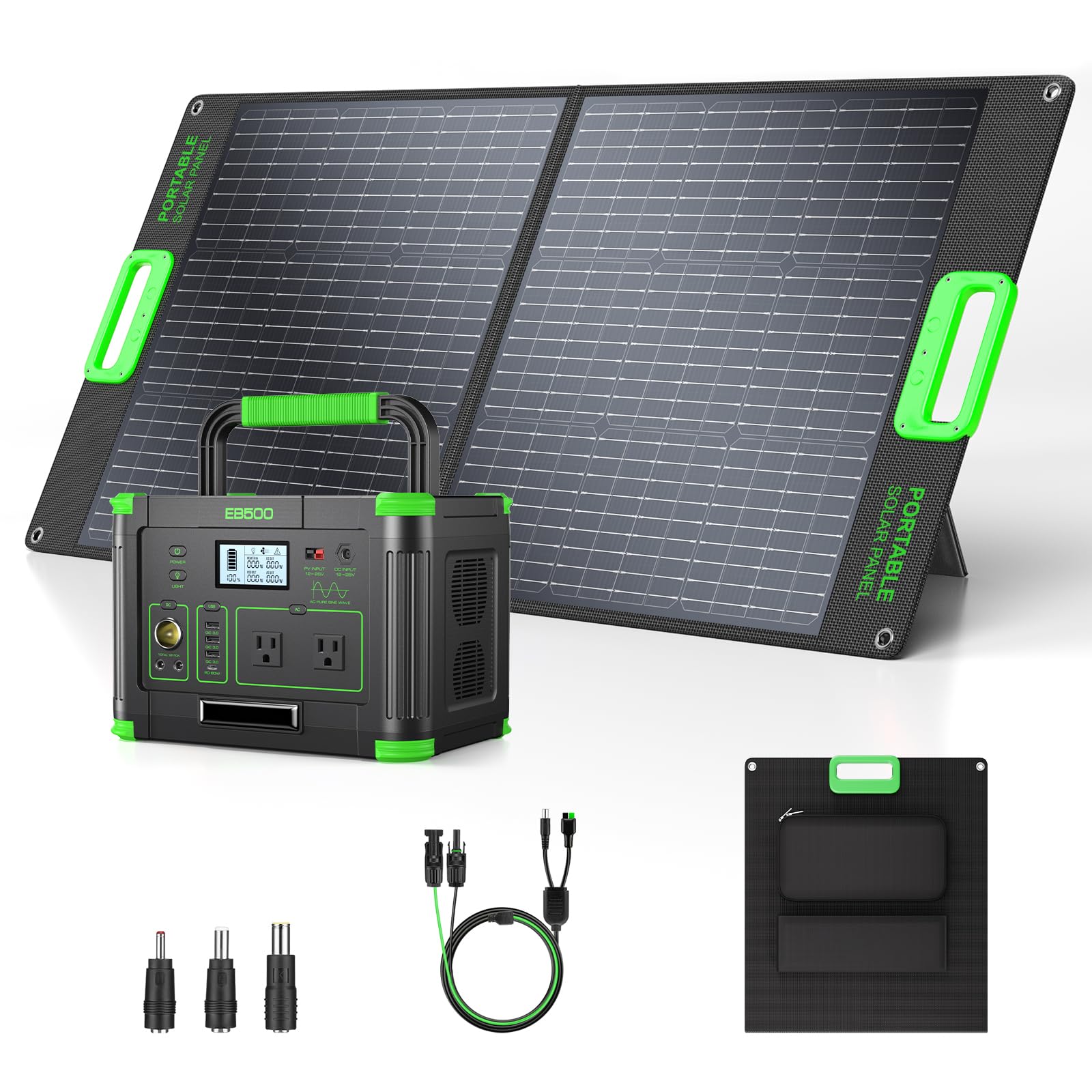
The GRECELL EB500 delivers 519Wh of capacity and 500W continuous output (1000W surge) at a price point that undercuts most competitors on a per-watt-hour basis. Ten output ports include two AC pure sine wave outlets, three USB-A QC 3.0 ports, one USB-C PD 60W, one DC car outlet, two DC5521 ports, and a built-in wireless charging pad on the top surface. The wireless charger supports up to 15W for Qi-compatible phones — a convenience feature rarely seen at this tier.
The bundled 100W monocrystalline solar panel achieves up to 23.5% conversion efficiency, using advanced cell technology to capture more sunlight in partial shade and overcast conditions. Smart chip auto-detection optimizes charging speed for connected devices while preventing overcharging. The panel folds into a portable package and includes multiple adapter heads — 7909, Anderson, and 5.5×2.1mm — ensuring compatibility with most third-party power stations beyond just GRECELL’s ecosystem.
The built-in BMS (Battery Management System) provides temperature control, overvoltage protection, overcurrent protection, and short circuit protection. The LCD display shows real-time input/output wattage and remaining battery percentage. Reviewers report it held a charge for five days during dry camping, powering phones, fans, and a headlamp without issue. The compact 11.5 x 7.9 x 7.9 inch dimensions fit easily in a cupboard or RV cabinet.
Why it’s great
- 519Wh for exceptional per-dollar value
- Built-in 15W wireless charging pad
- 23.5% efficient monocrystalline solar panel
Good to know
- 500W output limits high-draw appliances like microwaves
- No app-based monitoring or control
9. DARAN NEO
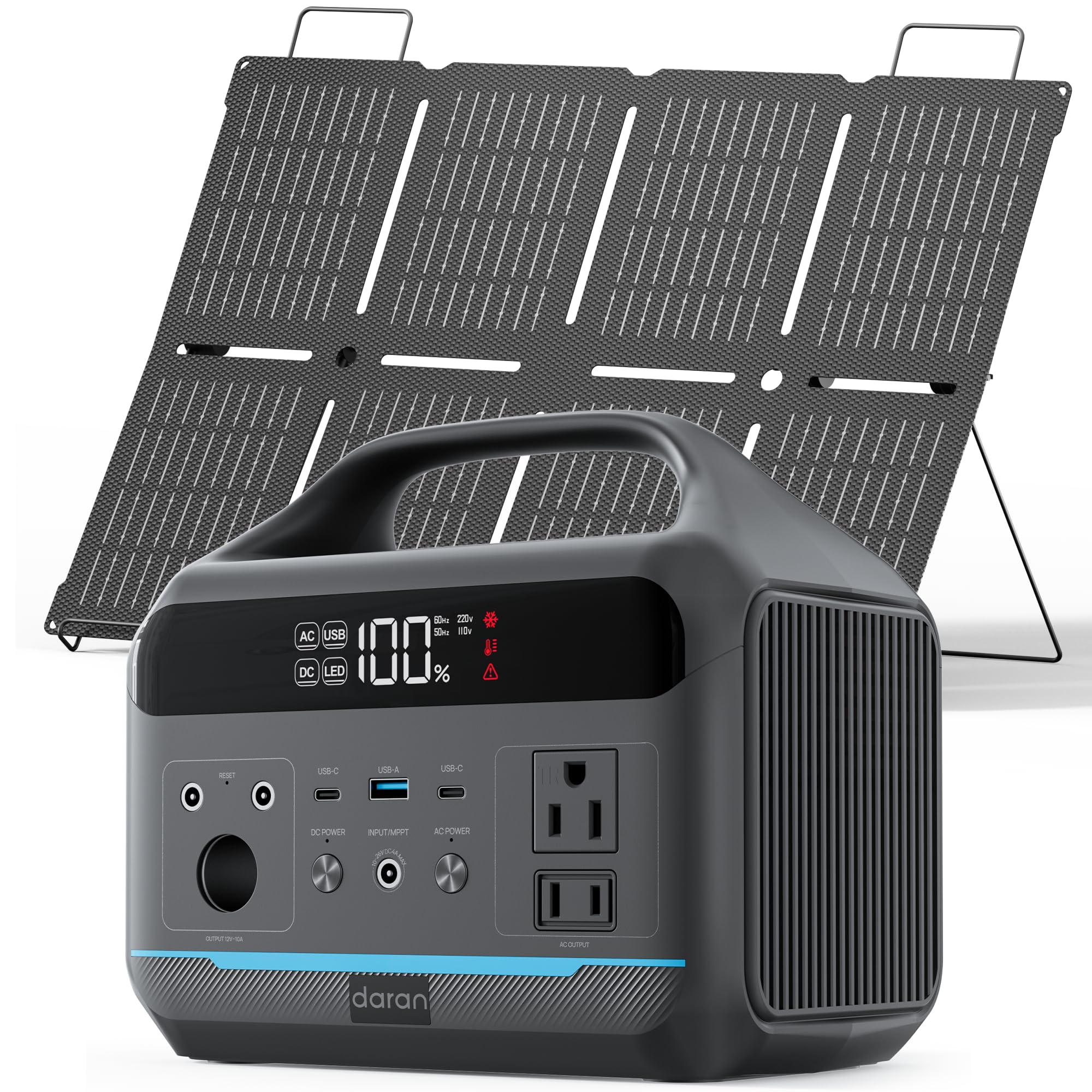
The DARAN NEO combines a 288Wh LiFePO₄ power station (600W continuous, 1200W surge) with an 80W monocrystalline solar panel for a complete off-grid starter kit. AC wall recharge hits 80% in approximately two hours — faster than many competitors in this watt-hour class — making it practical for quick top-ups between camping trips or during work breaks. Two AC pure sine wave outlets, a 100W USB-C PD port, a 30W USB-C port, an 18W USB-A port, DC5521, and a 120W car outlet give you broad device compatibility.
The 80W solar panel uses advanced monocrystalline cells for reliable charging even on partly cloudy days, achieving a full recharge in about 4–5 hours under strong sunlight. The panel folds down to a portable size and includes a kickstand for optimal sun tracking. The station’s LiFePO₄ battery is rated for 3,500+ cycles, translating to roughly 10 years of regular use before capacity degrades to 80%.
The integrated LED light offers four modes — 100%, 50%, strobe, and SOS — for emergency signaling or nighttime campsite illumination. The LCD display shows real-time input/output wattage and remaining battery level. Reviewers note it keeps a remote security camera charged continuously in the field, eliminating the need for biannual battery changes. Weighing 8.38 lb, it’s light enough to carry in one hand during a hike or emergency grab-and-go scenario.
Why it’s great
- 2-hour 0-80% AC recharge — very fast for the class
- 80W bundled panel is usable for daily top-ups
- 3,500+ cycle LiFePO₄ battery
Good to know
- Battery drains faster than premium brands under heavy load
- No car charger cable included in the box
FAQ
Can a budget solar generator run a refrigerator?
How long does a budget solar generator last on a single charge?
Can I leave a budget solar generator plugged in all the time?
What size solar panel do I need for a budget generator?
Are budget solar generators safe to use indoors?
Final Thoughts: The Verdict
For most users, the best budget solar generator winner is the Jackery Explorer 2000 v2 because its 2042Wh LiFePO₄ capacity, 2200W output, and 66-minute fast recharge deliver whole-home backup capability at a price that undercuts competitors like EcoFlow. If you want a truly portable camping companion with integrated solar, grab the Anker SOLIX C300. And for the best value on a per-watt-hour basis with a bundled solar panel, nothing beats the GRECELL EB500.