
Dropped packets, VPN bottlenecks, and a network that chokes when twenty employees hop on a video call — these are the daily realities that separate a consumer-grade router from a proper business router. Unlike a standard home unit built for streaming and social media, a business-grade wired or multi-WAN gateway is engineered for high concurrent session counts, failover reliability, and secure remote access. Whether you are scaling a small office or managing a distributed team, the choice of router directly impacts uptime, throughput, and data security.
I’m Min — the co-founder and writer behind Gadgets Feed. After analyzing session capacities, VPN throughput limits, port configurations, and SDN integration across dozens of wired gateways and enterprise access points, I compiled this guide to cut through the noise and help you match hardware to your actual workload.
If your network needs to support dozens of concurrent clients, multiple WAN links, and secure site-to-site VPN tunnels without breaking a sweat, finding the right best business router means understanding session tables, failover timing, and throughput ceilings — not just marketing speeds.
How To Choose The Best Business Router
Selecting a business router requires shifting focus from peak WiFi speeds to sustained wired throughput, session stability, and security features. For an office or managed network, the primary bottlenecks are often the router’s CPU, its RAM for handling concurrent NAT sessions, and the VPN encryption engine. A unit that costs twice as much today may save you hours of downtime over its lifespan.
Concurrent Sessions and Client Capacity
Consumer routers typically choke at a few thousand concurrent sessions. Business-grade gateways like the TP-Link ER707-M2 handle up to 500,000 sessions, supporting over a thousand connected clients. This metric directly determines whether your network stutters during peak usage. Look for a session count at least ten times your expected active devices.
Multi-WAN Failover and Load Balancing
An ISP outage can halt business operations. Routers with dual or quad WAN ports allow you to connect a primary fiber line and a secondary DSL, cable, or LTE backup. The best models perform sub-15-second failover automatically, so end-users never notice the switch. Load balancing across multiple WANs also maximizes aggregate bandwidth during normal operation.
VPN Throughput and Security
Remote access and site-to-site connectivity depend on hardware-accelerated VPN processing. A router that only manages 50 Mbps over IPsec is insufficient for a team sharing large files. Look for models that advertise LAN-to-LAN IPsec connections in the hundreds and support modern protocols like WireGuard for faster encrypted tunnels. Integrated SPI firewalls and DoS defense are non-negotiable.
SDN Integration and Centralized Management
As your network grows, managing individual router web interfaces becomes impractical. SDN platforms like TP-Link Omada and Ubiquiti UniFi allow centralized provisioning, monitoring, and firmware updates across multiple sites from a single cloud dashboard. This reduces IT overhead and ensures consistent security policies across all gateways, switches, and access points.
Quick Comparison
On smaller screens, swipe sideways to see the full table.
| Model | Category | Best For | Key Spec | Amazon |
|---|---|---|---|---|
| TP-Link ER707-M2 | Mid-Range / Wired Gateway | High client density & multi-WAN | 500,000 concurrent sessions | Amazon |
| TP-Link ER7206 | Mid-Range / Wired Gateway | Affordable Omada SDN integration | Up to 700 clients | Amazon |
| NETGEAR Nighthawk RS140 | Mid-Range / WiFi 7 | Small office with WiFi 7 clients | BE5000 speed class | Amazon |
| GL.iNet Flint 3 | Mid-Range / Tri-Band WiFi 7 | VPN-centric users & power users | 680 Mbps WireGuard speed | Amazon |
| ASUS RT-BE88U | Premium / WiFi 7 & 10G | Maximum wired port capacity | Dual 10G ports + 4x 2.5G | Amazon |
| Ubiquiti UDM-SE | Premium / Enterprise All-in-One | Full UniFi ecosystem management | Built-in PoE switch + 10G SFP+ | Amazon |
| NETGEAR Nighthawk RS700S | Premium / WiFi 7 Flagship | Extreme wireless speed & coverage | 19 Gbps aggregate speed | Amazon |
In‑Depth Reviews
1. TP-Link ER707-M2 Omada Multi-Gigabit VPN Router
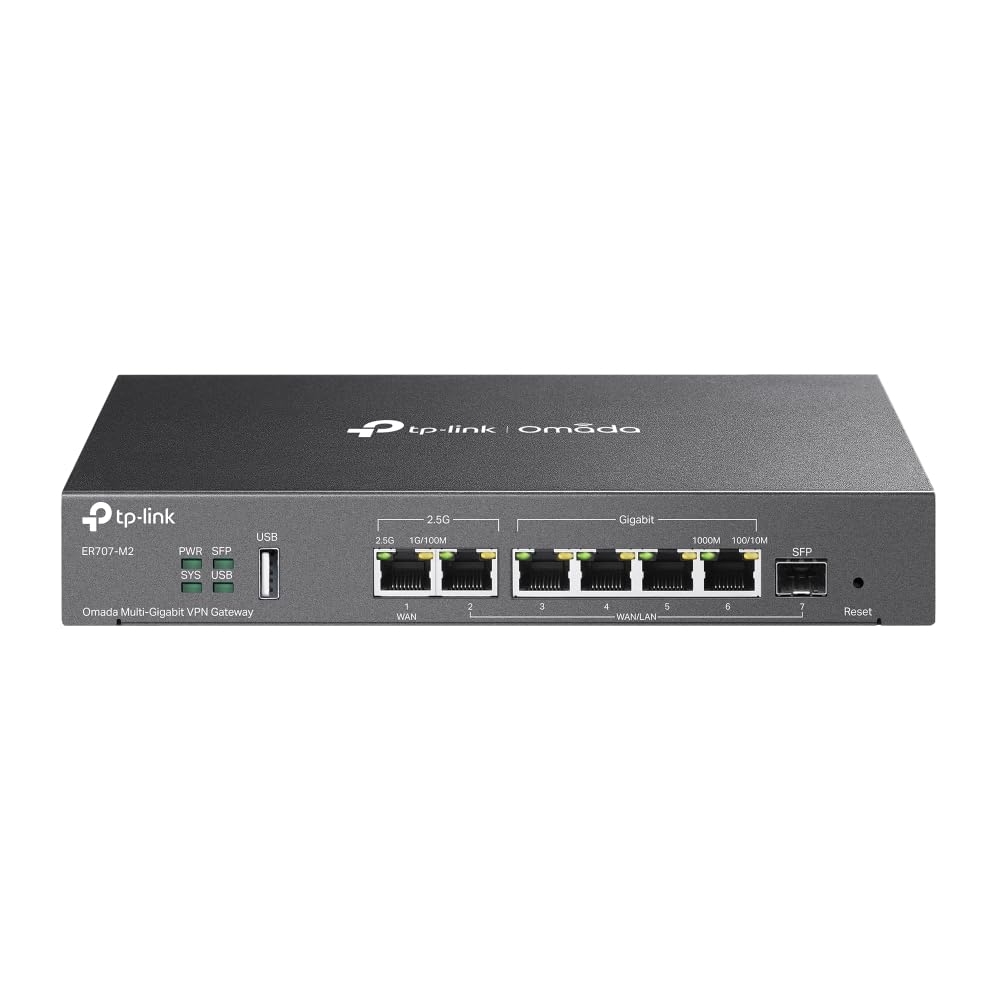
The ER707-M2 is the sweet spot for most small to mid-sized businesses. Its dual 2.5Gig WAN ports combined with a dedicated SFP port provide flexible multi-gig connectivity, while the internal antenna design keeps the chassis compact for rack or shelf placement. Supporting up to 500,000 concurrent sessions and over 1,000 clients, this wired gateway handles high-density environments without breaking a sweat.
VPN performance is exceptional for its class, offering up to 100 LAN-to-LAN IPsec tunnels alongside OpenVPN, L2TP, and PPTP support. Integration into the Omada SDN platform means you can manage this router alongside Omada switches and access points from a single cloud dashboard or the mobile app. The five-year warranty and responsive technical support further reduce total cost of ownership.
Real-world users report seamless ISP failover in under 15 seconds, making the switch between primary and backup lines invisible to end-users. Setup is straightforward through the web interface, though some have noted that TP-Link’s terminology can take getting used to. For a wired gateway that balances performance, port flexibility, and long-term reliability, this unit is difficult to beat.
Why it’s great
- Dual 2.5G WAN ports plus SFP for maximum connectivity
- 500,000 concurrent sessions handle heavy office traffic
- Omada SDN integration simplifies multi-site management
Good to know
- No built-in WiFi — requires separate access points
- Terminology in the interface can be confusing initially
2. TP-Link ER7206 Multi-WAN Gigabit VPN Router

The ER7206 brings true multi-WAN flexibility to a more accessible price point. With one Gigabit SFP WAN port, one dedicated Gigabit WAN port, and two additional WAN/LAN ports, you can bond up to four internet connections for load balancing or failover. Session capacity reaches an impressive 150,000 associated devices, supporting up to 700 concurrent clients — ample for a busy office or co-working space.
This gateway is fully integrated into the Omada SDN ecosystem, allowing centralized cloud management across multiple sites. The VPN engine handles 100 IPsec, 50 OpenVPN, and 50 L2TP tunnels simultaneously, making site-to-site encrypted links straightforward to deploy. Security features include advanced firewall policies, DoS defense, and IP/MAC/URL filtering out of the box.
Users consistently praise its rock-solid stability over many months of continuous operation. The clean web UI and responsive tech support add to the value proposition. While it lacks 2.5Gig ports and the session count is lower than the ER707-M2, for most small to medium businesses this unit delivers exceptional reliability at a lower investment. It is a wired gateway that prioritizes stability over raw throughput.
Why it’s great
- Four WAN ports for maximum ISP redundancy
- Proven stability over years of continuous operation
- Full Omada SDN support with cloud management
Good to know
- Ports are limited to 1 Gbps each
- Initial VPN setup can be complex for beginners
3. NETGEAR Nighthawk RS140 WiFi 7 Router

The Nighthawk RS140 brings WiFi 7 to the small office at an accessible price while maintaining a compact footprint. With BE5000 wireless speeds and a 2.5 Gigabit internet port, it can saturate most fiber connections without bottlenecks. Coverage is rated up to 2,250 square feet, sufficient for smaller offices or retail spaces without demanding multi-WAN requirements.
Setup is streamlined through the Nighthawk app, and the router includes a 1-year subscription to NETGEAR Armor for basic threat protection. It handles up to 80 devices simultaneously, making it suitable for a growing team where wired infrastructure is minimal. The dual-band design keeps things simple, and compatibility with all major ISPs means minimal deployment friction.
Users note the easy setup and strong wireless range, pairing well with common cable modems like the Motorola B12. However, this is fundamentally a consumer-oriented WiFi router, not a dedicated business gateway. It lacks multi-WAN support, SDN integration, and the session capacity of wired alternatives. For a very small office that prioritizes wireless simplicity over granular network control, it works well as an entry point.
Why it’s great
- Simple app-based setup ideal for non-technical users
- WiFi 7 delivers solid throughput for a small team
- Compact design saves desk space
Good to know
- No multi-WAN failover capability
- Lacks SDN platform for centralized management
4. GL.iNet GL-BE9300 Flint 3 Tri-Band WiFi 7 Router

The Flint 3 is a specialized tool for businesses that prioritize VPN performance above all else. With WireGuard speeds up to 680 Mbps and OpenVPN similarly capable, this tri-band WiFi 7 router encrypts traffic without turning your internet connection into a bottleneck. The 1GB DDR4 RAM and 8GB eMMC storage allow for extensive plugin installation, catering to DIY network engineers who want custom routing solutions.
Multi-Link Operation technology ensures ultra-low latency even in high-density environments, and the built-in AdGuard Home integration provides ad-blocking and DNS-level filtering natively — a cost-saving alternative to subscription-based security services. The web-based admin interface is intuitive and responsive, with no app required for full control. Range is rated up to 2,000 square feet, though users report performance is strongest in open-plan layouts.
While the Flint 3 excels at VPN throughput and feature depth, its wireless range is moderate compared to dedicated office access points. Some users have noted that USB 3.0 NAS speeds drop after initial transfer spikes, and the 6GHz band has limited wall penetration. For businesses that need a fast, flexible VPN gateway with modern WiFi 7 support and granular control, this unit delivers exceptional value.
Why it’s great
- Industry-leading WireGuard throughput for a home/office router
- Built-in AdGuard Home blocks ads without subscription fees
- Open-source-friendly platform with extensive plugin support
Good to know
- WiFi range is modest compared to dedicated enterprise APs
- 6GHz band struggles through multiple walls
5. ASUS RT-BE88U Dual-Band WiFi 7 Router

The RT-BE88U is a wired connectivity beast disguised as a WiFi router. With one 10G SFP+ port, one 10G WAN/LAN port, four 2.5G ports, and four Gigabit ports, it offers a staggering 34 Gbps aggregate wired capacity. This makes it ideal for businesses that need to distribute high-speed connections to NAS devices, servers, and workstations without bottlenecks. The quad-core 2.6 GHz 64-bit CPU ensures routing decisions are made at wire speed.
ASUS AiProtection Pro, powered by Trend Micro, provides commercial-grade security without ongoing subscription fees. The Guest Network Pro feature allows up to five separate SSIDs with independent VPN assignments and parental controls — useful for segmenting IoT devices or visitor access. AiMesh compatibility means you can extend coverage with additional ASUS nodes, though the RT-BE88U alone covers up to 3,000 square feet.
Users praise the rock-solid stability and extensive wired port selection, noting that the router handles over 30 devices on a 3100 sq ft property without any need for extenders. The dual WAN functionality with USB tethering is a nice failover option. Some early firmware bugs with MLO have been reported, and the lack of a 6GHz band in a WiFi 7 flagship is a notable omission. For wired-heavy environments, this is a top contender.
Why it’s great
- Unmatched wired port config with dual 10G and four 2.5G ports
- AiProtection Pro provides free commercial-grade security
- AiMesh ecosystem allows seamless network expansion
Good to know
- No 6GHz band despite being a WiFi 7 device
- Early firmware still has minor MLO bugs
6. Ubiquiti UniFi Dream Machine Special Edition

The UDM-SE is the definitive all-in-one appliance for small to medium businesses that want enterprise-grade network management without the Cisco licensing overhead. It combines a 10G SFP+ WAN port, multi-gig LAN ports, a built-in 8-port PoE+ switch, and the full UniFi OS controller — all in a 1U rack-mountable chassis. This single device replaces a router, switch, NVR, and cloud key, dramatically simplifying the network stack.
UniFi OS provides deep visibility into traffic patterns, client health, and security threats through an intuitive dashboard. IDS/IPS can be enabled without significant throughput degradation, and VLAN management is straightforward once configured. The integrated PoE+ ports power UniFi access points and cameras directly, eliminating the need for separate power injectors. Geo-blocking and DNS-based content filtering add another layer of protection.
Network engineers consistently recommend the UDM-SE for its blend of performance and ease of use. It handles demanding scenarios like 10Gb NAS transfers and high-density WiFi deployments without breaking a sweat. Some users note that the port LEDs are blindingly bright (tape is a common remedy), and advanced IPv6 configuration has quirks. For a business committed to the UniFi ecosystem, this is the central nervous system that ties everything together seamlessly.
Why it’s great
- All-in-one design eliminates need for separate switch and controller
- Enterprise-grade visibility without recurring licensing fees
- 10G SFP+ uplink future-proofs the WAN connection
Good to know
- Port LEDs are extremely bright in dark environments
- IPv6 implementation has some limitations
7. NETGEAR Nighthawk RS700S Tri-Band WiFi 7 Router

The RS700S is NETGEAR’s flagship WiFi 7 router, capable of an aggregate 19 Gbps across tri-band frequencies. Its 10 Gig internet port ensures even the fastest fiber plans won’t be bottlenecked, and the coverage extends up to 3,500 square feet with strong signal penetration through walls. The sleek body houses high-performance antennas engineered for 360-degree coverage, making it a solid choice for larger office spaces or open-plan layouts.
Setup is straightforward via the Nighthawk app, and the included 1-year Armor subscription provides basic intrusion prevention. The router handles over 30 devices easily, and users consistently report full 1 Gbps wireless speeds on the 6GHz band. The 5GHz band delivers 600-700 Mbps at range, outperforming many competitors in real-world wall penetration tests. The absence of a fan means silent operation — a plus for open offices.
The RS700S is fundamentally a consumer-grade router repackaged for high-performance environments. It lacks multi-WAN ports, SDN integration, and the session handling capacity of dedicated business gateways. Some early firmware versions have caused 6GHz dropouts, though the hardware is stable on 5GHz and 2.4GHz. For a business that needs maximum WiFi speed and coverage with minimal complexity, this unit delivers raw wireless performance.
Why it’s great
- Exceptional 3,500 sq ft coverage with strong wall penetration
- True 1 Gbps+ wireless speeds available on 6GHz
- Silent operation with no fan noise
Good to know
- No multi-WAN failover for business continuity
- 6GHz band stability affected by some firmware versions
FAQ
Can I use a consumer WiFi router for my small business?
What is the difference between load balancing and failover?
How many concurrent sessions do I need for my office?
Final Thoughts: The Verdict
For most users, the best business router winner is the TP-Link ER707-M2 because it combines multi-gig WAN flexibility, massive 500,000 session capacity, and full Omada SDN integration at a price that scales with your business. If you want absolute port density and wired throughput, grab the ASUS RT-BE88U. And for a complete enterprise network in one box, nothing beats the Ubiquiti UDM-SE.