
Every network tech, low-voltage installer, and electrician has faced the same frustrating scene: a bundle of unlabeled Cat5e, Cat6, and phone cables tangled in a dark closet, and no way to tell which one leads to the office jack without pulling and praying. A reliable cable toner solves this by injecting an electrical signal onto a specific wire, letting you trace it through walls, ceilings, and crowded patch panels with a probe. Choosing the wrong one means wasted hours, false tones, and batteries that die mid-job.
I’m Min — the co-founder and writer behind Gadgets Feed. I’ve spent countless hours analyzing the technical specifications, real-world user feedback, and market positioning of dozens of cable toner kits to build a guide that separates the tools that actually save time from the ones that just add noise.
Whether you’re a professional installer wiring a new office or a homeowner labeling a structured media cabinet, finding the right tool depends on signal reach, noise filtering, and build quality — this guide to the best cable toner breaks down every critical spec so you can buy with confidence.
How To Choose The Best Cable Toner
Not all cable toners are created equal. A budget-friendly unit might work fine for a home office, while a premium kit with digital signal filtering is essential for a data center environment. Here are the three most important factors to consider before buying.
Analog vs. Digital Toning Technology
The core technology determines how the toner injects a signal onto a wire and how the probe interprets it. Analog toners generate a simple audio tone that you listen for with the probe — works well on non-active, unshielded cables but can struggle when dozens of wires run parallel. Digital toners like the Fluke IntelliTone use a digitally encoded signal that the probe locks onto, filtering out background noise and false positives. If you regularly trace cables in active network environments or near electrical lines, a digital or filtered probe saves massive time.
Signal Range and Noise Filtering
The distance a toner can send a usable signal varies wildly. Entry-level models may only reach 30 meters, while professional units like the Fluke Pro3000F60 can push a tone up to 10 miles (16 kilometers) on typical copper cable. More critical is the probe’s ability to filter out 60Hz AC hum from nearby power lines. A 60Hz filter is a must-have for anyone tracing cables in walls or ceilings near electrical wiring, as it eliminates the buzzing interference that makes standard probes nearly useless.
Connectivity and Voltage Protection
Check what connectors the toner supports. Most units include RJ45 and RJ11 ports plus alligator clip leads for unterminated wires. If you work with coax, speaker wire, or automotive DC circuits, ensure the included adapters match those needs. Also verify the maximum input voltage the device can withstand — many network toners are rated for low-voltage only (9-60V) and will be damaged if accidentally connected to live AC lines. Premium kits include over-voltage protection to prevent costly mistakes.
Quick Comparison
On smaller screens, swipe sideways to see the full table.
| Model | Category | Best For | Key Spec | Amazon |
|---|---|---|---|---|
| Fluke Networks MT-8200-60-KIT IntelliTone Pro 200 | Premium Digital | Pro network installers | Digital + analog toning | Amazon |
| Fluke Networks PRO3000F60-KIT | Premium Filtered | Active network tracing | 60Hz filter, 16km range | Amazon |
| Klein Tools VDV500-820 | Professional Analog | Electricians & low-voltage | 5 tone cadences, bed-of-nails | Amazon |
| TEMPO Communications 701K-G | Mid-Range Classic | Voice/data/video tracing | LED proximity indicator | Amazon |
| TESMEN TLP-900AR | Mid-Range Multifunction | Network + NCV detection | Pairing + NCV + flashlight | Amazon |
| Mastfuyi FY869B | Entry-Level All-in-One | Home & small office | POE live tracing, 30m range | Amazon |
| VDIAGTOOL V210 | Budget Automotive | Automotive DC circuits | 6-42V DC, flexible probe | Amazon |
In‑Depth Reviews
1. Fluke Networks MT-8200-60-KIT IntelliTone Pro 200

The IntelliTone Pro 200 is the gold standard for structured cabling professionals. It combines a digital toning mode that eliminates noise and false signals with a SmartTone analog mode for precise pair isolation. The probe also includes a built-in pair tester that identifies opens, shorts, and reversed pairs in a single step — a feature that alone can replace a separate cable tester on smaller jobs.
Signal strength indicator LEDs on the probe help you zero in on a single cable even when it’s buried in a bundle of 50 others. The kit includes alligator clips, RJ11 and RJ45 connectors, and a rugged carrying case. With a transmission range that handles runs through multiple patch panels, this unit is designed for daily use in hospitals, schools, and enterprise networks where downtime is expensive.
The price places it firmly in the premium tier, but the time saved on a single tangled IDF closet can justify the investment. Some users reported that the digital range on the first unit was subpar, but Fluke’s warranty and exchange process resolved the issue quickly. For serious IT techs, this is the endgame toner.
Why it’s great
- Digital mode eliminates false positives on active networks
- Built-in pair tester finds opens, shorts, and reverses instantly
- Signal strength LEDs help pinpoint cables in dense bundles
Good to know
- Premium price point may be overkill for home use
- Digital range can be limited if unit is defective — test on arrival
2. Fluke Networks PRO3000F60-KIT

The PRO3000F60 is the filtered probe king. Its 60Hz filter blocks the electrical hum from nearby AC lines, letting you trace cables through drywall, wood floors, and ceiling plenums without the constant buzzing interference that plagues standard probes. The tone generator sends a signal loud enough to be heard up to 16 kilometers on most twisted-pair copper — far more than any residential or commercial building requires.
SmartTone technology delivers five distinct tones for precise pair identification, and a filtered/unfiltered mode button with green (filtered) and red (unfiltered) LEDs gives immediate visual feedback. The probe includes a 3.5mm headphone jack for noisy server rooms and an auto-off function after five minutes to preserve battery life. The kit comes with angled bed-of-nails clips, an RJ-11 connector, and a belt-mountable nylon case.
This is not a tool for DIY homeowners running a single Cat6 drop — it’s built for technicians who trace cables daily in environments with high electrical noise. The price reflects professional-grade construction and reliability. One pro user noted it’s essential for active networks with PoE and phone lines, while another warned that the included batteries can leak if left in long-term, so remove them between uses.
Why it’s great
- 60Hz filter eliminates AC hum for clean tracing near power lines
- Extreme signal range — up to 16 kilometers on standard cable
- Auto-off extends battery life during daily use
Good to know
- Expensive for casual or one-time use
- Not designed for automotive or DC circuit tracing
3. Klein Tools VDV500-820 Tone Generator and Probe Kit
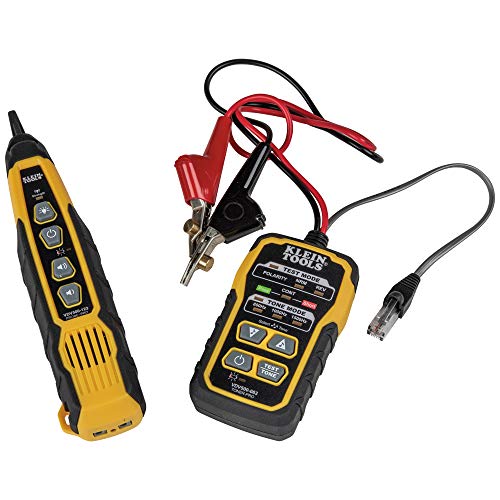
Klein Tools brings its legendary build quality to the VDV500-820, a professional-grade analog toner that punches above its price point. The Toner-Pro offers five distinct tone cadences — a crucial feature when you need to differentiate between cables in a bundle or distinguish your signal from ambient noise. It can transmit signals reliably beyond 1,000 feet on open-ended, non-energized wiring.
The rugged Angled Bed of Nails (ABN) clips provide a secure connection that stays put during tracing, and the RJ11 and RJ45 plugs let you tone pairs directly from wall jacks. The Probe-Pro includes a 3.5mm headphone jack for noisy environments and a durable non-metallic replaceable tip. Continuity and polarity testing LEDs are clearly labeled and easy to read in dim lighting.
At roughly half the price of the Fluke filtered kits, the Klein VDV500-820 is the smart buy for electricians and low-voltage installers who need reliable analog performance without digital bells and whistles. One reviewer cautioned that the unit cannot locate cables hidden behind drywall with no accessible end — it excels at exposed tracing and patch panel work. The included batteries are cheap; swap them for quality 9V cells before first use.
Why it’s great
- Five tone cadences prevent confusion in multi-cable bundles
- ABN clips provide stable, hands-free wire attachment
- Headphone jack enables quiet tracing in noisy server rooms
Good to know
- Cannot trace cables blindly behind solid drywall without an endpoint
- Included batteries are low-quality — replace immediately
4. TEMPO Communications 701K-G Wire Tracer

Tempo Communications has been manufacturing industry-standard test tools since 1984, and the 701K-G kit reflects that heritage. The 77HP-G tone generator and 200EP-G probe amplifier work together to deliver unrivalled accuracy for voice, data, video, and security alarm wiring. The LED tone proximity indicator on the probe glows brighter as you approach the correct pair — a subtle but powerful visual cue when audio alone is ambiguous.
The probe also includes an LED worklight for viewing behind furniture and inside dark racks. Distinct tracing warbling tones are engineered to pierce through noisy environments, making this kit effective even in active MDF rooms. The maximum operating voltage is 150V, giving you a wider safety margin than typical network-only toners. Included are modular plug, alligator test leads, RJ11/45 socket adaptor, and a sturdy nylon carrying case.
Users consistently praise its ability to trace wires through drywall and find broken circuits that other methods missed. One reviewer said it saved hundreds of dollars by avoiding an electrician callout. The 701K-G occupies a sweet spot: more capability than entry-level units but significantly less expensive than the top-tier Fluke kits. Great for general contractors and home inspectors.
Why it’s great
- LED proximity indicator gives visual confirmation of correct pair
- 150V max rating provides extra safety margin on unknown circuits
- Warbling tones cut through background noise in data closets
Good to know
- Requires some practice to interpret radio wave reflections
- No digital toning mode — analog only
5. TESMEN TLP-900AR Network Cable Tester
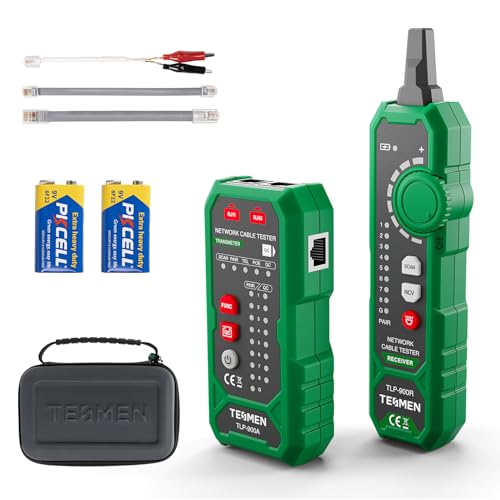
The TESMEN TLP-900AR packs an impressive feature set into an entry-to-mid-range price. Beyond standard cable tracing and pair testing for Cat5/Cat6/POE/shielded cables, the receiver includes a Non-Contact Voltage (NCV) detection function that identifies live wires and sockets before you touch them — a genuine safety feature for construction environments where you can’t always trust the breaker labeling.
The unit tests line sequence and continuity with a clear LED indicator, supports QC inspection of RJ45 crimps, and can detect telephone line polarity and identify standby, off-hook, and ringing states. The probe tip includes a worklight for dim crawl spaces, and the system auto-shuts down after 30 minutes of inactivity. The kit comes with RJ11 alligator clip adapter, two 9V batteries, and a molded storage box.
Build quality feels solid, and the adjustable sensitivity and volume on the receiver help when working with large cable bundles or long runs. One downside reported by multiple users: the built-in flashlight on the transmitter doesn’t work on some units, though the core tracing and testing features function flawlessly. For the price, the NCV alone makes this a compelling choice for semi-professional use.
Why it’s great
- NCV detection identifies live wires, improving safety on job sites
- Auto shutoff conserves battery during intermittent use
- Telephone line polarity and state detection for telecom work
Good to know
- Flashlight on some units may not function out of the box
- Instructions are minimal and not always clear
6. Mastfuyi FY869B Network Cable Tester
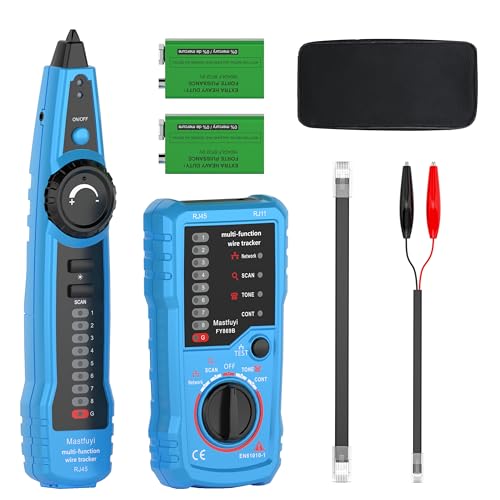
The Mastfuyi FY869B is a surprising contender at an entry-level price. It uses digital signal technology to trace RJ11 and RJ45 cables, and supports POE live cable tracing with up to 60V voltage resistance — meaning you can trace a cable while the switch is powered, which is a feature often missing from sub- kits. The included alligator clip adapter extends its utility to speaker wires and other metal conductors (with power disconnected).
Beyond tracing, the FY869B functions as a full network cable continuity tester. Pin-by-pin mapping detects open circuits, short circuits, wiring errors, and reversed polarity with clear LED indicators, supporting cable runs up to 30 meters. It can independently test telephone line status (idle/ringing/busy) and differentiate TIP from RING. The receiver has a backlit display and adjustable volume.
Users report it works well for tracing Ethernet in residential bundles and troubleshooting pre-made cables, though one noted the signal drops off on long runs. The instructions are printed in extremely small type and require careful reading — for example, the “Tone” dial setting is for phone line dial tone, not for coax; use “Scan” instead. For the budget-conscious home networker, this offers excellent value.
Why it’s great
- POE live tracing prevents downtime during cable identification
- Digital signal reduces false positives in noisy bundles
- Telephone line status detection adds telecom utility
Good to know
- Limited to 30-meter cable runs for full diagnostics
- Tiny instruction font makes setup unintuitive
7. VDIAGTOOL V210 Wire Tracer

The VDIAGTOOL V210 is purpose-built for automotive electrical diagnostics. Unlike network-focused toners, this unit is designed to trace open and short circuits on DC systems from 6 to 42 volts — perfect for finding broken wires in car harnesses, trailer wiring, and motorcycle looms. The transmitter and receiver each run on a 9V battery, and the receiver features a 7-inch flexible probe that reaches into tight engine bay spaces.
The receiver delivers both audible tone and LED indicators to locate circuit breakers, open connections, and current leaks. Sensitivity is adjustable via a knob, so you can dial in on a specific wire even when surrounded by other harnesses. The tool does not require stripping insulation to trace a signal, which saves time on already-frayed wiring. A built-in buzzer changes tone to help pinpoint exact fault locations.
At this entry-level price, the V210 is a fantastic entry point for DIY mechanics and small garage technicians. Master auto techs with decades of experience have praised its ability to quickly pinpoint alternator wire shorts to ground. The main caveats: no auto shut-off means it will drain batteries if left on, and the battery compartment is slightly undersized — some users needed to modify it slightly to fit standard 9V cells. For network cable tracing, look elsewhere; this is a DC-focused tool.
Why it’s great
- Designed specifically for automotive 6-42V DC circuits
- 7-inch flexible probe reaches tight engine bay spaces
- Adjustable sensitivity helps isolate wires in complex harnesses
Good to know
- No auto shut-off — batteries drain if left on
- Not suitable for network or high-voltage AC cable tracing
FAQ
Can a cable toner trace wires through drywall without an accessible endpoint?
Why does my cable toner pick up signal on every wire in the bundle?
Is a filtered probe worth the extra money for home network tracing?
Final Thoughts: The Verdict
For most users, the best cable toner winner is the Fluke Networks MT-8200-60-KIT IntelliTone Pro 200 because its digital toning mode eliminates false signals on active networks and its built-in pair tester handles two diagnostic steps in one tool. If you need extreme noise filtering and range for tracing near electrical lines, grab the Fluke Networks PRO3000F60-KIT. And for the best balance of professional build quality and price, nothing beats the Klein Tools VDV500-820.