
That white, crusty ring forming at your pool’s waterline isn’t just ugly—it’s a hard, stubborn layer of calcium carbonate that ordinary scrubbing barely touches. Left unchecked, it etches into tile grout and can even damage your salt cell or heater. The right chemical cuts through that crust without you having to scrape for hours.
I’m Min — the co-founder and writer behind Gadgets Feed. I’ve spent countless hours analyzing technical data sheets, cross-referencing chemical formulations, and reading hundreds of real-world user experiences to find which products actually dissolve calcium scale rather than just masking it.
Whether you manage a residential saltwater pool or a public hot tub, this guide breaks down the top contenders to help you find the best calcium remover for pool tiles that matches your specific water chemistry and maintenance routine.
How To Choose The Best Calcium Remover For Pool Tiles
Not all “scale removers” do the same job. Some are sequestering agents that hold calcium in suspension to prevent new scale—great for ongoing maintenance but useless on existing crust. Others are strong acids that dissolve calcium on contact. Here are the three factors that matter most for pool tile scale.
Acid Strength vs. Surface Safety
The two main active ingredients are phosphoric acid and sulfamic acid. Phosphoric acid is aggressive; it dissolves thick scale fast but can etch plaster, marble, or grout if left on too long. Sulfamic acid is gentler—slower acting, but safer for tile grout and pool liners. If your pool has a fiberglass or vinyl finish, opt for a sulfamic-based or chelant-based formula to avoid surface dulling.
Prevention Chemistry vs. Removal Chemistry
Sodium hexametaphosphate and other sequestering agents (found in products like BioGuard Scale Inhibitor) bind existing calcium in the water column so it doesn’t precipitate onto tile. These are excellent maintenance tools but do nothing for scale already caked on. For removal, look for the words “scale remover” or “descaler” on the label—these indicate an active acid that dissolves calcium carbonate on contact.
Concentration and Volume per Treatment
Read the dosage instructions carefully. A 32-ounce bottle treated at 2 ounces per week lasts four months for a standard hot tub, but for a full swimming pool you may need 8–16 ounces per application. Larger bottles like the 64-ounce EasyCare offer better value for high-use setups, while 1-quart sizes suit small spas and quarterly cleanings.
Quick Comparison
On smaller screens, swipe sideways to see the full table.
| Model | Category | Best For | Key Spec | Amazon |
|---|---|---|---|---|
| EasyCare BeauTec | Premium | Salt cell + heavy tile scale | 64 fl oz bottle; no-scrub formula | Amazon |
| In The Swim Super Stain Away | Mid-Range | Metal stain + scale combo | 32 fl oz; chelant-based sequester | Amazon |
| BioGuard Scale Inhibitor | Mid-Range | Ongoing scale prevention | 32 fl oz; concentrated formula | Amazon |
| ADIOS! Hard Water Clarifier | Value | Hot tub scale prevention | 32 fl oz; 2 oz per 800 gal/week | Amazon |
| Bio-Dex #300 Tile Cleaner | Value | Targeted waterline removal | 1 qt; apply on dry tile below water | Amazon |
| CLR Pro Calcium, Lime & Rust | Value | Rust + heavy calcium deposits | 1 gal; industrial strength acid | Amazon |
| Wipe Out All Purpose Cleaner | Budget | Light scum + body oil removal | 1 qt; spray-on surface cleaner | Amazon |
In‑Depth Reviews
1. EasyCare 22064 BeauTec Salt Cell and Tile Cleaner

The EasyCare BeauTec is the rare product that genuinely delivers on “no scrubbing required.” User reports describe a calcium ring around an entire pool disappearing within two days after dosing slightly above the recommended amount—with zero manual labor. The 64-ounce bottle is the largest in this roundup, translating to better value per treatment for full-sized pools.
Its dual-action purpose is what sets it apart: it acts as a salt cell descaler and a tile cleaner simultaneously. For saltwater pool owners, that means fewer manual cell cleanings and longer equipment life. Monthly application in high-rain climates like Houston keeps scale manageable, and filters stay easier to rinse. One reviewer noted it pays for itself in reduced labor and replacement parts.
The primary drawback is upfront cost—it’s the most expensive bottle here. Some long-time users feel the price has crept up over the years, but most agree the convenience of a no-scrub removal justifies the premium. It’s best suited for gunite, plaster, and salt-cell pools with moderate to heavy existing scale.
Why it’s great
- Requires no scrubbing; dissolves tile ring in 1–2 days
- 64 oz bottle offers best volume-per-dollar for large pools
- Protects and extends salt cell lifespan
Good to know
- Higher price point than smaller alternatives
- Effectiveness varies with water chemistry and scale thickness
2. In The Swim Super Stain Away

In The Swim Super Stain Away targets a specific pain point: pools with high iron or copper levels that produce both staining and scaling. The concentrated formula uses chelating chemistry to neutralize metals before they oxidize onto surfaces. Multiple users confirm it lifted brown staining on vinyl liners that resisted other products.
Unlike acid-based removers that dissolve calcium aggressively, this uses a sequestering mechanism—meaning it binds existing minerals in the water and helps fade scale gradually rather than stripping it instantly. It works best as a shock treatment after opening the pool or after a metal spike. For gunite pools, users note it should be applied sparingly to avoid over-chelating.
The limitation is clear: it’s not a heavy-duty scale dissolver for thick, established crust. Users with extreme mineral loads (e.g., well water) may find it insufficient on its own. It shines as part of a two-step regimen: use this to handle metal stains and prevent future scaling, then pair with a dedicated acid-based cleaner for existing tile deposits.
Why it’s great
- Excellent at lifting stubborn iron/copper stains on liners
- Gentle enough for vinyl and fiberglass surfaces
- Creates cloudiness that clears as minerals are removed
Good to know
- Does not dissolve thick, established calcium scale
- May require multiple applications for severe metal staining
3. BioGuard Scale Inhibitor

BioGuard’s Scale Inhibitor is the quintessential maintenance product for pools battling high calcium hardness. It uses a sequesterant polymer that prevents calcium and magnesium from precipitating out of solution, keeping them suspended until the filter catches them. Users on well water report it as a “must have” to keep scaling under control.
What makes it valuable is its compatibility with all pool types—saltwater, chlorine, bromine, and even hot tubs. One reviewer noted visible calcium chips appearing in the vacuum after a few weeks, indicating that the product was slowly releasing existing scale from plumbing and surfaces. It also reduces how often the salt cell needs manual descaling.
It’s not a remover—it’s a preventer. If you already have a thick crust around your tiles, this will not dissolve it. A few users also report that it can affect pH and ORP readings if overdosed, so careful metering is required. Best used preventatively from the start of the season rather than as a rescue product.
Why it’s great
- Effectively prevents new scale formation in high-hardness water
- Reduces manual salt cell cleaning frequency
- Works across all pool types (salt, chlorine, bromine)
Good to know
- Will not remove existing thick calcium deposits
- May alter pH/ORP if not dosed precisely
4. ADIOS! Hot Tub Hard Water Calcium Remover

ADIOS! is specifically formulated for hot tubs—a different beast from swimming pools. Hot tubs have smaller water volumes (typically 200–800 gallons), higher temperatures that accelerate scaling, and more frequent bather loads that introduce oils. This clarifier uses a polymer-based approach to dissolve problematic minerals and help the filter catch them.
Customer results are striking: one user reported a 90% reduction in hard water deposits from a hot tub without draining, simply by adding the clarifier alongside chlorine. A user in the desert Southwest with “extremely hard water” applied it three times and saw the water turn crystal clear. The dosage is economical—2 ounces treats 800 gallons for a week, meaning a 32-ounce bottle covers nearly four months.
There are two caveats. First, it is not compatible with bromide tablets—using them together causes cloudiness. Second, several users note it does not technically lower water hardness or calcium ppm; it only prevents minerals from depositing as scale. If you need actual calcium removal from the water, this is not the product. It’s a clarifier and scale preventer, not a hard water remover in the chemical sense.
Why it’s great
- Highly effective at clearing cloudy hard water in hot tubs
- Low dosage (2 oz per 800 gal) extends bottle life to 4 months
- No strong odor and easy to use
Good to know
- Incompatible with bromide sanitizing tablets
- Does not actually remove calcium; only prevents scaling
5. Bio-Dex #300 Tile Cleaner

Bio-Dex #300 is a professional-strength tile cleaner that relies on sulfamic acid chemistry to break down calcium deposits. Its key application method sets it apart: you apply it directly onto dry tile below the water line, let it sit briefly to react with the scale, and then scrub with a nylon brush before rinsing immediately.
This is a hands-on product requiring physical effort, but for neglected saltwater pools with thick deposits, it delivers results that spray-and-forget products cannot. Multiple reviews confirm it effectively removes calcium, though it takes several applications and persistent scrubbing for heavy buildup. The manufacturer explicitly recommends a small test patch first to determine the ideal contact time for your specific tile type.
The downsides are significant: it can discolor or etch concrete and plaster if left on too long, so it’s not for unattended treatment. Some users report it failed to remove the scale they expected despite following directions. It’s best reserved for determined DIY owners who don’t mind wearing gloves and scrubbing—not for those seeking a set-it-and-forget solution.
Why it’s great
- Professional-grade sulfamic acid formula for stubborn deposits
- Can be applied directly to dry tile for targeted treatment
- Works well when used consistently as part of a maintenance routine
Good to know
- Requires scrubbing and multiple applications for heavy scale
- Can etch concrete/plaster if contact time is too long
6. CLR Pro Calcium, Lime & Rust Remover
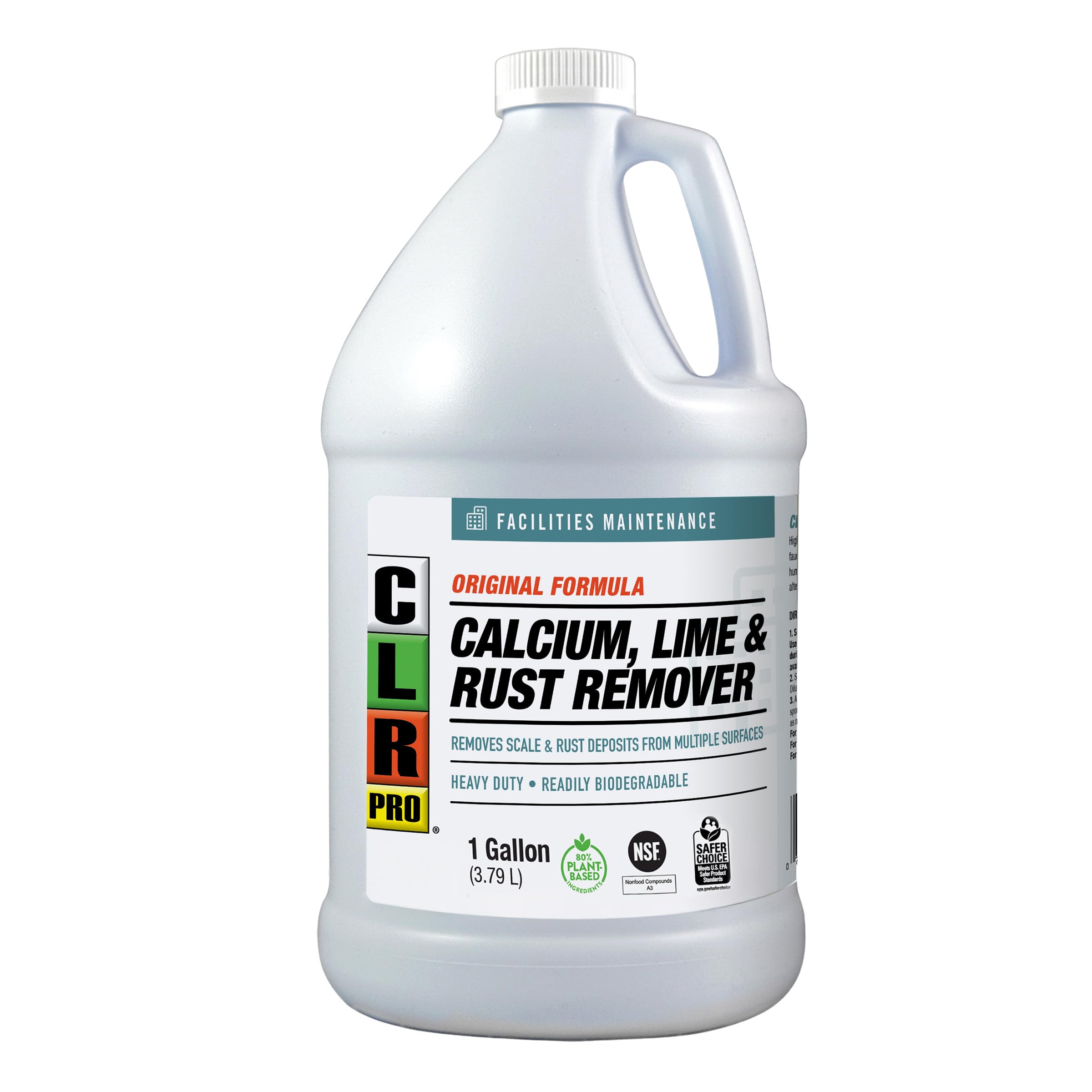
CLR Pro is a household name, but its industrial gallon size is what makes it relevant for pool tile work. The active acid formula is aggressive on calcium carbonate, lime scale, and rust stains. Users have used it to restore slow-draining toilets to full flush after overnight soaks and to clear shower pipe blockages that resisted vinegar.
For pool tile specifically, CLR works best on removable parts (like salt cell assemblies or pump baskets) that can be soaked separately. Submerge the part in a plastic bucket with undiluted CLR for 5–15 minutes—any longer risks etching. The gallon size provides enough volume for multiple soak sessions. It is EPA Safer Choice certified, meaning no phosphates, ammonia, or bleach.
Do not apply CLR directly to pool tile in situ without protecting surrounding surfaces. The acid can damage pool plaster and grout if not rinsed thoroughly. Strong ventilation, gloves, and eye protection are non-negotiable. It’s a powerful tool for specific tasks but too harsh for routine tile cleaning, and the 5-minute maximum contact time limits its effectiveness on very thick scale.
Why it’s great
- Fast-acting industrial strength on calcium and rust deposits
- Gallon size provides excellent volume for soaking equipment
- EPA Safer Choice certified, no bleach or phosphates
Good to know
- Acidic formula can etch pool plaster, grout, and finishes
- Maximum safe contact time is only 5 minutes
7. Wipe Out All Purpose Surface Cleaner

Wipe Out is not a calcium remover in the chemical-dissolution sense—it’s a surfactant-based cleaner designed to break down body oils, sunscreen film, and light scum before they bake into scale. For pools with a thin oily ring rather than a hard white crust, Wipe Out is remarkably effective. Users report spraying it on section by section, scrubbing with a Scotch-Brite pad, and rinsing away grime that had accumulated over 12+ years.
Its real strength is speed: one reviewer cleaned an entire 18×36-foot inground vinyl liner pool in about 45 minutes. The formula has minimal odor and doesn’t require the protective gear that acid cleaners demand. It’s also safe for multiple surfaces including vinyl, fiberglass, tile, and concrete.
The limitation is clear: it has zero effect on actual calcium scale. Users with thick white deposits at the waterline find it disappointing. It will leave some bubbles that need to be shocked out afterward. This is an excellent “first pass” product for removing the organic layer that often sits on top of scale, but it cannot replace a dedicated acid or chelant-based remover for hard mineral deposits.
Why it’s great
- Quickly removes sunscreen, body oils, and organic scum
- Safe for vinyl, fiberglass, tile, and concrete surfaces
- Low odor; no acid or harsh chemical precautions needed
Good to know
- Will not dissolve hard calcium or lime scale
- Leaves residual bubbles that require shocking post-treatment
FAQ
Can I use a calcium remover on pool tile without draining the pool?
Will a calcium remover damage my salt chlorine generator cell?
How often should I apply a scale remover to prevent buildup?
Final Thoughts: The Verdict
For most users, the best calcium remover for pool tiles winner is the EasyCare BeauTec Salt Cell and Tile Cleaner because it offers the only true no-scrub solution that dissolves existing scale while protecting equipment. If you need a powerful preventer for well water with high mineral content, grab the BioGuard Scale Inhibitor. And for hot tub owners who want crystal-clear water without draining, nothing beats the ADIOS! Hard Water Clarifier.