
A single smudge on your front element or a stubborn dust speck on your sensor can mean the difference between a sharp, sellable image and hours of frustrating clone-stamp work in post. The wrong swipe—using a dirty cloth, an abrasive household cleaner, or just a dry tissue—can permanently etch an anti-reflective coating or push debris deeper into your mirrorless body’s sensor cavity. Protecting thousands of dollars in glass starts with one decision: the right cleaning tools on hand before you need them.
I’m Min — the co-founder and writer behind Gadgets Feed. I’ve spent countless hours dissecting the chemical formulations, swab weave densities, and blower nozzle designs that separate a safe clean from a costly mistake, so you don’t have to guess which kit protects your gear.
Whether you shoot full-frame landscapes, crop-sensor street photography, or medium-format commercial work, finding the best camera cleaning kit means balancing tool completeness against sensor-safe materials and portability for field use.
How To Choose The Best Camera Cleaning Kit
Not every tool inside a cleaning kit is made equal. The wrong blower can kick dust *into* your mirror box; the wrong swab width can leave a stripe of residue across your sensor. Here’s what separates a kit that protects your investment from one that creates more problems.
Sensor Compatibility: Swab Width is Everything
The single most critical spec in any cleaning kit is the width of its sensor swabs. A 24mm swab is engineered for full-frame (35mm) sensors, while APS-C sensors typically require a 16mm swab to avoid the edges smearing debris against the interior baffles. Medium format cameras call for 33mm swabs. Using the wrong size guarantees a partial clean at best—and a scratched sensor baffle at worst. Always confirm your camera model’s sensor format before ordering.
Solution Chemistry: Alcohol-Free, Ammonia-Free
Many household glass cleaners contain ammonia or high-concentration isopropyl alcohol, both of which can strip the delicate multi-coating applied to modern camera lenses and sensor cover glass. A proper camera cleaning solution uses purified water, mild surfactants, or low-VOC organic solvents that evaporate without residue. Any kit that doesn’t explicitly state “ammonia-free” or “alcohol-free” on its cleaner should be treated with suspicion.
Workflow Completeness: The Multi-Step Process
A professional clean follows a strict sequence: blow loose dust off with the air blower, brush away stubborn particles with the lens pen’s filament side, apply solution to the microfiber cloth (never directly to the lens), then finish with the carbon tip of the pen for finger oils. A kit that skips any of these tools—particularly the blower or the dual-tip pen—forces you to buy them separately, defeating the purpose of an all-in-one solution.
Quick Comparison
On smaller screens, swipe sideways to see the full table.
| Model | Category | Best For | Key Spec | Amazon |
|---|---|---|---|---|
| Altura Photo Cleaning Kit | Mid-Range | Full-frame sensor deep clean | 24mm swabs (6-pack) + 2oz all-natural solution | Amazon |
| K&F CONCEPT 25-1 Kit | Mid-Range | Most comprehensive tool count | 25-piece set with 60ml + 20ml dual solutions | Amazon |
| VSGO DKL-15D | Mid-Range | Portable everyday carry | 30ml cleaner + 5 microfiber cloths in hard case | Amazon |
| llano 7-in-1 Kit | Mid-Range | Nano-carbon pen precision cleaning | 60ml solution + 8 swabs + nano-carbon pen | Amazon |
| VSGO DKL-20F | Premium | Dual cleaner (lens + sensor) kit | 6x 24mm swabs + 30ml lens + 15ml sensor cleaner | Amazon |
| SPUDZ Ultra Variety Pack | Budget | Quick lens wipe on the go | 5x 6″ microfiber cloths with neoprene pouches | Amazon |
| PhotoSol Sensor Swab Ultra 33mm | Premium | Medium format sensor cleaning | 12x 33mm cleanroom-sealed swabs | Amazon |
In‑Depth Reviews
1. Altura Photo Camera Cleaning Kit

The Altura kit earns the top spot because it delivers the two essential sensor-cleaning components—factory-sealed 24mm swabs and a 60ml all-natural, ammonia-free cleaning solution—inside a hard-shell case that fits any camera bag without adding bulk. The solution’s plant-based formulation neutralizes static charge on the sensor cover glass, meaning fewer dust specks resettle immediately after your swipe. At the liquid volume, you can wet-clean a full-frame sensor a dozen times before needing a refill.
The tool selection here is lean but complete: six vacuum-sealed swabs, a dual-tip lens pen, a squeeze blower, a horsehair brush, fifty sheets of lens tissue, and two microfiber cloths. The absence of a dedicated sensor cleaner bottle is notable, but the all-natural solution performs equally well on lens glass and sensor surfaces. Astro and wildlife shooters particularly praise the cloths for leaving zero lint on telescope eyepieces and telephoto front elements.
Several users have reported the case zipper failing after a few months of daily carry. While the tools themselves hold up, the bag is clearly the weakest link. If you are expecting a bombproof Pelican-style case, you will be disappointed—this is a soft zip shell better suited for stationary storage than being tossed loose into a full backpack. Keep the kit inside a padded divider and the zipper fatigue is a non-issue.
Why it’s great
- All-natural solution is safe for coated lenses and sensor glass.
- Six factory-sealed 24mm swabs give you multiple deep-cleaning sessions.
- Hard case organizes every tool neatly in a camera bag without rattling.
Good to know
- Case zipper is prone to failure under heavy daily use.
- No dedicated sensor cleaning fluid: the all-in-one solution does double duty.
- Swabs are only compatible with full-frame sensors; APS-C shooters need the separate 16mm kit.
2. K&F CONCEPT 25-1 Professional Camera Cleaning Kit
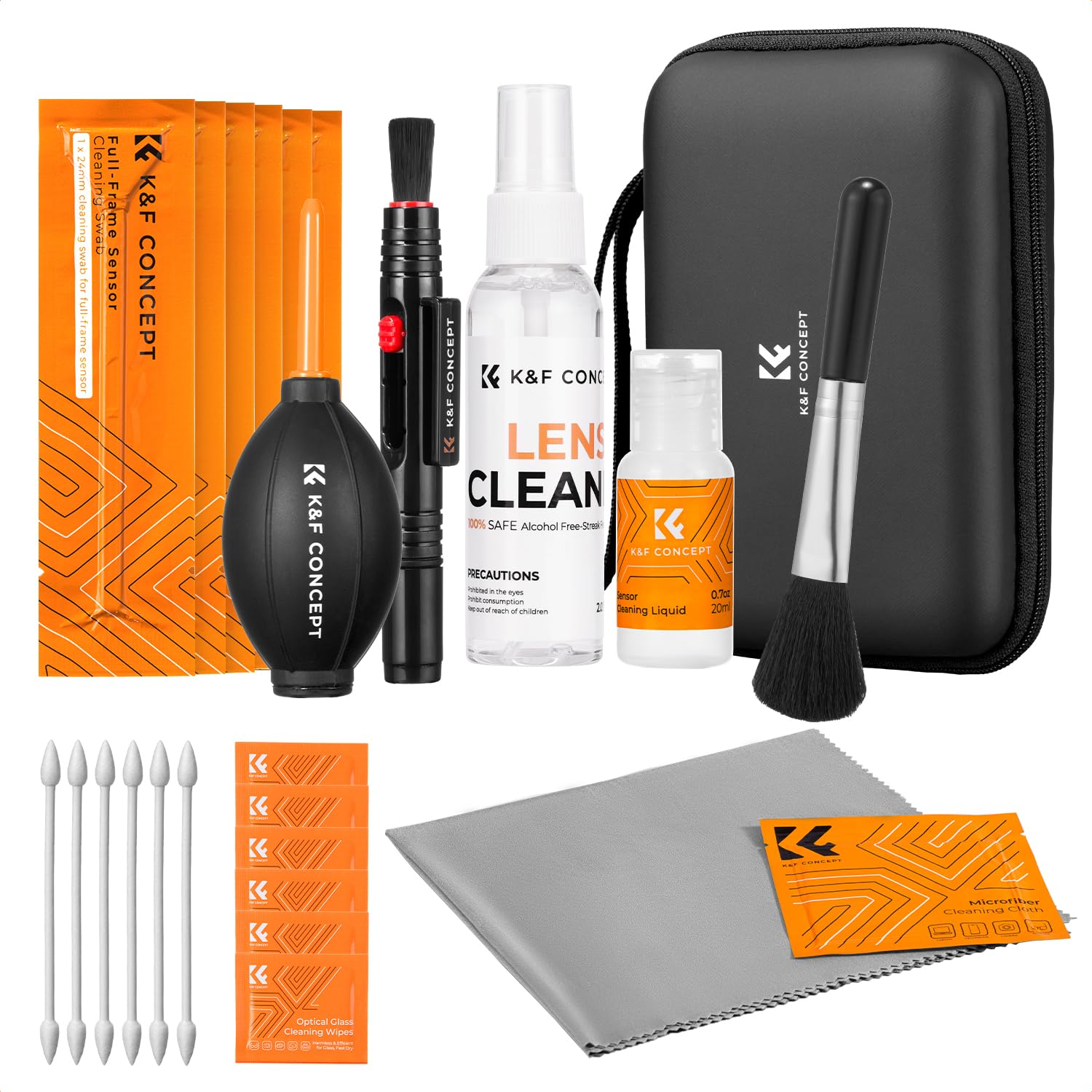
K&F CONCEPT’s 25-1 kit is the quantity crown jewel of this comparison, packing everything from six 24mm full-frame sensor swabs and six cotton swabs to two separate cleaning solutions—a 60ml bottle for general optics and a 20ml bottle labeled specifically for sensor cleaning. This dual-volume approach lets you use the smaller sensor cleaner only for the CMOS, saving the larger bottle for lens front elements and eyepieces. The inclusion of a vacuum pump head on the sensor cleaner bottle helps dispense a controlled drop without over-wetting the swab.
The air blower is a standard squeeze bulb with a decent reach, and the lens cleaning pen offers the expected carbon tip plus retractable brush. The two microfiber cloths (36cm and 15cm) give you one dedicated to sensor work and one for body/bodywork. Users report the kit successfully removed a fingerprint from inside a Canon RP’s sensor assembly, a repair a shop quoted at —a strong testimonial for the 20ml sensor solution’s wet-cleaning ability.
The carrying case is the most common complaint: after unpacking all 25 pieces, the storage bag is too tight to zip closed easily. You either have to leave some supplies in a separate drawer or buy a larger case. The loose organization also means items like the cotton swabs can scatter inside the bag. If you prioritize neat, always-ready storage, the Altura or VSGO hard cases offer a more secure fit.
Why it’s great
- Includes both a 60ml general cleaner and a dedicated 20ml sensor solution.
- Full-frame 24mm swabs and cotton swabs cover large and fine detail work.
- Two-year warranty provides peace of mind for the investment.
Good to know
- Storage case is too small to close after removing all items.
- Blower is basic; no high-force rocket-style nozzle.
- Not ideal for APS-C sensors: only 24mm swabs are included.
3. VSGO Professional Lens Cleaning Kit (DKL-15D)

VSGO’s DKL-15D is the kit you grab when you need to sling it into a side pocket and forget it exists until a rogue rain splash hits your UV filter. The hard plastic storage case is compact enough to slip into the accessory pouch of most Mirrorless sling bags, yet holds a dual-tip lens pen, a 30ml spray cleaner, a mini air blower, five 10x10cm microfiber cloths, a large 11.5x15cm blue screen cloth, and ten wet wipes. The blue screen cloth is a nice touch for cleaning the LCD without scratching the display coating.
The mini air blower is notably smaller than a standard rocket blower, but its size is deliberate: it fits inside the case without disassembly. It generates enough force to dislodge dust from a hot-shoe or zoom ring crevice, but don’t expect it to blast heavy grit off a sensor stack. The pen’s activated carbon tip handled fingerprint grease effectively during tests on a 70-200mm front element, and the filament brush cleaned the knurled focus ring without shedding bristles.
The most obvious omission is the lack of dedicated sensor swabs. This kit is built for lens bodies, filters, and the camera exterior—not for wet-cleaning the CMOS directly. If you only ever change lenses in a dust-free studio, that is fine. But field shooters who need sensor access on location will have to buy swabs separately. The 30ml solution is alcohol-free and safe for coatings, but users should double-check the ingredient list if they plan to use it on the sensor glass.
Why it’s great
- Hard case is genuinely pocketable for sling bags and vest pouches.
- Ten wet wipes included: chemical pre-moistened for quick field swipes.
- Large 15cm screen cloth works well on tablet and phone displays.
Good to know
- No sensor swabs: this is a lens-and-body-only kit.
- Mini blower is weaker than full-size rocket blowers.
- 30ml bottle runs out faster than larger kits with 60ml.
4. llano 7-in-1 Camera Lens Cleaning Kit
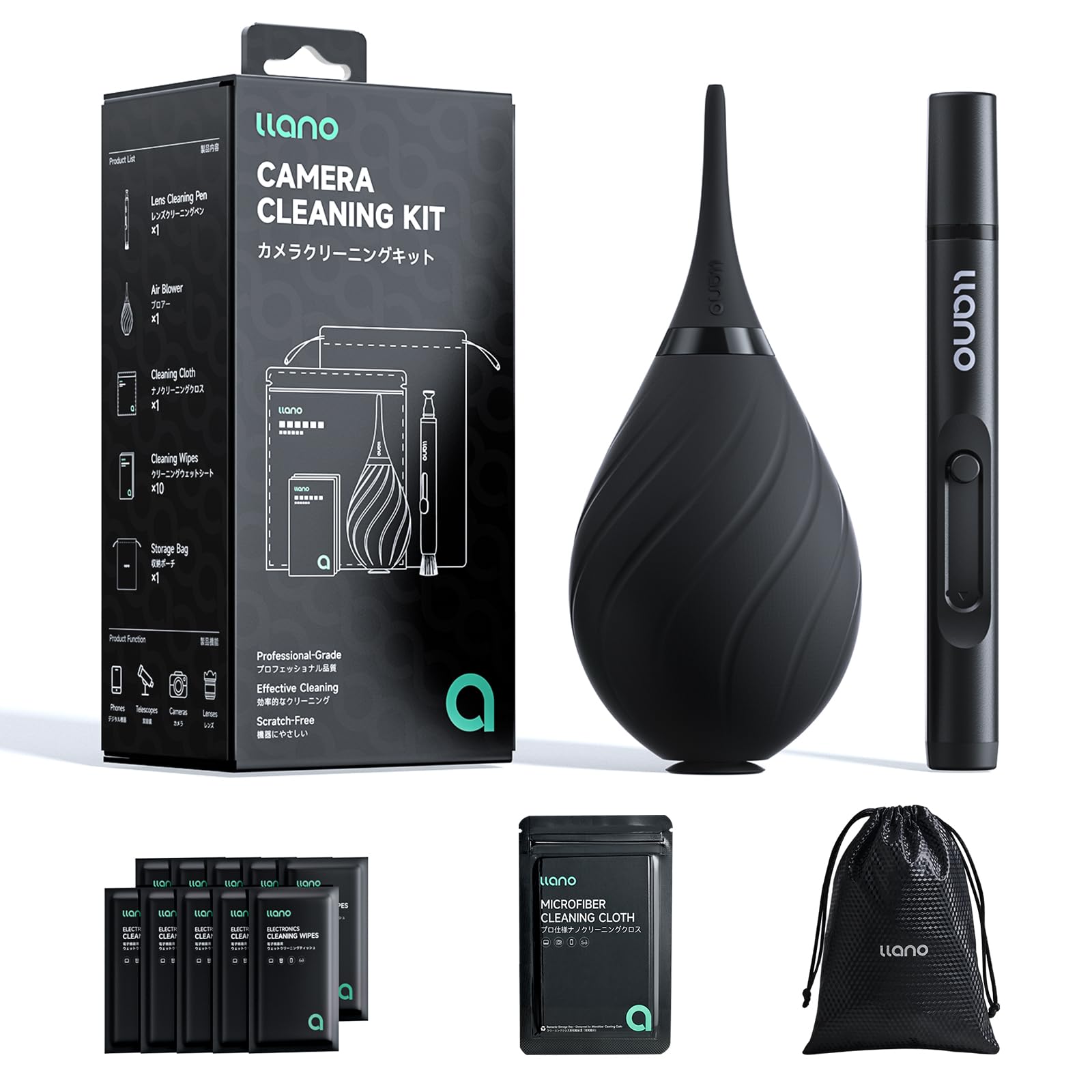
The llano 7-in-1 kit differentiates itself with a nano-carbon lens pen that uses molecular adhesion technology to lift 99.8% of particles from optical glass without scratching. The pen’s carbon tip is noticeably softer than standard rubberized tips, reducing the risk of embedding grit into the lens coating. The kit also includes a 60ml cleaning solution, three nano-fiber cloths, ten wet wipes, eight cotton swabs, a silicone air blower, and a drawstring storage bag—making it the second most tool-dense kit after the K&F CONCEPT.
The silicone air blower features an integrated slender nozzle design that minimizes the friction contact area when inserted into tight crevices like the gap around a mirrorless mount or between a lens hood and front element. The nozzle does not have a one-way valve, so you must keep the blower pointed upward during storage to prevent dust from settling back inside. The nano-fiber cloths have a capillary-channel weave that wicks oil rather than smearing it, which means fewer passes to achieve a streak-free finish.
Several users note that the wet wipes are alcohol-based and dry out quickly, so they are best used on hard surfaces like filter threads or the camera body rather than on coated glass. The drawstring bag is a tight fit for all seven components, and the lack of a hard case means the bottle and the blower can knock against each other inside a bag. For the price per tool count, it is a balanced value, but serious travelers may want a hard-shell alternative.
Why it’s great
- Nano-carbon pen removes prints without spreading grease.
- Generous 60ml solution volume for long-term use.
- Three nano-fiber cloths provide backup spares.
Good to know
- Wet wipes are alcohol-based and dry quickly.
- No hard case: drawstring bag offers minimal protection.
- Blower lacks a one-way valve for dust-free storage.
5. VSGO All-in-One Camera Cleaning Kit (DKL-20F)

The VSGO DKL-20F splits cleaning fluids into two specialized bottles: a 30ml lens cleaner for front and rear elements, and a 15ml sensor cleaner for the CMOS. This separation matters because sensor cleaner formulations are typically lower in surfactants to avoid leaving residue on the imaging array, while lens cleaners can handle heavier grease. The kit also includes six 24mm full-frame sensor swabs, a dual-tip lens pen, and a mini air blower, all packed in a hard carrying case.
During a real-world test on a Fujifilm X-H2S (APS-C sensor—the 24mm swab technically overhangs, but careful use on the sensor cavity still worked), the sensor cleaner removed a grease dot that had been visible in test exposures at f/16. The swabs are lint-free and the same quality as the standalone VSGO swabs sold separately. The lens pen’s carbon tip is identical to the one in the DKL-15D, offering consistent fingerprint removal performance.
The biggest limitation is the 15ml sensor cleaner bottle, which is small enough to disappear inside a camera bag pocket. Users who wet-clean their sensor frequently may find themselves reordering the solution sooner than they would with larger bottles. The mini air blower, while portable, lacks the volume of air needed for heavy dust dislodgment on large-diameter telephoto lenses. This kit is a solid middle ground for photographers who want one case but also want the chemical separation of lens vs. sensor cleaning.
Why it’s great
- Separate sensor and lens cleaning solutions prevent cross-contamination.
- Six 24mm full-frame swabs included for multiple wet cleans.
- Hard case keeps both bottles upright and organized.
Good to know
- 15ml sensor cleaner bottle will run out quickly for frequent cleaners.
- Blower is a mini version; not as powerful as full-size rocket blowers.
- Swabs are full-frame size; not compatible with APS-C out of the box.
6. SPUDZ Ultra Variety Pack (5-Pack)
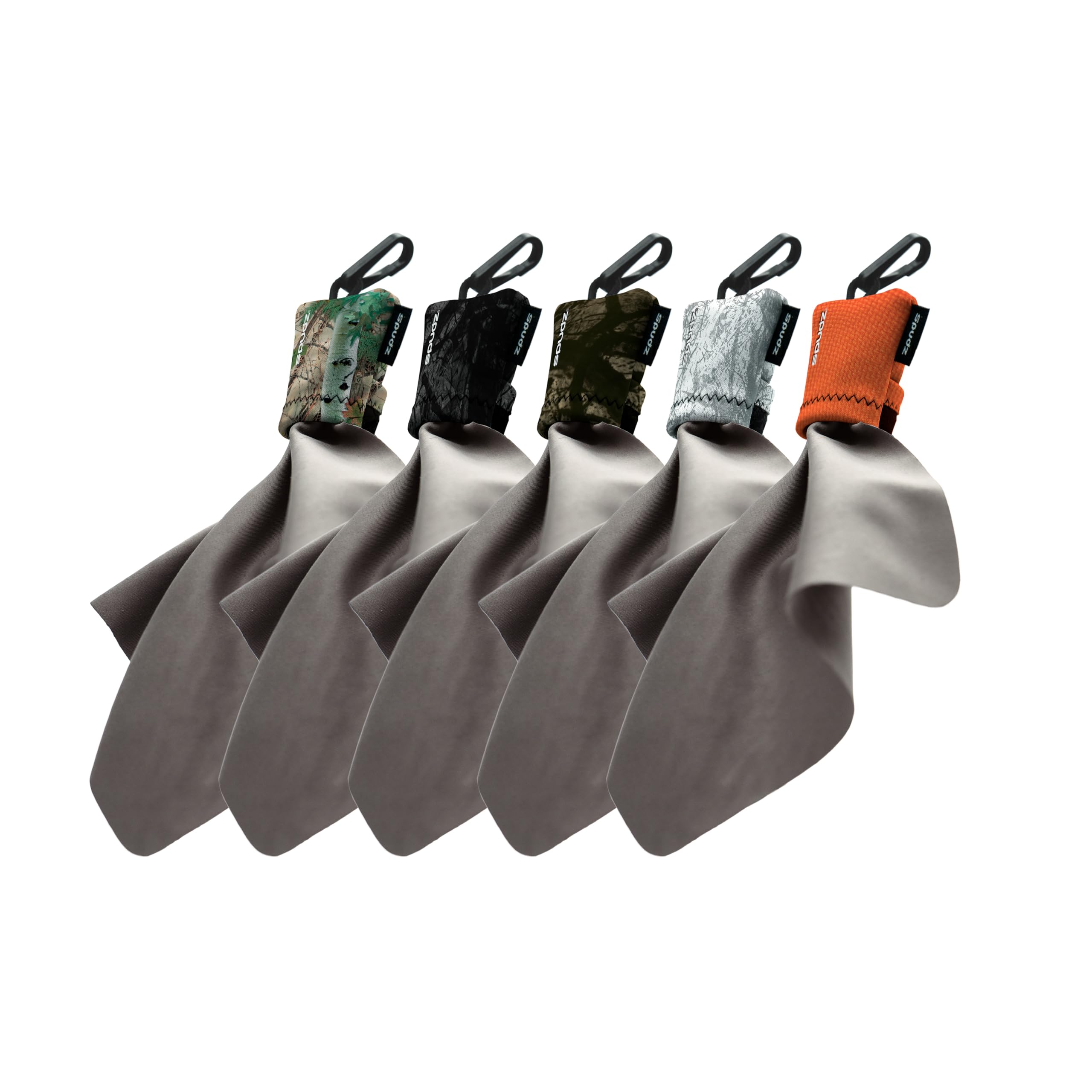
SPUDZ takes a radically different approach: rather than a full tool kit, you get five 6×6-inch premium microfiber cloths, each housed in a neoprene pouch with an integrated plastic clip. The cloth is permanently attached to the interior of the pouch, so you cannot lose the cloth. A simple tug pulls the fabric out for a quick wipe, and the pouch closes with a Velcro flap. This design is ideal for hunters, birders, and hikers who need to clean a binocular eyepiece or telephoto lens without stopping to open a zipper case.
The microfiber material is machine-washable, which matters because field cloths inevitably accumulate grit and salt over time. The neoprene sleeve acts as a barrier that prevents the cloth from picking up pocket lint or dust between uses. The plastic clip is strong enough to attach to a backpack shoulder strap, a belt loop, or the harness of a pair of binoculars, keeping it within a two-second reach during a hike or shoot.
This is not a sensor cleaning kit by any definition—there are no swabs, no solution, no blower. If you need to remove dust from your camera body or lens glass, the SPUDZ cloths can handle surface smudges and light dust, but they cannot replace the wet-cleaning workflow for stubborn sensor spots. The 6-inch size is small enough for a pocket but too small for a full-sensor pass if you were to repurpose it as a cleaning cloth. The colors in the “Outdoor” variety pack lean heavily toward red and pink, so buyers looking for camo or neutral earth tones should check individual color options.
Why it’s great
- Clip-on pouch keeps the cloth accessible, not buried in a bag.
- Machine-washable microfiber lasts through many cleaning cycles.
- Neoprene sleeve protects cloth from pocket debris between uses.
Good to know
- No swabs, solution, or blower: this is a cloth-only accessory.
- 6-inch cloth is too small for full sensor cleaning passes.
- Color palette may not appeal to users wanting subdued earth tones.
7. Photographic Solutions Sensor Swab Ultra 33mm (12-Pack)
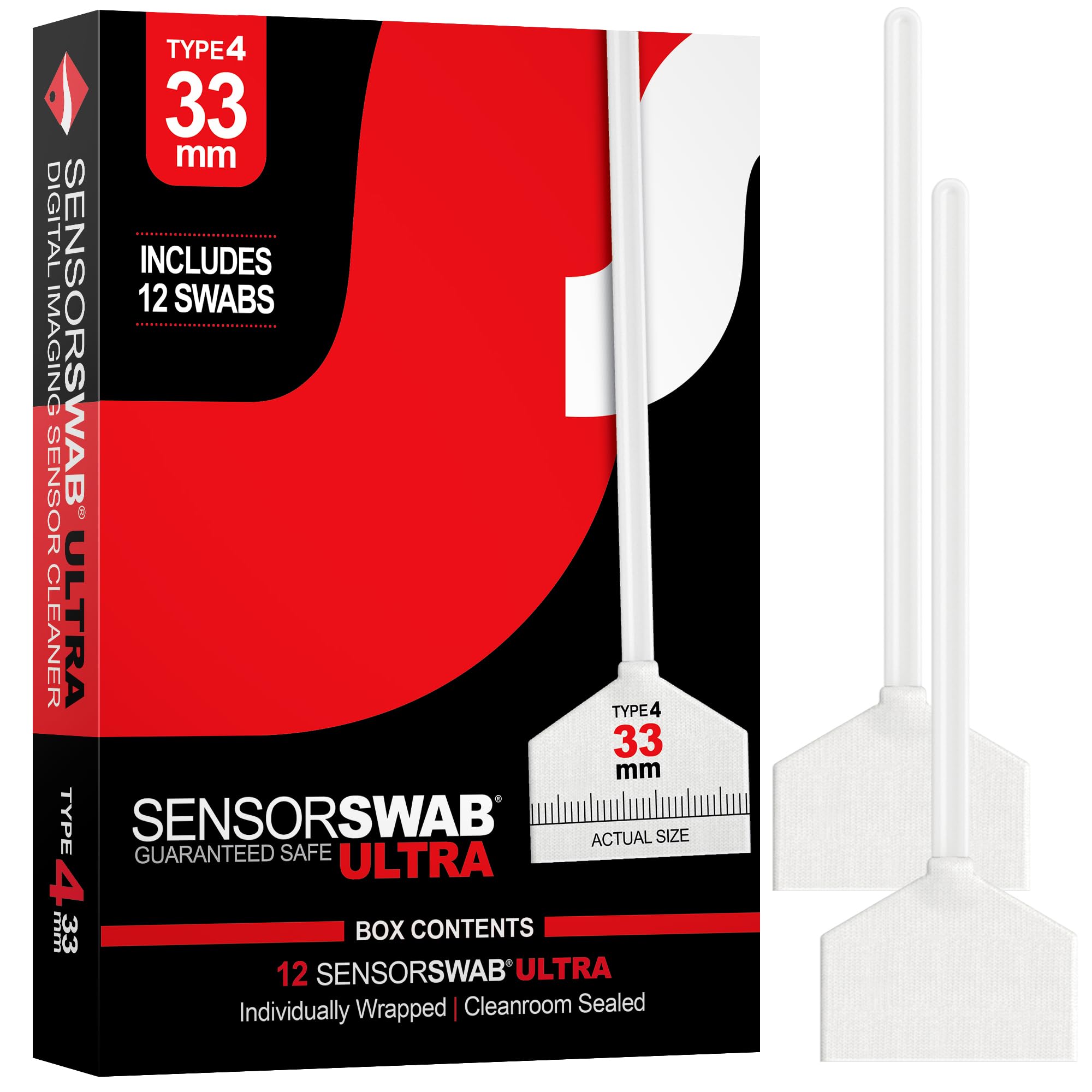
Photographic Solutions’ Sensor Swab Ultra 33mm is the professional-grade choice for medium-format photographers shooting cameras like the Fujifilm GFX series, Hasselblad X1D, or Pentax 645Z. The 33mm width correctly spans the full medium-format sensor without forcing you to make multiple overlapping passes that create streak lines. The swab features a textured honeycomb weave that traps dust and oil particles instead of pushing them to the edges, and the welded seams prevent the microfiber fabric from coming loose inside the camera.
Each swab is individually sealed in a cleanroom environment, which is critical for sensor cleaning: airborne dust can settle on a swab within seconds of opening the wrapper, so the factory-sealed packaging ensures the pick-up surface is truly sterile when you break the seal. The handle has a slight “horn” shape at each end that helps you reach the corners between the sensor and the baffle—a common trouble spot where dust accumulates. Users report effective removal of stubborn oil spots that required multiple passes with other swabs, using Eclipse or Aeroclipse cleaning fluid.
The price per swab works out to roughly three dollars each at the pack level, which is a premium over multi-tool kits that include a few swabs as throw-ins. But for working professionals who cannot tolerate any risk of scratching a medium-format sensor—where a replacement costs thousands—the cleanroom quality and consistent weave density justify the cost, and many report it beats Canon’s own cleaning service for simplicity and on-the-spot convenience.
Why it’s great
- 33mm width is specifically designed for medium-format sensors.
- Cleanroom-sealed packaging prevents pre-contamination.
- Textured honeycomb weave traps oil and dust effectively.
Good to know
- You must buy cleaning fluid separately; none is included.
- Not compatible with full-frame or APS-C sensors.
- Higher per-swab cost than swabs bundled in multi-tool kits.
FAQ
Can I use a camera cleaning kit on my phone or tablet screen?
How often should I wet-clean my camera sensor?
What does “factory-sealed” mean for sensor swabs?
Final Thoughts: The Verdict
For most photographers, the best camera cleaning kit is the Altura Photo Camera Cleaning Kit because it combines factory-sealed 24mm swabs, an all-natural cleaning solution, and a comprehensive tool set in a portable hard case that handles full-frame sensor cleaning straight out of the box. If you need the most tools for your money to cover lenses, bodies, and sensors simultaneously, grab the K&F CONCEPT 25-1 Kit. And for medium-format shooters who demand cleanroom purity on a larger sensor, nothing beats the Photographic Solutions Sensor Swab Ultra 33mm 12-Pack.