
Choosing a professional-grade camera body is the single most consequential gear decision a working photographer will make. The sensor size determines your depth-of-field latitude and low-light ceiling, the autofocus system dictates whether you nail the decisive moment or come home with soft misses, and the file format and bit-depth pipeline define how much latitude you have in post-production. Every spec on this list — from stacked CMOS architecture to native ISO ranges and phase-detection point counts — translates directly into whether that wedding, commercial editorial, or wildlife assignment earns its delivery fee.
I’m Min — the co-founder and writer behind Gadgets Feed. I have spent hundreds of hours breaking down MTF charts, sensor readout speeds, and real-world image processor behavior to separate genuine professional tools from bodies that only look the part on paper.
This guide exists to help you identify the body that matches your actual workflow, whether you shoot studio portraiture, action sports, or high-stakes event coverage — without paying for specs you do not need. These are the most capable options available today in the camera for professional photography space.
How To Choose The Best Camera For Professional Photography
The body you select defines your ceiling. You can upgrade lenses, lighting, and grip gear, but the sensor, processor, and autofocus platform are locked in. The following criteria are the non-negotiable filters that separate pro tools from enthusiast bodies.
Sensor Format and Resolution
Full-frame (35.6×23.8mm) is the standard for professional work because it balances light-gathering area with lens ecosystem availability. Medium format sensors like the 44×33mm chip offer higher native resolution and smoother tonal transitions but sacrifice burst speed and lens selection. For most commercial and editorial workflows, a 24MP to 45MP full-frame sensor provides the resolution headroom for large prints and heavy cropping without bogging down storage and buffer performance.
Autofocus System Depth
Phase-detection coverage percentage and subject-recognition algorithms are the real differentiators. A 693-point or 1,053-point system with deep-learning-based animal, vehicle, and eye tracking delivers a significantly higher keeper rate in unpredictable scenarios like sports or event photojournalism. The AF system must operate reliably down to -5 EV or lower for mixed-lighting environments.
Continuous Shooting and Buffer Depth
For action and wildlife, a mechanical shutter rate of 10 fps minimum with a buffer capable of storing 100+ raw frames is essential. Electronic shutters at 20 fps or higher add silent shooting capability but introduce rolling-shutter artifacts unless the sensor uses a stacked architecture with high readout speed.
Video Capability as a Professional Floor
Even if you primarily shoot stills, modern professional cameras must deliver 4K 10-bit 4:2:2 internal recording without overheating and with reliable autofocus. This hybrid capability makes the body usable for B-roll capture, commercial video work, and multi-day productions where the camera must serve double duty.
Quick Comparison
On smaller screens, swipe sideways to see the full table.
| Model | Category | Best For | Key Spec | Amazon |
|---|---|---|---|---|
| Sony a7 III | Mid-Range | Best Overall Value | 24.2MP BSI Sensor, 693 AF Points | Amazon |
| Nikon D850 | Premium | High-Resolution Studio Work | 45.7MP BSI Sensor, 153 AF Points | Amazon |
| Canon EOS R6 Mark II | Mid-Range | Action and Event Photography | 24.2MP, 40fps e-shutter, Dual Pixel AF II | Amazon |
| Sony Alpha 7 IV | Mid-Range | Hybrid Stills/Video | 33MP, 4K 60p 10-bit 4:2:2 | Amazon |
| Nikon Z 8 | Premium | Pro Hybrid Production | 45.7MP Stacked, 8K/60p N-RAW | Amazon |
| Canon EOS R5 | Premium | 8K & Ultimate Resolution | 45MP, 8K RAW, Dual Pixel AF II | Amazon |
| Panasonic LUMIX S5II | Mid-Range | Video-First Hybrid Workflows | 24.2MP, Phase Hybrid AF, Open Gate | Amazon |
| Panasonic LUMIX S1II | Premium | Pro-Level Hybrid Cine Workflow | 24.1MP Stacked, 30fps Burst, 6K Open Gate | Amazon |
| Nikon D500 | Mid-Range | DX Action & Wildlife | 20.9MP, 153pt AF, 10fps, 200-frame Buffer | Amazon |
| Sony a6400 | Budget | Entry-Level Pro Learning Tool | 24.2MP APS-C, 0.02s AF, 425pt | Amazon |
| Nikon D7500 | Budget | Reliable DSLR Workhorse | 20.9MP, 51pt AF, 8fps, 4K UHD | Amazon |
| OM SYSTEM OM-3 | Premium | Weather-Sealed Travel & Macro | 20MP Stacked MFT, IP53, 5-Axis IBIS | Amazon |
| Fujifilm GFX100S II | Premium | Ultra-Resolution & Medium Format | 102MP CMOS II, 8-Stop IBIS, 5.76M-Dot EVF | Amazon |
In-Depth Reviews
1. Sony a7 III Full-Frame Mirrorless with 28-70mm Lens

The Sony a7 III remains the most balanced entry point into professional full-frame photography because its 24.2MP back-illuminated CMOS sensor delivers 15 stops of dynamic range with 14-bit uncompressed RAW output. The 693 phase-detection points covering 93% of the sensor area provide reliable subject acquisition even in challenging backlight. The mechanical shutter hits 10 fps with full AF/AE tracking, and the native ISO range extends from 50 to 204,800, giving you real low-light headroom for event work.
The kit 28-70mm f/3.5-5.6 lens is serviceable for initial exploration, but the body’s real strength emerges when paired with fast primes or f/2.8 zooms. Its in-body stabilization, combined with the large battery rated for roughly 710 shots per charge, makes it a dependable all-day companion. The 4K video output is uncropped and uses full-pixel readout, and while the menu system is deep, it rewards investment of setup time.
For a photographer moving from crop-sensor into the first pro-level full-frame body, the a7 III offers the highest combination of sensor performance, AF reliability, and ecosystem flexibility at a price point that leaves budget for good glass. It lacks the 33MP resolution of the a7 IV and the stacked sensor speed of premium bodies, but for general commercial, portrait, and event work, it is the hardest-wearing value proposition on this list.
Why it’s great
- Excellent 15-stop dynamic range and low-light performance
- 693 AF points deliver reliable tracking for moving subjects
- ~710-shot battery life outperforms most mirrorless competitors
Good to know
- Menu layout is dense and not immediately intuitive
- Kit lens is functional but demands an upgrade for pro results
2. Nikon D850 FX-Format DSLR Body

The D850 is the DSLR that refused to become irrelevant. Its 45.7MP back-illuminated sensor delivers resolution that still rivals modern mirrorless cameras, while the absence of an optical low-pass filter ensures maximum sharpness without moiré risk. The Multi-CAM 20K 153-point AF system, inherited from the flagship D5, provides exceptional tracking for action, sports, and wildlife. The optical viewfinder remains superior for all-day battery life and zero blackout lag.
At 9 fps with full AF performance and a buffer capable of holding 51 raw frames, the D850 was designed for demanding studio and location work. The tilting touchscreen enables low-angle composition without lying on the ground, and the focus shift shooting mode makes it ideal for macro and product photography. The 4K time-lapse and 1080p slow-motion video at 120 fps add hybrid capability, though video autofocus trails modern mirrorless systems.
The XQD card slot is fast but expensive, and the body is heavy by contemporary standards. However, the combination of 45MP resolution, 14-bit RAW depth at base ISO 64, and the most mature DSLR lens ecosystem in history makes the D850 the definitive choice for commercial photographers who prioritize resolution and mechanical reliability over video-centric features.
Why it’s great
- 45.7MP BSI sensor delivers class-leading resolution and dynamic range
- 153-point AF system with 3D tracking excels for action
- Base ISO 64 provides exceptional clean shadows and highlights
Good to know
- Video AF is basic compared to modern mirrorless
- XQD media is fast but costly and less common than SD
3. Canon EOS R6 Mark II Body

The R6 Mark II is Canon’s response to the hybrid shooter who needs both speed and image quality without stepping up to the R5 price. The 24.2MP sensor paired with the DIGIC X processor enables electronic shutter speeds up to 40 fps with full AF/AE tracking — enough to capture a hummingbird’s wingbeat in single-frame bursts. The Dual Pixel CMOS AF II system with 1,053 AF points covers nearly 100% of the frame and detects people, animals, vehicles, horses, trains, and aircraft.
The 8-stop in-body stabilization makes handheld low-light shooting at 1/15s possible without microblur, and the 6K oversampled 4K 60p video output is crisp with Canon’s C-Log 3 color science. The vari-angle 1.62-million-dot touchscreen and 3.69-million-dot EVF with 120 fps refresh rate provide excellent composition feedback in bright outdoor conditions. The body is weather-sealed, and the dual SD card slots give professional redundancy.
Battery life is rated at 760 shots per charge (CIPA), and the ergonomics are refined for long studio sessions or all-day event coverage. The 24.2MP resolution may feel low compared to 45MP alternatives, but the sensor’s sensitivity and the AF system’s speed make the R6 Mark II the best tool for photographers who prioritize keeper rate over pixel count.
Why it’s great
- 40fps electronic shutter with full AF tracking is unmatched at this price
- Dual Pixel CMOS AF II detects a wide range of subjects reliably
- 8-stop IBIS enables confident handheld shooting in low light
Good to know
- 24.2MP resolution may feel limiting for heavy cropping
- Single UHS-II card slot is a consideration for redundancy
4. Sony Alpha 7 IV Body

The Alpha 7 IV sits in the sweet spot between the a7 III and the premium a7R line. Its 33MP Exmor R back-illuminated sensor offers resolution headroom for commercial printing without the massive file sizes of 45MP sensors. The BIONZ XR image processing engine, the same as in Sony’s cinema line, drives a 693-point phase-detection AF system with real-time Eye AF for humans and animals that locks focus with minimal hunting even in low-contrast environments.
Video performance is a major step forward: 7K oversampled 4K 30p 10-bit 4:2:2 provides exceptional sharpness and color depth, and 4K 60p is available with full pixel readout. The inclusion of S-Cinetone color profile means commercial videographers can match Sony cinema cameras without grading. The 3.69-million-dot EVF and vari-angle touchscreen are bright and responsive, and the dual card slots support CFexpress Type A and SD UHS-II.
The 33MP resolution strikes a practical balance for photographers who deliver both high-res stills and 4K video as part of the same project. The battery is rated at roughly 580 shots with the EVF, which is adequate but not outstanding. The body is heavier than the a7 III, but the improved grip and refined button layout justify the weight for all-day professional use.
Why it’s great
- 33MP resolution provides detail headroom for commercial work
- 7K oversampled 4K 30p 10-bit video with S-Cinetone profile
- Real-time Eye AF works reliably even in tricky lighting conditions
Good to know
- Battery life is shorter than the a7 III under heavy use
- 4K 60p introduces a 1.5x crop factor
5. Nikon Z 8 Body

The Z 8 delivers the core of Nikon’s flagship Z 9 in a smaller body that mirrors the ergonomics of the D850. The 45.7MP stacked CMOS sensor with EXPEED 7 processor enables internal 8K/60p N-RAW and 4K/120p recording, plus silent RAW burst shooting at 20 fps with full autofocus. The stacked architecture virtually eliminates rolling shutter, making the electronic shutter usable for fast-moving subjects that would distort on non-stacked sensors.
The AF system uses deep-learning algorithms to detect and track people, dogs, cats, birds, cars, motorcycles, trains, and aircraft. The 493 phase-detection points cover the full frame, and the -9 EV sensitivity means you can acquire focus in near-total darkness. The 3.69-million-dot EVF with 120 fps refresh rate provides real-time feedback with no blackout during burst shooting.
Single CFexpress Type B and SD UHS-II card slots are a step down from the dual CFexpress configuration of the Z 9, but for most professional stills work, the combination is adequate. Heat management is generally effective, though prolonged 8K recording in hot climates may trigger thermal throttling. The Z 8 is the most versatile hybrid body in the Nikon lineup, offering photo quality nearly identical to the Z 9 in a lighter, more travel-friendly package.
Why it’s great
- 45.7MP stacked sensor virtually eliminates rolling shutter
- 20fps RAW burst with full AF tracking
- Internal 8K/60p N-RAW with no external recorder needed
Good to know
- Single CFexpress + single SD slot limits redundancy
- 8K recording may overheat in direct sunlight or high ambient temps
6. Canon EOS R5 Body

The R5 is Canon’s high-resolution hybrid body that competes directly with the Nikon Z 8. Its 45-megapixel CMOS sensor with DIGIC X processor delivers stunning detail for commercial stills, and the 1,053-point Dual Pixel CMOS AF II with up to 100% coverage provides responsive tracking for even the fastest subjects. The eye-control AF capability lets you select focus points simply by looking at them through the EVF — a feature unique to Canon and genuinely useful in fast-paced shooting scenarios.
Video capability includes 8K RAW internal recording up to 30p, 4K up to 120fps in all formats, and 10-bit 4:2:2 internal output. The 5-axis in-body stabilization provides up to 8 stops of compensation, making handheld video viable even at long focal lengths. The mechanical shutter fires at 12 fps, and the electronic silent shutter reaches 20 fps with full autofocus.
The early reputation for overheating during 8K recording has been somewhat mitigated by firmware updates, but sustained 8K capture in warm environments remains limited. The battery life is rated at roughly 490 shots with the mechanical shutter, which means professionals will need at least two spare batteries for a full day. Pair the R5 with RF f/2.8 zooms or fast primes to extract the full potential of the 45MP sensor.
Why it’s great
- 45MP sensor with 8K RAW video capability is a true hybrid tool
- 1,053-point Dual Pixel CMOS AF II covers the full frame
- Eye-control AF selection is a practical innovation for action shooters
Good to know
- 8K recording still triggers thermal management in warm conditions
- Battery life is below average for the class
7. Panasonic LUMIX S5II with 20-60mm Lens
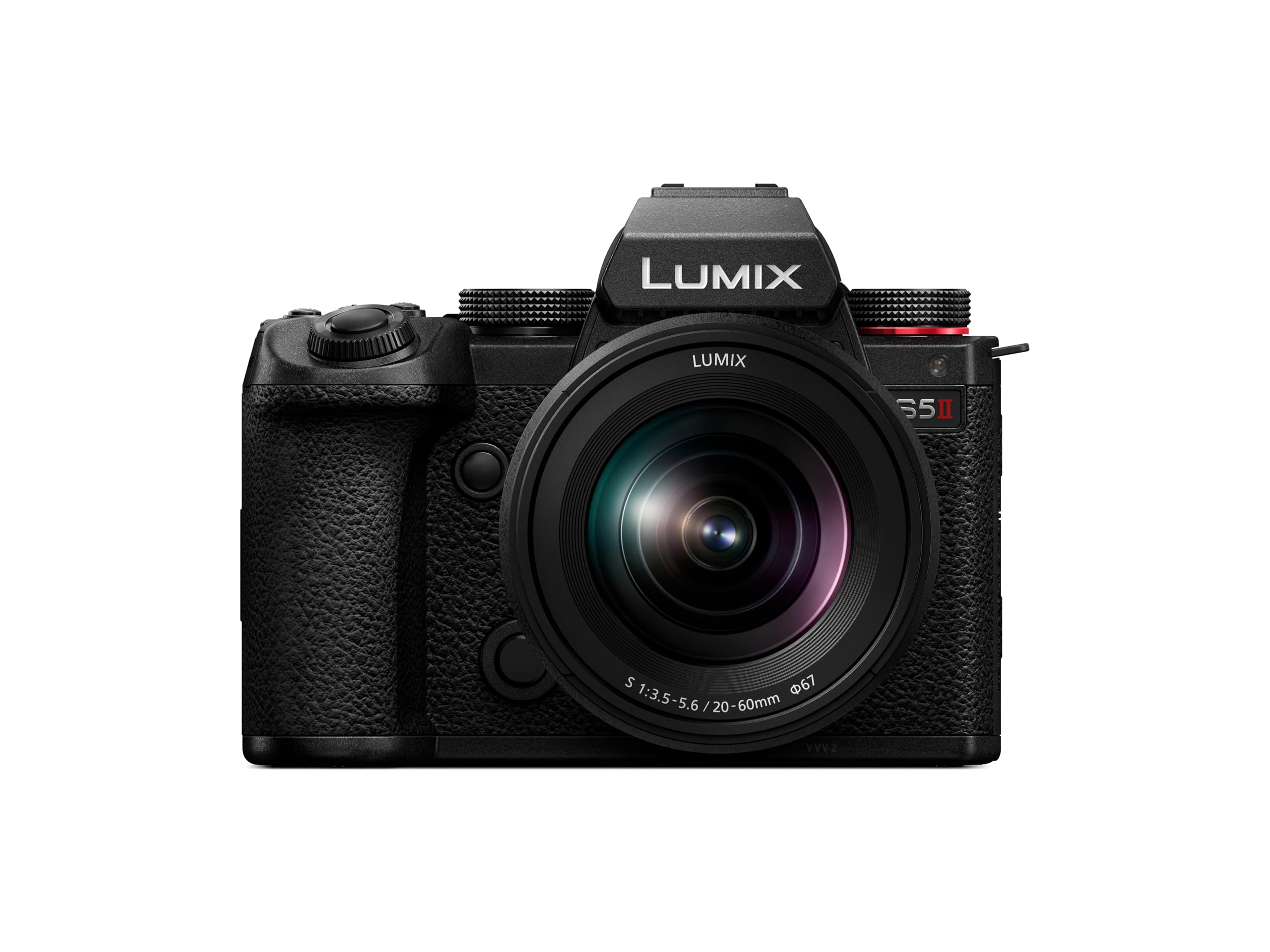
The S5II marks Panasonic’s transition from contrast-detect autofocus to a true phase-hybrid system, solving the primary complaint against earlier LUMIX bodies. The 24.2MP full-frame CMOS sensor with the new Phase Hybrid AF system provides reliable subject tracking that now competes with Sony and Canon for speed and accuracy. The 14+ stop V-Log/V-Gamut capture offers exceptional dynamic range for color grading, and the Real Time LUT feature allows in-camera color grading for fast turnaround.
Video performance is outstanding: 6K 30p Open Gate recording uses the full width of the sensor, 4K 60p 4:2:2 10-bit is unlimited thanks to a built-in fan and heat-dissipation heat sink, and the Active I.S. technology effectively stabilizes walking footage without a gimbal. The 20-60mm f/3.5-5.6 kit lens is versatile for video and vlogging, though its variable aperture is limiting for stills in dim conditions.
The build quality feels solid, and the grip is comfortable for long handheld sessions. The L-mount ecosystem includes Sigma, Leica, and Viltrox lenses, giving professional users a wide range of native glass options. Battery life is average at around 370 shots per charge, so a battery grip may be necessary for extended shoots. The S5II is the strongest option for photographers who prioritize video capability alongside stills at a mid-range price point.
Why it’s great
- Phase Hybrid AF finally brings competitive autofocus to LUMIX
- Unlimited 4K 60p 10-bit recording with active fan cooling
- 6K Open Gate recording full-width no crop
Good to know
- Kit lens aperture is variable and limits performance in low light
- Battery life is moderate and may need a grip for all-day work
8. Panasonic LUMIX S1II Body

The S1II is a significant step above the S5II, stacking a 24.1MP BSI CMOS sensor for faster readout speeds and reduced rolling shutter. The partially stacked architecture enables blackout-free shooting at 30 fps in SH burst mode with pre-burst capture, making it one of the fastest full-frame hybrid cameras on the market for action stills. The 8-stop 5-axis IBIS system is among the best in class, allowing stable handheld shooting at shutter speeds that would be impossible on lesser bodies.
Video features rival dedicated cinema cameras: 6K 30p 10-bit Open Gate (3:2) for maximum flexibility in post, 4K 120p internal recording, and internal ProRes RAW and Blackmagic RAW codecs that eliminate the need for an external recorder. The LUMIX Lab and Frame.io integration streamline professional workflows from capture to delivery. The advanced AI-based subject recognition tracks not only people and animals but also vehicles with precision.
The body is built for professional environments with full weather sealing, dual card slots supporting CFexpress Type B and SD UHS-II, and a 3.69-million-dot OLED EVF with 120 fps refresh. Battery life is adequate but not exceptional, and the body is slightly heavier than competitors. The S1II is designed for hybrid professionals who need internal raw recording capabilities and maximum stabilization without stepping into a dedicated cinema ecosystem.
Why it’s great
- Internal ProRes RAW and Blackmagic RAW recording
- 30fps burst with pre-burst and autofocus tracking
- 8-stop IBIS enables unprecedented handheld flexibility
Good to know
- Battery life is moderate and may require a grip for long sessions
- Body is heavier than most mirrorless competitors
9. Nikon D500 DX Body

The D500 is widely considered the best DX-format camera ever built, and for wildlife and action photographers, it remains a legitimate contender even against modern mirrorless options. The 20.9MP CMOS sensor with the EXPEED 5 processor delivers clean files at ISO 10,000 and usable images at ISO 25,600, which is remarkable for an APS-C sensor. The Multi-CAM 20K 153-point AF system is identical to the D5 flagship and offers 3D tracking that effectively maintains lock on birds and fast-moving wildlife.
The 10 fps burst rate with a 200-frame raw buffer means the D500 never blocks your shot during critical moments. The 2,359k-dot tilting touchscreen is practical for low-angle wildlife photography, and the backlit button layout is intuitive for long sessions in low light. The camera is weather-sealed and built like a tank, with a magnesium alloy chassis that has survived years of field abuse reported by users.
The 1.5x crop factor effectively increases reach by 50%, turning a 300mm lens into a 450mm equivalent — a major advantage for wildlife photographers on a budget. The SnapBridge app is the weak point, with reported connection issues on iOS. The lack of a full-frame upgrade path means you commit to DX glass, but the D500’s mechanical performance and AF system are still competitive with modern bodies costing twice as much.
Why it’s great
- 153-point AF system with 3D tracking rivals flagship D5
- 200-frame raw buffer at 10fps never blocks a sequence
- 1.5x crop factor gives instant focal-length reach
Good to know
- SnapBridge has known connectivity issues on iOS
- DX format limits lens upgrade path to crop-sensor glass
10. Sony a6400 with 18-135mm Lens

The a6400 offers the world’s fastest autofocus (0.02s) in a compact body that is ideal for entry-level professionals building their first kit. The 24.2MP APS-C sensor with 425 phase-detection and 425 contrast-detection points provides 84% coverage of the frame, making it extremely capable for portrait, street, and event work at a fraction of the cost of full-frame bodies. The real-time Eye AF and object tracking systems are inherited from Sony’s full-frame line and work effectively for both stills and video.
The tiltable LCD screen that flips 180° up makes the a6400 suitable for vlogging and self-recording, though it does block the hotshoe when fully articulated. The 11 fps continuous shooting with buffer sufficient for 46 raw files is adequate for most non-action scenarios. The 4K video is oversampled from the full sensor width and provides sharp, detailed footage with minimal rolling shutter.
The kit 18-135mm f/3.5-5.6 lens covers a useful wide-to-telephoto range, making it a solid all-in-one starting lens. The electronic viewfinder is 2.36-million-dot OLED that is bright but small. The controls are dense, and the menu takes time to learn. The a6400 is a legitimate professional tool for photographers who need a compact, budget-friendly body that delivers autofocus and image quality that compete with cameras at twice the price.
Why it’s great
- 0.02s autofocus speed rivals much more expensive bodies
- 425-point AF coverage is comprehensive for APS-C
- 4K oversampled video output is sharp and detailed
Good to know
- EVF is small compared to full-frame competition
- Menu system is dense and requires significant setup time
11. Nikon D7500 with 18-140mm Lens

The D7500 is an 8-year-old DSLR that remains relevant because its core imaging specs are derived from the far more expensive D500. The 20.9MP DX sensor and EXPEED 5 image processor produce class-leading image quality with excellent color depth and noise control up to ISO 3200. The 51-point AF system with 15 cross-type sensors provides reliable autofocus in moderate light, and the 8 fps continuous shooting with a 50-frame raw buffer is sufficient for most action scenarios.
The 3.2-inch tilting touchscreen with 922k dots is practical for composition and menu navigation, and the 4K Ultra HD video at 30 fps with stereo sound and power aperture control delivers usable B-roll. The 18-140mm f/3.5-5.6 VR kit lens is one of the best all-in-one offerings, providing a 27-210mm equivalent range with effective vibration reduction that makes a real difference in low-light handheld shooting.
The single SD card slot and limited AF point count show the camera’s age. The body is larger and heavier than mirrorless alternatives, but the optical viewfinder provides zero-lag viewing and all-day battery life (roughly 950 shots per charge). The D7500 is the right choice for photographers transitioning from entry-level DSLRs to professional work who want the reliability and battery endurance of a DSLR without the cost of full-frame glass.
Why it’s great
- Image quality and processing inherited from the flagship D500
- 18-140mm VR kit lens covers a broad range effectively
- Excellent battery life of ~950 shots per charge
Good to know
- Single SD card slot is a professional limitation
- AF system only has 51 points, lacking modern coverage
12. OM SYSTEM OM-3 with 12-45mm F4.0 PRO

The OM-3 is the cheapest camera on the market with a stacked CMOS sensor, offering readout speeds that virtually eliminate rolling shutter in a compact Micro Four Thirds body. The 20MP Live MOS sensor paired with the TruePic X processor delivers excellent high ISO performance for the format, and the 5-axis in-body image stabilization is peerless at up to 7.5 stops of correction. The IP53 weather sealing rating makes it the most durable camera on this list, fully dustproof and splashproof with freeze-proof operation down to -10°C.
Computational photography features are deeply integrated: built-in neutral density filter simulation, Live ND up to 6 stops, high-res shot mode for 80MP JPEG output, and in-camera focus stacking that works without a tripod. The creative dial and dedicated computational lever allow quick switching between JPEG film simulations and advanced shooting modes. The 2.36-million-dot OLED EVF is sufficient but not class-leading in resolution.
The MFT sensor has a 2x crop factor that provides reach for telephoto work but limits depth-of-field separation compared to full-frame. The 12-45mm f/4.0 PRO kit lens is sharp throughout its range and weather-sealed to match the body. The OM-3 is for the professional who needs a go-anywhere, take-any-beating camera that produces excellent JPEGs and 4K video out of the box, without the weight commitment of full-frame gear.
Why it’s great
- IP53 rated for dust, splash, and freeze resistance
- Peerless 5-axis IBIS for handheld stability
- Stacked sensor eliminates rolling shutter in electronic shutter mode
Good to know
- MFT sensor limits depth of field compared to full-frame
- EVF resolution is modest at 2.36M dots
13. Fujifilm GFX100S II Body

The GFX100S II delivers 102 megapixels of medium-format resolution in a body that weighs only 883g — comparable to high-end full-frame cameras. The newly developed 102MP CMOS II sensor paired with the X-Processor 5 provides exceptional tonal gradation, color depth, and dynamic range that surpasses any full-frame sensor on this list. The 8-stop in-body image stabilization means you can shoot this 102MP sensor handheld and still get critically sharp images.
The 5.76-million-dot OLED EVF is the highest resolution viewfinder on this list, providing an incredibly detailed preview that is essential for critical focus with 102MP files. The AI-assisted subject tracking autofocus works down to -5.5 EV, making it usable for portrait and documentary work in low light. The 4K 30p 4:2:2 10-bit internal video with ProRes and Blackmagic RAW support offers video quality that matches the stills capability.
The GFX100S II is not designed for action, sports, or wildlife. The burst rate is modest, the buffer is shallow compared to stacked-sensor cameras, and the lens selection is limited to the G-mount ecosystem. The 102MP files require substantial storage and processing power. For studio photographers, commercial product shooters, and high-end portrait artists who need the maximum possible resolution and color depth, the GFX100S II is peerless in its weight class.
Why it’s great
- 102MP resolution with 8-stop IBIS for handheld high-res shooting
- 5.76M-dot EVF is the highest resolution in the group
- Medium format files provide unmatched color depth and tonality
Good to know
- File sizes are massive and require fast storage in post-production
- Burst rate and AF speed are not suitable for action or sports
FAQ
Is full-frame essential for professional photography?
How many megapixels do I actually need for professional work?
What is the difference between mechanical and electronic shutter?
Why does buffer depth matter for professional photography?
Final Thoughts: The Verdict
For most users, the camera for professional photography winner is the Sony a7 III because it delivers class-leading dynamic range, reliable autofocus, and excellent battery life at a price that leaves room for premium glass — the true secret to professional image quality. If you need the highest resolution and mechanical performance for studio or commercial work, the Nikon D850 remains the definitive DSLR for resolution-focused pros. And for action and event photographers who prioritize keeper rate over pixel count, nothing beats the Canon EOS R6 Mark II for its 40fps burst, 8-stop IBIS, and class-leading subject detection.