
Framing a grand landscape is an exercise in selection—choosing what to include and what to leave out. A lens that strays even slightly from true rectilinear rendering introduces barrel distortion that bends horizons, or soft corners that undermine the illusion of infinite depth. The right glass for this job must project a flat focal plane, resist chromatic aberration where sky meets treeline, and resolve texture across the entire frame at common landscape apertures.
I’m Min — the co-founder and writer behind Gadgets Feed. I’ve spent hundreds of hours cross-referencing MTF charts, field-curvature tests, and real-world sample galleries to isolate the optics that actually deliver on their promises for wide-open spaces.
This guide breaks down the top contenders in the best camera lens for landscape photography segment, weighing focal-length versatility against maximum aperture and optical correction to help you match a lens to your specific terrain.
How To Choose The Best Camera Lens For Landscape Photography
Landscape photography demands a lens that delivers uniform sharpness from center to corner, resists flare when the sun is in the frame, and offers a focal length wide enough to exaggerate foreground elements without distorting straight lines. Three variables dominate the decision: focal length, maximum aperture, and optical design complexity.
Focal Length: Prime vs Zoom Trade-offs
A 14-24mm zoom gives you compositional flexibility—pull back to include sweeping sky, push to 24mm for more intimate compressions. Prime lenses like a 16mm or 20mm offer simpler optical formulas with fewer elements, which often translates to less flare and higher per-element transmission. The trade-off is physical: a prime forces you to move your feet to change the frame, which can be limiting on a ridge or in a canyon.
Maximum Aperture: F/1.8 vs F/2.8 vs F/4
Wide apertures matter less for light gathering (most landscapes are shot at f/8 to f/11 for depth of field) and more for the viewfinder brightness they provide. An f/1.8 or f/2.8 lens renders a brighter image in the viewfinder, which helps in early-morning or late-evening golden hour. A wider aperture also enables astrophotography—composing the Milky Way without resorting to ISO 6400 at f/4.
Optical Corrections: Aspherical and ED Elements
To maintain edge-to-edge sharpness at wide apertures without color fringing, lens makers use aspherical elements to reduce spherical aberration and extra-low dispersion glass to tame chromatic aberration. The number and arrangement of these elements directly predicts how well a lens performs at infinity focus—the typical landscape distance. A lens with three aspherical and four ED elements (like the VILTROX 16mm) should outresolve a simpler design on high-megapixel sensors.
Quick Comparison
On smaller screens, swipe sideways to see the full table.
| Model | Category | Best For | Key Spec | Amazon |
|---|---|---|---|---|
| Nikon NIKKOR Z 14-24mm f/2.8 S | Ultra-Wide Zoom | Nikon Z series users needing corner-to-corner resolution | 650g weight, Nano Crystal Coating | Amazon |
| Canon RF15-35mm F2.8 L IS USM | Wide-Angle Zoom | Canon RF shooters wanting stabilization | 5-stop optical IS | Amazon |
| Sigma 14-24mm F2.8 DG DN Art | Ultra-Wide Zoom | High-res Sony bodies and VR videography | Dust and splash-proof construction | Amazon |
| Sony FE 24mm F1.4 GM | Wide Prime | Astrophotography and low-light landscapes | 445g weight, f/1.4 max aperture | Amazon |
| ZEISS Batis 18mm f/2.8 | Ultra-Wide Prime | Sony E mount, OLED display for DoF preview | 329g weight, weatherproof metal build | Amazon |
| Panasonic LUMIX S 24-60mm F2.8 | Standard Zoom | L-Mount travel and versatility | 0.3x max magnification | Amazon |
| Sony FE 20mm F1.8 G | Ultra-Wide Prime | Compact travel ultra-wide for Sony full-frame | 374g weight, two XD linear AF motors | Amazon |
| Canon EF 17-40mm f/4L USM | Ultra-Wide Zoom | Canon EF DSLR users seeking L-series build | Weather-sealed, 77mm filter thread | Amazon |
| VILTROX AF 16mm F1.8 Z | Ultra-Wide Prime | Nikon Z budget astro/landscape hybrid | 550g weight, built-in LCD display | Amazon |
In‑Depth Reviews
1. Nikon NIKKOR Z 14-24mm f/2.8 S

This ultra-wide zoom delivers consistent edge-to-edge sharpness even at f/2.8, thanks to its Nano Crystal Coating and advanced aspherical element arrangement. At 650 grams, it’s significantly lighter than its F-mount predecessor, making it a practical carry for extended hikes where every gram counts. The 14mm end provides an extreme 114-degree angle of view that lets foreground rocks or wildflowers dominate the frame while keeping distant peaks in crisp focus.
The constant f/2.8 aperture gives you a bright viewfinder for composing in low light, and it handles astrophotography duty when you need to capture the Milky Way without excessive noise. The weatherproof construction includes sealing at the mount and zoom rings, so a sudden rain shower won’t ruin a morning shoot in the mountains. Two lens hoods ship in the box—one for flare protection and one that accepts 112mm screw-on filters.
Real-world tests show negligible chromatic aberration on high-contrast edges like branches against a bright sky. The autofocus is silent and rapid, though landscape shooters will likely rely on manual focus via the wide, damped ring. The rear gel-filter slot allows creative ND or polarizer use without a bulky front adapter. For Nikon Z users, this is the reference standard for wide-angle landscape optics.
Why it’s great
- Extraordinary sharpness at f/2.8 across the entire frame
- Lightweight build (650g) for an ultra-wide zoom
- Weather-sealed against dust and moisture
Good to know
- Requires alignment to mount the front cap
- Limited rear-filter compatibility for circular polarizers
2. Canon RF15-35mm F2.8 L IS USM

Canon’s RF 15-35mm L-series brings five stops of optical image stabilization into the wide-angle zoom realm, a feature that directly benefits handheld landscape compositions during low-light golden hour. The 15mm wide end captures an expansive 110-degree field, while the 35mm top offers a semi-normal perspective for compressing layered mountain ranges. The Nano USM motor delivers near-silent, snappy autofocus that locks onto distant subjects without hunting.
The optical formula includes three aspherical elements and a UD glass element to suppress lateral chromatic aberration. Testers consistently report sharp results center-to-corner at f/8, though the extreme edges show slight softness wide open at 15mm. The lens weighs 840 grams—noticeable on a gimbal but balanced for handholding with the R-series bodies. The control ring allows direct exposure compensation adjustment without diving into menus.
Weather sealing is comprehensive, with gaskets at the mount, zoom ring, and control rings. The 82mm front thread accepts standard screw-in filters, a major advantage over bulbous-front lenses that require expensive adapter systems. For RF-mount shooters who prize stabilization and filter compatibility, this lens offers a practical balance of range and optical quality that covers most landscape scenarios.
Why it’s great
- 5-stop optical image stabilization for handheld shooting
- Standard 82mm filter thread for ND/polarizer use
- Professional L-series weather sealing
Good to know
- Heavier than prime alternatives (840g)
- Edge sharpness at f/2.8 is not as high as the 14-24mm competition
3. Sony FE 24mm F1.4 GM

Sony’s 24mm GM prime combines an f/1.4 aperture with G Master resolution in a 445-gram body that feels compact on the A7 series. The wide aperture is the key advantage for night landscapes: at f/1.4, you can shoot the Milky Way at ISO 3200 with a 13-second shutter, cutting noise compared to f/2.8 lenses that require longer exposures. Two XA (extreme aspherical) elements suppress astigmatism and sagittal flare to keep star points tight across the frame.
Daytime landscape performance is equally strong, with contrast-rich rendering and minimal chromatic aberration even in high-contrast edge scenes. The manual focus ring is electronically coupled but offers linear response for precise focus. Dust and moisture sealing protects against light precipitation. The 67mm front thread is standard for a filter kit, though the 24mm focal length is less dramatic than a 14mm or 16mm for exaggerated foreground perspective.
Customer reports highlight the lens as a favorite for both video and photo due to its smooth bokeh and responsive autofocus. Some users note that 24mm is not the most extreme wide angle, but its lack of distortion makes it a reliable choice for stitching multi-shot panoramas. If you shoot landscapes exclusively in daylight, the f/1.4 aperture is overkill, but the optical quality justifies the premium for serious Sony shooters.
Why it’s great
- Exceptional sharpness at f/1.4 for astrophotography
- Lightweight (445g) and compact for G Master build
- Low coma and chromatic aberration
Good to know
- 24mm is less wide than typical landscape prime options
- No optical image stabilization on the lens
4. Sony FE 20mm F1.8 G

Weighing just 374 grams, the Sony 20mm F1.8 G is the lightest ultra-wide prime in this selection, making it an obvious choice for backpacking landscape assignments where every gram matters. The f/1.8 aperture delivers sufficient light for night-sky work, though the 20mm focal length captures a slightly narrower field than 14-16mm options. Two XD (Extreme Dynamic) linear motors drive a fast and silent autofocus that maintains lock during video focus pulls.
The optical design uses advanced aspherical elements to produce natural-looking images with minimal distortion—a rare trait at this price tier. Nano AR Coating reduces flare and ghosting when shooting directly into the sun at sunrise or sunset. The lens includes a physical aperture ring with a click/de-click switch, useful for video shooters who need silent aperture changes. Close focusing to 7.1 inches allows creative foreground blur that exaggerates depth in landscape compositions.
User feedback consistently praises the balance of size and image quality. On APS-C bodies, the 20mm becomes a 30mm equivalent, suitable for walkaround use. Some testers report minor barrel distortion that is easily corrected in post. For Sony shooters who prioritize a light kit without sacrificing speed, this lens represents a high value proposition that competes with G Master primes at a lower weight.
Why it’s great
- Extremely light (374g) for travel and hiking
- Fast and accurate AF with XD motors
- Aperture ring with de-click for video
Good to know
- 20mm not as sweeping as 14-16mm options
- No lens-based stabilization
5. VILTROX AF 16mm F1.8 Z

VILTROX’s 16mm F1.8 Z is a native Nikon Z-mount prime that brings f/1.8 speed to an ultra-wide focal length at a fraction of the cost of first-party options. The optical formula crams 15 elements in 12 groups, including three aspherical elements and four ED elements that suppress color bleeding and deliver what users describe as “shocking” sharpness at the edges. The built-in LCD display on the barrel shows aperture, focus distance, and depth of field at a glance, a feature usually reserved for lenses costing three times as much.
The STM stepping motor provides quiet autofocus that supports eye and face detection on Nikon Z bodies, making it functional for video and environmental portraits alongside primary landscape duty. At f/1.8, it allows 13-second Milky Way exposures on a tracker without significant coma distortion. The click aperture ring has a de-click switch for smooth exposure ramps during video, and the lens includes a Fn-2 button that can be programmed for instant infinity focus.
Build quality is solid with a metal barrel and weighted focus ring that inspires confidence. Some users report minor vignetting wide open that clears by f/2.8. No image stabilization is built in, though most Nikon Z bodies have IBIS. For Nikon Z shooters who want ultra-wide f/1.8 performance without paying Nikkor prices, this lens offers an impressive blend of speed and resolution that works for both landscapes and night sky work.
Why it’s great
- Excellent sharpness with 3 aspherical and 4 ED elements
- Built-in LCD display for focus parameters
- High value for f/1.8 ultra-wide performance
Good to know
- No optical image stabilization
- Some vignetting at widest aperture
6. Sigma 14-24mm F2.8 DG DN Art

Sigma’s 14-24mm Art series lens for Sony E-mount balances extreme width with constant f/2.8 in a shell designed for rugged outdoor use. The 14mm wide end is one of the widest in this test, capturing a 114-degree field that lets you place a foreground subject within arm’s reach while keeping background peaks identifiable. Dust- and splash-proof sealing at the mount, zoom ring, and cover connection protects against the elements during sudden weather shifts.
The optical design incorporates three FLD (low dispersion) elements and three aspherical elements that collectively reduce lateral chromatic aberration to near-zero across the zoom range. Sharpness peaks between f/5.6 and f/8, making it ideal for classic landscape apertures. Some users note that edges are slightly softer than the Sony 16-35mm GM at the wide end, but the Sigma offers a stop more light at 14mm. The bulbous front element prevents the use of screw-in filters without a dedicated filter holder system.
The Hyper Sonic Motor delivers fast, reliable autofocus that locks on in low-contrast scenes. The lens is also compatible with Sigma’s front conversion service for VR/multi-camera videography. For real estate and architecture shooters, the 14mm width is invaluable for tight interiors. While the weight (795g) and filter limitations are worth noting, the optical performance-to-price ratio makes this a strong contender for Sony shooters seeking ultra-wide versatility.
Why it’s great
- Extreme 14mm wide angle for dramatic compositions
- Constant f/2.8 with good overall sharpness
- Rugged weather-sealed construction
Good to know
- Bulbous front element prevents standard screw-in filters
- Edges not as sharp as some prime rivals
7. ZEISS Batis 18mm f/2.8

The ZEISS Batis 18mm f/2.8 is a compact weather-sealed prime built for Sony E-mount shooters who prioritize build quality and color rendition above pure speed. At 329 grams, it is the lightest lens among the premium options while still using a robust metal barrel that resists dust and spray water. The OLED display on the top surface shows focus distance and depth of field at a glance, a unique feature that helps landscape photographers set hyperfocal distance without squinting at tiny scale markings.
Optically, the Batis uses ZEISS’s T* anti-reflective coating to minimize flare and ghosting, delivering high contrast and vivid saturation—a signature that many users describe as “Zeiss pop.” At f/2.8, resolution is very high in the center, though some edge softness is noticeable compared to newer primes. The autofocus is smooth and reliable, though not as fast as the latest GM or G lenses. The 18mm focal length sits in a sweet spot between the extreme 14mm and the more common 20mm.
Some user reviews mistakenly reference the 85mm Batis variant, but the 18mm model is specifically designed for landscape and architecture. The lack of an aperture ring and the somewhat plasticky lens hood are minor drawbacks. For Sony users who want a lightweight, weather-resistant prime that delivers distinctive color science and an informative OLED display, the Batis 18mm remains a solid choice for deliberate landscape work.
Why it’s great
- Lightweight (329g) metal construction
- OLED display for DoF and focus distance
- Excellent color and contrast from ZEISS T* coating
Good to know
- Edge sharpness not class-leading
- No physical aperture ring
8. Panasonic LUMIX S 24-60mm F2.8
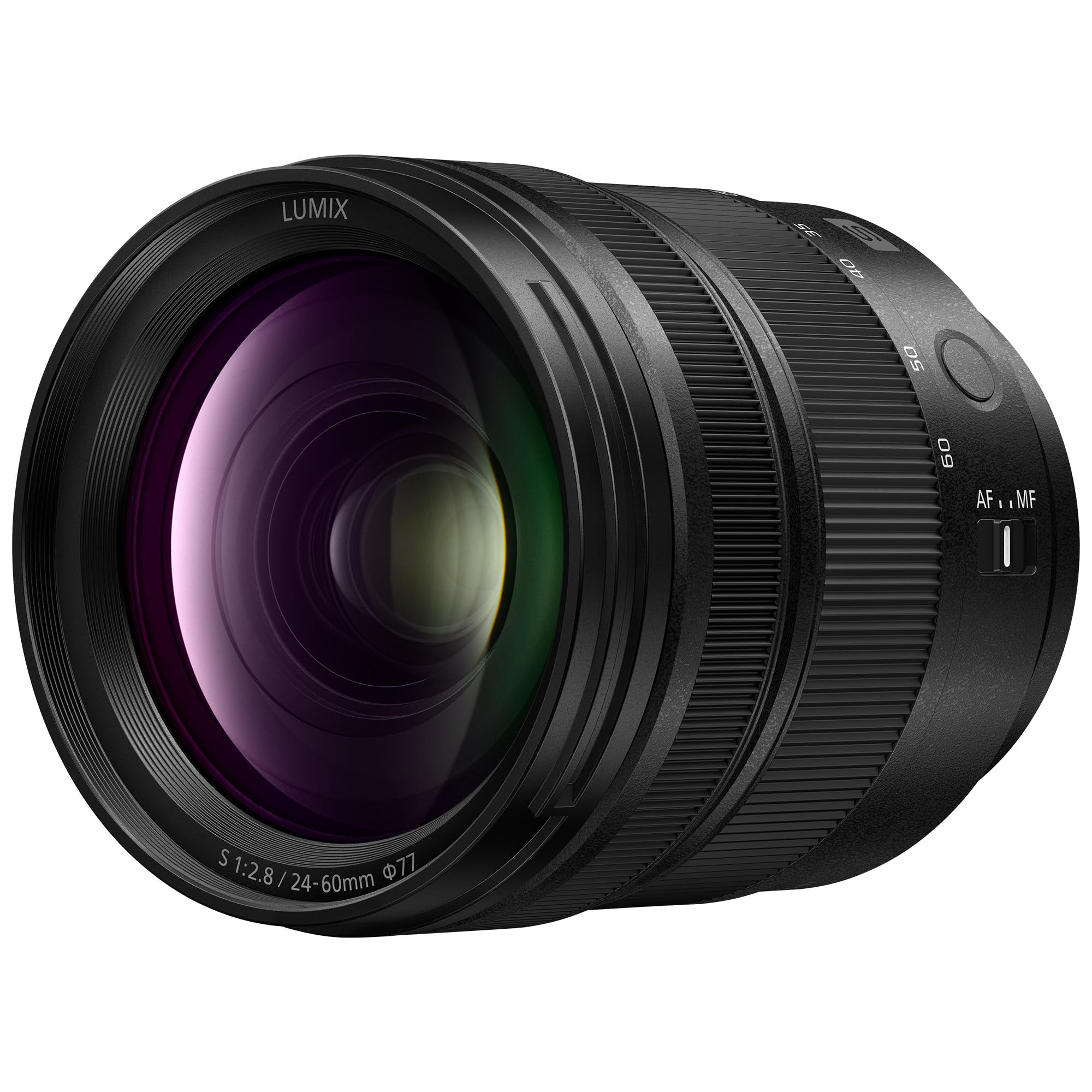
Panasonic’s 24-60mm F2.8 S-series zoom covers a moderate wide to short telephoto range that suits landscape shooters who want both environmental wide shots and tighter compressions. The 24mm end provides solid width for sweeping vistas, while 60mm allows isolating distant trees or mountain ridges against a softer background. The close focusing distance of 0.62 feet with 0.3x magnification enables creative foreground detail shots of flowers or texture.
The lens is designed for the Leica L mount system and offers dust, splash, and freeze resistance, making it practical for harsh outdoor conditions. The focus ring doubles as a customizable control ring, letting you adjust aperture or exposure compensation without taking your eye from the viewfinder. A Hybrid Zoom feature extends reach up to 187mm on compatible Lumix bodies, though this uses sensor cropping rather than optical magnification.
Users consistently note the sharp rendering and cinematic image quality. The constant f/2.8 aperture provides consistent exposure across the zoom range and bright viewfinder composition. Some wish the zoom extended to 70mm, but the 24-60mm range is well-suited for gimbal use due to its compact size. For L-mount users, this lens offers a practical balance of range and speed for landscape work that transitions to video.
Why it’s great
- Versatile 24-60mm range with close focus
- Dust, splash, and freeze resistant construction
- Customizable control ring for quick adjustments
Good to know
- Not as wide as 14-16mm landscape specialists
- Hybrid Zoom is digital, not optical
9. Canon EF 17-40mm f/4L USM

The Canon EF 17-40mm f/4L USM is a legacy L-series zoom that remains relevant for Canon DSLR users seeking an entry point into wide-angle landscape glass. The 17-40mm range covers ultra-wide to moderate wide angles, with the 17mm end offering a 104-degree diagonal view for dramatic foreground and sky inclusion. The constant f/4 aperture is one stop slower than f/2.8 alternatives, but for landscape work typically shot at f/8 to f/11, the speed difference rarely limits exposure flexibility.
The optical formula includes three aspherical elements and a Super UD element to reduce chromatic aberration. Performance peaks at f/5.6 to f/8, where center sharpness is high and edge resolution becomes acceptable. Some users note field curvature at the wide end that requires careful micro-adjustment for flat-field subjects like architecture. The ring-type USM autofocus motor is fast and silent for a screw-drive-era design, though manual focus override is available without switching AF off.
Build quality is classic L-series: weather-resistant seals, a metal lens mount, and a smooth-turning zoom ring. The 77mm front filter thread is standard and affordable for ND and polarizer stacks. While the 17-40mm cannot match the resolution of modern primes or the newer RF 15-35mm, it offers a cost-effective path to L-series construction and wide-angle coverage for Canon EF shooters. Pair it with a 70-200mm for a complete outdoor kit.
Why it’s great
- Affordable L-series build quality and weather sealing
- Standard 77mm filter thread for easy filter use
- Fast and silent USM autofocus
Good to know
- f/4 aperture is slower than f/2.8 competitors
- Edges not as sharp as newer designs
- Field curvature requires careful adjustment
FAQ
Should I choose a zoom lens or a prime lens for landscapes?
What is the ideal aperture for landscape photography?
Do I need a filter thread on a landscape lens?
Why does field curvature matter for landscape lenses?
Final Thoughts: The Verdict
For most users, the best camera lens for landscape photography winner is the Nikon NIKKOR Z 14-24mm f/2.8 S because it delivers uncompromising edge sharpness and a practical weight for hiking in a weather-sealed body. If you want the widest possible field for dramatic foreground compositions, grab the Sigma 14-24mm F2.8 DG DN Art. And for Sony shooters who prioritize compact size and astrophotography performance, nothing beats the Sony FE 24mm F1.4 GM.