
The 8×32 format hits a sweet spot few other optics can claim: enough magnification to pick out a warbler’s eye stripe from fifty yards, yet compact enough to slide into a daypack without a second thought. The trouble is that this popular category is flooded with options that look identical on paper but diverge wildly once you put them to your eyes—phase coatings, prism quality, and glass type separate a sharp, color-true image from a muddy, frustrating one.
I’m Min — the co-founder and writer behind Gadgets Feed. I’ve spent hundreds of hours combing through manufacturer spec sheets, decoding lens coating jargon, and cross-referencing real-user field reports to build a guide that cuts through the marketing noise surrounding this specific magnification and objective size.
Whether you’re a birder tracking fast flyovers or a hiker who values a lightweight carry, this deep dive into the best 8×32 binoculars will help you match your needs to the right optical instrument without overpaying for features you won’t use.
How To Choose The Best 8×32 Binoculars
Selecting the right pair of 8×32 binoculars means understanding the trade-offs between compactness and light-gathering ability. Unlike larger 42mm objectives, 32mm lenses prioritize portability, making them the top choice for day hikes, travel, and birding sessions where weight matters more than twilight performance.
Lens Coatings and Glass Type
Fully multi-coated optics and extra-low dispersion (ED) glass are the two specs that separate premium image quality from budget haze. Full multi-coating means every air-to-glass surface receives multiple anti-reflective layers, maximizing light transmission and minimizing glare. ED glass corrects chromatic aberration—the purple or green fringing you see along high-contrast edges—giving you a cleaner, more natural image.
Prism Quality and Phase Coatings
BaK-4 prisms are superior to BK-7 because they produce a perfectly round exit pupil and brighter image. Phase coatings on roof-prism binoculars correct phase shift that otherwise reduces contrast and sharpness. Without phase coating, a binocular can look like a pair—it’s that critical for 8×32 roof-prism designs.
Field of View and Eye Relief
A wide field of view (measured in feet at 1,000 yards or in degrees) lets you track moving birds or game without scanning the horizon. Look for 360 feet or more in 8×32 models. Eye relief of at least 16mm is essential for eyeglass wearers to see the full image without vignetting—twist-up eyecups with multiple stops improve comfort for both glassed and naked eyes.
Quick Comparison
On smaller screens, swipe sideways to see the full table.
| Model | Category | Best For | Key Spec | Amazon |
|---|---|---|---|---|
| Swarovski NL Pure 8×32 | Premium | Ultimate wide FOV and ergonomics | 492 ft FOV at 1,000 yds | Amazon |
| Leica Ultravid 8×32 HD Plus | Premium | Legendary build and warm color rendition | Mg chassis, 62° apparent FOV | Amazon |
| Vortex Razor UHD 8×32 | Premium | Alpha-level optics with VIP warranty | XR Plus coatings, 472 ft FOV | Amazon |
| ZEISS Terra ED 8×32 | Mid-Range | German ED glass at a mid-tier price | 88% light transmission, 315 ft FOV | Amazon |
| Carson 3D ED Series 8×32 | Mid-Range | ED glass performance on a budget | 19.5 mm eye relief, 392 ft FOV | Amazon |
| Eschenbach Sektor D 8×32 | Mid-Range | Rugged German design for all-weather use | Nitrogen-filled, phase-corrected BaK-4 | Amazon |
| Nocs Provisions Field Issue 8×32 | Mid-Range | Compact travel-friendly binocular with IPX7 rating | 387 ft FOV, 16.7 oz weight | Amazon |
| Celestron Nature DX 8×32 | Budget | Best entry-level value for beginners | Fully multi-coated BaK-4, 7.4° FOV | Amazon |
In‑Depth Reviews
1. Swarovski Optik NL Pure 8×32

The Swarovski NL Pure 8×32 delivers a 492-foot field of view at 1,000 yards—the widest in this entire lineup and a figure that rivals many 8×42 models. SWAROVISION technology, including fluoride-containing HD glass and field-flattener lenses, delivers edge-to-edge sharpness without the pincushion distortion common in wide-angle designs. The open-bridge magnesium chassis weighs just 22.5 ounces, making it light enough for all-day neck carry without fatigue.
Ergonomically, the NL Pure sets a new standard. The curved barrel shape fits the palm’s natural contour, and the focus wheel is perfectly placed for your index finger to make micro-adjustments without shifting your grip. Reviewers consistently praise its ability to eliminate eye strain during extended sessions—a direct result of precise collimation and the 8.2-degree apparent angle of view. The included forehead rest is a worthwhile add-on for tripod-free stability.
Build quality is impeccable: the magnesium housing is armored, o-ring sealed, and argon-purged for waterproof and fogproof performance. The objective covers are functional but can pop open when laid flat, and the premium price tag puts it out of reach for casual users. For serious birders and optics enthusiasts who demand the absolute best, the NL Pure justifies its position as the top-performing 8×32 on the market.
Why it’s great
- Unmatched 492 ft FOV for effortless tracking
- Edge-to-edge sharpness with zero chromatic aberration
- Lightweight magnesium construction for all-day comfort
Good to know
- Premium investment—best for dedicated enthusiasts
- Objective lens covers may open on flat surfaces
- Forehead rest sold separately
2. Leica Ultravid 8×32 HD Plus

The Leica Ultravid 8×32 HD Plus represents over a century of German optical engineering in a compact roof-prism body. Its HD Plus system combines fluoride glass with HDC multi-coating and a phase-correcting P40 prism coating to produce a warm, natural color rendition that Leica loyalists prize. The 62-degree apparent field of view is generous for a 32mm class binocular, and the 4mm exit pupil delivers bright, contrast-rich images even under dense forest canopy.
Build quality is exceptional: the magnesium chassis is wrapped in a textured rubber armor that provides a secure grip in wet conditions. The center focus wheel is silky-smooth with zero play, and the diopter adjustment locks firmly in place—a design detail that prevents accidental shifts during field use. At 21.5 ounces, it is slightly heavier than the Zeiss Terra ED but feels more substantial without being burdensome. The twist-up eyecups have positive-click stops, though some users with shallow eye sockets report the 13.3mm eye relief can cause blackout issues.
Optically, the Ultravid delivers stunning clarity with minimal color fringing, even against high-contrast backdrops like a white bird against a blue sky. It is a lifetime purchase—the build tolerances allow for servicing decades down the road. The minor eye relief caveat means you should test them if you wear glasses or have deep-set eyes, but for most users, these binoculars deliver an image quality that competes with models costing significantly more.
Why it’s great
- Warm, true-to-life color reproduction with HDC coatings
- Superior build quality with lockable diopter
- Compact magnesium body for everyday carry
Good to know
- 13.3mm eye relief may be short for eyeglass wearers
- Premium price point for dedicated users
- Eyecups lack multiple position stops
3. Vortex Razor UHD 8×32
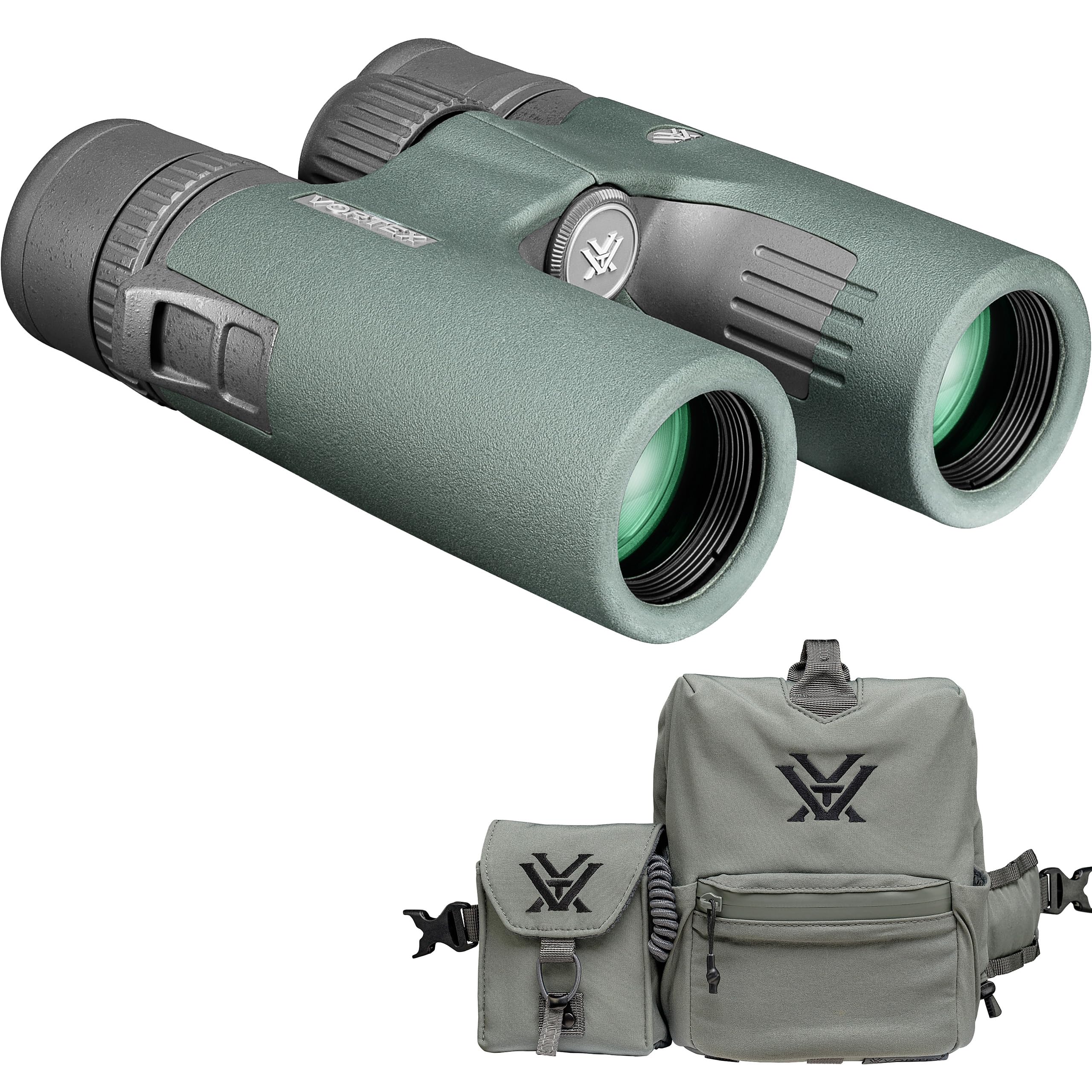
The Vortex Razor UHD 8×32 brings ultra-high-definition optics to a compact 8×32 format that was previously reserved for larger objectives. Index-matched lenses and XR Plus anti-reflective coatings combine to deliver exceptional light transmission—reviewers note it competes directly with European alpha brands at a lower price point. The 472-foot field of view is among the widest in class, giving you expansive panoramic views perfect for scanning open habitats or tracking fast-moving songbirds.
Build quality is robust: the magnesium open-bridge chassis is argon-purged and o-ring sealed for lifetime waterproof/fogproof reliability. The locking diopter ring is a standout feature—once set, it stays put, unlike many budget models where the dipper drifts during use. The included GlassPak Pro harness distributes weight across your shoulders rather than your neck, a practical addition for all-day field sessions. The ArmorTek lens coating resists scratches and makes cleaning smudges effortless.
Some users note the focus wheel requires more than one full turn from near to infinity, which can feel slow when tracking quick-moving targets like warblers in dense foliage. At 19mm eye relief, it accommodates eyeglass wearers comfortably, and the twist-up eyecups offer multiple stops. The VIP warranty is unconditional and transferable—Vortex will repair or replace these binoculars no matter what happens, adding long-term peace of mind.
Why it’s great
- Alpha-level optical clarity with XR Plus coatings
- Locking diopter and Argon-purged waterproofing
- Lifetime unconditional VIP warranty
Good to know
- Focus wheel travel is slow for fast-action tracking
- Premium price but below European alpha brands
- Heavier than open-bridge competitors at 22.9 oz
4. ZEISS Terra ED 8×32

The ZEISS Terra ED 8×32 is the most accessible entry point into premium German optics without sacrificing the core lens technology that defines the brand. It uses the same Schmidt-Pechan ED glass design as higher-end ZEISS models, delivering 88% light transmission and excellent color fidelity. The hydrophobic multi-coating repels water and reduces glare in wet conditions, making it a reliable companion in unpredictable weather. The 315-foot field of view is narrower than the NL Pure or Razor UHD, but still adequate for general birding and nature observation.
Ergonomically, the Terra ED is designed for speed: the large focus wheel is easy to operate with gloved hands and requires minimal rotation to shift focus from near to far. The fiberglass-reinforced polycarbonate housing is lightweight at just 18 ounces, making it one of the lightest 8×32 models in this roundup. The twist-up eyecups offer a comfortable seal against the face, and 16.5mm eye relief works well for most eyeglass wearers. The included hard case and neoprene harness add practical value out of the box.
Reviewers consistently praise its image sharpness and contrast, noting it outperforms models costing twice as much in the mid-range space. The main trade-off is build material—polycarbonate vs. magnesium—which affects long-term durability if dropped repeatedly. Still, for the price, you get genuine ZEISS ED glass and a brand reputation that retains resale value. It is the logical choice for anyone wanting alpha-tier optics without the alpha-tier price.
Why it’s great
- Genuine ZEISS ED glass at a mid-range price
- Hydrophobic multi-coating for all-weather use
- Lightweight polycarbonate frame (18 oz)
Good to know
- 315 ft FOV is narrower than premium competitors
- Polycarbonate body less impact-resistant than magnesium
- Eye relief may feel tight for some eyeglass wearers
5. Carson 3D ED Series 8×32

The Carson 3D ED Series 8×32 delivers ED glass performance at a price point that undercuts most competitors by a significant margin. Extra-low dispersion glass eliminates chromatic aberration almost entirely, producing images that reviewers compare favorably to the Nikon Monarch 7 and Maven B3. The 392-foot field of view is generous for an 8×32, and the fully multi-coated optics with BaK-4 prisms ensure bright, contrast-rich views even under overcast skies. The 19.5mm eye relief is the longest in this lineup, making it the most accommodating for eyeglass wearers who need to see the full field without vignetting.
Build quality is where the Carson makes concessions to hit its price. The rubber-armored body feels slightly plasticky compared to magnesium-chassis models, and the eyecups have only one locking position, which can be a minor annoyance during long sessions. However, the included shoulder harness and deluxe carry case add practical value, and the lifetime warranty from Carson provides peace of mind. The focus wheel is smooth and precise, requiring minimal effort to dial in sharpness at varying distances.
In low-light conditions, the 4mm exit pupil limits performance compared to 8×42 models, but that is inherent to the 8×32 format. For dedicated daytime use—birding, hiking, sporting events—the Carson 3D ED offers image quality that punches well above its price class. It is an ideal upgrade path for someone moving from entry-level binoculars who wants ED glass without committing to a premium investment.
Why it’s great
- ED glass eliminates color fringing effectively
- Exceptional 19.5mm eye relief for eyewear users
- Lifetime warranty and premium harness included
Good to know
- Polycarbonate body feels less premium than magnesium
- Only one locking position for eyecups
- Low-light performance is typical for 8×32 format
6. Eschenbach Sektor D 8×32

The Eschenbach Sektor D 8×32 is a German-engineered roof-prism binocular built for rugged outdoor conditions. It features phase-corrected BaK-4 prisms and full multi-coating to deliver sharp, high-contrast images with accurate color reproduction. The 115-meter field of view at 1,000 meters (approximately 345 feet) is adequate for general birding and wildlife observation, and the nitrogen-filled, o-ring-sealed construction ensures reliable waterproof and fogproof performance in rain, snow, or humidity.
Build quality is a highlight: the polycarbonate body is wrapped in a textured rubber armor that provides a secure, non-slip grip even in wet hands. At 16.5 ounces, it is among the lighter options in this review, making it an excellent choice for travelers and hikers who prioritize pack weight. The fixed-focus design is a notable quirk—it uses a central wheel to set focus, but some users initially mistake it for a traditional center-focus system. Once adjusted, it provides fast, intuitive focus changes without the stiffness that plagues some competitive models.
Customer reviews consistently praise its optical clarity and build durability, with one 30-year optics expert calling it equal or superior to premier brands at half the cost. The lens caps are a minor ergonomic annoyance, as they can be awkward to remove and replace quickly. For birders or hunters who need a compact, waterproof 8×32 that can handle adverse weather without hesitation, the Eschenbach Sektor D delivers reliable performance in a well-priced package.
Why it’s great
- German precision optics with phase-corrected BaK-4 prisms
- Nitrogen-filled waterproofing for extreme conditions
- Lightweight design (16.5 oz) for travel and hiking
Good to know
- Focus system may feel unfamiliar to new users
- Lens caps are slightly awkward to use
- Field of view (345 ft) is narrower than top competitors
7. Nocs Provisions Field Issue 8×32

The Nocs Provisions Field Issue 8×32 is designed for the modern outdoor explorer who values portability and durability above all else. With an IPX7 waterproof rating, it can be submerged in up to three feet of water for 30 minutes without damage, making it one of the most water-resistant models in this review. The fully multi-coated optics and Swiss-designed BaK-4 prism deliver a 387-foot field of view that is bright and sharp across the central 80% of the image, with only minor softness at the extreme edges.
The ergonomic rugged wave grip design provides a secure hold in wet or sweaty hands, and the oversized focus wheel allows for precise adjustments even with gloves. At 16.7 ounces, it is light enough for easy carry on a backpack strap or in a small daypack. The multi-stop twist-up eyecups offer three distinct positions, accommodating eyeglass wearers and naked-eye users alike. The included drawstring sack and lens protectors are basic but functional, though the neck strap feels less premium than the binocular itself.
Nocs Provisions backs the Field Issue with a “No-Matter-What” lifetime warranty, reflecting their confidence in the build quality. Some users note the included case and strap are lower quality than the optics, but the company clearly prioritized lens performance and ruggedness over accessories. For backpackers, travelers, and casual birders seeking a compact, worry-free 8×32 that can handle river crossings and rainstorms, the Nocs Field Issue is a smart choice.
Why it’s great
- IPX7 waterproof rating for submersion protection
- Lightweight (16.7 oz) with ergonomic wave grip
- Lifetime “No-Matter-What” warranty
Good to know
- Included case and strap are basic quality
- Slight edge softness in the field of view
- Not ideal for serious low-light birding
8. Celestron Nature DX 8×32
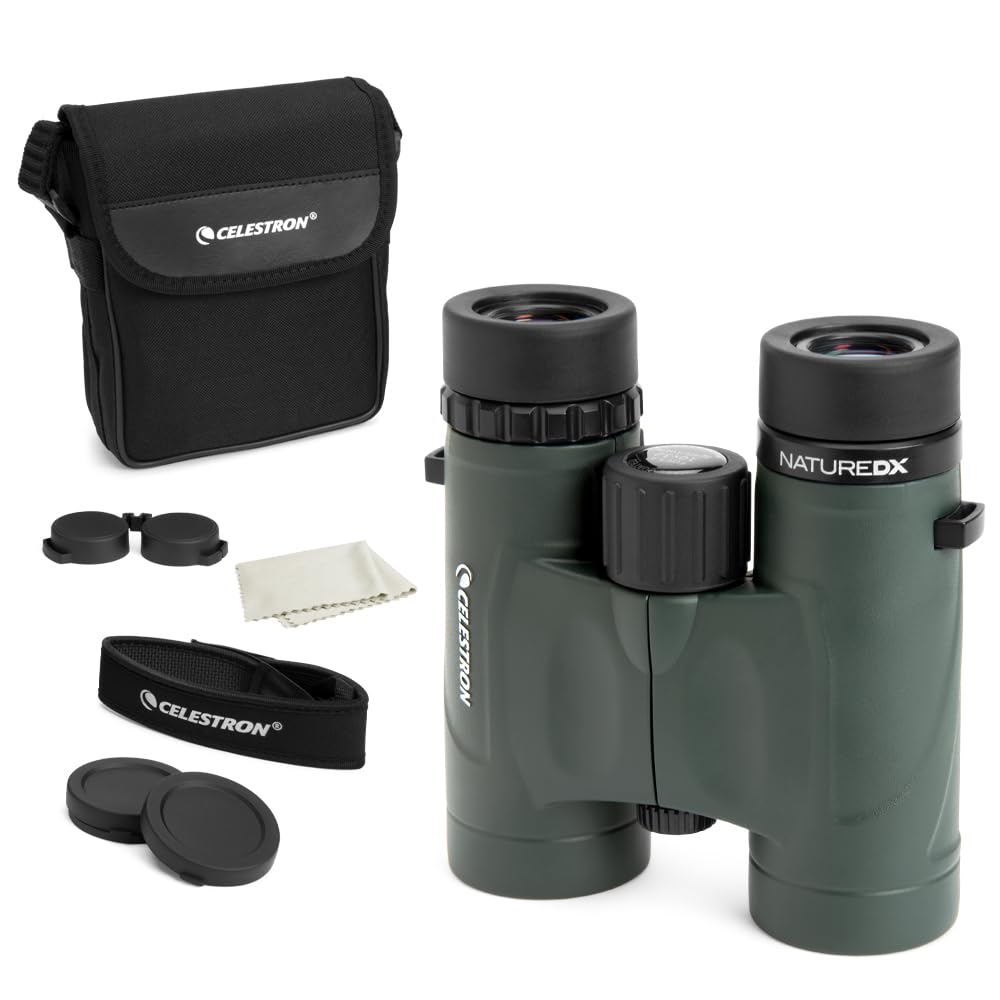
The Celestron Nature DX 8×32 is the entry-level recommendation for anyone new to birding or outdoor observation on a budget. Despite the low price point, it uses phase-coated BaK-4 prisms and fully multi-coated optics—features often omitted from budget bins—delivering surprisingly bright and sharp images for the price. The 7.4-degree field of view (388 feet at 1,000 yards) is competitive with mid-range models, providing a wide enough sweep for tracking birds in flight or scanning open landscapes.
The rubber-armored polycarbonate housing is waterproof and nitrogen-purged to prevent internal fogging, a feature rarely found at this price tier. The center focus wheel is smooth and responsive, and the twist-up eyecups provide 17.5mm of eye relief, which is adequate for most eyeglass wearers. The built-in tripod adapter socket allows for stable long-duration viewing—a thoughtful inclusion for astronomy or prolonged wildlife observation. The included neck strap and lens covers are basic but serviceable.
Customer reviews consistently highlight the value proposition: many compare the Nature DX favorably to models costing two to three times more, noting that the optical clarity and build quality punch above their weight. The main trade-offs are ergonomic—some users find the weight distribution causes thumb strain during extended use, and the autofocus designation is misleading (it uses manual focus). For the price, it is the best entry point into quality 8×32 optics and leaves room to upgrade later without having wasted money on a poor first pair.
Why it’s great
- Phase-coated BaK-4 prisms at an entry-level price
- Waterproof and nitrogen-purged build
- Excellent value for beginners and casual users
Good to know
- Weight distribution may cause thumb strain
- “Autofocus” label is misleading—manual focus only
- Lacks the premium feel of higher-tier models
FAQ
Is an 8×32 binocular good enough for birdwatching?
What does phase coating do in 8×32 binoculars?
How does the 4mm exit pupil of 8×32 compare to 8×42?
Final Thoughts: The Verdict
For most users, the best 8×32 binoculars winner is the Swarovski NL Pure 8×32 because it delivers an unmatched 492-foot field of view and alpha-level optical clarity in a lightweight magnesium body. If you want Zeiss ED glass at a more accessible price, grab the ZEISS Terra ED 8×32. And for budget-conscious beginners who refuse to compromise on waterproofing and optical coatings, nothing beats the Celestron Nature DX 8×32.