
A stray cloudburst or a persistent drizzle shouldn’t force you to pack up mid-shoot. A dedicated camera rain cover delivers the difference between a soaked sensor and a portfolio-worthy frame, keeping your body, lens, and LCD dry while you work the scene.
I’m Min — the co-founder and writer behind Gadgets Feed. I’ve pored over dozens of spec sheets, customer reports, and real-world field tests to isolate the materials, sealing methods, and fit tolerances that actually matter when you’re shooting in wet conditions.
Whether you’re chasing storm light or documenting an outdoor event in the rain, choosing the right best camera rain cover means weighing sleeve length, window clarity, and tripod compatibility against your specific lens arsenal and shooting style.
How To Choose The Best Camera Rain Cover
A rain cover is a deceptively simple accessory. Get the length wrong and your lens hood becomes a funnel. Pick an opaque fabric and you’ll lose all access to your rear screen. Below are the three specs that separate a genuinely useful cover from one that will frustrate you in the field.
Lens Length and Sleeve Fit
The single most common mistake is buying a cover that’s too short for your longest glass. Measure from the camera body’s base to the front of your lens hood. A cover like the NEEWER Large (900mm sleeve) is mandatory for 500-800mm primes, while a Think Tank Small (140mm max) works well with a 24-70 or 70-200 f/4. Most covers offer drawstrings or cinch straps to fold back excess material, so err on the longer side.
Window Clarity and Control Access
A foggy or distorted window defeats the purpose of a rain cover. Look for oversized transparent panels made from thick, anti-fog TPU or clear PVC. The best designs also provide side openings with cord locks so you can reach in to adjust aperture, focus, or shutter speed without peeling the whole cover off. Peak Design’s Shell uses a stretch neoprene fit rather than a window, which limits rear-screen visibility but allows tactile control through the fabric.
Sealing Method and Tripod Compatibility
Drawstrings, Velcro straps, and zippers each have tradeoffs. Drawstrings create a tight seal around the lens hood but can loosen over time. Velcro is instant and reliable but may catch on clothing. Zippers offer the most secure closure but can snag on fabric. Every cover should also include a slit or pass-through for your tripod’s quick-release plate — if the cover blocks your tripod mount, you’ll be forced to shoot handheld in the rain.
Quick Comparison
On smaller screens, swipe sideways to see the full table.
| Model | Category | Best For | Key Spec | Amazon |
|---|---|---|---|---|
| Think Tank Medium | Premium | Pro-grade 70-200mm kits | Hot-shoe anchor + 200mm sleeve | Amazon |
| Peak Design Shell Small | Premium | Compact mirrorless + Capture Clip | 4-way stretch neoprene membrane | Amazon |
| LensCoat RainCoat Medium | Premium | Large telephoto 100-500mm glass | Cinch strap adjust + 4.1 oz weight | Amazon |
| Think Tank Small | Mid-range | Everyday 24-70mm walkaround | Non-slip lens-hood Velcro | Amazon |
| NEEWER Large PB004 | Mid-range | Super-telephoto 500-800mm lenses | 900mm sleeve + viewing window | Amazon |
| NEEWER Small PB003 | Budget | Compact DSLR up to 200mm | 500mm sleeve + 5 oz weight | Amazon |
| Kiorafoto Hot Shoe Umbrella | Budget | Sun/light rain + accessory mounts | 360° ball joint + cold shoe mount | Amazon |
In‑Depth Reviews
1. Think Tank Emergency Rain Cover Medium

The Think Tank Medium is engineered for the most common pro-zoom — the 70-200mm f/2.8 — and delivers a level of fit and security that cheaper nylon sleeves simply can’t match. The hot-shoe tab locks the cover in place over your camera’s flash mount, preventing the whole assembly from sliding forward when you tilt the lens down. A grippy, non-slip Velcro band at the lens end wraps tightly around the lens hood, so you never have to worry about wind peeling the cover back during a downpour.
At 4 ounces and folding nearly flat, this cover lives permanently in a side pocket without adding noticeable bulk. The oversized rear window gives you a clear view of the LCD and viewfinder, though some distortion is present at extreme angles. Zoom and focus rings remain accessible through a cord-adjustable opening on the barrel, and the drawstring lets you cinch the cover down to shorter lenses. For portrait orientation, there is enough material to cover the exposed side of the camera, though it can feel a bit baggy on vertical grips.
Reviewers consistently praise its ability to keep gear bone dry during sea kayaking trips and heavy Pacific Northwest rain. The only tradeoff is that accessing the zoom ring on a 70-200mm internal zoom lens can be slightly tight, and the clear plastic window sits slightly off-center on some body models. Still, for reliability under sustained wet conditions, this is the most complete solution for mid-telephoto shooters.
Why it’s great
- Secure hot-shoe clip prevents cover from sliding.
- Non-slip Velcro lens-hood band stays put in wind.
- Compact enough to stash in any bag pocket.
Good to know
- Window distortion at extreme viewing angles.
- Zoom ring access can feel tight with internal-zoom lenses.
2. Peak Design Shell Camera Rain Cover Small

The Peak Design Shell breaks the traditional rain-cover mold by using a form-fitting, four-way stretch neoprene fabric bonded to a waterproof membrane. Instead of a bulky sleeve with a viewing window, the Shell wraps snugly around your camera and lens like a wetsuit. This design eliminates the flapping and condensation issues that plague loose nylon covers, and the stretch material allows the same cover to accommodate variable zoom lengths without sagging.
The Small size fits mirrorless bodies like the Sony a6500 or Fuji X-T3 with a standard zoom, and the cinchable tail lets you tighten the fit around shorter lenses. It pairs perfectly with Peak Design’s Capture Clip and anchor-link straps, so you can keep the cover on while the camera is clipped to your backpack strap. The tradeoff is that there’s no clear window for the LCD — you must rely on tactile familiarity with your camera’s controls. In heavy storms, some users report slight dampness near the strap pass-throughs.
At just 0.15 grams (the shell material is extremely lightweight), it’s the most packable option here. It excels as an “always on” cover for commuters and hikers who need protection from sudden showers and trail dust rather than sustained downpours. The material also doubles as a scratch guard when tossing your camera into a bag. Expect premium build quality and a precise fit, but also a premium price tag for a cover with no viewing port.
Why it’s great
- Snug stretch fit eliminates flapping in wind.
- Designed to work seamlessly with Capture Clip.
- Ultra-light and packs to almost nothing.
Good to know
- No clear window — requires tactile operation.
- Strap pass-throughs can allow minor dampness in heavy rain.
3. LensCoat RainCoat RS Medium LCRSMBK

LensCoat built the RainCoat RS for shooters who regularly carry big glass — think 100-500mm zooms, 400mm f/2.8 primes, and even the Sigma 600mm with teleconverter. The Medium size folds up remarkably small for its coverage, yet stretches to accommodate the chunkiest telephoto bodies with a battery grip and L-bracket attached. The neoprene construction is thick, waterproof, and extremely durable, standing up to heavy snowfall and salt spray without letting moisture through.
The defining feature is the cinch-strap system: you fold the excess material over itself at the lens end and fasten it with Velcro straps, creating a custom-tight seal around any diameter lens hood. There is no dedicated eyepiece or clear rear window, which means you must know your camera well enough to operate by feel. The bottom Velcro seam opens to accommodate a tripod quick-release plate, and the side openings allow battery changes and manual focus adjustments without exposing the whole camera body.
Reviewers who have used the RainCoat in slushy snow and continuous downpours report that the interior stays bone dry. The one minor durability note is that one of the cord retainers can work loose over time, though it’s easily adjustable. If you regularly shoot with heavy telephoto lenses in harsh weather and prefer a robust neoprene sleeve over a windowed nylon cover, this is the most field-tested option available.
Why it’s great
- Fits massive telephoto lenses up to 600mm.
- Cinch straps allow custom length adjustment.
- Velcro bottom accommodates tripod L-brackets.
Good to know
- No clear window — operates entirely by feel.
- Must dry inside-out to prevent condensation.
4. Think Tank Emergency Rain Cover Small

The Think Tank Small is the scaled-down version of the Medium, designed for standard zoom kits such as a Canon R5 with a 24-105mm or a Sony A7SIII with a 24-70mm. It inherits the excellent non-slip Velcro lens-hood fastening and hot-shoe anchor from its larger sibling, so the cover stays put even when you’re tilting the camera up for a low-angle shot. The clear window is slightly off-center on some bodies, but the LCD remains visible enough for framing and reviewing shots.
At a 140mm maximum compatible lens length, the Small is not intended for long telephoto work. It fits neatly into a bag’s side pocket and weighs only 3.5 ounces. Users report that the Small fits perfectly on an OM-1 with a 12-100mm as well as a Fuji X-T3 with an 18-55mm. The inclusion of a hot-shoe tab is a welcome touch at this price tier — it’s a pro-grade detail that most budget covers omit entirely.
The tradeoff is that the Small is not truly “small” — it has enough material to extend well past the lens hood, meaning you’ll need to manage the excess fabric if you’re shooting a compact prime lens. The clear plastic window can be slightly off-center on some camera models, though the LCD remains visible. For anyone who wants Think Tank’s proven Velcro-and-anchor system in a more compact form factor, this is the pick.
Why it’s great
- Secure hot-shoe tab + lens-hood Velcro combo.
- Compact and lightweight for everyday carry.
- Fits many standard zoom setups cleanly.
Good to know
- Clear window sits slightly off-center on some bodies.
- Not designed for lenses longer than 140mm.
5. NEEWER Camera Rain Cover Large PB004

The NEEWER Large is the most cost-effective way to protect a super-telephoto setup — it accommodates lenses up to 800mm with its 900 x 550mm sleeve. The nylon fabric is fully waterproof, and the oversized transparent window gives you a clear view of the rear LCD, viewfinder, and control buttons. Two drawstrings let you seal the lens end tightly, and if the sleeve is too long for your 300mm lens, you can fold back the excess material and cinch it down.
Weighing just 7.4 ounces and folding into its own included bag, the Large packs down smaller than most camera batteries. The dual sleeve openings for your hands make it easy to reach in and operate controls, though some users note that the zipper can stick occasionally and the interior can fog up if moisture gets trapped. For tripod-mounted shooting, the cover allows the camera to sit on a quick-release plate without blocking the mount.
The most common praise from owners is simply that it works: it kept a Sony 400-800mm telephoto bone dry during extended sessions. The most common complaint is that the inside can fog up if there is any ambient moisture, and the zipper on the main compartment can snag. For the price, it offers unmatched coverage for long lenses, making it the go-to choice for wildlife and sports shooters on a mid-range budget.
Why it’s great
- Massive 900mm sleeve covers 800mm telephotos.
- Folds into included carry bag for easy storage.
- Oversized window provides clear rear-screen view.
Good to know
- Zipper can snag on internal fabric.
- Interior may fog in humid conditions.
6. NEEWER Camera Rain Cover Small PB003
The NEEWER Small offers a 500 x 500mm sleeve that fits most compact DSLR and mirrorless bodies with a 70-200mm lens or shorter. It is essentially a scaled-down version of the Large, using the same waterproof nylon fabric, oversized viewing window, and dual hand sleeves. The drawstrings at both ends allow you to seal the cover around the lens barrel and the camera body, creating a reasonably watertight enclosure for the price.
At only 5 ounces and packing into the included bag, this is the best option for beginners or second-body shooters who need occasional rain protection without spending premium dollars. The window is large enough to see the entire rear LCD, and the hand sleeves provide enough dexterity to change basic settings. Some users report that the cover is bigger than expected — it has no trouble fitting a 300mm lens with room to spare, so you can fold back the sleeve tip if your glass is shorter.
The main downsides mirror those of its larger sibling: the zipper can stick, and moisture trapped inside can fog the window. A reviewer noted that it kept the camera dry during sports shooting but wouldn’t recommend it for sustained heavy rain due to fogging. For casual use, light showers, and storage protection, it delivers solid performance at a minimal investment.
Why it’s great
- Affordable entry-level protection for 70-200mm kits.
- Clear viewing window for the entire rear LCD.
- Lightweight and folds into a compact carry bag.
Good to know
- Zipper tends to stick and can snag fabric.
- Fogging issues in humid or prolonged rain.
7. Kiorafoto 3-Level Height Adjustable Hot Shoe Umbrella
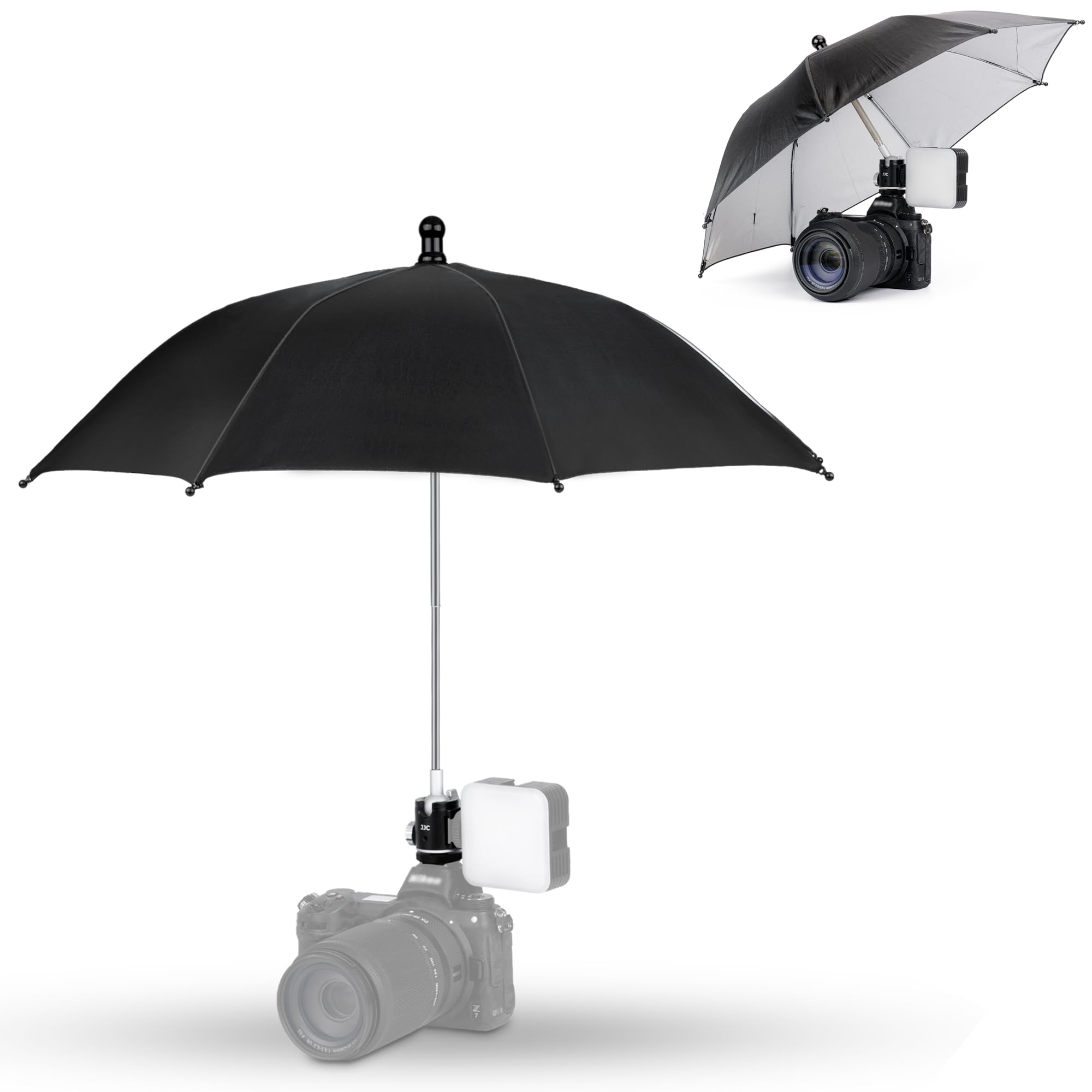
The Kiorafoto Umbrella takes a completely different approach: instead of a sleeve that wraps around the camera, it mounts directly into the hot shoe and extends a waterproof canopy above your gear. The 360-degree ball-and-socket joint with a 90-degree tilt notch lets you position the umbrella at any angle to block rain, sun, or snow. A built-in cold shoe mount on the top of the umbrella allows you to attach a fill light or microphone, turning a single hot shoe into both a rain solution and an accessory mount.
The umbrella is made from waterproof polyester with a stainless steel frame, and it telescopes to three height settings. When stored, it collapses to a size that fits into the included waterproof storage bag. It works best in light to steady rain and acts as an excellent sunshade for both the camera and the photographer. In heavier downpours or strong wind, the umbrella is less secure than a full sleeve, and it does not cover the camera body from below — so rain bouncing off the ground can still hit your gear.
This is the ideal choice for photographers who shoot from a tripod or monopod and want quick, tool-free rain protection without bagging their entire rig. It also works brilliantly as a sunshade for windshield repair or outdoor product shots. For sustained heavy rain, you’ll still want a sleeve — but for versatility, portability, and the ability to mount accessories simultaneously, this design is genuinely unique.
Why it’s great
- Hot-shoe mount requires no sleeve or bagging.
- Cold shoe mount adds accessory compatibility.
- Excellent dual-purpose sunshade and rain cover.
Good to know
- Not secure in heavy rain or strong wind.
- Does not protect camera body from ground splash.
FAQ
Will a rain cover fit a camera with a battery grip attached?
Can I use a camera rain cover underwater?
How do I prevent the viewing window from fogging up?
Final Thoughts: The Verdict
For most users, the best camera rain cover winner is the Think Tank Emergency Rain Cover Medium because it combines a secure hot-shoe anchor, non-slip lens-hood Velcro, and a clear viewing window in a compact, pro-grade package that handles 70-200mm kits through sustained downpours. If you want a stretch-fit cover that works with a Capture Clip and packs to nothing, grab the Peak Design Shell Small. And for massive telephoto lenses up to 800mm on a mid-range budget, nothing beats the NEEWER Large PB004.