
A camper hitch that sways at highway speed or lets the rear of your truck squat under a heavy load ruins the entire towing experience. The wrong choice translates into white-knuckled steering, premature wear on your tow vehicle’s suspension, and a constant battle against crosswinds. You need a system that locks the trailer to the truck as one unit, distributes tongue weight across all axles, and resists sway without demanding you disconnect for every tight turn.
I’m Min — the co-founder and writer behind Gadgets Feed. I’ve spent hundreds of hours cross-referencing real-world towing capacity, shank drop ranges, sway control mechanisms, and material durability across dozens of models to separate marketing claims from actually safe setups.
From compact tri-ball mounts for light-duty campers to heavy-duty weight distribution systems rated for lifted trucks and 16,000 lbs trailers, this guide breaks down the critical specifications, integration methods, and real owner feedback to help you confidently buy the best camper hitch that fits your truck and trailer combination.
How To Choose The Best Camper Hitch
The right camper hitch depends on three core variables: the loaded weight of your travel trailer or fifth-wheel, the tongue weight at the coupler, and your tow vehicle’s receiver class. A mismatch in any of these creates a dangerous combination that degrades steering, braking, and stability at highway speeds.
Weight Distribution vs. Standard Ball Mount
If your camper’s tongue weight exceeds 300–350 lbs, a standard solid ball mount is inadequate. Weight distribution hitches (WDH) use spring bars or tension chains to transfer a portion of the tongue weight back to the front axle of the tow vehicle and the trailer axles. This eliminates rear-end sag, keeps headlights aimed at the road, and restores front wheel traction for steering.
Integrated Sway Control
Sway control is not a luxury — it is a safety requirement for campers longer than 20 feet or those exceeding 3,000 lbs gross trailer weight. Hitches like the Equal-i-zer and Fastway e2 integrate sway control into the weight distribution mechanism via friction between the spring bars and the bracket arms. Add-on friction sway bars exist, but an integrated system allows you to back up without disconnecting, which matters when navigating a crowded campground.
Receiver Size, Shank Drop, and Ball Diameter
Your truck’s receiver size (typically 2-inch or 2.5-inch) dictates the shank you can insert. The shank drop must adjust so the hitch ball sits approximately 1 inch higher than your camper’s coupler when the trailer is level. Ball diameters of 1-7/8, 2, and 2-5/16 inches exist; most large campers use the 2-5/16-inch ball. An adjustable hitch with multiple drop/rise positions eliminates the need for swapping shanks between different vehicles.
Quick Comparison
On smaller screens, swipe sideways to see the full table.
| Model | Category | Best For | Key Spec | Amazon |
|---|---|---|---|---|
| Equal-i-zer 90-00-1000 | WDH / 4-Point Sway | Campers up to 10,000 lbs GTWR | 1,000 lbs tongue weight rating, 10K GTWR | Amazon |
| Andersen 3350D (2-in shank) | Chain-Style WDH | Quiet, lightweight towing, 14K GTWR | 14,000 lbs GTWR, 49 lbs total weight | Amazon |
| Andersen 3380.25 (2.5-in shank) | Chain-Style WDH | Lifted trucks, 8-inch drop needed | 16,000 lbs GTWR, 2.5-inch shank | Amazon |
| Husky Towing 30849 | WDH with Sway Control | Heavy campers up to 12,000 lbs GTWR | 12,000 lbs GTWR, 1,200 lbs tongue weight | Amazon |
| Fastway e2 94-00-0800 | WDH / 2-Point Sway | Mid-size campers, 8,000 lbs GTWR | 8,000 lbs GTWR, 800 lbs tongue weight | Amazon |
| CURT TruTrack 17500 | WDH / 4-Point Sway | Light to mid-weight campers, easy install | 10,000 lbs GTWR, spring & cam system | Amazon |
| GWTAUTO Tri-Ball Adjustable | Standard Ball Mount | Light utility trailers & small campers | 18,500 lbs GTW, 3 ball sizes + hook | Amazon |
| XPE Adjustable 2-in Receiver | Standard Ball Mount | Heavy utility, farm, skid steer hauling | 22,000 lbs GTW, 8-inch adjust range | Amazon |
| Curt Class 3 13135 | Fixed Hitch | Small SUVs & compact crossovers | 3,500 lbs GTW, vehicle-specific fit | Amazon |
In‑Depth Reviews
1. Equal-i-zer 90-00-1000 4-Point Sway Control Hitch

The Equal-i-zer uses a patented 4-point sway control system that generates friction at both the hitch head and the bracket arms simultaneously. With a 10,000 lbs GTWR and 1,000 lbs tongue weight rating, it handles a 34-foot bumper-pull camper without breaking a sweat. The spring bars are 1-3/8 inches wide and 36 inches long with a 12-inch shank, providing substantial lever-arm force to transfer weight back to the front axle. Owners report that crosswinds and semi-truck passes produce zero sway once the tension is dialed in — a dramatic improvement over unloaded setups.
The integrated design means you never need to remove components before backing up. That matters when maneuvering in a tight RV park where every inch counts. The hitch head requires a torque of 425–430 ft-lbs on the ball nut, a specification that often sends buyers to a tire shop or requires a thin-walled deep socket. The L-brackets need to be mounted 27–32 inches back from the coupler center, and setup is tedious — expect at least an hour on level ground with the trailer fully loaded.
Owners of 29-foot Airstreams and 34-foot travel trailers confirm the noise on tight turns is significant but normal; the friction between the spring bars and the channel creates a groan that proves the sway system is engaged. After 10,000 miles of use in one reported case, the hitch maintained structural integrity with no deformation, and the powder coat finish resisted corrosion well despite sea-level humidity. The ball is not included, and it requires a 2-5/16-inch ball with a specific shank length to fit the head — a detail that catches first-time buyers off guard.
Why it’s great
- Four-point sway control provides the highest resistance to camper sway on the market.
- Lifetime limited warranty signals confidence in long-term durability.
- No restrictions on backing up or turning — stays attached in all maneuvers.
Good to know
- Setup is involved; requires precise torque measurements and flat ground.
- Audible metal-on-metal noise on sharp turns is inherent to the friction design.
- Ball is not included and requires a specific shank length.
2. Andersen Hitches 3350D Weight Distribution Hitch (2-in Shank)
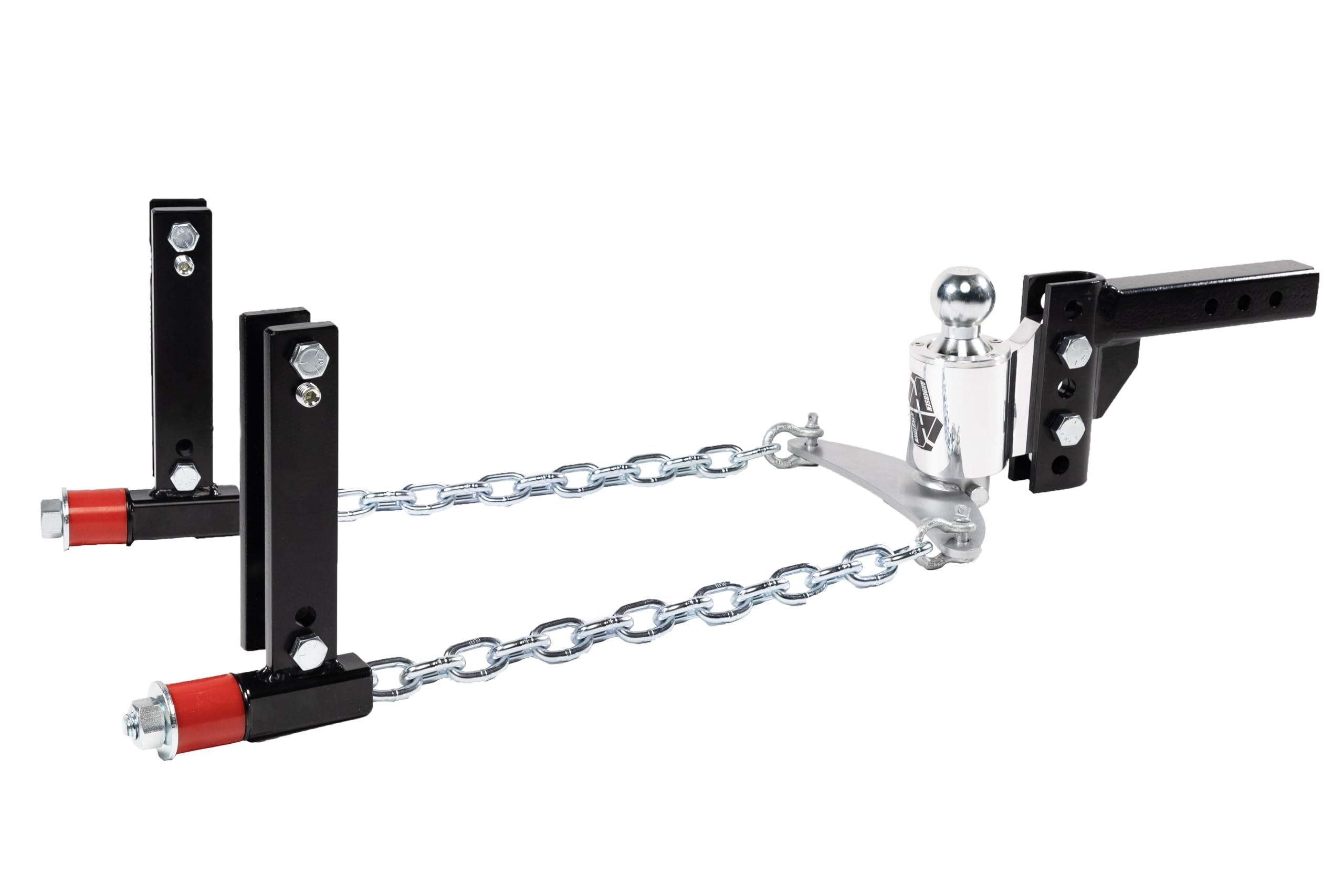
Andersen takes a different path: instead of 78-pound spring bar assemblies, it uses a tension-chain system with a friction cone integrated into the ball housing. The total hitch weight is just 49 lbs, making installation and removal a one-person job. This system is rated for up to 14,000 lbs GTWR, which covers most triple-axle travel trailers. The patented design eliminates the need for heavy spring bars, and owners consistently report near-silent towing — no groaning or clanking on turns, a welcome break from traditional WDH noise.
The ball housing houses a urethane friction cone that actively resists sway as the trailer rotates across the ball. The tension chains pull the trailer and truck together, distributing weight while allowing two inches of lateral articulation for sway dampening. Setup requires selecting the correct bracket height (3, 4, 5, or 6 inches — not the standard 7/8-inch bracket on this model, so high-head-angle setups need the larger variant). Owners of F-150s towing 29-foot travel trailers report zero sway at 65 mph in crosswinds, and the lack of a backing restriction makes campground navigation seamless.
A reported customer service anecdote stands out: one owner received a replacement missing part overnight via video call, reflecting the kind of support that matters when a camping trip is on the line. The chain system does not stop porpoising (the bouncing sensation) as effectively as spring bars; keeping cargo over the trailer axles is still required. The ball is included in this model, which simplifies purchase, and the American-made claim is backed by owners confirming consistent weld quality and powder coat adhesion after years of use.
Why it’s great
- Ultra-light 49 lbs design makes it the easiest WDH to handle alone.
- Near-silent towing with no metal-on-metal noise on turns.
- Customer support is responsive and replacement parts arrive quickly.
Good to know
- Bounce (porpoising) is reduced less effectively than spring bar systems.
- Maximum towing capacity may be limited with smaller spring bar options.
- Setup requires careful bracket selection; buying extra bracket sizes may be necessary.
3. Andersen Hitches 3380.25 (2.5-in Shank, 8-in Drop)

Designed for lifted trucks and heavy campers, this Andersen variant swaps the 2-inch shank for a 2.5-inch shank and extends the drop range to 8 inches. The 16,000 lbs GTWR rating accommodates large fifth-wheel-style bumper-pulls and heavy toy haulers. The four bracket options — 3, 4, 5, and 6 inches — allow precise head angle adjustments that are critical when the receiver sits high off the ground. Owners of F-250s towing 7,000 lb travel trailers report that the setup eliminated both sway and porpoising, restoring a planted feel even when pushed by crosswinds.
The tension chain mechanism is identical in principle to the 3350D, but the larger shank and drop range address a specific market: trucks with factory lift kits, aftermarket leveling kits, or heavy-duty chassis that raise the receiver opening 24 inches or more off the ground. At 54 lbs, it remains manageable, and the included 2-5/16-inch ball means no separate purchase. The friction cone fights sway continuously without requiring chain detachment for backing, a convenience that owners of long campers especially appreciate when maneuvering in tight spaces.
One owner logged 12,000 miles over two seasons with a 32-foot enclosed trailer and reported no noise, no rust, and no need to adjust tension after the initial setup. The biggest challenge is achieving correct tension: if the chain extension kit is needed for A-frame accessories, you must buy it separately. The hitch is compatible with surge brakes (rare for a WDH), making it uniquely versatile for boat towers who also camp. The American construction is confirmed by stamping on the shank, and the manufacturer backs it with a lifetime warranty.
Why it’s great
- 16,000 lbs GTWR handles the heaviest bumper-pull campers.
- 2.5-inch shank and 8-inch drop are essential for lifted trucks.
- Quiet, light, and easy to install compared to spring bar systems.
Good to know
- Chain extension kit may be required for trailers with certain A-frame designs.
- Bracket selection requires careful measurement; wrong size reduces effectiveness.
- Premium price reflects the heavy-duty rating and construction quality.
4. Husky Towing 30849 Weight Distribution Hitch

The Husky 30849 is a no-nonsense weight distribution hitch built around a bolt-together shank and ball mount assembly. Rated for 12,000 lbs GTWR and 1,200 lbs tongue weight, it sits near the top of the mid-range segment in terms of sheer load capacity. The spring bars are interchangeable between left and right sides, simplifying replacement. The shank provides 8 inches of total height adjustment with a rise of 5-5/8 inches and a drop of 2-3/8 inches, covering most stock-height trucks and SUVs without requiring an adjustable ball mount.
The dual sway control platform accepts an optional friction sway bar, and the hitch head includes a 1-1/4-inch hole compatible with standard sway control brackets. This means you can add sway control post-purchase if your trailer requires it, though the system performs at its best when paired with the manufacturer’s optional sway control. Owners pulling 10,500-lb trailers report that the weight distribution eliminates visible rear squat and restores front tire contact, and that the sway control (when equipped) eliminates sway at highway speeds.
The main criticism centers on installation difficulty. The assembly requires large sockets, a torque wrench capable of 300+ ft-lbs, and clear instructions that some owners describe as vague. The lift brackets make hook-up easier than traditional chain-style systems, and the black powder coat finish resists corrosion well — one owner reported no rust after a season of wet-weather towing. At 104 lbs, this hitch is heavy; carrying it solo is a challenge, and the box can arrive damaged due to weight. The ball (2-5/16 inch) and sway control bar are included, which adds direct value compared to hitches that ship without them.
Why it’s great
- 12,000 lbs GTWR and 1,200 lbs tongue weight maximum capacity.
- Includes 2-5/16 ball and sway control bar — ready to install.
- Durable powder coat finish holds up well against road salt and rain.
Good to know
- Heavy overall package at 104 lbs; two-person lifting recommended.
- Assembly requires high-torque tools not included with the kit.
- Instructions can be vague; experienced installers find it straightforward but beginners struggle.
5. Fastway e2 94-00-0800 Weight Distribution Hitch

The Fastway e2 delivers integrated 2-point sway control at a price that undercuts premium 4-point systems by a meaningful margin. With an 8,000 lbs GTWR and 800 lbs tongue weight rating, it matches well with mid-size travel trailers (typically 20–26 feet) pulled by half-ton trucks and large SUVs. The round bar design uses trunnion-style spring bars that friction against the bracket arms to provide simultaneous weight distribution and sway damping. Owners report that the system eliminates the need for a separate sway bar, and that the braking confidence at highway speeds increases dramatically — one owner noted that even in 40+ mph winds, the trailer stayed stable.
The unit ships with a standard shank and all required hardware, but the ball is not included. The 10-year limited warranty signals durability expectations, and the 78-lb weight makes it manageable for two people to install without a lift. The sway control works without requiring the user to disconnect for backing or tight turns, which is a known hassle with add-on friction sway bars. The installation is straightforward for someone with basic mechanical skills: bolt the head assembly to the shank, torque the ball to spec (a specialty socket may be needed), and set the spring bar tension using the included gauge.
A common note from owners involves the sway bars rubbing and rusting — this is normal for any friction-based design and does not affect function. The brackets fit trailer frames up to 6 inches wide, and the shank offers 12-3/4 inches of ball-to-pin-hole distance. The unit works with trailers equipped with surge brakes, which is rare for a WDH. Some users mention that the backup sensors on modern trucks get triggered by the hitch head’s physical width; one owner solved this by temporarily disabling the rear sensors while towing.
Why it’s great
- Integrated 2-point sway control eliminates need for separate sway bar purchase.
- 10-year limited warranty provides long-term coverage.
- Easy installation for mechanically inclined users; clear instructions.
Good to know
- Sway bars will rub and rust over time; this is normal for friction-based systems.
- Specialty socket for ball torque is not included.
- May trigger rear backup sensors on newer trucks due to hitch head bulk.
6. CURT TruTrack 17500 Weight Distribution Hitch
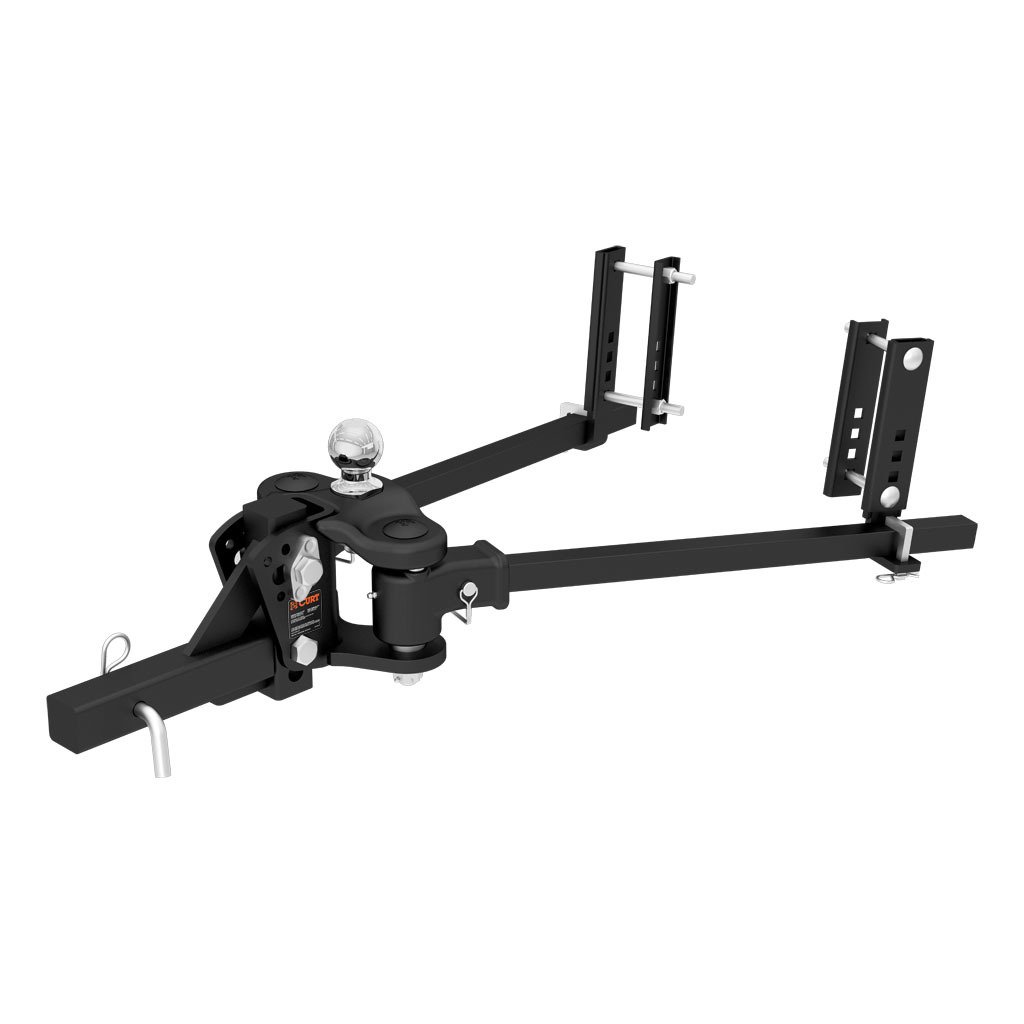
The CURT TruTrack uses a spring and cam system rather than pure friction to provide 4-point sway control. This design mechanically forces the spring bars back into alignment when the trailer begins to sway, rather than simply resisting through friction. Rated for 10,000 lbs GTWR, the system includes a 2-inch shank, a 2-5/16-inch ball, and trunnion-style forged steel spring bars. The welded head and cast pieces create a rigid structure that resists torsional flex when the trailer pushes against it. Owners towing 19-foot campers with F-150s report that the system eliminated sway up to 68 mph, with only very slight movement at 70 mph — a clear improvement over friction-only systems.
The biggest advantage of the TruTrack is its ground clearance. The spring bars mount to the head at a higher point than many competitors, keeping them clear of curbs, driveways, and uneven terrain. The adjustable brackets provide fixed support points rather than relying on chain tension, which simplifies the initial setup — you measure the bracket position and lock it in, then add or remove spring bar tension via the cam mechanism.
However, the TruTrack is best suited for lighter campers in the 3,500 to 6,500 lbs range. Owners report that at loads near the 10,000 lbs maximum, the spring bars feel underspec and the cam mechanism resists adjustment. The 90-degree turn prohibition is also a real constraint: making a tight turns can overstress the cam assembly. The ball is included, which simplifies purchase, but the L-brackets can bend if over-tightened — one owner had to replace the bracket set after applying excessive torque. The limited lifetime warranty covers manufacturing defects but the finish is only covered for one year.
Why it’s great
- Spring & cam system provides active sway correction, not just friction resistance.
- Excellent ground clearance for uneven campsite terrain.
- Faster install than many friction-based WDH systems; typically under 2 hours.
Good to know
- Best for lightweight campers under 6,500 lbs; feels underspec near 10K limit.
- 90-degree turns should be avoided to prevent overstressing cam assembly.
- L-brackets can bend if over-tightened; precise torque is critical.
7. GWTAUTO Adjustable Trailer Hitch with Hook, Tri-Ball
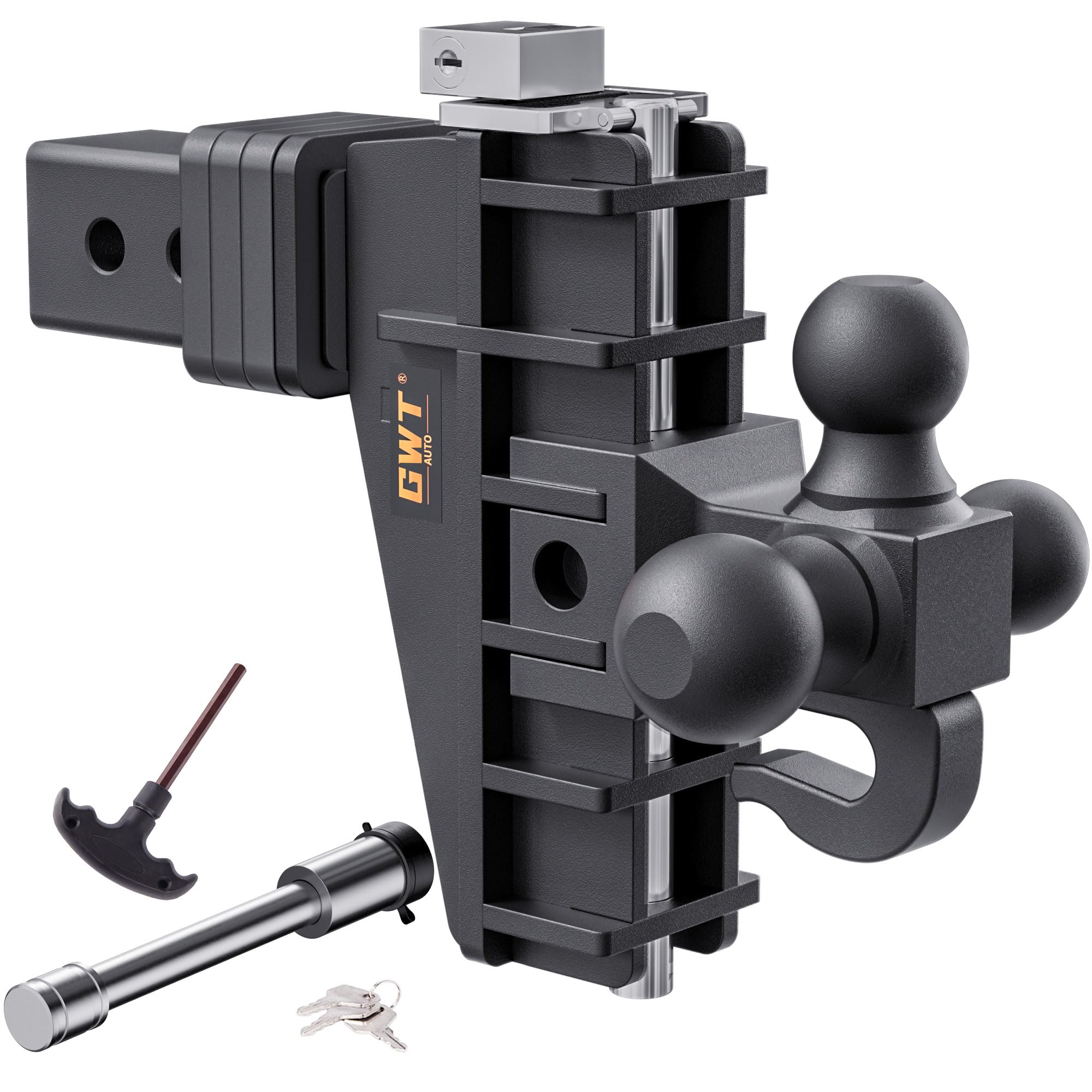
The GWTAUTO Tri-Ball is not a weight distribution hitch — it is a standard adjustable ball mount with a rotatable head that offers three ball sizes (1-7/8, 2, and 2-5/16 inches) plus a recovery hook rated for 10,000 lbs of tension. It fits a 2.5-inch receiver and provides 6 inches of drop adjustment. The 18,500 lbs GTW rating is the maximum gross trailer weight the ball mount can handle, but without weight distribution bars, it cannot transfer tongue weight to the front axle. This limits its safe use to lighter campers where tongue weight stays under 350–400 lbs and the tow vehicle can handle the squat.
The inclusion of a hook completes a recovery-rated solution, something rare in camper hitch designs. The screw-adjustable anti-rattle mechanism uses an iron pad and hex socket to narrow the gap between the shank and the receiver tube, eliminating the clunk and chatter that many standard ball mounts produce. Owners report that the build quality is impressive for the price category — they describe the welds as consistent and the powder coat as thick. One owner who hauls a skid steer at roughly 14,000 lbs noted zero bounce or noise, though the trailer was likely well within the weight distribution limits of his F-350.
The main limitation is the lack of integrated sway control. Owners have reported that the anti-vibration spacers are ineffective at preventing the shank from rattling loose over long distances — the hex-wrench screw system is good at stopping vertical play but cannot prevent lateral wobble. The hook is also narrow, requiring a soft loop recovery device rather than a standard clevis. The overall weight of 17.7 kg (about 39 lbs) makes it manageable for one person to install. This is a solid choice for owners who need multiple ball sizes for different trailers and want a recovery point, but who also understand the limits of a non-WDH setup.
Why it’s great
- Three ball sizes in one unit eliminate the need to swap ball mounts between trailers.
- Integrated recovery hook adds a secondary utility function for off-road or farm use.
- Anti-rattle screw system reduces receiver clunk significantly.
Good to know
- Not a weight distribution hitch; does not transfer tongue weight.
- Anti-vibration feature struggles with lateral wobble over long distances.
- Recovery hook is narrow; only works with soft loop devices, not standard shackles.
8. XPE Adjustable Trailer Hitch (2-inch Ball)

The XPE adjustable hitch brings an 22,000 lbs gross trailer weight rating and 8 inches of drop/rise adjustment at a price point that undercuts most competitors. It fits a 2.5-inch receiver and ships with both a 2-inch and a 2-5/16-inch ball, giving users two common ball diameters in one package. The shank is made from 8mm-thick alloy steel with a black powder coat over corrosion-resistant zinc plating, and the welds — done by German-sourced robots — are consistently reported as clean and smooth by owners. For those hauling livestock trailers, skid steer loaders, or heavy utility trailers, this is a high-capacity standard ball mount that provides the adjustability needed when swapping between vehicles with different receiver heights.
The 8-inch adjustment range in 1-inch increments provides mechanical flexibility without requiring a separate adjustable shank. The weight — 17.69 kg (39 lbs) — is reasonable for a ball mount of this capacity. Owners report that it sits solidly in the receiver with minimal noise, and that the adjust collar locks positively into each position. The anti-theft pin is a nice security addition for those who leave the hitch mounted on a truck bed or in an open garage.
The most significant limitation is the same as the GWTAUTO — it is a standard ball mount, not a weight distribution system. At 22,000 lbs GTW, the tongue weight potential is high, and without weight distribution bars, the rear axle of a half-ton truck will squat severely under a heavy camper. The intended use case is heavy utility towing where the load is balanced over the axle, not campers with high tongue weight percentages. A few owners note that the powder coat finishes can chip at the adjustment collar if the hitch is frequently changed between vehicles, though this is cosmetic rather than structural. The weld quality is confirmed by most reviews as excellent, and the price for this capacity makes it an entry-level high-value option.
Why it’s great
- 22,000 lbs GTW rating at a budget-friendly price point.
- 8-inch drop/rise range accommodates different tow vehicle heights.
- 2-inch and 2-5/16-inch balls included in the package.
Good to know
- Not a weight distribution hitch; unsuitable for high-tongue-weight campers without WDH.
- Powder coat can chip at adjustment collar with frequent height changes.
- Heavy for a standard ball mount due to 8mm-thick steel construction.
9. Curt 13135 Class 3 Trailer Hitch
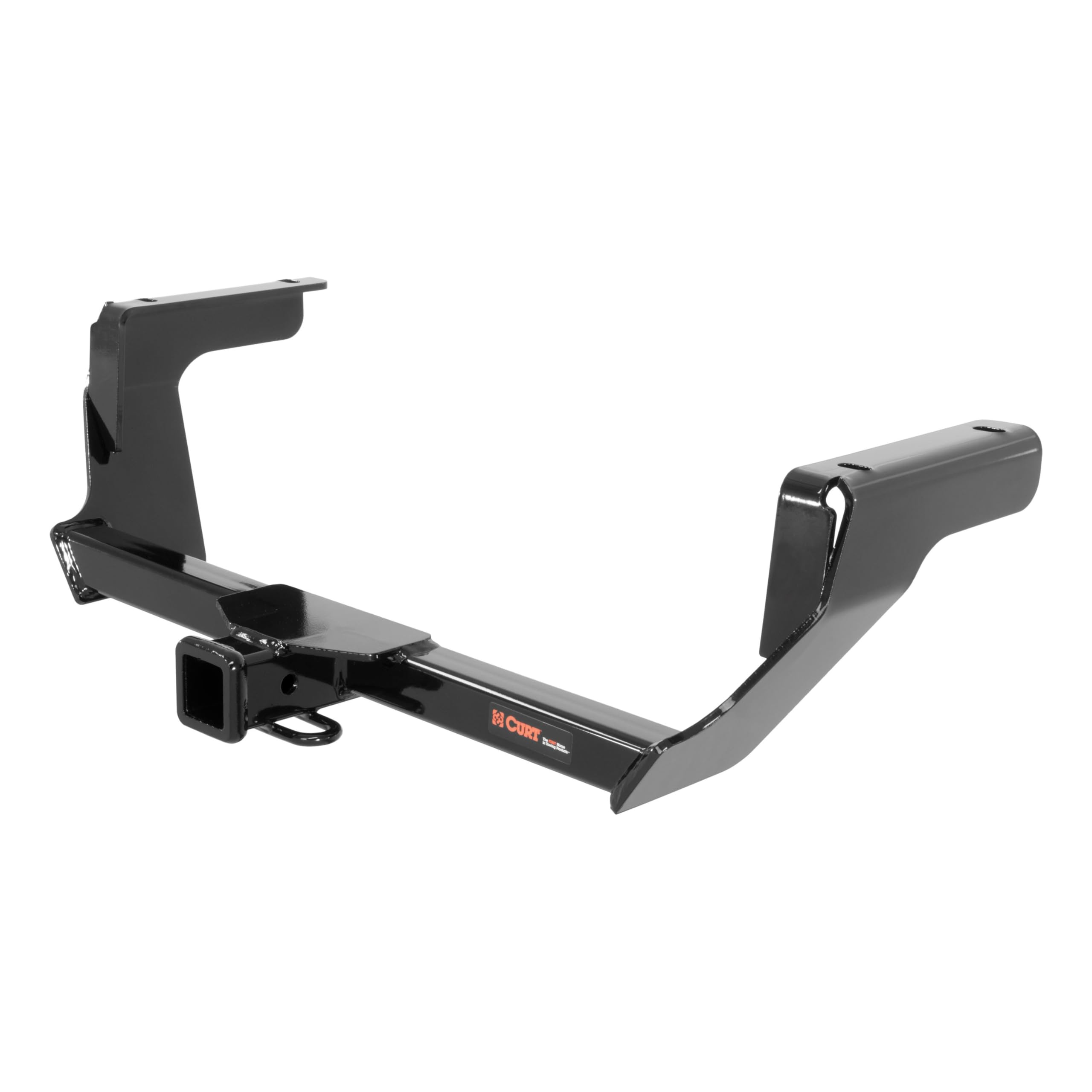
The Curt 13135 is a vehicle-specific Class 3 fixed hitch for the Subaru Crosstrek and XV models. Rated for 3,500 lbs GTW and 525 lbs tongue weight, it is designed for small campers (such as teardrops and pop-ups) and lightweight utility trailers. It is not an adjustable ball mount or a weight distribution system — it is the foundation piece that bolts to the vehicle frame and accepts a ball mount. The vehicle-specific design means it contours to the Crosstrek frame rails and uses existing bolt holes plus two holes that must be enlarged with a round file. The 34-lb weight is light compared to universal hitches, and the powder-coated carbon steel construction resists road salt and moisture well.
The installation process is known to take about 45 minutes to an hour, with the hardest step being widening the two forward frame holes by about 1/4 inch using a round file (a Dremel tool also works). The included spacers add a 2–3 degree upward angle to the receiver tube, which improves ground clearance when the vehicle is loaded. A 90-degree needle-nose pliers is recommended for installing the fishwire spacers, though many owners report skipping the fishwire system entirely and using double-sided tape to hold the spacers in place. The welds are consistently described as excellent, with the paint finish surviving multiple winters without peeling.
This is a niche product for owners of compact SUVs who want to tow a small camper or a bike rack. It does not provide any drop, rise, or sway control — those features must come from the ball mount or WDH attached to the receiver. The 3,500 lb GTW rating limits its use to the smallest campers, and owners looking to tow a full-size travel trailer should move up to a Class 4 or 5 hitch. The price is significantly lower than the dealer-installed alternative (often quoted at ), making this a strong budget-first option for Crosstrek owners who already own a separate ball mount.
Why it’s great
- Vehicle-specific design ensures a perfect, rattle-free fit on Subaru Crosstrek/XV.
- Light weight (34 lbs) reduces impact on fuel economy.
- Powder coat finish holds up well against corrosion in wet climates.
Good to know
- Requires enlarging two frame holes with a round file during installation.
- 3,500 lbs GTW rating limits use to small pop-up or teardrop campers only.
- Included spacers require careful positioning; fishwire method can be fiddly.
FAQ
Can I use a standard ball mount for my camper instead of a weight distribution hitch?
Do I need to disconnect sway control to back up in a tight campsite?
What happens if my hitch ball does not include the right shank length for my weight distribution hitch head?
How do I measure the correct drop or rise for my receiver and camper coupler?
Can I use a weight distribution hitch on a trailer with surge brakes?
Final Thoughts: The Verdict
For most users, the best camper hitch winner is the Equal-i-zer 90-00-1000 because its patented 4-point sway control, 10,000 lbs GTWR, and lifetime warranty deliver the safest, most confidence-inspiring towing experience for mid-size and large travel trailers. If you want a lighter, quieter alternative with easier hookup, grab the Andersen 3350D. And for owners of lifted trucks towing 7,000+ lbs campers who need a 2.5-inch shank and an 8-inch drop, nothing beats the Andersen 3380.25.