
A handmade card starts with the right blank canvas and the right tools. Too many crafters grab a generic kit only to discover the paper bleeds, the stamps lack detail, or the envelopes are too thin to mail. The difference between a card that looks store-bought and one that looks homemade—in the wrong way—comes down to material quality and spec knowledge.
I’m Min — the co-founder and writer behind Gadgets Feed. I’ve spent countless hours researching card stock weights, ink pad formulations, stamp silicone densities, and envelope sizing to separate the true craft staples from the disposable fillers.
Once you understand what 300 GSM card stock feels like versus 180 GSM, why cold-pressed watercolor paper matters, and how 0.7mm glitter marker tips behave on dark surfaces, you’ll know exactly which card making supplies deserve a permanent spot on your desk.
How To Choose The Best Card Making Supplies
Every card starts with a substrate and ends with a tool. If you pick the wrong paper weight or the wrong ink system, no amount of skill can salvage the final result. The core decisions come down to three layers: the base material (card stock or watercolor paper), the marking tool (stamps, markers, or ink pads), and the finishing components (envelopes and embellishments).
Paper Weight and Core Dye
Measured in GSM (grams per square meter), card stock below 200 GSM feels flimsy and buckles under wet media. For standard greeting cards, 250–300 GSM is the sweet spot—sturdy enough to hold shape in an envelope without extra postage. Core-dyed card stock, where the color runs through the entire sheet rather than sitting on the surface, prevents ugly white lines when you fold, tear, or punch the paper. This is critical for projects where the edge is visible, like layered card toppers or die-cut shapes.
Stamp Material and Ink Type
Clear silicone stamps offer precision because you can see exactly where you’re placing the image through the block. The durometer (softness) of the silicone determines how fine the detail transfers—softer silicone captures intricate lines but can deform under heavy pressure. Dye-based inks dry fast and are water-soluble, making them ideal for stamping on coated card stock. Pigment inks sit on top of the paper, giving richer, more opaque color, but they take longer to dry and require heat setting on non-porous surfaces. Always match your ink type to your paper’s coating.
Quick Comparison
On smaller screens, swipe sideways to see the full table.
| Model | Category | Best For | Key Spec | Amazon |
|---|---|---|---|---|
| Grabie Glitter Markers 24 Pack | Premium | Shimmer detail on dark paper | 0.7mm fine tip, water-based acrylic | Amazon |
| Aunt Kaylee’s Card Making Kit | Premium | All-in-one beginner kit | 24 cards + stamp set + embellishments | Amazon |
| Silunkia 100 Pack Blank Cards | Mid-Range | Bulk batch card making | 300 GSM card stock, 10 colors | Amazon |
| KOVIEDE Watercolor Cards 50 Pack | Mid-Range | Watercolor and wet media | 140 lb / 300 GSM 100% cotton | Amazon |
| LIVHOLIC 48 Pack Folded Cards | Mid-Range | Color variety for occasions | 250 GSM card stock, 24 colors | Amazon |
| GLASSWINDS 29 Pcs Stamp Set | Mid-Range | Stamping beginners | 3 acrylic blocks + 6 silicone sheets | Amazon |
| TUXIYA 800 Sheets Card Stock | Budget | High-volume classroom projects | 180 GSM, 50 assorted colors | Amazon |
In‑Depth Reviews
1. Grabie Glitter Markers, 24 Pack Extra Fine Tip Acrylic Paint Markers
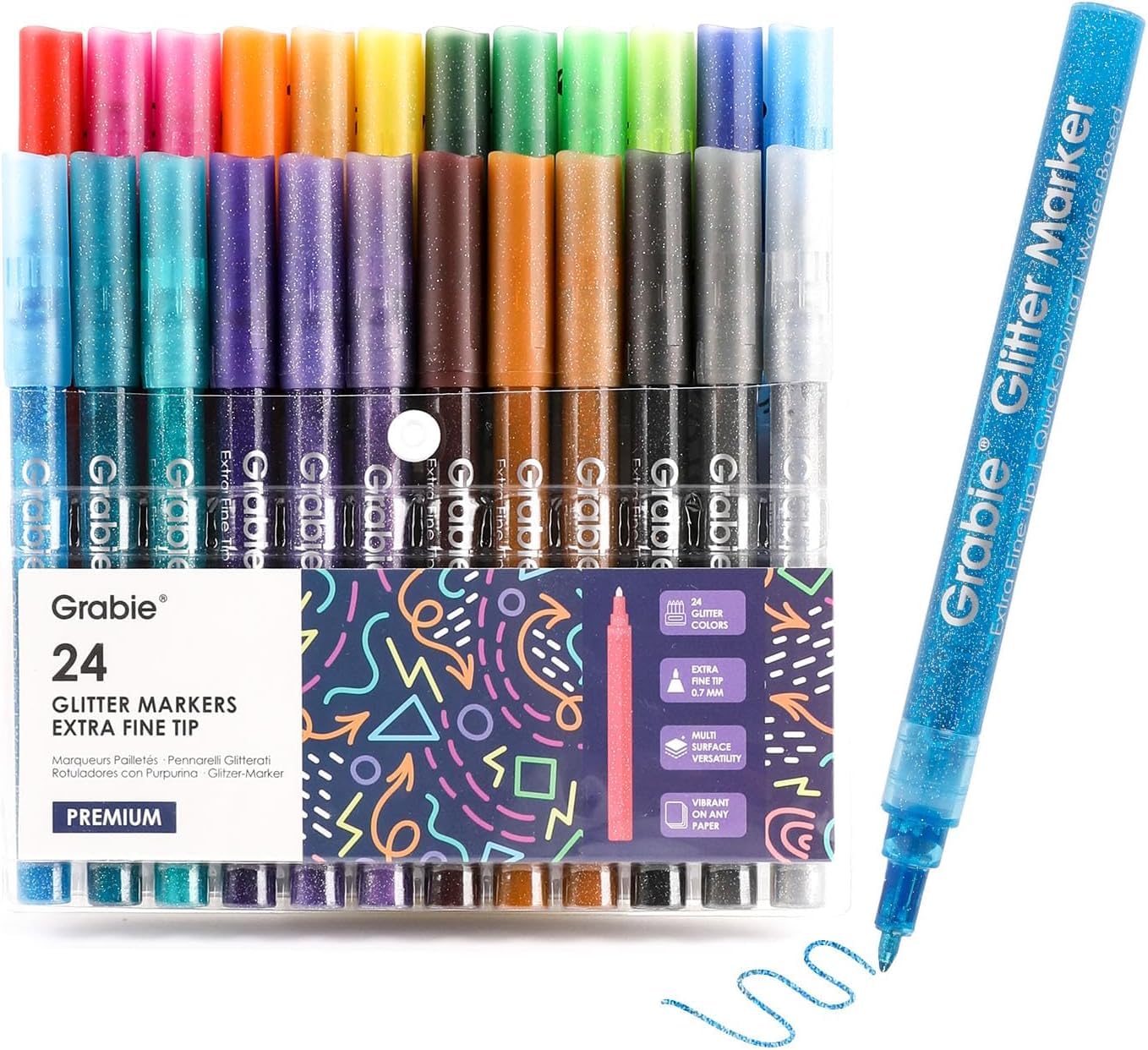
The 0.7mm extra-fine plastic tip delivers precise, skip-free lines that hold detail even on textured card stock. The iridescent chameleon effect shifts color under different lighting angles, which is rare in a water-based glitter formulation. Because the ink is water-based acrylic, it adheres to dark, non-porous surfaces like black card stock without soaking in—something dye-based markers simply cannot do. The set includes 24 distinct colors, each with visible shimmer particles suspended in the pigment base.
Reviewers consistently note that the ink flow is generous and requires priming—shaking the marker with the cap on before each use to re-suspend the glitter. On standard 80 GSM printer paper, bleed-through is noticeable, but on 250 GSM card stock or higher, the markers dry quickly and leave a smooth, dimensional finish. The included five coloring cards are a thoughtful addition for immediate play, but experienced card makers will skip those and go straight to their own blank stock.
The primary trade-off is the tip durability. Fine plastic tips dry out faster than bullet-tip alternatives if left uncapped, and the glitter particles can cause slight feathering on coated papers. For intricate lettering and delicate floral details on dark backgrounds, these markers deliver a visual pop that no standard acrylic pen can match. They are a dedicated finishing tool, not an everyday writer, and they excel in that specific role.
Why it’s great
- True iridescent chameleon color shift on dark surfaces
- 0.7mm tip allows fine lettering and detailed outlines
- Water-based formula is non-toxic and odorless
Good to know
- Requires shaking to re-suspend glitter before each use
- Bleed-through on thin or standard-weight paper
- Tip can dry out if cap is left off for extended periods
2. Aunt Kaylee’s Card Making Kits For Adults And Kids

This kit packs everything needed to finish 24 complete cards without a trip to the craft store. The included 5×7 inch blank cards and coordinating envelopes provide the substrate, while the bonus stamp kit adds three colored ink pads, an acrylic stamp block, and multiple sheets of clear silicone stamps. The designer cutouts, adhesive gemstones, pearls, stickers, and glitter tape handle the embellishment layer. For someone who has never made a card from scratch, this removes the paralysis of choice—every element is curated to work together visually.
Reviewers highlight the variety of themed supplies: enough hearts and stickers for Valentine cards, enough general sentiments for birthdays and thank-yous, and a stamp set that covers multiple occasion types. The card stock weight feels substantial in hand—consistent with a mid-grade 250-ish GSM paper that accepts stamping and glue without warping. The silicone stamps adhere well to the acrylic block and release cleanly after pressing, which is a common failure point in cheaper kits where stamps slide during transfer.
The packaging is a double-edged sword. The designer gift box looks premium enough for gifting, but several buyers reported dented boxes or unsealed shrink wrap on arrival, which compromises the presentation if you planned to give the kit as a present. Also, the ink pads are small—roughly 1.5 x 1 inch—and will run dry faster than full-size pads. For a self-contained starter experience, this kit provides the highest density of usable components per dollar spent.
Why it’s great
- Complete 24-card set with stamps, inks, and embellishments included
- Silicone stamps release cleanly from the acrylic block
- Packaged in a gift-ready box for presentation
Good to know
- Ink pads are small and may dry quickly with heavy use
- Shipping box sometimes arrives dented or unsealed
- Not refillable—once supplies run out you need separate purchases
3. Silunkia 100 Packs 10 Assorted Colors Blank Note Cards and Envelopes

At 300 GSM, Silunkia’s card stock sits at the thicker end of the standard greeting card range—sturdy enough to hold wet watercolor washes and layered paper toppers without bending. The set includes 100 cards distributed across 10 colors: red, pink, green, light green, orange, blue, purple, light purple, yellow, and cream. Each color is printed on both sides, which matters when you fold the card and want the interior to match the exterior. The A4 envelopes use a self-seal adhesive pull strip, eliminating the need for glue sticks or licking flaps.
Reviewers consistently praise the thickness and the fact that the card stock takes inkjet and laser printer output without smearing—the surface is smooth enough for photo printing but has a slight tooth that holds colored pencil and watercolor without immediate soak-through. The pre-scored fold line eliminates cracking on the crease, a common issue with cheap card stock where the coating splits. The 120 GSM envelopes are heavier than the standard office envelope, which reduces the risk of tearing during mailing.
The color selection is limited to 10, which may feel restrictive if you need pastels or neon shades for specific projects. Some users noted that the cream color reads more beige in person, slightly duller than the product images suggest. For bulk card making—birthday invites, thank-you notes, baby shower announcements—this is the most efficient way to get 100 professional-grade card bases without ordering multiple packs.
Why it’s great
- 300 GSM card stock resists warping with wet media
- Self-seal envelopes with pull-tab adhesive
- Printer-compatible surface with no ink smearing
Good to know
- Only 10 color options, no pastels or neons
- Cream color appears somewhat dull compared to listing photos
- Box is bulky—storage space needed
4. KOVIEDE 50 Pack Foldable Blank Watercolor Cards with Envelopes

These 4×6 inch blank cards are made from 100% cotton cold-pressed watercolor paper, which provides the fibrous surface texture necessary for wet-on-wet watercolor techniques. The 300 GSM weight (equivalent to 140 lb) means the paper can absorb multiple washes without buckling—critical when the card needs to lie flat in an envelope after painting. The cold-pressed medium texture holds pigment in the valleys of the paper, giving watercolor paintings that characteristic soft edge rather than a hard, puddled line. Included are 50 white envelopes with gummed flaps.
Reviewers who use wet media confirm that the paper does not pill or warp under normal water-to-pigment ratios. The acid-free composition ensures that artwork won’t yellow or fade over time, which matters for keepsake cards meant to be cherished. The 4×6 size is large enough for a meaningful painting but small enough to mail within a standard A6 envelope without additional postage. The included postcards are a bonus—same 100% cotton paper stock, but uncoated on the back for stamping and addressing.
The limitation is the surface texture: cold-pressed paper has a visible tooth that can interfere with fine-line stamping. Rubber stamps and fine-tip markers may not transfer cleanly to the uneven surface, so this pack is best reserved for watercolor-specific projects rather than mixed-media stamping. The envelopes, while perfectly fitting, are standard gummed-style and require moisture to seal. For card makers whose primary medium is watercolor paint, these cards perform at a professional level.
Why it’s great
- 100% cotton cold-pressed paper handles wet washes without warping
- Acid-free for archival-quality keepsakes
- 300 GSM weight prevents bleed-through on heavy applications
Good to know
- Textured surface is not ideal for fine stamping or fine-liner pens
- Envelopes require moisture to seal (gummed flap)
- 4×6 format may feel small for elaborate multi-layer designs
5. LIVHOLIC 48 Pack Blank Folded Cards and Envelopes

With 24 different colors in a single 48-card pack, LIVHOLIC offers the broadest palette among the card base options. Each 5×7 inch folded card is made from 250 GSM card stock—slightly lighter than the premium 300 GSM options but still thick enough to hold its shape in a standard A7 envelope. The interior is white on all cards, which means any handwritten message is legible regardless of the exterior color. The white 120 GSM envelopes coordinate with the cards visually without competing through color matching.
Reviewers frequently mention the color accuracy: the reds are true red, the mints are soft, and the blues span from turquoise to navy. The card stock is compatible with laser, inkjet, and copier printers—the surface accepts toner without pooling and dries quickly. The pre-scored fold is clean, and the paper does not split along the crease. For photo cards, the white interior provides a neutral backdrop that makes printed images pop without fighting a colored background.
The 250 GSM weight is the main compromise. Compared to 300 GSM cards, these feel slightly less substantial in hand, and heavy wet media like acrylic paint or thick watercolor washes may cause slight warping. The envelopes are standard office quality—functional but not luxurious. For a card maker who needs many color options for different occasions and doesn’t plan to use heavy wet media, this is the most versatile color range available in this tier.
Why it’s great
- 24 different colors provide maximum variety for occasion matching
- White interior makes handwritten messages easy to read
- Printer-compatible surface with fast drying time
Good to know
- 250 GSM is lighter than premium card stock options
- May warp slightly with thick wet media applications
- Envelopes are standard office grade, not premium weight
6. GLASSWINDS 29 Pcs Acrylic Stamps for Crafting Card Making Supplies Set

This 29-piece set centers on the stamping workflow: three clear acrylic blocks ranging from 2×2 inches to 5.9×2 inches, six sheets of clear silicone stamps, and 20 mini ink pads. The silicone stamps cover six thematic categories—blessing words, vintage stamps, calendar labels, stained backgrounds, insects, and wildflowers. Each sheet is 4.3×6.3 inches, giving you a dense array of individual images per sheet. The acrylic blocks are etched with grid lines on one side, which helps with alignment when positioning multiple stamps on a single composition.
Reviewers are split sharply on the ink pads: the stamps themselves receive consistent praise for their fine detail and easy cleaning with water, but the included ink pads are described as tiny, thin, and low-pigment. Several buyers noted that the ink does not fully cover the stamp surface, resulting in patchy impressions. The solution is to use the stamps with your own full-size pigment or dye ink pads—the silicone quality justifies the purchase, but the ink pads are essentially disposable. The stamp variety includes both full sentiments and individual images, enabling layered card scenes without buying multiple sets.
The stamps store well on the transparency backing sheets and can be repositioned on the acrylic block easily. The silicone has enough tack to stay put during stamping but releases cleanly without leaving residue. The main caveat is the learning curve: new stampers sometimes apply too much pressure, causing the detailed lines of the insect and flower stamps to blur. For the price, you get a functional stamping ecosystem that needs only a better ink pad to produce professional results.
Why it’s great
- Six thematic stamp sheets cover a wide range of card occasions
- Acrylic blocks with grid lines aid in alignment
- Silicone stamps clean easily with water and reposition well
Good to know
- Included ink pads are tiny and low-quality—plan to replace them
- Ink coverage is thin and may produce patchy impressions
- Fine detail stamps require light, even pressure
7. TUXIYA 800 Sheets 8.5″ X 11″ Colored Cardstock
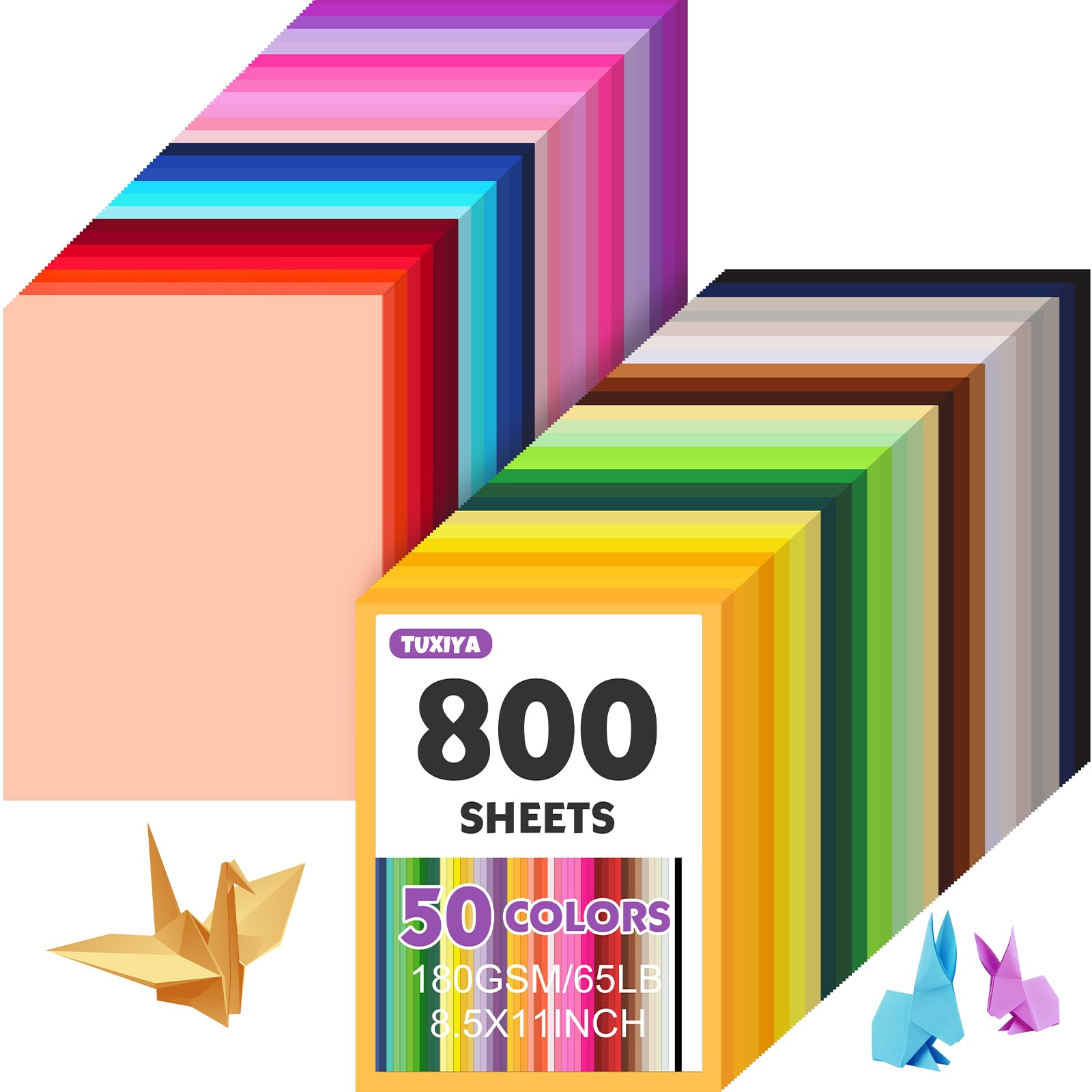
At 800 sheets across 50 colors with a price point that lands well below most per-sheet competitors, TUXIYA’s card stock is a volume play for heavy-use environments—classrooms, community craft groups, and card makers who burn through bases quickly. The 180 GSM weight is lighter than true greeting card stock (250-300 GSM is standard), but it is heavier than printer paper and qualifies for most crafting applications where the card will not carry heavy wet media. The full-core dye means the color runs through the entire sheet, so punched edges and folded creases do not expose white fibers.
Reviewers confirm that the paper holds up to markers, gel pens, and light watercolor without immediate bleed-through, though heavy washes will soak through due to the lower GSM. The 8.5×11 format is a double-edged sword: it fits standard printers for custom printing, but you must cut and fold each sheet to card size rather than having pre-folded blanks. The 50-color palette includes both standard shades (red, blue, green, yellow) and fluorescents (fluorescent green, fluorescent orange, fluorescent vermilion), giving you more variety than most 24-color packs.
The primary limitation is the weight. At 180 GSM, folded cards feel less substantial than store-bought greeting cards, and the paper can crease more easily under pressure. Additionally, some colors are not consistent across batches—early buyers noted slight shade variations between the listing photos and the physical product, particularly in the gray and lavender tones. For bulk applications like party decorations, classroom crafts, and simple one-layer cards, this pack delivers an unbeatable cost per sheet.
Why it’s great
- 800 sheets at a low per-sheet cost for high-volume projects
- Full-core dye prevents white edges on cuts and folds
- 50 colors include fluorescent shades not found in standard packs
Good to know
- 180 GSM is lighter than standard greeting card weight
- Requires cutting and folding—no pre-folded blanks
- Some colors may have slight shade variation between batches
FAQ
What GSM card stock should I use for layered card toppers?
Can I use watercolor paints on standard 250 GSM card stock?
Why do my clear silicone stamps slide on the acrylic block?
Final Thoughts: The Verdict
For most users, the card making supplies winner is the Silunkia 100 Pack Blank Cards because the 300 GSM card stock, self-seal envelopes, and 10-color variety cover the broadest range of projects without compromise. If you want shimmer on dark paper and detailed glitter lettering, grab the Grabie Glitter Markers 24 Pack. And for a complete all-in-one experience that includes stamps and embellishments for a beginner, nothing beats the Aunt Kaylee’s Card Making Kit.