
Nothing kills the joy of a new aftermarket stereo faster than losing the steering wheel controls you relied on every day. Volume up, track skip, answer a call — all of it goes dead the moment you swap out the factory head unit without the right adapter. The interface between your car’s data bus and your new radio is the only thing standing between you and a frustrating, distracted driving experience.
I’m Min — the co-founder and writer behind Gadgets Feed. I’ve spent hundreds of hours cross-referencing CAN-Bus protocols, resistive steering wheel circuits, and aftermarket radio compatibility charts to identify exactly which adapters actually preserve OEM chimes, amplifier integration, and button functionality across the widest range of vehicles. This guide separates the plug-and-play winners from the wiring-schematic nightmares.
Whether you drive a GM truck, a Ford sedan, or a Honda crossover, retaining factory steering wheel controls and safety chimes after upgrading your radio comes down to one critical purchase, and this guide will help you find the best steering wheel controls adapter for your specific vehicle and budget.
How To Choose The Best Steering Wheel Controls Adapter
A steering wheel controls adapter is not a generic purchase — it is a vehicle-specific bridge between your factory data bus and your aftermarket radio. Buying the wrong version or skipping the compatibility check is the single largest cause of returns in this category. Focus on three variables: your car’s communication protocol, your stereo brand, and whether you need full CAN-Bus integration or a simpler analog data stream.
Know Your Vehicle’s Communication Protocol
Older GM vehicles (roughly 2000-2013) use a Class II serial data bus, while many Ford and Chrysler models shifted to MSCAN and CAN-Bus systems. Adapters like the Scosche GM2K-WP are hard-coded for Class II, while the PAC C2R-FRD1 is built for Ford’s MSCAN bus. If you plug a Class II adapter into a CAN-Bus vehicle, the steering wheel buttons will not register a single command. Check your vehicle’s production year against the adapter’s advertised model range — the fit guide images on Amazon product pages are not optional reading.
Match the Adapter to Your Aftermarket Stereo Brand
Not all SWC adapters are brand-agnostic. Universal interfaces like the iDatalink Maestro SW and the PAC SWI-CP2 work with dozens of radio brands (Sony, Pioneer, Kenwood, Alpine, Boss, Atoto), but they require a firmware flash via USB or an app to map the correct button protocol. On the other hand, vehicle-specific harnesses like the Crux SWRGM-48 are pre-programmed and detect your radio brand automatically through the wiring — but they only work on the exact vehicle platform listed. If your stereo is an off-brand or a very old model, a universal programmable adapter is safer.
Decide Whether You Need Full Data Retention or Just Steering Wheel Buttons
Some adapters do more than pass through volume and track controls. If your car has an integrated factory amplifier (common in Bose, THX, or JBL systems), you need an adapter that outputs a remote turn-on signal and retains the amp’s internal crossovers. The Scosche GM3K-WP and the Crux SWRGM-48 both handle this gracefully, while simpler adapters may leave your door speakers dead or your factory subwoofer silent. Also consider safety chimes — if losing the parking brake warning or turn signal click drives you insane, choose an adapter that explicitly retains factory chimes.
Quick Comparison
On smaller screens, swipe sideways to see the full table.
| Model | Category | Best For | Key Spec | Amazon |
|---|---|---|---|---|
| Scosche GM2K-WP | GM Class II | 2000-2013 GM Steering Retention | Class II Data Bus + Chime Output | Amazon |
| PAC C2R-FRD1 | Ford MSCAN | 2005-09 Ford SWC & Amp | MSCAN CAN-Bus + VSS Output | Amazon |
| Motorcraft SW6880 | OEM Switch | Direct Button Replacement | OEM Volume On/Off Switch | Amazon |
| PAC SWI-CP2 | Universal SWC | Multi-Brand Stereo Compatibility | Analog + CAN-Bus Dip Switch | Amazon |
| iDatalink Maestro SW | Universal SWC | Button Remapping & Hold Functions | Programmable Dual-Function Buttons | Amazon |
| Scosche GM3K-WP | GM CAN-Bus | 2006-24 GM Chime & OnStar | CAN-Bus + OEM Amp Integration | Amazon |
| CRUX SWRGM-48 | GM Class II | 2002-13 Bose/Non-Bose Full Integration | Class II + Voice Command Pass-Through | Amazon |
In‑Depth Reviews
1. iDatalink Maestro SW Steering Wheel Control Adapter (ADS-MSW)

The iDatalink Maestro SW is the most flexible universal steering wheel control adapter on the market because it goes beyond simple button retention — it actually adds functionality. Each physical steering wheel button can trigger two distinct actions: a single press for your primary function and a long press for a secondary command. That means your volume up button can also skip to the next track if you hold it, or your call answer button can mute the stereo with a two-second press. This dual-function mapping is not available on most vehicle-specific harnesses, making the Maestro SW a genuine upgrade over factory behavior.
Compatibility is the Maestro SW’s second standout trait. It supports over 1,700 vehicles made after 1998 and works with virtually every major aftermarket radio brand including Pioneer, Kenwood, Alpine, Sony, Boss, and JVC. The programming process requires a USB cable and a computer — you flash the unit through iDatalink’s Weblink Desktop interface, select your vehicle and radio model, then assign button functions. Real-world users report that the setup is significantly easier to troubleshoot than the PAC SWI-RC series, and the press-and-hold customization eliminates the need for extra adapter modules.
The main tradeoff is the soldering requirement. Unlike some plug-and-play harnesses, the Maestro SW expects you to splice into your vehicle’s wiring and solder the connections. This is standard practice for universal adapters, but if you are not comfortable with a soldering iron, the installation time jumps considerably. Additionally, at this price point, it sits at the premium end of the universal SWC market. For anyone who wants maximum button remapping control across multiple future vehicles, however, the Maestro SW is the clear winner.
Why it’s great
- Programmable dual-function press-and-hold per button — volume and track skip from one switch
- Supports over 1,700 vehicle models and all major aftermarket radio brands
- Online firmware creation tool for vehicles not in the default database
Good to know
- Requires soldering and basic wiring knowledge — not a true plug-and-play solution
- Lacks a dedicated ACC power output for data-bus vehicles
2. CRUX SWRGM-48 Radio Replacement Interface
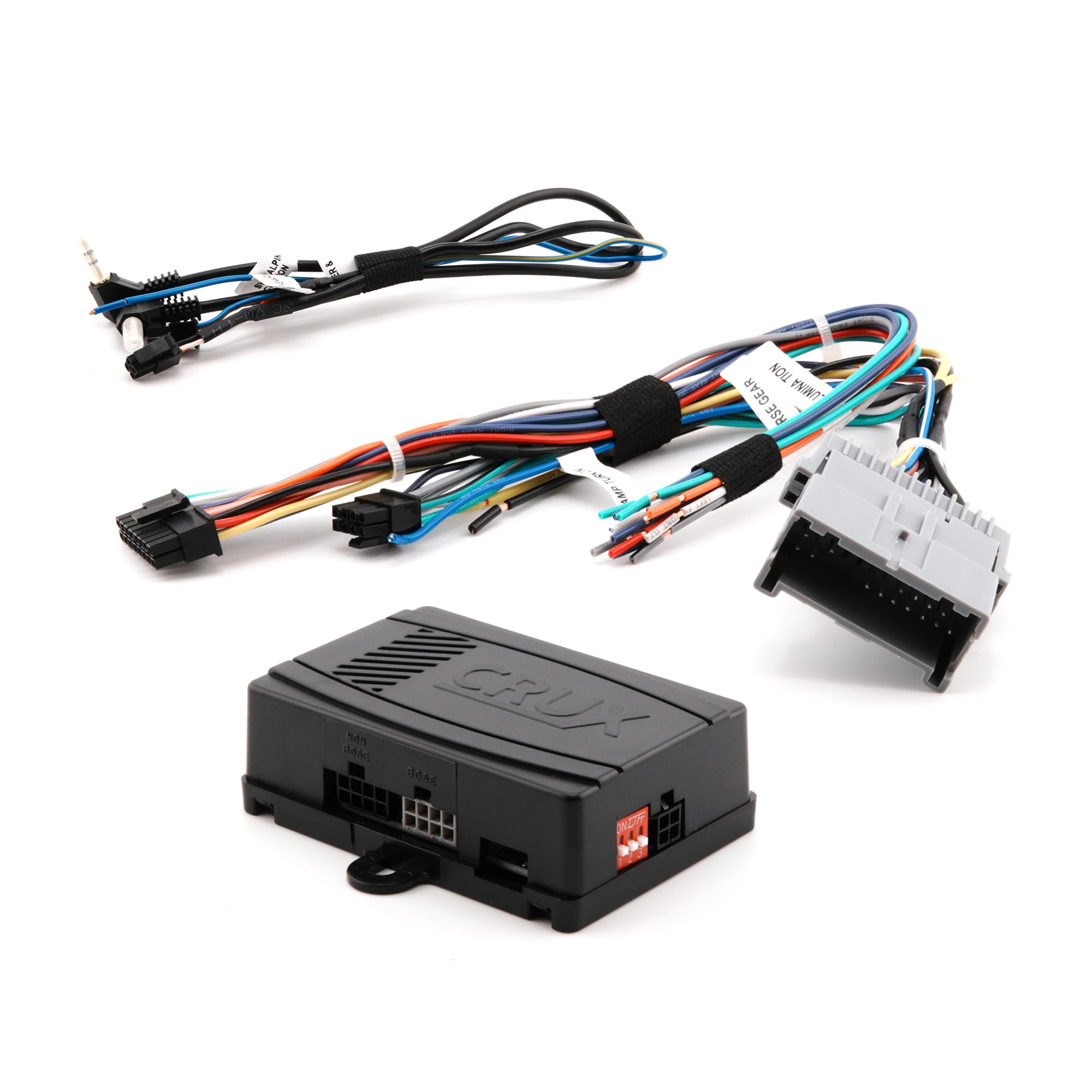
The CRUX SWRGM-48 is the most comprehensive adapter for 2002-2013 GM vehicles with Bose or standard factory audio. Unlike universal interfaces that require manual dip switch configuration or computer flashing, the CRUX unit is pre-programmed out of the box to detect your specific GM platform — Chevy, GMC, Cadillac, Buick, Pontiac — and automatically map the steering wheel controls to your aftermarket radio. It also passes through factory voice recognition commands directly from the steering wheel, a feature rarely found on budget adapters.
Retention of the factory chime system is another CRUX advantage. Many GM adapters kill the door-ajar warning or turn signal click entirely, but the SWRGM-48 preserves those sounds at a lower, less intrusive volume. For vehicles with Bose amplified systems, the interface correctly triggers the external amp turn-on and keeps the factory equalization curve intact. Users with Y91 premium Bose packages report zero sound degradation after installation, and the Metri-pack connectors match the factory plugs exactly — no wire splicing is needed for basic functionality.
The main critique is the connector layout. All four plugs sit on different sides of the small black box, making it awkward to tuck the unit behind the radio cavity. A bit of electrical tape and careful cable routing solves the problem, but it is a minor ergonomic annoyance on what is otherwise a flawless integration piece. For GM owners who prioritize a sold-free, pre-programmed install with full Bose support, the CRUX is the top option.
Why it’s great
- Pre-programmed plug-and-play for 2002-2013 GM vehicles — no computer or dip switches required
- Retains factory voice command, chimes, and Bose amplifier integration out of the box
- Metri-pack connectors match GM factory harnesses for a solder-free install
Good to know
- All four connectors exit from different sides, making cable management behind the radio challenging
- Antenna adapter is not included — must be purchased separately for most installs
3. Scosche GM3K-WP Factory Stereo Replacement Interface
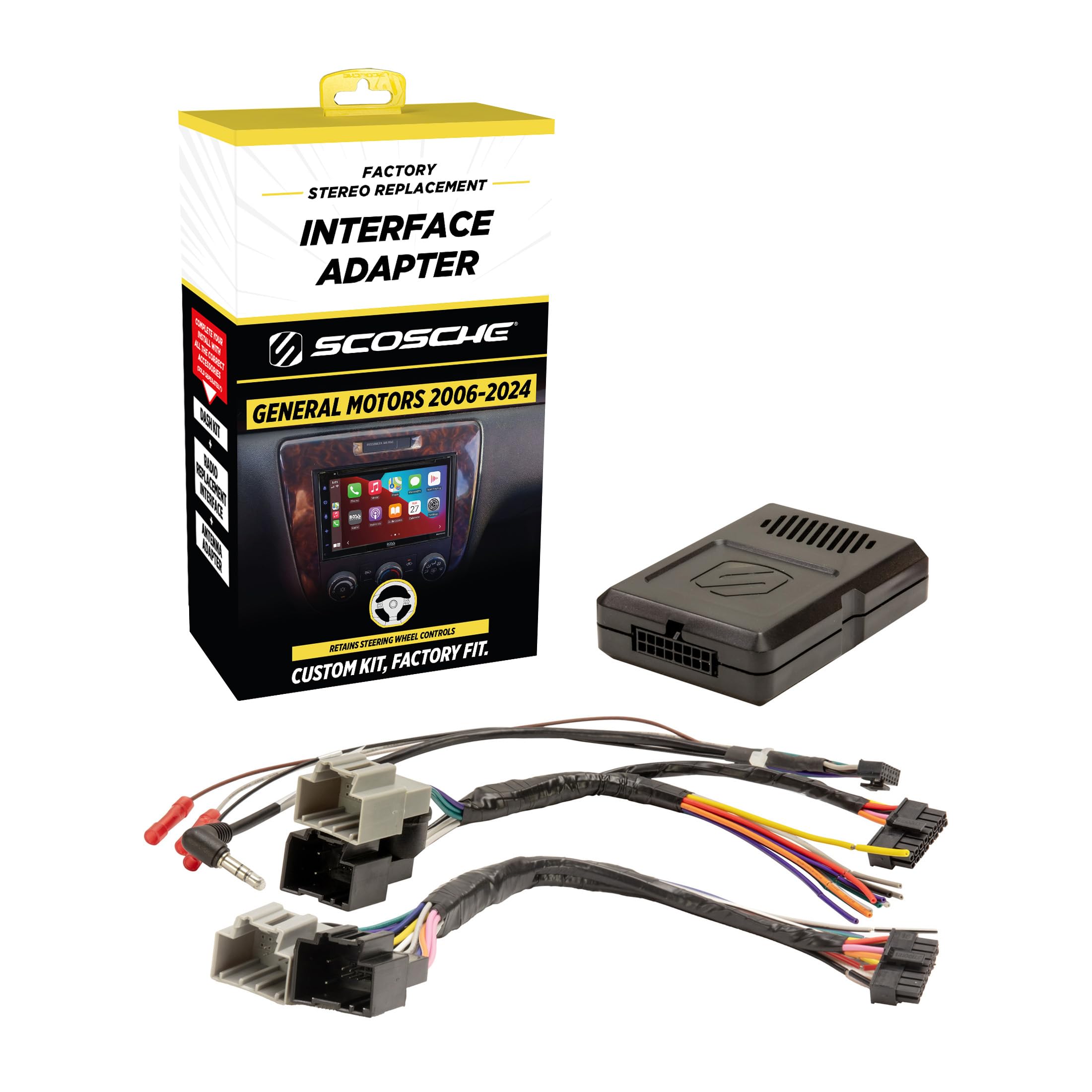
The Scosche GM3K-WP covers the widest GM vehicle production span of any adapter on this list — 2006 through 2024 models — making it the go-to interface for late-model trucks and SUVs. If you drive a 2018 Silverado, a 2020 Tahoe, or a 2014 Yukon with OnStar, this harness retains your steering wheel controls, warning chimes, and the OnStar module integration. The GM3K-WP connects via a flat ribbon connector to the factory CAN-Bus port, so there are no analog wires to tap for basic radio control functions.
For vehicles with premium Bose amplifies, the GM3K-WP provides a stable data output that keeps the factory subwoofer and door speakers active without needing an external line output converter. The standard color-coded wires simplify the connection to your aftermarket radio’s harness — solid color codes match industry standards (red for ACC, yellow for battery, black for ground). Users report that the chime volume is well-calibrated, not the annoying loud beep some adapters produce. The inclusion of a lifetime warranty with tech support is rare at this price tier and adds confidence for long-term ownership.
The main limitation is technical support responsiveness. Several users noted that phone support calls went unanswered or unreturned, leaving them to troubleshoot on their own. For most installations, the wiring diagram in the included manual is sufficient, but if you hit an unusual vehicle trim level with a unique audio package (like a Bose system with rear-seat entertainment), the lack of live support can stall the project. Additionally, the flat ribbon connector is specific to GM CAN-Bus vehicles — do not attempt to use this on earlier Class II GM vehicles, as the pinout is completely different.
Why it’s great
- Works with GM vehicles from 2006-2024 — the widest model year coverage in this guide
- Retains OnStar module, factory chimes, and Bose amplifier integration seamlessly
- Lifetime limited warranty included for long-term peace of mind
Good to know
- Phone tech support is unreliable — some users report calls going unanswered
- Not compatible with Class II GM buses from earlier model years (requires CAN-Bus)
4. Scosche GM2K-WP Factory Stereo Replacement Interface
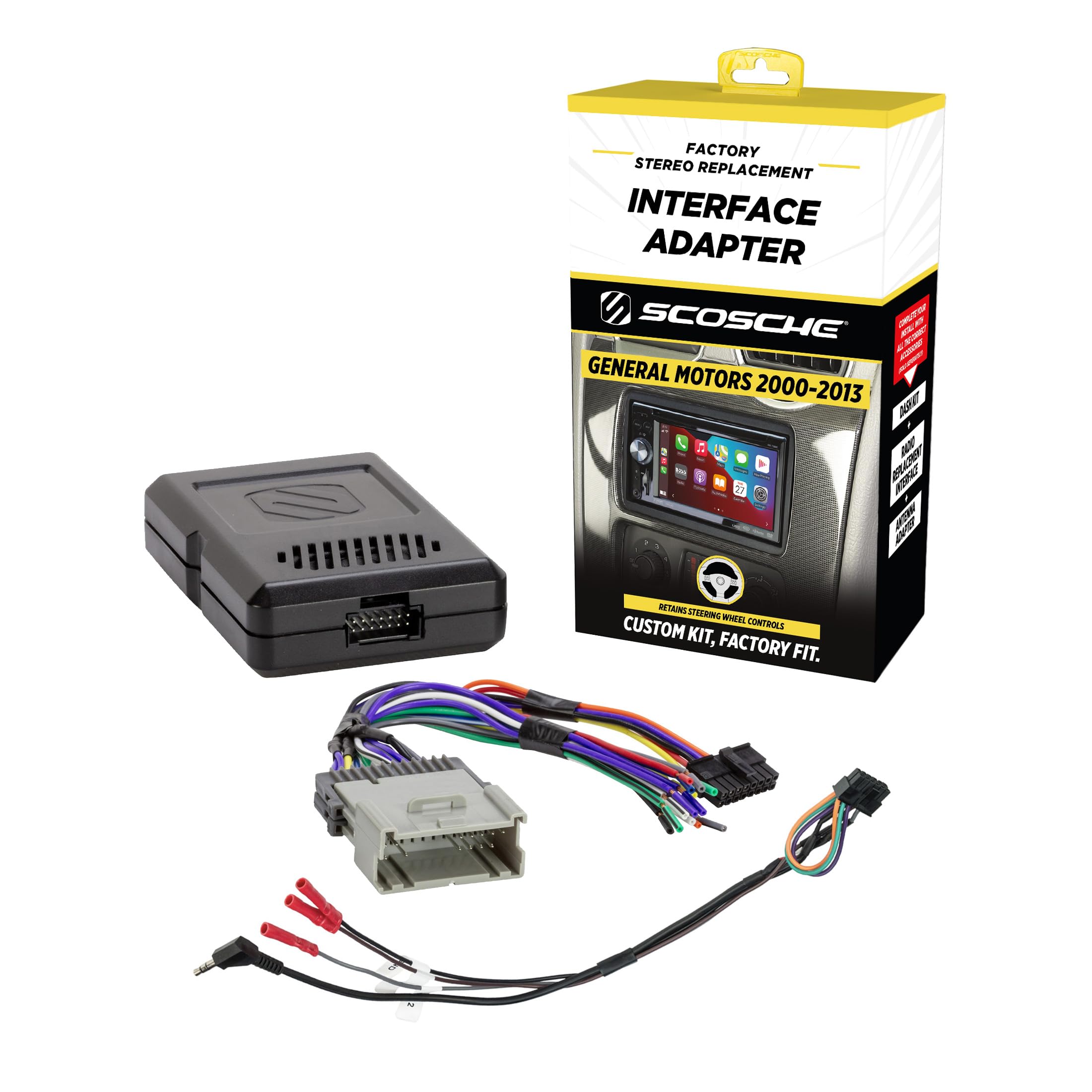
The Scosche GM2K-WP is the definitive adapter for older GM vehicles running the Class II serial data bus — specifically models from 2000 through 2013. It is essentially the older sibling of the GM3K-WP, using the same color-coded wire scheme and the exact same approach to chime retention, but without CAN-Bus support. For Chevy Silverado, Suburban, Tahoe, and GMC Sierra owners in that model window, this is the adapter that consistently delivers steering wheel volume and track controls on the first attempt with zero programming.
One of the most appreciated features is the built-in switched ACC output. Instead of needing to pull a 12V accessory wire from the fuse panel or tap into the cigarette lighter, the GM2K-WP generates a dedicated ACC signal from the Class II bus. This saves a significant amount of installation time, especially for trucks where the fuse panel is buried behind the kick panel. Users across multiple Silverado generations report that the adapter grabs the steering wheel signals without any DIP switch configuration — just match the wire colors and the interface handles the rest. The 3.5mm jack input is a useful addition for connecting auxiliary audio sources.
The build quality is a mixed bag. While the main wiring harness is robust and uses OEM-grade connectors, the included speaker box (the module that generates the door chime sound) has been described as sounding like a children’s toy. The chime function works — it just lacks the rich tonal quality of the factory chime module. For most drivers this is a minor annoyance, but if you are picky about sound fidelity from your warning alerts, you may notice the downgrade.
Why it’s great
- Generates a switched ACC output directly from the Class II bus — no fuse tap needed
- Plug-and-play for 2000-2013 GM vehicles with zero DIP switch programming
- Lifetime tech support and limited warranty for a budget-friendly price
Good to know
- Separate chime module produces a thin, toy-like sound compared to factory chimes
- Only for Class II GM vehicles — does not support later CAN-Bus platforms
5. PAC C2R-FRD1 Radio Replacement Interface

The PAC C2R-FRD1 is the dedicated interface for 2005-2009 Ford, Lincoln, and Mercury vehicles using the MSCAN data bus architecture. This is a narrow but critical compatibility zone — Ford switched from a simpler analog protocol to CAN-Bus around 2005, and many universal adapters simply do not speak MSCAN correctly. The C2R-FRD1 translates the MSCAN signals into standard aftermarket radio outputs, retaining factory subwoofer control, the auxiliary jack, rear seat entertainment, and the RAP (Retained Accessory Power) function that keeps your radio running until the driver’s door opens.
Beyond steering wheel controls, this interface outputs vehicle speed signal (VSS), parking brake status, illumination data, reverse indication, and a 12V accessory wire — all of which are essential for aftermarket navigation units and double-DIN receivers that need these signals for GPS lock and safety interlock. The interface handles THX, Sony, Shaker, and Audiophile factory amplifier systems without additional modules. Installation is straightforward for anyone comfortable reading a wire diagram, with many first-time users completing the job in about 90 minutes.
The one documented reliability issue involves the backup camera control circuit. Several users reported that the unit leaves the backup camera energized 24/7, which eventually causes the camera to fail and can lock up the stereo after 6-8 months. If your vehicle relies on a factory backup camera signal routed through the adapter, you may want to install an inline relay to cut power to the camera when not in reverse. For users not using a factory camera integration, the C2R-FRD1 remains a rock-solid solution for Ford SWC retention.
Why it’s great
- Retains factory subwoofer, RAP, rear seat entertainment, and THX amplifier on Ford MSCAN vehicles
- Outputs VSS, illumination, parking brake, and reverse signals for aftermarket navigation units
- Clear wiring diagram enables a 90-minute install for non-professionals
Good to know
- Backup camera control circuit may keep camera powered 24/7, causing premature failure
- Only compatible with 2005-2009 Ford MSCAN vehicles — no cross-brand support
6. PAC Universal Analog CAN-Bus SWC Interface SWI-CP2

The PAC SWI-CP2 is a universal analog and CAN-Bus steering wheel control interface that covers the widest cross-brand compatibility of any non-vehicle-specific adapter. It handles both resistive analog SWC systems (common in Japanese and older domestic vehicles) and data-bus systems (more common in late-model European and domestic cars). Configuration happens either through manual DIP switches using a vehicle lookup chart or via the ControlPRO app on PC, iOS, or Android. This dual configuration path is a lifesaver if you ever swap your stereo to a different brand — just toggle the dip switches and re-learn your buttons.
The interface supports button learning mode, meaning you can assign any steering wheel function to any radio command. This is especially useful for vehicles with more buttons than your aftermarket stereo supports — you can merge redundant functions or deactivate buttons you never use. The SWI-CP2 also provides a 2-amp, 12V ACC output for data-bus vehicles, eliminating the need to hunt down a separate switched power source. Many users with Boss and Power Acoustik floating screen radios report that the PAC adapter solved issues that their previous SWC interfaces could not handle.
Two failure points emerge from real-world usage. First, the ControlPRO app has a reputation for freezing mid-configuration, especially on Android, and the customer support ticketing system on the PAC website is reportedly broken, returning “Page not found” errors. Second, a known cold-weather quirk: the unit may refuse to communicate and cause the aftermarket radio to fail to power on at the first ignition cycle in sub-freezing temperatures, requiring a full system reset. For garage-kept vehicles or users in mild climates, this is rarely an issue, but if you park outside in a northern winter, be aware of the possibility.
Why it’s great
- Universal compatibility with both analog (resistive) and CAN-Bus SWC systems across all brands
- Dual configuration via DIP switches or ControlPRO app — no soldering required for setup
- Provides a 2-amp ACC output for data-bus vehicles without separate wiring
Good to know
- Cold-weather bug may prevent radio power-on until a full system reset is performed
- ControlPRO app has configuration freezes and manufacturer tech support is unreliable
7. Motorcraft Switch Asy – Control (SW6880)

The Motorcraft SW6880 is not an adapter — it is a direct replacement OEM steering wheel button assembly for Ford and Lincoln vehicles. This distinction is important because many drivers searching for a steering wheel controls adapter actually need a worn-out button replacement rather than an interface module. The SW6880 replaces the factory volume and track control pod that mounts on the steering wheel spoke, and it is the genuine Motorcraft part, meaning the button feel, tactile response, and connector fit are exactly what the original factory installed.
The standout benefit is installation simplicity. Users report swapping the button pod in under 10 minutes without removing the airbag module — the old unit simply pries out with a trim tool and the new one clips into place. This fixes the common Ford problem where the volume up button starts triggering a track skip command or the buttons become intermittent due to worn internal contacts. Because it is an OEM component, you get the same normally-open circuit type and screw terminal connection that the factory harness expects, eliminating any compatibility guesswork.
The limitation is obvious: this does nothing to integrate factory steering wheel buttons with an aftermarket radio. If you already swapped your stereo and the buttons are not responding, the SW6880 is not the solution — you need an interface adapter like the PAC C2R-FRD1. The SW6880 is strictly for restoring function on a factory-installed radio. But for the specific case of a worn-out button on an otherwise stock system, this is a perfect, affordable fix that outperforms any adapter.
Why it’s great
- Genuine Motorcraft OEM quality with exact factory button feel and connector pinout
- Simple 10-minute swap without removing the steering wheel airbag module
- Resolves common Ford button wear issues like volume up accidentally skipping tracks
Good to know
- Fits stock factory radios only — does not integrate with aftermarket stereo installs
- Vehicle fitment varies by trim and model year; confirm compatibility before purchase
FAQ
Do I need a steering wheel control adapter if I replace my radio with an aftermarket unit?
What does the chime module do on GM adapters like the Scosche GM2K-WP?
Can a faulty steering wheel control adapter drain my car battery overnight?
Will a universal SWC adapter work with a very old aftermarket radio from 2010 or earlier?
Final Thoughts: The Verdict
For most users, the steering wheel controls adapter winner is the iDatalink Maestro SW because it combines universal vehicle compatibility with programmable dual-function button mapping that genuinely improves the daily driving experience. If you drive a 2002-2013 GM vehicle with a Bose system and want a true plug-and-play solution, grab the CRUX SWRGM-48 for its pre-programmed voice command pass-through and chime retention. And for Ford owners with an MSCAN-based truck or SUV who need factory subwoofer and rear seat entertainment support, nothing beats the PAC C2R-FRD1.