
Few things are more frustrating than watching your call drop mid-conversation or waiting for a text to send while sitting in your own living room. A weak cellular signal isn’t just an inconvenience—it’s a barrier to reliable communication, remote work, and even emergency access. The right amplifier can pull a usable signal from thin air, but the market is flooded with options that differ wildly in coverage area, antenna type, and carrier compatibility.
I’m Min — the co-founder and writer behind Gadgets Feed. My approach to analyzing cellular signal boosters involves cross-referencing frequency band support, gain ratings, and real-world user feedback across a spectrum of indoor environments, from metal buildings to rural basements.
This guide cuts through the noise to identify the best cellular signal booster for homes, offices, and off-grid locations, based on hard specs and verified performance data.
How To Choose The Best Cellular Signal Booster
Picking the right signal booster requires more than just glancing at the coverage area. You need to understand the interaction between gain, antenna type, and the specific frequency bands your carrier uses. A mismatch in any of these three areas can render a high-priced system useless in your environment.
Gain (dB) and Coverage Area
Measured in decibels (dB), gain represents the amplifier’s ability to strengthen the incoming signal. Entry-level models hover around 65dB, while premium units push past 100dB. Higher gain is crucial in rural areas where the nearest tower is miles away, but too much gain in a strong-signal area can cause oscillation. The coverage area in square feet is directly tied to the available outside signal—expect 2000 sq ft from a marginal 1-bar signal, but up to 4000+ sq ft when the outdoor antenna sees 3 bars.
Frequency Bands and Carrier Compatibility
Different carriers broadcast on different frequencies. Verizon primarily uses Band 13 (700MHz), AT&T relies on Bands 12/17 (700MHz), and T-Mobile pushes Band 71 (600MHz). A booster must support the exact downlink and uplink frequencies your carrier uses. Multi-carrier units cover 700-2100 MHz ranges, but always verify the specific band pair—a booster that supports Band 13 won’t help with Band 71.
Antenna Types: Directional vs. Omni
The outdoor antenna is the most critical component. A directional Yagi antenna must be aimed precisely at the cell tower, offering higher gain and longer range—ideal for rural setups. An Omni antenna captures signal from all directions and works well in suburban areas with multiple towers, but sacrifices range. Indoors, a dome antenna distributes signal evenly, while a panel antenna focuses coverage in a specific direction.
Quick Comparison
On smaller screens, swipe sideways to see the full table.
| Model | Category | Best For | Key Spec | Amazon |
|---|---|---|---|---|
| HiBoost 10K SL | Premium | Whole home, large offices | 5500 sq ft coverage | Amazon |
| SureCall Fusion4Home | Premium | Largest coverage, weakest signals | 4000 sq ft / 2XP uplink tech | Amazon |
| HiBoost 8K SL | Premium | Multi-room, 5-6 rooms | 8000 sq ft / 2 indoor antennas | Amazon |
| HiBoost 4K Mate | Mid-Range | Medium homes with LCD control | 4500 sq ft / LCD touchscreen | Amazon |
| ZORIDA Ace 5S | Mid-Range | Affordable, all carriers, app | 2000 sq ft / 72dB gain | Amazon |
| weBoost Home Studio | Mid-Range | Small homes, easy setup | 3000 sq ft / Made in USA | Amazon |
| GAGBK Verizon Booster | Entry-Level | Verizon/Straight Talk only | 5000 sq ft / 65dB gain | Amazon |
| F FREEQUEEN AT&T Booster | Entry-Level | AT&T/T-Mobile Band 12/17 | 4500 sq ft / 65dB gain | Amazon |
| CEL-FI GO G41 | Commercial Grade | Extreme coverage, enterprise | 15000 sq ft / 100dB gain | Amazon |
In‑Depth Reviews
1. HiBoost 10K SL

The HiBoost 10K SL strikes a rare balance between coverage area and intelligent control. Its 5500 sq ft rating in a standard home typically translates to strong 4-5 bar improvement in 2500-3500 sq ft of actual conditioned space, which matches most medium-to-large houses. The integrated LCD screen and companion “Signal Supervisor” app deliver real-time signal strength readings and antenna alignment guidance—a feature usually reserved for commercial-grade systems.
On frequency support, the 10K SL covers Bands 2/4/5/12/13/17/25, which spans the major 4G LTE and DSS-based 5G networks for Verizon, AT&T, and T-Mobile. Users in hurricane-prone zones have reported jumping from no usable data to 50+ Mbps 5G downloads indoors on Verizon after installation. The unit lacks Band 71 (600MHz T-Mobile), so rural T-Mobile customers should verify local tower frequencies first.
The Automatic Gain Control (AGC) intelligently prevents oscillation when the outdoor signal is strong, while the metal case minimizes external RF interference. Installation requires mounting the directional outdoor antenna and running two cables—one through-window cable avoids drilling. The 3-year warranty and US-based tech support provide long-term confidence.
Why it’s great
- App and LCD provide real-time signal monitoring and antenna aiming
- 50+ Mbps 5G data speed improvements reported by verified users
- Comprehensive 3-year warranty with responsive US-based support
Good to know
- Does not support T-Mobile Band 71 (600MHz)
- Coverage area depends heavily on outdoor signal quality
- App sync can lag on metal roofs with Bluetooth interference
2. SureCall Fusion4Home

SureCall’s Fusion4Home is engineered for the most challenging signal environments, where the outdoor signal is barely measurable. Its key differentiator is the patented 2XP technology, which doubles the uplink power sent back to the cell tower. This matters immensely in rural and mountainous terrain where the phone’s own transmitter struggles to reach the tower—2XP ensures the booster carries the conversation both ways.
The kit ships with a high-gain Yagi outdoor antenna that must be precisely aimed (use CellMapper or a similar tower-finding tool). The indoor dome antenna provides 360-degree coverage, and the 50-ft RG-6 cable allows flexible placement. Coverage scales with outside signal: 1-2 bars outside yields roughly 2000 sq ft indoors, while 3-4 bars pushes toward the 4000 sq ft maximum. Users in metal buildings have reported going from zero bars to 3 bars of stable 4G LTE.
Frequency support spans n2, n4, n5, n25, n26, n30, n41, n66, n71, n77, n78, n79, n260, n261—a remarkably deep list that includes both low-band and mmWave 5G. The 3-year warranty and lifetime US-based tech support add peace of mind, though some users have reported hardware failures after 12-18 months in extreme temperature conditions.
Why it’s great
- 2XP technology doubles uplink power for difficult rural environments
- Supports 14+ frequency bands including mmWave 5G
- Lifetime US-based technical support included
Good to know
- Coverage area shrinks significantly with weak outdoor signal
- Some units may fail after 12-18 months in harsh conditions
- Installation requires ladder work and precise antenna aiming
3. HiBoost 8K SL

The HiBoost 8K SL addresses a specific pain point: multi-room coverage in larger structures. It ships with two indoor antennas—one built into the main unit and one separate dome/panel antenna—enabling signal distribution across 5-6 rooms or multiple floors. The 70dB gain figure is modest compared to premium competitors, but the dual-antenna design compensates by creating a more uniform signal field rather than a single hot spot.
The included LCD screen and app provide the same real-time monitoring found on the 10K SL, including AGC adjustments and gain readouts. Band support covers 700-2100 MHz (Bands 2/4/5/12/13/17/25), which covers all major US carriers on 4G LTE and DSS 5G. Users in 4500 sq ft, 3-floor homes have reported eliminating dropped calls entirely after raising the outdoor antenna just 2 feet higher.
Installation is more involved than single-antenna systems—you’ll need to run coaxial cable from the outdoor Yagi to the booster, then from the booster to the second indoor antenna. The through-window cable kit eliminates drilling but requires a slightly open window. The 3-year warranty and US support team are responsive via app, text, and email.
Why it’s great
- Dual indoor antennas provide uniform coverage across multiple rooms
- LCD and app offer precise signal strength and alignment feedback
- Excellent for 3-floor homes and multi-room offices
Good to know
- Cable routing for two indoor antennas adds installation complexity
- Does not support T-Mobile Band 71
- Coverage claims assume strong outdoor signal baseline
4. CEL-FI GO G41
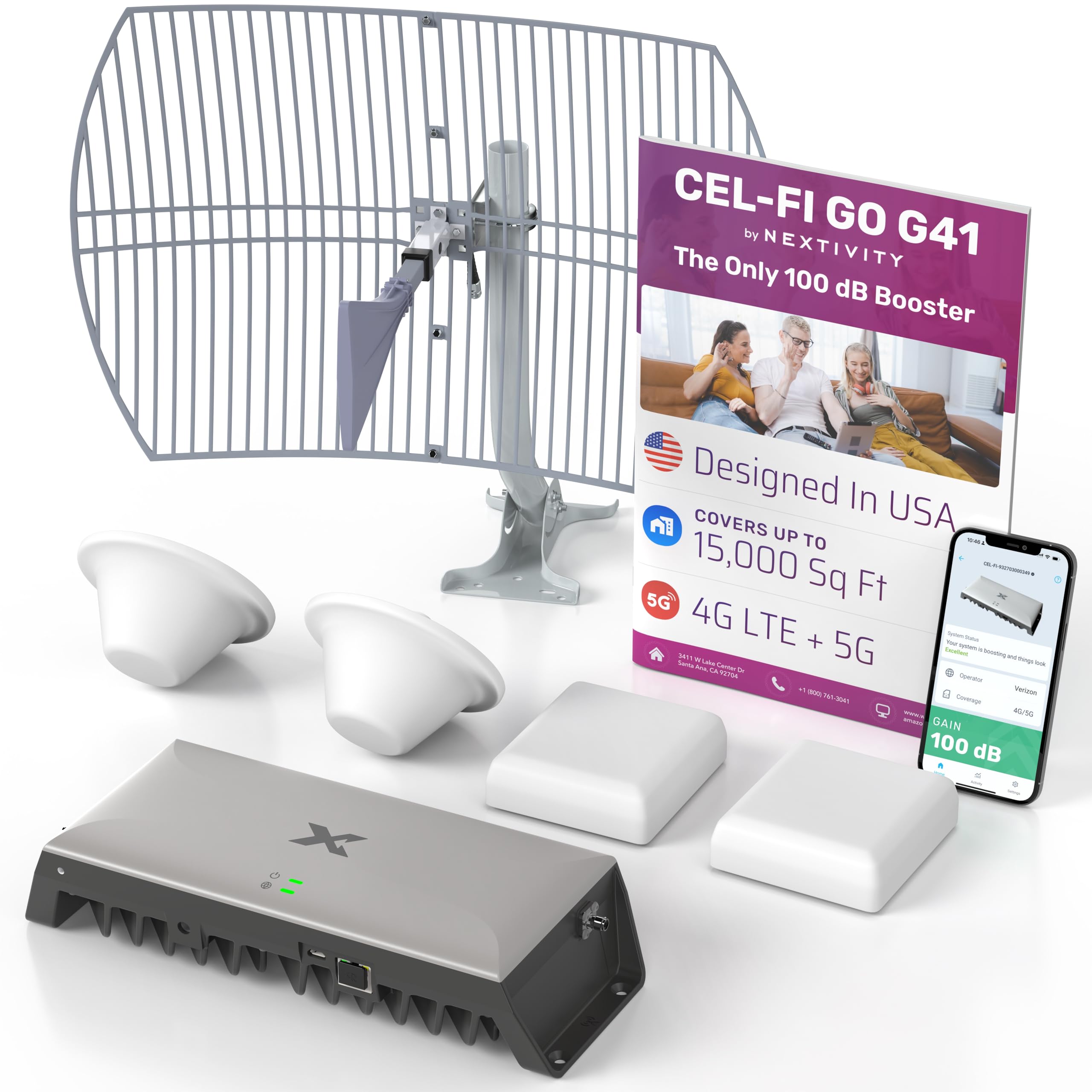
The CEL-FI GO G41 operates in a different class than other consumer boosters. With 100dB gain and support for 4G LTE, 5G-DSS, and 5G NR, it represents the current ceiling of what’s available for residential use. Nextivity’s 4th-generation IntelliBoost chipset intelligently manages the signal path, preventing oscillation across two simultaneous bands. The kit includes both dome and panel indoor antennas, giving you flexibility to choose the right radiation pattern for your space.
Real-world results are dramatic. Users in remote “hollers” with zero cell service have achieved 3-4 bars of consistent 4G LTE across 2000 sq ft farmhouses after installation. The 2x antenna kit covers up to 15000 sq ft in open-plan environments. However, the unit only amplifies two bands simultaneously, which can be problematic in areas served by more than two base stations—carrier aggregation may cause the phone to ignore the boosted signal in favor of a weaker unboosted band.
Installation requires a full day of work, including mounting the outdoor grid antenna, routing cables, and configuring the system via the WAVE app. The instructions are adequate but not beginner-friendly. The price point places it firmly in commercial-grade territory, but for users who absolutely cannot lose their connection, the G41 delivers.
Why it’s great
- 100dB gain covers whole homes and large commercial spaces
- 4th-gen IntelliBoost chipset prevents oscillation and improves efficiency
- Works in extreme rural environments where other boosters fail
Good to know
- Only amplifies 2 bands simultaneously; carrier aggregation can cause conflicts
- Installation is complex and time-consuming (up to a full day)
- Premium price point may be overkill for suburban users
5. HiBoost 4K Mate
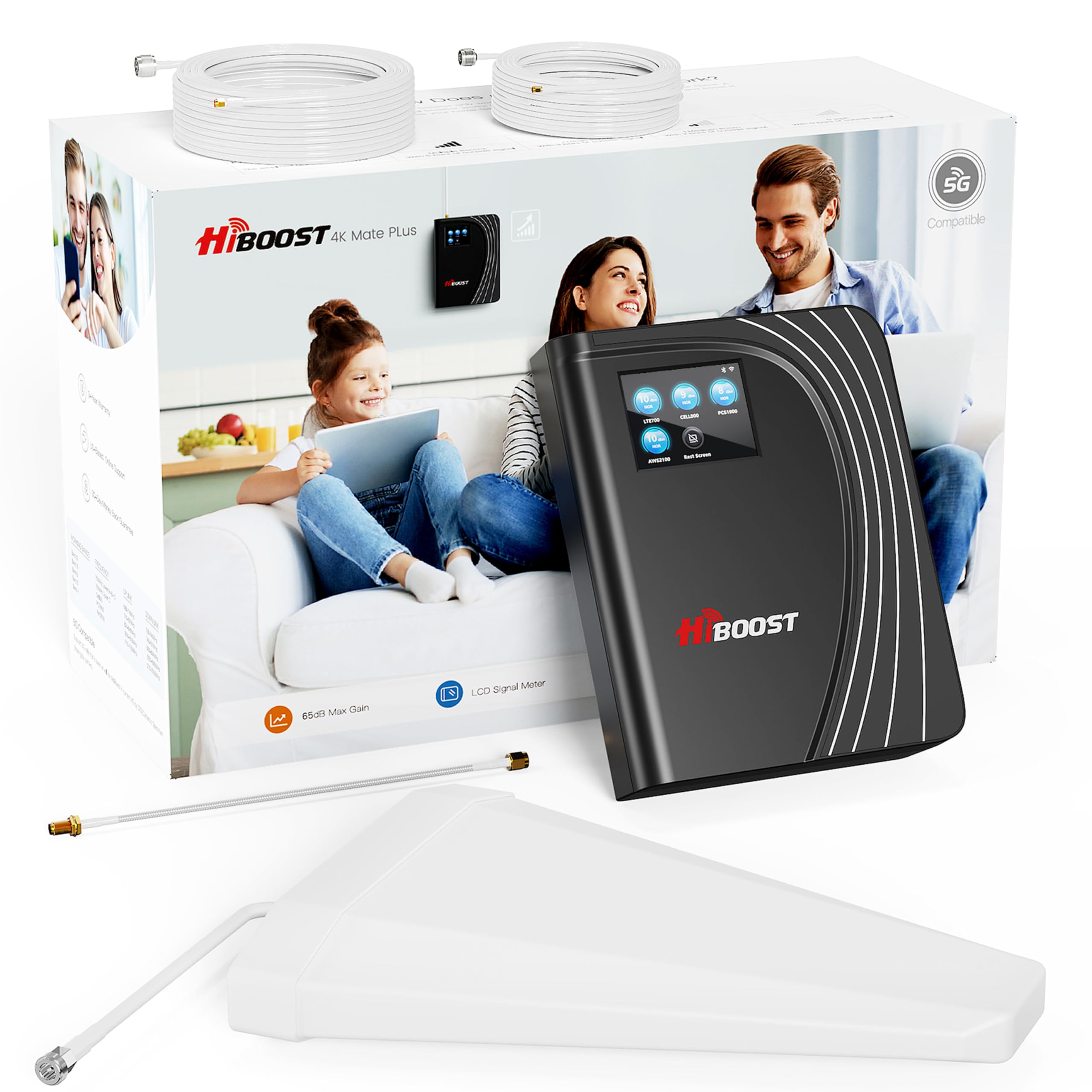
The HiBoost 4K Mate brings premium features like an LCD touch screen and dedicated app support to the mid-range price bracket. Its 65dB gain covers up to 4500 sq ft, which in most real-world installations with 1-2 bars outside translates to solid signal improvement across a 1500-2000 sq ft home. The built-in indoor antenna keeps the footprint clean—no second antenna to mount unless you buy the expansion kit.
The touch screen displays real-time gain, uplink/downlink power, and oscillation warnings, which simplifies installation dramatically. The app adds Bluetooth-based remote monitoring (though Bluetooth range is limited through metal roofs). Frequency support spans 700-3500 MHz, covering Bands 12/13/17/5/4/2/25 plus extended 5G NR ranges. Users in mountain cabins have reported 4 bars of 4G LTE Verizon service after mounting the outdoor antenna on a 30-ft mast.
The 2-year warranty is shorter than HiBoost’s other models, but the app-based technical support remains responsive. The package includes a through-window cable to avoid drilling, though the 50-ft cable length may be insufficient for very large properties. The design is compact enough for tabletop placement.
Why it’s great
- LCD touch screen makes installation and troubleshooting highly intuitive
- Compact, all-in-one indoor unit with no separate antenna required
- Strong improvement for medium-sized homes and cabins
Good to know
- 2-year warranty is shorter than other HiBoost models
- Bluetooth app connectivity may be unreliable through metal roofs
- Coverage area shrinks noticeably if outdoor signal is below 1 bar
6. ZORIDA Ace 5S

The ZORIDA Ace 5S proves that effective signal boosting doesn’t require a premium price. Its 72dB gain exceeds many mid-range competitors, and the 2000 sq ft coverage rating is realistic—users in semi-rural areas have jumped from 1-2 unreliable bars to 5 solid bars after installation. It supports Bands 12/17/13/5/4/2/25, covering all major US carriers including Verizon, AT&T, and T-Mobile.
The included indoor whip antenna is compact and mounts directly on the booster unit, making it one of the cleanest installations available. The outdoor directional antenna comes with a 49.2-ft cable. ZORIDA’s app provides 1-on-1 technical support with video guides and before/after signal data, which is unusual at this price point. The 3-year warranty is standard, but the lifetime US-based tech support via app chat is a standout feature.
One important caveat: the booster requires at least 1 bar of usable signal outside to function. Users with truly zero signal will need a higher-gain system. The 2000 sq ft rating assumes a strong outdoor signal baseline—with marginal 1-bar outside, coverage may drop to 800-1000 sq ft. FCC and IC certification ensure compliance.
Why it’s great
- 72dB gain outperforms many competitors in the same price tier
- Excellent app-based 1-on-1 technical support with video guides
- Compact, simple installation suitable for first-time users
Good to know
- Requires at least 1 bar of outdoor signal to function
- 2000 sq ft coverage shrinks significantly with weak outdoor signal
- Does not support T-Mobile Band 71
7. weBoost Home Studio

The weBoost Home Studio is designed for simplicity and reliability in smaller spaces. Its 3000 sq ft rating is realistic for a single large room or a modest two-bedroom home. The kit includes two 30-ft low-loss cables, a directional outdoor antenna with mounting bracket, and an indoor whip antenna. weBoost’s reputation for build quality means fewer returns and consistent performance.
Frequency coverage includes Bands 12/17, 13, 5, and 4, which covers the core 4G LTE and 5G-DSS networks of all major US and Canadian carriers. The 5G-ready chipset ensures forward compatibility as carriers migrate. Users in off-grid cabins have reported jumping from SOS/1 weak LTE to 2-3 bars of 5G after mounting the antenna on a 20-ft flagpole. The installation is straightforward but does require finding the nearest cell tower using tools like CellMapper.net.
The price point puts it in the mid-range, but Made-in-USA manufacturing justifies the premium. The unit runs warm during operation—some users express caution about leaving it plugged in continuously, though weBoost’s engineering tolerances are well-respected. Customer support is responsive, though some users with apartment installations report the directional antenna’s limited range (about 5-10 ft inside) can be restrictive.
Why it’s great
- Made in USA with rigorous quality control standards
- Simple, clear installation instructions ideal for DIY users
- Strong improvement in cabins and off-grid locations with 20-ft mast mounting
Good to know
- Coverage area is small—best for single rooms or small homes
- Unit runs warm/hot to the touch during operation
- Does not support T-Mobile Band 71
8. GAGBK Verizon Signal Booster

The GAGBK booster is laser-focused on Verizon and Straight Talk users operating on Band 13 (700MHz). Its 65dB gain and claimed 5000 sq ft coverage make it an intriguing budget option—but only for the right carriers. The kit includes a high-gain directional outdoor antenna and an indoor omni whip antenna, plus 50-ft cable. The LED indicator shows signal strength and oscillation status.
Real-world users on the Boost network (which rides on T-Mobile) reported the booster working after installation, going from no indoor signal to usable calls. However, the critical limitation is carrier compatibility: this unit only works on Band 13 (Downlink 746-757 MHz, Uplink 776-787 MHz). AT&T, T-Mobile, and US Cellular users on different bands will get zero improvement. The 65dB gain is sufficient for suburban areas with marginal signal but will struggle in deep rural zones.
The 2-year warranty is adequate for the price tier, and the 30-day money-back guarantee reduces risk. The small, portable form factor allows easy relocation between home and garage. The AGC (Automatic Gain Control) prevents oscillation in most situations. The unit goes into sleep mode when no signal is detected, saving power.
Why it’s great
- Affordable solution specifically for Verizon/Straight Talk Band 13 users
- Compact, portable design with sleep mode for power savings
- LED indicators simplify troubleshooting
Good to know
- Only supports Band 13—incompatible with AT&T, T-Mobile, and most other carriers
- 65dB gain is lower than many competitors; struggles in deep rural areas
- 5000 sq ft coverage is unrealistic without strong outdoor signal
9. F FREEQUEEN AT&T/T-Mobile Booster
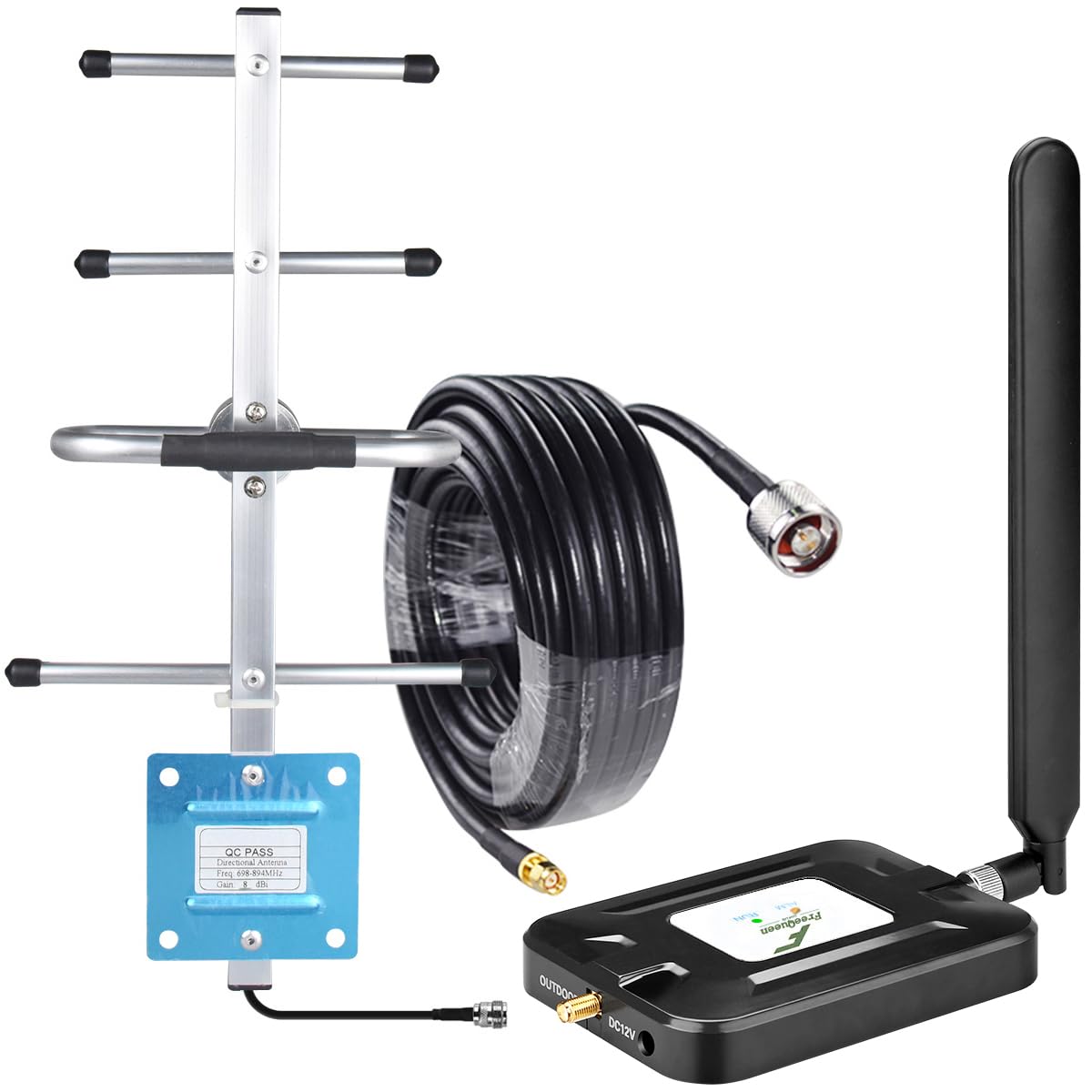
The F FREEQUEEN booster serves the AT&T, T-Mobile, US Cellular, and Cricket ecosystem operating on Band 12/17 (700MHz). Its 65dB gain and 4500 sq ft rating mirror the GAGBK unit but target different carriers. The kit includes a high-gain outdoor Yagi antenna and an indoor whip antenna, along with 50-ft N-SMA coaxial cable that can be extended to 100-ft.
The AGC (Automatic Gain Control) function and sleep/inactivity mode provide stable operation. The LED indicator shows signal strength in real time. Coverage scales with outdoor signal: users with 1-2 bars outside can expect improvement across 1000-2000 sq ft indoors. The 3-year manufacturer guarantee is generous at this price point, though the brand is less established than weBoost or SureCall.
The major limitation is band specificity: this unit only supports Bands 12/17 (Downlink 728-746 MHz, Uplink 698-716 MHz). Verizon Band 13 users, T-Mobile Band 71 users, and anyone on Sprint’s Band 25/26 will get no benefit. The 65dB gain is adequate for suburban environments but insufficient for remote areas. Customers have noted that the instructions could be clearer, and the cable connectors require careful tightening to avoid signal loss.
Why it’s great
- Affordable entry point for AT&T/T-Mobile Band 12/17 users
- Includes 50-ft cable expandable to 100-ft for flexible installation
- 3-year manufacturer guarantee provides budget-friendly peace of mind
Good to know
- Only supports Band 12/17—incompatible with Verizon Band 13 or T-Mobile Band 71
- 65dB gain is insufficient for deep rural or mountainous areas
- Customer reviews suggest instructions lack clarity
FAQ
Will a signal booster work if I have zero bars outside?
Can I use one booster with Verizon, AT&T, and T-Mobile simultaneously?
How far can the outdoor antenna be from the booster?
Do I need to register my booster with my carrier?
Can a booster cause interference with nearby cell towers?
Final Thoughts: The Verdict
For most users, the best cellular signal booster winner is the HiBoost 10K SL because it offers the strongest balance of coverage area (5500 sq ft), intelligent app/LCD control, and comprehensive carrier support across 4G LTE and 5G-DSS networks. If you need the maximum possible gain and coverage for a very large home or extreme rural environment with near-zero signal, the SureCall Fusion4Home with its 2XP uplink technology is the better choice. And for budget-conscious buyers with moderate signal issues, the ZORIDA Ace 5S delivers surprising 72dB gain and excellent app-based support at a fraction of the price.