
Our readers keep the lights on and my morning glass full of iced black tea. As an Amazon Associate, I earn from qualifying purchases.
Specs are compiled from manufacturer listings and verified buyer reviews and can change over time — please confirm the key details on the product page before buying.
A front-only dash cam leaves half your story untold. You can capture a car merging into you from the side, but if someone rear-ends you at a light, or a tailgater swerves behind you in a hit-and-run, you have zero evidence from the back. A dual-camera setup—a Dash Cam Front And Rear—removes that blind spot, recording everything behind you in the same crisp detail as the road ahead, so one unit handles both tails of your car.
I’m Min — the founder and writer behind Gadgets Feed. This guide is built by comparing the manufacturers’ published specifications and the patterns across verified customer reviews, so you get each pick’s real strengths and trade-offs instead of marketing spin.
There are only a few truly worthwhile models in this space, and I have pulled the best five together to show you exactly what each costs and delivers. This is your straight-forward breakdown of the best dash cam front and rear models you can buy today.
Quick Picks
- ROVE R2-4K Dual PRO Dash Cam Front and Rear — Best Overall
- REDTIGER F77 4K+4K Dash Cam Front and Rear — Frontrunner
- Coolcrazy 4K Dash Cam Front and Rear — Best Value
- FAIMEE 4K+2K Dash Cam Front and Rear — Wide Vision
- 70mai Dash Cam Front and Rear A410 — Smart Starter
How To Choose The Best Dash Cam Front And Rear
When you are shopping for a dual camera system, you want to balance five key decisions: video resolution, the quality of each camera’s sensor, the available storage, if you need GPS or Wi‑Fi built in, and how you want the parking monitor to work. Let’s walk through each one so you know what to look for.
Resolution and sensor quality
The front camera usually records at 4K (3840×2160P) or 2.5K (2560×1440P), while the rear can be 1080P, 2K, or even a second 4K in premium units. Higher resolution means you can read a license plate from farther away, especially at night. Look for Sony STARVIS or STARVIS 2 sensors — these are specifically designed to capture more light in dark conditions, so your night footage does not turn into a blur of headlights.
Storage: memory card vs. built-in eMMC
Most dash cams use a microSD card (up to 256GB or 1TB), and many come with a 64GB or 128GB card included so you can start recording right away. Some higher-end models, like the REDTIGER F77, use built-in eMMC memory instead — that is a chip soldered onto the circuit board that is faster and less likely to fail from the constant writing and rewriting of loop recording. The tradeoff is that you cannot swap in a larger card later if the built-in memory turns out to be too small for your needs.
Wi‑Fi, GPS, and app connectivity
Built-in Wi‑Fi lets you connect your phone to the dash cam wirelessly, so you can view live footage, download clips, or change settings without pulling out a memory card. Look for 5.8GHz or dual-band Wi‑Fi for faster transfer speeds — some models hit 30MB/s, which means a large 4K clip downloads in seconds instead of minutes. GPS records your speed, route, and location alongside the video, which can be important for insurance claims or proof of where you were at a specific time.
Parking mode and how it works
A true 24-hour parking mode requires a hardwire kit (sold separately) that connects the dash cam to your car’s fuse box so it stays powered when the engine is off. Once installed, the camera either records in time-lapse (one frame per second) or waits for a bump to trigger full recording. Models with a G-sensor — a tiny accelerometer inside the camera — will lock the video file as soon as it feels a collision, so a hit-and-run in a parking lot does not get overwritten.
Quick Comparison
| Model | Best For | Front+Rear Resolution | Field of View | Max Storage | Amazon |
|---|---|---|---|---|---|
| 70mai A410 | Budget-friendly starter with HDR and GPS | 2.5K+1080P | 125° | 256 GB | Amazon |
| FAIMEE 4K+2K | Wide coverage and triple-band Wi‑Fi | 4K+2K | 170° | 256 GB | $74.09$129.99Limited time dealAmazon |
| Coolcrazy 4K | Night vision with STARVIS sensor plus 128GB card | 4K+1080P | 170° | 256 GB | $79.97$109.99Limited time dealAmazon |
| ROVE R2-4K Dual PRO | Top-tier clarity with dual STARVIS 2 sensors | 4K+2K | 150° | 1 TB | $206.49$349.99Limited time dealAmazon |
| REDTIGER F77 | Fully integrated 4K+4K with built-in memory | 4K+4K | 160° | 128 GB (built-in eMMC) | Amazon |
In‑Depth Reviews
1. ROVE R2-4K Dual PRO Dash Cam Front and Rear
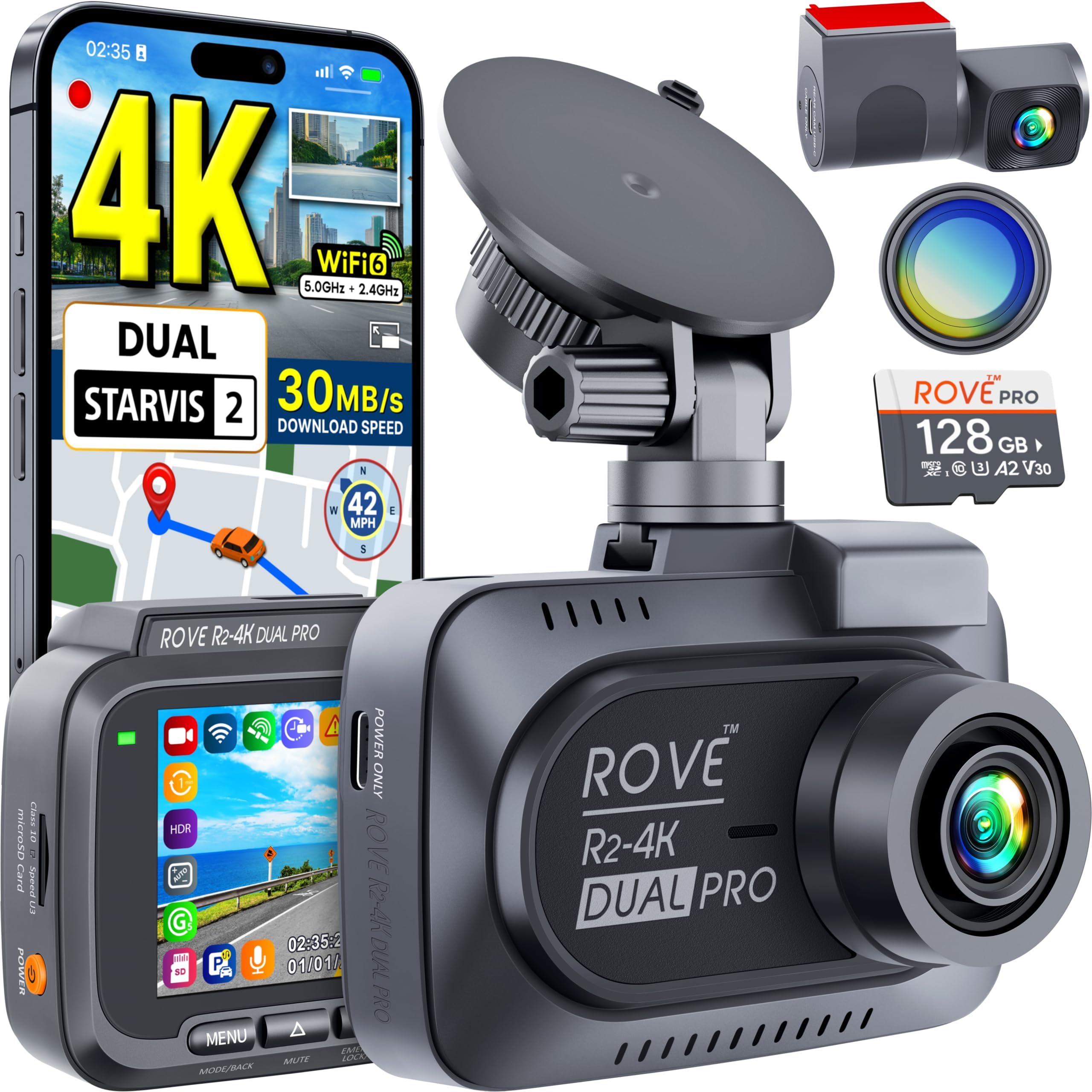
Sony’s best sensors on both ends give you night vision that actually sees plates.
What makes the ROVE R2-4K Dual PRO the pick of this list is that it uses Sony’s latest STARVIS 2 sensors — the IMX678 (8MP) on the front and the IMX675 (5MP) on the rear — to capture a 4K front view at 3840×2160P and a 2K rear view at 2560×1440P. That means your rear camera is not the usual low-res afterthought; it is clear enough to read plates behind you at night. The front lens has a wide aperture of F1.7 and the rear is even wider at F1.55, so both cameras pull in more light in dim conditions, and the included ROVE Ultimate CPL filter cuts windshield glare that can wash out footage in bright sunlight.
Buyers report that the video quality is excellent for identifying license plates day and night — one reviewer noted the detail is “sharp front 4K and rear 2K video” with “excellent day/night clarity.” The 150° front and 140° rear fields of view give you broad coverage without the fisheye distortion you often see on ultra-wide 170° lenses. Wi-Fi 6 with 5GHz and 2.4GHz lets you download 4K clips at up to 30MB/s — significantly faster than the 20MB/s of competitors like the 70mai A410 (which uses standard Wi‑Fi). It also supports Quad-Mode GPS (GPS, BEIDOU, GALILEO, GLONASS) that logs speed and route directly on the video, which you can replay later with the free ROVE Dash Cam GPS Player software.
For a premium model, the 24-hour parking mode offers three options: time-lapse at 1FPS, motion detection, and collision detection — it records a full 1-minute locked event video when triggered, then alerts you with a voice prompt the next time you start the car. You do need a separate hardwire kit to keep it powered overnight. The included 128GB ROVE PRO microSD card is tested for sustained 4K writes, so you will not get dropped frames. One owner mentioned the rear cable might be short for a full-size SUV, which is worth checking if you drive a larger vehicle.
Strengths
- Sony STARVIS 2 IMX678 + IMX675 sensors on both cameras for night clarity
- WiFi 6 transfers 4K clips up to 30MB/s
- Supports up to 1TB microSD for weeks of recording
- Quad-Mode GPS logs speed and route to video files
Drawbacks
- Rear camera cable may be too short for large SUVs or trucks
- Hardwire kit for 24H parking mode is sold separately
- Build quality is premium, but the price is for serious users only
If you want the sharpest night footage from both ends: the ROVE R2-4K Dual PRO wins on sensor tech, Wi‑Fi speed, and max storage capacity — it is the one to buy if you prioritize evidence-grade video over saving a few dollars.
One thing to know first: a rear cable extension may be needed for larger vehicles, and parking mode requires buying the hardwire kit separately, so budget for that extra piece.
2. REDTIGER F77 4K+4K Dash Cam Front and Rear
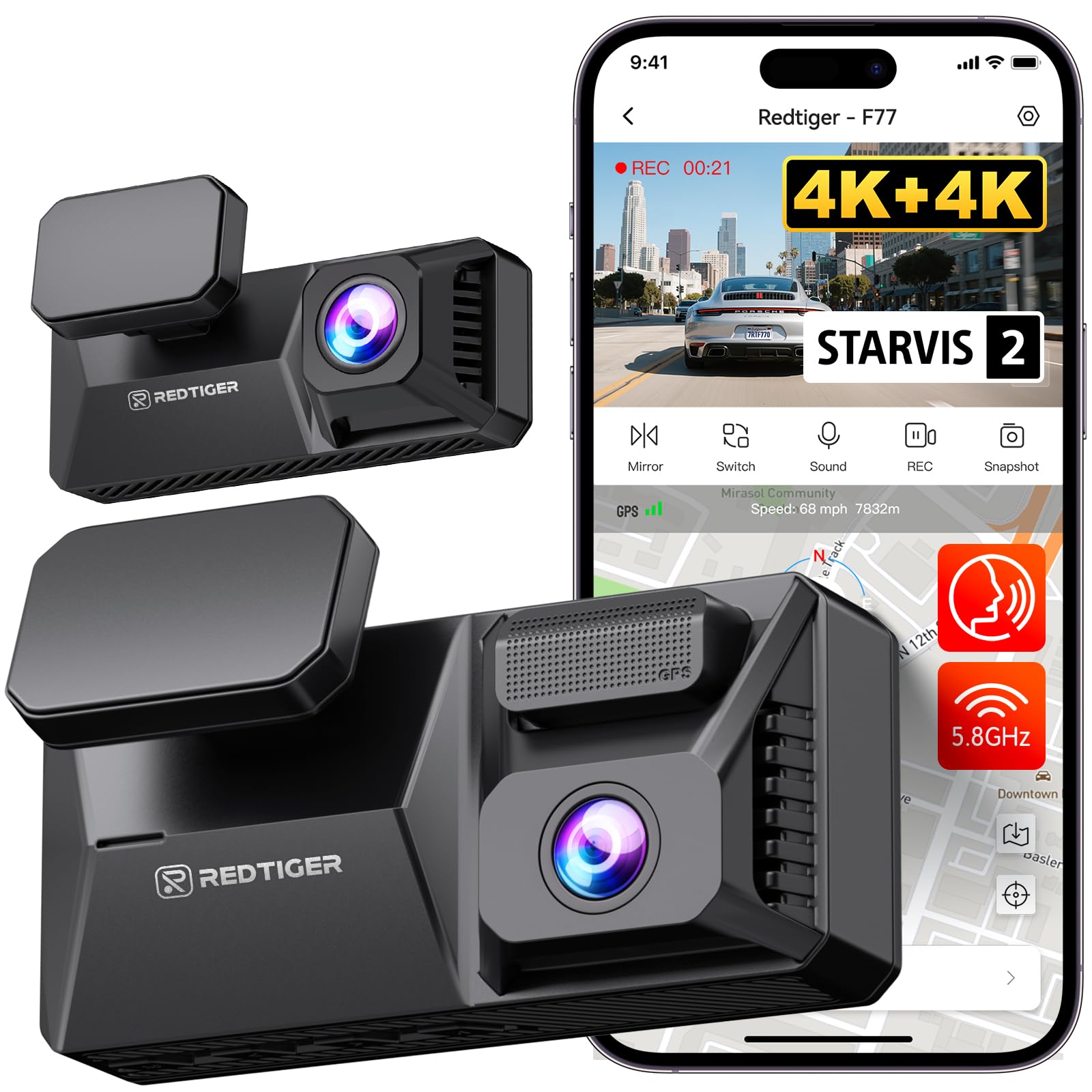
No memory card needed — the first dash cam with built-in eMMC that just works.
The REDTIGER F77 is unique in this lineup because it records in full 4K resolution on both the front and rear cameras simultaneously — 3840×2160P at 30fps from each — using Sony STARVIS 2 IMX678 sensors on both ends. That means the footage from behind you is just as detailed as what you capture ahead, which is rare even among premium dual-camera models. The 7-layer glass lens with an F1.8 aperture works with 4K HDR and WDR technology to balance extreme light and dark areas, so tunnel exits and oncoming headlights do not wash out the image. The 4-inch IPS touch screen makes it easy to swipe through settings without digging through tiny menu buttons.
One buyer summed it up as “the best dash cam I have owned in 6 years — amazing picture quality” and another specifically praised its built-in 128GB eMMC storage, which handles loop recording for about 5 hours of continuous 4K footage and eliminates the risk of a removable SD card getting corrupted or dislodged during an accident. You also get 12 voice commands — “start recording,” “lock video,” “take photo” — so you can keep your hands on the wheel. The 5.8GHz Wi-Fi transfers files faster than standard 2.4GHz, though some reviewers noted that downloading full 4K clips can take time, especially for a long drive. The parking monitor (via a sold-separately hardwire kit) triggers on collision detection or motion, and the 18-month warranty includes phone and email support with a team that responds within 24 hours.
The main trade-off is that built-in storage caps at 128GB — if you regularly record long daily commutes and want to keep weeks of footage, you cannot swap in a larger card. The rear cable runs about 21.3 feet, which is more generous than the ROVE’s 6-foot cable, but a few owners of minivans and larger trucks mentioned it still came up short. REDTIGER’s customer service (one buyer mentioned a rep named Emma) sent free extended cables and hardwire kits to a few users who had issues, so the support seems proactive.
What stands out
- True 4K+4K — both cameras at 8MP resolution, no quality drop on the rear
- Built-in 128GB eMMC storage eliminates SD card failure risk
- 12 voice commands allow hands-free operation while driving
- 4-inch touch screen simplifies menu navigation
Worth noting
- 128GB internal storage is not expandable — may fill up faster than a large card
- 4K video downloads are slow over Wi-Fi (some users report >1 hour for 2.5 hours of footage)
- Hardwire kit for parking mode is an extra purchase
Buy it if: you want the only dual 4K system in this roundup, especially if you drive at night or want to avoid fiddling with a memory card ever.
Consider instead if: you need to store more than 5 hours of 4K video without clearing it — then a model with a 256GB or 1TB removable card is a better fit.
3. Coolcrazy 4K Dash Cam Front and Rear
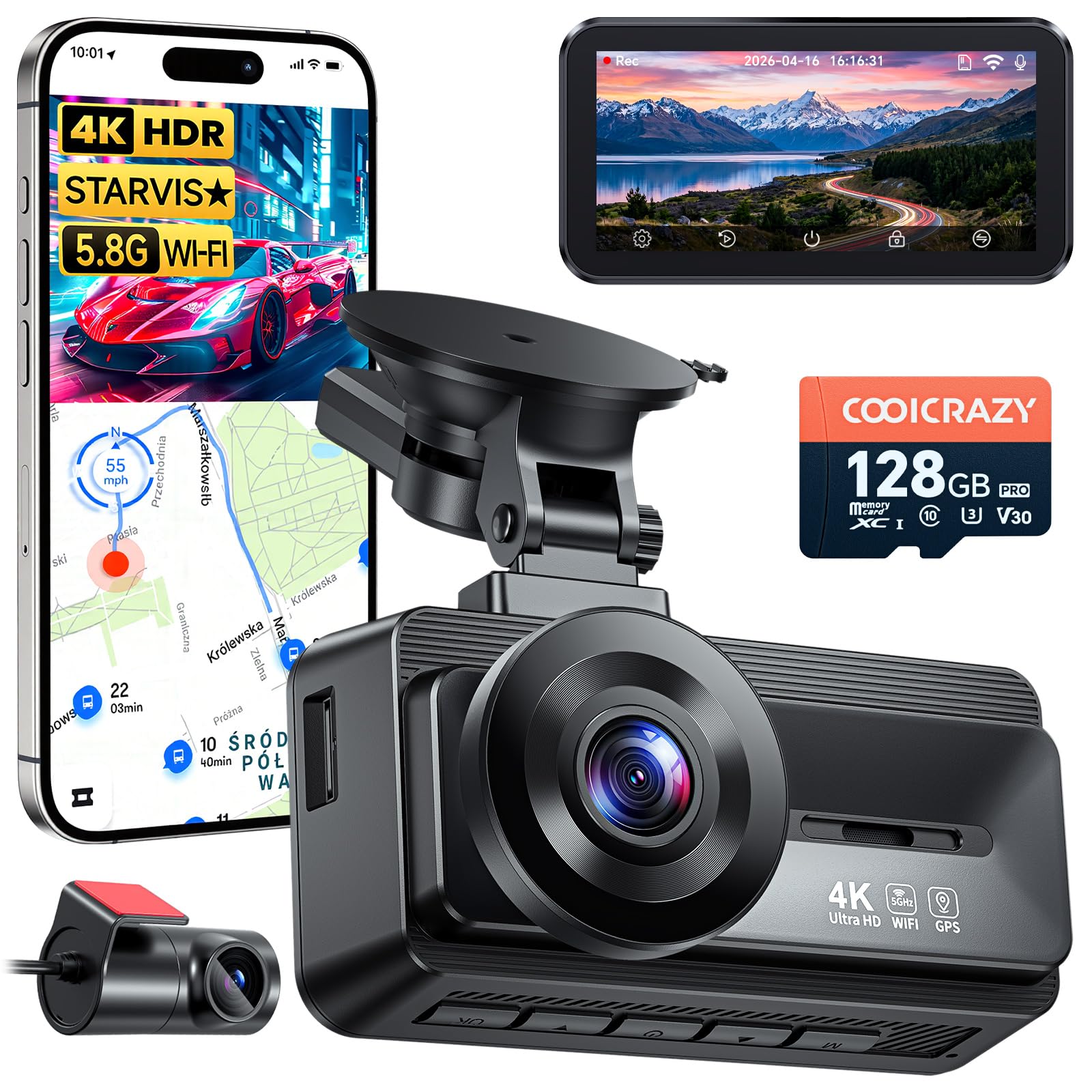
A 128GB card, a STARVIS sensor, and 5GHz Wi‑Fi for under — tough to beat.
Coolcrazy squeezes a surprising amount of hardware into a mid-range price. The front camera records at 4K UHD (3840×2160P) at 60fps — that is a higher frame rate than most competitors, which typically cap at 30fps for 4K — and the 170° front plus 150° rear ultra-wide lenses capture nearly everything around your car. The STARVIS starlight night vision sensor and large-aperture WDR (wide dynamic range) technology work together to reduce headlight glare on wet roads and bring out details in dark alleys and underground garages. The 5GHz Wi-Fi (compared to the 2.4GHz-only Wi-Fi on the 70mai A410) allows a fast phone connection, and owners mention the app downloads files at a decent pace — one buyer described it as “WiFi hotspot works great for phone viewing.”
You get a 128GB memory card in the box, so there is no separate purchase before your first drive. The G-sensor locks footage during collisions and the 24-hour parking monitor runs on time-lapse mode (again, a hardwire kit is needed for constant power). Early customers note that the rear camera’s adhesive can fail after a few months, so you may want to secure it with an extra strip or mount. The front suction cup works well on the windshield for temporary placement, though the included electrostatic sticker is better for a permanent, clean install. A couple of owners said the 4K resolution is not crisp enough to read every license plate from farther back, but at this price point that is a reasonable trade-off.
Compared to the ROVE R2-4K Dual PRO ( range), the Coolcrazy sacrifices the dual STARVIS 2 sensor setup and the super-fast Wi-Fi 6, but it still delivers a solid video quality and the same 256GB max storage capacity for about half the cost. If you want a reliable day-to-day dash cam that includes a decent memory card from the start and you do not mind a small chance of the rear cam adhesive wearing out, this is the strongest value option.
What you get for the money
- Includes a 128GB memory card and suction mount in the box
- Front camera records at 60fps for smoother fast-driving footage
- 5GHz Wi-Fi for faster phone downloads than 2.4GHz models
- STARVIS sensor and WDR improve night visibility without a big price jump
The trade-offs
- Rear camera adhesive may weaken over time — some buyers had it fail on both units
- 4K not always sharp enough for distant license plates
- Hardwire kit for parking mode not included
For savvy first-time buyers: this gives you 4K front footage, a big included card, and 5GHz Wi‑Fi without pushing past the mark — hard to argue with the feature set at this level.
The honest catch: rear camera adhesive and long-term reliability may not match the premium picks above, so it is best for those who do not mind occasionally checking the mount.
4. FAIMEE 4K+2K Dash Cam Front and Rear
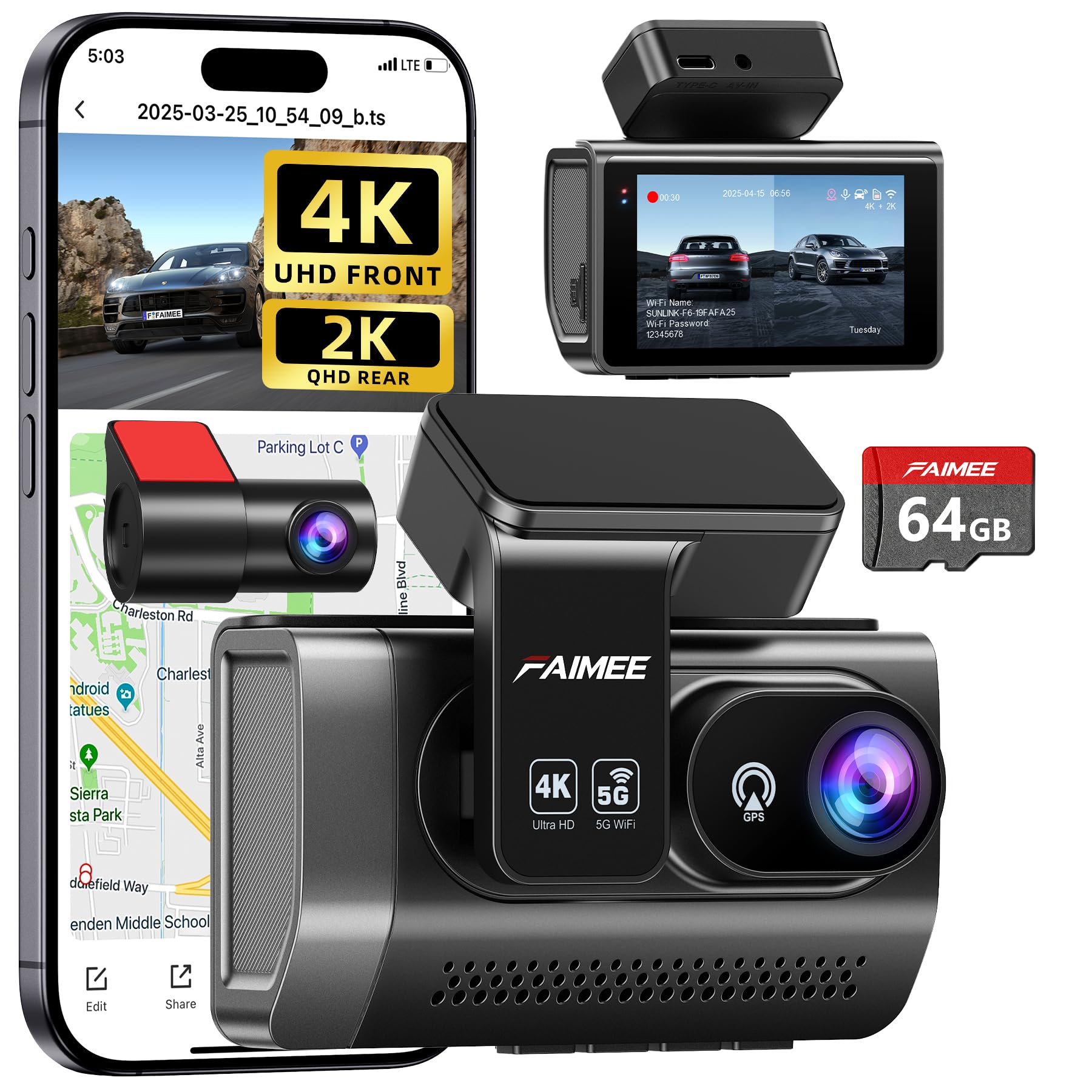
The widest lens in the list — 170° front and rear captures six lanes of traffic.
If your biggest worry is the blind spot on either side of your car, the FAIMEE 4K+2K covers it with a 170° field of view on both the front and rear cameras. That is wider than the 150° on the ROVE and the 160° on the REDTIGER, and it means you can see vehicles pulling alongside you without a gap in your coverage. The front records at 4K UHD (3840×2160P) with an F1.8 aperture and the rear at 2K (2304×1296P), and both use WDR and night vision to handle high-contrast scenes like sun glare or oncoming headlights. Reviewers point out the “video quality is good for the price” and the “auto-deletes old footage” works smoothly.
A standout spec here is the dual-band Wi-Fi supporting both 5.8GHz and 2.4GHz — that is the same 5.8GHz band the REDTIGER F77 uses, so you get faster downloads than the 70mai’s standard 2.4GHz-only Wi-Fi. The compact 3-inch IPS screen sits discreetly behind the rearview mirror, and the stick-on mount stays put without the sticky residue that some other models leave on the glass. The 64GB memory card is included, with support for up to 256GB expansion. One reviewer pointed out that the “cable may be too short for vans/large trucks,” so if you drive a longer vehicle, you may need an extension cable. A few owners also mentioned the camera is slightly larger than some others, and the PC/laptop connection did not work natively — you will rely on the app or the microSD card for file transfer.
Compared to the 70mai A410 (which has a 125° field of view), the FAIMEE’s 170° gives you a 36% wider coverage gap — a meaningful advantage for catching side-swipe incidents on both front and rear channels. If you drive a sedan or compact car, the standard cables and mount should fit without issue, and the 18-month warranty provides a solid safety net.
Reasons to choose this one
- 170° front and rear lens captures six lanes for minimal blind spots
- 5.8GHz+2.4GHz dual-band Wi-Fi for faster app transfers
- Stick-on mount installs cleanly without residue on the windshield
- 64GB card included; expandable to 256GB
Reasons to think twice
- Rear camera cable is too short for vans and large trucks
- No direct PC/laptop connection — file transfer is app or SD card only
- Camera body is slightly larger than some competitors
Best for sedan and compact car drivers: you get the widest combined coverage, dual-band Wi‑Fi, and a clean install — enough to catch side traffic without stepping up to the premium tier.
skip it if: you drive a full-size van or long truck, because the rear cable simply will not reach without an aftermarket extension.
5. 70mai Dash Cam Front and Rear A410
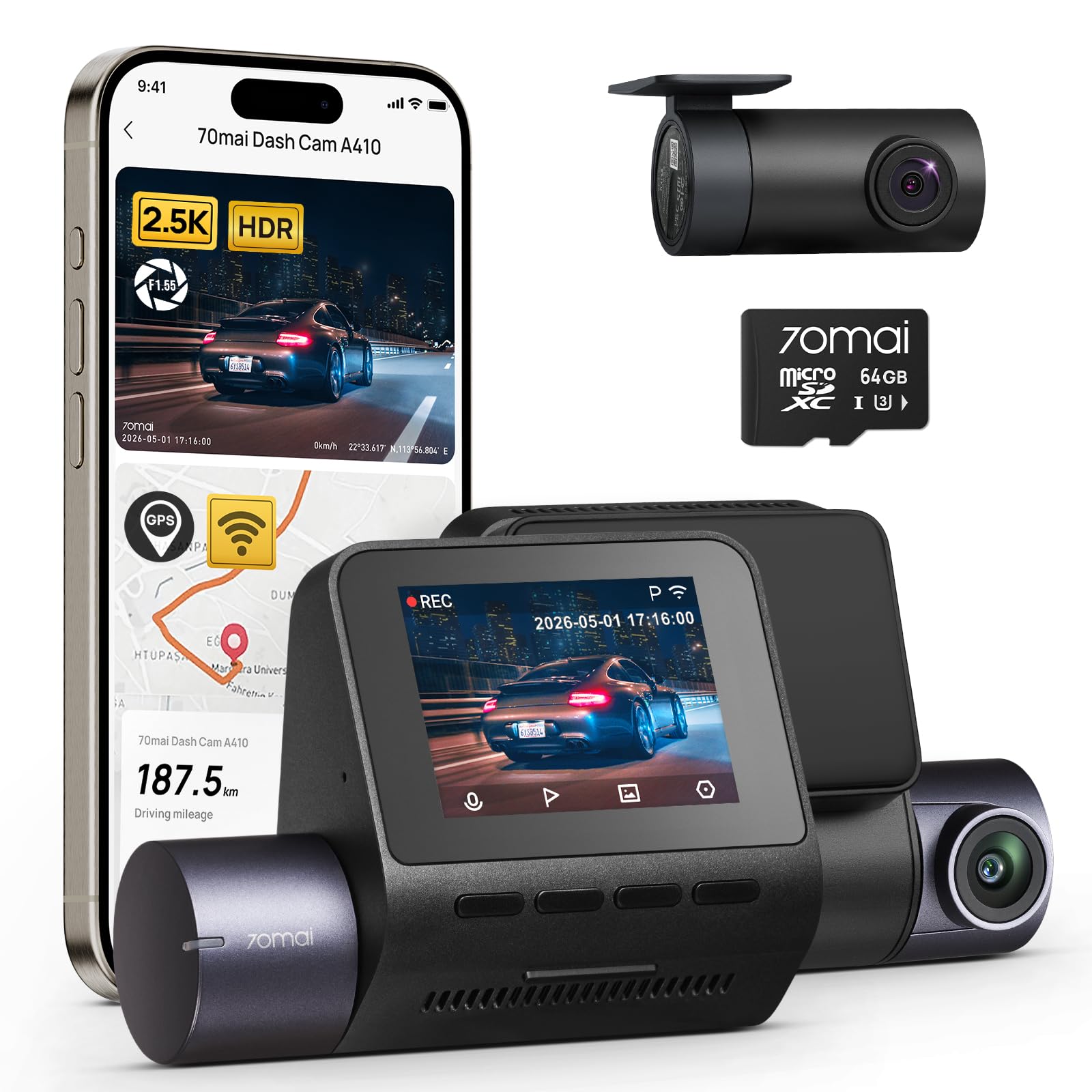
The budget pick that still tucks away GPS, HDR, and a 64GB card.
70mai’s A410 is the entry-level champion of this lineup, offering a front camera at 2.5K (2560×1440P) and a rear camera at 1080P — a step down from the 4K models above, but still more than enough for most daytime and city driving. The F1.55 ultra-large aperture (the widest of any camera here, even the ROVE’s F1.7 front lens) pulls in plenty of light for night footage, and HDR technology keeps bright street signs from blowing out. The 125° wide-angle lens covers four lanes of traffic, which is narrower than the 170° on the FAIMEE and Coolcrazy, but still enough to catch lane-changing incidents. Built-in GPS logs your speed and route directly to the video file, a feature that many cheaper dash cams leave out entirely.
Reviewers consistently praise the build quality and ease of use — one buyer called it the “perfect dash cam” and noted it “includes all needed; easy setup, compact behind mirror.” Another mentioned that the battery lasts 1.5–2 years and is easy to replace, which is an important detail if you plan to keep this camera long-term. The app works well for live view and downloads, and the electrostatic sticker holds the mount firmly on the windshield without leaving sticky residue. A 64GB memory card is included and the unit supports up to 256GB. Shoppers say that the camera withstands Florida heat and Georgia cold without malfunctions, and that the video quality is reliable enough for accident documentation.
The trade-off is the narrower field of view — at 125°, it misses the side coverage of the FAIMEE and Coolcrazy models, which cover 170°. The 2.5K front resolution is also noticeably less detailed than 4K when you need to zoom in on a license plate from a distance. But if you are looking for a solid, proven dual-camera system that does not break the budget and still includes GPS, an app, and a 64GB card, the 70mai A410 is a safe, well-reviewed pick. As one owner said, it is “the best value in its price range.”
Solid foundation
- F1.55 aperture is the widest in this roundup for night-time low-light capture
- Built-in GPS with speed/route logging standard, not an extra cost
- Includes a 64GB card and electrostatic sticker — ready to install from the start
- Buyers report reliable construction that survives extreme heat and cold
Limits to know
- 125° field of view is noticeably narrower than 170° competitors (36% less coverage)
- Front camera is 2.5K, not 4K — less detail when zooming in on distant plates
- Battery lasts 1.5–2 years, though it is user-replaceable
Reach for this when: you want a proven, affordable dual cam with the widest aperture for night driving and do not mind trading a little side-view coverage to stay under a budget-friendly price.
Look elsewhere if: you need the widest lens or 4K front resolution for catching license plates far down the road — step up to the FAIMEE or Coolcrazy for those extra degrees and pixels.
Understanding the Specs
Resolution: 4K vs 2.5K vs 1080P
The front camera’s resolution determines how far you can zoom into a license plate or road sign and still read it. 4K (3840×2160P) gives you four times the pixels of 1080P, so a plate 30 feet away stays readable. 2.5K (2560×1440P) is a middle ground — clearer than 1080P but with about a third fewer pixels than 4K. The rear camera on most models is 1080P or 2K, which is fine for capturing cars behind you at close range. Premium models (like the REDTIGER F77) now put 4K on the rear too, which matters if you want the same detail from behind.
Aperture (F‑stop) and Night Vision
The aperture, written as F1.55 or F1.8, is the size of the lens opening — a smaller number means a wider opening that lets in more light. A camera with F1.55 captures noticeably better footage in dark parking lots or unlit roads than a camera with F2.0, because more light hits the sensor each frame. Look for STARVIS or STARVIS 2 sensors alongside a wide aperture; the sensor quality matters just as much as the lens. HDR (high dynamic range) or WDR (wide dynamic range) helps balance very bright and very dark areas in the same scene, like a tunnel exit or a car’s headlights at night.
FAQ
What is the difference between 4K+2K and 4K+1080P in a dual dash cam?
Can I install a dual dash cam myself or do I need a professional?
How long does the rear camera cable need to be for an SUV or truck?
What does G‑sensor do in a dash cam?
Is parking mode worth the extra cost for a hardwire kit?
How much storage capacity do I need for a dual dash cam?
What is the difference between a STARVIS sensor and a standard CMOS sensor?
Will a front-and-rear dash cam drain my car battery when parked?
Can I use voice control with any dual dash cam?
Final Thoughts: The Verdict
For most buyers, the best dash cam front and rear winner is the ROVE R2-4K Dual PRO because it pairs Sony STARVIS 2 sensors on both cameras with Wi-Fi 6 transfers and up to 1TB storage — no other model offers that combination of sensor quality, speed, and future-proof capacity. If you want a fully integrated 4K+4K system with built-in memory and voice control, grab the REDTIGER F77. And for the best value package that includes a huge 128GB card and a STARVIS sensor under, the standout is the Coolcrazy 4K — it covers the essentials without demanding a premium budget.
How We Picked
We do not accept paid placement. Every pick is matched to a real buyer and a real use-case; we do not hands-on test units.
Sources & Methodology
Specifications: manufacturer listings and product documentation. Review insights: verified customer reviews, as of July 2026. Pricing: not shown on this page (it changes often); check the current price via the retailer link.
As an Amazon Associate, Gadgets Feed earns from qualifying purchases. This does not affect which products we feature.
Product prices and availability are accurate as of the date/time indicated and are subject to change. Any price and availability information displayed on Amazon at the time of purchase will apply to the purchase of this product. As an Amazon Associate I earn from qualifying purchases.
CERTAIN CONTENT THAT APPEARS ON THIS SITE COMES FROM AMAZON. THIS CONTENT IS PROVIDED "AS IS" AND IS SUBJECT TO CHANGE OR REMOVAL AT ANY TIME.
Amazon and the Amazon logo are trademarks of Amazon.com, Inc. or its affiliates.