
A door-frame pull-up bar that wobbles mid-rep destroys your form and risks a nasty fall. That single shaky sensation is the difference between a bar that collects dust and one that builds a V-torso. The narrow category you’re shopping — a permanent mounted pull-up bar — demands you choose between three distinct anchor philosophies: doorway wedge, joist/cement ceiling bolt, or direct wall plate. Each method changes how much clearance your head has, whether your knuckles scrape drywall, and how many grip angles you can actually use without your knees hitting the frame.
I’m Min — the co-founder and writer behind Gadgets Feed. I’ve spent countless hours cross-referencing load-test specs, weld quality reports, and real-user installation feedback to separate the genuinely rigid bars from the bracket failures waiting to happen.
Whether you need to bolt into ceiling joists over an unfinished basement or mount a multi-grip plate directly above your bedroom door frame, this guide evaluates the seven models that define the current best home pull-up bar category based on steel gauge, weight capacity, and mounting versatility.
How To Choose The Best Home Pull-Up Bar
Mounting method is the single most important decision. Doorway bars that clamp using rotational pressure (no screws) offer zero-install convenience but can damage the door trim and slip under dynamic movement. Wall-mounted plates require drilling into wood studs or concrete but deliver true stability for weighted sets. Ceiling/joist mounts maximize head clearance if your overhead beams are accessible. Match the mount to your rental situation and preferred training style.
Steel Thickness and Weld Integrity
A bar built from 11-gauge steel (roughly 3 mm wall thickness) is noticeably heavier and more rigid than a bar made from thin-walled tubing. Inspect product images for visible weld seams — look for continuous bead welds at bracket joints rather than tack welds. The weight capacity rating (typically 275 to 600 lbs) correlates directly with steel quality, but the bracket attachment points fail long before the bar itself does.
Grip Width and Wall Clearance
Standard grip spacing ranges from 14 inches (narrow neutral) to 50 inches (wide pronated). Measure your shoulder width and the width of your door frame or available wall space. Head clearance is the vertical distance from the bar to the ceiling — 12 inches is the minimum for chin-ups without hitting the ceiling. For wall-mounted designs, the distance from the wall to the bar (14 to 22 inches typical) determines whether you can perform kipping pull-ups or hang gymnastics rings.
Quick Comparison
On smaller screens, swipe sideways to see the full table.
| Model | Category | Best For | Key Spec | Amazon |
|---|---|---|---|---|
| Ultimate Body Press Doorway Bar | Wall/Doorway Mount | Rigid door frame mounting | 1.25-inch welded steel, 275-lb capacity | Amazon |
| Yes4All Heavy Duty Wall Mount | Wall Mount | Full clearance for rings/kipping | 50-inch bar, 30-inch wall clearance, 500-lb capacity | Amazon |
| Titan Fitness Adjustable Depth | Wall Mount | Depth flexibility (14 or 22 inch) | 11-gauge steel, 400-lb capacity, 52-inch bar | Amazon |
| Kipika Multi Handle with Ball | Wall Mount | Specialized grip variety (ball finger) | 1 3/10-inch steel, 440-lb capacity, 5 grip positions | Amazon |
| AmStaff Fitness Joist Mount | Ceiling/Joist Mount | Maximum head clearance | 42-inch bar, 12-inch vertical supports, 400-lb capacity | Amazon |
| SELEWARE Heavy Duty Welded | Wall/Doorway Mount | Versatile mount (door/joist/beam) | 4mm alloy steel, 500-lb capacity, triangular supports | Amazon |
| ONETWOFIT Doorway Bar | Doorway Mount | Adjustable fit for non-standard doors | 23 to 36 inch adjustable width, 440-lb capacity | Amazon |
In‑Depth Reviews
1. Ultimate Body Press Wall Mounted Doorway Pull Up Bar

The Ultimate Body Press Doorway Bar is a hybrid design that mounts directly into the door frame using all-welded 1.25-inch thick steel tubing, eliminating the rotational-pressure mechanism that makes typical doorway bars bounce. It stands 4.25 inches off the wall, providing just enough clearance for a full range of motion without sacrificing the compact footprint of a door-based install. The bar supports an honest 275 pounds of static load — a ceiling that reflects its doorway-anchor limitations rather than the steel’s actual tensile strength.
Three grip positions (wide pronated, shoulder-width, and neutral) are built into the single welded arch, and the slight upward angle at the grip ends relieves wrist strain during chin-ups as it encourages a natural forearm alignment. Users report no creaking or flex at 210 pounds, and the included lag bolts grab cleanly into wood studs through the door frame if you pre-drill with a 1/4-inch bit. The bar’s powder coat resists rust well indoors, though it can chip if the mounting hardware is over-torqued during installation.
The primary trade-off is the bar’s smooth finish — sweaty palms lose traction quickly, and several reviewers fix this by wrapping athletic tape or grip tape over the contact points. The 275-pound weight ceiling also rules out weighted vest work for heavier athletes. For the majority of home users who want a permanently rigid bar that doesn’t require a dedicated wall station, this is the cleanest solution on the list.
Why it’s great
- All-welded steel eliminates moving parts and frame damage
- Ergonomic angled grips reduce wrist strain
- 10-year manufacturer defect warranty
Good to know
- 275-lb capacity limits weighted vest training
- Smooth bar grip becomes slippery with sweat
- May be too narrow for extremely broad shoulders
2. Yes4All Heavy Duty Wall Mounted Pull Up Bar

The Yes4All wall-mounted bar commands serious real estate: a 50-inch steel bar sits 30 inches off the wall on heavy-duty brackets, giving you enough clearance for kipping pull-ups, ring dips, or hanging ab straps without your knuckles grazing drywall. The tubing measures 1.25 inches in diameter, and the powder-coated finish remains grippy even during high-rep sets — a deliberate design choice that avoids the slippery chrome trend. The 500-pound capacity rating is supported by bracket analysis that calculates concrete anchor strength at 1,777 pounds, solid brick at 888 pounds, and hollow brick at 355 pounds.
Installation requires anchoring directly into wood studs at standard 16-inch or 24-inch spacing — the included drywall anchors are functionally useless for anyone over 150 pounds, so plan for 3/8-inch by 3.5-inch lag bolts and a powerful impact driver. The bar itself weighs 23 pounds, reflecting the heavy-gauge steel construction. Users successfully perform muscle-ups, hang TRX straps, and mount heavy punching bags from the single frame without detectable flex.
The main drawbacks are the bracket footprint — the mounting plates require substantial wall space and precise leveling — and the fact that the assembly hardware is sometimes insufficient for deeper studs. Tall athletes with high ceilings will appreciate the 30-inch wall clearance that allows full leg extension without touching the floor. This bar is the obvious pick if you have a dedicated wall in a garage or basement gym and want the most versatile training platform available.
Why it’s great
- 30-inch wall clearance enables rings and kipping
- 500-lb rated structure with verified anchor strength analysis
- Non-slip powder coat finish outperforms chrome
Good to know
- Included lag bolts too short for deep studs
- 23-pound unit requires two-person install for safety
- Drywall anchors included are insufficient for real use
3. Titan Fitness Adjustable Depth 52″ Wall Mounted Pull Up Bar
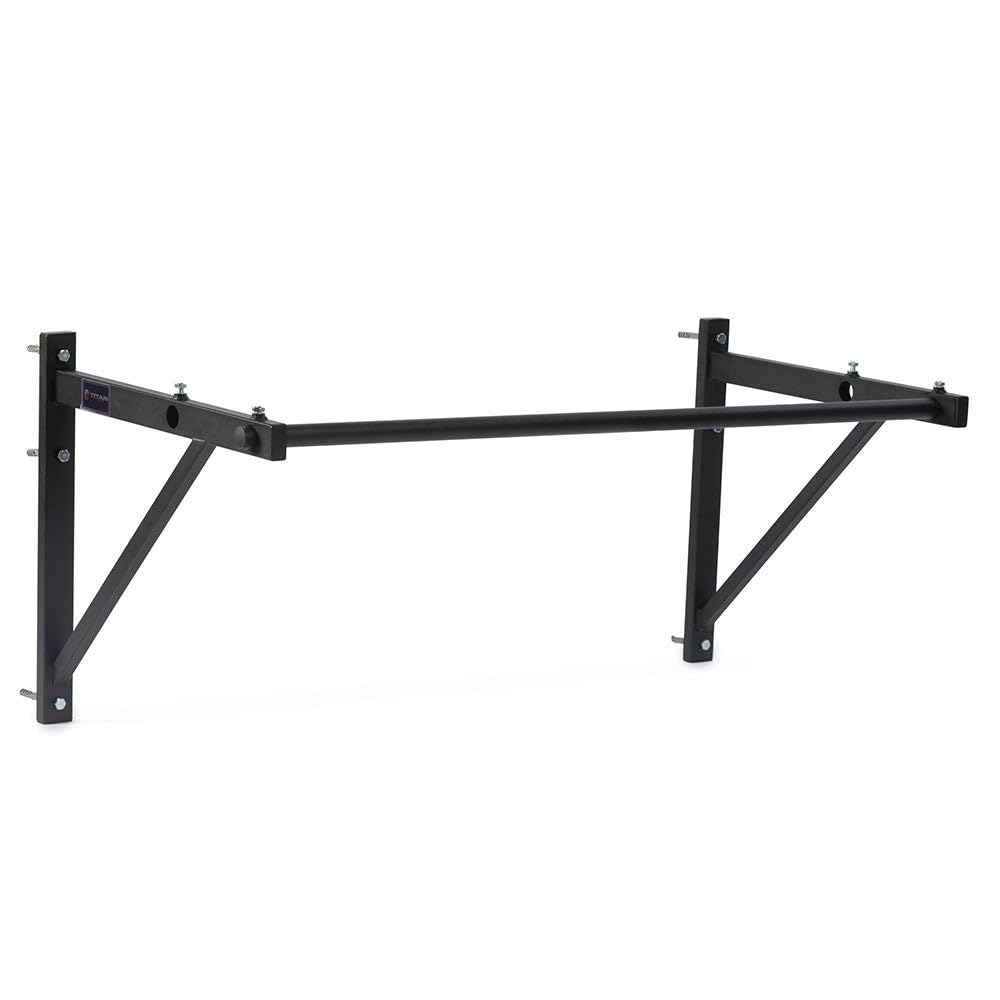
The Titan Fitness Adjustable Depth bar solves a specific clearance problem that stationary wall bars ignore: you can select between 14-inch or 22-inch spacing from the wall by repositioning the support arms. The 14-inch setting works in tight spaces where overhead clearance is limited, while the 22-inch extension accommodates kipping pull-ups, hanging leg raises, and attaching gymnastics rings. The bar measures 52 inches wide with a 32mm diameter grip surface (roughly 1.25 inches), and the frame is constructed from 11-gauge steel rated to 400 pounds.
The frame weighs 20 pounds and installs on standard 16-inch stud centers with included hardware, though the lag bolts should be upgraded for concrete mounting. Users report that the adjustable length design saved installs when studs were oddly spaced (up to 42 inches apart) because you can mount the brackets without forcing them to a pre-set width. After five months of daily use including kipping, reviewers noted only a single re-tightening of the mounting screws. The smooth powder-coated bar finish works fine for steady-state pull-ups but benefits from grip tape for sweaty sessions.
The only structural concern is that the mounting brackets are welded to the adjustable arms, not the main bar — the rotational force during kipping transfers entirely through those welds. The 400-pound limit is conservative for the steel gauge, but athletes over 250 pounds should stick to strict pull-ups to keep the bracket welds under their design load. For the price, this is the most space-adaptable heavy-duty wall bar on the market.
Why it’s great
- Depth adjustable (14 or 22 inches) for space flexibility
- 52-inch wide bar accommodates wide grip pull-ups
- 11-gauge steel frame rated for kipping movements
Good to know
- Bracket welds may be the failure point under dynamic load
- Included mounting hardware is basic
- Smooth grip surface needs tape for sweaty hands
4. Kipika Heavy Duty Wall Mounted Doorway Pull Up Bar

The Kipika wall bar differentiates itself with five distinct grip positions packed into a single 40-inch frame: wide pronated, narrow pronated, neutral, hammer, and a dedicated ball finger grip for training climbing and martial arts grip endurance. The ball finger protrusion is a category rarity — a small rubberized sphere that isolates finger strength without requiring a separate hangboard. The main bar uses 1 3/10-inch steel tubing and the six-hole bracket design spreads the load across six lag bolts for redundant safety. The 600-pound static rating is the highest on this list, though practical limits depend on your framing.
The wall clearance is just 6 inches from the bar to the wall, which means you cannot kip or hang rings without your knuckles contacting drywall. This bar is designed for strict controlled reps only, and the short projection makes it ideal for tight hallways or above door frames where space is at a premium. The foam handles on the auxiliary grips are comfortable for the first month but wear and become sticky over time — several users swapped them for hockey tape or athletic tape for better texture retention.
Installation requires drilling into wood studs through the provided bracket plate, and the included hardware is adequate for drywall mounting if you use the six-hole spread across a board in between studs (a common DIY workaround). The foam padding on the main bar degrades faster than powder-coated steel, so expect to replace the foam tubes every 6-8 months with regular use. For athletes focused on grip strength diversity and strict form over dynamic movement, this is the most specialized option available.
Why it’s great
- Unique ball finger grip for climbing-specific strength
- Six-hole bracket provides redundant anchor points
- 600-lb capacity gives high safety margin
Good to know
- Only 6 inches of wall clearance — no kipping or rings
- Foam grips deteriorate faster than welded steel
- Installation may require a backer board for spacing
5. AmStaff Fitness Joist Mount Pull Up Bar

The AmStaff Fitness Joist Mount breaks away from the wall-plate design: it bolts directly into ceiling joists or exposed rafters, leaving the floor completely clear. The bar spans 42 inches wide with a 1.25-inch padded diameter, and the 12-inch vertical supports drop the bar down from the ceiling for maximum head clearance. This is the ideal setup for unfinished basements, garages, or any space where you can see bare wood beams — you get a gym-grade full range of motion without sacrificing any floor square footage.
The steel construction uses 1-inch by 1.75-inch heavy-duty supports rated to 400 pounds, and the 5-inch parallel grips add a neutral-grip option that targets brachialis and reduces shoulder impingement risk. The multi-part design makes it possible to install across varying rafter spacing, and the included mounting hardware works with wood or concrete ceiling substrates if you pre-drill with a 1/4-inch masonry bit for concrete. After 1.5 years of use in one reviewer’s basement, the bar showed no signs of bending or twisting — the lag bolts into the bulkhead held tight despite daily dead hangs and pull-ups.
The only real limitation is that you need accessible ceiling joists; if you have a finished drywall ceiling, you must cut access holes or mount blocking between joists, which adds complexity. The foam padding on the main bar is comfortable for moderate rep ranges but compresses over time and can slide slightly if wet. For anyone with a basement gym or garage with exposed beams, this ceiling-mounted bar delivers the most unobstructed training experience in the lineup.
Why it’s great
- Ceiling mount leaves zero floor footprint
- 12-inch drop maximizes head clearance
- Multi-part design adapts to various rafter spacing
Good to know
- Requires exposed joists for direct installation
- Foam padding compresses and may slide when wet
- Maximum 12-inch drop limits use for very tall users
6. SELEWARE Heavy Duty Welded Pull Up Bar

The SELEWARE bar is a utilitarian wall/doorway mount built from 4mm thick alloy steel — noticeably denser than the standard 3mm tubing found on most bars at this tier. The triangular support base design distributes the load across three contact points per bracket, reducing the bending moment at each lag bolt. The 500-pound capacity is backed by a US patent pending on the triangular geometry, and the included carabiners at each end allow you to attach resistance bands, suspension straps, or a heavy bag without adding a separate anchor.
The 36-inch bar length is shorter than the 42-inch to 52-inch options, which makes this mount work best in narrow doorways or between studs spaced at 16 inches. The welded construction showed extremely clean bead welds in customer reviews, with no visible slag or undercut. Installation requires a pre-drill with a 1/4-inch bit and an impact driver for the lag bolts, and the bar sits flush enough that it does not protrude into room traffic when mounted in a corridor.
The primary limitation is the lack of grip width variety — you get a single straight-bar grip with no neutral or wide offset. The smooth powder coat provides decent friction dry but demands chalk or tape when humidity rises. For a budget-focused build that does not sacrifice steel thickness or load rating, the SELEWARE bar competes with bars costing 50 percent more. It is the right choice if you need a no-frills, mount-and-go bar in a confined space.
Why it’s great
- 4mm thick steel exceeds typical 3mm tubing
- Triangular supports reduce bracket flex
- Integrated carabiners for band/TRX attachment
Good to know
- 36-inch bar is shorter than most wall-mounted options
- Single straight grip only — no offset positions
- Powder coat needs chalk or tape for sweaty use
7. ONETWOFIT Pull Up Bar for Doorway
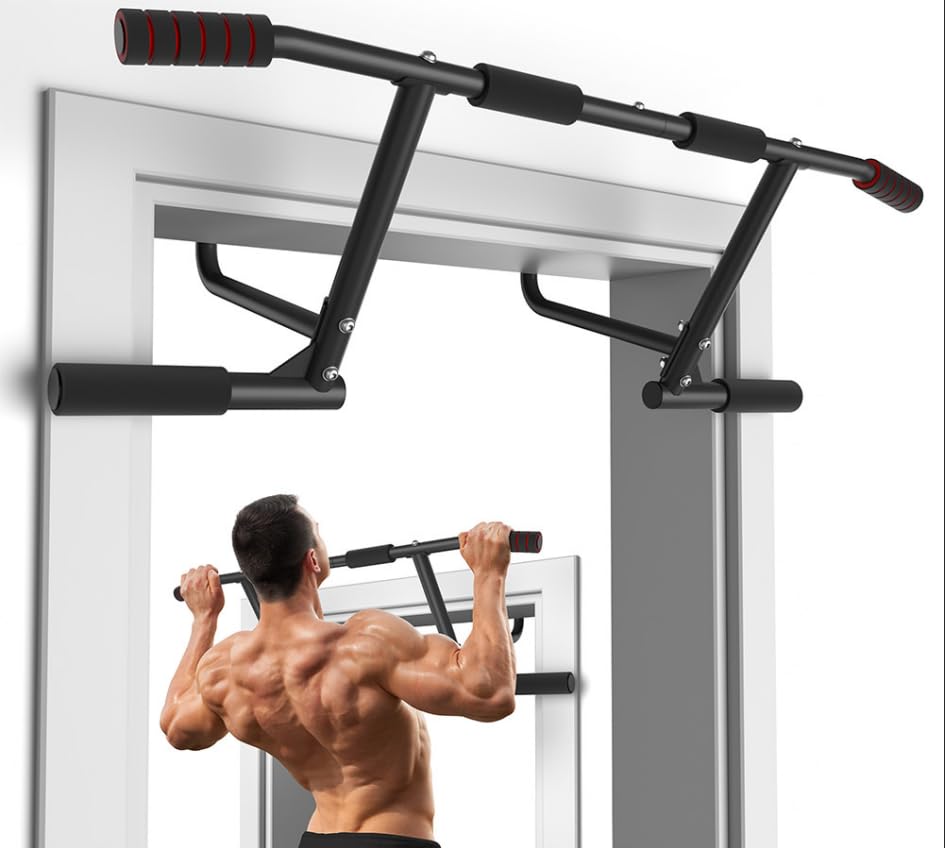
The ONETWOFIT bar is a wall/doorway mount that prioritizes adjustability: it fits door widths from 23 to 36 inches and accommodates door depths between 4.72 and 9.84 inches with trim heights up to 5 inches. The crossbar design features a middle cutout that lets you open and close the door fully without removing the bar — a convenience feature that matters in high-traffic rooms like home offices or laundry rooms. The thickened steel construction supports up to 440 pounds, and the full-coverage foam protectors prevent scuffing or denting the door frame.
The ergonomic end angles are angled downward to protect wrist alignment, and the soft foam grips cover the entire contact area for users with sweaty palms. The bracket system mounts using six bolts per side and can be installed on a board above the door (using 2×4 stringers) for users who prefer not to drill into the door frame directly. At 200 pounds, testers reported zero flex in the bar, and the 19-inch bracket spacing conveniently aligns with standard stud spacing for most doors.
The main compromises are the foam grip durability (the middle handles can slip after repeated use, and the end handles lack rubber padding) and the installation difficulty — the instructions are minimal, and the included screws may not be adequate for all wall materials. The wide grip spacing can stress the shoulders if you have a narrower frame, so measure your shoulder width before committing. This is the best option for renters or users who want a non-permanent or at least low-damage install that still provides bolt-through rigidity.
Why it’s great
- Adjustable width fits non-standard door frames
- Center cutout allows normal door operation
- Ergonomic angled grip reduces wrist strain
Good to know
- Foam grips slip after repeated use
- Instructions are minimal and may confuse first-timers
- Included screws not always adequate for wall type
FAQ
Can I install a wall-mounted pull-up bar on drywall without studs?
Does the foam grip padding wear out quickly on home pull-up bars?
What is the minimum ceiling height for a ceiling-mounted pull-up bar?
Final Thoughts: The Verdict
For most users, the best home pull-up bar winner is the Ultimate Body Press Wall Mounted Doorway Bar because it combines the convenience of a door-based installation with the rigid stability of all-welded steel, delivering a no-wobble training platform at an accessible price. If you need full clearance for kipping pull-ups or hanging gymnastics rings, grab the Yes4All Heavy Duty Wall Mount for its 30-inch offset and 500-pound structure. And for a ceiling-joist setup that frees up every inch of floor space in a basement or garage gym, nothing beats the AmStaff Fitness Joist Mount Pull Up Bar.