
Cutting the cord starts with one decision: replacing your monthly cable subscription with a single piece of hardware that pulls free over-the-air broadcast channels directly to your TV. An amplified indoor antenna is the most direct path to that goal, turning invisible VHF and UHF signals into crystal-clear HD programming from networks like ABC, NBC, CBS, Fox, and PBS without a recurring bill.
I’m Min — the co-founder and writer behind Gadgets Feed. I spend my time studying market trends and dissecting technical specifications across the consumer electronics landscape, and I’ve analyzed the real-world reception data and user feedback on dozens of indoor amplified antennas to identify the models that actually deliver on their range claims and signal stability.
This guide focuses exclusively on the best indoor amplified antenna options available right now, cutting through the marketing hype to help you find the model that matches your home’s unique signal environment and viewing needs.
How To Choose The Best Indoor Amplified Antenna
Selecting the right amplified indoor antenna is less about picking a brand and more about matching the antenna’s reception profile to your specific location. The distance to broadcast towers, the terrain between you and those towers, and the construction materials of your home all affect which model will work best. Understanding a few key specifications will save you from buying a product that underperforms in your environment.
Amplifier Quality and Gain
The amplifier is the heart of any powered indoor antenna. Look for models that specify low-noise amplification, often marketed as ELN (Extremely Low Noise) or with an amplifier gain figure measured in decibels. A good amplifier boosts weak signals without introducing noise that degrades picture quality. An antenna with a 20 dB gain amplifier will typically pull in more usable channels than one with a 10 dB amplifier, all else being equal.
Range Realism: Miles vs Reality
Advertised ranges of 50, 200, or even 5000 miles are marketing figures, not real-world guarantees. Indoor antennas are fundamentally limited by physics — walls, windows, and interference from electronics cap effective range to about 30-50 miles for most urban and suburban homes. Focus on the antenna’s ability to receive both VHF (channels 2-13) and UHF (channels 14-51) signals, which matters more than the mile number on the box.
VHF vs UHF Reception
Not all antennas handle both frequency bands equally. Many flat, sleek models excel at UHF but struggle with VHF signals, which are longer wavelengths that require larger elements. If your local broadcast towers transmit on VHF channels, you need an antenna specifically designed with VHF reception elements. Check your local station frequencies at dtv.gov/maps before making a purchase.
Quick Comparison
On smaller screens, swipe sideways to see the full table.
| Model | Category | Best For | Key Spec | Amazon |
|---|---|---|---|---|
| Winegard FL5500A | Premium | Urban/suburban with 60-mile reception | 60 Mile Range | Amazon |
| Antennas Direct ClearStream Flex | Premium | Multi-directional UHF/VHF reception | 50+ Mile Range | Amazon |
| Yirkais 2026 Digital Antenna | Mid-Range | Long-range claim with 360° reception | 5000+ Miles Claimed | Amazon |
| RCA ANT1360E | Mid-Range | Flat design with easel stand | 40 Mile Range | Amazon |
| RCA ANT310Z | Mid-Range | Dual TV and FM radio reception | 30 Mile Range | Amazon |
| Tijoort Long-Range Antenna | Budget | Budget-friendly with magnetic base | 3000+ Miles Claimed | Amazon |
| GE 48732 | Budget | Entry-level amplified pick | 50 Mile Range | Amazon |
In‑Depth Reviews
1. Winegard FL5500A FlatWave
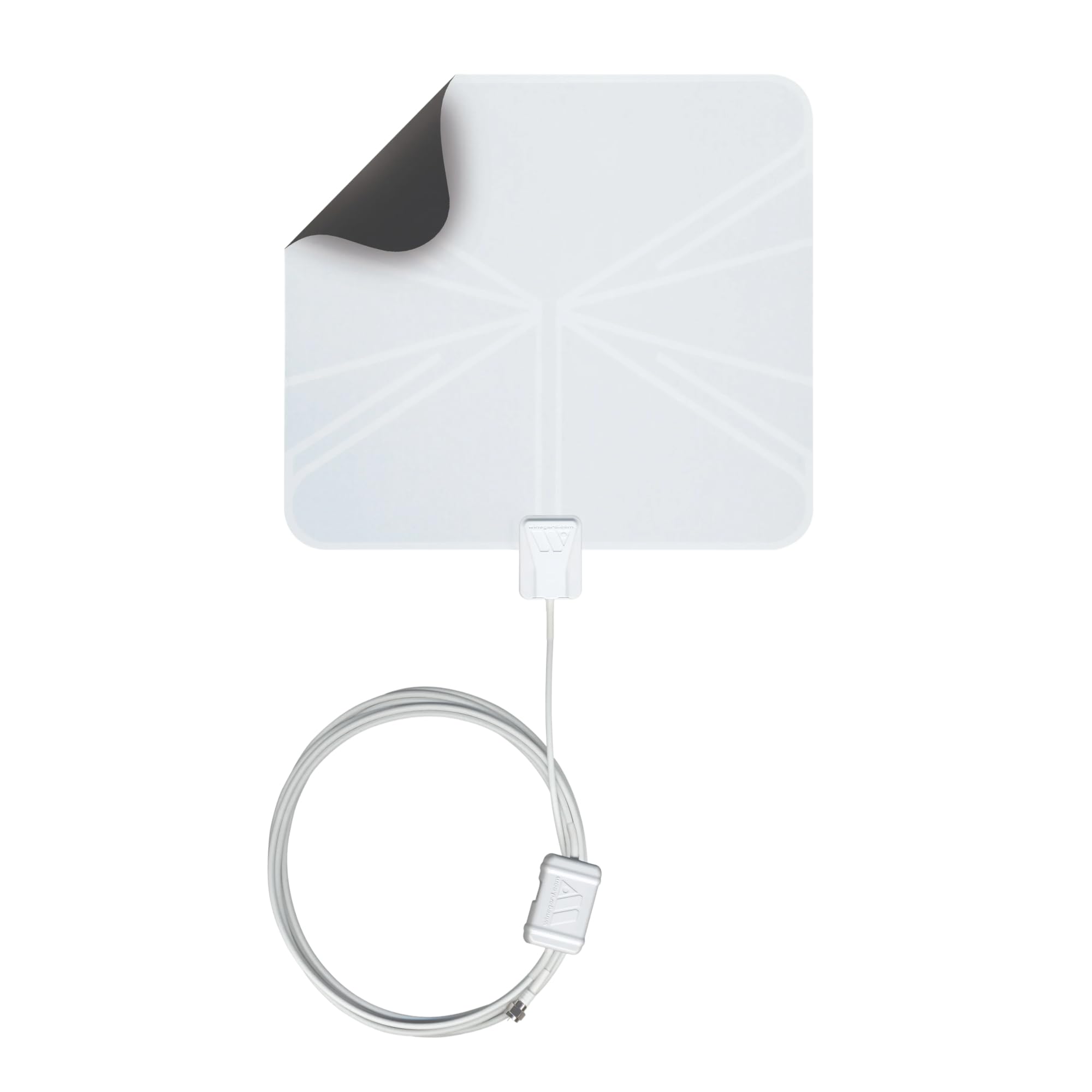
The Winegard FL5500A is the benchmark that other indoor amplified antennas are measured against. Its dual-color reversible design lets you match the white or black side to your wall or window, and the ultra-thin panel measures only 0.6 inches deep. More importantly, the built-in amplifier delivers genuine 60-mile reception for both VHF and UHF signals, making it one of the few compact antennas that handles VHF channels reliably without requiring larger rabbit-ear elements.
Setup requires no tools beyond plugging the attached 18.5-foot coaxial cable into your TV and running a channel scan. The Winegard app helps you identify the best placement in your room by showing which direction the broadcast towers are located. Users in metropolitan areas routinely report pulling in 22 to 40 channels, with stable reception even during storm conditions. The amplifier’s power cord is only 3 feet long, so you may need to plan your placement near an outlet.
The permanently attached coaxial cable prevents using a 90-degree adapter, which some users find limiting when mounting the antenna flush against a wall. Additionally, reception varies by location — some users report difficulty holding a weak signal from a distant station that other antennas managed. For most urban and suburban homes, however, the Winegard FL5500A represents the most reliable balance of performance, aesthetics, and ease of use in this category.
Why it’s great
- True dual-band VHF and UHF reception
- Reversible black/white panel blends into any room
- Winegard app helps locate optimal placement
Good to know
- Coaxial cable is permanently attached, limiting connector options
- Amplifier power cord is short at only 3 feet
- Some users report weaker signal retention compared to larger designs
2. Antennas Direct ClearStream Flex

The Antennas Direct ClearStream Flex brings a unique feature to the table: a Jolt Switch in-line amplifier that gives you real-time control over signal boost. When reception is strong, you can leave the amplifier off to avoid overloading the tuner; when signals are weaker, flip the switch for an instant boost. This flexibility makes it ideal for homes where signal strength varies between stations or changes with weather conditions.
At 16 inches wide and 12 inches tall, the ClearStream Flex is larger than most flat-panel competitors, but it compensates with legitimate multi-directional UHF and Hi-VHF reception. The paper-thin .04-inch profile means it can sit behind a picture frame or TV without being noticeable. Users confirm it receives towers at 15-20 miles even with mountainous terrain, and the amplifier includes out-of-band filters that reduce interference from cellular and FM signals better than many competing amplifiers.
The unit ships only with a black coaxial cable, which undermines the reversible black/white design — you cannot hide the cable against a white wall without painting or covering it. Some reviewers note that the antenna’s gain is insufficient for deep fringe areas, though the amplifier worked well when paired with a different antenna. For suburban homes with moderate tower distances, the ClearStream Flex offers the most adaptable signal management available in a flat-panel format.
Why it’s great
- Jolt Switch amplifier provides on-demand signal boost
- Exceptional out-of-band filter reduces cellular interference
- Paper-thin profile hides behind frames or furniture
Good to know
- Larger footprint than most flat antennas
- Only black coaxial cable included, regardless of side chosen
- Not ideal for deep fringe reception without additional gain
3. Yirkais 2026 Digital Antenna

The Yirkais 2026 Digital Antenna represents the mid-range sweet spot where performance meets affordability. Its 2026-upgraded built-in IC chip and amplifier are designed to capture signals from a full 360-degree direction, which means you do not need to aim the antenna toward broadcast towers — it pulls from all sides simultaneously. This is particularly useful in homes where towers are scattered in multiple directions rather than clustered in one area.
Users consistently praise the crystal-clear HD picture quality and stable reception even during bad weather. The compact, lightweight design makes it easy to place on a desktop, mount on a wall, or stick in a window, and the included coaxial cable is long enough to reach most TV setups without needing an extension. Setup takes under five minutes: connect to the ANT/IN port, run a channel scan, and start watching free local channels including ABC, CBS, NBC, Fox, and PBS.
The advertised 5000+ mile range is pure marketing hyperbole — no indoor antenna can achieve that distance under normal conditions. Users in rural areas report solid performance for its price tier, but those far from towers should still expect a realistic effective range of 30-45 miles. For the price, the Yirkais delivers dependable performance and easy installation that makes it a strong contender for anyone entering the cord-cutting space.
Why it’s great
- 360° reception eliminates the need for aiming
- Compact and lightweight for flexible placement
- Very easy setup with clear picture quality
Good to know
- Advertised range is not achievable in real-world use
- Not suitable for deep fringe areas without external placement
- Build quality feels less premium than higher-end options
4. RCA ANT1360E Amplified Indoor Flat HDTV Antenna

RCA’s ANT1360E uses a patented dual-stage amplification system with Auto Gain Control to deliver the clearest picture possible from signals up to 40 miles away. The multi-directional 360-degree design captures signals from every direction simultaneously, eliminating the need to reposition the antenna when you switch channels from different broadcast towers. This makes it an excellent choice for apartments and homes where towers are scattered around the compass.
The flat profile is paintable, allowing you to match it to your wall color for near-invisible installation. It also includes a built-in easel stand for shelf or desktop placement, giving you three mounting options: hang it flat on the wall, lay it on a surface, or prop it up with the stand. The 15-foot coaxial cable provides ample reach to position the antenna at an optimal window or wall location without needing an extension.
Some users report that the ANT1360E struggles with VHF channels, as the flat design inherently favors UHF frequencies. In areas where broadcast towers use VHF bands, this antenna may miss channels that a larger VHF-capable model would catch. A small number of units have been reported as non-functional out of the box, so testing immediately after purchase is advisable. For primarily UHF reception areas within 40 miles, the RCA ANT1360E delivers strong performance at a reasonable entry point.
Why it’s great
- Paintable surface hides antenna against any wall color
- Dual-stage amplification with Auto Gain Control
- Multi-directional reception from all 360 degrees
Good to know
- VHF reception is notably weaker than UHF
- Occasional reports of non-functional units
- Limited to 40-mile range in optimal conditions
5. RCA ANT310Z Amplified Indoor FM and TV Antenna
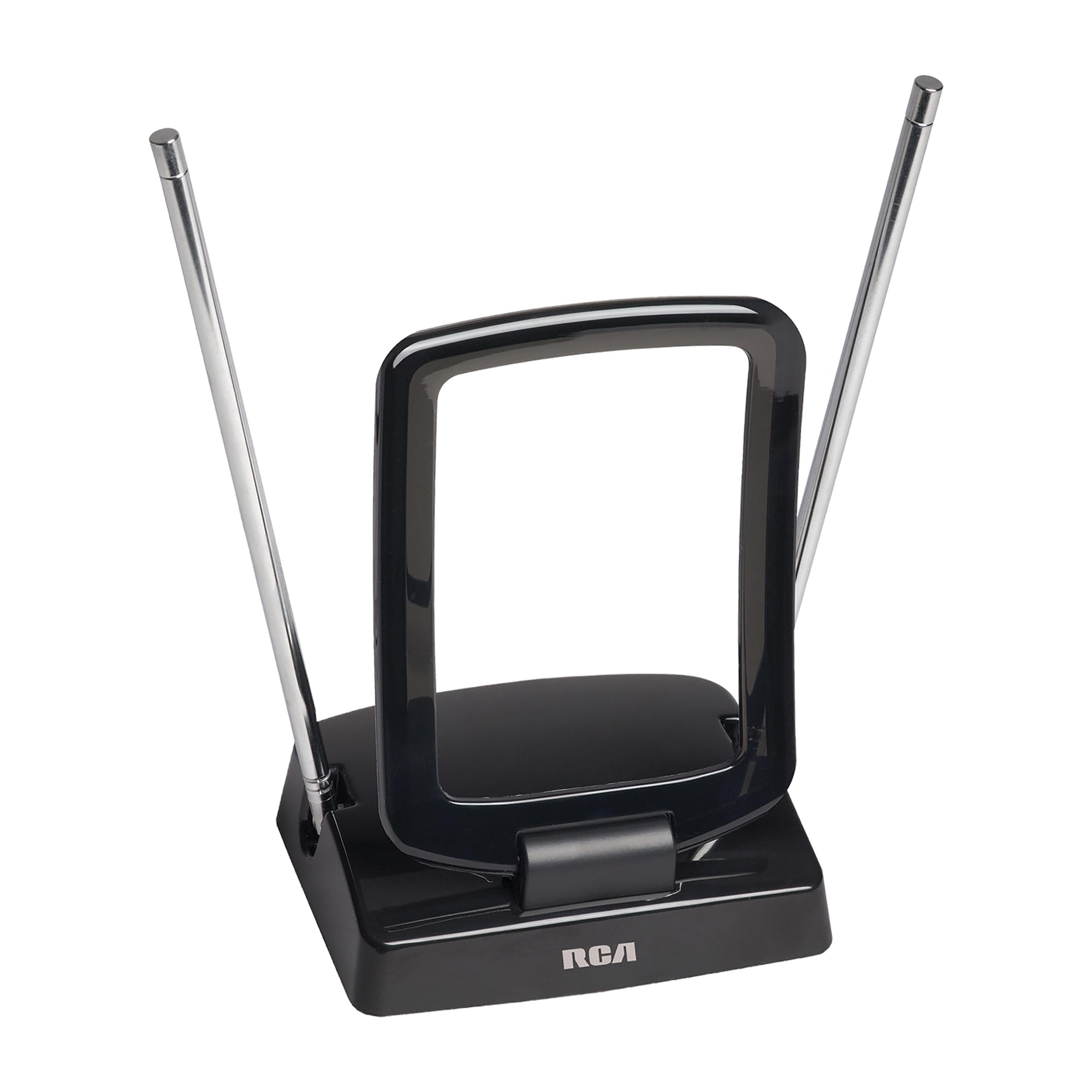
The RCA ANT310Z stands out from flat-panel competitors by offering dual-purpose reception for both HDTV broadcasts and FM radio signals. This makes it a practical choice for users who want to pull in local radio stations alongside their TV channels. The Extremely Low Noise (ELN) amplifier boosts weak signals while preserving signal purity, which is critical when you are receiving from farther distances.
The unique flat-panel UHF element targets digital and analog channels 14-69, and the design includes a 10.1-ounce weight that makes it sturdy enough to survive accidental drops — users report it still functioned after falling from a 2-foot windowsill. The coaxial cable is generously long, allowing flexible placement, and multiple users confirm it grabbed more stations than larger flat antennas they had tried previously in the same location.
The advertised 30-mile range is conservative compared to competitors, but in practice the real-world performance often exceeds that figure as long as the VHF towers are reasonably close. Some users report severe pixelation on many of the scanned channels, and the free OTA content may feel limited compared to cable packages. The ANT310Z performs best in suburban areas with moderate tower density, where its FM capability adds genuine value.
Why it’s great
- Receives both HDTV and FM radio signals
- ELN amplifier preserves signal purity at longer ranges
- Sturdy build survives accidental drops
Good to know
- 30-mile range is more conservative than competing models
- Some channels may experience pixelation
- Not the best choice for deep fringe reception areas
6. Tijoort Long-Range TV Antenna
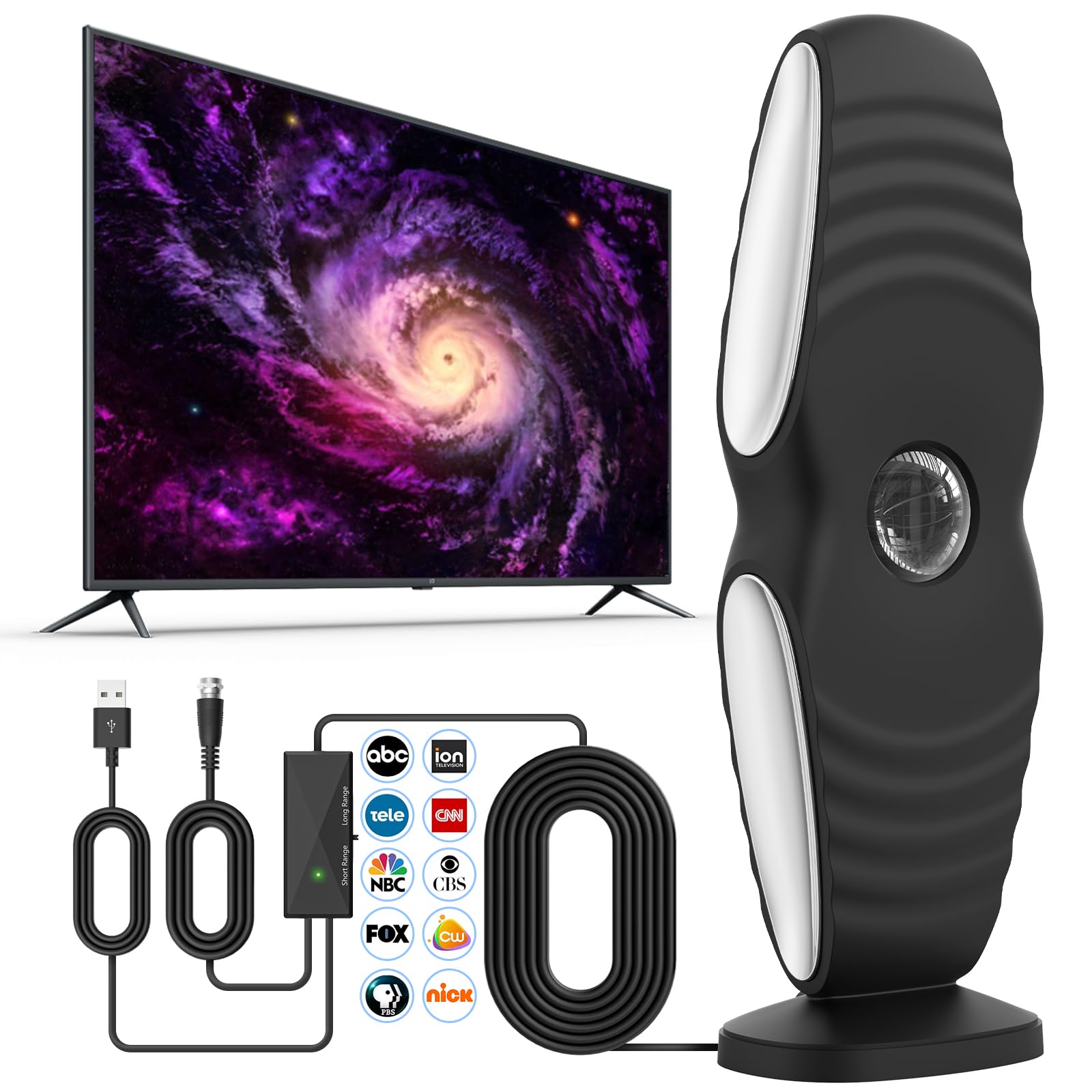
The Tijoort indoor antenna delivers impressive value for its price point by combining a 2026-upgraded high-gain amplifier with a Smart IC chip designed to filter out cellular and FM interference. The magnetic base adds a surprisingly useful convenience — you can attach the antenna to any metal surface like a window frame, TV stand leg, or metal shelf without needing adhesive or mounting hardware. The compact 8-inch by 3-inch dimensions make it one of the most space-efficient options in this lineup.
Setup is genuinely plug-and-play: connect the 20-foot extended coaxial cable to your TV’s ANT/IN port and scan for channels. The long cable gives you flexibility to position the antenna at a window, on a wall, or even on a balcony for better reception. Users consistently report finding a surprising number of channels after the initial scan, with clear HD picture quality for local news, sports, and network programming.
The advertised 3000+ mile range is unrealistic for any indoor antenna, and actual performance will be limited to the standard 30-45 mile effective range that physics allows. Some users found they needed to experiment with placement near a window to get stable signals from all major networks. For the price, the Tijoort antenna is a solid entry-level option that works well for cord-cutters on a tight budget who have reasonable proximity to broadcast towers.
Why it’s great
- Magnetic base allows quick attachment to metal surfaces
- 20-foot coaxial cable provides flexible placement options
- Smart IC chip reduces interference from cellular signals
Good to know
- Advertised range is not achievable in real-world conditions
- May require window placement for optimal reception
- Build materials feel basic compared to premium models
7. GE 48732 TV Antenna

GE’s 48732 antenna brings the reliability of a household name to the amplified indoor antenna category. Its PureAmp Technology is designed to increase signal strength while reducing dropouts, which is especially helpful in homes where signals fluctuate based on weather or time of day. The adjustable stand allows you to position the antenna horizontally or vertically, adapting to different shelf depths and window sill widths for maximum stability.
The 50-mile advertised range is more realistic than many competitors, and users in suburban areas report receiving major networks including ABC, NBC, CBS, Fox, and PBS with minimal pixelation. The design is straightforward and functional — no paintability or reversible panels here, just a practical black unit that sits discreetly near your TV. Setup takes minutes, and the compact footprint means it won’t dominate your entertainment center.
Some users report that the 48732 fails to capture specific local channels, notably missing NBC, CBS, or Fox in certain locations while pulling in 28 other channels. Others find that older amplified flat-panel designs they replaced performed better in the same spot. The mixed reception experience means this antenna works well for some homes but may not be the best choice for users in areas with difficult signal paths or towers behind hills.
Why it’s great
- Adjustable stand supports horizontal or vertical placement
- PureAmp Technology reduces signal dropouts
- Trusted brand with straightforward setup
Good to know
- Inconsistent channel capture reported by some users
- Not the strongest performer for difficult signal environments
- Basic design lacks aesthetic refinements
FAQ
Does an amplified indoor antenna work in apartments with concrete walls?
How do I find which direction to point my indoor antenna?
Why does my antenna lose channels during storms or at night?
Final Thoughts: The Verdict
For most users, the best indoor amplified antenna winner is the Winegard FL5500A because it delivers genuine dual-band VHF and UHF reception, a realistic 60-mile range, and a design that disappears into any room. If you want real-time control over signal boosting, grab the Antennas Direct ClearStream Flex with its Jolt Switch amplifier. And for the best value that still delivers reliable performance, nothing beats the Yirkais 2026 Digital Antenna.