
A massage ball is a simple tool that can change how you handle muscle tightness, knots, and trigger points. Unlike a foam roller that covers broad areas, a massage ball lets you apply focused pressure exactly where it hurts — the nook of a shoulder blade, the arch of your foot, or deep in your glutes. Whether you are recovering from a workout, managing chronic tension, or working at a desk all day, the right ball can feel like a physical therapist in your pocket.
I’m Min — the co-founder and writer behind Gadgets Feed. I have spent hundreds of hours analyzing the technical specs, construction materials, and real-world feedback across the most popular massage balls to find the ones that actually deliver lasting relief.
This guide compares seven top options to help you find the best massage ball for your specific needs — from ultra-firm foam to vibrating deep-tissue tools and multi-size kits for full-body recovery.
How To Choose The Best Massage Ball
Choosing a massage ball is not about grabbing the cheapest or the hardest one off the shelf. The best ball for you depends on the muscle group you are targeting, your pain tolerance, and whether you need vibration to get deep into a knot. Here are the key factors to weigh.
Material and Density
Foam balls are lightweight and offer varying levels of firmness. Low-density foam is suitable for gentle pressure on sensitive areas like the neck, while extra-firm foam delivers the deep compression needed for glutes and calves. Silicone provides a grippy surface that does not slide on skin or clothing, making it ideal for peanut-shaped rollers that need to stay in place against the spine. Rubber and plastic-core balls (often sold as lacrosse ball mimics) offer the hardest surface, best for aggressive trigger point work but uncomfortable for beginners.
Shape and Size
A standard 2.5- to 3-inch single ball works well for feet, shoulders, and glutes. Peanut-shaped balls (two connected spheres) are purpose-built for the spine — the groove between the two balls allows the vertebrae to pass through while the spheres press into the paraspinal muscles. Textured or spiky balls add a knobby surface that can increase blood flow to the skin and superficial fascia, though the sensation may be too intense for some users. Portability is a factor too: smaller balls fit in a gym bag or desk drawer, while larger five-inch balls require more space.
Vibration and Power
Vibrating massage balls add an extra dimension by introducing rapid oscillations that can penetrate deeper into muscle tissue without requiring as much bodyweight pressure. These models need rechargeable batteries and offer multiple speed settings — lower speeds for warm-up and relaxation, higher speeds for deep-tissue release. The tradeoff is weight, noise, and the need to keep the unit charged. Non-vibrating balls are silent, weigh less than half a pound, and never run out of power.
Quick Comparison
On smaller screens, swipe sideways to see the full table.
| Model | Category | Best For | Key Spec | Amazon |
|---|---|---|---|---|
| Pro-Tec Orb Mini 3″ | Foam Ball | Single-point deep release | 3″ diameter, dense foam | Amazon |
| RAD Original Peanut | Silicone Peanut | Spine and neck relief | 2.5″ spheres, silicone grip | Amazon |
| RAD Neuro Ball | Textured Ball | Feet, hands, and face | 2.5″ spiky, splits in half | Amazon |
| TriggerPoint MBX | Extra-Firm Foam | Deep glute/shoulder work | 2.6″ extra-firm foam | Amazon |
| Fitballz 6-Pack | Multi-Ball Kit | Variety for all muscles | 3 sizes + spiky + peanut | Amazon |
| Plyopic 4-Piece Set | Multi-Ball Kit | Complete home therapy | Lacrosse + spiky + peanut + roller | Amazon |
| Vulken Vibrating Ball | Vibrating Ball | Hands-free back massage | 4 speeds, 4000 RPM, strap | Amazon |
In‑Depth Reviews
1. Pro-Tec Athletics Orb Massage Ball

The Pro-Tec Orb is a deceptively simple ball that punches far above its price. At exactly 3 inches in diameter, it hits the sweet spot between being small enough to isolate a single trigger point and large enough to distribute pressure across a broader muscle belly. The foam construction is dense enough to support full body weight without collapsing, yet it retains a slight surface give that prevents the bone-on-hard-plastic sensation you get with lacrosse balls.
Multiple verified buyers mention using this ball to replace tennis balls, which consistently split under pressure after a few uses. The foam outer layer is smooth and does not grip clothing aggressively, so you can slide it under your back while lying on a carpeted floor without it grabbing and rolling away. It weighs only 0.04 kg (roughly 1.4 ounces), making it virtually unnoticeable in a gym bag or travel pack.
One common observation is that the “Extreme Mini” label undersells the intensity. This is not a soft recovery ball — it delivers a firm, targeted sensation that some users describe as “painful but effective” when working deep glute knots from power lifting injuries. For foot cramps and flat-arch pain, five to ten minutes of rolling produces noticeable relief.
Why it’s great
- Supports full bodyweight without deforming
- Ultra-lightweight and portable
- Far more durable than a tennis ball
Good to know
- Very firm texture may be too hard for some users
- Small diameter means less surface area for broad muscle groups
2. RAD Original Peanut Massage Ball

The RAD Roller eliminates the need for the “tennis balls in a sock” hack that self-massage enthusiasts have been using for decades. Its peanut shape — two 2.5-inch spheres connected by a narrow bridge — is purpose-engineered to straddle the spine. When you lie on it vertically, the spheres press into the erector spinae muscles on either side of the vertebrae while the bridge keeps the spinous processes free from direct pressure.
Made from medium-density silicone, the RAD has a rubbery, high-friction surface that grips the skin rather than sliding away. This grip is especially useful when using the ball against a wall for thoracic or lumbar work, because it stays put instead of dropping to the floor. The silicone material is also easy to wipe clean, though some users note that it attracts lint and hair when used on bare feet or carpet.
Customer feedback consistently highlights dramatic results for lower back pain. One reviewer reported a 70% reduction in chronic pain from a pinched nerve after just two sessions. The medium density means the ball has a slight give that some users find more effective and safer than a rock-hard lacrosse ball, especially when bearing full weight on the thoracic spine.
Why it’s great
- Spine-safe design with central groove
- High-grip silicone stays in place
- Medium density penetrates well without being brutal
Good to know
- Silicone picks up dust and hair easily
- May be too small for very muscular frames
3. RAD The Original Neuro Ball

The Neuro Ball from RAD is the most versatile textured ball on this list. Its surface is covered in small rounded spikes that provide a distinct knobby sensation — more stimulating to cutaneous nerves and superficial fascia than a smooth foam ball. The clever design feature is that the ball unscrews into two separate halves, giving you two independent tools: the spiky base and a smaller smooth inner ball for more precise pressure point work.
At 2.5 inches in diameter, it is compact enough for foot and hand massage, but the split functionality really shines for plantar fasciitis relief. You can stand on one half with each foot, allowing the spikes to work the arch while your weight stays centered. The silicone construction is BPA- and latex-free, and the material has just enough give to feel therapeutic without being painful. One Pilates instructor reports using it on clients during sessions to stop muscle cramps in real time.
Some users find the two halves difficult to separate initially, and the price point trends higher than a basic foam ball. However, the build quality is excellent — reviewers confirm that the halves never come apart accidentally during use, and the material rinses clean easily under running water.
Why it’s great
- Splits into two pieces for dual-foot or hand use
- Spiky texture stimulates surface and deep tissues
- Lifetime warranty from manufacturer
Good to know
- Opening the two halves can be tricky at first
- Premium price for a non-vibrating ball
4. TriggerPoint Performance MBX Massage Ball

TriggerPoint is a well-known name in the recovery space, and the MBX extra-firm ball carries the brand’s reputation for aggressive deep-tissue work. At 2.6 inches with an extra-firm foam density, this ball is essentially a more hygienic, easier-to-grip version of a lacrosse ball. The foam surface cleans easily with a damp cloth, unlike the porous cloth covering found on some competing products.
The primary use case for this ball is targeting small, stubborn areas like the piriformis, the pec minor under the collarbone, and the rhomboids between the shoulder blades. Multiple reviewers who suffer from piriformis syndrome report that this ball is more effective than a tennis ball because it does not flatten under bodyweight — it maintains its shape and delivers consistent, point-specific compression. The extra-firm rating is not an exaggeration; some users find it too hard for their tolerance, even after trying other tools.
One durability note: a daily user reported that their first unit eventually broke after months of intense use, indicating that the foam has a finite lifespan under sustained heavy pressure. The ball is also lightweight at 1.76 ounces, making it easy to carry but prone to rolling away if placed on an uneven surface without a wall to brace against.
Why it’s great
- Extra-firm density for aggressive trigger point work
- Easy-to-clean foam surface
- Excellent for piriformis and shoulder knots
Good to know
- Too hard for users with low pain tolerance
- Foam may degrade after months of daily use
5. Fitballz 6-Pack Massage Ball Set

The Fitballz 6-Pack eliminates the guesswork of choosing a single ball by giving you three smooth foam balls in large, medium, and small sizes, plus a peanut-shaped ball, a firm spiky ball, and a soft spiky ball. All pieces are made from 100% EVA foam that is latex-free and non-toxic, and the entire set comes in a small mesh carry bag that keeps everything organized.
Having multiple sizes and textures allows you to adapt your recovery session to the specific muscle you are targeting. The large smooth ball works well for broad back work against a wall, the peanut ball excels for the neck and spine (though some petite users find it too wide, as it hits the scapulae), and the firm spiky ball is effective for foot fascia when you want a more aggressive texture. The soft spiky ball is the most forgiving option — good for beginners or sensitive areas.
A few users note that the smooth foam balls are quite firm — the medium and large sizes have minimal give, which can feel uncomfortable when used on a hardwood floor without a mat. The spiky balls, especially the firm one, are effective for knot relief but may leave temporary indentations on the skin. If you want a single kit that covers every angle of self-myofascial release, this is the most comprehensive option available.
Why it’s great
- Six different balls for every muscle group
- Includes both firm and soft spiky options
- Compact carrying bag included
Good to know
- Peanut shape may be too wide for smaller torsos
- Smooth foam balls are quite firm with limited give
6. Plyopic Deep Tissue Massage Ball Set

The Plyopic set covers the widest range of massage modalities in a single box. You get a 5-inch smooth ball for broad pressure, a 3.5-inch ball for general use, a 2-inch dense ball for pinpoint trigger point work, a 3-inch double peanut ball for spine-targeting, and a small foam roller. The materials vary by piece — some use EVA foam, others use PVC or silicone — which means each tool has a distinct feel and density.
The standout piece is the solid rubbery lacrosse-style ball at 2 inches, which multiple users describe as the most effective tool in the set for isolated knots in the neck, shoulder blade area, and calves. The peanut ball is slightly wider than the RAD version but still effective for thoracic extension work. The 5-inch ball provides a broader surface area that is useful for glutes and quads, bridging the gap between a massage ball and a foam roller.
A physiotherapist recommended this set for a user with fibromyalgia and hEDS, noting that the variety of densities allowed for customized pressure depending on the day’s pain level. The included mesh carry bag is larger than the Fitballz bag, accommodating the foam roller as well. The main limitation is that none of the pieces have a textured or spiky surface, so users who want knobby stimulation will need to supplement with a separate spiky ball.
Why it’s great
- Five tools plus a foam roller in one kit
- Solid rubber ball is excellent for isolated knots
- Wide range of sizes for different muscle groups
Good to know
- No spiky or textured balls in the set
- Carry bag is larger but still travel-friendly
7. Vulken Vibrating Massage Ball
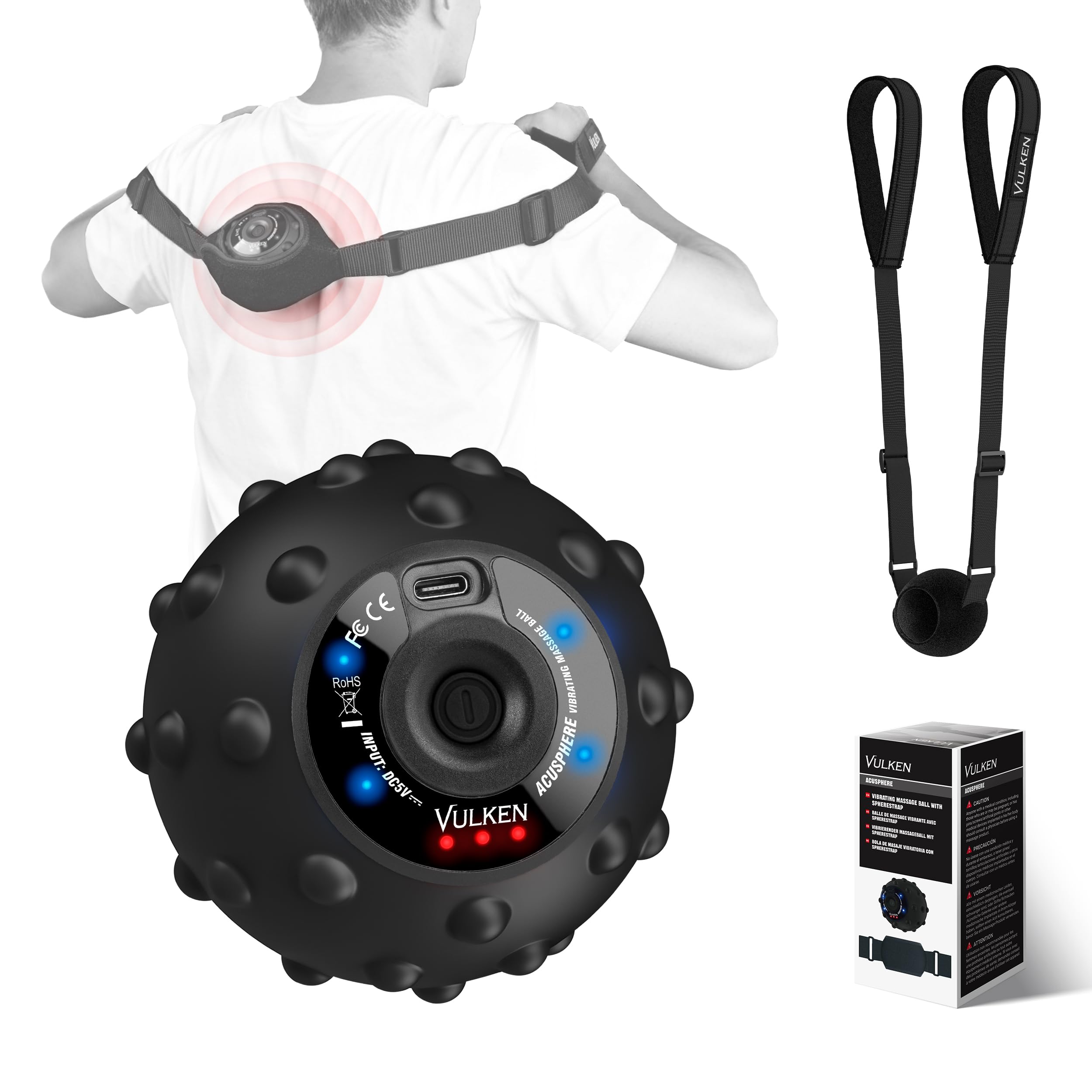
The Vulken is the only powered option on this list, and it brings features that passive balls simply cannot match. At 3.75 inches and 0.66 pounds, it is larger and heavier than any foam ball here, but the tradeoff is a motor that delivers up to 4000 RPM across four vibration modes: Low, Medium, Pulsating, and High. The recessed power button is a thoughtful design choice — it prevents accidental shut-offs when you lean your bodyweight onto the ball during a deep-tissue session.
The distinctive accessory is the adjustable harness strap, which measures 19.7 to 27 inches. You strap the ball to your body to target hard-to-reach areas like the mid-back, rhomboids, and shoulders without needing to lie on the floor or brace against a wall. This hands-free capability is unique among the products reviewed here and makes the Vulken useful for pre-workout activation as well as post-workout recovery. The silicone-textured grip on the ball’s surface helps keep it from slipping out of the strap.
Battery life is rated at up to 1.5 hours depending on the vibration level, which translates to roughly three to five sessions per charge. A common criticism is the 10-minute auto-off timer, which can interrupt a session when you are lying on the ball and cannot reach the button. The intermittent auto-off issue appears most often when the ball is compressed under body weight, so users recommend propping it against a wall rather than lying directly on top of it. Despite these quirks, chiropractors and physical therapists frequently recommend vibrating massage balls for myofascial pain that resists stationary pressure.
Why it’s great
- Four vibration speeds up to 4000 RPM
- Adjustable strap enables hands-free back massage
- Recessed button prevents accidental power-off
Good to know
- 10-minute auto-off timer can be disruptive
- Heavier and larger than non-vibrating balls
FAQ
Can a massage ball replace a foam roller for back pain?
How much body weight should I put on a massage ball?
Should I get a vibrating massage ball or a non-vibrating one?
Final Thoughts: The Verdict
For most users, the best massage ball winner is the RAD Original Peanut because its spine-safe peanut shape and medium-density silicone grip make it the most versatile single tool for back, neck, glutes, and legs. If you want a vibrating option for deep, hands-free relief, grab the Vulken Vibrating Massage Ball. And for a complete home recovery station that covers every muscle group, nothing beats the Fitballz 6-Pack Set.