
That patchy, hard-packed lawn that deflects water like a parking lot is telling you something: the soil needs mechanical relief. A proper soil aerator physically extracts cores of earth or drives deep spikes to shatter compaction, letting air, water, and nutrients finally reach the root zone. Without it, every bag of fertilizer and every sprinkler cycle is largely wasted on the surface.
I’m Min — the co-founder and writer behind Gadgets Feed. After spending countless hours cross-referencing tine geometry, steel gauge, soil-type performance data, and real user reports across dozens of models, I’ve isolated the handful of manual and tow-behind aerators that actually deliver measurable lawn improvement without wasting your time.
Whether you’re rehabilitating a small urban plot or managing a sprawling suburban lawn, finding the best soil aerator for your specific ground conditions is the single highest-leverage investment you can make for a thicker, greener stand of grass this season.
How To Choose The Best Soil Aerator
Choosing the wrong soil aerator is a recipe for back pain and wasted afternoons. The right choice depends entirely on the size of your lawn, the type of soil you’re wrestling with, and your tolerance for manual labor. Here are the critical decision points.
Core vs. Spike: Which Action Actually Works
This is the fundamental fork in the road. Core (plug) aerators physically remove a 2- to 4-inch cylinder of soil, physically reducing compaction and creating space for root expansion. Spike aerators simply poke holes, which can actually compress the soil around each hole in heavy clay. For seriously compacted lawns, core aeration is the standard of care. Spikes are better suited for light maintenance aeration or sandy loam soils where compaction is minimal.
Tine Count and Penetration Depth
For manual tools, the number of tines directly trades against the force required to sink them. A 3-tine design is generally more manageable for average body weight, while a 4-tine unit demands a heavier push or a body-weight jump. Look for tine lengths of at least 2.5 to 3 inches. Anything shorter fails to reach the root zone where compaction does its worst damage. Stainless steel or hardened alloy tines resist bending in rocky or clay-heavy soils.
Handle Reach, Grip, and Leverage
An ergonomic handle that hits waist height for your stature is non-negotiable. A 36-inch handle forces a stoop that guarantees lower back fatigue within 15 minutes. The premium manual models land between 37 and 42 inches, allowing a mostly upright stance. Look for padded or contoured grips, and pay attention to foot-bar design — a flat, wide step bar gives better leverage than a thin round tube.
Coverage Rate and Yard Size Matching
Manual core aerators cover roughly 100 to 200 square feet per hour at a steady pace. If your lawn exceeds 3,000 square feet, a manual tool becomes a multi-day project, and you should strongly consider a rolling spike aerator or a tow-behind unit that attaches to a riding mower or ATV. Rolling aerators trade per-hole quality (spike-only) for massive coverage speed. Tow-behind core aerators combine speed with actual soil extraction, but carry a premium investment.
Quick Comparison
On smaller screens, swipe sideways to see the full table.
| Model | Category | Best For | Key Spec | Amazon |
|---|---|---|---|---|
| Dolibest Manual 4-Plug | Core Manual | Anti-clog core removal | 4 semi-open stainless plugs | Amazon |
| Dolibest Stainless Corer | Core Manual | Durability & wet soil | Stainless bottom, 3.5″ tines | Amazon |
| EEIEER Manual 3-Tine | Core Manual | Soil storage basket | 3 alloy tines, 38″ handle | Amazon |
| Yard Butler Spike | Spike Manual | Light aeration & cost | 4 spikes, 3-inch depth | Amazon |
| Yosuny Rolling Spike | Spike Rolling | Large lawn speed | 40 spikes, 18″ roller | Amazon |
| Landzie Hollow Tine | Core Manual | Pro-grade build, no clog | 3 stainless hollow tines | Amazon |
| Brinly SAT2-40BH-P | Tow-Behind Spike | Large acreage, minimal labor | 11 tine stars, 40″ width | Amazon |
In‑Depth Reviews
1. Dolibest Manual Aerator Lawn Tool, 4-Plug
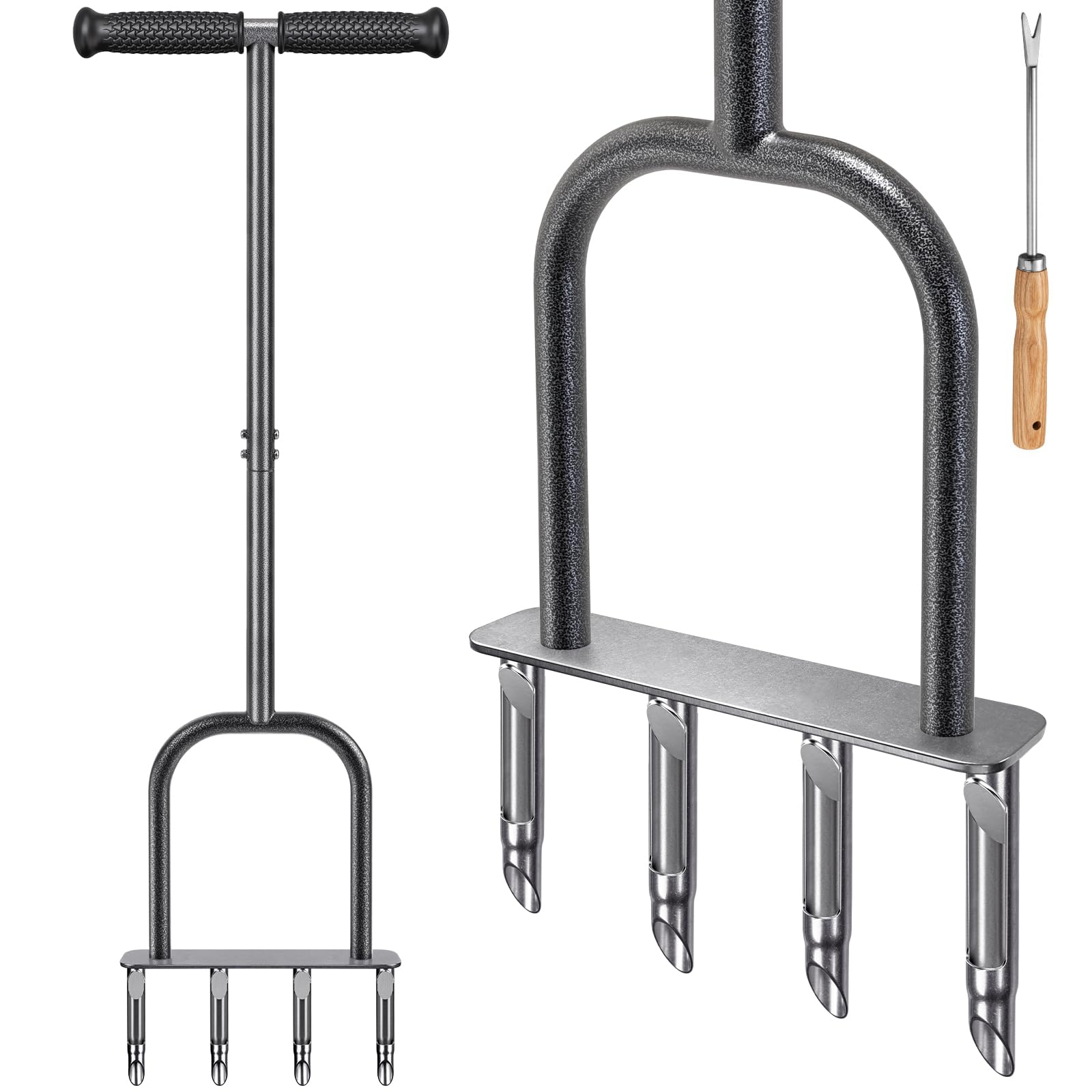
The Dolibest 4-plug manual aerator solves the single most annoying problem with plug aerators: clogged tines. The semi-open stainless steel design allows the extracted soil cores to escape upward and outward naturally, meaning you rarely have to stop and poke out stuck plugs. In moist to dry loam, the tool self-clears reliably, keeping your work rhythm steady.
Four tines working simultaneously deliver roughly 25 percent more coverage per step than the typical 3-tine design, and the thick steel step plate accepts a full stomp without flexing. Users consistently report covering 25 square feet in about three minutes on moderately damp ground. The 37.2-inch handle keeps your back upright during extended sessions, and the rust-resistant coating on the steel pole and stainless base promises longevity in wet storage conditions.
The main structural trade-off is the three-piece assembly with a single-bolt handle connection, which can loosen during aggressive use and require periodic re-tightening. Very dry or rocky soil will still demand significant body weight to sink all four tines to full depth. For medium to large lawns with typical clay or loam, this tool delivers the best throughput-to-effort ratio of any manual core aerator.
Why it’s great
- Self-clearing semi-open tines eliminate constant unclogging
- Four plugs per step increase coverage speed
- Rust-resistant stainless steel base and coating
Good to know
- Single-bolt handle joint needs occasional tightening
- Hard, dry soil requires substantial force
2. Landzie Hollow Tine Lawn Aerator Tool
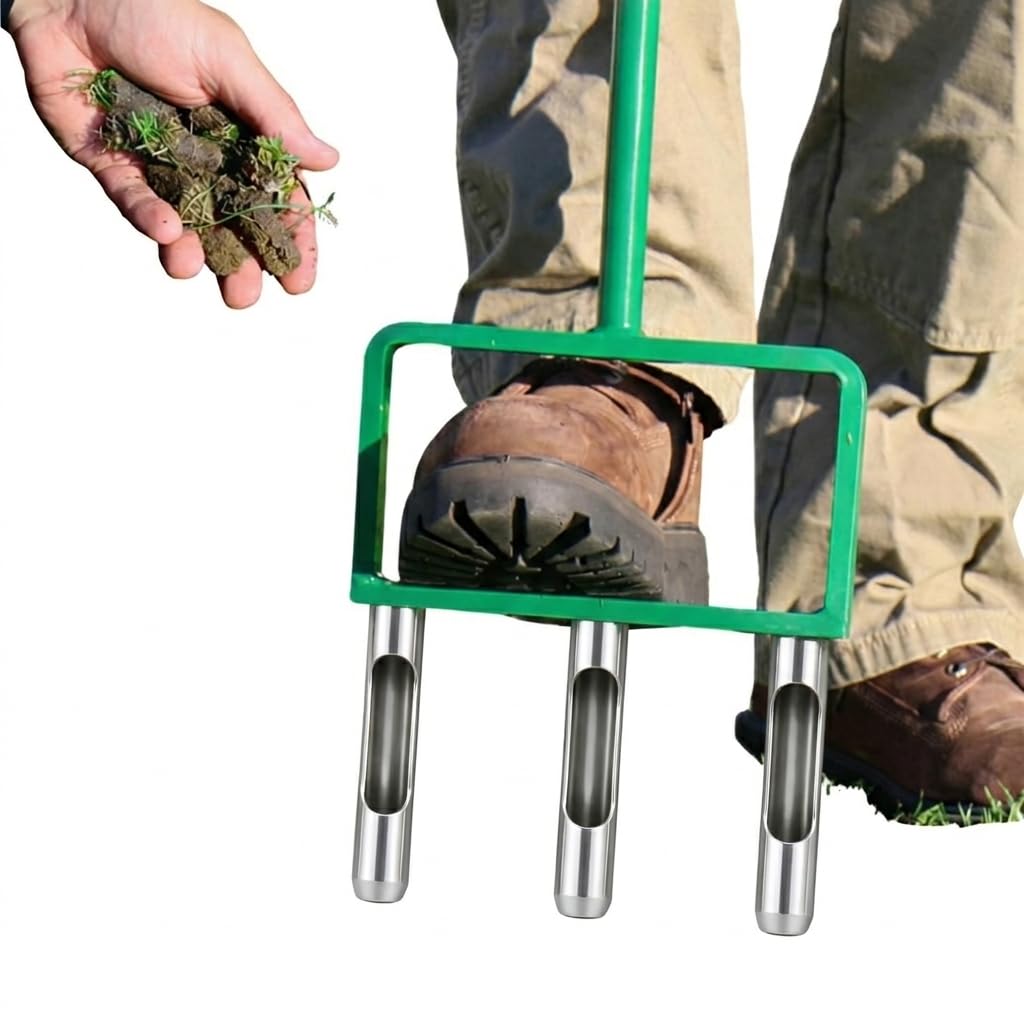
The Landzie is built for the homeowner who wants professional-grade core aeration without renting a machine. It arrives fully assembled with three stainless steel hollow tines that have a beveled cutting edge specifically designed to resist clogging. The proprietary shape allows the core to lift cleanly out of the ground and escape upward, a design that users with heavy clay soil report working effectively on most lawn area.
The 42-inch handle is the tallest in this manual class, making it the best option for taller users who experience back strain with shorter tools. The powder-coated steel frame is noticeably thicker than budget alternatives, and the tines are replaceable when they eventually dull. Users tackling 3/4-acre lawns report 50 to 60 hours of use without structural failure. The tool also features a generous foot bar, though some note it lacks anti-slip texture when wet.
The obvious trade-off is the investment required. It sits at a premium tier for a manual tool, and the hollow tines must be tightened onto the frame every hour or two during heavy use to prevent wobble. Very dry, compacted soil can reduce penetration depth significantly, an issue with every manual core aerator. For the homeowner committed to long-term lawn health without a machine, this is the last manual aerator you’ll buy.
Why it’s great
- Fully assembled out of the box, no build time
- Beveled hollow tines resist clogging in clay
- 42-inch handle suits taller users
Good to know
- Premium investment for a manual tool
- Tines need periodic re-tightening during use
3. Dolibest Lawn Coring Aerator, Stainless Steel
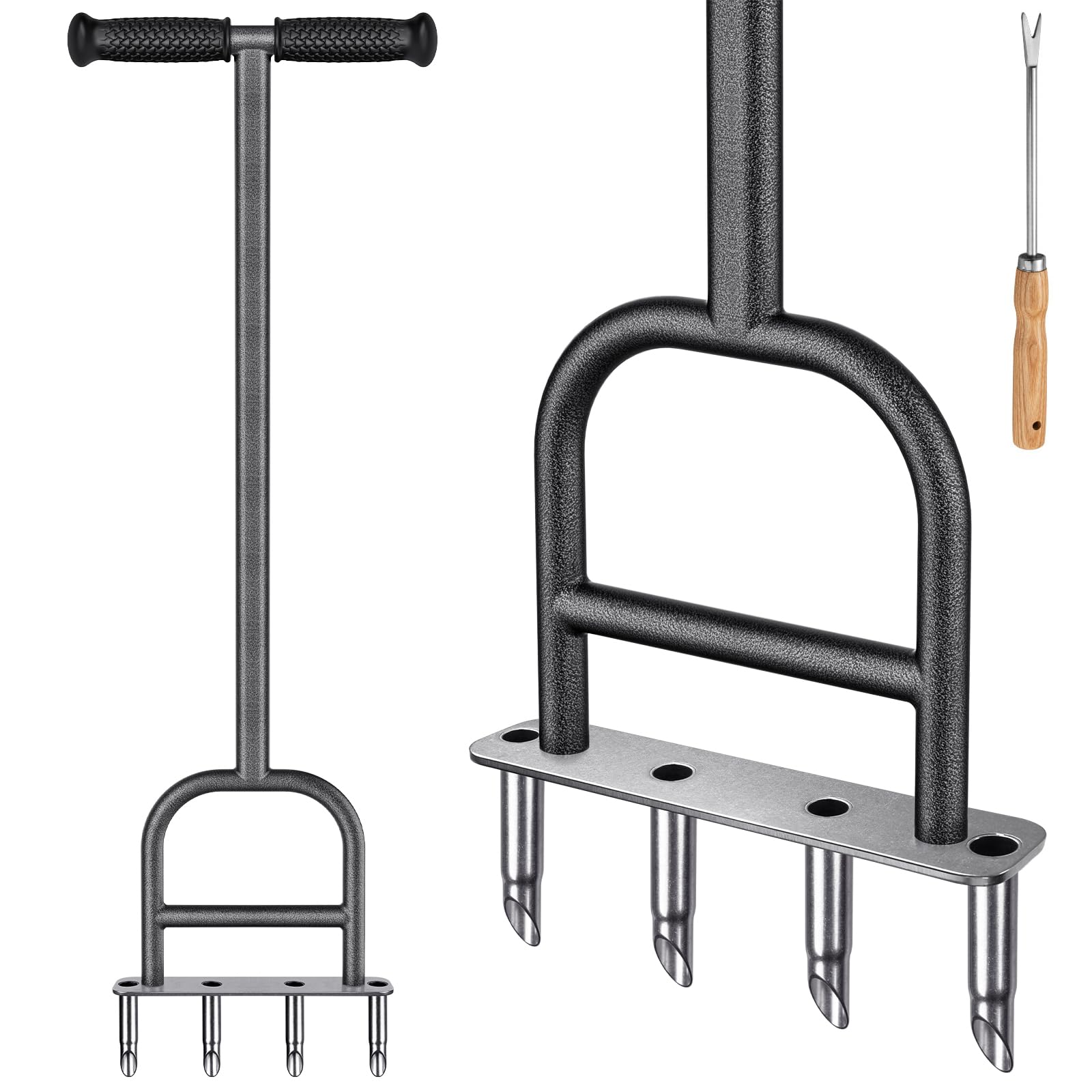
This Dolibest coring aerator prioritizes material durability with a full steel frame, black powder-coated finish, and a stainless steel bottom section and corer plugs that resist rust and bending even after years of outdoor storage. The four corer plugs each measure 3.5 inches long and 0.5 inches in diameter, producing deep, narrow extraction plugs that maximize root-zone disturbance without tearing up the grass surface.
The soft rubber grip on the handle reduces hand fatigue significantly during longer sessions, and the addition of a foot bar that sits clear of the tine ejection path prevents your shoe from interfering with soil plug exit. Users consistently describe the construction as “single welded” rather than bolted, which eliminates the loosening issues found on multi-piece tools. It feels solid and handles the punishment of clay-heavy soils without bending.
The practical limitation is that four tines require more force per press than three-tine competitors, especially in dry or dense clay. Some users report needing a side-to-side rocking technique or extra body weight to achieve full depth. The rounded foot step can also reduce downward leverage compared to a flat step design. For users willing to exert the leg strength, the 4-plug coverage rate is excellent, and the stainless bottom guarantees you won’t be replacing this tool due to rust.
Why it’s great
- Stainless steel bottom and plugs resist corrosion
- Welded frame eliminates joint loosening
- Soft rubber grip reduces hand fatigue
Good to know
- Four tines demand more force per press
- Rounded foot step reduces leverage slightly
4. EEIEER Manual Lawn Aerator with Soil Storage Basket

EEIEER approaches the manual aeration problem from a different angle: keeping the lawn clean while you work. The built-in soil storage basket catches the extracted cores as they push upward through the hollow tines, saving you from the tedious cleanup of scattering soil plugs across the grass. This is a genuine time-saver for homeowners who want a tidy final appearance without an extra raking pass.
The tool features a unique patented one-piece bottom structure rather than welded joints, which significantly improves durability at the stress point where most budget aerators snap. The tine wall thickness has been upgraded from 1.2mm to 2mm, and the high-density alloy construction resists bending. The 38-inch ergonomic handle and 4.3-inch heightened pedal provide comfortable leverage, and a dedicated cleaning stick is included to clear any clogs that do occur.
Real-world performance is best on slightly moist, non-compacted soil. In very wet or heavy clay conditions, the tines can clog, requiring use of the cleaning stick. The foam handle grip may not last through multiple seasons of heavy use. For small to medium lawns where aesthetics and minimal mess are priorities, the EEIEER delivers a noticeably cleaner workflow than tine-only designs.
Why it’s great
- Integrated storage basket catches extracted soil
- One-piece bottom construction resists breakage
- Upgraded 2mm thick alloy tines
Good to know
- Can clog in very wet, heavy clay
- Foam handle may degrade over time
5. Yard Butler IM-7C Spike Aerator
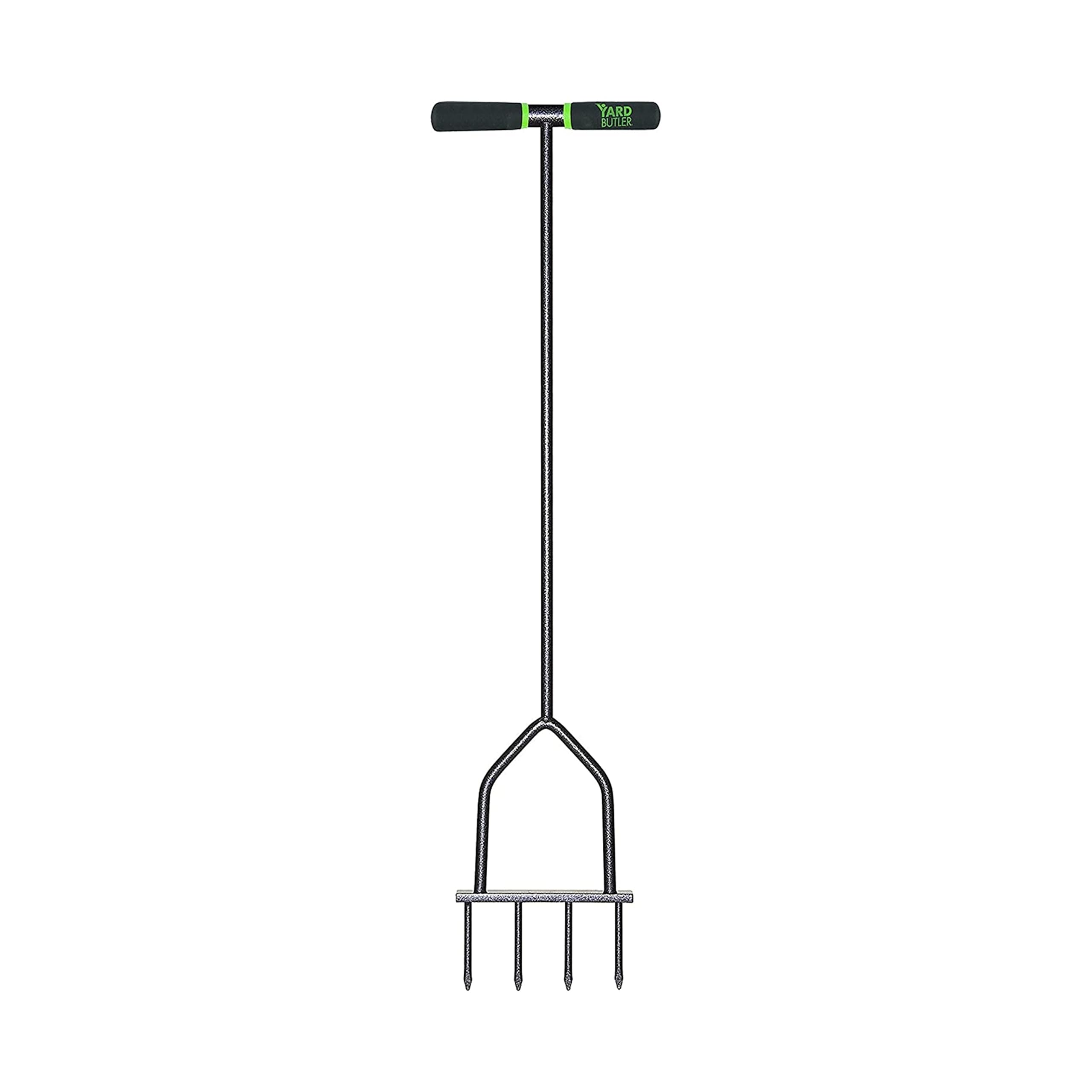
The Yard Butler is the classic spike aerator that has been a lawn care staple for years. It uses four 3-inch steel spikes to create ventilation holes in the soil, and its lightweight 2.25-pound frame makes it easy to carry around the yard. The long handle allows you to aerate while standing straight, and the powder-coated steel construction is built to last through many seasons.
In moist clay soil, the Yard Butler penetrates effectively when using body weight and a slight rocking motion. Users frequently report finishing a backyard in a few hours, with a coverage rate around 325 square feet per hour. The four spikes create solid holes that help water penetration and seed germination. The simple, single-piece design means there are no joints to loosen or tines to replace.
The limitation of any spike aerator is that it does not remove soil cores. In heavy clay, the action of pushing spikes in can actually compact the soil around each hole. The 36-inch handle length causes back fatigue for taller users over extended sessions. For light maintenance aeration on established lawns with decent soil, it is a cheap and effective tool, but it is not a substitute for core aeration on heavily compacted ground.
Why it’s great
- Lightweight and easy to maneuver
- Simple, durable single-piece construction
- Long handle reduces bending
Good to know
- Spikes can compact clay soil around holes
- 36-inch handle short for taller users
6. Yosuny 18-Inch Rolling Lawn Aerator

The Yosuny rolling aerator dramatically accelerates coverage by letting you walk behind a 40-spike drum rather than pressing a tool into the ground step by step. The 18-inch wide roller and retractable handle that extends from 50 to 70 inches allow operators of different heights to work comfortably for longer periods. The included sandbag adds ballast to help the 2.36-inch spikes penetrate the soil.
Assembly is required but straightforward with the included tools and gloves. The carbon steel frame is powder-coated for rust resistance, and the tripod connection between handle and roller provides a stable rolling platform. On moderately damp soil, the spikes create consistent holes across a wide swath, making this an excellent choice for lawns in the 3,000 to 10,000 square foot range where a manual step aerator would take multiple days.
The main design compromise is weight. Even with the sandbag filled, the unit is relatively light, and in hard, compacted clay, the spikes may not achieve full depth penetration. Some users report that the hardware screws can loosen during rolling and require a re-tightening after each session. Like all spike aerators, this tool creates holes without removing cores, so it is effective for surface-level ventilation but does not relieve deep compaction the way a core aerator does.
Why it’s great
- Large coverage area per minute for big lawns
- Adjustable handle height for different users
- Includes ballast sandbag for better penetration
Good to know
- May not penetrate deeply in hard clay
- Hardware can loosen during use
7. Brinly SAT2-40BH-P Tow Behind Spike Aerator

The Brinly SAT2-40BH-P is built for the homeowner with a riding mower and serious acreage. It covers a 40-inch wide path with 11 separate tine stars, each bearing 12 spike tips that penetrate the soil up to 2 inches deep. The patent-pending 3-D galvanized steel tines offer significantly better strength than flat stamped tines, resisting bending even in rocky, compacted soil.
All-steel construction with a 5/8-inch solid steel axle and nylon spacers between each star delivers genuine durability for the long haul. The rigid weight tray can hold up to 150 pounds of extra ballast (bricks, cinder blocks, or sandbags) to force penetration deeper into hard soil. The single-lever transport mode engages turf-tread wheels for crossing driveways and sidewalks without scarring the pavement.
Assembly is required and can be challenging due to the sharp tines — heavy-duty gloves are mandatory. The hex lock nuts on the transport wheels have been noted to not thread fully, and users recommend replacing them with nylon lock nuts immediately. The unit effectively aerated a 1.5-acre property with added cement blocks, transforming hard clay into workable soil over one season. For large-scale spike aeration with minimal personal labor, the Brinly is in a class of its own.
Why it’s great
- 40-inch coverage suits large acreage
- Weight tray handles up to 150 lbs for deep penetration
- Transport wheels for hard surfaces
Good to know
- Sharp assembly requires heavy gloves
- Wheel nuts may need aftermarket replacement
FAQ
Should I water my lawn before using a manual core aerator?
How often should I aerate my lawn with a plug aerator?
Can a spike aerator damage my lawn?
Final Thoughts: The Verdict
For most users, the best soil aerator winner is the Dolibest Manual 4-Plug because it combines self-clearing semi-open tines with a comfortable 37-inch handle and corrosion-resistant materials at a mid-range investment. If you want pro-grade build quality and have a larger budget, grab the Landzie Hollow Tine. And for massive acreage where manual work is not an option, nothing beats the Brinly SAT2-40BH-P Tow Behind for mechanical, high-speed spike aeration.