
A six-year-old’s brain is a singularity of curiosity — it craves hands-on manipulation, cause-and-effect feedback, and the satisfaction of building something real. The best gifts at this age don’t just entertain; they feed that hunger with tangible, screen-free challenges that transform a child from passive observer into active creator. Finding the right balance between engagement and genuine educational depth is the real puzzle.
I’m Min — the co-founder and writer behind Gadgets Feed. By cross-referencing hundreds of verified purchase patterns, component quality reports, and developmental milestones for this exact age group, I’ve separated the true brain-builders from the flash-in-the-pan novelties.
This guide looks at seven rigorously selected options — spanning chemistry sets, circuits, building blocks, and math games — to help you find the absolute best 6 year old gifts that actually deliver on their STEM promises.
How To Choose The Best 6 Year Old Gifts
A six-year-old is reading fluently enough to follow simple instructions, yet still needs tactile, cause-and-effect feedback to stay engaged. The wrong choice is either too simple (bored in minutes) or too complex (frustrated in minutes). The right choice hits the zone of proximal development — challenging enough to require persistence, achievable enough to deliver pride.
Prioritize Open-Ended Play Over Single Outcome
Toys that offer one finished build or one type of experiment are consumed quickly. A 125-piece building block set or a 420-project circuit kit, in contrast, provides near-infinite replayability. Look for component counts, the number of suggested builds, and whether the box explicitly states how many different things a child can create. More permutations equals more value.
Beware Hidden Power Requirements
Several electronics kits and microscopes require AA or AAA batteries. If the kit warns “batteries not included,” that’s an immediate trip to the store before the gift can be used. Separately, check whether the toy needs adult supervision for the first session — the best kits acknowledge this upfront with clear, illustrated instruction booklets rated for minimal adult intervention.
Match the Tool to the Attention Span
A digital microscope with instant 2-inch IPS screen gratification works better for a wiggly 6-year-old than a traditional eyepiece scope that demands perfect eye alignment. Similarly, a math board game with a dice roll and a 15-minute round keeps a child engaged far longer than a worksheet-style app. The medium matters as much as the content.
Quick Comparison
On smaller screens, swipe sideways to see the full table.
| Model | Category | Best For | Key Spec | Amazon |
|---|---|---|---|---|
| SMILESSKIDDO Snap Circuits | Premium | Serious budding engineers | 420 projects, 35 circuit parts | Amazon |
| BMDSAE 1000X Microscope | Premium | Curious nature explorers | 2.0″ IPS screen, 600mAh battery | Amazon |
| National Geographic Junior Chemistry | Mid-Range | First introduction to chemistry | 50 experiments, 20+ lab tools | Amazon |
| Doctor Jupiter Science Kit | Mid-Range | Screen-free daily experiments | 50+ experiments, no batteries | Amazon |
| Qirptey 125-Piece Building Blocks | Mid-Range | Creative open-ended building | 125 pieces, storage box included | Amazon |
| choopheme 10-in-1 Stem Kit | Mid-Range | Kids who love construction vehicles | 10 models, 112 pieces, moving parts | Amazon |
| Clever Fox Play Number Hunter | Budget | Math practice through play | Addition & subtraction, 50 challenge cards | Amazon |
In‑Depth Reviews
1. SMILESSKIDDO Snap Circuits

With 420 distinct projects packed into a single box, this is the deepest electronics exploration kit available for the 6-year-old demographic. The 35 circuit parts — including a spray module, RGB light module, and flying saucer accessory — let a child build a working vacuum one day and a glowing siren the next, all without a single drop of solder. The plastic snap-together design is genuinely foolproof: each part clicks onto the board with clear orientation guides, so there is no way to install a component backward and create a short.
The 37-page illustrated manual walks through 118 specific build configurations, but the real magic is that kids quickly start experimenting on their own — combining the flying saucer with the 3-color lamp just to see what happens. Reviewers with children as young as 3 report independent play after the first tutorial session, which speaks to the intuitive interface. The need for AA batteries (not included) is the only logistical hiccup, and a few users noted two small pieces broke under heavy use, though the manufacturer’s replacement service resolved those cases within days.
For a child who asks “how does this work?” about every appliance in the house, this kit transforms them from consumer to creator. The educational scope — covering parallel vs. series circuits, motors, and sound modules — is genuine elementary physics, not a toy approximation. This is the one gift that grows with the child from ages 5 through 10.
Why it’s great
- 420 unique builds from 35 parts — near infinite replay
- No soldering or tools required for any project
- Covers real electrical engineering concepts (parallel, series)
Good to know
- Requires 2 AA batteries not included in the box
- Two users reported small breakable tabs under heavy play
2. BMDSAE 1000X Handheld Digital Microscope
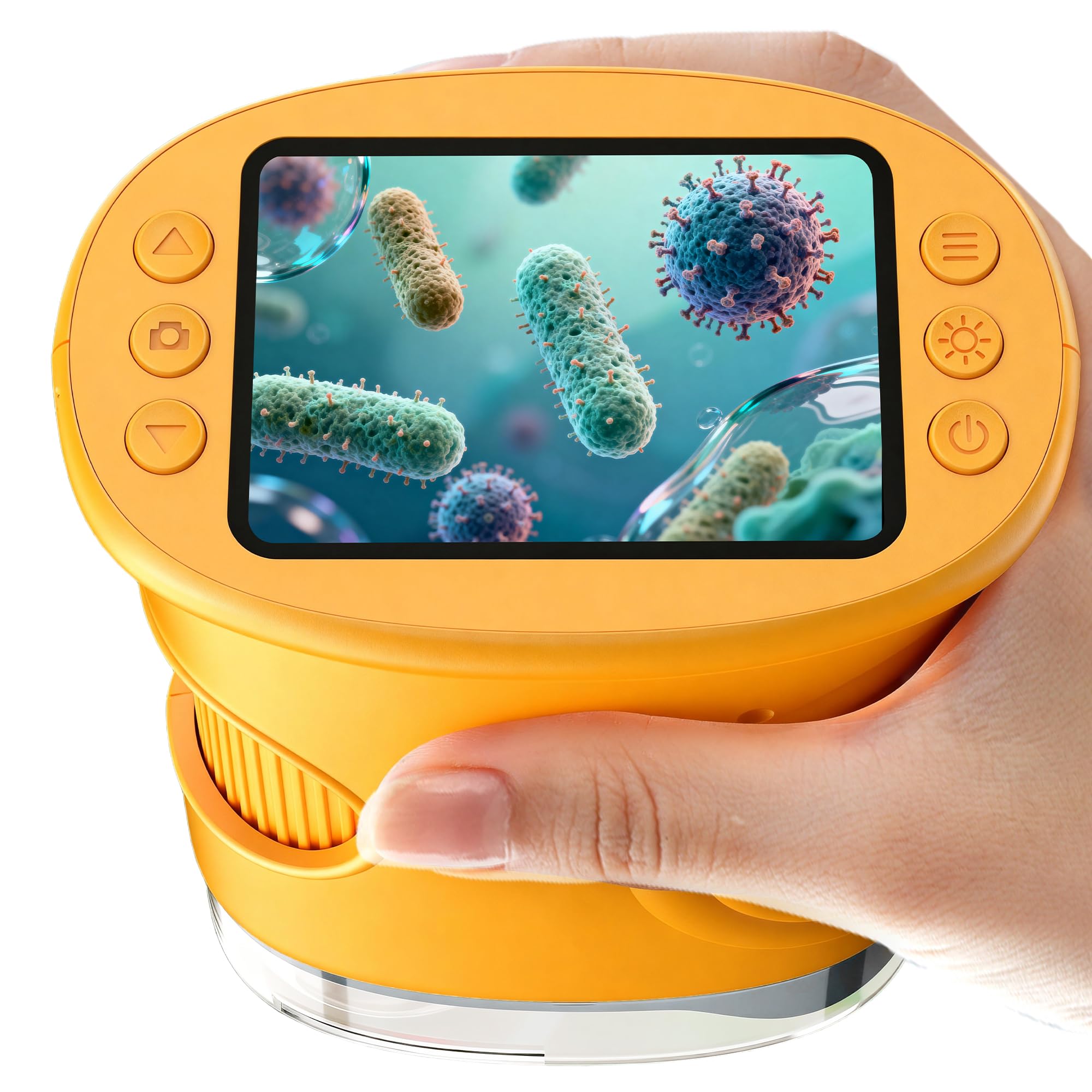
Traditional eyepiece microscopes frustrate young children because they require perfect alignment between the eye, the lens, and the specimen. This handheld unit bypasses that bottleneck entirely with a 2.0-inch IPS screen that shows exactly what the lens sees, instantly. The 1000X optical-plus-digital magnification is sufficient to reveal individual plant cells, fabric weaves, and insect anatomy — which is dramatically more rewarding than the blurry toys that occupy the same price tier.
The manual focus wheel is oversized and textured for small fingers, and the eight adjustable LEDs have three brightness levels plus a diffuser to prevent glare on reflective surfaces like coins or paper. The 600mAh battery runs for about two hours of continuous use and recharges via USB-C, which is a welcome modern convenience. Storage holds over 200 photos or video clips that can be exported to Windows or Mac for science fair projects.
The only real limitation is that the maximum magnification cannot resolve bacteria — a point of confusion for a few buyers. The kit does not include prepared slides, so a parent should be ready with a leaf, a strand of hair, or a salt crystal on day one. For a 6-year-old who picks up every interesting rock and bug on the sidewalk, this is the tool that turns a walk into a research expedition.
Why it’s great
- Instant on-screen image eliminates eyepiece frustration
- Lightweight 200g with lanyard for field trips
- Photo/video capture enables science fair documentation
Good to know
- Cannot see bacteria despite 1000X spec (optical limit)
- No prepared slides included in package
3. National Geographic Junior Chemistry Set

The National Geographic brand carries weight in educational circles, and this junior chemistry set lives up to the reputation. It includes over 20 durable, kid-safe lab tools — test tubes, goggles, a tray, and measuring tools — plus a 50-experiment guidebook that relies primarily on common household supplies like baking soda and vinegar. This means a parent isn’t scrambling to source exotic chemicals for the first weekend of play. The experiments are genuinely varied: color-changing liquids, homemade slime, fizzy reactions, and crystal growth.
What separates this from the Doctor Jupiter kit is the quality of the included hardware. The test tubes and goggles feel like real lab equipment rather than thin plastic throwaways. The instruction manual is fully illustrated with step-by-step visuals that most 6-year-olds can follow with minimal adult help — though some experiments still benefit from a parent’s presence for pouring and measuring. The set has earned the Toy of the Year Award from its parent company, Blue Marble, which aligns with the premium feel of the components.
The tradeoff is that this kit strongly emphasizes guided experiments rather than free-form exploration. Once the 50 projects are completed, the child may feel the box is “done.” A savvy parent can keep the momentum going by reusing the tools for homemade experiments, but the kit itself stops at that 50-project boundary. For a first chemistry set, though, this is the gold standard of structure and safety.
Why it’s great
- Professional-grade lab tools in a kid-safe format
- 50 varied experiments using common household items
- Clear illustrated guide requires minimal adult intervention
Good to know
- Experiments are guided rather than open-ended
- Once all 50 are done, box feels fully consumed
4. Doctor Jupiter My First Science Kit

Doctor Jupiter’s kit edges out its competitors by including most of the consumable ingredients directly in the box — food coloring, baking soda, corn starch, jelly powder, face masks, and even mango and rose essences. This means a parent can open the box and run an experiment within minutes without a grocery run. The 50+ experiments range from the classic baking-soda volcano to making dinosaur squishies and infinity soap, which skews more playful and less academic than the National Geographic set.
The included components are thoughtful: two cups, two stirring sticks, a spatula, beaker, test tube, mini volcano, tray, spray bottle, funnel, dinosaur mold, and dropper. The instruction manual is well-illustrated and aimed squarely at a 4-to-6-year-old’s comprehension level. Reviewers consistently praise how many experiments are genuinely new or unfamiliar even to parents who have previously owned other science kits — the “squishy” and “perfume” projects stand out as crowd-pleasers.
One experiment (walking water) failed to work correctly for a reviewer despite following instructions exactly, suggesting a minor design inconsistency in that specific activity. The kit also recommends adult supervision for pouring and mixing, so it is not a fully independent play option. But for a 6-year-old who loves messy, colorful, sensory-rich play, this kit delivers 50+ days of screen-free entertainment at a price point that leaves room for a second gift.
Why it’s great
- Consumable ingredients included — no extra shopping needed
- Fresh experiments not found in typical kits (squishies, perfumes)
- Covers 50+ days of daily activity
Good to know
- One specific experiment (walking water) has inconsistent results
- Adult supervision required for pouring and mixing steps
5. Qirptey 125-Piece STEM Building Blocks

Some of the best gifts for a 6-year-old require no batteries, no instructions, and no parent — just 125 colorful building blocks and a flat surface. This set from Qirptey delivers exactly that freedom. The pieces include gears, axles, wheels, and connector blocks in multiple shapes and colors, all designed to snap together firmly but release easily enough for small hands to disassemble. The included idea booklet shows how to build a race car, robot, truck, and dinosaur, but the real value is in the unscripted building that happens after.
The blocks are made from non-toxic, odorless ABS plastic with rounded edges — no sharp corners to worry about. The 0.92 kg weight of the full set plus the included storage box means cleanup is a quick dump-and-lid-seal affair, which parents appreciate. Customer reviews consistently mention that children between 3 and 8 play with these for hours and that the availability of spinning gears adds a mechanical dimension that flat stacking blocks lack. The set is also compatible with many other standard building block brands, so it can integrate into an existing collection.
The only meaningful critique is that the 125-piece count, while generous, may feel limited to a child who already owns a large building block collection. There are no motors or electronics, so the builds are static — they roll and spin but don’t move autonomously. For a child who has never experienced gear-based construction, this is a fantastic entry point that will occupy many rainy afternoons.
Why it’s great
- Gears and axles add mechanical movement to builds
- Rounded edges and nontoxic materials ensure safety
- Storage box included for easy cleanup
Good to know
- No motors or electronic components for autonomous movement
- 125-piece count may feel small for advanced builders
6. choopheme 10-in-1 STEM Building Kit

While other building kits focus on abstract shapes, this choopheme set specializes in construction vehicles — bulldozer, crane, forklift, windmill, gantry crane, carrier vehicle, and rotary crane. For a child who watches excavators on job sites with rapt attention, this is the perfect gift. The 112 pieces include girders, tires, cranks, hooks, and flat plates that assemble into ten distinct working models, each with moving parts that actually function as their real-world counterparts do.
The instruction booklet is clear and step-by-step, with 10 to 12 assembly steps per model. A 6-year-old with some building experience can construct the simpler vehicles independently, while more complex builds like the rotary crane may benefit from an older sibling or parent guiding the first attempt. The pieces are large enough to avoid choking hazards and reduce dexterity frustration, and the plastic is durable with no sharp edges. The toolbox-style storage container keeps everything organized between sessions.
The main mechanical tradeoff is that the bolts and nuts tend to loosen during play, requiring periodic tightening. A few reviewers noted that the moving joints can slip out of alignment if the child plays roughly. But the sense of accomplishment from building a 10-inch crane that actually rotates and lifts outweighs this maintenance quibble. For a 6-year-old who dreams of operating heavy machinery, this is the closest they’ll get to the real thing.
Why it’s great
- Ten different construction vehicle builds with working movement
- Large parts suitable for lower dexterity
- Comes in a toolbox container for organized storage
Good to know
- Bolts and nuts loosen during active play
- More complex builds require adult guidance initially
7. Clever Fox Play Number Hunter Math Game
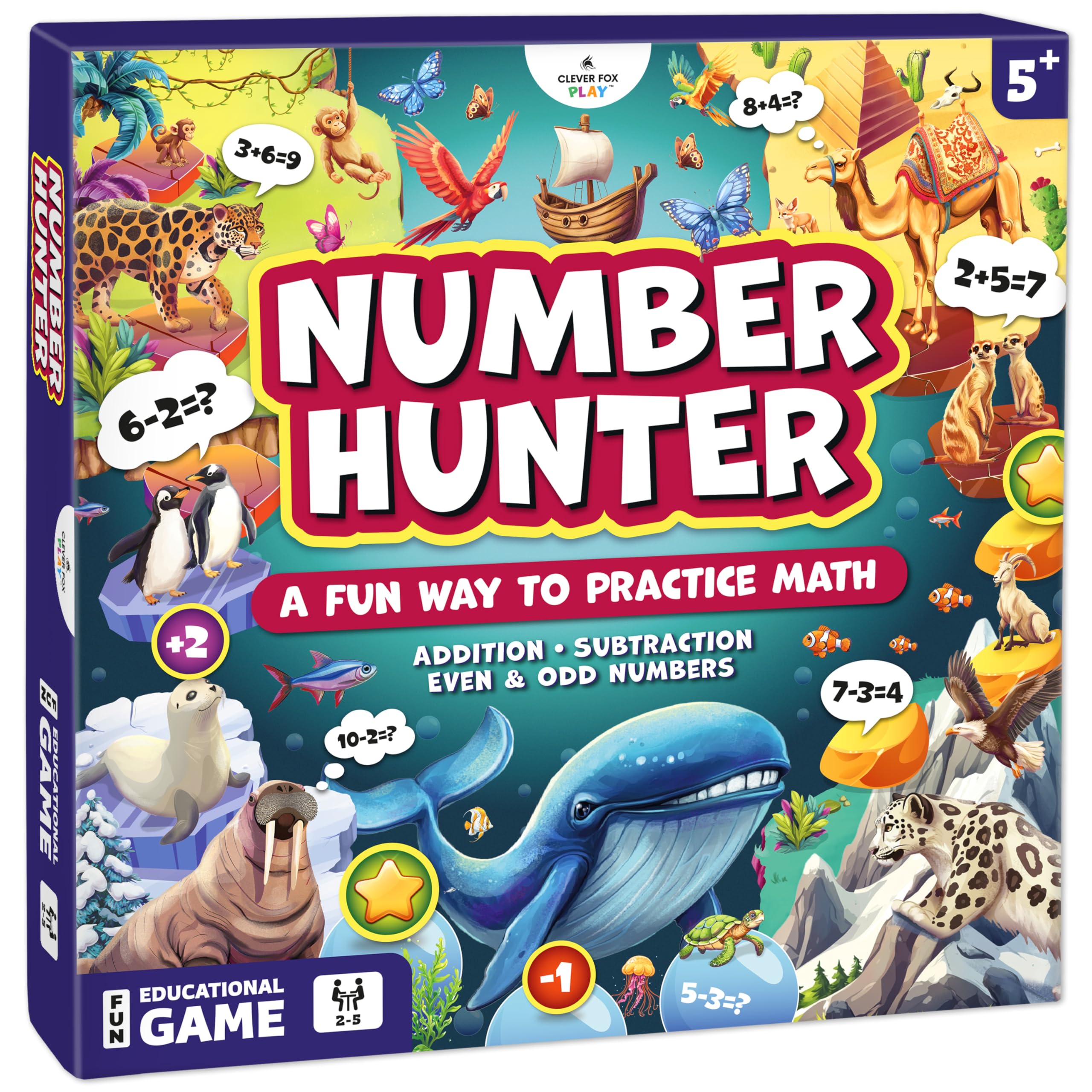
Not every gift needs to be a box of parts — sometimes the best tool for a 6-year-old is a board game that disguises math practice as a race around the world. The Number Hunter game from Clever Fox Play turns addition and subtraction into a competitive expedition. Players roll two number dice and one operation die, compute the result, and move their game piece forward. Landing on a star tile triggers a physical challenge — hopping on one leg, balancing, or a bonus math question — which keeps active kids engaged beyond just mental arithmetic.
The components are sturdy: a large double-sided game board, five game pieces, two number dice, one operation die, and 50 challenge cards. The game supports 2 to 5 players and rounds typically finish in 15 minutes, which is the ideal attention span window. Kindergarten and first-grade teachers have reported success using this as a homeschool staple and classroom math center activity. The “even/odd” recognition built into the star tiles adds an extra layer of number sense development.
The only limitation is that the challenge cards require reading fluency, which many 6-year-olds have but some may not. An adult or older sibling may need to read the card aloud until the child is fully independent. Also, the core math only covers single-digit addition and subtraction — it won’t challenge a child who is already doing two-digit arithmetic. For a typical 6-year-old working on basic fact fluency, this game is a fun alternative to worksheets.
Why it’s great
- 15-minute rounds keep attention from drifting
- Physical movement challenges break up sitting time
- Solid construction survives repeated play
Good to know
- Challenge cards require reading skills
- Math limited to single-digit addition and subtraction
FAQ
Which type of 6-year-old gift holds attention the longest?
Are chemistry sets safe for a 6-year-old?
Final Thoughts: The Verdict
For most users, the best 6 year old gifts winner is the SMILESSKIDDO Snap Circuits because it offers 420 projects from 35 parts, grows with the child from ages 5 to 10, and teaches genuine electrical engineering concepts without soldering. If you want easy independent play and a nature focus, grab the BMDSAE 1000X Digital Microscope. And for a low-mess, no-battery math option that works perfectly for family game night, nothing beats the Clever Fox Play Number Hunter.