
A limp baby against your chest, a screaming lower back, and zero free hands — that is the reality of a cheap, ill-designed papoose carrier that turns every errand into a spine-crushing chore. The narrow market of structured baby papoose carriers exists to fix exactly this: engineered weight distribution, ergonomic hip seats, and breathable fabric that saves your posture while keeping your little one securely in the M-position for healthy hip development.
I’m Min — the co-founder and writer behind Gadgets Feed. I’ve spent weeks cross-referencing every spec panel, real-owner review, and weight-distribution claim across seven of the most debated baby papoose carriers on the market.
After analyzing over 3,500 verified customer insights on shoulder-strap padding, lumbar support geometry, and seat width, this guide narrows down the only seven models worth considering when searching for the best baby papoose carrier.
How To Choose The Best Baby Papoose Carrier
Not every papoose carrier is engineered equally. The critical differentiators live in the seat width, strap architecture, and fabric breathability — not the marketing bullet points. Focus on these three factors before you click buy.
Hip Seat vs. Soft Structure vs. Wrap Hybrid
Hip-seat carriers use a rigid shelf that supports the baby’s weight directly on your pelvis, reducing lower-back strain by up to 40% compared to soft-structured carriers without a seat. Wrap hybrids like the Boppy ComfyFit blend stretchy fabric with a padded waist belt — great for newborns but less support for toddlers over 20 lbs. Pure buckle carriers like the WildBird Aerial offer the best lumbar support for extended all-day wear but require precise strap adjustment to avoid shoulder digging.
Weight Range and Real Capacity
Manufacturers often advertise a wide range like 7-45 lbs, but the carrier’s ergonomics degrade near the upper and lower extremes. A 7 lb newborn needs a deep, narrow seat and removable head support. A 35 lb toddler needs a seat width of at least 5 inches to maintain the M-position without fabric bunching. Cross-reference the labeled range with real parent reviews showing how the carrier performs at 25 lbs — the midpoint where most carriers either shine or fail.
Strap System and Body Fit
X-shaped back straps (Momcozy) distribute pressure across the shoulders and abdomen, ideal for parents with scoliosis or chronic back pain. Crossable straps (Boppy) allow one-person tightening but can twist in the buckle mechanism if the strap width is too thin. A waist belt wider than 5.5 inches with thick sponge padding effectively offloads weight from the spine to the hips — the single most important spec for preventing fatigue during 3-hour wear sessions.
Quick Comparison
On smaller screens, swipe sideways to see the full table.
| Model | Category | Best For | Key Spec | Amazon |
|---|---|---|---|---|
| Momcozy Hip Seat | Hip Seat + Carrier | Active babies, quick on/off | 10mm cushioned seat, 45″ waist limit | Amazon |
| Mabē Monarch | Soft Structured | Premium all-day wear, style | 90% Cotton / 10% Linen, 7-35 lbs | Amazon |
| WildBird Aerial | Buckle Carrier | Long carries, lumbar support | Padded cross straps, 7-45 lbs | Amazon |
| KIYUMI 6-in-1 | Hip Seat + Sling | Budget value, hip dysplasia | 5.5″ waist belt, 7-45 lbs | Amazon |
| GROWNSY Ergonomic | Soft Structured | Newborn protection, C-shape spine | EVA waist support, 7-44 lbs | Amazon |
| Boppy ComfyFit | Wrap Hybrid | Plus-size, stretchy comfort | Machine washable, 8-35 lbs | Amazon |
| BabyBjörn Mini | Newborn Specific | First carrier, ultra-soft 3D jersey | Adjustable seat, 7-25 lbs | Amazon |
In‑Depth Reviews
1. Momcozy Baby Carrier with Hip Seat
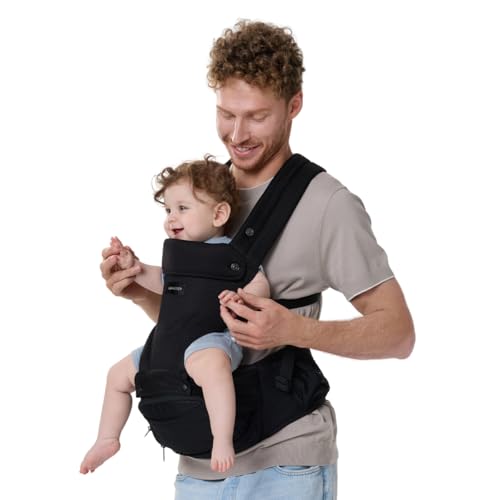
The Momcozy Hip Seat Carrier is the smartest hybrid on this list — pairing a detachable 10mm cushioned hip seat with a full structured carrier that converts in seconds. Its 360° rotating waist design supports six positions (cradle, hip, forward-facing, inward, outward, and back carry), making it the most versatile option for parents whose baby transitions from passive snuggle to active exploration between 5 and 18 months. The 3D AirMesh fabric keeps airflow constant, preventing the sweat pooling that plagues closed-weave carriers during summer outings.
The X-structure back support evenly distributes weight across the shoulders and abdomen, with multiple verified owners reporting relief from scoliosis and chronic back pain compared to their previous carriers. The waist belt sits high enough that one reviewer noted she could use the restroom without removing the carrier — a rare design win. The 45-inch waist limit accommodates plus-size parents, though the snap system on the strap connector has a small rate of loosening over heavy daily use.
For the mid-range price point, this carrier packs more adjustability than the pure-structured WildBird and more hip-seat cushioning than the KIYUMI, all while remaining lighter than the Mabē Monarch by roughly 0.3 lbs. The detachable seat folds into its own pocket, turning the carrier into a standalone hip seat (similar to a Tushbaby) when you want to skip the straps entirely.
Why it’s great
- Detachable hip seat converts to standalone carry pad
- 360° rotation with six carrying positions
- Breathable 3D AirMesh resists sweat buildup
- High waist belt allows bathroom access without removal
Good to know
- Snap system on strap connector can loosen with daily use
- Not ideal for newborns under 5 months — best for 5+ months
- Waist limit of 45 inches may exclude some larger body types
2. Mabē Monarch Ergonomic Baby Carrier
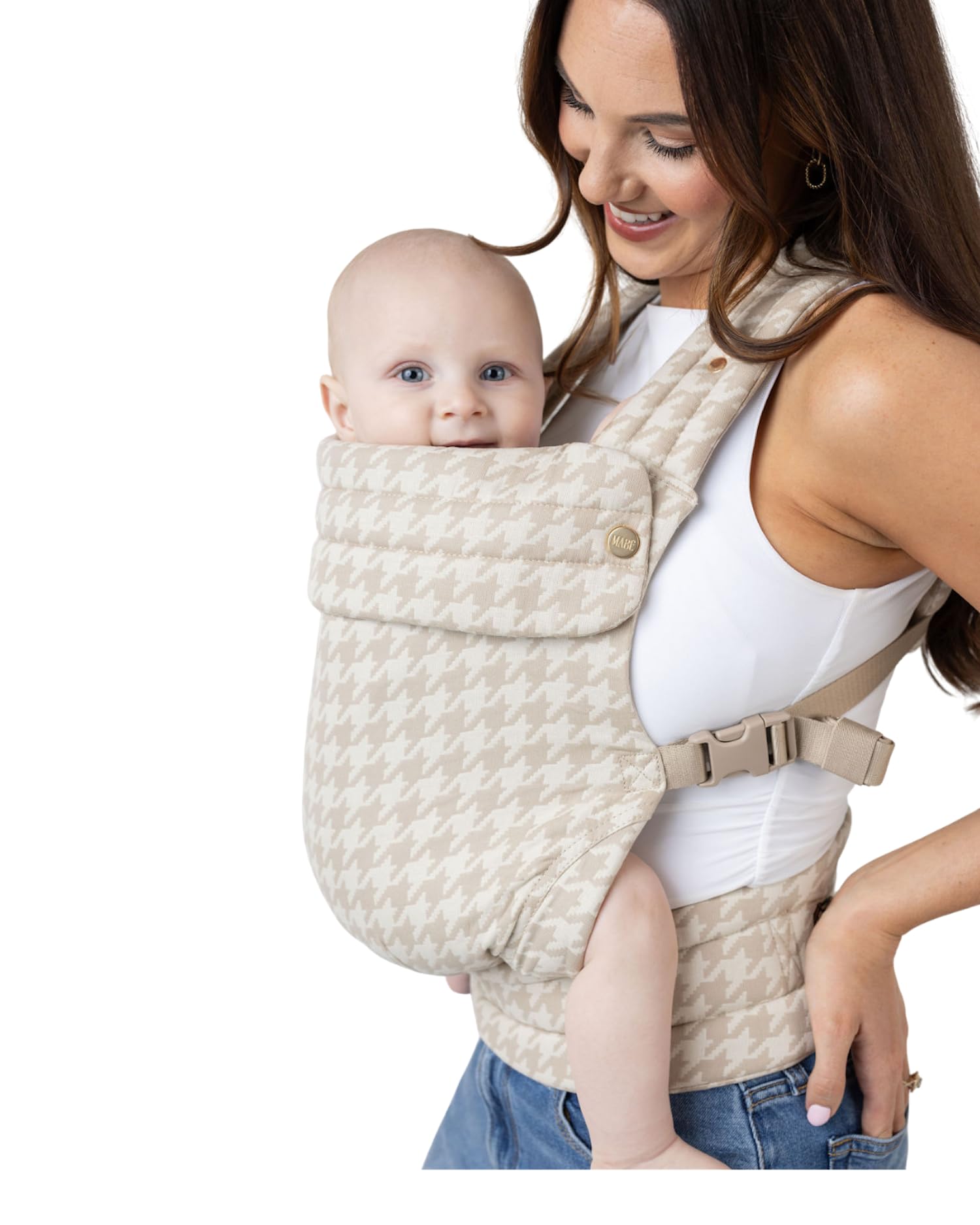
The Mabē Monarch is the only carrier on this list constructed from a 90% cotton and 10% linen weave — a fabric combination that breathes naturally, softens with each wash, and resists pilling longer than the synthetic blends used by the Momcozy and KIYUMI. It supports three ergonomic positions (front inward, front outward, back carry) across a 7-35 lb range, with a deep seat that maintains the M-position for hip-healthy development. The thick padded straps are wide enough to prevent shoulder digging even when carrying a 30 lb toddler for two-hour stretches.
Owners consistently praise the easy one-person buckling system — you can put it on and tighten the straps without a mirror or a second set of hands. The back carry mode is particularly well-engineered: the chest clip is removable, allowing the straps to sit cleanly without bunching. The fabric is machine washable on a cold gentle cycle (in a garment bag), which is essential for handling the spit-up and drool that accumulates during daily wear.
The trade-off is weight and breathability compared to the mesh-heavy Momcozy. At roughly 1.1 lbs, the Monarch is slightly heavier, and the cotton-linen weave, while breathable, doesn’t wick moisture as aggressively as engineered mesh.
Why it’s great
- Premium cotton-linen fabric softens over time without pilling
- Easy one-person buckling with no-mirror tightening
- Removable chest clip for clean back carry setup
- Machine washable with long-lasting color retention
Good to know
- Heavier than mesh-based carriers by roughly 0.3 lbs
- Cotton-linen fabric dries slower after washing
- Higher price point — best for committed long-term use
3. WildBird Aerial Buckle Carrier
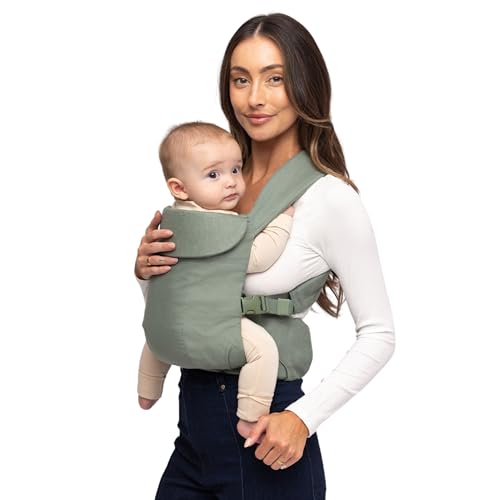
The WildBird Aerial is engineered for the parent who spends four hours or more in a carrier per day — hiking, airport layovers, or full-day museum trips. Its defining feature is the integrated lumbar support panel, which sits below the waist belt and provides structural reinforcement that prevents the carrier from sagging forward as the baby’s weight shifts. The padded cross straps distribute load across the trapezius muscles rather than the acromioclavicular joint, eliminating the sharp shoulder pain that buckle carriers without cross-strap geometry cause.
The fabric is a breathable linen weave that prevents overheating — multiple reviewers noted their babies didn’t sweat through the carrier even during summer walks. The waist belt adjusts from 24 to 41 inches (Standard size) or 35 to 53.5 inches (Large), making it one of the most size-inclusive options. However, the Aerial does not support front-facing outward carry, which is a dealbreaker for parents whose babies demand forward-facing engagement after 6 months.
At the top end of the price spectrum, the WildBird delivers exceptional resale value (the linen fabric holds its structure through dozens of machine washes) and the most refined lumbar support of any carrier on this list. The infant snap placement requires a 20-minute initial adjustment to get the seat depth correct, but once dialed in, the carrier remains comfortable across multiple users without re-adjustment. It supports 7-45 lbs, covering the entire baby-to-toddler window without needing an infant insert.
Why it’s great
- Integrated lumbar support prevents forward sag during long wears
- Padded cross straps eliminate acromioclavicular joint pain
- Breathable linen fabric prevents baby overheating
- Available in Standard and Large sizes for body inclusivity
Good to know
- No front-facing outward carry position
- Infant snap placement requires 20-minute initial setup
- Highest price point on this list
4. KIYUMI Baby Carrier with Hip Seat
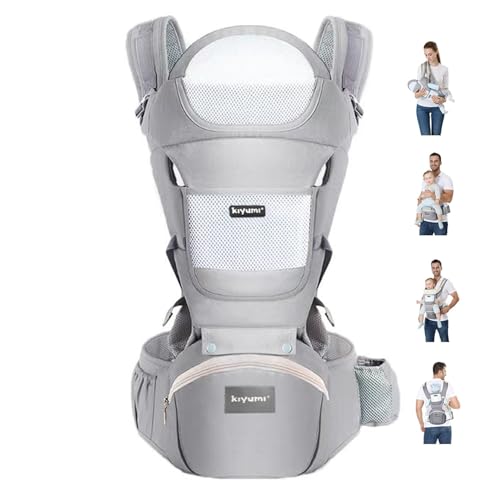
The KIYUMI 6-in-1 is the budget champion that doesn’t feel cheap — the thickened hip seat is firm enough to support a heavy-squirmy toddler’s M-position without collapsing, and the 5.5-inch wide waist belt with thick sponge padding effectively channels weight away from the lower spine. The carrier separates into a standalone hip seat, shoulder straps, and waist belt, giving you six carrying configurations (newborn inward, facing out, back carry, hip seat alone, hip seat with straps, and cradle mode) that cover 0-36 months without needing to buy additional accessories.
Where this carrier punches above its weight class is in user-reported pain relief — owners with scoliosis and chronic back pain reported measurable reductions in lumbar strain compared to the BabyBjörn Mini and traditional soft-structured wraps. The breathable 3D mesh panels along the baby’s back prevent heat rash during extended wear. The storage pockets on the hip seat are large enough for a phone, keys, and a 5 oz bottle, eliminating the need for a separate diaper bag on short outings.
The only real compromises are the weight range discrepancy (the manual states up to 33 lbs while the Amazon listing claims 45 lbs — the actual safe limit aligns closer to 33 lbs for maintaining proper M-position depth) and the slightly lower fabric quality compared to the Mabē or WildBird. The padding deflates faster after heavy use, and the grey color shows dirt more readily than darker options. Still, for a price that sits in the entry-level tier, the structural engineering rivals carriers costing three times as much.
Why it’s great
- Detachable hip seat converts to six carrying modes
- 5.5-inch wide waist belt with thick sponge padding
- Integrated storage pockets eliminate diaper bag need
- Reported back pain relief for scoliosis and chronic back issues
Good to know
- Labeled 45 lb limit is misleading — practical safe limit ~33 lbs
- Padding degrades faster than premium tier carriers
- Grey fabric shows dirt and wear quickly
5. BabyBjörn Baby Carrier Mini
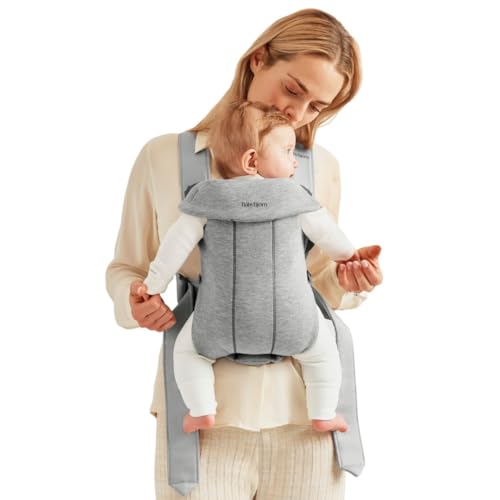
The BabyBjörn Mini is the gold standard for the newborn-through-6-month window — its 3D Jersey fabric is the softest and most flexible material on this list, conforming to a tiny baby’s natural C-spine curve without any stiff backing. The adjustable seat and head support grow with the baby from 7 lbs up to 25 lbs, and the two front-carrying options (inward facing and inward with legs tucked) are specifically optimized for the frog-leg position that pediatricians recommend for hip joint development in infants under 4 months.
Where the Mini excels is sheer simplicity — it snaps on and off in under 10 seconds with no complicated strap routing, and the lack of a bulky waist belt means it packs flat into a diaper bag. Verified owners consistently praise it as the easiest carrier to use alone, especially when handling a crying newborn. The 3D Jersey is also machine washable without any fabric softening instructions, surviving repeated spit-up cycles without losing stretch.
The limitation is the short use window — at 25 lbs max, most babies outgrow the Mini around 10-12 months, making it a specialized tool rather than a long-term investment. It also cannot carry forward-facing or on the back, so you will need a second carrier if you plan to continue babywearing past the first year. The premium price for a product with limited longevity makes it a niche pick, but for parents prioritizing the newborn phase above all else, the Mini’s fabric quality and ease of use remain unmatched.
Why it’s great
- Ultra-soft 3D Jersey fabric conforms to newborn C-spine
- Snaps on/off in under 10 seconds — easiest solo setup
- Adjustable seat and head support grow within 7-25 lb range
- Machine washable with no fabric softening restrictions
Good to know
- Limited to 25 lbs — outgrown by 10-12 months
- No forward-facing or back carry positions
- High cost-per-month of use compared to 0-36 month carriers
6. GROWNSY Baby Carrier Newborn to Toddler

The GROWNSY carrier positions itself as a budget-friendly alternative to the Momcozy and KIYUMI, with a specific focus on newborn spine protection through its foldable head and neck support and EVA (ethylene-vinyl acetate) waist support that adds rigidity to the lumbar area. The X-shaped back support and widened shoulder straps are designed to distribute pressure evenly, and multiple owner reviews confirm that daily use for 2 months straight shows zero fabric degradation — the 3D mesh and stitching hold up well.
The carrier supports both inward and front-facing positions, with the front-facing mode activating after 6 months. The buckle system is straightforward enough for a new parent to install in roughly 30 seconds using the 4-step process outlined in the manual. Hidden pockets at the bottom of the carrier add storage for keys or a pacifier, and the fabric folds compactly for storage — a feature that owners of the bulkier WildBird will appreciate.
The main drawbacks are the back strap design — the straps tend to twist inside the buckle mechanism, requiring the user to buckle them wrong-side-first to seat properly — and the waist strap’s tendency to deform into a rippled pattern that can cause discomfort when wearing thin shirts. The stated weight range of 7-44 lbs is more accurate than the KIYUMI’s inflated claim, with the carrier maintaining proper M-position depth up to roughly 35 lbs before the seat width becomes insufficient.
Why it’s great
- EVA waist support adds lumbar rigidity lacking in soft-only carriers
- Foldable head and neck support protects newborn C-spine
- 30-second 4-step setup — beginner-friendly
- Fabric maintains integrity after 2 months of daily use
Good to know
- Back straps twist in buckle, requiring awkward reverse buckling
- Waist strap ripples with continued wear, irritating thin shirts
- M-position depth degrades after 35 lbs
7. Boppy ComfyFit Adjustable Baby Carrier

The Boppy ComfyFit is the only wrap-hybrid on this list — a stretchy spandex-polyester outer (88% Polyester, 12% Spandex) that combines the cozy, cradled feel of a stretchy wrap with the weight-distributing structure of a padded waist belt. It is JPMA certified, meeting the highest safety standards for performance and functionality. The adjustable arm straps, wrap panels, and belt allow for a custom fit across a wide range of body types, with plus-size and large-chested users reporting it as the only carrier that comfortably supports their frame without digging into the shoulders.
The three carrying positions (newborn front face-in frog position, baby front face-in with legs out, and front face-out) cover the 8-35 lb range without requiring an infant insert — the stretchy fabric naturally contours around smaller babies. The carrier packs into its own pouch and is machine washable, making it a practical choice for diaper bag storage. Owners report that babies fall asleep faster in the ComfyFit compared to structured buckle carriers, likely due to the swaddle-like tension the stretch fabric provides.
The compromise is the setup time — because the straps need to be adjusted for proper tension each time, it takes about 60 seconds to get the fit right, versus the 10-second snap-on of the BabyBjörn Mini. The stretch fabric also means the carrier works better for stationary activities (walks, house chores, babywearing at home) than for high-mobility scenarios like jogging or hiking, where the baby may bob more than in a rigid hip seat carrier. The 35 lb weight limit also means it maxes out earlier than the Momcozy or WildBird.
Why it’s great
- Stretchy wrap fabric provides swaddle-like comfort for baby
- JPMA certified for safety and performance
- Excellent fit for plus-size and large-chested parents
- Packs into own pouch — most portable option
Good to know
- 60-second setup time — slower than buckle carriers
- Stretch fabric causes more bob during high-mobility activity
- 35 lb limit — outgrown earlier than rigid hip-seat carriers
FAQ
What is the M-position and why does it matter for a papoose carrier?
Can I use a papoose carrier for a newborn under 7 lbs?
How do I clean a baby papoose carrier without damaging the structure?
Is front-facing outward carry safe for my baby’s hips and spine?
Final Thoughts: The Verdict
For most users, the best baby papoose carrier winner is the Momcozy Baby Carrier with Hip Seat because it combines a detachable 10mm cushioned hip seat with six carrying positions, 3D AirMesh breathability, and an X-structure back support that relieves pressure for parents with back pain — all at a mid-range price point that undercuts the premium tier carriers by a significant margin. If you want premium cotton-linen fabric and the highest resale value, grab the Mabē Monarch. And for long all-day carries where lumbar support is non-negotiable, nothing beats the WildBird Aerial Buckle Carrier.