
Matching an amplifier to your speakers is the single most consequential decision in a home audio system—get the power output wrong and you either starve your speakers of dynamics or risk blowing tweeters with a clipped signal. The right amp delivers clean headroom, low noise floor, and tonal character that complements your listening preferences, whether you favor the measured neutrality of Class AB or the harmonic richness of a vacuum tube circuit.
I’m Min — the co-founder and writer behind Gadgets Feed. I’ve spent countless hours analyzing amplifier specifications across the to price band, cross-referencing power ratings with real-world speaker sensitivity data to separate inflated marketing claims from honest engineering.
After reviewing dozens of models, clear winners emerged, and this guide ranks the top candidates so you can confidently buy the best amp for home audio that fits your system and budget.
How To Choose The Best Amp For Home Audio
Selecting an amplifier involves three core variables: power output relative to your speaker sensitivity, amplification topology, and connectivity features. Understanding these removes the guesswork.
Power, Impedance, and Sensitivity
The wattage rating you need depends entirely on your speakers’ sensitivity (measured in dB at 1 watt/1 meter). A speaker rated at 88 dB sensitivity requires roughly twice the amplifier power to reach the same volume as a 91 dB speaker. Check your speaker’s nominal impedance (typically 4, 6, or 8 ohms) and ensure the amp can deliver its rated power at that load—many budget amps underperform below 6 ohms.
Amplifier Topology: Class AB vs. Class D vs. Tube
Class AB amplifiers offer a proven balance of linearity and efficiency, running warmer but delivering rich midrange. Class D amps pack high power (upwards of 100 watts per channel) into compact chassis with minimal heat, ideal for tight shelves. Tube amplifiers produce characteristic even-order harmonics that many listeners describe as “warm” or “liquid,” but their output is limited—typically under 15 watts per channel—making them suitable only for high-sensitivity speakers (89 dB or higher).
Digital Features and Room Correction
Modern amplifiers increasingly incorporate streaming modules, DACs, and room calibration. Built-in Wi-Fi with support for Spotify Connect, TIDAL, or Apple AirPlay 2 eliminates the need for a separate streamer. Room correction systems like Dirac Live or WiiM RoomFit use a microphone to measure your space and apply corrective filters, taming bass modes and uneven frequency response automatically.
Quick Comparison
On smaller screens, swipe sideways to see the full table.
| Model | Category | Best For | Key Spec | Amazon |
|---|---|---|---|---|
| WiiM Amp Ultra | Streaming Integrated | All-in-one hi-fi streaming | 100W/ch, ESS ES9039Q2M DAC | Amazon |
| Cambridge Audio CXA81 MkII | Integrated Stereo | Reference two-channel music | 80W/ch, ESS ES9018K2M DAC | Amazon |
| Onkyo TX-RZ70 | AV Receiver | Immersive multi-channel theater | 140W/ch 11.2-ch, Dirac Live | Amazon |
| Denon PMA-900HNE | Integrated Stereo | Mid-level streaming + phono | 85W/ch, HEOS multi-room | Amazon |
| Yamaha RX-A4A | AV Receiver | 7.2-channel home theater with AI | 8K HDMI 2.1, Surround:AI | Amazon |
| Marantz MM7025 | Power Amplifier | Adding clean power to a pre/pro | 140W/ch, XLR + RCA inputs | Amazon |
| Reisong A10 EL34 | Tube Integrated | Warm, euphonic sound at low volume | 2x EL34, 12W/ch, hand-wired | Amazon |
| Yamaha R-S202BL | Stereo Receiver | Simple two-channel with FM/AM | 100W/ch, Bluetooth 4.1 | Amazon |
| Rockville RPA9 | Power Amplifier | High-output DJ and pro audio | 3000W peak, 800W RMS | Amazon |
In‑Depth Reviews
1. WiiM Amp Ultra with Voice Remote 2
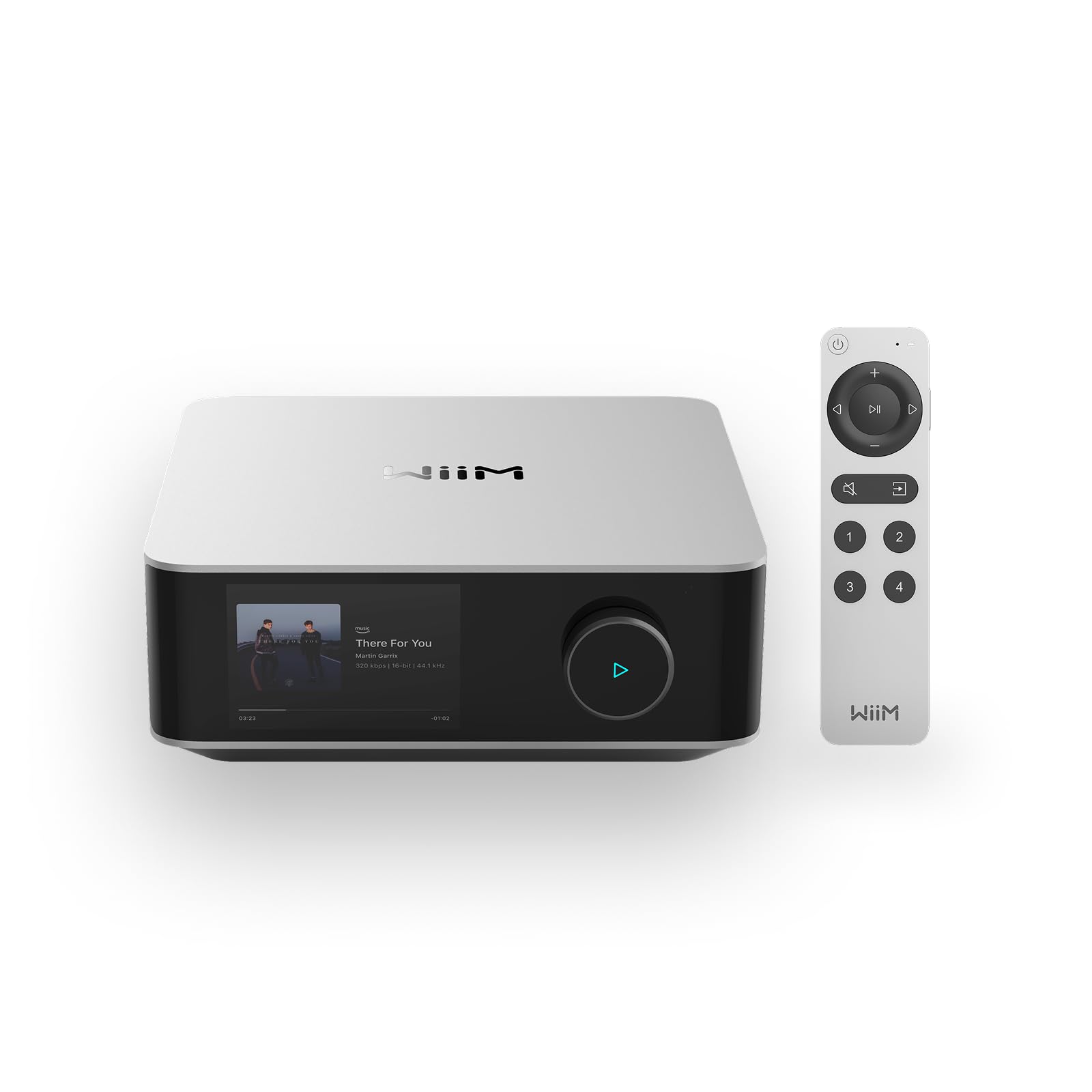
The WiiM Amp Ultra delivers 100 watts per channel into 4 ohms via dual TI TPA3255 amplifiers in Class D configuration, achieving a total harmonic distortion plus noise (THD+N) of just -106 dB. The ESS Sabre ES9039Q2M DAC handles 24-bit/192 kHz audio streams, and the unit supports Wi-Fi 6, Bluetooth 5.3 with LE Audio, HDMI ARC, optical, and RCA inputs—making it the most versatile streaming amplifier at its price tier. The built-in RoomFit room correction uses a microphone to generate corrective EQ filters that address bass nulls and peaky treble, a feature typically reserved for separates costing twice as much.
In listening tests with Klipsch RP-600M speakers (96 dB sensitivity), the WiiM Amp Ultra produced studio-perfect clarity with spot-on instrument separation and a wide, layered soundstage. Vocals sounded natural and uncolored, while the bass management menu allowed seamless integration with a powered subwoofer, applying a 12 dB/octave high-pass filter to the mains. The 3.5-inch touchscreen displays album art and system settings, though the primary control point remains the WiiM Home app, which provides per-source EQ presets, fixed and variable line outputs, and individual volume limits for each zone.
The only notable omission is AirPlay compatibility—the unit cannot function as an AirPlay receiver, so Apple users will need to stream via Chromecast or Bluetooth. The internal DAC delivers reference-grade conversion that rivals external units around the mark, making the WiiM Amp Ultra a genuinely complete system hub. If you want a single box that handles streaming, DAC duties, room correction, and amplification with zero fuss, this is the benchmark.
Why it’s great
- Integrated room correction adapts to real spaces
- ESS Sabre DAC eliminates need for external converter
- Wi-Fi 6 and HDMI ARC for modern TV integration
Good to know
- No AirPlay support for Apple device users
- Bluetooth input introduces a delay when switching sources
2. Cambridge Audio CXA81 MkII

The Cambridge Audio CXA81 MkII is a Class AB integrated amplifier delivering 80 watts per channel into 8 ohms, built around a toroidal transformer that provides a low-noise power supply and excellent soundstage width. The ESS ES9018K2M SABRE32 DAC handles digital-to-analog conversion, supporting PCM up to 384 kHz and DSD128 via the USB-B input. The preamp section includes both single-ended RCA and balanced XLR inputs, allowing premium connection to a separate streamer like the CXN100, plus TOSLINK optical and coaxial digital inputs for a CD transport or television.
Paired with Monitor Audio Silver 500 floorstanding speakers, the CXA81 MkII delivers a warm-neutral tonal balance with exceptional instrument separation—piano and acoustic guitar sound realistic and present, while electric bass lines maintain fullness without bloat. The amplifier’s damping factor is sufficient to keep even 4-ohm loads under control; during extended listening sessions at moderate volumes, the chassis remained cool to the touch, a hallmark of well-executed Class AB design. Bluetooth aptX HD streaming from a smartphone maintains solid fidelity, though the Bluetooth version is 4.2 rather than 5.3, causing occasional reconnection issues with certain computers.
A brief two-day break-in period is commonly reported before the amplifier fully opens up, revealing a smoother top end and more relaxed treble. The remote control is large and well-built but does not control Cambridge Audio CD players. For buyers seeking a no-compromise two-channel stereo amplifier with a proper moving-magnet phono stage option (via external MM/MC phono preamp input), the CXA81 MkII punches well above its price category in build quality and sonic transparency.
Why it’s great
- Toroidal transformer provides excellent soundstage and low noise
- Balanced XLR inputs for premium source connection
- Handles 4-ohm loads with authority
Good to know
- Bluetooth 4.2 can disconnect with some computers
- Requires a brief break-in period for optimal treble presentation
3. Onkyo TX-RZ70 11.2-Channel AV Receiver
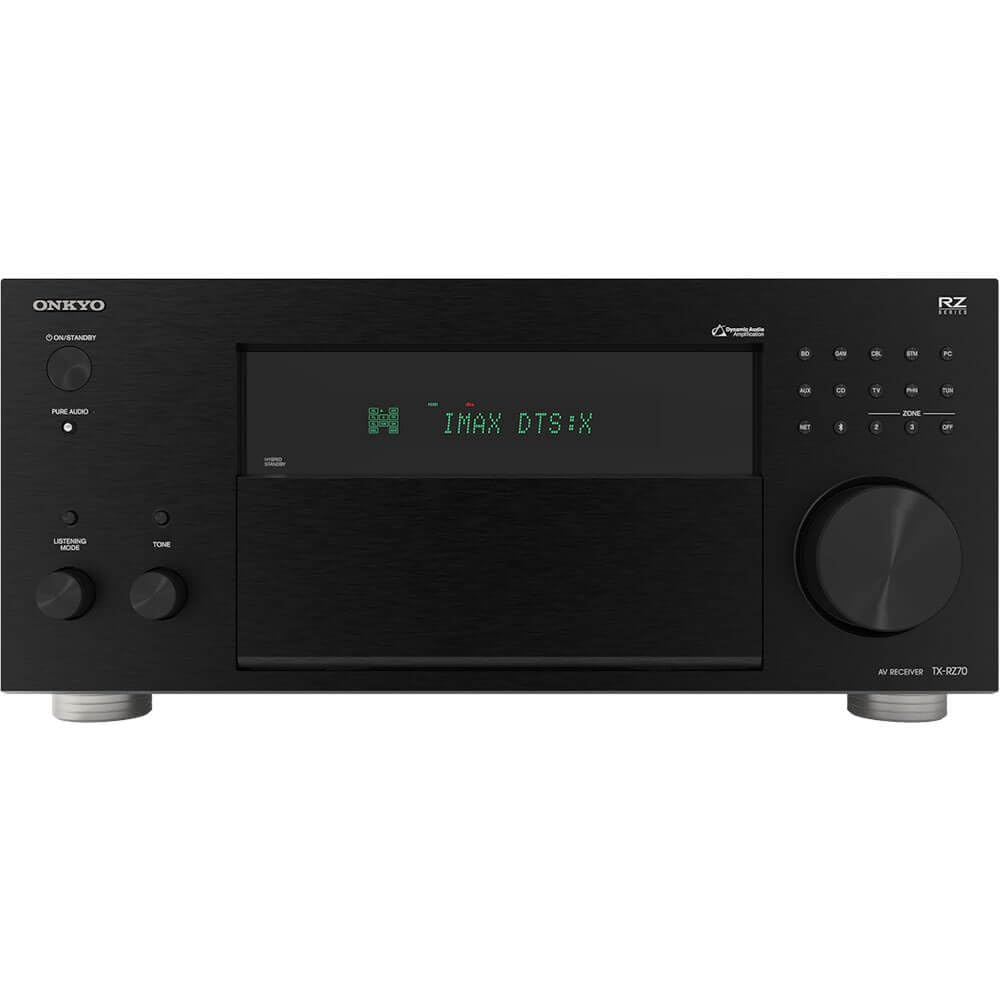
The Onkyo TX-RZ70 is an 11.2-channel AV receiver rated at 140 watts per channel (8 ohms, 20 Hz–20 kHz, two channels driven). Independent bench measurements indicate real-world delivery closer to 170 watts before distortion becomes audible. The unit ships with Dirac Live Full Bandwidth room correction out of the box—a value in competitor ecosystems—and supports optional Dirac Live Bass Control for multi-subwoofer setups. THX certification guarantees zero added coloration across all input modes, while IMAX Enhanced mode stretches picture aspect ratio by up to 26% for an immersive cinema experience.
All seven HDMI inputs handle 8K60 and 4K120 at 40 Gbps, with support for variable refresh rate (VRR) and auto low-latency mode (ALLM), making this receiver equally suited for a gaming console as for a home theater. The ESS Sabre DAC array drives the 11 channels with vanishingly low noise—users report that internal DAC performance rivals dedicated high-end streamers. The unit is Roon Ready, allowing direct integration with a Roon core for gapless multi-room playback. At 57.85 pounds, the TX-RZ70 demands ample rack space and robust ventilation; a dedicated cabinet with open airflow is strongly recommended.
Zone 2 control exhibits a minor limitation—no numeric volume display—and the remote control feels disappointingly cheap relative to the build quality of the chassis. These are small compromises for a receiver that delivers reference-grade dynamics and a Dirac-calibrated soundstage that tightens bass response and tames room modes with precision. If you demand the most powerful AV receiver under with professional-grade calibration baked in, the TX-RZ70 sets the standard.
Why it’s great
- Dirac Live Full Bandwidth included at no extra cost
- Roon Ready for high-res multi-room streaming
- HDMI 2.1 supports 4K/120 gaming with VRR
Good to know
- Extremely large and heavy—needs oversized cabinet
- Remote feels low-quality for this price tier
4. Denon PMA-900HNE Integrated Stereo Amplifier

The Denon PMA-900HNE is a Class AB integrated amplifier delivering 85 watts per channel (rated into 8 ohms, with the Advanced High Current circuit providing robust current delivery into lower impedances). The ESS ES9018K2M DAC sits at the heart of the digital section, and built-in HEOS enables wireless multi-room streaming via Wi-Fi, AirPlay 2, or Bluetooth. The phono stage supports both moving magnet (MM) and moving coil (MC) cartridges—a rare feature at this price point—making the PMA-900HNE a complete hub for vinyl and digital sources.
In listening sessions with Klipsch KG 4.5 floorstanding speakers (98 dB sensitivity), the amplifier exhibited a recessed top end with warm mids and tight bass, a classic Denon house sound that suits listeners who prioritize smooth, fatigue-free listening over analytical detail. Pure Direct mode bypasses the tone controls and digital processing for the cleanest signal path. The subwoofer pre-out applies a fixed 100 Hz low-pass filter—acceptable for most subwoofers with their own crossover, but less flexible than a variable LPF. Total harmonic distortion measures 0.07% at 85 watts into 8 ohms.
The HEOS app interface can feel clunky compared to native Spotify Connect or TIDAL Connect, and the volume knob is metal while the input selector knobs are plastic—a minor cost-cutting detail. The PMA-900HNE runs notably warm during extended listening; ensure at least five inches of clearance above the chassis. With its built-in streaming, MM/MC phono stage, and high-current power supply, this amplifier offers outstanding value for the audio system that needs to serve multiple sources without external boxes.
Why it’s great
- Integrated MM/MC phono preamp for turntable users
- High current design drives low-impedance speakers well
- HEOS support for whole-home audio streaming
Good to know
- Fixed 100 Hz subwoofer crossover may limit flexibility
- HEOS app interface lags behind native streaming solutions
5. Yamaha RX-A4A AVENTAGE 7.2-Channel AV Receiver

The Yamaha RX-A4A is a 7.2-channel AVENTAGE-series AV receiver with Dolby Atmos, DTS:X, and Auro-3D immersive audio support. All seven HDMI inputs handle 8K60 and 4K120 at 40 Gbps, with HDCP 2.3 and eARC, plus ALLM and VRR for next-generation gaming consoles. The Surround:AI engine analyzes audio scenes in real time and adjusts surround parameters to optimize effects, vocals, and ambient sounds. YPAO R.S.C. (Reflected Sound Control) with 3D multipoint measurement provides room calibration with precision EQ and a dedicated low-frequency mode.
When driving a 5.1.2 Dolby Atmos setup with Klipsch Reference speakers, the RX-A4A produced accurate sound with a wide, spacious soundstage that made modest rooms feel larger. The Surround:AI mode works well with films, dynamically shifting energy to the center channel for dialogue clarity during action sequences. For music, the All-Channel Stereo mode provides a pleasing immersive experience, though purists may prefer the Straight mode for unprocessed stereo. The RX-A4A includes a phono input for a turntable, plus Wi-Fi, Bluetooth, AirPlay 2, and MusicCast for multi-room streaming.
Firmware updates require a USB flash drive rather than being applied over the network—a tedious process that involves downloading the file to a computer first. The setup menu system involves many nested screens that take time to learn, but once configured the receiver operates as a set-and-forget hub. The RX-A4A includes pre-outs for an external power amplifier, allowing future upgrades to drive demanding mains. For a balanced combination of film immersion, music fidelity, and modern HDMI features, the RX-A4A is a strong mid-premium choice.
Why it’s great
- Surround:AI optimizes audio effects in real-time for films
- All HDMI inputs support 8K60 and 4K120 with ALLM/VRR
- Phono input included for vinyl playback
Good to know
- Firmware updates require USB flash drive, not OTA
- Setup menu system is complex for beginners
6. Marantz MM7025 Stereo Power Amplifier

The Marantz MM7025 is a two-channel power amplifier rated at 140 watts per channel into 8 ohms, featuring both single-ended RCA and balanced XLR inputs. This is a straightforward, no-frills power amplifier—no streaming, no DAC, no preamp—designed to take a line-level signal from an AV receiver pre-out or a dedicated stereo preamplifier and deliver clean, current-rich power to a pair of front speakers. The chassis depth is under 14 inches, allowing it to fit on most shelves, and the cooling fan is effectively inaudible in normal operation.
When connected to a Yamaha RX-A4A via XLR cables and driving Klipsch RF-7 III floorstanding speakers, the MM7025 provided lively, clean sound with no hiss or noise—gunshots and vocals sounded authentic and dynamically unrestricted. The amplifier runs warm but the temperature-controlled fan maintains internal temperature around 80°F even during extended high-volume sessions. The Marantz sound signature leans warm and musical, though some listeners may find it less detailed than competing Class AB designs from Rotel or Cambridge Audio in the same power range.
Internally, the MM7025 uses a Class D output stage (despite the Marantz lineage), which some buyers find surprising at this price point. The build quality is solid, but the internal layout uses generic parts that do not match the premium expectations set by the brand. If you need a dedicated two-channel power amp to offload main-channel duties from an AV receiver and value a compact form factor with silent heat management, the MM7025 delivers. For purists seeking a fully discrete Class AB design, alternative options from Schiit Audio may offer better value.
Why it’s great
- Balanced XLR and RCA inputs for system flexibility
- Compact chassis fits easily in standard shelves
- Silent fan keeps internal temps low during high power
Good to know
- Uses Class D topology despite brand heritage
- Internal parts are generic for the price point
7. Reisong A10 EL34 Hi-Fi Audio Stereo Tube Amplifier

The Reisong A10 is a single-ended Class A tube amplifier delivering 12 watts per channel via two EL34 output tubes, two 6N2J driver tubes, and a 5Z4PJ rectifier tube. The amplifier uses point-to-point hand wiring rather than a printed circuit board, and the output transformers have been upgraded to 76×40 cores for improved frequency extension. This is an extremely low-power design by modern standards—the manufacturer explicitly recommends speakers with sensitivity of 89 dB or higher, and floorstanding or low-sensitivity speakers will not achieve satisfying volume levels.
Paired with Klipsch RP-600M speakers (96 dB sensitivity), the A10 produces a warm, spacious, and textured sound with a liquid midrange that tube enthusiasts prize. The bass response has surprising weight for a 12-watt amp—one reviewer noted more bass than an Onkyo 9150 integrated amplifier. The soundstage is wide and natural, with convincing vocal presence and airy treble. The amp runs hot, as all Class A designs do, but the included tube protective cover prevents accidental burns. The construction is heavy and finished in stainless steel and aluminum with a classic retro look.
Build quality issues are not uncommon: some units ship with bent power switches, loose power cables, or defective EL34 tubes. The seller has a reputation for responsive customer service, but buyers should inspect the unit thoroughly on arrival. Modding the bias resistors from 500 ohm to 250 ohm and swapping to higher-quality tubes (such as Gold Lion KT77 or Tungsol EL-34B) dramatically improves clarity and reduces noise floor. For listeners with high-sensitivity bookshelf speakers who crave the harmonic richness of tube amplification, the A10 offers a low barrier to entry into the world of single-ended Class A sound.
Why it’s great
- Point-to-point hand-wired construction for easy modding
- Warm, spacious sound with high-sensitivity speakers
- Upgraded output transformers for better frequency extension
Good to know
- Only 12 watts—requires speakers with 89 dB+ sensitivity
- Some units arrive with cosmetic or tube defects
8. Yamaha R-S202BL Stereo Receiver

The Yamaha R-S202BL is a stereo analog receiver rated at 100 watts per channel (into 8 ohms, 20 Hz–20 kHz, 0.2% THD) with built-in Bluetooth 4.1 + EDR for wireless streaming. The receiver includes 40-station FM/AM preset tuning, a headphone terminal, and speaker selector switches for two independent speaker systems. The frequency response spans 10 Hz to 100 kHz, making it suitable for high-resolution sources despite the lack of a dedicated digital input. The brushed aluminum front panel provides a clean, classic aesthetic that blends into most media cabinets.
In real-world use, the R-S202BL drives vintage Advent speakers and modern bookshelf designs with surprising ease. The FM tuner exhibits superb sensitivity—one reviewer noted picking up distant stations clearly even with a basic indoor antenna, and the signal-to-noise ratio for FM is higher than many receivers in its price tier. The Bluetooth pairing is straightforward and reliable, though the sound quality via Bluetooth does not match a wired CD input. For pure stereo music listening, the amplifier section delivers crystal-clear sound with no audible distortion at moderate volumes.
The R-S202BL lacks HDMI inputs, optical/coaxial digital inputs, a phono preamp, and a subwoofer output—it is strictly an analog stereo receiver with Bluetooth. The volume control is linear across 0–99, with most listening occurring in the 45–80 range, making the lower 45 steps effectively dead zone. Speaker wire connections use spring clips rather than binding posts, limiting cable options to bare wire or pin connectors. If your needs are limited to a simple two-channel system with FM radio and Bluetooth from a phone, the R-S202BL offers exceptional value, but it cannot expand to surround sound or home theater integration.
Why it’s great
- Excellent FM tuner sensitivity with high signal-to-noise
- 100 watts per channel provides clean headroom for moderate setups
- Speaker selector for two independent zones
Good to know
- No digital inputs (no HDMI, optical, or coax)
- Spring clip speaker terminals limit cable options
9. Rockville RPA9 3000W Peak/800W RMS Power Amplifier

The Rockville RPA9 is a two-channel power amplifier rated at 3000 watts peak and 800 watts RMS combined (400 watts RMS per channel into 4 ohms, or roughly 200–250 watts RMS per channel into 8 ohms in real-world conditions, according to owner measurements). The amplifier features a rugged metal chassis with dual cooling fans and a heat sink, plus XLR, 1/4-inch TRS, and RCA inputs, along with speakON and banana plug speaker outputs. Front-panel controls include individual channel volume knobs, signal/clip LEDs, and a power indicator.
This amplifier is designed for DJs, live sound, and pro audio applications rather than critical home listening. In a home theater context, the RPA9 drives passive subwoofers or PA speakers with authority—one reviewer successfully used it to power front channels in a 5.1 system with 160-watt-rated bookshelf speakers, noting clear sound at high volumes. The fans are audible at low listening levels (a common complaint), but the unit has not been reported to overheat even after 2–3 years of regular use. The power rating is almost certainly overstated—reviews suggest the real RMS output is closer to 200 watts per channel—but at this price point the value proposition remains strong for high-SPL applications.
The RPA9 lacks any smart features, wireless connectivity, or audiophile-grade DAC—it is a raw power amplifier requiring a preamplifier or mixer upstream. The build quality is decent for the price, but the fan noise rules out usage in a quiet living room or near-field listening setup. For a DJ rig, mobile PA system, or powering a passive subwoofer in a dedicated home theater, the Rockville RPA9 delivers enormous output without breaking the bank—just be realistic about its sonic limitations in a critical listening environment.
Why it’s great
- Very high output for the cost—suitable for PA and subwoofer duty
- Multiple input types (RCA, XLR, 1/4-inch) for pro audio gear
- Dual fan cooling system prevents thermal shutdown in extended use
Good to know
- Real-world RMS power is significantly lower than advertised
- Fans are audible at low volumes—not for quiet listening rooms
FAQ
Do I need 100 watts per channel for a home stereo?
What is the difference between a stereo receiver and an integrated amplifier?
Can I use a tube amplifier with my existing bookshelf speakers?
How important is the DAC in a modern amplifier?
Final Thoughts: The Verdict
For most users, the best amp for home audio is the WiiM Amp Ultra because it combines 100 watts per channel, an ESS Sabre DAC, built-in room correction, and full streaming support in a single compact chassis—eliminating the need for separate preamp, DAC, and streamer boxes. If you want a reference-grade two-channel stereo amplifier with balanced inputs and a toroidal transformer, grab the Cambridge Audio CXA81 MkII. And for an immersive multi-channel home theater with professional room calibration, nothing beats the Onkyo TX-RZ70.